A Napper Does Time

A Napper Does Time

So I’m permitted to say in the most general terms possible why I have to be at the courthouse every day, but I won’t even do that. I’ll only say that I have to be there–don’t know how long exactly.

Not only will this obligation overrule siestas, but it will also deprive me of working in my beloved Oniontown. Meanwhile, I’ll certainly fall behind in reading my blogging friends’ posts and writing my own. A Napper’s Companion will offer tumbleweed and crickets.

Until my release, I leave you with a question: Would you place your trust in a face like this?

Photo on 4-13-16 at 8.13 AM #2

Forty-five minutes until reporting time

Words from the Dead in a Frightening Season

IMG_4105

Our beautiful country . . . out my office window.

Voting seasons are generally a drag, but the 2016 presidential primaries in advance of this fall’s general election are scary. In response to a long, humorless essay on the subject I posted on A Napper’s Companion a few days ago, friend Mary wrote, “I am sick and frightened and don’t know where our beautiful country is going.”

To her excellent words, I would add powerless. Today is Super Tuesday, and millions of Americans are looking around wildly for a pause button that doesn’t exist. Will our next president’s greatest gift be barroom brawling? And will the spectacle that is United States government morph from paralysis to legislative deliberations dominated by bellowing, spittle, and locker room insults?

I’m not the only citizen asking these questions and fearing these fears. Friend Judie wrote to me, “I am so ashamed of what we have become in politics.” Mary and Judie speak for thoughtful Americans and, obviously, for me. I’m weary with sick and frightened and ashamed.

As the first votes are being cast, I’m taking this moment to up my personal ante: Shame for others’ conduct is bad, but shame for my own thoughts and actions is worse.

When hitting below the belt is the order of the day, the temptation to counterpunch in like fashion is acute. If you call me a loser, I can call you whatever I please—and think even worse. But this way is neither Christian nor mindful. It’s the way of the lowest common denominator and the reptile brain.

Frightening times can bring out the worst in us, myself included. We’ve been scared before, though. I’m too young to recall vividly 1968, another year that America felt itself cracking to pieces. Think the Vietnam War and Civil Rights movement, the assassinations of Martin Luther King and Robert Kennedy.

In April of that year, monk Thomas Merton wrote in his journal while on the road: “So the murder of M. L. King—it lay on top of the traveling car like an animal, a beast of the apocalypse. And it finally confirmed all the apprehensions—the feeling that 1968 is a beast of a year. That the things are finally, inexorably, spelling themselves out. Why? Are things happening because people in desperation want them to happen? Or do they have to happen? Is the human race self-destructive? Is the Christian message of love a pitiful delusion? Or must one just “love” in an impossible situation?”

Anyone familiar with Merton’s life and work knows how he would have answered his own questions. One must love. In beastly times, love is the mindful person’s center of gravity. Such love is sometimes obliged to fight, but its arsenal is selective. Cruel or dehumanizing weapons, for example, are out. Such love is also sacrificial and can appear not only risky, but reckless.

How difficult to remember in an alarming season that assaulting my neighbor ends in wounding myself. In an informal address in Calcutta in October of 1968, Merton spoke indirectly of love: “And the deepest level of communication is not communication, but communion. It is wordless. It is beyond words, and it is beyond speech, and it is beyond concept. Not that we discover a new unity. We discover an older unity. My dear brothers, we are already one. But we imagine that we are not. And what we have to recover is our original unity. What we have to be is what we are.

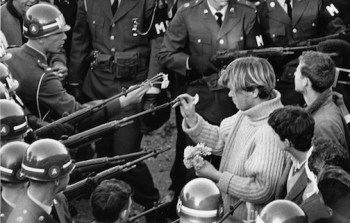
Flower_Power_by_Bernie_Boston

Flower Power, 1967 (Credit: Bernie Boston on Wikipedia)

Monks from various spiritual traditions, Western and Eastern, heard these words. In the context of what feels like a contemporary planetary crack up—campaign explosions, not to mention real bombs and climate change—Merton probably seems flighty, like a hippie sticking a flower in a rifle barrel. (And the monk himself added a tragic explanation point to 1968 on December 15th when he died of an accidental electrocution in Bangkok.)

If the human race is self-destructive, I want to be the weirdo holding out a daisy. If Christian love and human unity are pitiful delusions, nobody wake me up.

Wherever our beautiful country is going, history has taught us where hatred and fear lead. Call me a flake if I refuse to take the beastly path.

A Matter of Conscience: An Open Letter to Moderate Republicans

Blogger’s Note: This post is not only long, but upsetting. As the title suggests, I’m writing about politics. If you visit A Napper’s Companion for a lift, you may want to skip what follows. Please know that I feel compelled to share this letter.

800px-116_NYC_(Liberty_Island)

Mr. Trump, tear down this statue. (Credit: Wikimedia Commons)

February 26, 2016

Dear Moderate Republicans:

“If I were to remain silent,” Albert Einstein said, “I’d be guilty of complicity.” I’m neither a public figure nor a genius, but I borrow the iconic physicist’s words to make clear the reason for this letter. I don’t write as a Lutheran pastor, which I happen to be, but as a regular guy who feels not only sick, but under a moral obligation to speak.

I’m sick that half of the voting Republicans in Nevada believe that Donald Trump is the best available pick for President of the United States—49.6%. Half!

Sick that Trump appears poised to mop up delegates on Super Tuesday, now four days away.

Sick that the two youthful candidates seriously challenging Trump have ironic qualifications. One tried in 2013 to shut down the government he aspires to lead and is by all accounts reviled by his colleagues. The other has essentially given up on his elected responsibilities before his first term of service is finished. Why is he missing about 1/3 of votes? “Because I am leaving the Senate,” he replied, “I am not running for re-election.” If he thinks Senate duty is an insufferable slog, how well suited is he for the Oval Office, really?

Before going on—and you can stop reading any time—I want to qualify the word sick. I’m heartsick. The optimist in me says that most conservatives are troubled with how the Republican primaries are unfolding and embarrassed by the current candidates’ behavior. For what it’s worth, I write in the spirit of loving intervention. What I am compelled to point out pains me, as I have many dear friends who are Republicans, but the matter is urgent.

In less than a year, the next President will take office. What exactly is at stake?

Donald Trump promises to build a wall between the United States and Mexico, one foot taller than the Great Wall of China. “I want it to be so beautiful,” he says, “because maybe someday they’re going to call it the Trump wall.”

If Trump fails to get Mexico to pay for this project, he might fund it by selling the copper lady lifting her torch over New York Harbor. A nation that solves problems with walls won’t have much use for the words on her pedestal:

Give me your tired, your poor,

Your huddled masses yearning to breathe free,

The wretched refuse of your teeming shore.

Send these, the homeless, the tempest-tost to me.

Of course, a wall by any name may prevent wretched refuse from entering the United States, but it won’t get rid of those already here illegally. Trump remains steadfast in his intention to muster a deportation force, which will track down 11 million undocumented immigrants—a term he rejects as politically correct—and return them to Mexico. That figure is under dispute, but it does notably include the immigrants’ children, who are by law U.S. citizens. Through “good management,” the exodus will be accomplished in a year and a half, maybe two.

Could any compassionate American bear to witness the spectacle from round up to drop off. Picture those flippantly called anchor babies, hundreds of thousands of little kids, herded onto busses with their families and dumped, my God, who knows where. We’re talking about millions of people. What sane adult can’t foresee a humanitarian crisis?

Mark Krikorian, Director for the conservative Center for Immigration Studies, says what some Republicans must be hoping, that Trump’s deportation statements are a “gimmick’: “He’s just making it up as he goes along. Whatever goes into his mind comes out of his mouth. There’s no way to deport 11 or 12 million people in a short period of time.”

I must be a prude where campaign gimmicks are concerned. Blustering about the deportation of what would amount roughly to the populations of New York City and Chicago combined isn’t strategic, it’s obscene.

Maybe other campaign promises are primarily attention getters, too.

Ted Cruz says he’ll carpet bomb ISIS, which sounds hawkishly sexy until you reckon the term’s meaning. Having been corrected, the Texas Senator now knows that he is calling for what Business Insider defines as “large-scale, unguided bombing,” which military experts insist would be a horrible strategy. You don’t remove warts with bulldozers.

Cruz also claims that Trump is actually weaker on immigration than he is. What does that say? “I’ll see your gimmick and raise it by a million . . . people!”

And Rubio, poor Rubio, seems like he is trying to stay out of trouble until voters come to their senses. The Republican Party establishment is hastily huddling around him. If Rubio can find within himself what he lacks, grace under pressure, he offers perhaps the best shot at derailing Trump. In last evening’s debate in Houston, the part-time Florida Senator seemed unscripted, even nimble, in his engagement with the front-runner, so there may be hope.

But time grows short, not only for Republicans, but for all Americans. Sick with the urgency of Super Tuesday, I state directly what is a matter of conscience: setting aside for a moment the criticisms Democrats richly deserve, moderate Republicans need to reclaim their party’s integrity and live up to its claim to be the Party of Lincoln.

I wish these harsh words applied only to the primaries in the months ahead, but the mere conceivability of a Trump or Cruz presidency is the result of Republican conduct in recent years. (Again, I admit that my party’s transgressions are abundant, but Democrats aren’t lustily casting ballots for a candidate who routinely uses vulgar language on the stump and threatens his opposition with frivolous lawsuits.)

800px-Flickr_-_Shinrya_-_The_Great_Wall_of_China

Name that country. (Credit: Wikimedia Commons)

In 2012 Thomas E. Mann and Norman J. Ornstein, one Republican and the other Democrat, published an article in the Washington Post with a provocative title: “Let’s Just Say It: Republicans Are the Problem.” An excerpt summarizes their argument:

“We have been studying Washington politics and Congress for more than 40 years, and never have we seen them this dysfunctional. In our past writings, we have criticized both parties when we believed it was warranted. Today, however, we have no choice but to acknowledge that the core of the problem lies with the Republican Party. The GOP has become an insurgent outlier in American politics. It is ideologically extreme; scornful of compromise; unmoved by conventional understanding of facts, evidence and science; and dismissive of the legitimacy of its political opposition.”

Examples of Mann and Ornstein’s charges are legion, but for brevity’s sake I’ll limit myself to two.

It’s no secret that Republicans are hell-bent on repealing Obama’s Affordable Care Act. All Republican candidates for President are locked and loaded. Gone are the days of accepting congressional votes as laws of the land and moving on—long gone. Since the ACA became law on March 23, 2010, “The House GOP has voted over 50 times to repeal all or parts of the health bill. Almost all of the bills died in the Senate” (AP report). Any bill reaching the President’s desk would get a swift veto. In other words, the House has held over four dozen symbolic votes, which seem little more than a silly waste of time until you consider what a House vote costs taxpayers. CBS News estimated in 2013, when the symbols stood at 33, that each vote cost about $1.45 million. So today, $1,450,000 x 50 = $72,500,000. Contemplate this. We’re talking about $75 million-worth of chest puffing and foot stomping, and we funded it. What’s more, we all know the definition of insanity (never mind understanding and accepting mathematical facts).

The other example I’ll mention of toxic Republican conduct is fresh, not yet played out. Antonin Scalia’s body was still warm—only a slight exaggeration—when Senate Majority Leader Mitch McConnell said a replacement shouldn’t be named until after a new President takes office. A couple days ago Senate Republican leaders announced that shouldn’t has solidified into won’t. The New York Times reports McConnell’s edict: “This nomination will be determined by whoever wins the presidency in the polls. I agree with the Judiciary Committee’s recommendation that we not have hearings. In short, there will not be action taken.”

Why not? When I sort through the answers, what I hear is Bartleby the Scrivener’s response: “I would prefer not to.” Or “you can’t make me.”

So this is where we stand. The constitutional and traditional duties of governance can be simply waved off. Given the strategy of obstruction employed by Republicans since President Barack Hussein Obama took office in 2009, should anyone be surprised that the party establishment is betting its farm on a Senator who shirked his responsibilities before the paint in his Capital Hill office was dry?

In fact, the thus-far successful candidacy of Donald Trump is built upon the Republican Party’s recent performance reduced to a sophomoric gesture. Conservative columnist Michael Gerson calls the front-runner’s way “the political philosophy of the middle finger.” These are words, not mine:

This philosophy “assumes that practices we know are wrong in our private lives—contempt, mockery, cruelty, prejudice—are somehow justified in our political lives. It requires us to embrace views and tactics that we would never teach our children—but do, in fact, teach them through ethically degraded politics. Imagine your teenage son (or daughter, for that matter) calling a woman a ‘fat pig,’ ‘dog,’ ‘disgusting animal’ or ‘bimbo.’ Imagine your child labeling someone he or she knows as a ‘loser,’ ‘moron’ or ‘dummy.’

This is the evidence of poor character, in any context. For Christians, the price of entry to the Trump movement is to abandon their commitments to kindness and love of neighbor. Which would mean their faith has no public consequence at all.

I can imagine how maddening it must be to feel lectured about something as massive and abstract as one’s political party, but I risk being a scold for the sake of conscience. Hardly ever do I hear Republicans admitting that their party’s actions in recent years have done great damage and their leading candidate for the highest office in the land is unacceptable. (And, now, endorsed by Chris Christie. I’m stunned.)

Any effective intervention begins with accepting responsibility. As a private citizen and a Democrat—and out of love for you and country—I call upon moderate Republicans for the moment to resist attacking me and accept their party’s role in our current national situation.

And I promise to take seriously any appropriately-worded, well-substantiated criticism of the Democratic Party. My party may well need an intervention, which I’ll endure with a light heart, on one condition: given present circumstances, you go first, please.

Respectfully yours,

John Coleman

Erie, Pennsylvania

I Want to Be “Decisive” When I Grow Up

I guess decisive is the word. Maybe it’s convinced. Or certain. But since I’m fifty-something, the question of what I’ll be when I grow up is academic.

I am what I am, which is discerning. Discernment’s pace toward decisions is stately. It’s focused, but patient. That’s me. I’m comfortable with interesting and hmm. No need to stampede toward conclusions.

Practically speaking, I’m how rich and what poor. I know, for example, how to sit with people and listen, but am nearly clueless when it comes to what they should do. I can figure out how to string sentences together, but readers these days pay to be told what to do, and I suck at that. After “secure that smartphone and pay attention to your kid, wife, husband, and ferret Rafael,” my prescriptions run out.

Ferret_2008

Raphael (Credit: Wikipedia)

My life-management skills are sketchy. Walking with you? That I can do. Giving you a plan or grid or diet? Don’t look at me. This is a suspect orientation for a Lutheran pastor and writer. Men who get paid to wag their chins on Sunday mornings and volunteer their personal essays for Internet consumption should clarify more often than mystify.

Here’s a brief study in what I’m bleating about. If I were a decisive grown up, you would be reading a compelling case for one of the characters currently plotting to be President of the United States of America. What a rush it would be to write with the conviction of, say, former Secretary of Labor Robert Reich, who can tell you exactly whom to vote for and why.

I wish. Like hundreds of thoughtful citizens, I’ve been grazing in the unkempt fields of campaign coverage and punditry. Two states into the meal, I’ve strayed into gray pastures, nauseous with uncertainty. What I’ve got to say may feel good, but mostly as a purgative.

  • Does the news media manufacture—or at least feed—nerved up realities? Why the breathless, urgent reactions to voting in two Wonder Bread states—no insult intended (Iowa: 92.1% white; New Hampshire: 94% white)? Talk about racism! The suggestion that any candidate is already washed up comes from a malnourished perspective. Would Harry Carry have declared the game over if the Cubs gave up a couple of runs in the first inning? Do cancer patients call off chemotherapy when hair starts to fall out? Come on.
  • What is the most important consideration in voting for President of the United States? Platform? Experience? Promises? Charisma? The older I get, the more I care about intelligence and integrity. Maybe this concern grows out of my cynical hunch that some candidates don’t believe in much of anything—a whoredom that trumps all other prostitutions. I remember decades ago elders saying that they would vote for somebody from the other party; they rooted for the best person for the job. The sentiment is worth revisiting. How much stock should we place in a candidate’s humanity? You can study up on economics. But can you acquire character?
  • Is a revolution really the best corrective to our current governmental dysfunction? I acknowledge the appeal of a righteous battle, the blood rush and passion, the idealism and purity, the triumph of justice and common sense. There’s no shortage of revolts being proposed as we all pant for the results in South Carolina and Nevada. Bernie Sanders has employed the r-word itself. Other candidates vary the diction but stump in the same genre. Although I’m not without sympathy for Sanders’ uprising and even saw merit in Ron Paul’s long-shot crusade, revolutions have drawbacks. The Tea Party has been throwing everything not bolted down into the Potomac for a few years now, which has done nothing but dam up the government. How likely is it, then, that another revolution would yield better results? Nothing beats the language of war for whipping voters into a bloody foam, but if brawling remains our go-to legislative strategy, we’ll have to name Mathew Brady our Capital Hill Photographer. And 2.) losers in a revolution—and there can’t not be losers—go home pissed off and start plotting their revenge.

I could happily go on, speculating about the place of objective truth (what little there is) and manners in politics, but who really wants to follow me further into what started as a dreary example of one Lutheran pastor’s turn of mind?

The point, for anybody still awake, is me—by which I mean, maybe you, too. I’ll put myself in your shoes. Let’s see if I’m warm.

  • Every day is a litany of fast judgments and flawless answers. Television knows the best seat for surviving a plane crash and how to weave to escape a shooter. Family-friends-whoever cure timeless worldly ills with one flippant sentence. The lovely can transform the normal for three easy payments. You say, “I wish I were so sure.” Or “How can anybody be so impossibly full of crap?”
  • You’re overwhelmed, weary with information, each expert shaking you by the lapels. Even as you purchase another plan, your own wisdom speaks: “Tend first to your troubled heart, beloved.” “Hush up,” you respond, for the hundredth time, and swipe your credit card.
  • Part of you hangs onto the belief that you’ll feel settled eventually, at peace and complete. You’ll be grown up, a finished human being.
  • Then, sweet then: questions and doubts will fall silent. You won’t be vulnerable anymore. You won’t have to be humble either, but you will.
  • Long before the polls open, your choice will be set.

If your shoes don’t fit me, please forgive my presumption. But if they do, I’m guessing you have balm for humanity in your soul. If only somebody would listen, you would say, “Let’s pay attention to how we treat each other. Then what we should do to fix the world would be clear.”

As for me, I’m not decisive enough to speak up–afraid of sounding frivilous. Until I grow up, I’ll just say that I’m discerning.

Christmas Time Is (Still) Here

Christmas Time Is (Still) Here

Bing Crosby’s “White Christmas” playing in my ear buds is barely overcoming the percussive assault on Starbucks’ speakers—over which my beloved baristas have no control. The Mother Ship picks, I guess.

Our Advent binge on “Have Yourself a Merry Little Christmas” and “Blue Christmas” and “I’ll Be Home for Christmas” and “Christmas Time Is Here” and “The Christmas Song” and “Please Come Home for Christmas” and “What Christmas Means to Me” and “Merry Christmas (I Don’t Want to Fight Tonight)” has lots of folks hung over as of December 26th.

Not me. Music of the Nativity will decorate the Coleman house until the Epiphany, our idea being that it’s impolite to close down the celebration before the magi have arrived with their gold, frankincense, and myrrh. The tree is lovely. Leave it up. The songs are soothing. Keep listening.

Honestly, though, my reason for lingering in the yuletide has more to do with what has filled my soul’s stocking lately than with the Christian calendar. Over my fifty-four gift-giving seasons (good grief!), my thoughts have turned from what I hope to receive to what I’m fortunate to have. Much as I loved the packages I opened on Christmas day, never have I cared less about what would be in them.

A man would be greedy to expect more from his portion of years than I have right now. This understanding settled upon me as I lay in bed some nights ago while wife Kathy made doll clothes at the dining room table. Her sewing machine hums and whirs regularly in our Parkway Drive home, but hearing it embraced by the warm promise of sleep returned me to Wagner Avenue, where I grew up.

A sewing machine’s singing, like other music, is sweetened by rests. The gift being stitched together breathes, as does the whole dwelling.

My mother made her own skirts and alterations to our family’s clothes. It never occurred to me before that the sound of a sewing machine holds for me what was loving and healthy on Wagner Avenue.

IMG_4031

My mother’s Christmas cactus, once on Wagner Avenue, now on Parkway Drive

As I opened my eyes a crack to taste the hallway’s dim light and groaned at a throb of bursitis in my shoulder, the joy and affection that fed me long ago kept company with current blessings.

The Colemans are housed, fed, clothed, adequately employed, and reasonably healthy. In other words, we’re all okay at the moment.

Most of our life-stealing troubles have passed away or at least gone on hiatus.

Like many Americans, I wouldn’t protest if somebody threw unexpected fists-full of cash at me, but, thank goodness, money and possessions aren’t obsessions.

I’ve known the gladness of being a husband, father, grandfather, friend, and pastor. The people closest to me tolerate my shortcomings.

After thirty-two years, I love my wife more than ever.

I believe in a God of grace and mercy.

In the quiet between Kathy’s stitches, such unmerited gifts hemmed me in, behind and before. “Enough,” I thought, “much more than enough. More than plenty.”

But there was still more. There was Christmas day. Daughter Elena and son-in-law Matt donated immunizations and medicine in my name for Third World children. They thought about who I am and came up with that idea.

Son Micah made us close our eyes. After a minute, he told us to look. On our laps rested stockings. With 2015 being tight, we told the kids we would be skipping this tradition temporarily. “It’s not much,” Micah said, “but we’ve got to have stockings on Christmas.” Mary Janes never tasted so good.

Grandson Cole handed each of us a homemade ornament made out of some baked flour concoction. Like the others, mine bore a few smears of watercolor. “Cole paint that,” he said. Three words and earthly elements: a sacrament stirred in my chest.

When everybody headed home, Kathy said over and over again, “I had so much fun. That was the best Christmas.”

Just one more: Cole and I sat on the couch and shared peach pie a la mode. I got to watch him open his mouth for every bite as the Grinch and his rein-dog trumpeted their way back into Whoville to pass out gifts and share roast beast.

I’ve memorized all the kids’ Christmas shows. These days I would rather stay with my grandson’s eyes—merry and bright!—until I know them both by heart.

Open Letter to a Muslim Woman

Open Letter to a Muslim Woman

Dear Dr. Quraishi-Landes:

My hometown newspaper, the Erie Times-News, trumpets harsh headlines today: Muslims face threats: U.S. WOMEN WARNED TO STOP WEARING SCARVES, VEILS. “On the night of the California shootings,” the Associated Press article begins, “Asiha Quraishi-Landes sat on her couch, her face in her hands, and thought about what was ahead for her and other Muslim women who wear a scarf or veil in public.”

Although I read on, the image of you in your home, troubled at the prospect of you and your Muslim sisters being harassed or worse will be plenty to think about for one day.

I know what it’s like to sit with my face in my hands, but not out of fear for my safety. As a white man in the United States, I’m mostly to blame for my own bouts of suffering—poor decisions, personal weakness. I didn’t think twice about heading out the front door this morning and relaxing here at Starbucks with a tall Americano. Nobody cares what is on my head.

But you do have to consider scarfs and veils. “To all my Muslim sisters who wear hijab,” you wrote on Facebook, “If you feel your life or safety is threatened in any way because of your dress, you have an Islamic allowance (darura/necessity) to adjust your clothing accordingly. Your life is more important than your dress.”

The compassion of that last sentence is the fragrance of my Christian-Lutheran faith. In the end, I have to look up from my sacred pages and into the eyes of fellow pilgrims, whose lives call me to study with my heart. As a parish pastor I’ve taught for years that I can’t obey God with rancor strangling my mind and fear torching my soul. The letter of any law is brittle without mercy.

Do we speak these same thoughts in our own ways? I’m guessing we do. And we’ve felt the rancor, fear, and merciless convictions of our most troubled brothers and sisters take our breath away. These are jolting times. Like you, I hold my face and read sadness behind closed eyes.

But you looked up and wrote mindful words to an anxious world. Thank you. I look up with you and remember what the Gospel of John says about losing hope: “The light shines in the darkness, and the darkness did not overcome it.”

A few weeks ago at another Starbucks I caught some light, and it had to do with hijab. A young woman was waiting for her companion to doctor his coffee. Holding her scarf in place was a pin, a striking burst of gold. I thought at once of a monstrance, which holds the host in Roman Catholic practice.

I walked over to her and said, “I’m not a creep, I promise. I just wanted to say I love that pin you’re wearing.”

220px-Monstrans

I can’t tell you how much the woman’s pin resembled this monstrance. (Credit: Wikipedia)

She responded with an oh, thank you and a smile. I probably could have skipped the creep preface, since I was sitting with my wife. Anyway, I returned to my table, where I looked up after a few seconds. She was still offering me her smile. I gave her another one of mine for the road. In our small pocket of the United States, two believers exchanged mercy.

This is my reason for writing, actually: I wanted to return to you a mercy. You told your sisters, “Your life is more important than your dress.” I say to you, “Your life is important to me, yours and those in your Muslim family, no matter what you wear. If we should happen to meet, I’ll recognize in your eyes my own spirit, longing for a world of welcoming arms and kind voices.”

Your brother,

John Coleman

Letter to a Man on a Motorized Bicycle

Dear John:

I don’t know your name, so we may as well both use mine.

The first time I saw you, my wife Kathy was with me, and I confess, you gave us a laugh. We didn’t object to your chosen transportation, but you’re not a small man, and your bike is low slung. It reminded me of an old motorcycle with a sidecar. Bundled against November, you were out of proportion to your ride, like President Lincoln on the back of a Shetland pony.

I saw you again yesterday on the way home from picking up a bottle of Crane Lake Petite Sirah. The temperature was stuck in the thirties, cold weather for buzzing around Harborcreek, Pennsylvania, with your face uncovered. Still, maybe you like the wind against your skin. Maybe you’re wisdom in disguise, your one lonely horsepower a choice rather than a consequence. What the hell do I know?

1921_Quadrant_motorcycle_with_sidecar

Your bike reminds me of this old 4.5 horsepower, John. (Credit: Wikimedia Commons)

Not much is the short answer. I’ve already laid out my total knowledge of you. Everything else is a guess. I guess you would prefer a car to bike powered by, what, a lawn mower engine? I guess you made mistakes or ran up against bad luck or both. You have what I’ll euphemistically call some issues? You’re on meds or not. And you’re mostly alone, right?

It seems like I’m trying to excuse you and your ride, but if we were shooting the breeze over coffee, I would tell you about myself. Then you would know that I’m in no position to defend, explain, condemn, or absolve anybody. I’m on meds. My years are punctuated by silly choices. And like lots of citizens we both pass on Buffalo Road, I’m not far from needing dirt-cheap wheels.

I would explain, too, that as you disappeared from my rear view mirror yesterday, I didn’t say, “There but for the grace of God go I.” The sentiment is humble, but I’m not sipping an overpriced Americano because God has been gracious to me. And it makes me nauseous to think that your knuckles get raw when you ride in the rain because God has denied you grace.

If we were together I would laugh and say, “Boy, John, shit happens, doesn’t it?” That’s as much explanation as I have.

There’s a lot I couldn’t share, at least not until cup three or four. I live on God’s grace, but that has nothing to do with my pudgy Chevy or your bike, my excess or your need. I bet neither one of us merits much in the way of blessing or curse. “It is what it is” would have to be enough from me for today.

2112b394-c7d2-4f0d-8857-6e34e1594191

Are my wheels better than yours? I’m not at all sure, John.

Down the line, if we got to be friends, I would ask if you’re okay. The truth is, you might be way more okay than I am. A man who doesn’t mind being seen traveling on a contraption when snow is forecast probably has a thing or two to teach me.

Better still, I would say that sharing my name with you would be a privilege. And maybe you would look into my eyes, past the dark circles, and understand I was guessing about you not because you need my approval, but because you already have all the grace that’s mine to give.

Peace,

John

Why All This Crazy Killing? America’s Rights Addiction

Dear Friends,

The following essay first appeared under a different title on A Napper’s Companion in April of 2013. I had about -10 followers at that time, so my 2700+ words amounted to whistling into the wind. So I’m dusting off this old post, stripping it of photographs, and raising it up the flagpole again.

Why am I repeating myself? Yesterday morning, yet another kid walked into yet another classroom and started shooting, this time at Oregon’s Umpqua Community College. Add one more wretched absurdity to our national profile. This long, detail-heavy, occasionally sarcastic, probably boring rant still stands as my opinion of what ails America and has us paralyzed in the face of a shameful body count.

This is your last chance. Everything below the pizza is an absolute bummer. If you’re having a good day, save this for one when you’re already in a funk.

Love and peace,

John

800px-Pepperoni_pizza

“Hello, yes, I’d like to order a one-acre pizza with cheese, pepperoni, and mushrooms for pick up.” (Credit: Jon Sullivan on Wikimedia Commons)

In late January of 2013, a boy’s stunned, pale face greeted me on msn.com along with this headline: “Teen: horror movie inspired crime.” “Here we go again,” I thought, but clicked on horror anyway. If you don’t want to feel sick, don’t read on.

On October 3, 2012, Jake Evans (17) killed his sister Mallory (15) and mother Jami. In a four-page confession, Jake explained that he’d watched Rob Zombie’s 2007 remake of Halloween several times earlier in the week, and the movie got him thinking. “While watching it I was amazed at how at ease the boy was during the murders and how little remorse he had. Afterward, I was thinking to myself it would be the same for me when I kill someone” (dailymail.co.uk). He planned to use a knife, but he thought some more: “If I were to kill my mom and Mallory, I wouldn’t want them to feel anything, so I decided to kill them both with the .22 revolver I stole from my Grandpa.”

Since Jake’s aim was sloppy, his sister died hard. He told the 911 dispatcher, “This is really going to mess me up in the future” and “I’m really worried about, like, nightmares and stuff like that. Are there any times [sic] of medications, and stuff?” Jake ends his written confession by summarizing all his stuff: “I know now though that I’m done with killing. It’s the most dreadful and terrifying thing I will ever experience. And what happened last night will haunt me forever” (dailymail.co.uk).

Jake still has family left, though he doesn’t want to see them. His father and two other sisters weren’t at home at the time of the killings. Red-headed Mallory looked like a cross country runner you’d see featured in the hometown newspaper. Jami appeared precisely forty-eight years old, probably wished God had given her more or a chin, and like many of us in middle age, carried a few surplus pounds; same with her husband. Jake looks like a lanky kid who’d help push your stalled car to the berm and say, “No problem.” His surviving sisters look like peas from the family pod. In short, the Evans were normal-looking, well-groomed white folk from the affluent Fort Worth suburb of Aledo.

Of course, something was amiss, with Jake if with nobody else. He had breathtaking mental illness. And yet, his 911 call and the last lines of his confession demonstrate a mindset that’s yanking America along as if by a nose ring: shooting his mother and sister was “dreadful and terrifying” for [Jake]; his sister’s screaming is really going to mess [Jake] up in the future; the experience “will haunt [Jake] forever.” The kid’s narcissism is glaring, but if we think the germ that was lethal in him isn’t making America sick, we’re kidding ourselves.

Adam Lanza, James Holmes, Jared Loughner, Sueng-Hoi Cho, Eric Harris, and Dylan Klebold: the NRA’s Wayne LaPierre isn’t the only American who has called them monsters and lunatics. It’s hard to blame folks for using these words, resonating as they do with our collective rage and dismay. The trouble with such labels, however, is they provide cover for us law-abiding citizens as we ignore our own inconspicuous lunacy. If we can put all Auroras at the feet of sick monsters with assault weapons, the rest of us can give ourselves a clean bill of health. Right?

I don’t think so. We Americans are rights junkies. Not all of us, of course, not even most of us, but the news is packed with stories of people who do lousy things simply because it’s their right. Many would argue that this addiction is healthy, even patriotic—Don’t Tread on Me! But rights, like all wholesome things, are best consumed in moderation.

Admit it: American’s don’t do moderation very well. We binge on practically everything. According to theweek.com, Americans consume 36,500 acres of pizza each year—that’s 1,327 Ellis Islands of pies; solutiondown.com spins the numbers differently, allotting each of us 23 pounds of pizza annually; we like fries even more, 29 pounds yearly. And we can’t get enough of ourselves either.  Smartmoney.com notes that in 2010 Americans spent $33.3 billion on cosmetics and other beauty products; oprah.com has us spending $10,677,415,674.00 on cosmetic procedures that same year. It’s an odd curse: we eat like pachyderms, but can’t stop looking in the mirror. Is it fair to say we Americans can be stuck on ourselves?

In The Civility Solution: What to Do When People Are Rude, Dr. P. M. Forni of Johns Hopkins University explains what happens when stuck on myself evolves into sucks to be you: “When the healthy pursuit of self-interest and self-realization turns into self-absorption, other people can lose their intrinsic value in our eyes and become mere means to the fulfillment of our needs and desires.”

Jake Evans’ confession and 911-transcript are part of the story of extreme mental illness, but his me-me-me thinking poses questions to the rest of us garden-variety neurotics: Has “the healthy pursuit of self-interest and self-realization” in America turned into “self-absorption”? And have other people lost “their intrinsic value in our eyes”? I think so and suggest that our narcissism has combined with a lust for individual rights to create a super virus. What we the people are allowed to do with constitutional protection has become what we should to do with a clear conscience. The result: our sense of individual rights has become perverted.

Most of the studies I’ve come across on the rise of narcissism pin the problem on young people, which may explain why some of the mass murderers of late are committed by males in their teens or early twenties. The Narcissism Epidemic: Living in the Age of Entitlement by Jean Twenge and W. Keith Campbell, which received lots of attention when it came out in 2010, claims that narcissism is as prevalent among college students as obesity. And according to the American Freshman Survey, published yearly by the Higher Education Research Institution at UCLA, narcissism among young people is at a fifty-year high (dailycaller.com). Like Dr. Jim Taylor, however, I think our problem cuts across age groups. In “Narcissism: On the Rise in America?” he writes, “The indifference, egotism, disrespect and lack of consideration that are central to narcissism are also reflective of the increasingly polarized and vitriolic tone of our current body politic, recent unethical corporate behavior, the rise in cheating among students in school and the gamut of bad behavior among professional athletes” (huffingtonpost.com).

The statistics may say that young people are this country’s leading narcissists, but as Taylor suggests, you need only look around to see that all generations are getting in on the fun. And by fun I mean, morally scurvy behavior that’s technically legal. The United States of America is by definition a country of freedom, which means that people who exercise their rights without a sense of responsibility are protected. So be it. Telling a child he’ll never amount to anything is free speech. I don’t think you’re legally bound to correct the waiter or waitress who leaves that shrimp scampi off your bill. You can invest in a company that makes life a misery for its employees—it’s probably profitable. We can’t go ten minutes without tripping over a right.

Nancy Lanza was within her rights to amass the arsenal that her son put to sinister use. So were the Pennsylvanians who, according to pennlive.com, responded to Sandy Hook by purchasing 133,241 firearms in December of 2012 (versus 84,486 in December of 2011). No law stands in the way of Rob Zombie’s remake of Halloween. Interested in making a great deal of money? Market a video game like Activision’s Call of Duty.

There’s no proof that repeated viewings of Halloween enticed Jake Evans to kill his mother and sister. And while pilots frequently hone their skills on flight simulators, nobody can prove that Adam Lanza’s endless hours spent in his boy cave pretending to cut enemies down in Call of Duty had anything to do with his massacre of the innocents in Newtown (nypost.com). If you believe Wayne LaPierre, the solution to gun violence is more guns; all teachers ought to be packing.

Of course, in the middle of acres of rights exercised out of simple greed and selfishness, serious artists take heat for legitimately challenging us. Martin Scorsese’s The Last Temptation of Christ was protested by theologically constipated Christians, but I found the film thoughtful and daring. Robert Mapplethorpe’s erotic photography unsettles me, but I suspect that was part of his purpose. Defending his “Piss Christ” photograph, Andres Serrano challenges Christians to consider the full horror of the crucifixion (guardian.co.uk.com). Anne Sexton’s poetry is graphic, but if ever I trusted that a poet was burning to get human beings to acknowledge her particular experience, I trust Sexton.

I trust the authenticity of Scorsese, Mapplethorpe, Sexton, et. al., but I don’t trust those who accept no responsibility in consideration of their right to free speech. That doesn’t mean I’m about censoring them. But trust them, respect them? No. (Point of clarification: if you could walk into a movie theater, kill twelve people and wound fifty-eight others with a poem, I’d favor some poem control. But the poets and serious artists I know aren’t the shrill voices in America’s rights-binge debate, and Mapplethorpe’s photographs, as far as I know, never led anyone to massacre others with whips and fists.)

For reasons I don’t understand, reading about Mallory and Jami Evans so soon after Sandy Hook has proven my tipping point, my enough moment. Since I first saw Jake Evans, another young face has looked out from msn.com. Somebody please show me a sweeter-looking kid than Hadiya Pendleton, the fifteen-year-old Chicago honor student who was shot and killed days after performing with her school band at Obama’s inauguration. Michael Ward (18) and Kenneth Williams (20) apparently thought Hadiya was part of a gang trespassing on their turf, so Ward fired into her group of friends huddled in a bus stop, and Williams drove the getaway car (usnews.nbcnews.com).

It’s actually odd that these gangbangers were caught. According to nation.time.com, “In 2012, 506 people were killed in [Chicago]. Only 25% of those murders were solved.” Obviously hundreds of people with faces less lovely than Pendleton’s are being cut down, plenty of them kids who aren’t in school bands. And the trouble is, so many are dying coast to coast that we the people are at our wits’ end. It’s been about three months since Adam Lanza opened fire, and slate.com estimates that another 2,605 people have been shot and killed. (Update: as of April 19, 2013, the number stands at 3,526.) (Update: as of April 15, 2015, we were at 82,033.)

The Violence Policy Center, a pro-gun control organization, notes that in 2012, there were “31,326 gun-related deaths nationwide” (slate.com). That’s 10.9 of every 100,000 citizens. So what explains the roughly 1,119 Sandy Hooks of various denominations we had in the United States in 2012? Nobody seems willing to contemplate, much less admit, any personal responsibility for or even indirect participation in the carnage.

Don’t blame the NRA. Wayne LaPierre and company are only protecting Americans’ Second Amendment rights. In 1999, the NRA ran an ad in USA Today stating, “We believe it’s reasonable to provide for instant background checks at gun shows, just like gun stores and pawn shops.” Now it’s Charlton Heston all the way: you can have my gun when you pry it “from my cold, dead hands.”

Don’t blame James Wan, director of the 2004 film Saw. (In one scene, a young guy has sixty seconds to dig a key out from behind his eyeball or a mask of nails called a Venus Fly Trap will snap shut, with unfortunate results; I won’t ruin it for you.) Don’t be too hard on Tom Six for his 2009 First Amendment tour de force, The Human Centipede. (How are the three humans in this bug sewn together? Imagine the worst.) Rob Zombie was only commenting honestly when he said in a vanityfair.com interview, “I don’t think my movies have a lesson. Or if they do, I guess it’s that it’s a f—ed up world and you’re probably f—ed too.” Nobody in this genre of the film-making industry is at fault; watching folks lose their intrinsic value in tormented, demeaning ways can do viewers no harm.

Don’t blame Rockstar Games for producing Grand Theft Auto or Activision for Call of Duty or parents for letting their kids play with these killing simulators. The latter’s Modern Warfare 3 grossed $775,000 in its first five days on the shelves—that’s over ¾ of a billion sweet expressions of free speech (guardian.co.uk). And about the former, one video game enthusiast tells me that you—you being, say, an eleven-year-old boy—can hire a prostitute, have your way with her, shoot her, take your money back, then speed off to other adventures. No matter. The Entertainment Software Association assures us that “years of extensive research . . . has shown no connection between entertainment and real-life violence” (newyork.newsday.com). (So you don’t think I’m pretending to be guiltless, I’ve let violent games and movies into my home. I regret that.)

Don’t blame citizens who reject outright the possibility that even the most miniscule limitations placed on weapons and magazines might save a life or two. Restrictions only punish law-abiding gun owners. Besides, any more gun control measures will shove America down a slippery slope, resulting in the Second Amendment falling off the constitutional cliff.

In short, as long as my DNA isn’t on the AR-15, I’m acquitted. As long as nobody can put me at the scene of the crime, I’m behaving like a responsible citizen. This is the epidemic logic of our time. It’s also the self-absorbed reasoning of a rights junkie.

It should not, however, be the reasoning of unselfish citizens of conscience. When deciding whether to exercise a right, I should consider how my constitutionally protected words or actions might impact others, whether I know them or not. Rights and responsibilities have to be held in healthy tension.

Bud McKelvey of Hermitage, Pennsylvania, strikes a nice balance. His February 7, 2013 letter to the editor of the Erie Times-News, two excerpts of which I share here, is encouraging: “When I bought my first pistol, I was told that there was a five-day waiting period before I could get my gun. The five days were to check my background. The exact words I told the gun dealer were ‘I don’t care if it takes you a month. I have nothing to worry about.’” And “I’m a firm believer in the Second Amendment, but when the Founding Fathers wrote the Constitution, they didn’t have weapons that could fire 600 rounds a minute, and at the time, the British had their soldiers quartered in the colonies. Naturally, they wanted everyone to be able to keep and bear arms. They didn’t mean for people to be able to slaughter their neighbors and groups of people.”

Bud McKelvey understands that, to paraphrase an old high school Problems of Democracy teacher, his rights end where his neighbor’s nose begins. “And who is my neighbor?” It takes only a small leap of compassion to recognize that my neighbors live not only next door, but in Newtown and Aurora and beyond. “Am I my brother’s and sister’s keeper?” Bloody right I am! I envision the faces of my many friends and family members whose spiritual beliefs are all over the map, and while they may not agree entirely with my argument here, I bet they’d answer Cain’s question as I do. Most Americans probably would, too: I am my sister’s and brother’s keeper. If I have to ask whether somebody is my neighbor, I already have the answer. Most Americans, not necessarily those with the loudest voices, know this.

At last, then, I land in a naïve, idealistic place. No matter what legislation sneaks through Washington, our body count will be disconcerting until our national rights binge abates. Before speaking freely, I ought to wonder whether my message might unnecessarily harm others. Before demanding unlimited access to weapons with frightening power, I could acknowledge that some limits are reasonable. It wouldn’t make for safe and sane roads if I could put a GE90-115B jet engine in my Mazda 4×4; a magazine with a 100-round capacity poses the same kind of hazard. Before doing anything at all, I should ask myself if my words or actions are in any way helpful, challenging, or constructive.

In land of the free and the home of the brave, our greatest patriots are often those who decide, for the sake of the common good, to refrain now and then from exercising their constitutional rights.
Lament for Aylan Kurdi

Sadness Alert! This post will be painful to read. 

He stood there biting his lower lip. “It is very difficult,” he said. “I cannot resign myself.”

He looked straight past me and out through the window. Then he began to cry. “I am utterly unable to resign myself.”

(from “In Another Country” by Ernest Hemingway)

IMG_3687

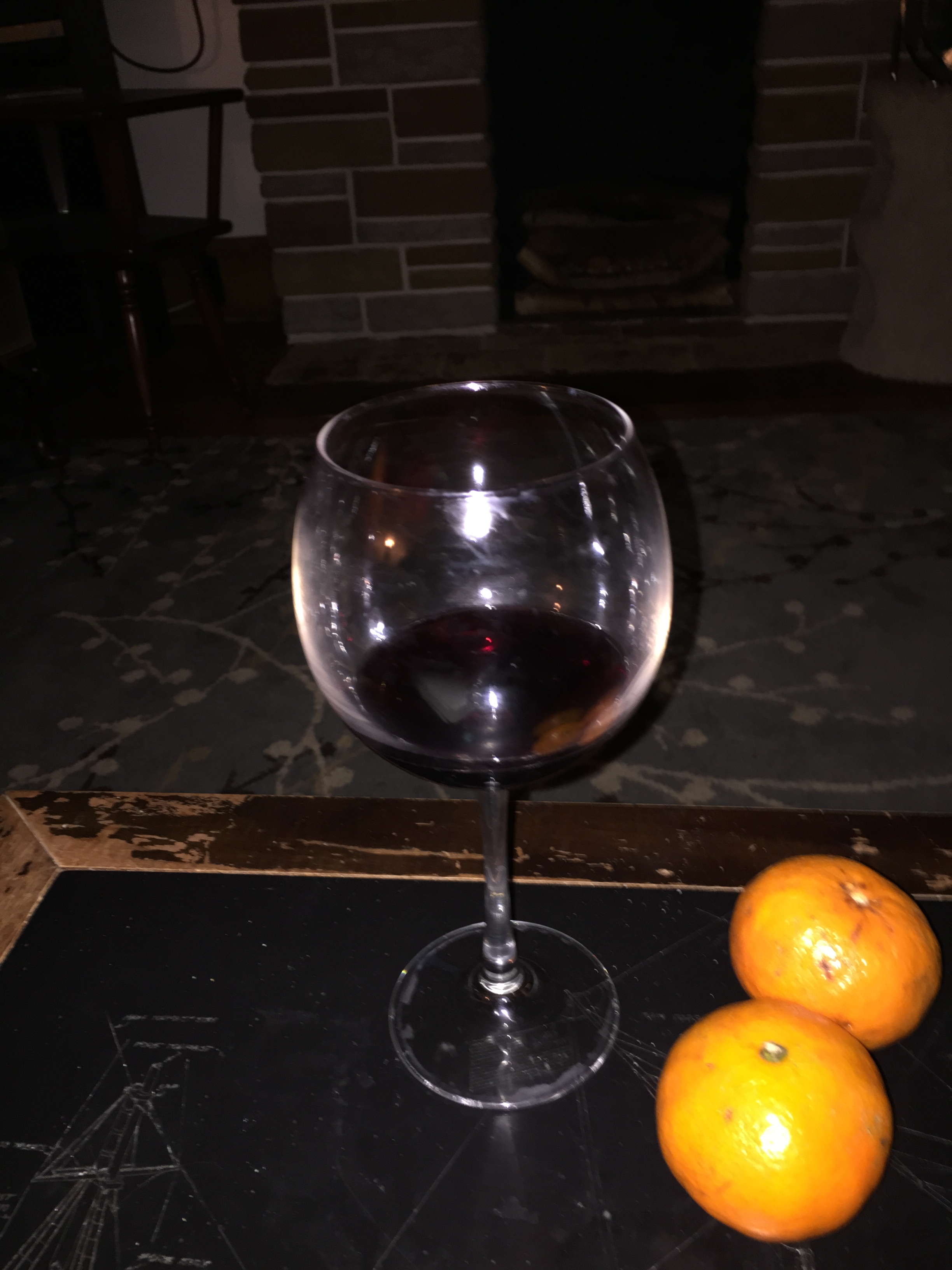
Citrus Photobomb of Pinot Noir

Close day in Erie, Pennsylvania, but central air pacifies me. So does a Smoking Loon pinot noir. A soprano (Callas, Sutherland, Caballe?) sings something from Madame Butterfly—I think. When hunger intrudes, I’ll walk a few feet to the kitchen, open the refrigerator, and decide what not to eat. That’s how stifling my life is. I have to eliminate meal options.

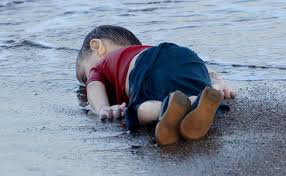
I’m inexcusably comfortable but for one trifle: Aylan Kurdi drowned. A photograph of a police officer carrying him from a Turkish beach appeared on the evening news. I recognized the boy immediately, his toddler legs. He was my grandson Cole. The tender calves, the tiny sneakers!

Two hours ago, he said, “Pop, come.” He had a tennis ball that he wanted me to toss high into the air. Into the humidity, above the young tree in his front yard, the yellow globe flew, then fell to the grass. Cole bounced. Or was it Aylan?

Unknown

Aylan Kurdi. Forgive me, friends, but can you make out your child here? Do you recognize the sneakers? (Credit: Reuters)

Now, as Jussi Bjorling kills some high notes from La Boheme, I comprehend: Aylan = Cole.

If my son-in-law fled bombs with my daughter and grandchildren and lost them to water, I would want nothing more than to join him, to sit beside their graves until merciful death arrived.

I cannot resign myself. I am utterly unable to resign myself.

Or as Aylan’s father Abdullah said, “I don’t want anything else from this world. Everything I was dreaming of is gone. I want to bury my children and sit beside them until I die.”

IMG_3640

Cole with Pop. Do you see Aylan’s hands? His little legs?

Hemingway’s Senior Maggiore grieved the unexpected death of his young wife from pneumonia after he had survived war, hand maimed but otherwise viable—the absurdity, the affront.

Syria is a hemisphere away, but geography is a rationalization. Aylan in the wet sand is Cole in the wet sand. To hell with similes. Any other conclusion is bullshit, for me and for the world. Our best hope is for Aylan to be my own grandson–and your very own, too. You feel this with me, don’t you?

I want to pick that boy up off the beach and love him back to life so badly my throat burns. You, too?

The Smoking Loon is gone, and I’m hungry.

Damn it!

Miracle Milk, Miracle Mothers

1560508_882546381815551_547569594810418436_n

Cole before his cold at a Mexican restaurant–looks like he is enjoying a mother’s milk buzz, sampling a tortilla chip, and watching out for the senoritas.

What’s more pathetic than sick toddlers? Living in the here and now, they know only that the present moment is plugged up or achy or poopy or yacky, as the case may be.

Grandson Cole is nearly over a head cold, which he has shared with mommy Elena, daddy Matt, and grandma Kathy. Adults get a pat on the back and a “hang in there,” but Cole had us all verklempt. Kiss him, walk him, monkeyshine him. His head was so packed with snot that it established its own gravitational field. Pantry moths, hummingbirds, and an occasional turkey buzzard got pulled into Cole’s orbit and circled a few times before flapping wildly to regain their freedom.

The worst part was my buddy couldn’t nurse. He got a tug or two in, tried to breathe, and had to veer off. Then came the tears, and not just for him. For a prolific producer like my daughter, the pain was threefold: lefty, righty, and the heart. Pumping took the edge off.

unnamed-2

Miracle Milk Strollers (Credit: Penny Shaut)

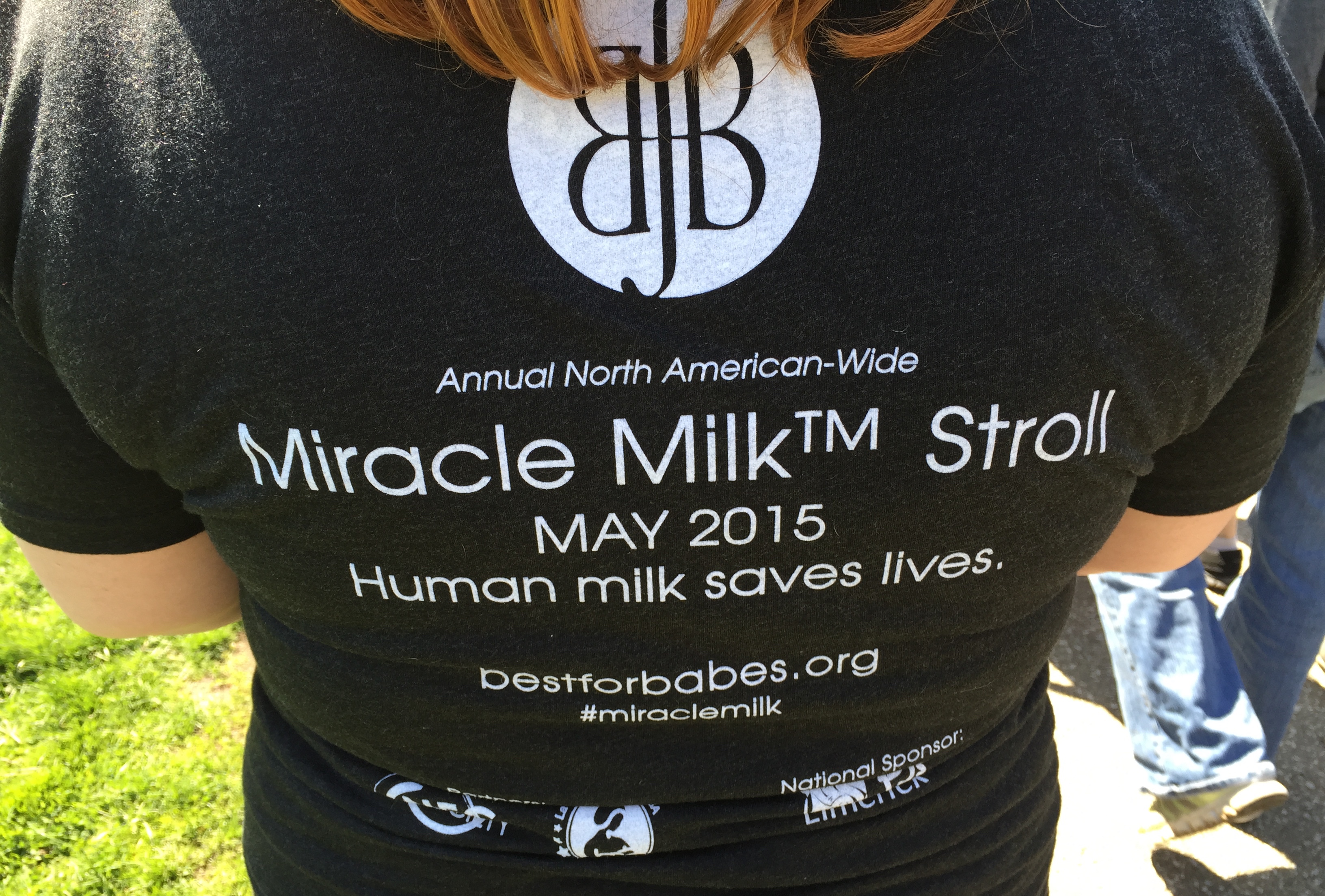
Both Elena and son Micah nursed, so I’m comfortable at the nursing rodeo as well as a big fan. The more I learn about breastfeeding, the more I want to speak up as its champion. This past Saturday the whole family joined scores of others at our local Miracle Milk Stroll, an event to raise awareness about the benefits of breast milk as well as a few bucks for the cause.

IMG_3255

The author, hereby applying to be the Official Clown for Miracle Milk

And it is a worthy cause, though it struggles against a headwind of sophomoric nonsense disguised as decorum. I’m amazed afresh each time a humble breast—servant of life, means of comfort—is greeted with harrumph or ew. An infant is hungry, say in a restaurant, and Mom provides. “Eh,” someone at the next table whispers, “I don’t want to have to look at that while I’m eating”—that being one standard-issue, boilerplate breast, either whole or in part.

I say, “It’s time for the squeamish to take a please-grow-up-already pill.” Why? Because breast milk is liquid gold, and nursing—for those women able and inclined to practice it—is a picture of earthly goodness. I won’t go into the many marvels of human milk here. Authoritative sources have done the heavy informational lifting far more effectively than I ever could. Please check out these sources if you’re curious.

CAM00985

My son shouldering my sick grandson on the stroll

So plenty of good research trumpets the physical benefits of nursing. After the Miracle Milk Stroll, lactation consultant Cass even suggested that Elena put drops of breast milk into Cole’s ears and nose. Overhearing this, I said, “I have a wart on the bottom of my foot. Maybe I ought to put some breast milk on it.” Cass and Elena said together, “Well, it is an antiseptic.”

I would rub some on my sole. Why not? I would also try human milk as a treatment for pink eye, as one mother successfully did for her preschooler. Cheese made from breast milk wouldn’t scare me, either. A New York chef made some out of his wife’s surplus, but the Health Department frowned, as did one food critic. Oh well.

Compared to probably 95% of the population, I’m a weirdo. Sorry, but the science is convincing. Research isn’t conclusive yet, but there’s even evidence that a mother’s milk has analgesic properties. In the future will we mix liquid gold with other ingredients and use it like nasal spray to calm a headache? Go ahead and laugh. As Elena used to say, “I don’t give a care!”

IMG_3257

Two of the most wonderful breastfeeding veterans, Kathy and Elena–with son-in-law Matt providing an innocent photo bomb

Let’s say human milk was no more nourishing than tap water. Would I still stick up for nursing? Amen and Amen. Go to a Miracle Milk Stroll as I have for the past two years and hang around with a bunch of women committed to the cause. Watch your children and grandson nurse. You’ll witness something more compelling than science.

When Elena says, “You want some milk, Baby?” Cole’s answer is joy and light. He gives the usual yeah and nods, but I wish you could see his expression. It’s as if he is thinking, “Oh, that’s the best thing! The world is perfect when I’m nursing.” Imagine a face showing gladness mixed with relief.

We used to joke about Cole being boob drunk once his tank was full. Take away any negative connotation, and you’ve got it right: the relaxing buzz, the drooping eyelids, the silly grin. We should all be so intoxicated.

Am I getting carried away to think that a nursing baby is about as close to the Loving Mystery as a person can get? And Mom—her skin, breast, warmth, and agape—is the vessel in this trinity: Eternity, Life Bearer, and Life.

unnamed-3

“La Compassion de Christ” by the late, self-taught Milton Sontheimer (1982). A Mothering Christ? This hangs in my study at Abiding Hope Lutheran Church.

Granted, breastfeeding is not entirely sacred cuddles. Kids chomp down, women grow weary, ducts get plugged. But for a chronic worrier like myself, a mother feeding her baby is a gift of peace in a nerved-up world. Together they remind me that I believe in a gracious forever and assure me that once this life of wonder and woe has passed, my hope of being so comforted in the arms of a Mothering God isn’t foolish after all.

At the Miracle Milk Stroll, we walked less than a mile, slowly like the name says. Without much thought, mothers nursed their children, talked with friends, and kept walking. Would that we all could travel this way, leaving judgment at the side of the road, quietly celebrating love made visible.

IMG_3266

Human milk saves lives!