Oniontown Pastoral #7: You Learn to Like It

Oniontown Pastoral #7: You Learn to Like It

“You learn to like it.” Grandma Coleman leaned hard into learn. She was talking about an instant mocha coffee powder, which she used at half strength. To me it tasted like stale water, but Gram, with her cherubic face, furrowed her brow and insisted. Raising children during the Great Depression taught her that she could decide what she wanted and needed. One teaspoon-full can taste better than two—but you have to work at it.

IMG_4552

Corn field: a great teacher if you work at listening

Gram’s wisdom echoes more with each passing year, mainly because what I want is often the opposite of what I need.

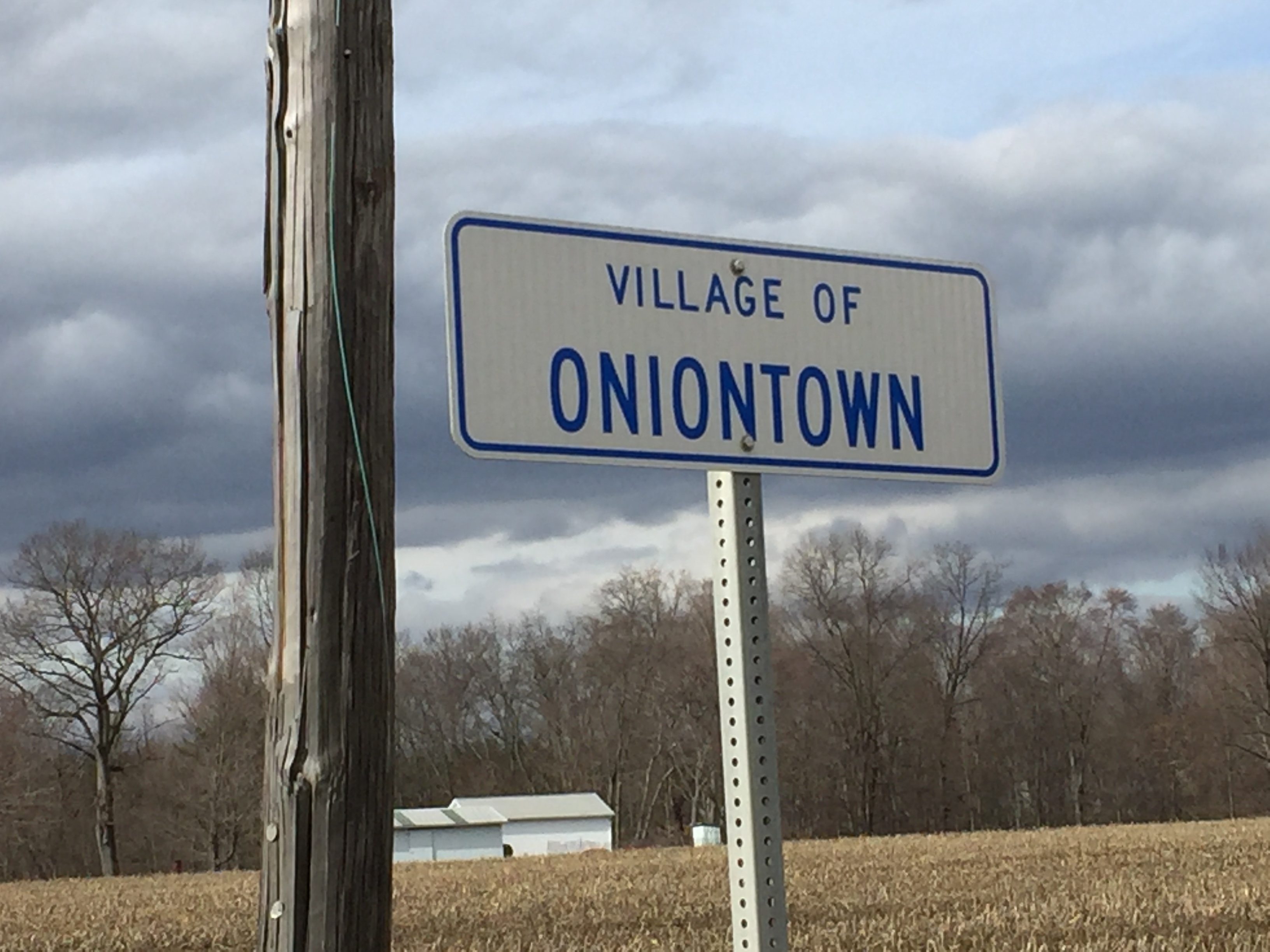
My latest lesson is, to tell the truth, plain silly. After fourteen years of ministry in Erie, I’ve settled nicely into the pulpit at St. John’s Lutheran Church in Oniontown. As I’ve said to parishioners and friends, “I’m having the time of my life. What a great place to be.” Since I showed up about six months ago, I’ve come to love the folks and the land—so much beauty.

But what’s embarrassing is this: although the scenery is soothing, I’m an impatient driver. The accelerator has a gravitational pull that I can’t resist. Come on, let’s go! On Route 19, District Road, and just about everywhere else, my brakes are getting a workout.
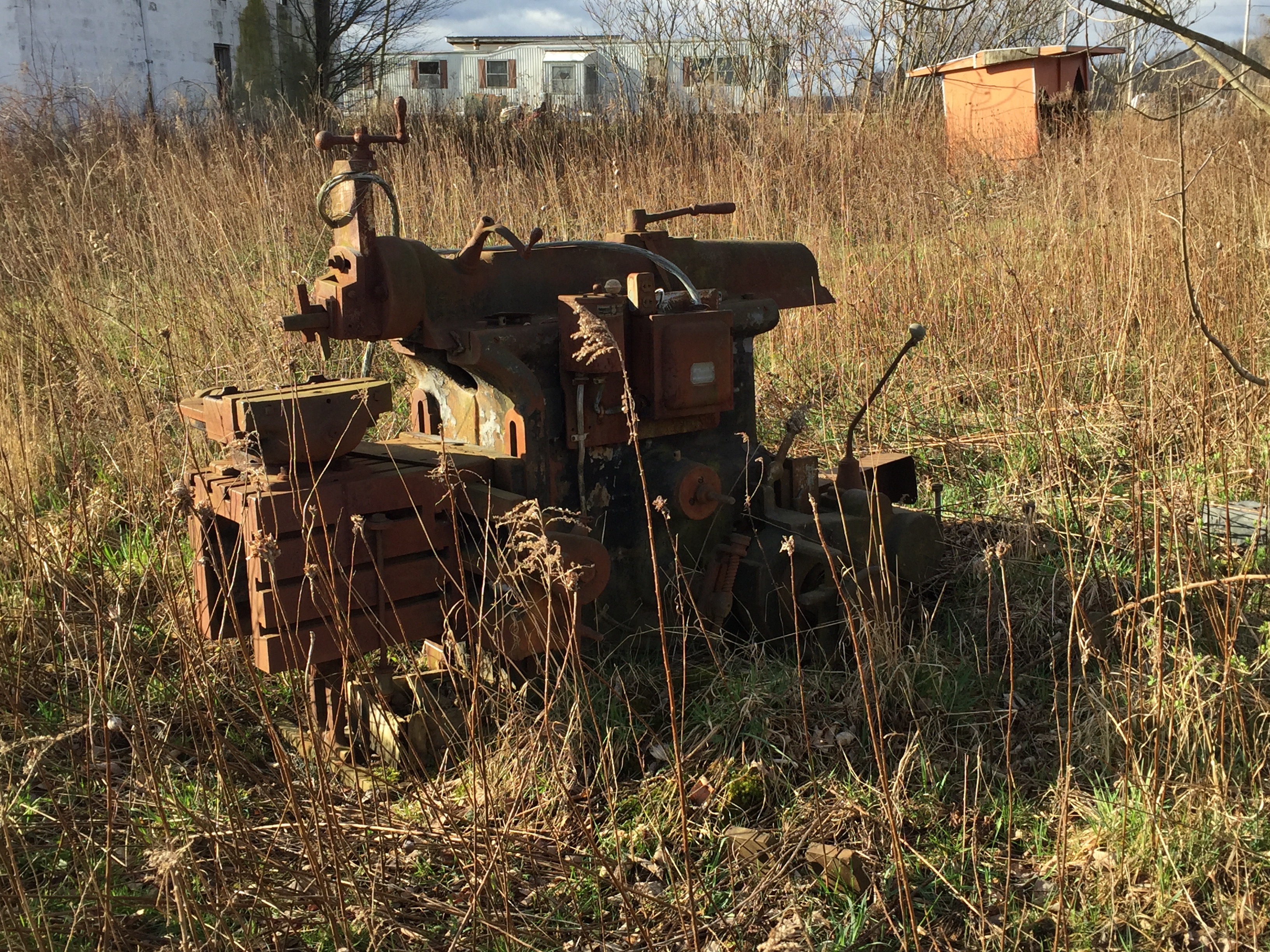
IMG_4358

No clue what purpose this old machine served, but its repose in a field is soothing to me

I’ve lived most of my life in medium to large cities where drivers don’t dillydally on turns. In these parts, abundant caution, reconnaissance and perhaps a little prayer precede pulling into each driveway or parking lot.

The other day at the Stone Arch, the St. John’s Seniors and I had a good laugh over the matter. “It’s as if,” I explained, “drivers are afraid a Tyrannosaurus rex is around each corner, waiting to chomp into the roof their car.”

“But there might be!” several said at once. “Or a cow or a dog or a . . . senior citizen!”

Thank God for their good humor. They already understand what I’m still trying to learn: slow down, what’s the rush?

I didn’t bother mentioning that on my way to the restaurant, a navy blue sedan in front of me inched fearfully into a lot that was so clear a Concorde could have come in for a hot landing. No tumbleweed, no crickets, just acres of glorious, barren blacktop.

“Why?” I cried out behind my closed windows. “What are you waiting for?”

Of course, I’m not proud of my frustration, but it does hold a truth: taking my time doesn’t come naturally. I’ve got to lean into liking second gear as much as fourth. My father would add his words to Gram’s: “Take it ease, disease,” he used to say, and “simmer down, bub.”

I have been making incremental progress. Last week an Amish guy sat stock still in his buggy in the middle of District Road as his horse swung his head this way and that, like a city dweller searching for a taxi. As I crawled past, my neighbor looked at me with a whimsical expression and waved, as if to say, “Thanks for not crashing into me.”

The exchange was pleasant. So, too, was my encounter with a wide piece of farm equipment—many circular blades—on my way to visit Ellen the other day. Both the farmer and I hugged our thin berms, and as we passed his eyes told me, “Yeah, we’re good. We’ve got this.”

I’ll simmer down eventually. My folks and the rolling fields are great teachers. Now I need to be patient with myself.
IMG_4284

April Fools’ Day, 2016: A Stimulation Junkie Waits for a Second Grandson

April Fools’ Day, 2016: A Stimulation Junkie Waits for a Second Grandson

The impulse to check my iPhone has been wicked lately. Of course, today I have good cause.

This very instant (10:42 a.m.) a text message from wife Kathy landed: “Contractions are picking up.” Daughter Elena is the contractor, and grandson Killian Davis Thompson is the contractee. I suppose that would be the arrangement.

The previous update rolled in at 9:22: “They just broke her water. All is well.”

IMG_4202

First grandson Cole listens for his little brother, Killian

Present circumstances are compelling, but I’m checking my iPhone now only a little more often than usual, which is idiotically, pathetically, embarrassingly often. It’s as if the 4.7-inch screen—yes, I looked up the dimensions on the devise itself—will give me what I’m after, which is . . . what?

I could say that I want to calm spiritual restlessness or escape mortal ennui, but the truth is mundane and unflattering and, I believe, pandemic. I’m so confident of the affliction that I won’t bother confirming the commonality of what follows with even a whiff of evidence.

I’m a stimulation junkie. And I don’t like it one bit. Seriously, I’ve got some work to do. How can a middle-aged man who has practiced prayer-meditation for over twenty-five years be so easily and frequently uncentered?

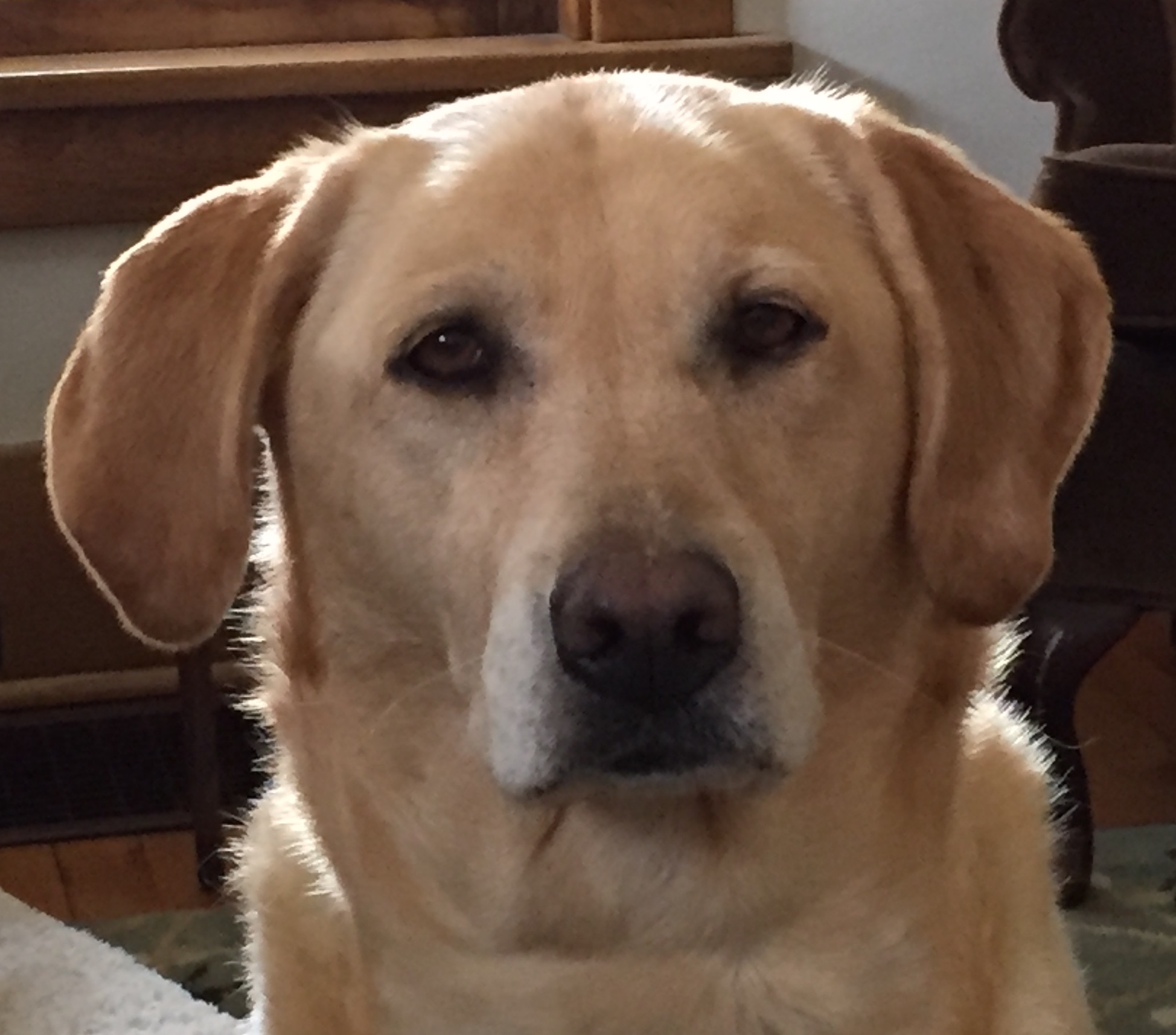
For the last few days, Kathy and I have dog-sat Layla, Elena and son-in-law Matt’s yellow Lab, who is affectionate, but as tranquil as a panicked doe. On our afternoon walks, Layla zigzags as though she is fleeing gunfire. The point: sometimes my soul looks like my grand-dog, aquiver with indecision about where to sprinkle her next droplets of pee. I’m looking wildly about for nothing in particular, or so it feels.

IMG_4573

Layla attempting the old K-9 mind trick: “Pop, you don’t want the rest of your sandwich.”

11:39, and I just checked for updates, even though my iPhone plays a come-hither, noir saxophone wah waaaah when Kathy sends a text. But, hey, I might not have heard.

In fairness, updates are always tapping me on the shoulder or landing like mosquitoes on my ankles. Heaven forbid I should miss something.

I have 568 Facebook friends, which means at any moment a photograph of food porn or an unsexy kissy-lips selfie might show up. Fortunately I have enough self-control to shut off the bee boop alert for each new post.

I don’t do Twitter because the whole hashtag lingo is lost on me. Thank God for small blessings.

But, really, these early years of the 21st century conspire to distract, rush and over-stimulate all of us who let technology and the media govern our habits. Consider:

  • Not only is patience often unnecessary, it’s downright discouraged. Used to be you had to endure a week of suspense and torment between episodes of your favorite television show. Now with enough Doritos and moxie, you can cram a whole season’s twists and turns into one calendar day.
  • I admit it, I’m a Pandora fan. Sadly, my tolerance for a song that gets off to an unappealing start is low. If it’s bland, I hit the skip button. During my teenage years, we Erie kids had WJET 1400 am or K104 fm. If both were playing clunkers, we had to wait it out, commercials, news, and all.
  • Credit cards: the black holes of impatience and impulse. Why plan and save?
  • Back to my iPhone: last night at the Coleman house we wondered if Steve Buscemi was, indeed, the voice of Templeton the rat in a film version of Charlotte’s Web. Shazam. We knew in seconds.
  • My MacBook Air, at my spoiled fingertips right now, dumps most of the information I need in my lap, without a drive to the library and an interrogation of the card catalog.

And so on. It’s hard to imagine what harm there might be in getting what I want when I want it, but I think the pace is injecting my disposition full of adrenaline. When nothing is going, when my head is left hanging with “shave and a hair cut . . . ,” I bob my leg.

4b3759e0-bff3-4cac-9f1f-a6416913b4cf

Leg bobbing in coffee shop

This is not good—not for me, not for us. Get ready to roll your eyes, but I suspect that our collective stimulation addiction has fueled the rise of at least one presidential contender, Donald Trump. I keep asking myself why his frightening behavior isn’t blasting him out of contention for the highest office in the land.

Why? Because every day he stimulates us out of our wits. What will the twit Tweet next? Stay tuned. As long as he accumulates delegates, there’s no way we can get bored.

But enough of this sad digression. It’s 12:32, and I’m jonesing for Kathy’s alluring sax and a second grandson.

My Killian is about to arrive! Now that’s a great reason to stare at an iPhone screen. But a goof gnawing on a ghost pepper? Or television news bloopers from 2014? Or worse? Why do I cram my head full of such diversional potato chips?

Later on, when I kiss my grandson’s head and smell the perfume all newborns wear, maybe he’ll birth a new grandfather—a man who enjoys deep breaths and looks at the sky.

Come on, kiddo. You’ll still have the wise before-world on your skin when I hold you. Share a little with your Pop.

IMG_4403

Pop receives before-world wisdom

13174148_1119980818072105_241983073667295058_n

Killian suits her. I can’t remember when I’ve seen Kathy quite this beautiful.


A Dog Story, Nice Ending

A Dog Story, Nice Ending

Layla is a lunk—there’s no other way to put it. She is eighty akimbo pounds of yellow Lab who bounds onto your lap and noses her way past your face and into your soul. My grand-dog is frantic with affection.

Since April Fools’ Day, when our second grandson Killian was born, wife Kathy and I have been dog-sitting. Daughter Elena and son-in-law Matt are rightly afraid that Layla might lick the skin off our newborn’s hide, accidentally trample grandson one, toddler Cole, or bowl over Matt, who recently broke his leg. So with the exception of a couple of trips home for good behavior, Layla has lodged at the Coleman house.

1488069_770029026400621_5346441143956460071_n

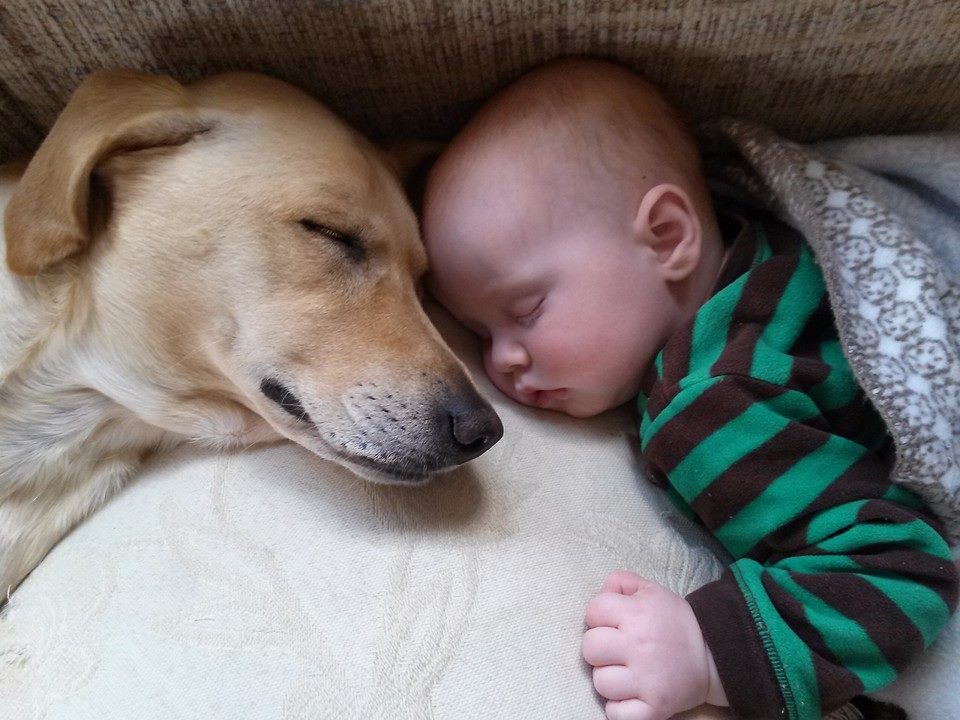
Layla and Cole when the latter was one year old

Last night she flopped beside me in front of the television, spent after a day of urgent missions only she understood. I ran my hand over her closed eyes and soft ears and said, “You’re Pop’s good pup, aren’t you? You’re a good girl.”

She was at ease, but nobody can bliss her out like Matt. And if any dog needs some bliss, it’s Layla. All it takes to reduce her to hours of trembling is a balloon. A couple weeks ago Kathy and Cole were in the basement popping leftover birthday balloons, probably a dozen of them. Later I found Layla in our mudroom, quivering and cowering.

Lots of dogs get panicky on July 4th, but why would loud pops unhinge a pup for a whole day? That’s how long it sometimes takes for Layla to stop shaking.

We’re pretty sure of the answer. On August 19, 2013, her owner, Dean Haggerty, was shot to death in his Summit Township mobile home. Dean’s daughter and son were there, as was Layla. Dean’s fiancé Kristina had pulled the trigger.

As one of Dean’s childhood friends, Matt gathered with the Haggerty family. The dust hadn’t even begun to settle. What exactly happened? Good Lord, the kids! And, oh yeah, what about the dog?

One room can contain only so much shock and uncertainty. Numb silence. Could anyone take in Layla? More silence.

Matt hadn’t seen much of Dean in the months before the shooting and had never laid eyes on Layla. But when he realized that his dead buddy’s dog might be homeless, Matt’s yes came out by its own volition. He hadn’t consulted Elena, who was seven months pregnant with Cole, or thought things through. In that moment, his love was like Layla’s, reckless and snout-first.

How old was Layla? Nobody knew, but she was clearly in the mad dash of puppyhood. That first night with Matt and Elena, she paced and whimpered. In the small hours of the morning, she finally fell asleep on the couch at Matt’s feet.

Over the last couple of years, Layla has become family. Early on, she ducked when I reached out to pet her. Was she fearful by nature or treated harshly? Again, nobody knew.

Today, Layla doesn’t look over her shoulder much. Family and friends have nosed into her vulnerable spirit and earned her trust. If the world would quit popping, her peace would be complete.

Layla must be at least four, but she hasn’t received the memo that she’s not a puppy anymore. The relentless K-9 energy sparking in Matt and Elena’s house can be overwhelming. When visitors get welcomed within an inch of their lives, Elena makes fists, squeezes her eyes shut, growls “Layla,” and then laughs and shakes her head. Charged with minding a toddler, an infant, a temporarily gimping husband, and a joyfully insane Lab, Elena deserves sainthood.

And Layla deserves her home and most of all Matt, a patient, insightful man. When she pins him down with kisses and army-crawls into his soul, he welcomes her in.

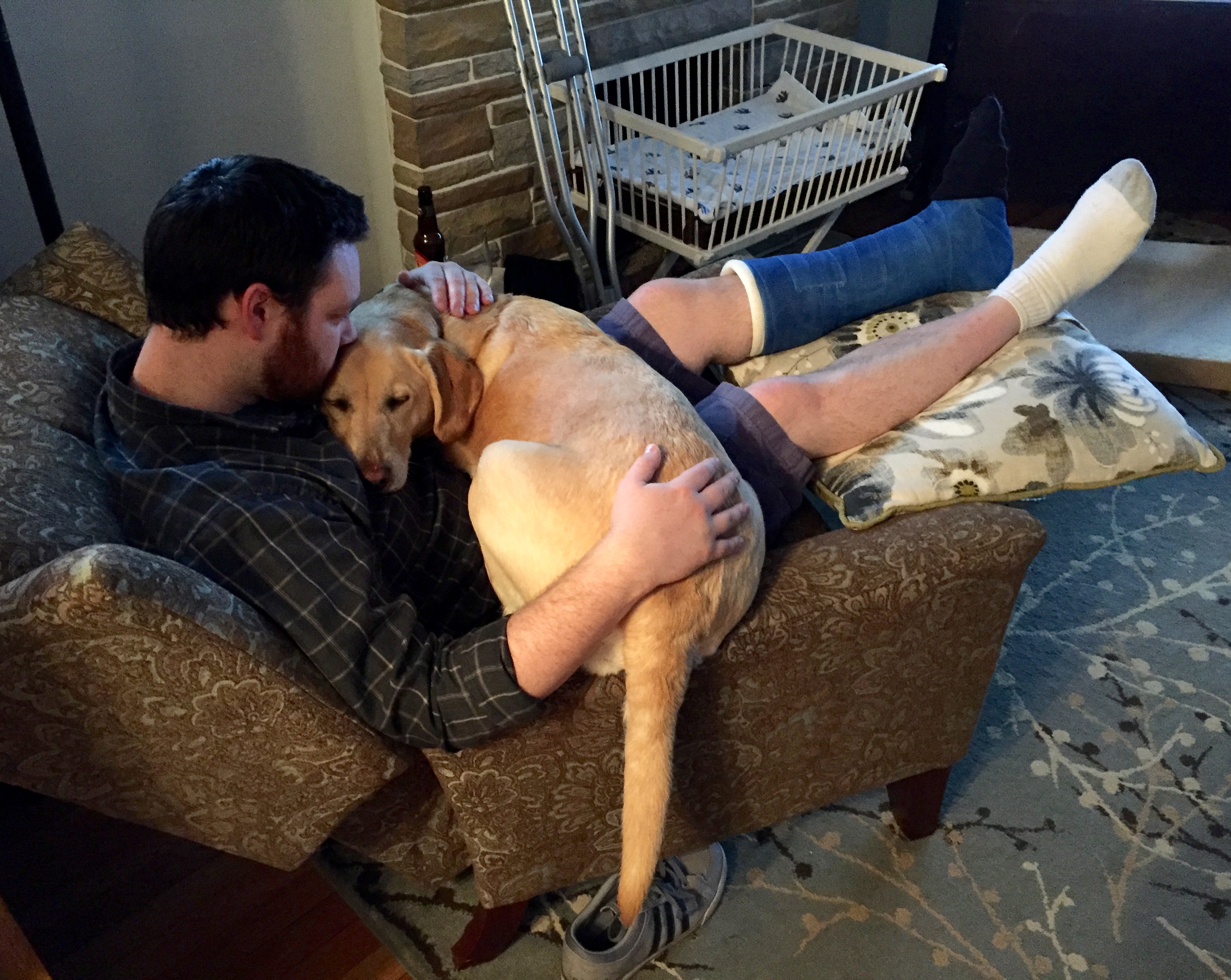
I never realized how much Layla loves Matt until recently. Pop will do in a pinch, but only one lap is home. Before family dinner one evening, Matt sat in my recliner, his cast resting on a pillow. Layla climbed aboard and settled in.

She hadn’t seen her master in two weeks and was finally home. No gunshots. Just a goofy dog and a man who said yes.

IMG_4545

Man and dog: home

I couldn’t help taking pictures. Such good feels. Honest stories have flawed endings. Friends die. Balloons explode. But once in a while a last page sings out the possibilities of reckless love. It convinced Layla that she’s a good girl, and maybe, one dog and human at a time, it can also heal the world.

Message for a New Grandson

Message for a New Grandson

Friend Jan assures me that those in extremis can hear and understand. Son Micah told me once that when death is close, euphoric chemicals show up with kind words, beloved faces, and bright lights.

IMG_3600

Lake Erie light

I’m all for our glands throwing us a going-away party, but what Jan says feels right. Besides, she is wise and knows about deathbeds.

But I have my own reasons for hoping that words of love and care somehow get through. During parishioner Annie’s last minutes, I leaned in close and whispered Psalm 23. Thou art with me. Goodness and mercy. Forever. A single tear ran down her crow’s foot to the pillow. I saw it.

And I saw my mother’s hand lift and fall as I said goodbye to her eighteen years ago. Mom’s purposeful movement said, “I’d answer if I could, John.”

Since then, I’ve spoken freely to the almost-gone. In fact, I’ll speak to everybody and nobody. Words are good, so I say what should be said in hopes that if nothing else, the universe might hear.

Years ago wife Kathy raised monarch butterflies on our front porch. Occasionally, one would be hopelessly deformed, and before resting it underneath a stargazer lily and giving it a quick end, I said, “I’m sorry this life didn’t work out, but it will be over soon. Everything will be okay. You’ll see.”

When geese fly over, in a pair or by the dozens, I say, “Thank you.” Am I addressing the birds or God? Both, I guess.

My most recent monologue came out on—appropriately enough—April Fools’ Day. Killian Davis Thompson, grandson number two, arrived at 2:01 p.m., and within a few hours I got to see him.

IMG_4401

Kathy and Killian

Kathy helped with the birth, so she had already held him. I let Micah go first. After Kathy had seconds, it was my turn.

Time passes dreamlike when you’re looking at a baby you’ve been imagining month after month. I heard giddy voices—daughter Elena, son-in-law Matt, Kathy and Micah—but, I swear, no words.

Killian and I were in a bubble. Even now, I remember only a couple of details, which I report without exaggeration: I disappeared into his face; before I knew what was happening, I found myself whispering to him; and, on one lucid front, I hoped my breath wasn’t nasty. (The little nugget was defenseless, after all.)

IMG_4403

Killian and Pop in a bubble

I can’t bring back exactly what I said, but what I meant is still fresh. As much as I wanted Mom to hear my goodbye, I longed for some quiet room in Killian’s soul to hold in safe keeping his foolish Pop’s welcome. I meant . . .

You were so safe and warm. Now here you are. It’s so cold and bright. Don’t wake up. You must be exhausted. Being born is hard, isn’t it?

But, listen, don’t be afraid. You’re so lucky! We’ve all been waiting for you, wanting to meet you, wanting to see your face.

Don’t be afraid. You have a whole bunch of people who will take care of you. Your mom and dad are beautiful. You have a nice little home. It’s warm and dry. And you have a big brother.

IMG_4444

Lucky baby, lucky family

I named everybody in the family and told him about his tribe. Then Elena’s voice penetrated the bubble: “Are you talking to him?” “Yeah.”

This world is pretty good, but it might not be as great as where you came from. I don’t know. But I’m here, don’t forget. Whatever you need, I’m here. I’ll try to stay close.

Yes, I know, newborns don’t remember anything. And a dying woman doesn’t take green pastures and still waters with her into forever.

But maybe. I’m allowed to hope. All I know is, loving words are good, and if only the universe hears, I’ll keep trying to say them.

Oniontown Pastoral #3: Hope Is an Old Tractor

Oniontown Pastoral #3: Hope Is an Old Tractor*

A few Mondays ago my friend’s son, forty-four, overdosed on heroin. The next day I took her stunned grief with me to the pastor’s study at St. John’s Lutheran Church in Oniontown, Pennsylvania.

IMG_4327

Farm art near Oniontown

My commute from Erie has four legs: I-79 South to US-19 South to District Road to Mercer Road. For seventy minutes gray trees and rolling fields heal me, but on this day my mind was on iffy roads and my friend. She and her husband had long anticipated the knock at the door and the crushing news. My wife and I used to have the same nightmares about our son, now thankfully clean.

As I thought about the numb terror of fresh loss, a line from Philippians visited me: “Your citizenship is in heaven.” Good sermon theme! I started to flesh it out. When political candidates carpet bomb each other, when explosive vests cut down the innocent, when El Nino and Zika lead the news, and when nasty heroin is as cheap as beer, then heavenly citizenship sounds, well, heavenly. My point, of course, wouldn’t be to reject this life, but to remember that we have a home over the horizon. Not particularly uplifting, but not all sermons can be sunbeams and dandelions.

I looked forward to getting to church and putting the ideas on paper. Alas, a snowy parking lot stood in my way. But since secretary Jodi’s truck was in its spot, I bravely punched the accelerator. Turns out my burnt-orange, bulbous Chevy HHR can’t compete with four-wheel drive.

“Man, am I stuck,” I reported to Jodi, who didn’t know when the plow guy would get to St. John’s. Might be evening. “We’ll get you out somehow,” she assured me.

I sulked at my desk. Wait-and-see isn’t my best mode. The sermon I pecked away at would sound whiny, I could tell.

Within half-an-hour Jodi said, “Do I hear a tractor?”

“I hear something,” I said. “Don’t know what.” Then out my window passed a bundled up man with a long beard pushing snow with an old tractor. The blade was behind the driver, a configuration I had never seen, but he was blazing me a trail.

“He lives over there,” Jodi pointed. He had seen my problem and arrived unbidden. Shoving snow this way and that, he kept at it, like a man subduing a wooly mammoth with a straight razor.

Watching him ride into and out of view, I came to love that tractor, pale red, faded by decades of sun and squalls. It must have been shiny once, but endurance gave it a different beauty. Hope, I think, is the color of my Samaritan’s tractor.

I finally understood why Jodi wasn’t concerned. And the sermon in process took on a glad color. “Our citizenship may be heavenly,” I now plan to say, “but God resides in Oniontown, too.” Then I’ll tell the folks about our neighbor and his tractor. And I’ll tell them about hope.

IMG_4284

*This essay first appeared a few weeks ago in Greenville, Pennsylvania’s, newspaper, the Record-Argus. 

Oniontown Pastoral #2: Visitation

IMG_4284

I don’t know anything sadder than a summer’s day.

(“The Geese” by E. B. White)

Who doesn’t love summer? Millions of northerners flock south each year in hopes of denying winter its due.

I accept the migration’s logic, but my attraction to summer or any mild weather is complicated. If the sky is flawless blue, I remember that for some folks, clouds block the light.

E. B. White’s summer sadness descended as he watched an old gander on his farm defeated by a young male. The Charlotte’s Web author, in his early seventies, sympathized with the displaced bird.

My ambivalence toward nice weather has its own causes. When I was a teenager my grandparents tried to outrun Gram’s arthritis by moving to Sun City, Arizona. While the dry climate was physically medicinal, the miles from children and grandchildren punished her heart.

My mother died in June of 1998 while I was doing chaplaincy training. At the end of each day of caring for others, I floated a city block to my car through a hot haze of grief.

So memories and disposition keep the unbridled joy of a beautiful day in check. I wouldn’t call my mood sad, though. Mindful is more accurate. I pray for people for whom getting from stoop to car is herculean or impossible. I dream them with me into the light.

Last week I visited homebound parishioners. Ah, the weather! Driving was a pleasure, windows down a couple of inches. Walking across parking lots was all Julie Andrews spinning and singing from the lively hills.

But it never takes long to recall that beauty depends on your perch. If walls and a non-compliant body keep you from taking in deep draughts of outside air and picking tomatoes with your own two hands, then whatever breeze sneaks in through the screen might bring out a sigh of resignation rather than delight.

IMG_4308

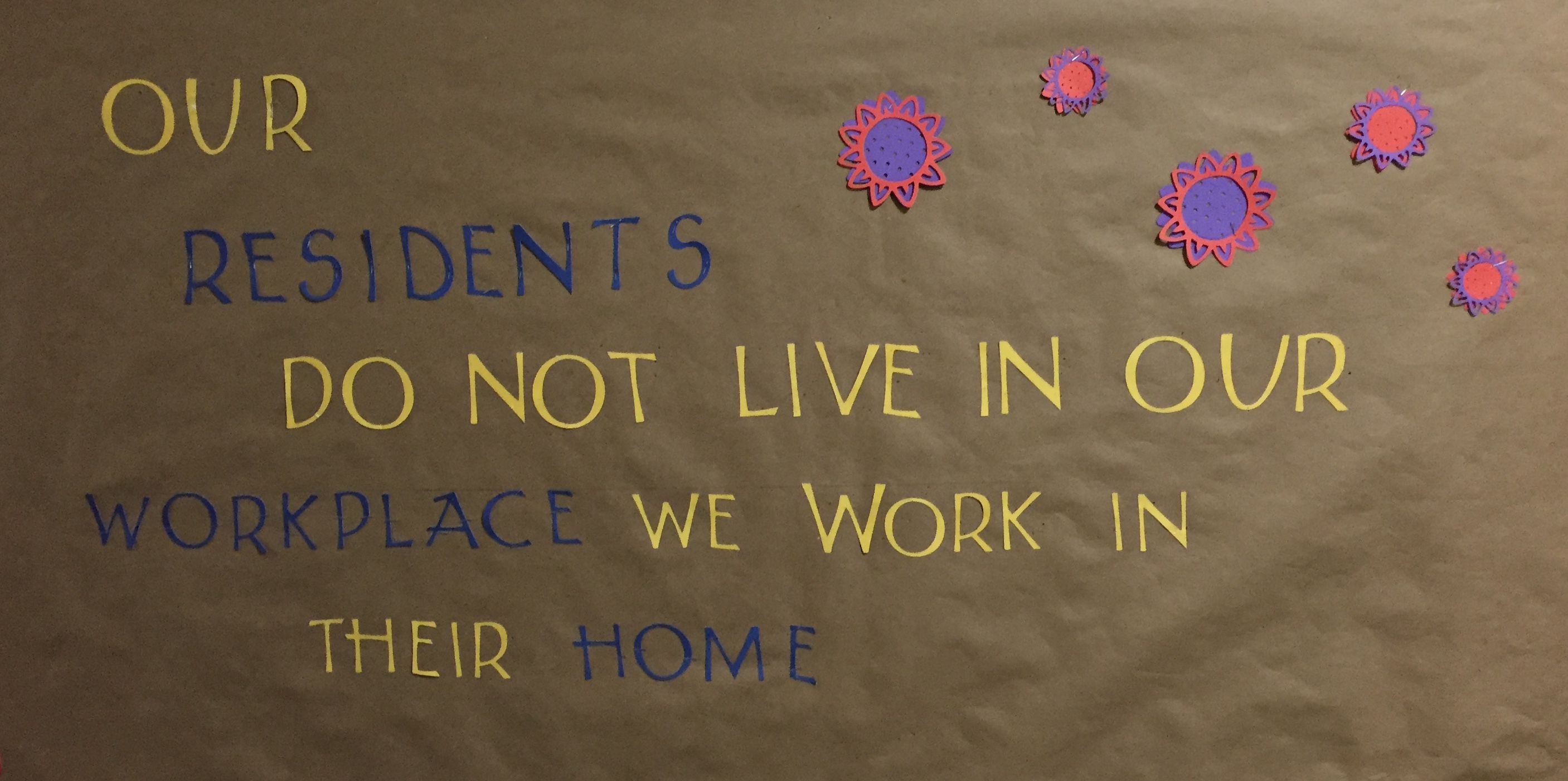
Bulletin board in an old folks’ home near Oniontown

This evening while enduring the television news, I’ll have a splash of pinot noir—just to gladden my human heart. What does a long-stem wine glass look like to an elderly child of God who shakes unpredictably? Or a chalice full of Sacred Presence? Spills waiting to happen?

Such questions should depress me, but they don’t. Seeing through homebound eyes is a lighter prayer than you might think. Anyway, I won’t dishonor them with sorrow. Maybe God can use my gratitude—for the filling of lungs, lifting a spoonful of broth, finding the Big Dipper—to bless my friends, to grant them an hour’s gladness.

My own joy is tender to the touch—only selfish joy isn’t bruised. I miss Mom now more than eighteen years ago when summer hung on me like wool.

But this March day is stunning, brilliant, 60 degrees. Chores are next on the list, then a walk. I’ll bring Mom and gather everyone I can remember as I go.

Dear God, please take the saints I forget by the hand and lead the way.

Words from the Dead in a Frightening Season

IMG_4105

Our beautiful country . . . out my office window.

Voting seasons are generally a drag, but the 2016 presidential primaries in advance of this fall’s general election are scary. In response to a long, humorless essay on the subject I posted on A Napper’s Companion a few days ago, friend Mary wrote, “I am sick and frightened and don’t know where our beautiful country is going.”

To her excellent words, I would add powerless. Today is Super Tuesday, and millions of Americans are looking around wildly for a pause button that doesn’t exist. Will our next president’s greatest gift be barroom brawling? And will the spectacle that is United States government morph from paralysis to legislative deliberations dominated by bellowing, spittle, and locker room insults?

I’m not the only citizen asking these questions and fearing these fears. Friend Judie wrote to me, “I am so ashamed of what we have become in politics.” Mary and Judie speak for thoughtful Americans and, obviously, for me. I’m weary with sick and frightened and ashamed.

As the first votes are being cast, I’m taking this moment to up my personal ante: Shame for others’ conduct is bad, but shame for my own thoughts and actions is worse.

When hitting below the belt is the order of the day, the temptation to counterpunch in like fashion is acute. If you call me a loser, I can call you whatever I please—and think even worse. But this way is neither Christian nor mindful. It’s the way of the lowest common denominator and the reptile brain.

Frightening times can bring out the worst in us, myself included. We’ve been scared before, though. I’m too young to recall vividly 1968, another year that America felt itself cracking to pieces. Think the Vietnam War and Civil Rights movement, the assassinations of Martin Luther King and Robert Kennedy.

In April of that year, monk Thomas Merton wrote in his journal while on the road: “So the murder of M. L. King—it lay on top of the traveling car like an animal, a beast of the apocalypse. And it finally confirmed all the apprehensions—the feeling that 1968 is a beast of a year. That the things are finally, inexorably, spelling themselves out. Why? Are things happening because people in desperation want them to happen? Or do they have to happen? Is the human race self-destructive? Is the Christian message of love a pitiful delusion? Or must one just “love” in an impossible situation?”

Anyone familiar with Merton’s life and work knows how he would have answered his own questions. One must love. In beastly times, love is the mindful person’s center of gravity. Such love is sometimes obliged to fight, but its arsenal is selective. Cruel or dehumanizing weapons, for example, are out. Such love is also sacrificial and can appear not only risky, but reckless.

How difficult to remember in an alarming season that assaulting my neighbor ends in wounding myself. In an informal address in Calcutta in October of 1968, Merton spoke indirectly of love: “And the deepest level of communication is not communication, but communion. It is wordless. It is beyond words, and it is beyond speech, and it is beyond concept. Not that we discover a new unity. We discover an older unity. My dear brothers, we are already one. But we imagine that we are not. And what we have to recover is our original unity. What we have to be is what we are.

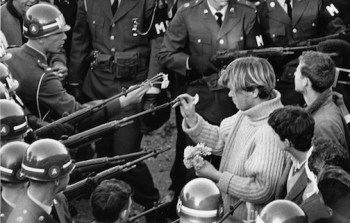
Flower_Power_by_Bernie_Boston

Flower Power, 1967 (Credit: Bernie Boston on Wikipedia)

Monks from various spiritual traditions, Western and Eastern, heard these words. In the context of what feels like a contemporary planetary crack up—campaign explosions, not to mention real bombs and climate change—Merton probably seems flighty, like a hippie sticking a flower in a rifle barrel. (And the monk himself added a tragic explanation point to 1968 on December 15th when he died of an accidental electrocution in Bangkok.)

If the human race is self-destructive, I want to be the weirdo holding out a daisy. If Christian love and human unity are pitiful delusions, nobody wake me up.

Wherever our beautiful country is going, history has taught us where hatred and fear lead. Call me a flake if I refuse to take the beastly path.

Oniontown Pastoral #1: My Wife Sleeping

Oniontown Pastoral #1: My Wife Sleeping

IMG_4284I’ve been going to bed by 9:00 p.m. lately and waking up several times during the night–changes in established rhythms. Wife Kathy and I have pruned home to 1000 square feet. My pastor work has slimmed to part-time to make room for writing. And Kathy cries out whenever she rolls over.

As our friends know, Kathy climbed to unfurl the royals on Brig Niagara. She put a new roof on our old house, remodeled the bathroom, fashioned a patio out of salvaged brick, and planted flowers I could never name.

When we bought our little house, which I call the hermitage, Kathy willed the dingy place into fresh order with elbow grease and doggedness. She has big plans: a vegetable and herb garden with raised beds; a deck cobbled together with wood from a backdoor ramp she will saw into pieces; and, of course, flowers.

Kathy has plans, but as we found out a few weeks ago, she also has rheumatoid arthritis. Questions still outnumber answers. Will medication help? Diet? Exercise? Can the condition be coaxed into remission?

She has swollen joints, particularly at the fingers and wrists, and pain all around. A steroid helps for now, but it’s not a long-term solution. Her spirit still sings. Just now she sent me this message: “I hope you are enjoying your morning writing time. You should try to get out for a walk today. What a lovely day. Love you.”

Lovely day, indeed. Lovely human being!

This morning at 1:48 I woke up, sipped some water, and watched Kathy sleep. She should win awards for the dexterity and variety of her snoring. A couple of exhales in a row, her throat sounded like a playing card being flip-flip-flipped by bicycle spokes.

When I smoothed hair away from her forehead, she started. “Oh, I’m sorry,” I said. For the first time in my life, I heard a complete, discernible sentence uttered in mmms. Cadence alone provided the words: “Oh, that’s okay. You can put your hand on my head.”

So I held her hair between the fingers of one hand, rested the other on her puffed out knuckles, and prayed—sort of. If wanting to draw pain out of my wife by touch, to take it upon myself, counts as prayer, then I prayed.

And if “Oh, my dear” counts, then I prayed without ceasing. How many times did moving a little bring rapid breaths and four or five ows out of her sleep?

“Your hands?” I asked.

“My leg,” she answered.

“Oh, my dear.”

She returned to snoring. I looked at her face and longed for a miracle, but I’m eccentric, a pastoral black sheep. You would expect articulate petitions from a trained theologian, but I pray best by breathing.

Each time Kathy resumed snoring, I drew close again and kept vigil. In our shadowy bedroom, we lay bathed in holy light.

One belief granted me sleep: every cry ripples in the waters of Eternal Love.

P. S. Please stay tuned for further Oniontown Pastoral posts and other explanations and solutions.

Thus Spake the Rabbi

My stride has been ragged lately, my groove flummoxed. As the poet said, “Nothing is plumb, level, or square.” Or the politician: “What a terrible thing it is to lose one’s mind. Or not to have a mind at all. How true that is.”

f503eb5a-2d90-44f2-ba21-32f9914a488a

Old buddy Watson, twelve years of family joy

Joy is largely to blame. Wife Kathy and I had friends over the other night to catch up. When eyes turned toward me, I said, “I’m happy,” which took some explaining. During the last couple of years, though surrounded by more love and support than anyone deserves, I have been tired and stressed. Maybe burnout is the word. Against all worldly good sense, Kathy and I raided my retirement funds and bought a hermit-sized home. (“You might come to regret that,” an old colleague said, and I couldn’t disagree.) I left a fourteen-year, full-time pastorate and accepted a part-time call seventy miles south of Erie, right through the region’s snow belt. Oh, and we haven’t sold our big house yet.

We Colemans have either lost our minds or found them. It could be that you have to lose one mind to find another. Since gladness and good sense seldom form right angles, I’m not surprised that my stride and groove—constructs of a neurotic brain—are stepping lightly these days.

I didn’t use these words exactly to unpack “I’m happy” for my friends, but they understood. Forced to choose between weary, anxious circumstances standing in crisp formation or calm ambiguity weaving like a drunkard, I’ll take the latter.

That is to say, I have taken the latter and am learning to embrace uncertainty and surprises. Lately sleep has been whimsical. A new work schedule has taken issue with my long-standing afternoon habit of napping. Like an AARP veteran, I’m reading in bed at 8:30 p.m. and surrendering by 9:00 or 9:30. The result: I wake up at 2:00 a.m., float to the bathroom, return to bed, and abide in a space that is to sleep what free association is to therapy.

Neither refreshed enough to get up nor drowsy enough to disappear, I breathe. Deep breaths, yes, but not those of my past, taken to lift a burden just enough to endure another hour or hush a remark that can’t be retrieved. If insomnia is an enemy, my peculiar wakefulness is a bearer of gifts.

60ab5db4-5da1-4824-95fc-0fde4cc86b6d

A bulge on the forehead: “soon and very soon,” Watson

Darkness is upsetting if you’re trying to find something, but it’s a gentle companion if you’re waiting to be found. A few nights ago snoring found me, not my own, but wife’s and dog’s. The sounds, joining for a moment then going their own ways, were blessings. Kathy has been swollen, weak, and achy for the last couple of months, and neither we nor the doctors know why. No matter what noise it makes, her sleep is medicinal. I welcome it. And Watson has weeks rather than months to live. The fatty tumor on his flank is getting hard. The growth on his forehead pains him more by the day. I now hope to come home and find that he has slipped away while dreaming that he and I are going for a run like we did years ago. His snore means that we don’t have to say goodbye quite yet. God bless his kind soul, even our walls and floors will miss him. I think now of his eyes, alive and expectant when Kathy and I left him this morning, and am close to undone.

The first decoration I nailed up in the Coleman’s new home is wisdom from a rabbi, Abraham Joshua Heschel.

7cc731dd-b219-4700-b2ee-3f9cdca525b4

Thus spake the rabbi

“Just to be” in a warm bed next to Kathy; “just to live” one more day with Watson: these are the teachings of wakefulness. My chest rises and falls, each in-breath a blessing, each out-breath sacred.

But my darkness isn’t deceptive. It would never say to a lost soul, “Just to be is a blessing.”

Instead I hear, “One corner of your joy will always be uneven, cracked with grief. Whatever mind you possess, it will never be satisfied.”

In this moment, I close my eyes to learn, invite the 2:00 a.m. wakefulness, and hear the rabbi more clearly. Breathing is grace. I survive on love. And I pray: “When my dog dies, Holy One, please help him not to be afraid.”

Fats Waller and the Frosted Trees

Fats_Waller_edit

Fats Waller (Credit: Alan Fisher on Wikimedia Commons)

Fats Waller and the Frosted Trees

Jelly Roll Morton, Scott Joplin, and Fats Waller make me grateful. As Steve Martin said decades ago, “You just can’t sing a depressing song when you’re playing the banjo.” Same with driving in the country and listening to piano rolls, rags, and strides.

This past week Fats, the color white, and gratitude owned my commute from Erie to St. John’s Lutheran Church in Oniontown, Pennsylvania. The hour south on I-79, Route 19, and District Road was a hot damn of thanksgiving–“Handful of Keys,” “Lulu’s Back in Town,” “When Someone Thinks You’re Wonderful.”

d8ab0138-1236-43ad-a8dc-a930a0642a7f

Grandson Cole, wonderful kid with a new lid

Why did pianos and frosted branches make me take inventory? I don’t understand myself all that well, so who knows? My list wrote itself slowly and silently.

  • I have a surplus of love. One step in any direction, there it is. Wife, grown kids, one grandson and another on the way, more family and a ton of friends. An absolute wonder of wonderful souls.
  • Those closest to me are holding together okay. No crises going down or chops busting in process.
  • I have a home, warm or cool as desired, so much food that possibilities have to be eliminated, and a king’s ransom of clean water.
  • My closet holds wardrobes for varying weight classes with acquisitions I’ve forgotten.
  • Bill collectors are not breaking down the door.
  • I dig the bookends of my commute—solace to the north and good purpose to the south.

As the miles clicked away, as Fats sparkled, as the snowy trees formed cathedrals surreal with beauty, Gershwin lyrics came to me: “Got my gal, got my Lawd, got my song.”

IMG_4148

Beloved Watson with the mother of fatty tumors

“No use complaining,” Porgy says as an aside, though he didn’t know about the Coleman family’s dog Watson, weary, arthritic, laden with tumors. He is our hobbling source of agape—unconditional love. A month ago, a lump appeared in the middle of his forehead. Its rapid growth foreshadows his absence, even as he manages a fetch or two. He snorts constantly, trying to clear a mass that won’t budge.

Nearing the end of my commute, I allowed that happiness isn’t a prerequisite for gratitude. Twelve years of Watson’s mild presence has been extravagant by any measure.

IMG_4150I would say that my inventory was a prayer, but Fats alone was that, as were the frosted trees and a line from a musical. I received the wide mercy—alpha to omega—of giving thanks for miles with my eyes, ears, and lungs and not once calling God by name.