Trump and Musk’s Collateral Damage: Human Beings

Trump and Musk’s Collateral Damage: Human Beings

This was 1984. My father was fifty-eight, five years younger than I am now. He sat on the couch and cried. He paced. He pulled himself together and made phone calls. The handshakes that guaranteed his return to American Meter’s tool room should his management position be eliminated turned out to be dead fish. A young Turk called Dad into his office and said, “You can run a drill press or retire.”

“But what about . . . ?”

“I’m sorry, Mr. Coleman.”

“No, thanks.”

No dishonor in running a drill press, but Denny Coleman, who had put in over thirty-five years, deserved better. He arrived at work early, drank black coffee at his desk and read the morning paper. He’d been a union steward. Everybody at the shop knew Coly. The place was in his bones.

But that’s how it goes. People lose jobs, get divorced, bury those they love. And sorrows greater than Dad’s befall millions the world over. Hopefully no litany of woe is necessary as evidence.

I thought of my late father a few hours ago while skimming The Washington Post. Headline: “President Donald Trump’s administration fired thousands of federal workers.” Bullet point: “Agency heads were told yesterday to terminate most trial and probationary staff.” The article estimates that the move “could affect as many as 200,000 employees.” That’s this particular move, with others to come that may kneecap a million or more. Who can say?

There are myriad complaints to register about this scorched earth campaign against governmental agencies and workers, but I want to stay focused on one consideration obscured by the consternation over Trump, Musk, and their operatives: human beings.

Musk and his son X in the Oval Office. (Credit: Wikimedia Commons)

Denny Coleman was fortunate compared to the many employees who could be affected in this season’s purge-first-and-ask-questions-later ambush. He was within sight of retirement, had decades of valuable experience and easily secured employment for the homestretch. Twenty years of comfortable living awaited him. This said, nothing excuses the bum’s rush American Meter gave Dad at the end.

For two days he sat on the couch and cried. I never saw this myself; my stepmother told me. He wasn’t worried about money. No, he was cut to the quick. In my imagination he occupied his usual end of the couch, ran fingers through his wavy gray hair, went into his back pocket for the third handkerchief of the day, wiped his eyes and blew his nose. Maybe you would need to love someone who served long and faithfully get backhanded on his way out the door by some snot nose to appreciate the loss of self such treatment would cause. Please take my word for it.

Were there legitimate reasons for the Meter to trim Coly from the payroll? I have no idea. Are there great fat caps of waste in government spending? Probably so. The question is—and always has been—how can costs be controlled without exacting an undue human toll? We might up this reflection’s ante and ask, “Can’t changes be made without destroying lives?”

That the destruction of specific agencies is Trump-Musk’s goal complicates matters. Were the American house ablaze, the speed of closings and firings might be understandable, but the urgency is certainly stoked by a strike-while-the-iron-is-hot philosophy. Keep on the attack, let anxiety and outrage interfere with the opposition’s ability to mobilize. If a few million citizens in America are incommoded and millions more in countries desperate for our assistance languish, well, that’s acceptable collateral damage.

When I saw that number, 200,000, though, a distressing vision came to me: thousands and thousands of people crying on their couches. How many of the millions in Musk’s crosshairs are like my father was, devastated but on his feet?

I know of one person in the current upheaval who is not like Dad. This from The Washington Post:

One staffer who lost her job worked in the department’s office of special education, helping students with disabilities. In an interview, she said she had moved across the country with her partner to take the position last summer, spending all her savings in the process. She was working from home because of the snow when she got the email. She was removed from her position in the civil service that same day. Before she could process what had happened, her supervisor called,she said.He was surprised and devastated, he told her. He’d received the email at the same time she did.

“Do I need to finish work?” she recalled asking.

“No,” he told her.

When I read this account, I thought of my daughter Elena, a thirty-something spitfire who grabs life by the lapels, yet tears up out of sympathy for strangers in need. This staffer could be my daughter, set out thousands of miles from home to heal humanity one student at a time. I would have watched her drive away, fueled by dreams, my tears wishing, “Godspeed, my lovely.”

Elena flying. Of course, I would catch her.

This civil servant may have reddish hair, like Elena’s. She’s on fire, I bet. I picture her taking in the admonition of planet earth’s wealthiest man: “We [Americans] have to reduce spending to live within our means. And, you know, that necessarily involves some temporary hardship, but it will ensure long-term prosperity.” Her cheeks flush at the hypocrisy.

So what has this young staffer—this grown offspring of my imagining—lost, exactly? Income, of course. But let’s not minimize other potential blows. Loss of esteem. Loss of purpose. Even loss of identity. Health itself unquestionably suffers when a vocation, perhaps long dreamed of and prepared for, is stolen by men who have lost count of how many dollars they’ve accumulated.

She and her partner drove across America, their piggy bank thereafter sighing like a seashell. Maybe they now cry on a futon, but they grieve all the same.

A ledger of the funds saved by gutting the United States government and dismissing millions of its servants is easy enough to compile, I suppose. Leaving aside concerns about the constitutionality of DOGE’s efforts, I ask citizens who witness what this department is doing and particularly how it’s accomplishing its goals, “Have you considered how people’s lives might be inadvertently upended or worse?”

Is there a column in your ledger for the price of one young staffer’s sojourn to Washington, D.C., accompanied by her parents’ longing and her own aspirations, only to be instructed, mid keystroke, “Your job ends now”? Can you spare the heart to multiply this cost by millions? And have you sufficient love within to sit on a couch or futon and, for their sake, reach for your handkerchief? 

A Letter to the Evangelical Lutheran Church in America

For America to be great, our Declaration of Independence and Constitution must not only be inscribed in documents but also written on our hearts. My point here is subtle, but critical. If Americans don’t snap to when the standards of good conduct envisioned by our founders and nurtured into normalcy by our three branches of government are trampled underfoot, then we should be alarmed.

Continue reading

Oniontown Pastoral: The Thanksgiving Blizzard’s Sweet Nothings

A festive spirit often accompanies weather that cancels school days. Staring slack-jawed at fat flakes riding the gusts and piling up at three inches an hour can feel like a tonic going down. If you’re normally able to get out and do as you please, being homebound can invite the soul to take a cleansing breath. Continue reading

Oniontown Pastoral: The Relevance of Canning Tomatoes

You wonder what there is for you to say or do. Remember that the reality you’re caught up in right now can’t stop the sauce you make from being delicious. Continue reading

A Coffee Shop Epiphany

A tea informed by anise, how odd and pleasing. And a paperback anthology of Immortal Poems of the English Language—the copyright nine years my senior—called me back to a self I’d left behind. The fragile pages smelling of an attic cost a quarter, I’m sure, in a junk store. The scent of heaven. Continue reading

Matters of Conscience

Matters of Conscience

As some of you may know, I have a second blog, Matters of Conscience, where I fence in essays on controversial subjects, as one might contain a puppy not yet house broken. Today I posted “Thoughts and Prayers and Motives” on that site. The subject isn’t quite right for A Napper’s Companion, but I doubt it will ruffle many feathers. The piece–with a link below–is essentially my take on precision where word choice is concerned. Please know ahead of time that my thoughts are gloomy, but not hopeless. 800 words.

Peace,

John Coleman

The three words are thoughts, prayers, and motives.

Oniontown Pastoral: God Rest the Queen–and Our Weary World

My point is, in an era gone mad with contradictions, falsehoods, deceptions, dalliances, dismemberment and Faustian bargains, we can learn from Queen Elizabeth’s way of addressing and interacting with her subjects—an unsavory but accurate term. Noblesse oblige is benevolent at its best. Continue reading

Farewell, Fifth and State Starbucks

Farewell, Fifth and State Starbucks

(Note: I wrote this commentary shortly after the Starbucks at Fifth and State in Erie, Pennsylvania, closed. It was supposed to have appeared in a local publication, but must have fallen between the cracks. These months later, then, I share it here on A Napper’s Companion.)

The catchy Starbucks logo . . . but not the soul of Fifth and State. (Credit: foursquare.com)

I’m awfully sad these days.

From 2001 through 2019, I wrote mostly in coffee shops. Erie, Pennsylvania, has seen its share of them come, go and hang on. Moonsense on Peach and Aromas on West Eighth were great. I piled up words at both. Brick House on West 26th is still brewing, but it’s way across town. Ember and Forge and Pressed are relative newcomers that I’ve sampled and may well wear out in their turn. The Tipsy Bean at 25th and Peach is my current perch. Of all the haunts, however, Starbucks has provided most of my gallons, from decaf Americanos to unsweetened iced teas. The one at Fifth and State was among my favorites.

Alas, the Coronavirus punched everybody’s routine in the throat. Shut out of beloved establishments, I ordered a prefab shed and spent the summer and fall of 2020 making it my writing hut. At this moment I’m tapping away as the bird feeders sway and snowflakes dance on their way to the backyard. The temperature is falling. Once my white noise was eclectic music, chatter and espresso machine hiss, but now it’s wind that sounds human: Ah, oh

Foxhound Sherlock Holmes keeping me company during a writing day in December of 2020. (Credit: John Coleman)

Still a robust coffee house patron, I look out from my 8’ x 12’ sanctum between sentences and wonder if Starbucks and Tipsy Bean know what they mean to their customers. My curiosity doesn’t come out of nowhere.

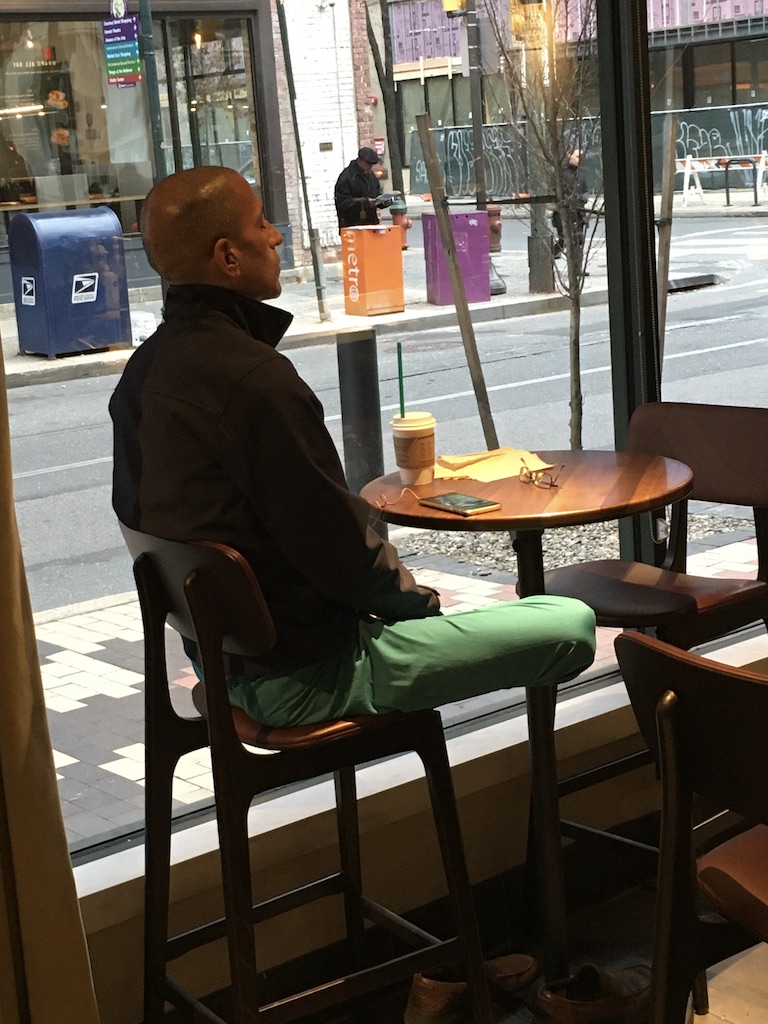
Man meditating at a Starbucks in Philadelphia. (Credit: John Coleman)

When I pulled up to Fifth and State yesterday, it was deserted. The windows were bare, no hours posted. The meaning was unmistakable, and it felt like a death.

I went right to the Bean. Barista Liv had already heard. Later I caught a statement from corporate on GoErie.com: “As part of Starbucks standard course of business, we continually evaluate our business to ensure a healthy store portfolio. After careful consideration, we determined it is best to close the (502 State St. store). Our last day at this location was Dec. 27.”

Now, I’ll try to be fair. When a mom and pop cries uncle, customers generally know about the decision. In fact, closure is often the end of a lengthy struggle. An owner might need years to bounce back personally from losses. What’s more, the community accompanies beloved proprietors to the last and appreciates the opportunity to say, “Thank you,” and “Godspeed.”

But Starbucks is no mom and pop. Forbes.com notes that the java colossus saw revenues of $23.5 billion in 2020. Still, the chain Howard Schultz made mighty is not in business to bleed money. Fifth and State is strangled to the north by a long-term construction project and lacks a drive through. And finding employees during the pandemic has been onerous, though I can’t help but imagine that peeling off a few billion of those profits for higher wages might have gone some way toward encouraging more applicants.

No comment necessary. (Credit: Giuseppe Colarusso)

Back to fairness, though. Shutterings happen. BusinessInsider.com reports that Schultz returned to the Starbucks helm in 2008 after an eight-year absence and reversed a downward trend in profits by taking assertive steps, “including temporarily closing all US stores to re-train employees on how to make an espresso” and permanently shutting down “600 . . . underperforming stores, 70% of which had been open for three years or less.”

So Fifth and State may have been doomed. That I can tolerate. Unless I missed a memo, however, the departure was shabby, reminiscent of football’s Baltimore Colts’ escape to Indianapolis at twilight in 1984 as fans slept. No announcements, no goodbye. Team owner Bob Irsay might have been pilloried by the press had he dawdled, but so what? All farewells deserve tending. Difficult ones require sacrifice.

Frankly, an outfit like Starbucks that is impressively in the black can afford—and would probably benefit from—an exit more sensitive than issuing beige blather about ensuring “a healthy store portfolio.” This is particularly true for a corporation that trains its baristas to be of tirelessly good spirits and nurtures a sense of community and loyalty to its brand. To Starbucks’ credit, the strategy works well.

The trouble is, severing relationships skillfully and meticulously built in such an offhand fashion makes devotees feel betrayed. Hearing our names called out as we cross the threshold; being asked if we want our usual; seeing our name on a wipe-screen with said usual noted; engaging in a moment’s banter and sharing a laugh: Look, we’ve known all along that this modus operandi was calculated, integral to the corporate formula.

Grandson Cole with Pop at Starbucks, 12th and Pittsburgh, seven years ago. All of the Erie Starbucks have been a big part of my life. (Credit: Elena Thompson)

But I’m talking about the soul of Starbucks, and in this respect Fifth and State was distinctive. The intersection is about as urban as Erie gets; therefore, many of the customers greeted with comfort and cheer stood in special need of both.

No location ought to be primarily a place to get warm in winter and cool in summer, but Fifth and State filled that need with remarkable grace. Many hours I sat elbow-to-elbow with folks whose dress was shabby. They nursed their purchased beverage, its cost having covered more than a product. Like all the regulars, they, too, were called by name. The table they occupied was come by fair and square. No kidding, I was proud to be there.

Maybe I’m projecting, but the baristas seemed to embrace an unspoken mission: Everybody deserves a friendly welcome, a comfortable place to sit for a while and top-notch coffee in a cup that takes the winter chill from hands circled around it.

I’m going to miss employees and clientele alike. Admittedly, nobody is going to freeze to death or suffer heat stroke because, say, an insurance agency moves into Starbucks’ old storefront. And the GoErie.com report notes that baristas “were given the option to transfer to nearby locations.” That’s considerate.

My long-standing habit is to tell anybody and everybody when they do a good job, and those behind the counter at coffee shops have been frequent recipients of praise. Now I’m compelled to send a little blame to Seattle: “It wasn’t sporting of you to close Erie’s Fifth and State and let us know retroactively. That’s poor form, and a corporation with your marketing wizardry is capable of much better. On the off chance that you read this, please reconsider your approach to leave-taking in the future. In this sad season for Americans, your patrons in one Pennsylvania town begin a new year sadder still.”

Farewell, my lovely, with an industrial casket out front, June 22, 2022. A final thanks to all the baristas who made Fifth and State a home along the way. (Credit: John Coleman)

Oniontown Pastoral: One Morning Before Heading South

A guy who seems always to be at Country Fair didn’t look himself. He had lost a lot of weight and kept hiking up his drooping sweatpants. On this chilly morning, a red fleece blanket tied around his neck in cape fashion and a Pittsburgh Steelers stocking cap were his only warmth. Continue reading

Oniontown Pastoral: Why I’ve Been Quiet Lately

Oniontown Pastoral: Why I’ve Been Quiet Lately

Dear Friends:

It was tomatoes cooking, the kindly surprise of their smell, that brought me around, helped my spirit to its feet and pointed me in a good direction.

If you look forward to my column in Greenville, Pennsylvania’s daily, The Record Argus, or my posts at A Napper’s Companion, you may have noticed that I’ve been quiet lately. When world and native land are convulsing in myriad ways, of what account are tomato-perfumed wisps rising in a middle-class kitchen? When the television news serves up images of relentless rage and pandemic, mentioning the cleansing joy of wife Kathy’s sunflowers bending in the breeze feels intrusive. When we human beings are enduring the labor pains of birthing a new society—and meanwhile throwing tantrums over trivialities and wetting our pants—who wants to think about a couple dozen corn stalks rising from a raised bed, the soil a mix of household compost and manure from a dear friend’s cows?

Kathy’s corn, not a lot

Maybe you do. I now believe my silence in recent weeks has been misguided. “Don’t go all poetic on me, John,” I imagined you saying, “about standing at a stove or pulling blessings from a garden, about how basil makes a sauce sing, about how walking by a bush of spearmint touches a place inside you didn’t know was aching. No rhapsodizing at a time like this, when so many of us are at each others’ throats and hardly an hour passes without yielding fresh anxiety and confusion.”

Of course, you weren’t saying anything like this. The fact is, I had convinced myself that what normally moves me to make paragraphs wasn’t relevant anymore. We all have bigger fish to fry, as the cliché goes.

But then those tomatoes reminded me of last summer, before the complication and misery of 2020. Kathy’s crop necessitated daily decisions. Would I make spaghetti or chili for supper? Or would I core and simmer down yesterday’s basketful, let it cool and pour it into freezer bags? More often than not, when Kathy got home from a day of nursing cancer patients, she would pause just inside the backdoor, close her eyes and breathe in.

“Oh,” her mantra went, “I do love the smell of my tomatoes cooking.” And then we’d kiss.

Kathy in August of 2016, with some work for me to do.

Yes, Norman Rockwell might have painted me wearing an apron and holding a wooden spoon straight up while Kathy looks on with rosy cheeks and a slight smile, but not one detail of the scene is embellished, honest. This was the start of our evening together. This was home and family and marriage. This was life and love.

All of these thoughts came to me wordlessly when, the other day, the pageantry of preserving my wife’s bounty started up again with the lovely scent I’ve described. She has already pulled garlic and onions, which I regularly help to fulfill their aromatic vocation, and canned some dilly beans. Cherry tomatoes are piling up, and, yes, I cook them along with the Better Boys and Romas and freeze them flat. That glad task will wait until tomorrow.

Out my writing hut window, grandsons and suds

At the moment Kathy is drizzling dish liquid into a slowly filling blowup pool. Grandsons Cole and Killian are staying over this Friday night. I’m watching them from my writing hut—more on this new outbuilding on the Coleman farmette soon. Killian is running the length of the yard and jumping into the shallow foot of water, emerging suds covered and delirious. The way Cole is waving the hose around to make water snakes in the air, the pool may never reach capacity. No matter.

Planet Earth may be going to Hades in a hand basket, but even the gates of hell shall not prevail against my grandsons’ wonders in this hour. Nor can powers and principalities stop Kathy’s sunflowers, soaring six feet above the corn, from waving at me.

Silence is a skillful teacher, but its students are lost unless they listen with the ear of their heart. That was my problem. I paid attention to the faculty members who scream and shout that their subjects, crucial though they may be—war, oppression and illness—are the only ones worth studying.

One of Kathy’s sunflowers

So I write to insist otherwise and resume interrupting our shared daily travail with promises. Tomatoes still ripen in August and will remind you of grace if you put them on to cook. And sunflowers will bow to you when the wind is right. Remember to breathe deeply and bow in return.

Love,

John