
Dear Blog Followers: If you enjoy A Napper’s Companion and are interested in my views on politics and society, I invite you to visit my other blog, Matters of Conscience. And if you appreciate what you read there, please consider … Continue reading
Dear Blog Followers: If you enjoy A Napper’s Companion and are interested in my views on politics and society, I invite you to visit my other blog, Matters of Conscience. And if you appreciate what you read there, please consider … Continue reading

For America to be great, our Declaration of Independence and Constitution must not only be inscribed in documents but also written on our hearts. My point here is subtle, but critical. If Americans don’t snap to when the standards of good conduct envisioned by our founders and nurtured into normalcy by our three branches of government are trampled underfoot, then we should be alarmed.
If only folks would pay as much attention to what they say and how they say it—whatever the medium—as yesteryear’s kids did mastering the stubborn capital “G” or lowercase “z,” how much better off humanity would be. Continue reading
What I have to say is important enough that I’ll share on my “non-political” blog.

Hardly anything is simple anymore. Children’s car seats now have expiration dates. Tiny screens are here to stay, but they anesthetize little brains. How long is too long? And, panning the camera for a global look, our climate is, like parents right now, under duress. Continue reading

A tea informed by anise, how odd and pleasing. And a paperback anthology of Immortal Poems of the English Language—the copyright nine years my senior—called me back to a self I’d left behind. The fragile pages smelling of an attic cost a quarter, I’m sure, in a junk store. The scent of heaven. Continue reading

My point is, in an era gone mad with contradictions, falsehoods, deceptions, dalliances, dismemberment and Faustian bargains, we can learn from Queen Elizabeth’s way of addressing and interacting with her subjects—an unsavory but accurate term. Noblesse oblige is benevolent at its best. Continue reading

This gallery contains 2 photos.
Oniontown Pastoral The Orphan’s Question: Where Is Love? Kathy’s breaths of sleep come and go. Awake at dawn, I’m in a high school choir concert 45 years ago, a musical’s lyrics forming behind my closed lips: Where is love? Does … Continue reading
Oniontown Pastoral: Why I’ve Been Quiet Lately
Dear Friends:
It was tomatoes cooking, the kindly surprise of their smell, that brought me around, helped my spirit to its feet and pointed me in a good direction.

If you look forward to my column in Greenville, Pennsylvania’s daily, The Record Argus, or my posts at A Napper’s Companion, you may have noticed that I’ve been quiet lately. When world and native land are convulsing in myriad ways, of what account are tomato-perfumed wisps rising in a middle-class kitchen? When the television news serves up images of relentless rage and pandemic, mentioning the cleansing joy of wife Kathy’s sunflowers bending in the breeze feels intrusive. When we human beings are enduring the labor pains of birthing a new society—and meanwhile throwing tantrums over trivialities and wetting our pants—who wants to think about a couple dozen corn stalks rising from a raised bed, the soil a mix of household compost and manure from a dear friend’s cows?

Kathy’s corn, not a lot
Maybe you do. I now believe my silence in recent weeks has been misguided. “Don’t go all poetic on me, John,” I imagined you saying, “about standing at a stove or pulling blessings from a garden, about how basil makes a sauce sing, about how walking by a bush of spearmint touches a place inside you didn’t know was aching. No rhapsodizing at a time like this, when so many of us are at each others’ throats and hardly an hour passes without yielding fresh anxiety and confusion.”
Of course, you weren’t saying anything like this. The fact is, I had convinced myself that what normally moves me to make paragraphs wasn’t relevant anymore. We all have bigger fish to fry, as the cliché goes.
But then those tomatoes reminded me of last summer, before the complication and misery of 2020. Kathy’s crop necessitated daily decisions. Would I make spaghetti or chili for supper? Or would I core and simmer down yesterday’s basketful, let it cool and pour it into freezer bags? More often than not, when Kathy got home from a day of nursing cancer patients, she would pause just inside the backdoor, close her eyes and breathe in.
“Oh,” her mantra went, “I do love the smell of my tomatoes cooking.” And then we’d kiss.
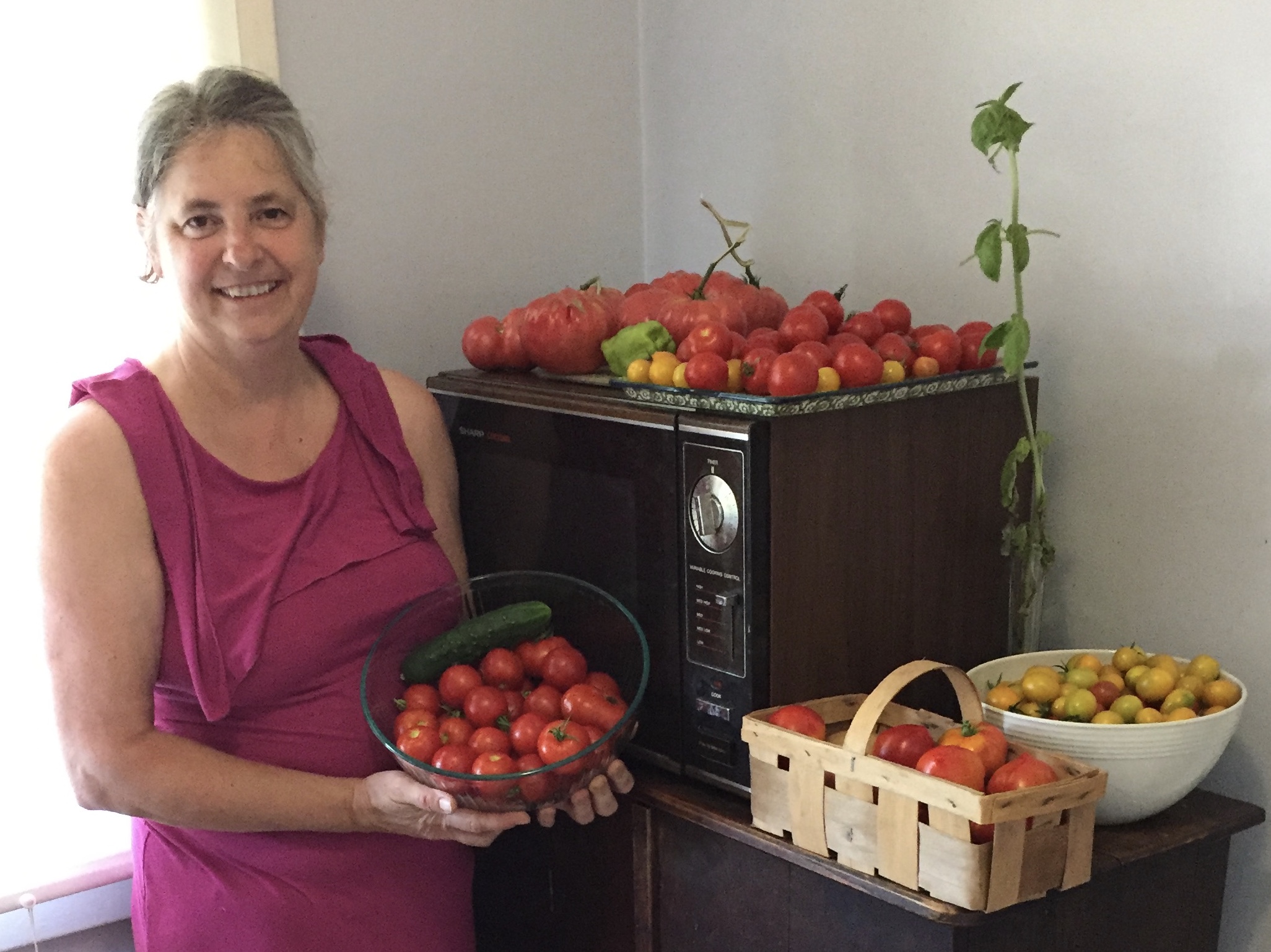
Kathy in August of 2016, with some work for me to do.
Yes, Norman Rockwell might have painted me wearing an apron and holding a wooden spoon straight up while Kathy looks on with rosy cheeks and a slight smile, but not one detail of the scene is embellished, honest. This was the start of our evening together. This was home and family and marriage. This was life and love.
All of these thoughts came to me wordlessly when, the other day, the pageantry of preserving my wife’s bounty started up again with the lovely scent I’ve described. She has already pulled garlic and onions, which I regularly help to fulfill their aromatic vocation, and canned some dilly beans. Cherry tomatoes are piling up, and, yes, I cook them along with the Better Boys and Romas and freeze them flat. That glad task will wait until tomorrow.
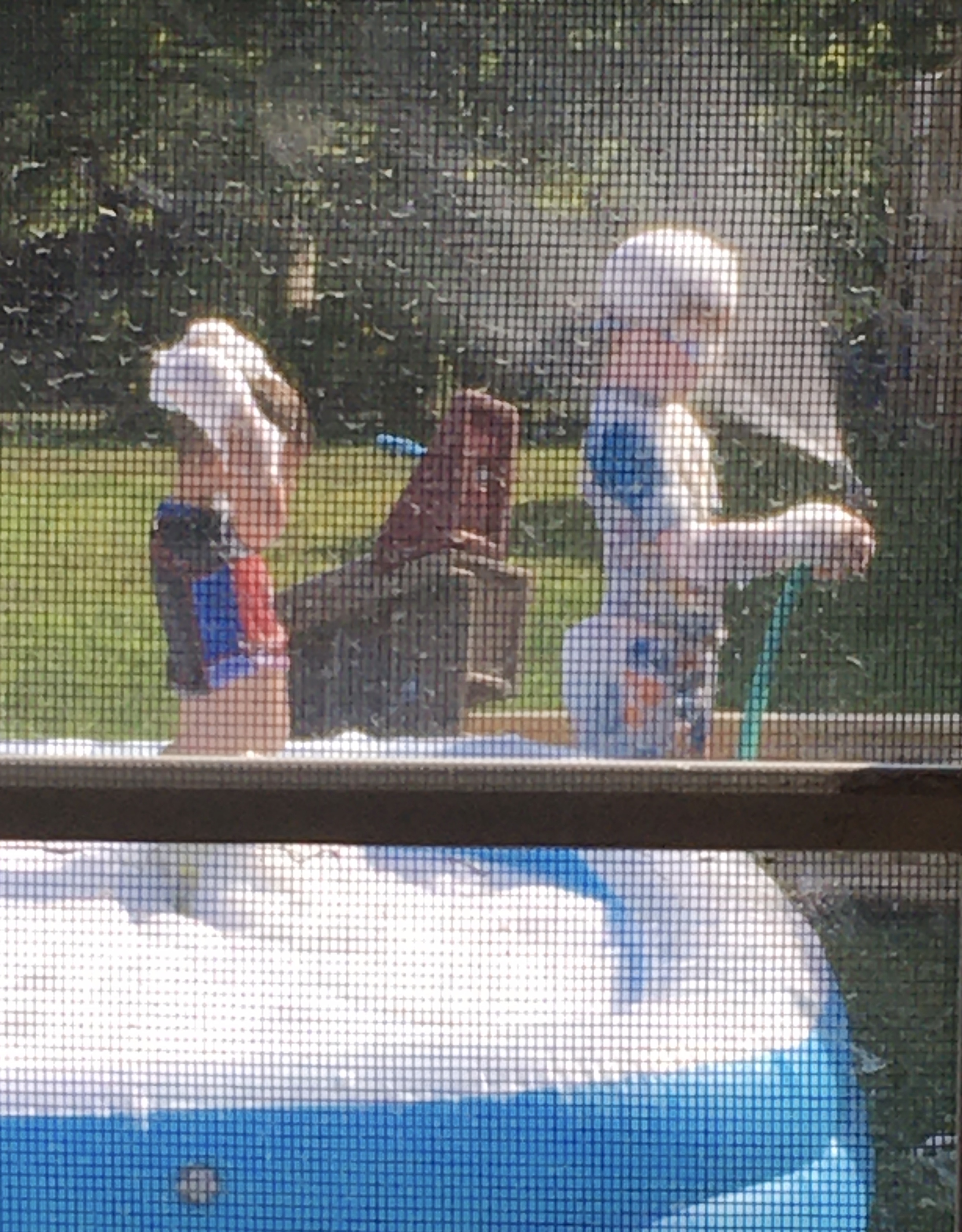
Out my writing hut window, grandsons and suds
At the moment Kathy is drizzling dish liquid into a slowly filling blowup pool. Grandsons Cole and Killian are staying over this Friday night. I’m watching them from my writing hut—more on this new outbuilding on the Coleman farmette soon. Killian is running the length of the yard and jumping into the shallow foot of water, emerging suds covered and delirious. The way Cole is waving the hose around to make water snakes in the air, the pool may never reach capacity. No matter.
Planet Earth may be going to Hades in a hand basket, but even the gates of hell shall not prevail against my grandsons’ wonders in this hour. Nor can powers and principalities stop Kathy’s sunflowers, soaring six feet above the corn, from waving at me.
Silence is a skillful teacher, but its students are lost unless they listen with the ear of their heart. That was my problem. I paid attention to the faculty members who scream and shout that their subjects, crucial though they may be—war, oppression and illness—are the only ones worth studying.

One of Kathy’s sunflowers
So I write to insist otherwise and resume interrupting our shared daily travail with promises. Tomatoes still ripen in August and will remind you of grace if you put them on to cook. And sunflowers will bow to you when the wind is right. Remember to breathe deeply and bow in return.
Love,
John
Oniontown Pastoral: Holy Ground
The real question is, “Why don’t I get up and go some place else?”
.jpg)
(Credit: Brian Snelson on Wikimedia Commons)
My morning at Starbucks in downtown Erie, Pennsylvania, began with a man shouting into his smartphone. Every word in The Drunken Sailor’s Handbook was deployed with such speed and spittle that the manager—courageous woman!—went over and told him to quiet down.
I thought we patrons might end up on the local news, but he apologized and soon walked calmly outside.
And is it ever cold out there, with the wind chill at 14 degrees. Sure, the weather could be worse, could be a blizzard stinging faces. Even in the still air, though, if you have nowhere in particular to be, the situation gets serious in a New York minute.
Erie is no Big Apple, but this is the urban scene playing out before me. In addition to students staring at their laptops, business types picking up their café whatevers, and readers and writers like me lost in words and white noise, there are folks who are homeless and/or mentally ill. Some seem like lost souls.
Of course, I’m doing guesswork. “All those who wander are not lost,” a popular saying goes. The pilgrim wearing a torn, mustard smeared parka might be a college professor for all I know. The guy who gets into heated discussions with his duffle bag and repeatedly sorts scraps of paper into stacks might have a cozy loft nearby. Clearly some live on the streets or in shelters.
A controversial Starbucks policy adopted in 2018 has made possible the spectacle I’ve described. A Philadelphia barista wrongly kicked out a couple of customers who hadn’t yet made a purchase, and the whole ugly episode played on TV. In response Starbucks wrote to employees, “Any person who enters our spaces, including patios, cafes and restrooms, regardless of whether they make a purchase, is considered a customer.”
The company obviously has protocols to deal with people who act up, but the intent here is otherwise. First, Starbucks wants to avoid further bad press—I’m not naive. But second, I do believe there’s some genuine hospitality in what is a risky business decision. As Gene Marks wrote on entrepreneur.com, “Do you sympathize so much [with the homeless] that you would sit next to someone who’s been living rough (and smells like it) after spending six bucks on a Frappuccino?”

(By Jan Georg van der Vilet, c. 1632 on Wikimedia Commons)
Yeah, I hear him. I’ll even confess to a similar frustration an hour ago when a drunk man staggered in to use the rest room, but couldn’t resist working the room and making like a mime while checking out the pricey travel cups. The same annoyance takes hold, too, when guys who—doggone it—look sketchy slouch for hours at prime tables and thumb out text messages.
“Why don’t I get up and go some place else?” Well, I certainly could leave and not be kept awake tonight by guilt. In fact, I wouldn’t think ill of anyone who said, “This is nuts. I’ve got to get out of here.”
As it happens, the man who was railing away on his smartphone when I first arrived has returned with several companions in tow. Meanwhile, traffic through the front door, down the hallway to the rest room and back outside again has been steady.
I’ll mention one thing more. I’m no superhero, but my spidey sense—or is it my prejudice?—tells me that this person or that is up to no good.
By now you must be screaming, “Hey, Oniontown Pastor, so leave already.”
I’ll respond first with a request. Go ahead and consider me a fool, but don’t call me “holier than thou.” My duffle bag of sin often has me weak in the knees.
What also weighs on me is a truth that I’ve given my life to: The people here—from the unfailingly friendly baristas to the studious young ladies beside me to the pale, tattered procession that needs only to pee and warm up—are God’s children, equals in the ways that matter most.

(Moses and the Burning Bush by Bourdon Sebastien, 1616-1671, on Wikimedia Commons)
A whisper tells me to abide with these sisters and brothers. It may well be that in eternity’s eyes, this Starbucks isn’t here so much to sell me beverages as it is to comfort those with no particular place to be.
In fact, as the arguing man paces around, making proclamations non-stop and itching for more trouble, that same whisper both shames and edifies me: “John,” I hear in the ear of my heart, “the place on which you are standing is holy ground.”
 A Napper's Companion