My drink finished, I notice the cool air on my arms and the silence, which is congested with circumstance, with the way things are, with roundabouts, blossoms and souls getting by on what they’ve got. That’s what we all do, I suppose. Continue reading →
Oniontown Pastoral: Going Visiting My career in visitation began over 50 years ago with Mrs. Gillespie, who lived across the backyard. Johnny’s perch was a red metal step stool beside the kitchen counter. His usual was strawberry Nesquik. Who knows, … Continue reading →
Oniontown Pastoral The Orphan’s Question: Where Is Love? Kathy’s breaths of sleep come and go. Awake at dawn, I’m in a high school choir concert 45 years ago, a musical’s lyrics forming behind my closed lips: Where is love? Does … Continue reading →
My five-year-old pal, you are having one rough time. In 10 years or more, you might find some value in your Pop’s thoughts about what your heart, mind and body are going through these days. I’m asking your mom and dad to hold onto this letter until you’re confused, stuck, maybe miserable, trying to figure yourself out—why you feel like you feel and tick like you tick.
Your family, Killian.
I’m almost 60 now, and for the whole stretch I’ve over-thought and over-felt nearly everything. I’m a genius at crippling myself with worry and concocting troubles that don’t exist. Just before your mother was born, I started to have panic attacks that raided my sense of self for a good five years. “Anxiety disorder,” that’s the box my therapist checked on my bill after each session.
Now at this point, listen closely. I’m not saying that someday you’ll go through what I went through. No, no, no. It’s just that the struggles you’re enduring tell me that you have a sensitive soul, like your Pop’s. If this is true, you’re in for a ride. Joy will take your breath away hour by hour. On the other hand, the wrongs you witness will bring on tears or—as my mother used to say—“make you so mad you could spit.”
The older you get, the less you’ll remember the preschool-aged Killian. I’m a reliable source, though, and you could do far worse than consider whether the boy you’ll now read about has turned out like his grandfather.
First, a caveat. Keep in mind that the last two years have been bat crazy. The Coronavirus, which has claimed over 600,000 lives in the United States alone, still has us frightened and confused. The social and political climate—to say nothing of our changing planetary climate—is brutish and wicked. In short, to be an American of any age in 2021 is to be hemmed in by exhausting absurdities.
Be assured, your mom and dad and both sets of grandparents are tender and mindful, doing everything possible to give you a safe, lively and fulfilling childhood. You and your brothers are lucky beyond measure. But I wonder if, despite much wise protection, you still manage to absorb how nasty and bonkers the world around you is without having the cognitive development to process it all.
Although your life with family and friends is charmed, you take deep breaths constantly. You’ve got a fiery, nameless burden in your chest that returns even as you blow it out through puffed lips.
You on the futon in Pop’s writing hut with Sherlock, having tablet time after a little learning. Your cheeks have food in them.
For months now you’ve had a cranky stomach. You chew food, then chipmunk it in your cheeks, afraid to send it down for digestion.
Sometimes in the middle of the night you wake up with cramps in your foot. For a while your eyes were always itchy, and I thought you might rub them right off your fair face. Oh, and for another while you got sharp headaches while riding in the car. All of these concerns are improved, thanks to your mom and dad’s persistent efforts to find causes and treatments.
You’re now reading about your younger self and maybe saying, “Man, I was a mess.” Well, to tell the truth, kind of, yes. I would call you delicate. Your mom said, “Some kids are dandelions, some are orchids.”
So far, your older brother appears to be a dandelion, while it’s too early to predict what flower your younger brother will be. But you, sir, are a delicate orchid. Accept no blame on that account. Feel no shame. This is a comrade addressing you. If honorary doctorates were awarded for fragility, your Pop would have a wall full.
My list of your ailments isn’t offered to depress you, but to open you up to self-awareness and ultimately a growing sense of ease with the person you are. This moment’s cleansing breaths and bellyaches may well be outward signs of turmoil trapped inside you. Nobody knows for sure.
But since your folks have handed you this letter, what you went through so long ago is possibly paying you a return visit—in a new form, spurred by new circumstances, wearing a new mask. Then again, maybe nothing is wrong. Mysteriously you’re rubbing your eyes again for no good reason. Riding in the backseat hurts your head.
Mystery is the perfect word. Microscopes and test tubes teach us what truths they can divine, but human beings pretend to know more than we really do. In many ways, the person you are and the person I am are mysteries. We are tiny mysteries caught up in a loving, but ferocious, embrace of the Great Mystery.
Why is Killian Thompson the way he is? No matter how you answer that question, in dark valleys you might long to turn into a different person altogether—somebody stronger, braver than you are, some carefree guy whose troubles lift from his mind like morning mist.
You can grow up, Killian, but try not to change this kid too much.
If you are ever granted such a wish, you will find what’s left of me inconsolable in my writing hut. You will little remember how many times I sidled up to the troubled five-year-old you, pulled you toward me and kissed the sandy shock of hair behind your right ear. Nor will your hurting feet recall the heat your grandmother applied to them at 5:00 a.m. And how could you know that your mom and dad breathed in your every sigh to be sure you never worried alone?
I ask you now, Killian, to trust that your parents and grandparents have always had but one fervent intention: To help you give birth to yourself and to love you so fiercely and unconditionally that you will dare to love yourself—exactly as you are and much the same as you were in 2021, when you gave your Pop more gladness than you’ll ever know just by sitting in his lap.
Intercessory Prayer in an Age of Malice by John Coleman “You have heard that it was said, ‘You shall love your neighbor and hate your enemy.’ But I say to you, Love your enemies and pray for those who persecute … Continue reading →
I’ve seen him before: a hulking man probably younger than he looks, dressed in stained layers, even in the summer. He paces outside a convenience store, stops and turns as if a shadow has called his name. His countenance is rage, barely mastered.
I always figure he is going to roar at me or ask for spare change. His base is in one of Erie’s rough areas, so being panhandled or hassled wouldn’t be unexpected. His bench is at the intersection 30 yards away. He sleeps on his side.
My mother raised me to avoid such neighborhoods. In fact, there’s one street in Erie that she refused to travel, and that’s where I was this morning, buying my newspaper and iced tea.
Getting back in my car, I glanced his way and thought, “Just like me.” Not the homelessness, thankfully. Not the dirty clothes, not what I take to be the fury on simmer. I’ve lost some weight recently, but remain hulking.
Still, I’m a lot like this guy. I want to be loved and understood. I want to be comfortable, sheltered, clothed and fed. I want a mind that functions, friends to laugh with and a decent portion of gladness.
The American Tibetan Buddhist nun Pema Chodron deserves credit for “just like me.” She told Oprah Winfrey about it, and I overheard. Admittedly, you probably don’t need to engage in this contemplative practice with folks you love, though it can’t hurt. No, realistically, Chodron’s phrase has to do with those you find objectionable, often strangers.
But even the first woman ordained a Buddhist monk in the United States didn’t come up with “just like me.” In the novel To Kill a Mockingbird, novelist Harper Lee famously put an echo of the notion into Atticus Finch’s mouth. His daughter has had a rough first day of elementary school and disapproves of her teacher. “Well, maybe she was just nervous,” Gregory Peck explains in the film adaptation. “After all, it’s her first day, too, teaching school and being new here.” Then comes Lee’s gem: “Just learn a single trick, Scout, and you’ll get along better with all kinds of folks. You never really understand a person until you consider things from his point of view, until you climb into his skin and walk around in it.”
In the novel’s last chapter, Scout recalls the lesson: “Atticus was right. One time he said you never really know a man until you stand in his shoes and walk around in them.”
Delivered in Peck’s legendary baritone, empathy comes across as warm and folksy, but American poet Walt Whitman knew better. Of his experience nursing Civil War soldiers, he writes in Leaves of Grass, “I do not ask the wounded person how he feels, I myself become the wounded person.”
All of this imagery points toward pain. Saying “just like me” demands that I set aside the fine appointments of my days and recognize that but for bad luck, an unfortunate decision or the curse of mental illness, I might have no roof to call my own. Climbing into another person’s skin implies that I first peel off my own. To become the wounded soldier—or the person I’m inclined to hate—means that I receive another’s gut shot, that I dare to trade places with a broken soul, that I claim a sister or brother’s graceless desert as my own.
Empathy is easy on occasion, but most often it’s exasperating, like a riddle that’s beyond my patience or capacity. Anyway, stewing in ill will is easier than reflection and over time gets to be addictive. And prior to my self-explication, the person who has triggered my brain stem is nothing like me, damn it.
Northern Mockingbird (Credit: Wikipedia)
Walking for a time in someone’s stilettos or loafers doesn’t mean that I condone a single chapter of her or his story. On the other hand, until I put into practice the raw, chafing wisdom of Chodron, Lee and Whitman, I’ve no business peddling criticism. In fact, if I review other people’s lives while still abiding in my own skin, I’m apt to kill a mockingbird.
“Mockingbirds don’t do one thing but make music for us to enjoy,” Atticus Finch says. “They don’t eat up people’s gardens, don’t nest in corncribs. They don’t do one thing but sing their hearts out for us.”
The older I get, the more I’m convinced that most people just want to be mockingbirds, in a fashion: To do no harm and sing their hearts out. Of course, if my supposition is true only of folks I love, then it isn’t true at all.
Thanksgiving for Eight Kisses In her journal The House by the Sea, May Sarton describes walking with her friend Judy and dog Tamas to the Maine shore in early December: “How glorious it was! Fifty-mile gusts of wind driving the waves … Continue reading →
Oniontown Pastoral: A Lutheran Response to COVID-19
Sometimes I’m particularly proud to be a Lutheran. When I read a pastoral letter about the Corona Virus from Elizabeth Eaton, Bishop of the Evangelical Lutheran Church in America, I was so grounded and refreshed I can hardly tell you. Before sharing what Bishop Eaton wrote, I’ll set the stage.
Bishop Elizabeth Eaton of the ELCA. Chicago, IL 2019
Wife Kathy was just checking the latest news across the table from me in our den—the tongue-in-cheek name of the room where both of us are working from home during COVID-19’s deadly fuss. She exclaimed something from behind her computer screen. (I feel like television’s Tim “The Toolman” Taylor peering over his privacy fence at neighbor Wilson’s forehead on Home Improvement.)
My beloved may have used colorful language, but I can’t swear to it—groan. She passed along a report from NBC News about a Louisiana pastor who persisted in holding worship services in defiance of Governor John Bell Edwards’ executive order against gatherings of more than 50 people. The Reverend Tony Spell, however, packs in around 500 at Life Tabernacle Church. The trouble is, songs and amens are accompanied by airborne spittle, which passes infection.
Don’t be deceived if I sound momentarily whimsical. According to the Los Angeles Times, on March 10th a choir of 60 asymptomatic voices in Skagit County, Washington, assembled for a practice complete with social distancing and hand sanitizer, and now 45 of them have tested positive for COVID-19. Two have died.
Faith gives life, but mindless faith can also snatch life away. I don’t fault members of the Shagit Valley Chorale for rehearsing, as no restrictions had yet been announced for their county. Tony Spell’s faith, on the other hand, is dangerous. I’m sorry, it just is. “The virus, we believe, is politically motivated,” he stated. “We hold our religious rights dear and we are going to assemble no matter what someone says.”
The Luther Seal at St. John’s Lutheran Church in Oniontown, Pennsylvania.
Lutheranism rejects such arrogance. Bishop Eaton rightly referenced Martin Luther, who wrote his own pastoral letter in 1527 on a topic that hits home today. “Whether One May Flee from a Deadly Plague” addressed a population still mindful of a scourge that killed over 23 million people in Europe 200 years before:
“I shall ask God mercifully to protect us. Then I shall fumigate, help purify the air, administer medicine and take it. I shall avoid places and persons where my presence is not needed in order not to become contaminated and thus perchance inflict and pollute others and so cause their death as a result of my negligence. If God should wish to take me He will surely find me and I have done what He has expected of me and so I am not responsible for either my own death or the death of others. If my neighbor needs me however I shall not avoid place or person I shall go freely as stated above. See this is such a God-fearing faith because it is neither brash nor foolhardy and does not tempt God.”
Martin Luther in 1529, Portrait by Lucas Cranach the Elder (Credit: Wikimedia Commons)
I am not a Luther scholar, nor do I possess any insight about 16th Century Germany. For this reason, I trust the ELCA Bishop’s knowledge and direction:
“Many of our [parishioners] have the same concerns as those in Luther’s day. Many of our people are anxious. Luther’s counsel, based on Scripture, is still sound. Respect the disease. Do not take unnecessary risks. Provide for the spiritual and physical needs of the neighbor. Make use of medical aid. Care for one another, especially the most vulnerable.”
This exhortation is neither soaring nor inspiring, which is why I love it. Discipleship looks pale compared to the flash and fluorescence that hypnotizes our culture. The acts of belief that move me most are nonchalant: swallowing an unkind word; listening to a loved one without glancing at the smartphone or television; shoveling a neighbor’s steps after a snow storm.
Most of all, in current circumstances, calling myself a Christian has a lot to do with using the brain God gave me. Health care professionals are begging Americans through their exhaustion and tears to stay home. Communicable disease experts say that COVID-19 is stealthy—and doesn’t the poor Skagit Valley Chorale know it?
Tell you what, as a diabetic, I’m going to listen to smart people. I don’t want to be infected or, what’s worse, pass along misery to an innocent bystander. Unless I must go into public places, you’ll find me at the Coleman house, praying for our protection and fumigating, my faith and intellect sitting peaceably side by side.
I can’t decide whether to feel guilty about a quirky, not-very-important dynamic having to do with the family dog’s routine.
About five times each week, the Coleman’s foxhound, Sherlock Holmes, goes to a dog park on Erie’s east side, several acres of fenced-in grass and trees.
Not to brag, but my lanky detective is a conversation piece among the regulars. He lustily announces his arrival with hoops and hollers as we pull into our parking spot. When I swing the gate open, he barrels toward the biggest cluster of dogs and skids to a miraculous stop in their midst without crashing into anybody. A session of chase quickly ensues, with Sherlock leading takers in a Rorschach pattern until by mutual consent they stop for a panting break, spittle flipping off of their tongues.
Thus loosened up, Mr. Holmes heads to a far corner for his daily constitutional. Yesterday the game was furiously afoot, such that four participants got nature’s memorandum at the same instant and dropped into the telltale crouch that, frankly, makes them look silly. (We might all learn from dogs the practical lesson that exercise can keep us regular.) Their communal bathroom break was no big surprise, as dogs tend to follow suit.
The shape of one of Sherlock’s chase routes (Wikimedia Commons)
For example, wherever snouts assemble, sniff tests are sure to be conducted. Some days, however, they can’t get enough of each other, which has me shouting, “All right, knock it off already!” In fact, our best friends have a policy akin to Murphy’s Law: “Awkward behaviors increase in proportion to the embarrassment they cause.”
This principle holds true with the most cringe-worthy, bawdy demonstration of dominance. One afternoon this summer, some human must have slipped steroids into the communal water bowls—that and/or Spanish Fly—as both males and females did nothing else for half hour other than show each other who was boss in the most sophomoric way possible. After dozens of protests, we moms and dads shrugged and actually resorted to chatting with each other.
Sherlock Holmes resting after a trip to the dog park
I exaggerate here only slightly. A fair amount of kibitzing does take place at the park, but for wife Kathy and me, the primary relationships are between ourselves and the dogs.
Which brings me to the dynamic on my mind: I can rattle off a baker’s dozen of dogs, but need only two fingers for the human names I recall. What does this say about me? People are more important than their pets, right?
I know Zero, Milo, Onyx, Titan, Max, Dexter, Gracie, Buck, Bailey, Prince, Zeus, Evy, Lego, Luna and Willow. And then there’s one of my favorites, Al, a female Rhodesian Ridgeback whose proper name is Alpine. The friendliest and least rambunctious regular, she was bred to hunt lions and other large game.
Used to be she would trot up as soon as I arrived and let me scratch the short Mohawk on her back. This was a thing, a ritual I came to love. Then she disappeared for a couple of months. There had been some dustups between dogs and spats between people, with the former acting more civilized than the latter. Anyway, I figured Al’s dad thought, “Forget this noise. We’re out of here.”
Al’s Mohawk, the ridge in the ridgeback
Turns out Al might have had ringworm and her dad kept her away out of consideration. But yesterday she strode into the place. I gave her time to renew old acquaintances before hollering from a good 50 yards away. “Alpine! Hey, Alpine, come here!”
To my delight, she made for me with steam in her stride. Holy cow! I’m not a huge presence in her life, just a park buddy. Still, once you’ve employed scratches, pats and sweet nothings to ask, “Can we be friends?” your heart’s doors swing open to let in a love as profound as that bandied about by humans. A dog’s affection is pure, no hidden agenda to rouse suspicion, no axe to grind.
Al, Gracie and the rest give me an infusion of uncomplicated joy, like a serum that cures scurvy of the soul.
So my mind is made up. Sherlock goes to the park to run off surplus energy, but I need to get there as much as he does. When I call my pals by name and they come to visit, something inside me feels right—hopeful, light, calm. For now I’ll grant myself special dispensation. Once the dogs make my heart big enough, I’ll ask what their moms and dads go by.
Events have conspired lately to make me emotional. In addition to the world’s brutish, rude, ignorant disposition, several situations have left my heartstrings frayed—and given me hope.
First of all, grandson Cole started kindergarten after Labor Day. Most went well, but one factor has befouled his new adventure. His bus driver has been—Lord, preserve me from cursing—insensitive. The maiden voyage was great, but on the second day, Cole cried on the bus, upset about not being with his mother and brother. The driver said that he needed to stop crying, that hers wasn’t a sad bus but a happy bus. Whether she elaborated I don’t know, but the rookie student thought that she was going to pull over and kick him off the bus. He was terrified. How would he get home? He would be lost.
Leaving for school, Cole said, “I have to get on the bus. Bye!”
Who knows what really happened? The point is, any adult with a splash of empathy can imagine a beloved five-year-old in such an inexcusable situation. Something in the bus driver’s delivery or manner conveyed the opposite of comfort and encouragement. Thankfully embarking this morning was more calm. A fifth grade girl has buddied up with him. Also, as he explained to Mom, “If I don’t cry, the driver won’t holler at me.” There must be a growth lesson somewhere in this kerfuffle, but at the moment I can’t help wanting to fix a wagon or two.
Cole’s bus woes have nothing to do with hope, except for that sport of a fifth-grader who took my little Red under wing. No, aches, pains and bullies come along, and we have to learn to shuck, jive and endure even as we dab our cheeks.
But two other vignettes soothe my spirit and speak of possibilities. The first is a picture of—surprise—Cole, who heard his mother’s smartphone chime with an Amber alert. She explained that a child in northwestern Pennsylvania was missing and in danger. Son Micah, who was visiting at the time, sent me a photograph of Cole’s response. He headed to the backyard, climbed his fort and scanned the landscape for any sign of a lost girl. Looking in one direction, then another, he believed the kid might be nearby, within reach. Maybe he could find her. Maybe he could help.
Scanning the landscape for a lost girl. (Credit: Micah Coleman)
And so he did! My kindergartener’s chances were slim, but from my perch his effort was in the service of hope. What if we all ascended our forts and glanced around? Who knows? Anyway, my grandson’s odds of succeeding were certainly greater than mine of hitting the Powerball Jackpot, which wife Kathy and I give an occasional go.
I thought of Cole this past week while visiting one of St. John’s eldest members in a nursing home. Lloyd is in his nineties and all but deaf. Conversation requires nose to nose shouting, and even then he is often lost. Each time I show up, more time passes before he recognizes me.
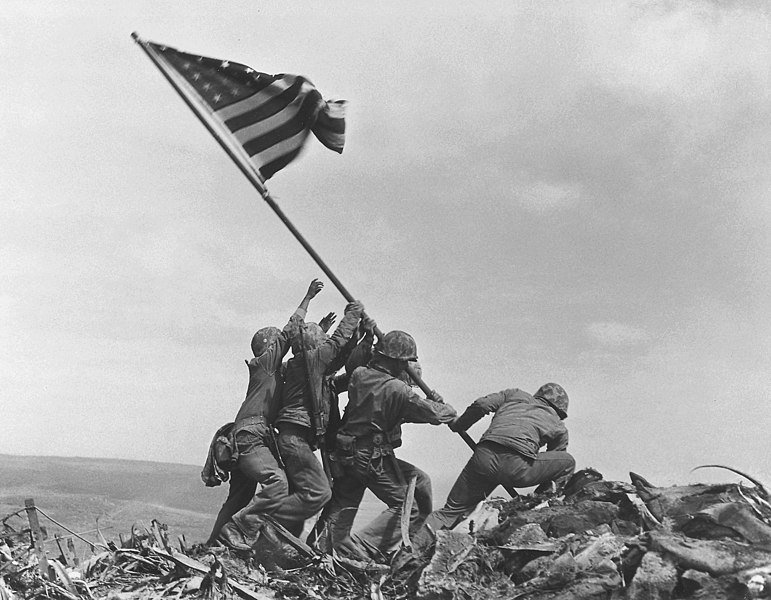
“Lloyd has a great story,” I hollered, looking back at wife Kathy, who had come to Oniontown with me that day. “He actually saw the flag go up on Iwo Jima.”
The flag goes up on Iwo Jima. (Credit: Wikimedia Commons)
His expression was blank. Then, as I stood to leave, he said, “I’ve got a story.”
Ahoy! I sat back down and leaned in, anticipating his beloved World War II tale. But for the first time ever, he needed my help. As we looked into each other’s eyes, I wished the old plot out of him. Boatswain on a landing craft, he conveyed soldiers to that costly assault. When Lloyd faded, I drew close and fixed on his pupils, as if to say, “Push, brother! I’m listening.” And it was a birthing of sorts.
He stared back at me and rummaged for the essentials: soldiers getting shot in the water; the captain telling everyone back on the staging ship to point binoculars toward Mount Suribachi; Marines putting shoulders to the flagpole; the stars and stripes snapping out into the wind.
Then and there I remembered that Cole also searched for a lost soul. His was young, mine was old and full of days, both were adrift.
Hope makes its home on perilous seas, where the mere prospect of safe harbor is enough to give a tenderhearted kindergartener and his grandfather cause to cry. In fact, wherever one set of eyes looks out for others desperate for rescue and communion, hope survives.
Nothing can drown hope, and honest to God, that brings me to tears.






 Northern Mockingbird (Credit: Wikipedia)


_workshop_-_Martin_Luther_(Uffizi).jpg)





 A Napper's Companion