We We We Could Hold Hands

We We We Could Hold Hands

I’ve been sad off and on for a month now, but let’s not dwell for long on why. Let’s just say that the land I love is different now. Values, principles and manners that ground life and give it sweetness have been flogged, and I’m confused. What rules will we live by from here on? And will these rules call forth our best, not our worst?

If you can’t imagine what’s got me down these days, reading further will be a waste of time. But if you sense where I’m coming from, please accept one premise: You don’t need to agree with the reasons for my grief to accept it as valid.
img_5468

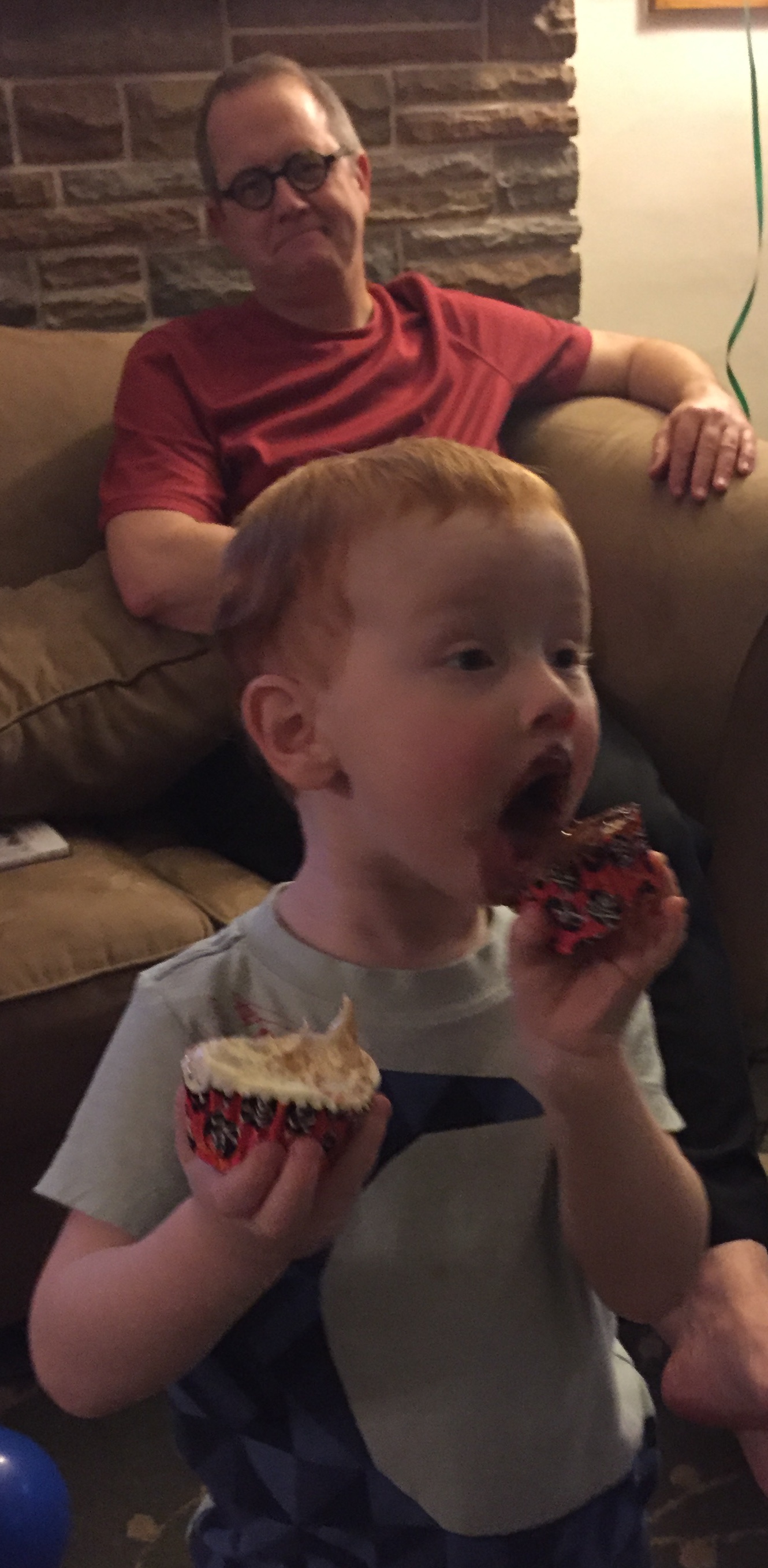
The master teaches the disciple. Lesson: Lick the frosting off first if that’s what you like.

If you can appreciate the distinction I’m making, you might also be interested in a chilly, rainy walk I took with my grandson Cole a couple weeks ago.

My mission was to occupy the three-year-old with sparks flying from under his sneakers so that Grandma Kathy and son-in-law Matt could do home repair and daughter Elena could mind grandson #2, Killian.

Cole and I were supposed to go to the corner and back, but when we got there, he pointed to the next corner and said, “I I I want to go to there.” (Cole’s speech can’t keep pace with his brain, so he repeats the subject until the rest of the sentence reaches his tongue.)

Sure, why not? When we reached the next corner, he pointed across the street and repeated his previous request. I could see his point. West 4th Street beyond Beverly Drive is missing some sidewalk, giving the passage a winding charm.

“But, Cole,” I said, “that’s across the street. We can’t go there.”

He thought for a few seconds, then looked at me: “But we we we could hold hands.”

“Ah ha,” I thought, “school is in session.” That’s how being a grandfather is for me. I’ve learned to recognize instantly when Cole has something to teach his lazy Pop, and his instruction is always edifying.

So off we went, looking both ways, his cold little hand in mine. He had tree climbing on his mind, but the neighborhood maples are matriarchs that haven’t had branches or footholds within reach for decades.

I explained and explained, the mist puffing from my mouth. “They’re too big, Cole. There’s nothing for you to hold on to.”

Finally, good sense caught up to me. “Okay, pal, give this one a try.”

He ran to the rooty base of a smooth-barked giant shiny from the weather. As he hugged the trunk, he was as confident in his ability to succeed as I am when approaching a cashier to pay for a loaf of bread. No sweat.

He rubbed around to check for some advantage and marched as if the wood might reach out to him as a staircase.

img_5345

If there were nothing else in the world to behold, this face would teach me more than I need to know.

To Cole’s credit, no fussing he made. A concrete telephone pole fifty of his rapid mini-strides away provided another option. “I I I could climb that.”

“You think so?” I lilted.

“Yeah!” he said. I must say, my grandson makes that word into a one-syllable hoedown. His yee dances in the clouds, and his ahhhh takes its sweet time landing.

Alas, same result, followed by the same okey-dokey shrug.

Our next stop was a pile of pumpkins Cole insisted was a fire hydrant. I didn’t argue. What he proposed was fine with me.

Even validictorians get pooped out, though, so I tempted Cole to head back home with the prospect of spotting turkeys on South Shore drive, where hens and gobblers mill about the yards of Erie’s rich folk.

Not quite there yet, he spotted an old guy bundled within an inch of his life and riding a zero-turn mower. “I I I want to see.”

Well, certainly. We stood on the boulevard, Cole in awe over the machinery, me wondering about the enterprise of getting rained on, running over wet leaves and turning pirouettes. But maybe a man in layers of well-worn gray and earmuffs also had something to teach me.

He parked, hopped to the ground and walked our way, arms swinging akimbo.

Cole froze at the sight. I held his hand again.

“You can cut through my yard,” the man said, “and take my steps down to the lake.”

That was the last thing I expected to hear, as owners on South Shore have the reputation of being grouchy toward trespassers. I guess you just don’t know the truth about people until you know them.

We said thanks anyway and waved goodbye, off to find birds.

I used to understand that no journey from A to B with a little boy could ever be direct, but I had forgotten. Cole reminded me by insisting on bending through the undergrowth and shrubbery rather than sticking to the sidewalk.

He was having fun trespassing, and I didn’t really care if we got hollered at. (It’s taken me five decades to adopt such a criminal attitude.)

Of course, we didn’t get chased off. We didn’t see any turkeys, either, but Cole jumped off of low stonework a few times. His wide eyes told me he knew the miracle of flight.

I’m not going to lie, I was glad for class dismissal when we got back home. My cheap black sneakers with elastic at the instep were soaked.

img_5351

Whenever you’re ready to teach me, Killian, I’ll be ready.

I want to be honest about something else, too. Years ago, as a young man, I wouldn’t have figured a walk with a red-headed boy could lead me to a better place. I would have considered the notion mushy.

Still, being a Pop will have everything to do with how I pass through this season’s mournful valley and grow as a man committed to kindness and compassion. Call this truth what you will.

My grandsons have the wisdom I need. I can feel it. Until their next lesson, I’ll use what Cole taught me on our walk in the rain.

I’ll I’ll I’ll remember that we can hold hands, climb even when the effort makes scant sense, and look for teachers who spin like fools.

Most of all, I I I won’t give up on love.

American Lament

American Lament

Dear Friends,

I just posted an essay called “American Lament” on my buzzkill of a second blog, Matters of Conscience. This primary blog, A Napper’s Companion, will probably be quiet a little longer–until I can write about beauty again.

I alert my Nappers to this lament because I know some of you will be interested. But I’m not encouraging or asking anybody to read. This was something I felt compelled to write.

Peace and love,

John

img_4616

Grandson Cole

Post-Election Letter to My Daughter

Dear Friends,

I’ve written a letter to my daughter that some of you might appreciate and posted it on my other blog, Matters of Conscience. Although what I have to say is ultimately hopeful–I think!–it’s dark enough that I don’t want it casting gloom here on A Napper’s Companion.

Please click here if you would like to read the letter.

Peace, love and best,

John

img_5186

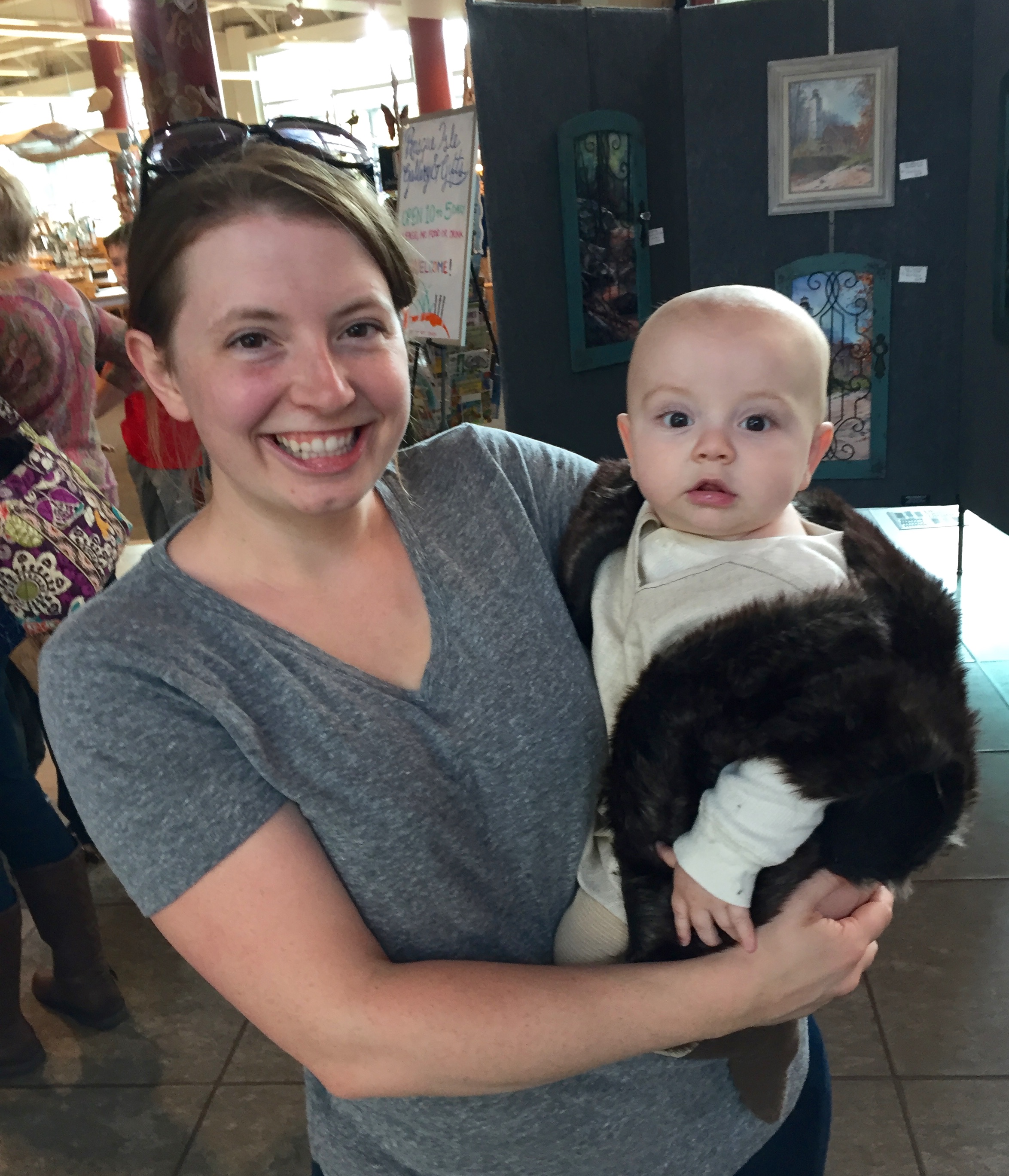
Elena and Killian–in his Halloween viking fur!

Election Eve: Standing with My Gay Sisters

unnamedThis evening before the dreaded presidential election, wife Kathy and I are heading back to Pennsylvania after visiting my sisters in North Carolina. Our objective was simple: relax!

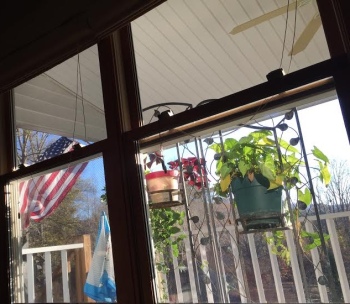
Yesterday we awoke in the joyful home of sister Cindy and her spouse Linda. We didn’t get out of bed right away, but breathed and gave thanks for the view out the guest room window: clear sky, hanging plants and American flag rising and falling with an occasional breeze.

We also gave thanks for other loved ones who stayed the night: eldest sister Cathy and her spouse Betsy Ann; and Linda’s daughter Tina, her spouse Rebecca, their toddler son Liam and infant daughter Renley. Four affectionate and slightly spastic dogs and a mellow cat named Hermione added diversity and commotion to the gathering.

As we talked off and on about what is consuming millions of Americans at the moment, I learned that one voter’s presidential election can be another’s painfully personal referendum.

Thus far my anxiety about our country’s future has been generalized. The women I listened to over breakfast yesterday share my concern about the economy, foreign relations, immigration and the planet, but they also fear the threat a Trump administration might pose to who they are as human beings.

image01

Cathy and Betsy Ann

With a Supreme Court fortified by judges favored by the Republican Party, will their marriages be under assault? Will the acceptance they’ve found recently as citizens be repealed? And what about the health insurance one married partner often provides for the other? Is there any way that same-sex couples could be denied that benefit all over again? After all, if Roe vs. Wade might be up for debate after forty-three years, why not the legality of gay marriage?

Kathy and I celebrated our thirty-third anniversary this year, and we’ve never had to contemplate our vows being cancelled by the Supreme Court.

My wife shares roughly the same profile as the Democratic Presidential nominee. If she wins, I imagine Kathy and other women will feel a burden lifted and an inexcusably overdue affirmation bestowed.

What will I feel? I’m a white, heterosexual male. My validation has been grandfathered in for centuries. I can’t remember ever being denied anything because of my packaging. Nobody has ever suggested that the person I understand myself to be is uniquely lacking, broken or abhorrent. Where social stability is concerned, I’m close to the top of the food chain.

But Cindy, Linda, Cathy, Betsy Ann, Tina and Rebecca face tomorrow with a fear I recognize but can never really know.

unnamed-2

A safe place

I can name beauty when I see it, though, and these women are among the kindest, smartest, most upright and beautiful people in my life. The warm North Carolina air was refreshing, but Kathy and I don’t drive ten hours for the southern climate. We take time to visit our unorthodox family because we find overflowing goodness and safety with them.

If you think that gay marriage is sinful and should be illegal, I wish you could meet my gay sisters and witness their tenderness and compassion. I wish you could hear how they struggled to find peace within themselves and how falling in love turned their landscapes into rich expanses of grace.

Their troubled sleep this night is difficult to bear for love’s sake. Of course, millions may lie awake in the small hours of this morning, wondering how many of the votes cast will say, “America is not your home. You have to leave. Your language is an annoyance. Your skin is ugly and so is your soul. You’re being checked out, and this we can tell you, we’re not impressed.”

unnamed-1

View from Guest Room Window . . . Gay Household.

When I vote tomorrow, I’ll be thinking of my family in North Carolina and every other sister and brother who want nothing more than to run into the open arms of a compassionate country.

Now, checked into a hotel in Summersville, West Virginia, I sip privileged wine. Kathy tells me the pizza just delivered is really good. And I make this promise: “Whatever happens tomorrow, the years ahead are sure to hurt, but you’re not alone. Plenty of Americans like me–especially those who don’t pretend to know what all you’ve gone through–love you and stand with you. When you were born, the cosmos rejoiced.”

Grandma Kathy Home

Grandma Kathy Home

So the Cleveland Indians hold a 3-2 edge over the Chicago Cubs as the World Series moves back to Cleveland for at least another game. One particularly sweet spot here is my sentiment that if the Tribe loses, I can be glad for the Cubbies. Both teams are long overdue for a championship.

Alas, the Fall Classic holds diminished interest for me this year. I’m in a space that is best described by a phrase my childhood friend Vince used a lot: tons of bummage.

Joy isn’t in short supply these days; in fact, I have a surplus, more than anybody deserves. The problem is my reaction to our present American season of bummage.

“Do not lose your inner peace for anything whatsoever,” Saint Francis de Sales said, “even if your whole world seems upset.”

Sorry, Francis, but my peace comes and goes. It goes when I assume my fears about the future are predestined. It comes when I forget myself long enough to be touched by grace.

“I want to go home,” grandson Cole said.

“But, Cole,” my daughter Elena answered, “you are home.”

“No, I want to go to Grandma Kathy home.”

img_4520

At Grandma Kathy Home. Cole checks Pop. (Credit: Kathleen Coleman)

Grandma Kathy and Pop have bored our friends slack-jawed with Cole’s words, but it’s hard to keep quiet. Sometimes a moment kisses your soul and brings hope within reach again.

Cole thinks of Grandma Kathy’s house as home. Do I care that he doesn’t include Pop on the deed? Actually, I like his name better. Kathy drops everything for Cole. They play in her garden and go to the basement and make repairs at her workbench. If she cooks dinner, he stands on a chair at the sink and does a few dishes with a whole bottle of soap.

He calls our den “my room,” and he and Grandma Kathy bunk there when he stays the night, as he did last Saturday. On church mornings, she sits beside him in the backseat for the hour drive to Oniontown.

Yesterday my sluggish sermon knocked the kid out, so he crawled under the pew and nodded off at her feet. After worship she let him sleep on, and friends stopped by to chat.

14910482_1285918731478312_5904596198397316899_n

Got insomnia? Come listen to one of my sermons. Bring a pillow, join Cole. (Credit: Kathleen Coleman)

Cole was safe. Grandma Kathy was there.

He didn’t say, “Grandma Kathy’s home.” He said, “Grandma Kathy home.” My wife is home to him. The dwelling and garden are incidental.

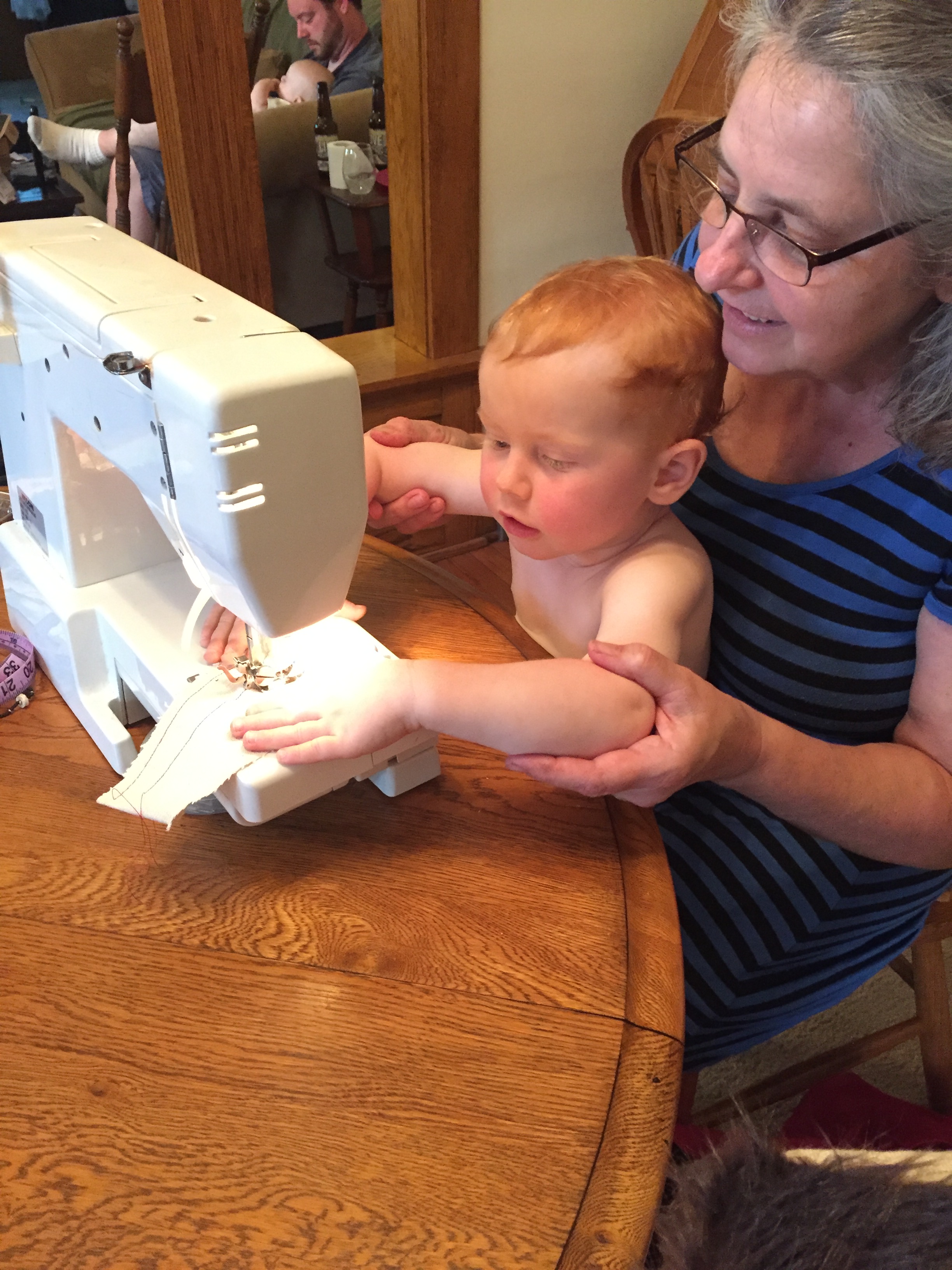
Kathy helps Cole sew. He leans against her, watches a movie and eats pretzels and dip. She hustles him off to use the potty like a big boy.

img_4858

Hope

Watching them together, I’m positive of at least one thing that’s right with the world.

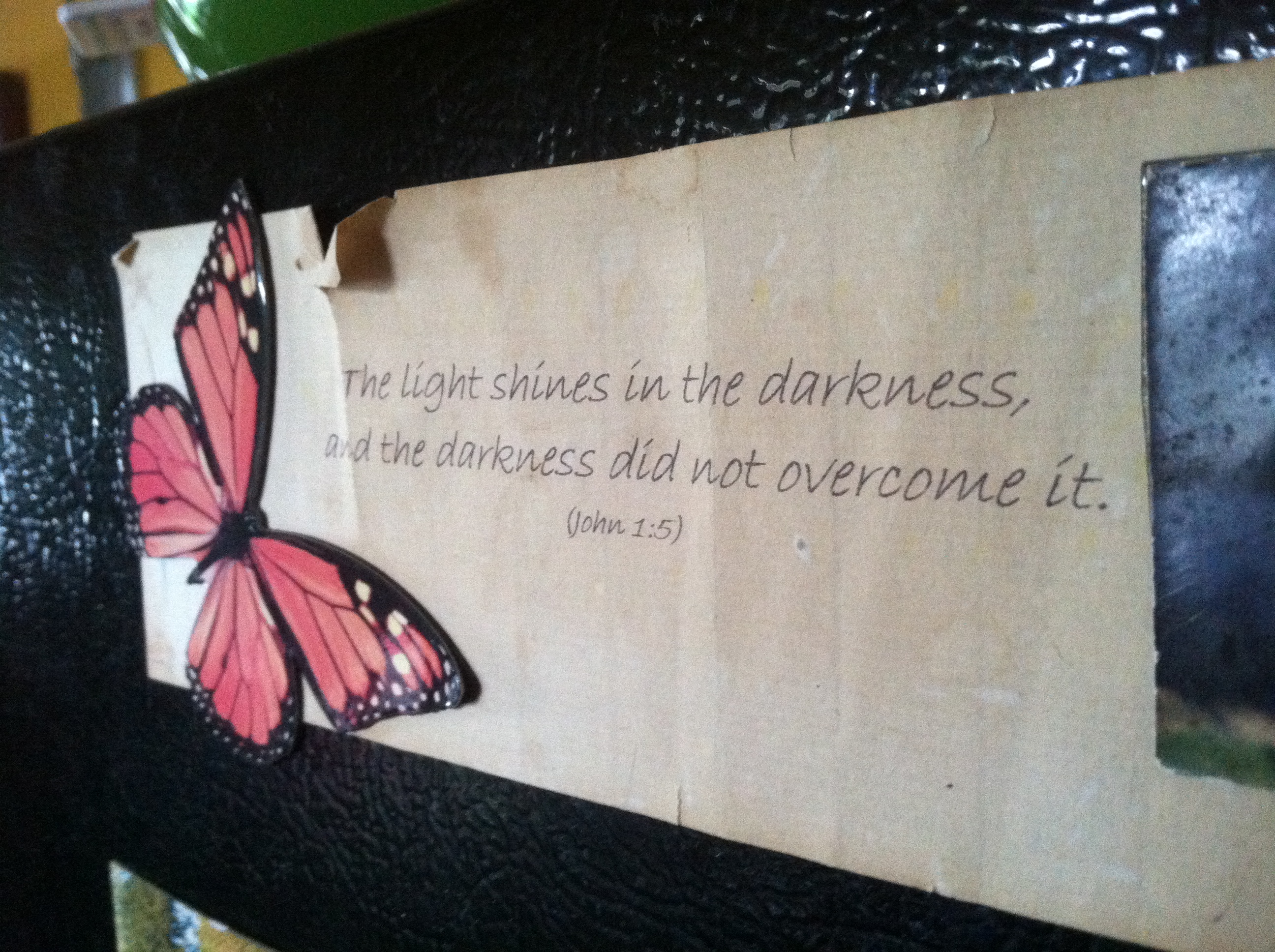
Fifteen years ago I copied a Bible verse on strips of paper and during a sermon suggested that parishioners put them on their refrigerators.

img_2236

The light shines in the darkness, and the darkness did not overcome it. (John 1:5)

The light is love. I bet my life that it will win in the end. That doesn’t mean, of course, that my Indians will whip the Cubs. And it especially doesn’t mean that my candidate will prevail.

I don’t for a moment believe that God gives us clean sheets when we’ve messed the bed.

What I do believe is this: love is the only way out of human bummage.

In 1968, during another ugly season, Thomas Merton asked, “Is the Christian message of love a pitiful delusion? Or must one ‘love’ in an impossible situation?”

When I watch a woman and a boy not yet three together, peace fills my lungs. The only way I know to abide in impossible situations is to love.

It seems like hour-by-hour I get hopeless and angry, then hear Saint Francis speaking and try to find my way back to love again. All signs are that I’m delusional.

I want to go to Grandma Kathy home, too, Cole. Let’s live there together.

Oniontown Pastoral: Listen to Your Grandma

Oniontown Pastoral: Listen to Your Grandma

Dear Cole and Killian:

img_4987Last week your Grandma Kathy came in all sweated up from picking vegetables and said, “Oh, John, there’s one of those tomato hornworms in the garden with eggs on its back, probably wasp eggs.” Her bottom lip wasn’t quivering, but tears weren’t far off. Poor bug.

I don’t want to see any creature suffer, but I’ve never been a fan of hornworms. First, they’re gross; they look like a bald, glossy-green, plump, juicy caterpillar. Second, they never finish their meals. I would be glad to share if they didn’t go from tomato to tomato, munching a portion and ruining the rest. And third, they leave pellet droppings called frass. Most of it falls into the soil unseen, but a little plastic table Grandma Kathy situated near a tomato plant got covered with it. The guilty insect frassed so much I couldn’t help thinking it chuckled to itself, pellet by pellet.

Your grandmother, who is on strangely good terms with the wastrels, wanted to send me on a rescue mission, but not by plucking the larvae off the hornworm or ending its suffering.

“You write about these things,” she said. “Maybe you could write about it.”

Grandma Kathy was right, boys. For whatever reason, your pop thinks a lot about sadness, and some likeminded folks like to read what I come up with. She was right, too, that in hopeless cases, one sympathetic witness can be a saving grace.

The trouble is, I don’t have much to say about future wasps dining on a hornworm, other than to note, “That’s life for you.” One being’s grilled chicken is another’s raw caterpillar. The main difference is presentation.

14291873_1234428669960652_5471190134161619255_n

Listen to your grandma, boys.

On the other hand, I do have something to say about Grandma Kathy. You won’t read this letter for another ten years, but as you grow I’ll be steering you toward this advice: “Grandma Kathy has a big soul. She knows how to live. Listen to her.”

I’m only trying to save you time and trouble. If my math skills are still operational, your grandmother and I have spent 2/3 of our lives together. Only in the last three years have I figured out that most of the time she knows best. Since 1980, then, I’ve been letting her steer 1/10 of the time, which is silly.

And I’ll tell you why. Grandma Kathy was right about that hornworm from the beginning. It’s as much a resident of the earth as I am and worthy of consideration.

“Don’t you think we ought to kill it?” I asked. “The last thing we need is a wasp infestation.”

“No, we’re too quick to kill things,” she answered. “Besides, I think wasps might be beneficial.”

I swallowed my response, which would have been, “Hey, I’m not too quick to kill things.”

But she was half right. I checked an almanac and learned that you shouldn’t squash the hornworm and its passengers. Wasps are—and I quote—“beneficial” for a garden.

img_5008Only in the last few weeks have I decided that Grandma Kathy also knows best where the garden hose is concerned. All our marriage long she has left it snaking around the yard rather than coiling it up. I bring the matter up once every decade, though not anymore. When I walk out the back door, my glance goes immediately to the hose and my mind says, “Unkempt.” Your grandmother looks first to the sunflowers, and her mind says, “Ah, beautiful.”

img_5011

The better part

She has chosen the better part, and I won’t take it from her.

When Grandma Kathy plays with you, Cole, she lets you decide what to do and where to go. That’s because you know how to play better than anybody else. By watching her, I’m learning to be a good pop.

And Killian, you’re just a few months old, but it already seems that you’re going to be quieter and more reserved than your big brother. You watch, kiddo, Grandma Kathy will look into your brown eyes and see how to help you love yourself and feel so happy you’ll want to fly.

Someday you’ll be able to understand that big souls make big sacrifices. When you’re ready, I’ll explain that Pop owes his life to Grandma Kathy.

IMG_4286But I’ll wait for later to tell you just how. It’s enough for now to say that when I was weary and lost unto despair, your grandmother left a few of her dreams behind as if they were frass to help me find myself again.

Grandma Kathy knows how best to love you and me and the rest of creation. Please, save yourself trouble and spend more than a sliver of your years following her lead and trusting her example.

Care for the tomato hornworm. Look first to the sunflower. Give yourself away for the sake of love.

We’ll talk before you know it,

Pop

Oniontown Pastoral: What I’m Looking For

Oniontown Pastoral: What I’m Looking For

IMG_4286Cashiers at Wine and Spirits Stores always ask the same question before scanning my bottle: “Did you find everything you were looking for?”

I say a lazy “yes, thanks” because an honest answer requires a treatise. Rarely, when nobody else is in line, the thesis comes out: “Well, I didn’t know what I was looking for, so I’m good.”

After a polite chuckle, the cashier carries on with no idea that a confessional transaction has also taken place.

I seldom know what I’m looking for. Call me slack, but purposeful searching generally yields frustration. The quotation residing warmly in memory is elusive, impossible to verify. And never go hunting for epiphanies. Those gems hide in desert caves until the seeker has forgotten that they exist.

But when I look for nothing, wonder ends up finding me. Of course, sometimes we’re all assigned a specific mission. There’s no avoiding, for example, the Thanksgiving curse of tracking down nomadic French fried onions in the grocery store for the sake of green bean casserole.

Obligations aside, though, I live like my late dog Watson, who was clueless as to what he was sniffing for, but overjoyed to discover it. What am I after? I’ll know when I find it.

Case study: Parishioner Barb invited me to her neighborhood. About twenty minutes from Oniontown, her neighbors are Amish. She introduced me to a couple of young guys working in their family’s lumber mill and walked me to points of interest, which on dirt roads can be beautiful, but nonchalant: houses with curtains pulled to one side, a sugar shack tucked back in the woods, a one-room school house, and one thing I wasn’t expecting.

IMG_4907

Amish phone booth

A phone booth. The Amish, it turns out, have a nuanced relationship with telephones. They can use them, but they can’t own them. So in her front yard, Barb collaborates to provide them with phone service. The booth, built with their wood and running off of her lines, gets used six or eight times each day.

An obvious question occurred to me: “What sense does it make to use a phone, but be forbidden to own one?” But hush. My faith can’t stand up to logic, either.

When Barb and I returned from our walk, a horse and buggy was parked by the phone booth. The father indulged in technology while his kids waited. The horse worried its bit and nodded as we rubbed its long face.

Since the Amish don’t allow photographs, I snapped only a shot of the booth. It says something about caring for people you don’t quite understand and keeping a spare room open in your heart for guests.

This is why I love Oniontown so much: it always teaches me. A village an hour south of Erie has even helped me to look at home and everything nearby with fresh eyes.

Days ago at Starbucks, I chatted with a boy, maybe six or seven, and his mother. The kid was a whip, his mom cheerfully resigned to having a child able to talk the bark off a tree. His segue between topics was “by the way.”

Our conversation ballooned to ninety minutes and included his Gentleman Claptrap toy, requests for the family shopping list, and some kiddie movie. I was weary, but sensed the approach of wisdom.

As Mom loaded her purse, I said, “I’ve never heard of that movie before.”

He looked at me in disbelief and said, “You have a lot to learn.”

Mom gave him a tame rebuke, but I interrupted: “Well, actually, he’s right.”

And he was. As a lifelong novice, I learn best by opening my eyes and holding out my hands.

Hope and Joy in a Roaring Wave

Hope and Joy in a Roaring Wave

Every year Erie, Pennsylvania, hosts Roar on the Shore, a gathering of approximately 165,000 motorcycle enthusiasts that makes my hometown rumble for a few days. According to the Roar’s website, its mission is “to raise money for a worthwhile charity while encouraging motorcycle riding, safety and fellowship.”

I’ll state directly that motorcycles aren’t my thing. Harley-Davidsons and their many cousins are like rollercoasters, lime Jell-o with chopped celery and carrots, romance novels and turtleneck sweaters. You can like them. I’m not against them, just parked in the eh category.

But hope and joy are my things, and generally they find me by surprise.

IMG_4776

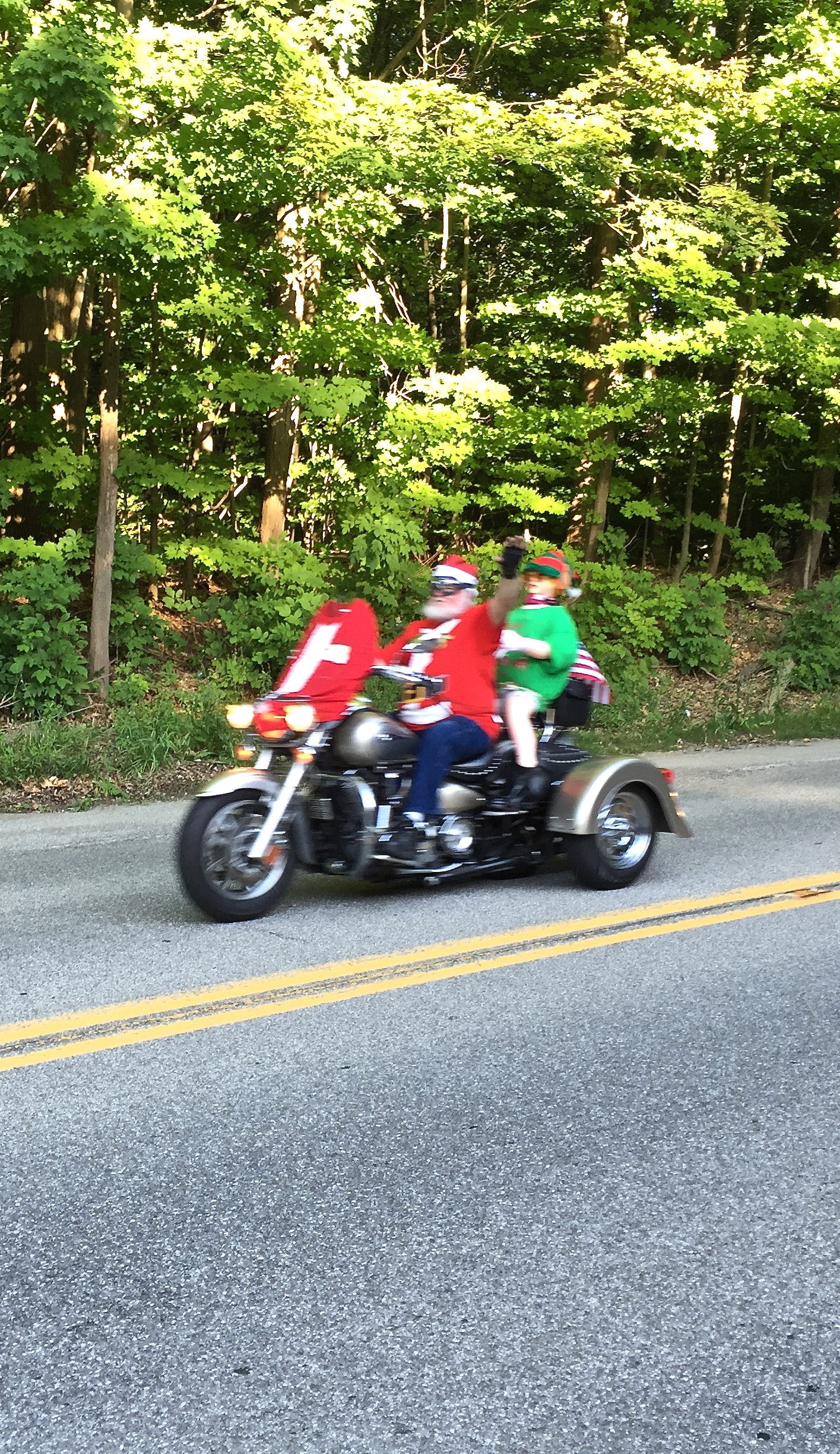
Hi, kind of blurry Santa and Mrs. Claus

I was minding my own business, standing along Glenwood Park Avenue with wife Kathy and grandson Cole. The Roar’s parade of motorcycles was going by, the riders vroom vrooming—such delight in engine flexing.

Cole needed to get used to the volume, so he sat in the car, peering out the open window. My body fat, from arm bingo to wine gut to muffin tops to saddlebags, trembled in the racket. The bikes were interesting, a smorgasbord of shiny eccentricity and plain weirdness. The air was a brew of exhaust and grilled hot dogs from nearby picnic shelters.

Such sensory overload would normally have me looking for an escape route, but this loud, funky scene was rendered gorgeous—every smell, sound, and sight, I swear—by human faces.

IMG_4788

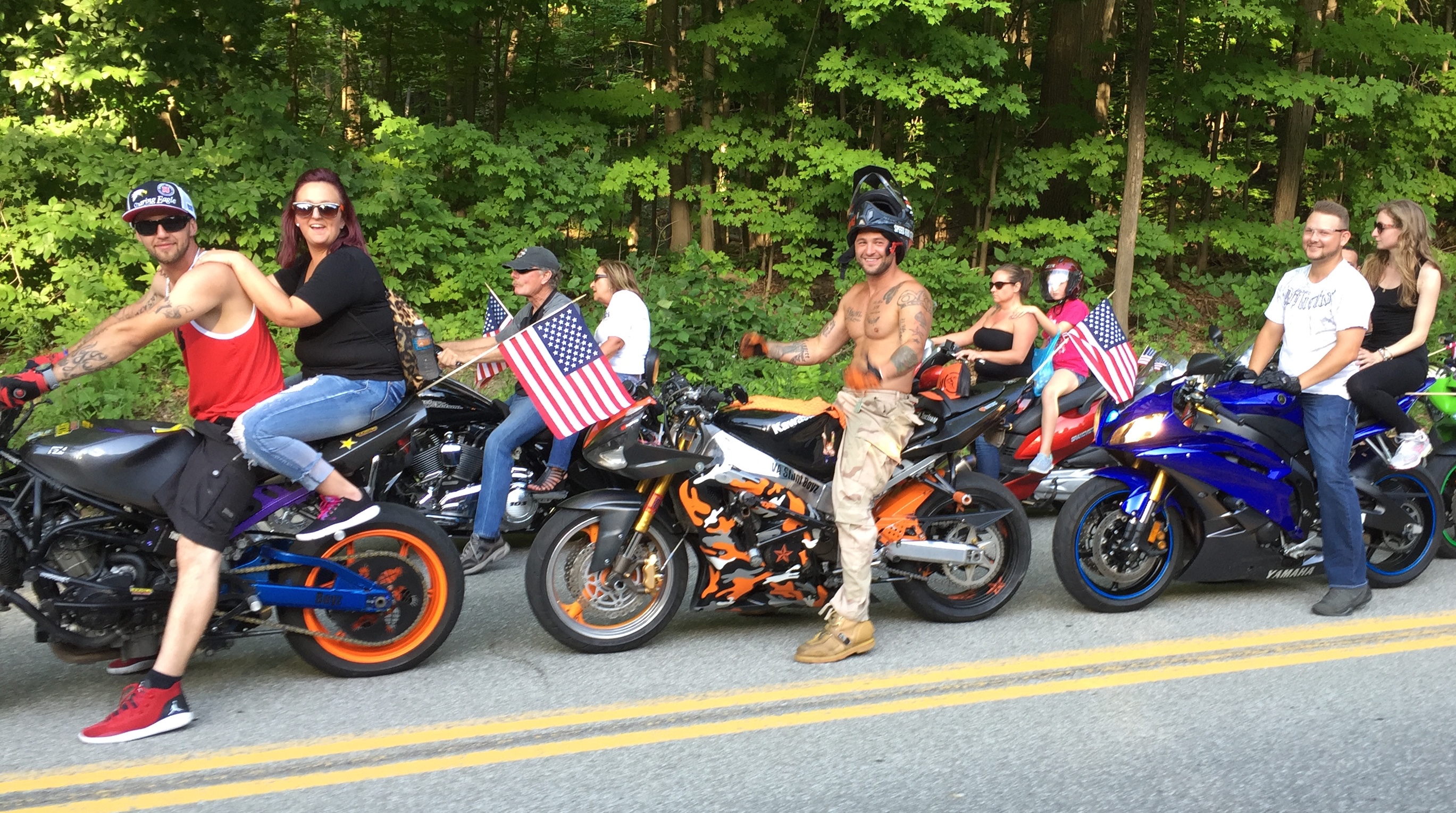
Happy dudes in a happy brood: one of these guys let out a vroom that sent Cole diving for cover.

Watching them rev by, I felt like crying. I should have cried. (Yes, I’m way too in touch with my tear ducts. Guilty as charged.) Face after face saw my face, and we waved at each other, human beings exchanging something pretty modest, if you stop and think about it.

What does a wave between strangers mean, after all? “You’re a person. Hey, I’m a person, too. And I see you.” That’s it.

But it wasn’t the waves alone that moved my old soul. The bikers’ dear faces were blissed out. And what an assortment: grizzly, metrosexual, young and fair, toothless, weathered, cherubic and gaunt; skin colors, check; genders, check; ages, check; orientations, check.

In other words, motorcycles marching to their guttural tunes presented me with a nice collection of humanity that, as near as I could tell, found a few miles of heaven rolling along together as a tribe.

“Why are you so choked up?” I asked myself.

“They’re so happy,” I said, out loud a couple times, almost in disbelief. “For as long as this ride lasts, they get to be happy.”

IMG_4792

Cole, the recipient of scores of smiles and waves

On the way home, Cole said, in as clear a sentence as his toddler tongue has yet uttered, “That was so much fun”—a perfect little word for what I’ve decided is a saving truth.

Why did 5000 bikers wave to over 20,000 spectators? Why did the eyes of those in motion shine like the sun? Why were those standing still so often laughing? Because when human beings see each other, smile and wave, some of the gladness each of us keeps inside comes out of hiding.

Lest you accuse me floating off into rosy clouds, I’ll acknowledge that a few beers and a conversation about politics and religion might ugly up lots of those silly parade grins. But then, Old Milwaukee and opinions can furrow brows in my very own family. Rancor and ridicule are always as close as our elbows.

But the joy of a smile and a wave lies in the truth that we are all more than our passions, righteous though they may be. My personhood begins with roots: I love; with luck, I am loved back; a woman gave birth to me; I can never put down my life, a heavy satchel of stories that could make you dance and cry; I’m afraid; I suffer; I have dreams.

IMG_4811

Tell me your dreams and stories.

I chatted this morning with Stacey, a Starbucks friend who rode and roared. She was moved, she said, by the flags and folks sometimes a dozen deep lining the route. Words couldn’t quite get at the power she felt in thousands waving.

I actually spotted Stacey and her wife in the procession and recognized their awe, which may be the best word to describe the simple, elusive hope I found in Roar on the Shore.

If only we could see each other! Not what we believe or whom we love or how genetics sculpt our bodies and color our skin.

Imagine the fragile world if our smiles and waves meant, “Hey, there, fellow person. I won’t hurt you. Let me hear all about your mother. Tell me a story to make me dance.”

Okay, I am in the clouds. But I believe in awe. Would you help me bring some clouds to earth, to where we’re standing?

Or maybe we can just look each other in the eyes. That’s not too much to ask. Good Lord, we can do that much, right?

The Counterintuitive Truth About Violence: The Day After Dallas

The Counterintuitive Truth About Violence: The Day After Dallas

Begin with speculation: Why do mass murderers often finish their missions by committing suicide, either by cop or their own hand? Various sources suggest self-loathing, hopelessness, a weird attempt at revenge, and a refusal to endure the consequences of their actions.

All of those reasons make sense, more or less, but this morning, riding out the dismay of yet another mass shooting, another explanation occurred to me.

After you kill people, you are in great measure dead already. Suicide is the end punctuation of the truth.

This basic idea—the violence you do to others returns home to you—is hardly new, but it is so unpalatable, abstract, and counterintuitive that we reject it, if we acknowledge it at all.

The Psalmist writes of his enemy, but speaks a universal reality: “He made a pit, and digged it, and is fallen into the ditch which he made. His mischief shall return upon his own head, and his violent dealing shall come down upon his own pate”(Psalm 7:15-16).

Arthur Conan Doyle certainly borrows from Psalm 7 when his Sherlock Holmes observes, “Violence does, in truth, recoil upon the violent, and the schemer falls into the pit which he digs for another” (“The Adventure of the Speckled Band”).

Buddhist teachings also acknowledge the result of letting yourself be consumed by anger and violence: “By doing [violence] you are like a man who wants to hit another and picks up a burning ember or excrement in his hand and so first burns himself or makes himself stink” (Visuddhimagga IX, 23).

The temptation is to domesticate such wisdom by restricting it only to terrorists and crazies. But anger is wild, violence a delinquent student. And, no revelation here, we human beings can all get pissed and throw haymakers. Who among us doesn’t take life from others, blood cell by blood cell, hour by hour? The unkind word recoils upon the speaker as surely as the shooter is wounded in his own crossfire.

Of course, not all violence is driven by anger. A soldier, for example, might wish to do anything rather than kill. Unfortunately, taking another person’s life, even for a just cause, can still be lethal for the most stable of soldiers. Some in military service die in battle, obviously. Others return home with beating hearts and tortured spirits. From 1999 to 2010, one veteran committed suicide every 65 minutes, 22 of them each day. In 2012, active-duty suicides ever-so-slightly outpaced deaths in engagement (177 to 176).

I regard members of the United States armed forces as heroes. They risk life and limb out of a deep, difficult calling. They carry out orders they may not like in conflicts perhaps troubling to them in hopes of defending their country.

It’s unfair that a noble person can survive a battle only to discover in the aftermath invisible, self-inflicted wounds. A glowing coal doesn’t care whether the hand about to throw it is right or wrong, good or evil. It burns whatever it touches.

I’m prepared to be corrected in my speculations. I’ve never taken a human life. But why did many veterans of my father’s generation remain silent about what they saw and did in World War II? Why was the scorn Vietnam vets endured so personally and spiritually devastating? Why are those serving in today’s military taking their own lives in record numbers?

Because killing kills. Failing that, it maims. The recoil of violence is so strong that even those of us who lash out only in insults and dirty looks bruise ourselves.

The sniper who murdered five police officers in Dallas was killed by a robot reaching toward him with an explosive—the fruit of his evening’s labors. But he was dead already.

And what about the rest of us? Is there any hope of stopping what has become our planetary routine of violence?

My kingdom for selfless love pandemic! But that wish amounts to whistling into the wind. What we have right now is rage, which, though understandable, is not inclined toward the Golden Rule.

Any suggestion these days ends up sounding impotent, but I’ll offer mine just the same: We ought to teach our children right from the start that any blood they shed in this life will generally include an equal share of their own.

Practicing Environmentally-Friendly Speech

Practicing Environmentally-Friendly Speech

(Note: Here’s a summer re-run for your enjoyment or consternation. I originally posted this in slightly different form in July of 2013, when not many folks knew about A Napper’s Companion.)

5:28 a.m.: Birds in the boulevard’s maples sing in the first breath of light. Hoping for a scratch on her temples, portly cat Shadow waits by Kathy’s hand. This is sweet pre-dawn, an hour made for shamatha—calm abiding. I woke up around 4:30, stepped on the bathroom scale, grimaced, and returned to bed for thirty minutes of propped-up prayer. Now I have until 7:00 to do as I please. One flat note on this start to my day off is a neighborhood skunk that responded to some threat. Ugh.

There’s always something to spray about: two pounds forward, one pound back; my right foot getting chilled in the breeze, now covered by the sheet; the moppy dog across the street complaining about newspaper delivery; skunk is as skunk does. But none of this noise overcomes the silence. Even a distant train’s groan and rattle treat the morning’s meditation kindly.

I want to be kind, too, kind and loving toward this day. For starters, I just set my iPhone alarm for wife Kathy, who has to get up at 6:50 and go give cancer patients chemotherapy. She doesn’t want to keep clicking her snooze button, and I don’t blame her.

Since an out-of-town visit with a friend got scuttled, I plan—in no particular order—to visit my friendly barber Pat, go for a four-miler at Presque Isle State Park, fold laundry, buy sardines in mustard sauce (yes, I do like them and recently read that they’re a nutritional marvel), and skim The Erie Times-News at Starbucks while sipping an iced coffee with a shot of espresso, all decaf, half and half, two Splendas.

The fish, jog beside Lake Erie, handkerchiefs, and the rest aren’t this Friday’s center of gravity, though. Neither are two ABC News articles slated for Starbucks: “New Limits on Arsenic in Apple Juice” (Huh? Shouldn’t the limit be . . . none?) and “The History of Urinating in Space” (pretty sure I’ll regret this one). With luck, loving silence will be the force pulling this day together.

With luck! I hope to devote two hours to prayer and napping, both sane and quiet acts. Lots of slow, deep breaths will be signs that my spirit is blinking its eyes. Breathing in and out makes wispy sounds—not noise pollution at all. Most important for the environment, I’ll try not to litter with my mouth.

Eco-friendliness is not only fantastic, but fashionable, and I’m on board. Like many families, the Colemans have a compost pile, recycle everything we can, conserve electricity, etc. My personal care for creation also includes the unconventional measure of shutting-up. Readers who know me personally are laughing: “Seriously, John?” Far from being quiet, I’m probably known as talkative and occasionally buffoonish. To be more specific, then, I want to practice environmentally-friendly speech: healing and productive rather than wounding and destructive.

I want to talk in life-giving ways, but my mindfulness slips constantly. If I could view a daily transcript of everything that comes out of my mouth, I’d be discouraged at how many words are either unkind or unnecessary. (Don’t worry. I’m not going to lose sleep over this. Humans talk a lot of crap, and I’m human.)

Still, I want to honor the life I’ve been granted by letting blessed silence—like that of pre-dawn shamatha—replace blather, gossip, snark, and holler. To center myself for the effort, I’ve poached some quotations from the Internet:

  • “All men’s miseries derive from not being able to sit in a quiet room alone.” (Blaise Pascal)
  • “You do not need to leave your room. Remain sitting at your table and listen. Do not even listen, simply wait, be quiet, still and solitary. The world will freely offer itself to you to be unmasked, it has no choice, it will roll in ecstasy at your feet.” (Franz Kafka)
  • “The deepest rivers make least din, the silent soule doth most abound in care.” (William Alexander)
  • “Words can make a deeper scar than silence can heal.” (Author unknown)
  • And, finally, a beloved quote from Anne Lamott, which you shouldn’t read if a mild swear-word will put you out: “Rule 1: When all else fails, follow instructions. And Rule 2: Don’t be an asshole” (from Plan B: Further Thoughts on Faith).

Regarding that last quote: I figure shutting-up is one of the best ways not to break Rule 2. Now that I think about it, Lamott wrote in four words what I just sweated out in a couple hundred. That’s why she makes the big bucks. I’ll be satisfied with getting a little better each day at listening to her.

IMG_0863

Sign hanging over my dresser–$3.00 at an estate sale