Dear Friend:
If you came here looking for “American Pastoral,” I’ve moved it to my new blog, Matters of Conscience. Please follow the link to get there.
Peace and best,
John
Dear Friend:
If you came here looking for “American Pastoral,” I’ve moved it to my new blog, Matters of Conscience. Please follow the link to get there.
Peace and best,
John
Oniontown Pastoral: Listen to Your Grandma
Dear Cole and Killian:
Last week your Grandma Kathy came in all sweated up from picking vegetables and said, “Oh, John, there’s one of those tomato hornworms in the garden with eggs on its back, probably wasp eggs.” Her bottom lip wasn’t quivering, but tears weren’t far off. Poor bug.
I don’t want to see any creature suffer, but I’ve never been a fan of hornworms. First, they’re gross; they look like a bald, glossy-green, plump, juicy caterpillar. Second, they never finish their meals. I would be glad to share if they didn’t go from tomato to tomato, munching a portion and ruining the rest. And third, they leave pellet droppings called frass. Most of it falls into the soil unseen, but a little plastic table Grandma Kathy situated near a tomato plant got covered with it. The guilty insect frassed so much I couldn’t help thinking it chuckled to itself, pellet by pellet.
Your grandmother, who is on strangely good terms with the wastrels, wanted to send me on a rescue mission, but not by plucking the larvae off the hornworm or ending its suffering.
“You write about these things,” she said. “Maybe you could write about it.”
Grandma Kathy was right, boys. For whatever reason, your pop thinks a lot about sadness, and some likeminded folks like to read what I come up with. She was right, too, that in hopeless cases, one sympathetic witness can be a saving grace.
The trouble is, I don’t have much to say about future wasps dining on a hornworm, other than to note, “That’s life for you.” One being’s grilled chicken is another’s raw caterpillar. The main difference is presentation.
On the other hand, I do have something to say about Grandma Kathy. You won’t read this letter for another ten years, but as you grow I’ll be steering you toward this advice: “Grandma Kathy has a big soul. She knows how to live. Listen to her.”
I’m only trying to save you time and trouble. If my math skills are still operational, your grandmother and I have spent 2/3 of our lives together. Only in the last three years have I figured out that most of the time she knows best. Since 1980, then, I’ve been letting her steer 1/10 of the time, which is silly.
And I’ll tell you why. Grandma Kathy was right about that hornworm from the beginning. It’s as much a resident of the earth as I am and worthy of consideration.
“Don’t you think we ought to kill it?” I asked. “The last thing we need is a wasp infestation.”
“No, we’re too quick to kill things,” she answered. “Besides, I think wasps might be beneficial.”
I swallowed my response, which would have been, “Hey, I’m not too quick to kill things.”
But she was half right. I checked an almanac and learned that you shouldn’t squash the hornworm and its passengers. Wasps are—and I quote—“beneficial” for a garden.
Only in the last few weeks have I decided that Grandma Kathy also knows best where the garden hose is concerned. All our marriage long she has left it snaking around the yard rather than coiling it up. I bring the matter up once every decade, though not anymore. When I walk out the back door, my glance goes immediately to the hose and my mind says, “Unkempt.” Your grandmother looks first to the sunflowers, and her mind says, “Ah, beautiful.”
She has chosen the better part, and I won’t take it from her.
When Grandma Kathy plays with you, Cole, she lets you decide what to do and where to go. That’s because you know how to play better than anybody else. By watching her, I’m learning to be a good pop.
And Killian, you’re just a few months old, but it already seems that you’re going to be quieter and more reserved than your big brother. You watch, kiddo, Grandma Kathy will look into your brown eyes and see how to help you love yourself and feel so happy you’ll want to fly.
Someday you’ll be able to understand that big souls make big sacrifices. When you’re ready, I’ll explain that Pop owes his life to Grandma Kathy.
But I’ll wait for later to tell you just how. It’s enough for now to say that when I was weary and lost unto despair, your grandmother left a few of her dreams behind as if they were frass to help me find myself again.
Grandma Kathy knows how best to love you and me and the rest of creation. Please, save yourself trouble and spend more than a sliver of your years following her lead and trusting her example.
Care for the tomato hornworm. Look first to the sunflower. Give yourself away for the sake of love.
We’ll talk before you know it,
Pop
Oniontown Pastoral: The Plain Old Here and Now
“How do you perform an intervention for an entire society?”Author and film critic Marshall Fine asks this astute question in his essay “Fighting Our Addiction to Empty Stimulation.” He refers mostly to the way electronic devices compromise users’ ability to focus and concentrate, and “addiction” is the perfect descriptor. We’re hooked. Technology developed to simplify and enrich life dims our wits like an opiate.
Of course, some folks are clean. Many of my Oniontown parishioners couldn’t send a text message even if it meant saving the Titanic. In their landline-blessed homes, conversations complete with uninterrupted eye contact occur every day. Amazing!
Personally, I’m not guiltless. My addiction is mild, yet active enough that judgment from me would be hypocritical. Any societal invention getting my vote would have to show understanding and compassion and resist browbeating.
Why? Because addictions won’t be shamed away and don’t surrender to good sense. Smokers with pneumonia still light up. Slack-jawed drivers gaze at screens the size of playing cards while zigzagging through traffic. That’s being hooked—repeatedly engaging in a practice you pretend can’t get you killed.
Distraction isn’t as lethal as some drugs, but the contest is just getting started.
This last figure sounds benign, but it provides the central insight about our societal addiction: You really cannot do two things at the same time.
Okay, chewing gum while walking is possible, but trying to watch the news and listen to your wife talk about her day insures you’ll do both tasks poorly. Read a text message as well, and you’ve hit a trifecta: flummoxed mind, angry spouse, and bad manners.
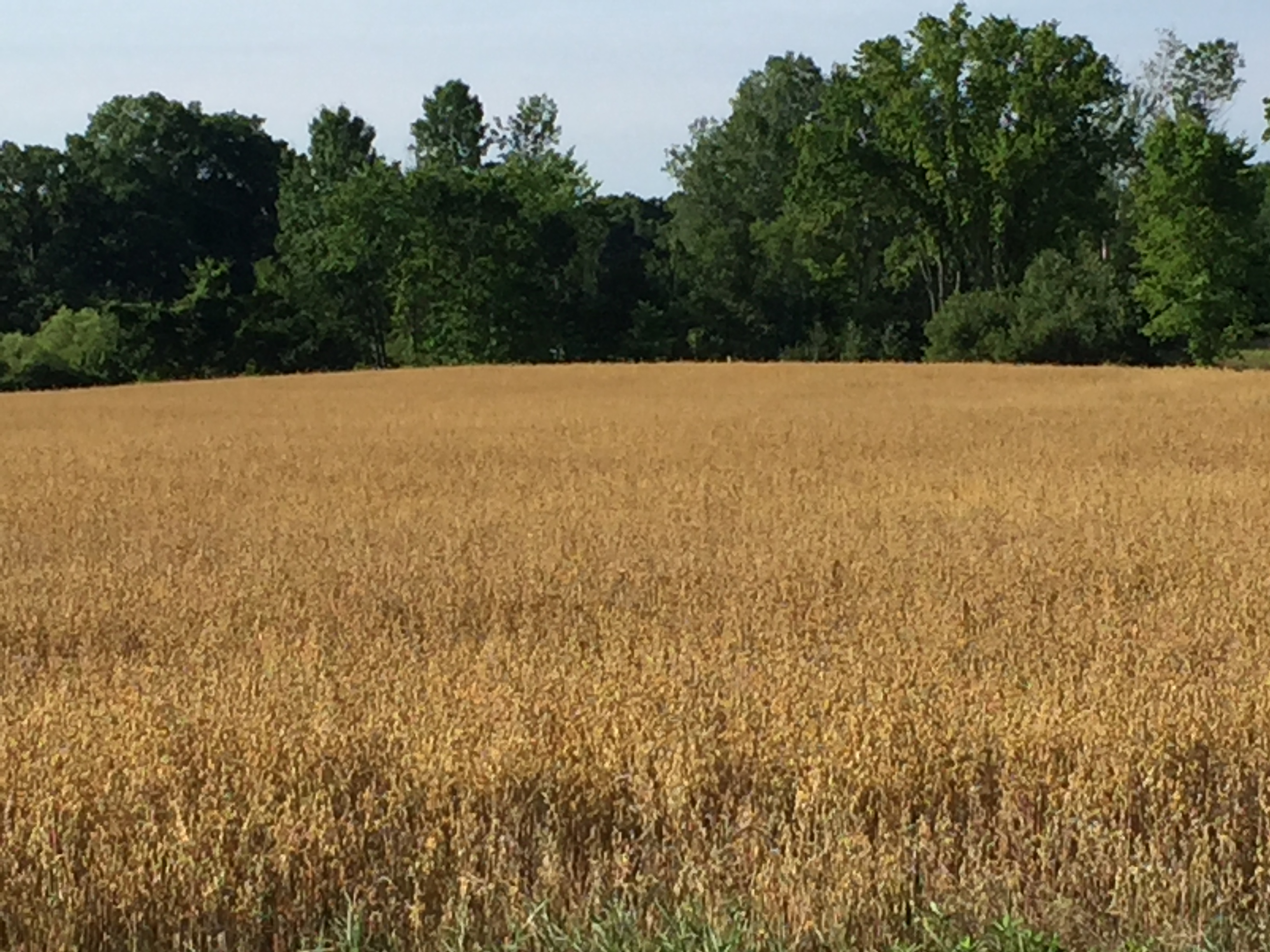
The trouble is, technology, especially the mighty capabilities of smart phones, has conned us into acting like just about anything is more needful than chatting with the friends across the table from us or noticing how a field of oats and the clear sky can put a gorgeous frame around the road.
Our adrenal glands go wild over everything but the plain old here and now, where loved ones need to bend an ear and clowns on unicycles offer us a laugh.
Joan Chittister writes in Reading the Sacred in Everyday Life about a disciple who asks an elder, “Where shall I look for enlightenment?”
The elder explains that the disciple needs simply to look.
“But what do I need to look for?” he asks.
“Nothing,” the elders says, “just look.”
Finally the elder shares the reality that escapes not only the exasperated disciple but also many of us over-stimulated pilgrims these days: “To look you must be here. You are mostly somewhere else.”
Oniontown Pastoral: A County Tour

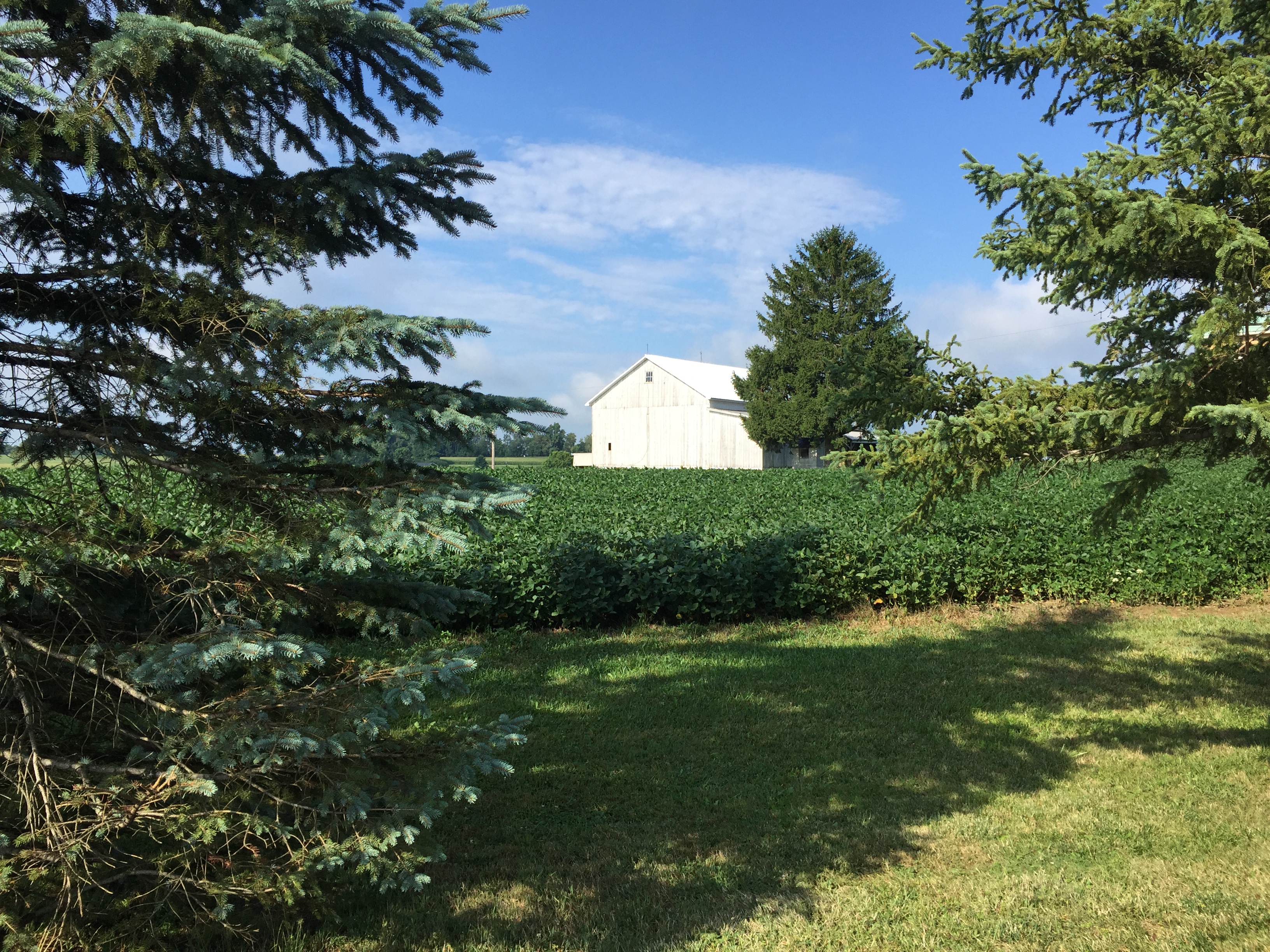
Prescription for discouragement: a look out at the soybean field behind St. John’s Lutheran Church and a dose of E. B. White’s wisdom
When I get discouraged about the civilized world, I often turn to E. B. “Andy” White, essayist for The New Yorker and Harper’s and author of Charlotte’s Web. White was not only a great prose stylist, but the last century’s most devoted naysayer to change.
He frowned upon atomic energy: “I would feel more optimistic about a bright future for man if he spent less time proving he can outwit Nature and more time tasting her sweetness and respecting her seniority.”
He rejected conventional wisdom: “Many of the commonest assumptions, it seems to me, are arbitrary ones: that the new is better than the old, the untried superior to the tried, the complex more advantageous than the simple, the fast quicker than the slow, [and] the big greater than the small.”
And he challenged orthodoxy—and got my mind working just the other day: “Our whole economy hangs precariously on the assumption that the higher you go the better off you are, and that unless more stuff is produced in 1958 than was produced in 1957, . . . you are headed for trouble, living in danger and maybe in squalor.”
I agree, but wondered, “Is growth necessary for a healthy United States economy?” Actually, I hoped the investigation might lead to existential insights—my habitual trajectory of thought.
The Internet ambushed me with economic principles. Turns out experts disagree so diametrically that Andy could be heard laughing from the curmudgeons’ bleachers in heaven.
I also received a wave of nausea for my research efforts. In 2014, Forbes printed Peter Ferrara’s “Why Economic Growth Is Exponentially More Important Than Income Inequality,” which presents dizzying statistics and a blueprint for our technological future.
The author rhapsodizes over futuristic physicist Michio Kaku, who claims, “When you need to see a doctor, you’ll talk to a wall in your home, and an animated artificially intelligent doctor will appear. You’ll scan your body with a hand-held MRI machine, the ‘Robodoc’ will analyze the results, and you’ll receive a diagnosis that is 99% accurate.”
My AI doc better be more skillful than my smart phone. Siri, my allegedly intelligent assistant, can’t locate a Dunkin Donuts. Why should I trust a virtual endocrinologist with my pancreas?
More to the point, why would I ever confide in a wall? In 1955, White grumbled at his telephone company “for having saddled us with dials and deprived us of our beloved operators.” My misgivings about healthcare via hologram will seem similarly quaint in eighty years.
Still, I have a quick response for Ferrara and Kaku: “I’ll pass!”
Give me Andy instead. He was never a churchgoer, but he held a divining rod for the sacred. And he would have delighted in the county tour parishioner Dave, a retired cow veterinarian, took me on last week.
We wandered a 4-H Club show, where I visited Jocelyn and her prize-winning cows and greeted pigs, goats, a llama and an alpaca.
We browsed at McCartney’s Feed and Hardware, which is packed with implements exotic to my city eyes and operates without cash registers. The clerks make change directly out of their pockets.
And Dave took me to the farmland he owns with wife Anne, where I got a primer on round bales and found out that cows can sleep out under the stars.
Andy would have pronounced the tour medicinal. Even now, his commentary on the wondrous land and skepticism about progress persist in my imagination. “A 99% accurate Robodoc might increase longevity,” he might ask, “but will the extra years hold any savor?”
While pastoring in my beloved Oniontown, I’ll honor E. B. White’s words and devote myself to “living itself, a task of such immediacy, variety, beauty, and excitement that one is powerless to resist its wild embrace.”
Hope and Joy in a Roaring Wave
Every year Erie, Pennsylvania, hosts Roar on the Shore, a gathering of approximately 165,000 motorcycle enthusiasts that makes my hometown rumble for a few days. According to the Roar’s website, its mission is “to raise money for a worthwhile charity while encouraging motorcycle riding, safety and fellowship.”
I’ll state directly that motorcycles aren’t my thing. Harley-Davidsons and their many cousins are like rollercoasters, lime Jell-o with chopped celery and carrots, romance novels and turtleneck sweaters. You can like them. I’m not against them, just parked in the eh category.
But hope and joy are my things, and generally they find me by surprise.
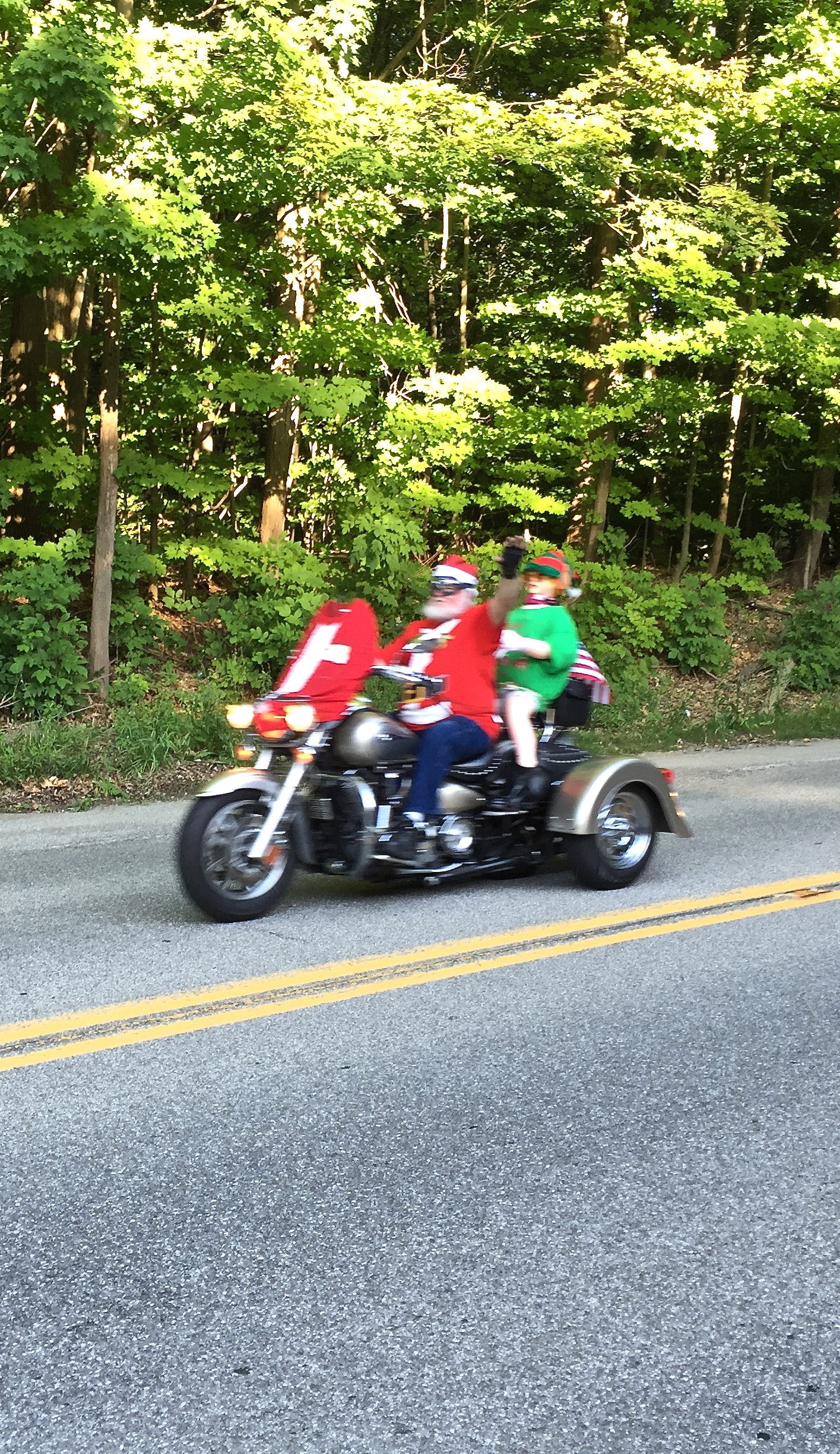
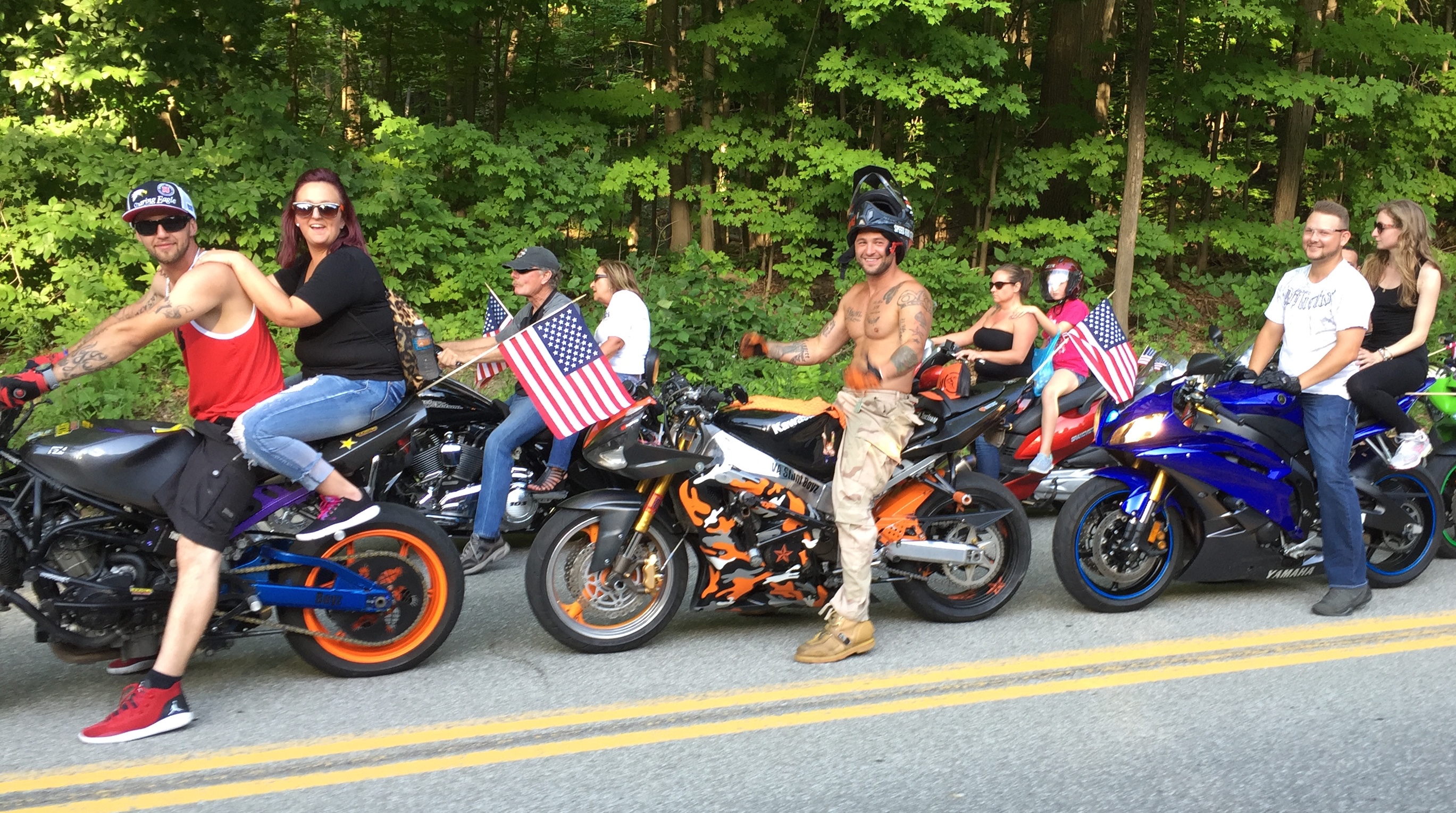
I was minding my own business, standing along Glenwood Park Avenue with wife Kathy and grandson Cole. The Roar’s parade of motorcycles was going by, the riders vroom vrooming—such delight in engine flexing.
Cole needed to get used to the volume, so he sat in the car, peering out the open window. My body fat, from arm bingo to wine gut to muffin tops to saddlebags, trembled in the racket. The bikes were interesting, a smorgasbord of shiny eccentricity and plain weirdness. The air was a brew of exhaust and grilled hot dogs from nearby picnic shelters.
Such sensory overload would normally have me looking for an escape route, but this loud, funky scene was rendered gorgeous—every smell, sound, and sight, I swear—by human faces.
Watching them rev by, I felt like crying. I should have cried. (Yes, I’m way too in touch with my tear ducts. Guilty as charged.) Face after face saw my face, and we waved at each other, human beings exchanging something pretty modest, if you stop and think about it.
What does a wave between strangers mean, after all? “You’re a person. Hey, I’m a person, too. And I see you.” That’s it.
But it wasn’t the waves alone that moved my old soul. The bikers’ dear faces were blissed out. And what an assortment: grizzly, metrosexual, young and fair, toothless, weathered, cherubic and gaunt; skin colors, check; genders, check; ages, check; orientations, check.
In other words, motorcycles marching to their guttural tunes presented me with a nice collection of humanity that, as near as I could tell, found a few miles of heaven rolling along together as a tribe.
“Why are you so choked up?” I asked myself.
“They’re so happy,” I said, out loud a couple times, almost in disbelief. “For as long as this ride lasts, they get to be happy.”
On the way home, Cole said, in as clear a sentence as his toddler tongue has yet uttered, “That was so much fun”—a perfect little word for what I’ve decided is a saving truth.
Why did 5000 bikers wave to over 20,000 spectators? Why did the eyes of those in motion shine like the sun? Why were those standing still so often laughing? Because when human beings see each other, smile and wave, some of the gladness each of us keeps inside comes out of hiding.
Lest you accuse me floating off into rosy clouds, I’ll acknowledge that a few beers and a conversation about politics and religion might ugly up lots of those silly parade grins. But then, Old Milwaukee and opinions can furrow brows in my very own family. Rancor and ridicule are always as close as our elbows.
But the joy of a smile and a wave lies in the truth that we are all more than our passions, righteous though they may be. My personhood begins with roots: I love; with luck, I am loved back; a woman gave birth to me; I can never put down my life, a heavy satchel of stories that could make you dance and cry; I’m afraid; I suffer; I have dreams.
I chatted this morning with Stacey, a Starbucks friend who rode and roared. She was moved, she said, by the flags and folks sometimes a dozen deep lining the route. Words couldn’t quite get at the power she felt in thousands waving.
I actually spotted Stacey and her wife in the procession and recognized their awe, which may be the best word to describe the simple, elusive hope I found in Roar on the Shore.
If only we could see each other! Not what we believe or whom we love or how genetics sculpt our bodies and color our skin.
Imagine the fragile world if our smiles and waves meant, “Hey, there, fellow person. I won’t hurt you. Let me hear all about your mother. Tell me a story to make me dance.”
Okay, I am in the clouds. But I believe in awe. Would you help me bring some clouds to earth, to where we’re standing?
Or maybe we can just look each other in the eyes. That’s not too much to ask. Good Lord, we can do that much, right?
Here’s Your Sign: In Memory of Joe Burgert
Organist and devout Christian Joe Burgert died in his sleep on June 25th at the Lay School of Theology, which was held at Thiel College in Greenville, Pennsylvania. His friends, my wife Kathy included, were devastated and knew they wouldn’t be able to continue attending class sessions, so they headed for Erie. Since Kathy had hitched a ride with Joe, she drove his car, the hatch filled with his luggage and laundry.
Traveling east on Route 322, the women in the two-car caravan had just started to grieve. Joe was a big presence, but sensitive and thoughtful. His laughter was thunderous and infective. Although health issues tired him out, he always seemed to be overflowing with life. How could he be gone so suddenly?
Kathy was hit particularly hard by Joe’s passing. They rode together, sat side by side at dinner, worshiped together, and then, pow, he was gone. But there was something else: I don’t think Kathy realized how much she loved Joe until he died. That was my experience, too. Let’s just say, Joe Burgert was a great soul.
So great, in fact, that he has helped a skeptic like me to believe in signs. For good or ill, much as I embrace miracles and the workings of the Holy Spirit, I resist explaining mysteries. “Leave them be” is my approach.
But it’s hard not to think that Joe reached out to his stunned friends on the highway. A bald eagle flew right at them, down the middle of the road, just at the treetops. The way Kathy tells it, they all saw the wings spread wide, almost close enough to touch, and thought the same thing: “Joe!”
He was considerate that way. If, in the governance of eternity, the dead can reach out to the bereaved, Joe would have put in a request for an eagle flyover. For days Kathy couldn’t share the story without crying. She loves eagles, scans the sky for them all the time.
Joe gave me a sign, too, I think, but to appreciate this, you have to know that I drove him crazy. He was meticulous and, even he would have admitted, kind of fussy. I’m more improvisational theater, as pastors go. We loved each other, but I tested the poor man’s patience.
A few days after Joe passed, I was running errands, my mind doing its normal noodling. Walking across a parking lot, I remembered that eagle and thought, “Hey, Joe, how about a sign for me.” No misty eyes were involved here at all. I might as well have been musing, “Boy, an ice cream cone would sure be good right now.”
Then I looked up at the storefront: GIANT EAGLE. There was my sign, and it was vintage Joe Burgert—exactly his sense of humor and sharp mind.
“Here’s your eagle, Pastor,” I imagined him saying, followed by his great laugh.
In Joe Burgert’s memory and honor, I’m choosing to believe not only that he staged my sign, but that the Communion of Saints conspired with him, joyful to the point of tears.
Oniontown Pastoral #9: Kitchen Talk
Given the number of hours I spend at the stove, it’s inevitable that my best conversations with son Micah take place in the kitchen. Dad smashes garlic or micromanages an Alfredo sauce, and son shows up with revelations and mysteries.
He and I once rehearsed the Chinese words for you’re welcome so that he could answer an elderly immigrant’s thank you at work the next day.
One evening he sputtered a profanity-laced account of a cruelty he had witnessed in a grocery store parking lot. I realized at once that his words were intended as a lament, rough-hewn, but holy.
Micah’s latest beauty parked itself in the kitchen doorway, blocking my way: “Hey, Dad, have you ever felt like you needed a reason to cry?”
“No,” I almost said, “I keep plenty of reasons to cry on hand,” but decided to give my twenty-something some space.
His explanation turned toward the haunting Celtic music from a war film, Black Hawk Down. The Breton lyrics, which sound to English speakers like groans put to notes, choke him up. Is he drawn to listen because, who knows why, tears need to be released?
Since the one activity I spend more time on than cooking is navel-gazing, long, mind-numbing speculations about sadness are always in stock.
I kept my theorizing brief with Micah, and I’ll extend the same courtesy here.
We human beings never really get over anything. That’s the pith. Every death, breakup, failure and injury sleeps folded up in our cedar chest of memory. The teacher who said you would never amount to anything? The words are preserved as if on stationary and fade with the years, but no matter, you know them by heart. And the day you received the devastating phone call? That instant is a photograph waiting for the lid to open.
We live in layers. Today’s scorching goodbye invites every other parting to come along with it. And the current betrayal may sing a solo, but it’s backed up by a choir.
Every joy also has its lineage, but most of us are content to receive a moment’s gladness without interrogation. Who asks, “Why am I having such a great day?”
No. The question left standing belongs to my son. “Do you ever need a reason to cry?” Another way of posing it might be, “Why does each hurt in the chest beg to be aired now and then?”
I don’t know, but my days of stifling the truth are past, as is the impulse to name every lump in my throat.
Fortunately, men’s tears aren’t frowned upon anymore, though most of mine visit privately during my hour to and from pastor work at St. John’s Lutheran Church in Oniontown, Pennsylvania.
A mandolin plays or an oboe or a gravelly voice. The land offers its countenance. I might stop at Camp Perry for some farmer’s cheese and let its salt and cream grace the drive.
Always the weight in my sternum and fullness behind my eyes arrive of their own accord—and not terribly often. A sniffle, a damp cheek. The road blurs a little.
Who am I missing? What passing wants attention? What shadow of rejection has returned to make me small? I don’t ask anymore.
“Come in, whoever you are,” I think, maybe at a crescendo. “Find the air you need.”
By the time I get home, a cleansing has usually occurred. I’m happy to start supper, ready for more kitchen talk with Micah. My lungs are filled sails.
If each soul does have a chest—cedar or hope—mine has no lock. The contents come out and go back in, awakened by music they must recognize. After fifty-four years, I suppose they’re family.
Practicing Environmentally-Friendly Speech
(Note: Here’s a summer re-run for your enjoyment or consternation. I originally posted this in slightly different form in July of 2013, when not many folks knew about A Napper’s Companion.)
5:28 a.m.: Birds in the boulevard’s maples sing in the first breath of light. Hoping for a scratch on her temples, portly cat Shadow waits by Kathy’s hand. This is sweet pre-dawn, an hour made for shamatha—calm abiding. I woke up around 4:30, stepped on the bathroom scale, grimaced, and returned to bed for thirty minutes of propped-up prayer. Now I have until 7:00 to do as I please. One flat note on this start to my day off is a neighborhood skunk that responded to some threat. Ugh.
There’s always something to spray about: two pounds forward, one pound back; my right foot getting chilled in the breeze, now covered by the sheet; the moppy dog across the street complaining about newspaper delivery; skunk is as skunk does. But none of this noise overcomes the silence. Even a distant train’s groan and rattle treat the morning’s meditation kindly.
I want to be kind, too, kind and loving toward this day. For starters, I just set my iPhone alarm for wife Kathy, who has to get up at 6:50 and go give cancer patients chemotherapy. She doesn’t want to keep clicking her snooze button, and I don’t blame her.
Since an out-of-town visit with a friend got scuttled, I plan—in no particular order—to visit my friendly barber Pat, go for a four-miler at Presque Isle State Park, fold laundry, buy sardines in mustard sauce (yes, I do like them and recently read that they’re a nutritional marvel), and skim The Erie Times-News at Starbucks while sipping an iced coffee with a shot of espresso, all decaf, half and half, two Splendas.
The fish, jog beside Lake Erie, handkerchiefs, and the rest aren’t this Friday’s center of gravity, though. Neither are two ABC News articles slated for Starbucks: “New Limits on Arsenic in Apple Juice” (Huh? Shouldn’t the limit be . . . none?) and “The History of Urinating in Space” (pretty sure I’ll regret this one). With luck, loving silence will be the force pulling this day together.
With luck! I hope to devote two hours to prayer and napping, both sane and quiet acts. Lots of slow, deep breaths will be signs that my spirit is blinking its eyes. Breathing in and out makes wispy sounds—not noise pollution at all. Most important for the environment, I’ll try not to litter with my mouth.
Eco-friendliness is not only fantastic, but fashionable, and I’m on board. Like many families, the Colemans have a compost pile, recycle everything we can, conserve electricity, etc. My personal care for creation also includes the unconventional measure of shutting-up. Readers who know me personally are laughing: “Seriously, John?” Far from being quiet, I’m probably known as talkative and occasionally buffoonish. To be more specific, then, I want to practice environmentally-friendly speech: healing and productive rather than wounding and destructive.
I want to talk in life-giving ways, but my mindfulness slips constantly. If I could view a daily transcript of everything that comes out of my mouth, I’d be discouraged at how many words are either unkind or unnecessary. (Don’t worry. I’m not going to lose sleep over this. Humans talk a lot of crap, and I’m human.)
Still, I want to honor the life I’ve been granted by letting blessed silence—like that of pre-dawn shamatha—replace blather, gossip, snark, and holler. To center myself for the effort, I’ve poached some quotations from the Internet:
Regarding that last quote: I figure shutting-up is one of the best ways not to break Rule 2. Now that I think about it, Lamott wrote in four words what I just sweated out in a couple hundred. That’s why she makes the big bucks. I’ll be satisfied with getting a little better each day at listening to her.
Oniontown Pastoral #8: When the Student Is Ready the Teacher Will Appear
My title here is widely attributed to the Buddha, but Bodhipaksa, host of the blog Fake Buddha Quotes, traces the idea to the 1886 book Light on the Path by Mabel Collins: “For when the disciple is ready the Master is ready also.”
Like any writer I want to be accurate, but in this case I’m busy learning and can’t afford to dwell on scholarship. In recent months, calmed and awakened by the pastures of Oniontown, I’ve found unexpected teachers, probably because I’m finally ready to receive their wisdom.
My teachers—the homebound, mostly—don’t recognize the lessons they’re lavishing upon me. I’m their pastor, after all, with a direct line to the Man Upstairs. When I pay them a visit, they expect to be on the receiving end of whatever insight and solace our time together yields. If only they could see how their fortitude blesses me.
Hopefully I have plenty of vitality ahead, but my teachers make me wonder if I will be strong in my final seasons, when the world grows painfully small. Afternoons bleed into evenings within the same four walls. Aches and frailties invite despair. Boredom and loneliness blanket even those blessed with visitors.
Wallowing would be understandable, but my teachers joke and ask after me and the St. John’s family. “It’s got to get discouraging,” I said to one man. “Well, sure,” he smiled, shifting in his recliner to ease a stab of hip pain, “but once you head down that road you’re done for.”
“What did you have for lunch today?” a parishioner with declining short-term memory often gets asked. “I don’t know,” he answers, “but it was good!”
Caregivers lift and wash and soothe hour after weary hour, unaware that they’re instructing my spirit in grace. How would I roll out of bed each morning with the knowledge that today will be just like yesterday? My teachers are heroic, their faces cleansing breaths of gentleness.
If my beloved Kathy no longer remembered our lives together, how would I cope? “You’re a hero,” I told a man who shows up at a nursing home every day to visit and eat dinner with his wife. “It’s what you sign up for,” he answered. For better or worse, indeed.
And could I endure infirmity, eyes dead to novels, ears deaf to sonatas, muscles slack, lungs spent?
Some of my teachers, their bodies like the elderly farm equipment castaways in the fields surrounding Oniontown, find ways to move forward without traveling anywhere at all.
One has model train tracks on a table in front of a window overlooking squirrels stealing from bird feeders. Imagine finding life in a locomotive with no destination!
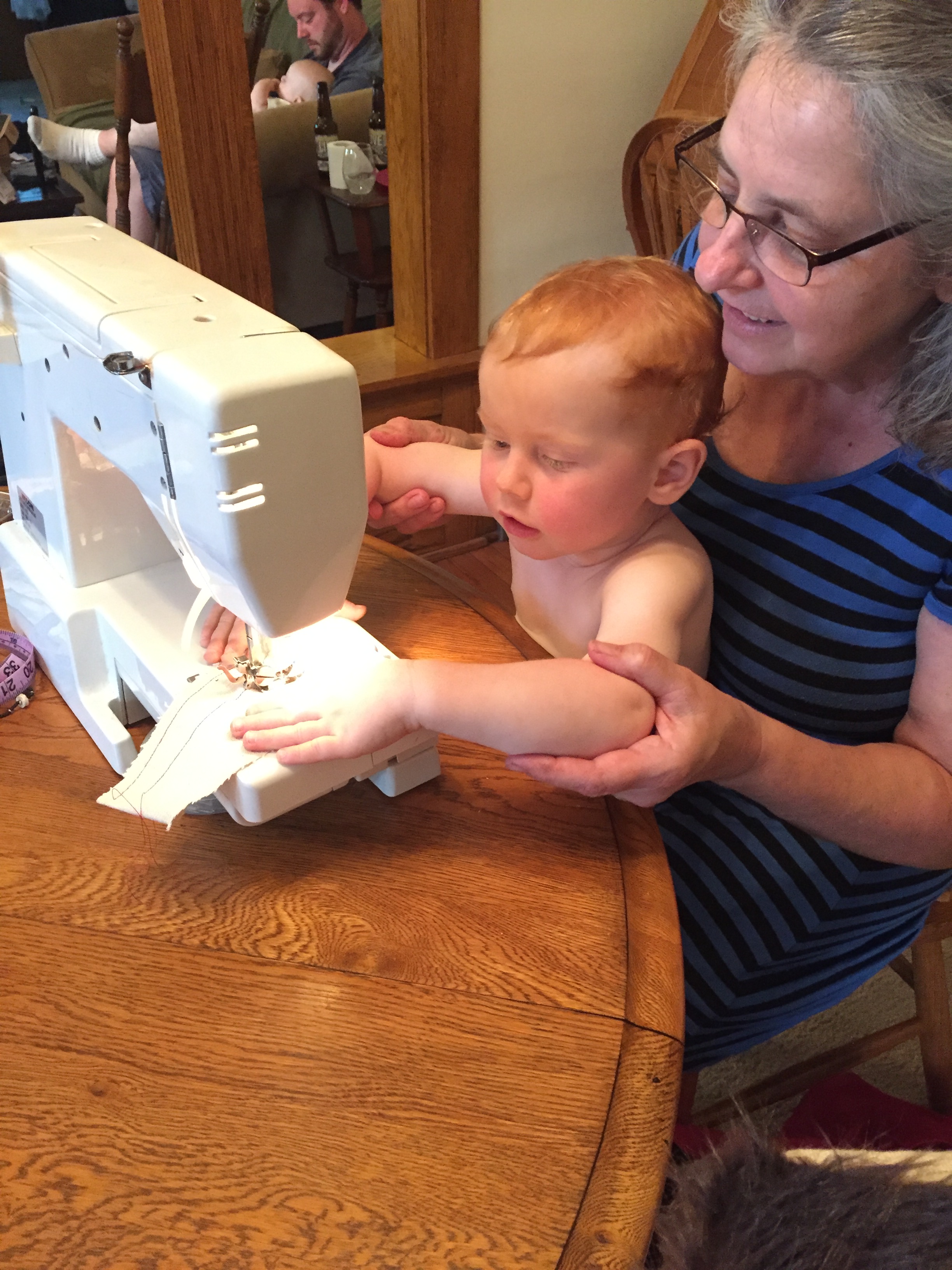
Or how about turning old, brittle pedal sewing machines into shining end tables? One of my sweetest teachers did just this. On the morning his young daughter died recently, he and I sat at his kitchen table. Cancer and grief had knocked the wind out of him, but he mustered the stamina to look with me out a window.
“My God,” I said, “is that a Baltimore oriole?” I had never seen one up close before.
“They’re only here a couple weeks,” he explained, “and then they’re gone. They like jelly.”
Every time I drive to the church I see this man’s house. Less than a month after his daughter passed, he got his wish and followed her into the rest of everlasting peace.
Can I be like him and my other teachers? Can I witness beauty until my last breath? Can I endure and soothe, laugh and learn even when the future is four walls?
And when death is near, can I remember that someone may visit my small world—a student who is finally ready to receive the quiet treasure I have left to share?
Oniontown Pastoral #6: Solace of the Red-Winged Blackbird
The animals were out of sorts yesterday. I trust them to keep me company on Route 19 and District Road, the last third of my commute from Erie to Oniontown, but the cows and horses were standoffish—or maybe they didn’t want to be out and about.
The farmers may not have let them out of the barns. I don’t know. Having lived in cities all of my life, I’m still figuring out how things work in the country. The next time one of my farming parishioners is around, I’ll ask why no cows were eating breakfast at around 9:00 a.m. on Thursday, May 12, 2016—none. And why did I see only a few horses, and those a football field or more from District Road, which they normally hug?
I don’t know these animals personally, but they seem like neighbors. “Hey, there,” I sometimes say while speeding by. “Morning!”
With the windows rolled down and warm air rushing in, I couldn’t help wondering if my beloved companions weren’t shy, but bereaved. Did they somehow sense that my destination was the home of a woman who died much too young? Did they know that loved ones wheeled her to the porch the night before she died for ten last minutes of bird song? And did they see through some cosmic collective lens when her daughter held sweet lilacs up to her nose?
No, of course not. Such magical thinking is a little too flighty, even for me. Still, the congruence was irresistible. On a sad morning, the landscape itself seemed depressed.
And cows and horses weren’t the only ones behaving strangely. Other critters kept running across the road in front of my bulbous, orange Chevy. A brief inventory: a squirrel, rabbit, chipmunk, mole, scrawny white cat and a turtle as big around as a softball.
This last pilgrim was the only one I nearly hit. “No!” I hollered, realizing that turtles can’t hustle. Fortunately, a glance in the rearview mirror showed no turtle, squashed or sound—nothing but pavement.
Never have so many road kill candidates presented themselves to me in so short a span. My thought: “Has a portion of the small animal population gone bonkers?”
A metaphor shouted back at me: “Boy, if this isn’t life, I don’t know what is. Some ugly car is always barreling toward some man, woman or beast.” The roads around Oniontown prove that the vehicle often wins.”
Only one species on that choked up Thursday morning reached out to me: the red-winged blackbird, which is my favorite. Red can be sassy, a Joan Rivers in the family of colors, but this blackbird always makes me believe that the Great Mystery is singing hope.
This solace is only in my head, but I’m fine with that. A message doesn’t have to be factual to be true.
Ten minutes before I reached my destination, four red-winged blackbirds passed just above my Chevy. I close my eyes now and see them again. Their red sashes at the shoulder are peace and gladness, maybe because their canvas is impossibly black. The yellow fringe is a smile and a wink.
How many of us gathered around the deathbed? Fifteen? And what exactly did we pray? I don’t remember. Words can do only so much when parents have to bury their child, short of fifty, and when a truck like cancer can be slowed down, but not stopped.
What do you say from a pitch-black heart-scape? The only prayer that makes sense is a promise. In the end, God will welcome us home.
This promise is a burst of color in the darkness, but that’s all it is, a promise. Why do we fold our hands for prayer? Because, let’s face it, what we have to hold onto sometimes feels slight—a hope that’s as humble as a kiss of red on a black bird. We weave our fingers together and hang on until our knuckles go white.
Or sometimes we join hands when we pray, borrowing bravery from each other.
On Thursday morning we neither folded nor clasped hands. Instead, we rested them on the body, touched the place every one of us has to go. The old promise was so vivid we cried.
Hope, thank God, doesn’t survive on facts. Seeing one red sash of it on a black wing brings on tears, an unlikely share of them joyful.