Thus Spake the Rabbi

My stride has been ragged lately, my groove flummoxed. As the poet said, “Nothing is plumb, level, or square.” Or the politician: “What a terrible thing it is to lose one’s mind. Or not to have a mind at all. How true that is.”

f503eb5a-2d90-44f2-ba21-32f9914a488a

Old buddy Watson, twelve years of family joy

Joy is largely to blame. Wife Kathy and I had friends over the other night to catch up. When eyes turned toward me, I said, “I’m happy,” which took some explaining. During the last couple of years, though surrounded by more love and support than anyone deserves, I have been tired and stressed. Maybe burnout is the word. Against all worldly good sense, Kathy and I raided my retirement funds and bought a hermit-sized home. (“You might come to regret that,” an old colleague said, and I couldn’t disagree.) I left a fourteen-year, full-time pastorate and accepted a part-time call seventy miles south of Erie, right through the region’s snow belt. Oh, and we haven’t sold our big house yet.

We Colemans have either lost our minds or found them. It could be that you have to lose one mind to find another. Since gladness and good sense seldom form right angles, I’m not surprised that my stride and groove—constructs of a neurotic brain—are stepping lightly these days.

I didn’t use these words exactly to unpack “I’m happy” for my friends, but they understood. Forced to choose between weary, anxious circumstances standing in crisp formation or calm ambiguity weaving like a drunkard, I’ll take the latter.

That is to say, I have taken the latter and am learning to embrace uncertainty and surprises. Lately sleep has been whimsical. A new work schedule has taken issue with my long-standing afternoon habit of napping. Like an AARP veteran, I’m reading in bed at 8:30 p.m. and surrendering by 9:00 or 9:30. The result: I wake up at 2:00 a.m., float to the bathroom, return to bed, and abide in a space that is to sleep what free association is to therapy.

Neither refreshed enough to get up nor drowsy enough to disappear, I breathe. Deep breaths, yes, but not those of my past, taken to lift a burden just enough to endure another hour or hush a remark that can’t be retrieved. If insomnia is an enemy, my peculiar wakefulness is a bearer of gifts.

60ab5db4-5da1-4824-95fc-0fde4cc86b6d

A bulge on the forehead: “soon and very soon,” Watson

Darkness is upsetting if you’re trying to find something, but it’s a gentle companion if you’re waiting to be found. A few nights ago snoring found me, not my own, but wife’s and dog’s. The sounds, joining for a moment then going their own ways, were blessings. Kathy has been swollen, weak, and achy for the last couple of months, and neither we nor the doctors know why. No matter what noise it makes, her sleep is medicinal. I welcome it. And Watson has weeks rather than months to live. The fatty tumor on his flank is getting hard. The growth on his forehead pains him more by the day. I now hope to come home and find that he has slipped away while dreaming that he and I are going for a run like we did years ago. His snore means that we don’t have to say goodbye quite yet. God bless his kind soul, even our walls and floors will miss him. I think now of his eyes, alive and expectant when Kathy and I left him this morning, and am close to undone.

The first decoration I nailed up in the Coleman’s new home is wisdom from a rabbi, Abraham Joshua Heschel.

7cc731dd-b219-4700-b2ee-3f9cdca525b4

Thus spake the rabbi

“Just to be” in a warm bed next to Kathy; “just to live” one more day with Watson: these are the teachings of wakefulness. My chest rises and falls, each in-breath a blessing, each out-breath sacred.

But my darkness isn’t deceptive. It would never say to a lost soul, “Just to be is a blessing.”

Instead I hear, “One corner of your joy will always be uneven, cracked with grief. Whatever mind you possess, it will never be satisfied.”

In this moment, I close my eyes to learn, invite the 2:00 a.m. wakefulness, and hear the rabbi more clearly. Breathing is grace. I survive on love. And I pray: “When my dog dies, Holy One, please help him not to be afraid.”

A Witness for Richard

I’m used to burying strangers. Plenty of deceased and their families believe in God, but the church not so much. That’s when pastors get a call from a funeral director. Not much explanation is necessary: “Are you available to do a service on such and such a date and time?”

If nothing is going, I’m in. Details are provided, name, next of kin, a phone number. From there I watch for an obituary and make the visitation if possible, talk to loved ones, gather some sense of the departed.

But my latest burial was a first: no name, no contacts, just when and where. I did reconnaissance in Section B of the paper and found one possibility, a man with a brother and a couple of nieces. Maybe the brother wanted a prayer and “ashes to ashes” at the grave. No fuss, just a man of the cloth and a few words. At the appointed hour I fishtailed to my commitment, confident I would find a seventy-something man in the casket.

Instead I found Richard, a fifty-something resident of a group home, where he lived with other adults in need of supervision and care. Some of them were sitting with their caregivers, waiting for an unfamiliar face to bring comfort and hope.

The funeral director pointed me toward Richard’s primary caregiver, who didn’t quite know what to tell me. Richard didn’t speak. He loved to look at artwork. “He loved to eat,” she said, raising her eyebrows and drawing out loved, making the vowel sound delicious. He expressed disapproval by screaming.

Others told me that he insisted on being called Richard and looked forward to his morning routine of chocolate milk.

Twenty minutes before the service, I stood with Richard: African-American guy about my age; chin drawn in; fingers showing some atrophy, I believe; passable suit jacket and tie; favorite afghan across his legs.

In certain situations I take it as my responsibility to witness, to pay attention and make a silent announcement to creation. Or maybe my job is to confess a belief consisting of equal parts tears, hope, and wonder. I don’t know.

But staring at an embalmed man whose life was nearly invisible, I put words in God’s mouth. Doing this has always felt dangerous. I don’t know the mind of God. I can’t even put together a sound argument that God exists. Anyway, words were in my mouth. I didn’t invite them. I heard them in my head as true beyond debate. It was as if I were not their author:

You’re as important as anybody in the world, Richard. Nobody is more loved than you are.

I imagined that Richard’s face, the lip puffed out over teeth that never got braces and his fingers bent at the last knuckle, were dear to God—as when a parent watches an infant sleep, each feature counted as a miracle. And to God’s ear, were Richard’s screams music?

I did my best with the service. Some lives make for scant eulogies, but that’s only if you forget that one person’s chocolate milk in the morning deserves mention as much as another’s Fulbright. “Richard was a charming, and funny man,” his obituary read. “He had a loving, caring soul and his smile would light up a room.” His friends, a dozen or so, cried for him. They wiped away tears, too, at the suggestion that God beheld Richard loving food and in him was well pleased.

A soul’s resume lists sacred trivia: knowing how to taste chocolate milk, getting lost in a painting, demanding to be called by name, caring for others with a smile or a scream. Richard’s accomplishments don’t shine up very well, but those who loved him in the world appreciated them and loved him to the end—from the group home to the funeral home to the cutting cold of the cemetery.

In under ten minutes, we had spoken the final amen and were back into our warm vehicles. Not many days later now, I sip routine coffee. Richard reminds me to taste it. His face, as clear in my eyes as when I stood by his body, doesn’t belong to a stranger. His features are fine the way they are. May God and all the quick and the dead remember to call him Richard.

Open Letter to a Muslim Woman

Open Letter to a Muslim Woman

Dear Dr. Quraishi-Landes:

My hometown newspaper, the Erie Times-News, trumpets harsh headlines today: Muslims face threats: U.S. WOMEN WARNED TO STOP WEARING SCARVES, VEILS. “On the night of the California shootings,” the Associated Press article begins, “Asiha Quraishi-Landes sat on her couch, her face in her hands, and thought about what was ahead for her and other Muslim women who wear a scarf or veil in public.”

Although I read on, the image of you in your home, troubled at the prospect of you and your Muslim sisters being harassed or worse will be plenty to think about for one day.

I know what it’s like to sit with my face in my hands, but not out of fear for my safety. As a white man in the United States, I’m mostly to blame for my own bouts of suffering—poor decisions, personal weakness. I didn’t think twice about heading out the front door this morning and relaxing here at Starbucks with a tall Americano. Nobody cares what is on my head.

But you do have to consider scarfs and veils. “To all my Muslim sisters who wear hijab,” you wrote on Facebook, “If you feel your life or safety is threatened in any way because of your dress, you have an Islamic allowance (darura/necessity) to adjust your clothing accordingly. Your life is more important than your dress.”

The compassion of that last sentence is the fragrance of my Christian-Lutheran faith. In the end, I have to look up from my sacred pages and into the eyes of fellow pilgrims, whose lives call me to study with my heart. As a parish pastor I’ve taught for years that I can’t obey God with rancor strangling my mind and fear torching my soul. The letter of any law is brittle without mercy.

Do we speak these same thoughts in our own ways? I’m guessing we do. And we’ve felt the rancor, fear, and merciless convictions of our most troubled brothers and sisters take our breath away. These are jolting times. Like you, I hold my face and read sadness behind closed eyes.

But you looked up and wrote mindful words to an anxious world. Thank you. I look up with you and remember what the Gospel of John says about losing hope: “The light shines in the darkness, and the darkness did not overcome it.”

A few weeks ago at another Starbucks I caught some light, and it had to do with hijab. A young woman was waiting for her companion to doctor his coffee. Holding her scarf in place was a pin, a striking burst of gold. I thought at once of a monstrance, which holds the host in Roman Catholic practice.

I walked over to her and said, “I’m not a creep, I promise. I just wanted to say I love that pin you’re wearing.”

220px-Monstrans

I can’t tell you how much the woman’s pin resembled this monstrance. (Credit: Wikipedia)

She responded with an oh, thank you and a smile. I probably could have skipped the creep preface, since I was sitting with my wife. Anyway, I returned to my table, where I looked up after a few seconds. She was still offering me her smile. I gave her another one of mine for the road. In our small pocket of the United States, two believers exchanged mercy.

This is my reason for writing, actually: I wanted to return to you a mercy. You told your sisters, “Your life is more important than your dress.” I say to you, “Your life is important to me, yours and those in your Muslim family, no matter what you wear. If we should happen to meet, I’ll recognize in your eyes my own spirit, longing for a world of welcoming arms and kind voices.”

Your brother,

John Coleman

If You Were My Daughter

By the time you took your first sip of coffee, a cop had already shown up, taken information from barista Tony, and loaded two pet carriers and bag of cat food into his cruiser. I didn’t see the woman pacing in the parking lot, trying to stay calm through a frantic phone call. I didn’t see her throw her arms up in the air, hop into her car, and speed off. Somebody else did, though, and got her license plate number. Now she is in trouble. You don’t leave a cat, dog, and Meow Mix in Starbucks’ parking lot and hope for the best.

If you were my daughter, I would have told you the whole story as soon as you sat down, ending with how sorry I felt not only for the pets, but also the woman. As if thinking out loud, I would ask what crisis led her to that moment and say as an aside, “Ah, hell, I guess we all do things we can’t take back.”

If you were my daughter, you would already know that I always want love and understanding to have the last word, which often makes my heart like a mutt the neighbors let bark outside hour after hour, the temperature sinking on a December night.

But you’re not my daughter. You spoke on your phone so quietly I could tell only that the language wasn’t English. The likelihood of my offspring randomly sitting down next to me and having a conversation in, say, French, is remote. And, of course, I wouldn’t have been stopped short at first by your beauty. I would know your birthday, where you are in your twenties.

You didn’t stay long, ten minutes and out the door. I watched and wondered. What car is yours? Where are you off to? But you walked so aimlessly, taking pictures of God-knows-what, I figured maybe you weren’t headed anywhere. Not to the bulky old Buick or maroon minivan, not to the Fox and Hound English Pub and Grille or Shoe Carnival or Ollie’s Bargain Outlet.

I stood to see you off. Your leather knapsack—almost empty?—was finally a black dot against your jean jacket. Then you were gone, and I couldn’t decide whether to be happy or worry. Going no place in particular can feel like grace if you know how to be alone and you’re not shouldering much weight.

If you were my daughter, I would be glad we didn’t talk about what you missed: the woman now rushing from suffering to punishment; the long-haired cat with eyes wide and still, waiting to slip from a carrier to the warm, bright sleeping spot on the back of the couch; the cop transporting animals, both trying not to be thrown by sharp turns, both able to remember and love.

If you were my daughter, you would probably say, “Damn, Daddy, lighten up.”

“Yeah,” I would say, “you’re right.”

But I might not be clueless about your next stop. Hopeful? Desolate? Either way, we could meet for lunch, and I would say, as if thinking out loud, “When a father loves his daughter, she always has at least one good place to be.”

Well It’s All Right: An Open Letter

Dear Everyone,

I woke up singing this morning, a losing-weight-but-still-fluffy guy sliding into jeans and the Baja hoodie Kathy lovingly de-hooded for me years ago. Gimpy Watson had to pee, so out we went, the song coming along:

Somewhere beyond the sea

Somewhere waiting for me . . .

IMG_3911

Out back, where Watson kills the grass with his pee, where I hum Bobby Darin.

The trouble with this swaggery Bobby Darin thing, which I both love and hate, is I don’t know all the words. Back inside, I finished putting myself together and noodled around with the signature lines:

I know beyond a doubt (HA!)

My heart will lead me there soon

HA! is the best part—so dated, so got-the-world-by-the-stones, so satisfying. Darin could walk on stage, say, “HA!” and I would cheer. Forget the lover on golden sands and birds flying on high. HA! and a smirk are plenty.

I crooned these juicy lines a few times, each HA! rattling the windows.

“Somebody’s peppy this morning,” Kathy called from the bathroom.

“That’s right,” I said, praying another song would break into my head. Yelping out HA! eventually triggers the gag reflex and makes you light-headed.

If your home has its standard measure of weirdness, a family member turning twelve lyrical words into a mantra might not be noteworthy, but in the midst of my heart dragging my smarm around the house, I noticed: I was singing. This hasn’t happened much recently, and certainly not upon waking, which generally amounts to a twenty-minute game of drag-ass.

About this singing, I’ll observe only that it’s not because I’m leaving one pastoral call and moving to another. Nothing is ever simple, is it? It’s possible to be both excited about a destination and bone-sad over a departure. My heart doesn’t know how to beat right now.

Which is why I appreciate the present singing. Before morning coffee, “Beyond the Sea” was relieved of duty by “End of the Line” by the Traveling Wilburys. Ah, Roy Orbison’s sweet warble, Tom Petty’s blessed assurance kissing me in my plump Chevy HHR:

Don’t have to be ashamed of the car I drive

I’m happy to be here, happy to be alive

“This is most certainly true,” my Lutheran-Zen brain answered. Ashamed of the car I drive? Ha! I have better shames than transportation. Happy to be alive? Why, yes, don’t mind if I am. Happy to be here and receive all kinds of music.

In the last couple of weeks I’ve realized a beauty that has always been offering itself to me. When I walk from the house to the car, at least one bird is in the sky or on a wire or atop a tree. Friend Mary could tell me all their names, just as Kathy can identify nearly every flower. My memory is Teflon with such details, but I can witness and give thanks.

220px-Cardinalis_cardinalis_-Columbus,_Ohio,_USA-male-8_(1)

A bird that friend Mary can certainly identify (Credit: Wikipedia)

I make that forty-foot trip from house to car and back again multiple times a day, and only once has a bird not accompanied me. Sometimes it’s a tiny, lone eye-song flying on high. Why have these companions been invisible for so long? A hardened heart and blinded eyes, maybe, projects of my own doing?

But gladness improves vision. As peace increases, the commonplace comes alive. Right before Kathy and I headed out the door a few hours ago, the kitchen windowsill said hosanna.

IMG_3910

Tomatoes from Kathy’s garden ripen, only after I had given up and decided to make cream of green tomato soup out of them.

IMG_3909

Rosemary from friend Denise, basil in water experiment, a ripening peach–each one a “hosanna.”

And yesterday Elena, Cole, and I had homemade vegetable soup and bread for lunch. As my wonder-of-a daughter poached eggs, my savior-grandson walked toward his bedroom and said, “Pop, come. Pop, come.” The message was of burning-bush proportions. I followed.

Cole is into hammering these days, so we went at rubber balls and his miniature electronic drum set, which said “Let’s jam again soon” each of the hundred times he turned it off. After lunch Elena got out his new piggy bank, and we all counted as he slipped in coins.

IMG_3908

Each time Cole says “Pop,” I stand on holy ground.

When I said, “Pop has to leave now,” Cole said, “Cole leave.” Referring to yourself in the third person is not only charming when you’re almost two, but also infectious.

“Oh, you want to go with Pop?” Elena said. “No, Cole has to stay here.”

My little buddy sagged at the screen door, his face widening into a pitiful toddler cry as I waved goodbye. By the time I reached the Chevy, I could see he was on to the next attraction, tears already drying.

“Pop, come.” Cole is calling me. Birds and songs are, too, as is the Lover of Souls: “Wake up, child,” Love whispers to me, “greet your sky-neighbors and sing. Two lines are enough. Even a HA! of joy will do.”

Love,

John

Under the Clock

Getting out of bed this morning was like lifting an anvil. Both wife Kathy and I lay slack-jawed through alarm after alarm. I’m not sure choosing Bach’s Goldberg Variations as my iPhone wake up call was a good idea. Such a gentle, thoughtful melody, but I now associate the first few measures with the shared human struggle of starting a day.

IMG_1139

Six already? Come on!

We tried to hold each other the way some wives and husbands do, with Kathy’s head on my chest and my arm around her. That worked for five seconds, thanks to bursitis in my left shoulder. So, we adapted. I put my arm down, she slung her arm across my belly, and we listened to the morning household. Son Micah’s obnoxious alarm nagged him—he was tired, too. Watson made old-dog dozing huffs and grumbles. Baby Crash, the most beautiful cat I’ve ever seen, played drumrolls by dashing around the hardwood floors.

“How old is Baby now,” I said out of nowhere, “four?”

“Six,” Kathy said.

“Six! How is she six?” I was only off by two years, but still, 1/3 of her life. The passing of time weighed in on my chest like a second anvil.

My God, where are the decades going? Next week I’ll turn fifty-four. How can that be, when I walk tentatively through the world, shaking just like I did trying to summon teenage bravery to ask a girl out on a date? Gray hair sticks out of my shirt collar. So why do I feel the same as I did when Kathy and I were dating, thirty-five years ago? Hot summer day. We were watching television, and I had one long, pathetic hair sprouting from my left nipple.

Innocently, Kathy spoke and acted in the same instant: 1.) “What’s that?” 2.) Reach toward hair. 3.) Grab ahold. 4.) Yank.

I screamed. Carbon dioxide hissed from the pinhole in my areola.

Kathy laughed, hard. “Oh, was that attached?”

“Yes.”

I now have hundreds, maybe thousands of chest hairs, but I still remember that first, overachieving pilgrim, its lilt to the left, a jaunty kink 2/3 of the way to top, not a suggestion of gray. My Precious.

I’m still that kid. My God, where is life going?

Mountainous questions are on my mind lately because I’m leaving the folks I’ve served as pastor for the last fourteen years, moving on to a small congregation. There isn’t any dishonor in my departure, but it’s not quite the way I wanted to go. I expect my exit on October 25th will be loving, but probably not celebratory.

Yesterday afternoon I went to an art show in downtown Erie. A couple of friends have work displayed, and I figured abandoning myself in shape, color, texture, whatever would be therapeutic.

IMG_3878When I arrived at the old Boston Store, a spacious building that used to be home of one of Erie’s proudest establishments, my first priority was to find the men’s room. It’s tough to get lost in art when your Kegel is clenched. The show would wait a few minutes.

I walked mindfully past a cluster of radio stations that now squat where women’s shoes or sheets and comforters used to be displayed. When my eyes fixed on the great clock hanging at the center of the place, I remembered that my mother, dead seventeen years now, worked at the Boston Store.

After confirming my suspicion that in all the acreage of the grand department store there was no obvious place for a middle-aged man to pee, I returned to the clock. “I’ll meet you under the clock,” Erie-ites used to say. For a while, a restaurant used that name and location. Now, all that’s left is an expanse of tan tile floor.

I looked up, checked the time, and missed my mother. In my mind she walked under the clock, no hint of arthritis yet, tastefully dressed, mascara and lipstick perfect.

The silence was of a comforting dream. I’m not too proud to admit that when I’m going through changes, trying to keep my footing, I want to be with my mom, to connect with the love that held my head when I puked and endured my adolescent travail.

Could Mom still abide in a great cradle of Eternal Love—the Love I invite each day to take hold of me, still the crazy waters, lift my anvils, and use me for Love’s sake in this wonderful, stressed world? I couldn’t feel her presence, but as I breathed in and out under the clock and received the quiet of deserted space, she seemed to live.

IMG_3874

Wrong

My God, where are we all headed? And how much time is left? The great clock was no help—four clocks, actually, one on each side. Only one was correct. Two others agreed but were wrong, as was another that lagged two hours behind, or rushed ten hours ahead, depending on how you figure.

The art show, when I got there, was as good as any collection can be when a guy is pressed at his equator. My friends’ works were so compelling that I’m looking at them again now, behind closed eyes. (Thanks, Mary and Mike.)

In today’s sky, wisps up high seem fixed, while full white clouds just above me ease to the southwest. Over Lake Erie, a long gray assembly floats in the same direction.

Where has the time gone? I may as well ask, “Where are the clouds going?” Rhetorical questions, sighs of the soul.

I didn’t make it to the church this morning. There’s much to do before I leave, but this week of telling loved ones that I won’t be their pastor for much longer has me feeling like the tender, gentle, awful sentimental Tin Man after Dorothy kisses him goodbye: “Now I know I’ve got a heart ‘cause it’s breaking.”

Always breaking, always healing back up, I suppose. In the end, I’m content to ask questions without earthly answers, breathe them up to the sky and let the wind blow them from sight. I’ve built my life on the promise that clouds, souls, and mysteries find their way to a loving place.

Now, the promise tells me to go home, take a nap, do dishes, and pick up Kathy from work. In other words, the Promise says, “Go, now, and join the day you’re given.”

P. S. A note to blogging friends: For the last couple of months, I’ve been guilty of what I call selfish blogging; that is, posting without reading much. Please forgive me. I’ll try to catch up soon.

I’ll Find You, Art, in the Sunset Dance

Art and I had a routine. He poked his head into my office doorway, checking to see if the coast was clear—a few times a week since Doris passed nine years ago.

“Thought I’d come in and bug you for a few minutes,” he said, then had a seat.

Image-20079_20150727

Friend Art

Half-hour by half-hour we picked through his life and pulled out stories as if from attic boxes: Korea, close enough to the action to hear the shells whistle; a garage-building crew in the old neighborhood and the keg they were bound to finish and the world spinning; Doris dying alone in the afternoon while he ran errands—he never quite forgave himself.

“Well,” Art said, standing up, “I’ll let you get back to work.”

“But, Art,” I always answered, “I have been working.”

He had to stop on the way home for something, maybe boloney. Samwiches every day for lunch get boring. After a while you forget to eat.

Art got to church first on Sunday mornings, unlocked the doors and set the bulletins out. But arthritis clamped down on his shoulders so badly that he gave in and got a crew cut. Combs and spoons weren’t his friends anymore. If I had a nickel for every time I fixed his collar or untwisted his suspenders . . . . Getting to worship became a project, weary and burdensome.

This past winter Erie, Pennsylvania, was cruel. Art’s car and many others at Niagara Village were snowbound, but the wind chills would have kept him inside anyway. He had time to dwell on the indignities of age: obstinate hearts, lungs, and bowels. And loneliness. He looked at Doris’ picture on the wall and told her, “Send me my ticket. I’m ready.” He lay in bed before dawn, anxious and hazy, and wondered if what he was feeling was death.

Kidney failure pushed him over the edge. I was there when a kind doctor leaned in close and with his manner as much as his words let Art know that forgoing dialysis was just fine. We prayed.

Oh, his poor arms, torn and purple.

Loved ones and nurses took in what was happening. Muffled tears. Compression devices off of his calves, the Velcro cackling. A tube or two removed. I don’t remember, exactly.

Art’s faithful son Mark went to make calls. Suddenly, Art and I were alone.

“What do you think Doris will say when you get there?” I said.

“Probably ‘What took you so long?’”

“Can I tell the [church] people what’s going on with you?”

“Yep, tell them I’m going home.”

I held his hand as he looked far off. Death wouldn’t arrive for a week or so, but he seemed to be peeking into another doorway, one where the coast is always clear—so I believe.

“Are you okay with this, Art?” I said. “Are you at peace?”

He was already on his way: “Yep, just help me through the door.”

Still holding his hand, I cried without him seeing.

IMG_0718

Church was home for Art. He always kept a prayer candle lit for Doris.

The sanctuary filled up for Art. We gave him a good send off—big choir, his boys sharp in uniform, loving words and a salute from his eldest, “How Great Thou Art” sung by one of his beloved church-grandchildren. We ended with our beautiful old prayer poem: “Into your hands, O merciful Savior, we commend your servant, Art. Acknowledge, we humbly beseech you, a sheep of your own fold, a lamb of your own flock, a sinner of your own redeeming. Receive him into the arms of your mercy, into the blessed rest of everlasting peace, and into the glorious company of the saints in light.”

The next morning I gathered with family at the cemetery. We said more words—“earth to earth, ashes to ashes, dust to dust”—and slid Art’s urn in next to Doris’. Some hugs later, I drove away through the deep, winding green of summer. I can’t recall what I did the rest of that day.

I sit now with coffee, keeping company with a few more tears that are still floating in my reservoir.

And I sit with an understanding: nothing can rush sadness through the door after a friend dies, especially one you’ve said to many times, “Here, let me fix your suspenders.” It was my privilege.

IMG_3583Last evening, knowing the best I can do is keep my own door open wide enough for grief to go in and out freely, I drove with wife Kathy to Presque Isle, to beaches that feel like home.

The Lake Erie sunset was on. Yes, a sunset, stunning cliché of the western sky, light everybody sails into eventually. Wind kept the landscape in motion, waves and light playing in the last few minutes of day.

Kathy and I stood at the water’s edge and held each other. The air moved over us—I want to say blew through us. As I breathed in and out, we seemed to be welcomed in by the sinking sun, the clouds mysteriously still, restless Lake Erie, and all the quick and the dead. We embraced each other, and creation embraced us.

It would be satisfying to say that I sensed Art’s presence, but that would be a slanted truth. Rather, resting my cheek against Kathy’s hair, receiving her cheek against my chest, my soul knew the hope of a gathering, a cosmic dance of sun, water, wind, sand, grass, and hearts. The song is of mercy.

IMG_3602

A pale vault opening

Just after the sun set, a pale vault opened in its place, glowing in the memory of the great light. I felt as though I was looking into the dance, moving with it as much as anyone can without joining it entirely.

What does death feel like? Art wondered, and so do I. Now he knows. I pray that it’s like losing yourself in a dance, completely embraced, yet free, too amazed by color, light, and love to straighten your collar or imagine that anybody has ever died alone.

An Anniversary Letter to My Wife

Dear Kathy,

Here we go again: Time to buy another used car.

Life is strange and, as we figure out how to celebrate the thirty-two years that have been our wedded casserole, so different from what I imagined it would be.

IMG_3539

121,000 miles and a blown clutch. Time to say goodbye.

I never thought that when we settled into our fifties, our vehicles would still be shitting the bed. We’ve never prayed, “Oh, Lord, won’t you buy me a Mercedes Benz?” Come to think of it, one of our neighbors does drive Porsches, but none of that’s for us. It would be nice, though, to own cars that don’t tremble and wheeze.

Tomorrow I’ll check out a bulbous orange Chevy priced at $5000, and, who knows, maybe we’ll get a couple of worry-free years out of it. Ah hell, it’s just that at this point in our lives, we shouldn’t be sweating bills every Saturday morning at the dining room table and lamenting a pile of dumb debt.

And, of course, there’s my old writing dream. I haven’t given up hope, but the picture has gotten more complicated. Could it be that what I need to say matters only to a small tribe? I’m an authority on precisely nothing except noticing the world and examining my own deepening naval. But the lurking question is, “Am I one of those writers who’s good, but not that good?”

IMG_3540

231,000 miles, tattered but holding up. The clock is ticking on this one, aye, Kath?

Basta! Looking out across decades of slipping transmissions and impulsive decisions and usurious interest and bulging files of sentences is like digging a ditch in mud, climbing in, and having a seat.

The good news is, we bought Schwinns. The other night when we went for a ride, I realized that it’s possible to be frustrated with you and treasure you in the same instant, to say, “You are such a pain in my ass” and “I couldn’t possibly love you more” in a single utterance.

You know that I like to take walks and rides the same way I shop for shoes. I’ve got a mission: Go to shoes. Try on a pair. Purchase. Return home.

Whether you know it or not, you like to take walks and rides the same way you shop for shoes. Go to shoes. Stop on the way at a bargain outlet, check out area rugs, and leave with cookie sprinkles and Swiffer accessories. Arrive at shoes, frown, and go to other shoes. Stop on the way at a fabric remnant store for no other reason than sewing’s gravitational pull. Arrive at other shoes. Ooh. Ahh. But not in your size, ma’am. And so on.

Bottom line: I’m focused on the destination. You’ve got your eyes peeled for Yeti and milkweed. I stick to the chosen route. You veer onto dirt roads and cul-de-sacs.

My dear, how is it that we’re still together?

IMG_3291

Look familiar? One of your favorite detours close to home.

On our bike ride, you took every available detour to get as close as possible to the lake, to receive whatever the waves and light might offer you. Close to home, when we stopped at a cliff for you to have a hundredth look at the water, I watched you—the new helmet making your head look like a shiny white mushroom, your lovely beak pointed north.

Swallowing a grr, I knew that if a Schwinn could fly, you would peddle to a great height, then bank and dive, pulling up just before a splashdown. Your eyes would be wide, and from shore I could hear you laugh.

Nothing has turned out for us like I figured. Used cars and thin wallets. My God, what our kids went through! What we witnessed and endured. And years of paragraphs stacked up like aging split wood in the garage.

But then, I never knew Elena and Micah and Matt would eventually swing open the gate to my weathered soul and come in and go out and find pasture. Such gladness.

unnamed-1

Joy catches in my throat. Our Cole!

Most of all, who could have predicted that a man who doesn’t get misty about babies would be so undone by a grandson?

The truth: If our possessions burned, I could warm my hands by the flames with not much regret as long as my own small tribe was whole and nearby.

Our tribe, Kathy, those we adore in a broken down, breathtaking world, and each other. That’s what matters.

That and what I’m going to tell you now, what I said inside as you enjoyed the view from the cliff: “Damn it, can we go home already?” and “Save me, my love. Don’t give up on me. Teach me to fly.”

Happy anniversary! Love,

John

Burying Aunt Sue

I buried Aunt Sue yesterday morning. That’s what some pastors call funerals. We bury the dead, speaking the word with reverence.

It was ashes a dozen or so family and friends commended to the earth. Since Aunt Sue died in February, all had grieved for a couple of months, maybe spent their quota of tears.

I loved my aunt, but her passing hasn’t crushed me—the sad result of extended families drifting apart. I saw her once or twice a year. She was cheerful, loved china painting, made elegant sea-foam, and traveled a lot in her later years. A few loved ones shared such memories, and I tossed in a couple of my own: her twittering laugh and her faithful attention to my dad during his decline, punished by dementia. She never quite understood that a person whose brain has gone to pieces can’t read a book or assemble puzzles or in any other way snap out of it. But she was present to her brother in the best way she knew how, which is all any of us can do.

IMG_3292

When I buried Dad a few years ago, Aunt Sue stayed in the car. She couldn’t bear his passing.

An hour before the graveside service, images of poor, confused Dad went through my head, and I remembered something he said a few months before his death in January of 2012. His words were confused, but poetic.

At that time Dad and his wife Mary were in different care facilities, both having lost not only each other, but themselves. I arranged to take Dad from Independence Court (great facility, absurdly named) to Mary at Pleasant Ridge (well, that’s half right), hoping that seeing each other might bring them joy. When I wheeled him into her room, they were joyful, indeed: a kiss, a hug; then he took her hand as if he had found a fragile treasure and held it to his lips. “Come on, let’s get out of here,” he said, the old Dad surfacing for an instant, eyes narrowing into his old enough-of-this-bullshit expression.

“Oh, Dad,” I thought. Mary was mostly bedridden, her legs dead weight. But, of course, who doesn’t want to close his length of days at home, with his beloved? Does the longing for the warmth of familiar skin ever die?

During one visit to Dad, he thought I was his brother—he didn’t have a brother. He confided that he planned to ask Mary to be his wife, but was worried she wouldn’t say yes. He couldn’t remember her name.

“Mary,” I said.

“Yes, Mary.” He wiped away tears. “She’s my favorite.” They had been married for over thirty-five years.

When dementia or Alzheimer’s had stolen everything else, it granted Dad the slight mercy of leaving Mary’s face. When he said “let’s get out of here,” I imagine he just wanted to be close to his favorite.

IMG_3293

A view of Lake Erie that Dad and, eventually, Mary will share–sad they won’t see it.

Mary was silent, lucid enough in the moment to know that they had no place to go, no muscles or wit to get them anywhere.

“Well, then, maybe we can get together . . . .” Dad paused, searching his atrophied vocabulary. “Maybe we can get together at the other post.

“If only we could step out onto a cloud,” Mary said, still holding Dad’s hand. “But that can’t be.”

Dad’s enough-bullshit face returned. “Why not?”

I don’t remember anything else about the visit, but Dad’s suggestion has played again and again in my memory: “Maybe we can get together at the other post.”

So an hour before giving Aunt Sue a good send off, Dad gave me the right words. When the time came to speak them, the nightmare of his last days stopped me. I barely managed Dad’s longing, his wish: “Maybe we can get together at the other post.”

Sometimes tears make the most honest eulogy. I remember my Grandma Miller, her body stooped and gnarled with arthritis; my sedated mother on her death-bed with her left hand, scarlet and impossibly swollen, reaching for my hand as I thanked her for being a good mother; my father, howling and clawing through his final hours.

Oh, for the hope of another post—where minds are restored, where pain rises like fog at dawn and burns off, where wounds are healed, injuries forgiven.

Then I hear Mary: “But that can’t be.”

My lips purse, eyes narrow: “Why not?”

IMG_3309

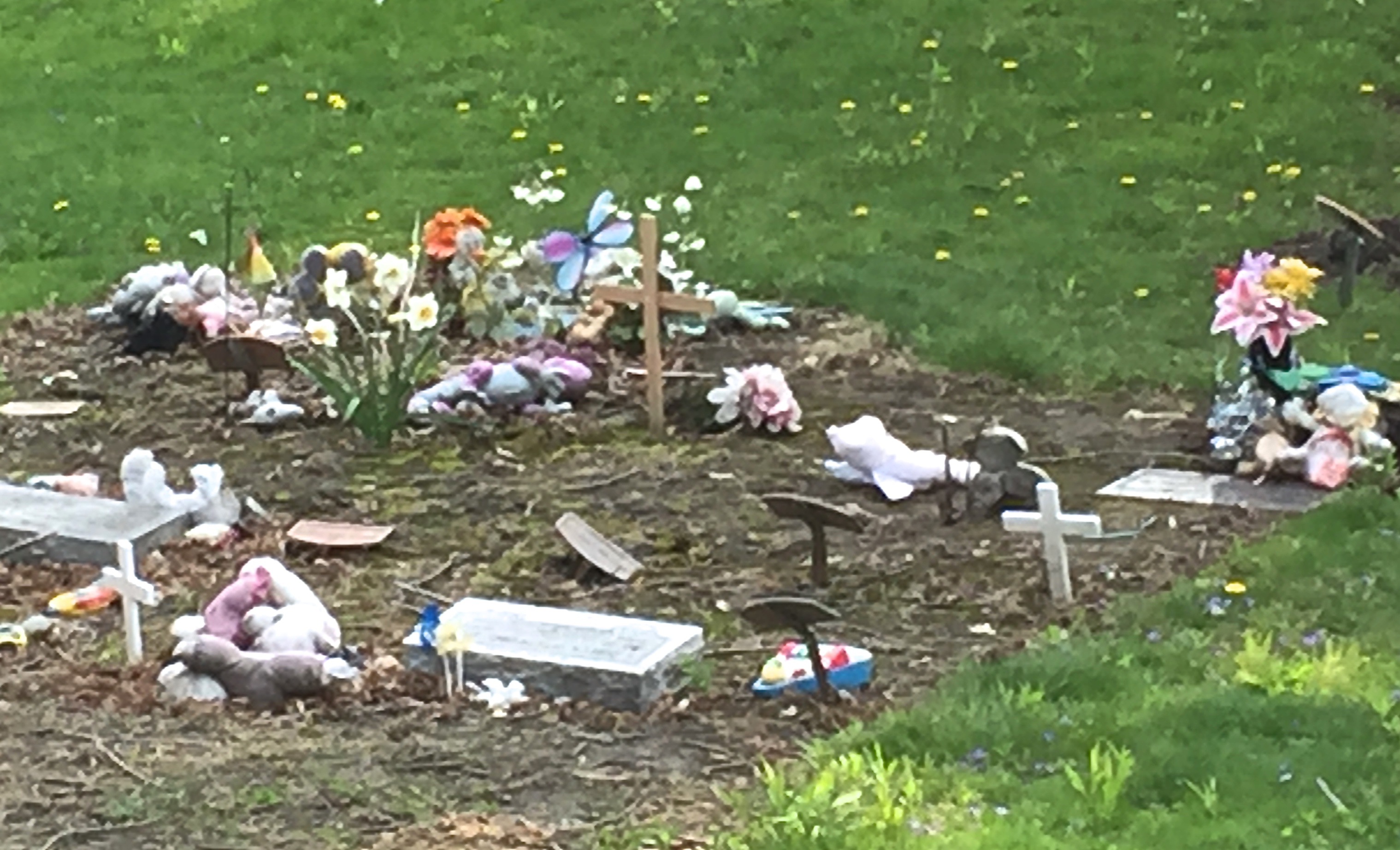
The closed children’s portion of Lakeside Cemetery, where Dad and his sisters, mother, and father are buried: soaked Teddy Bears and plastic flowers.

This morning I ached for the other post and knew that nothing but sitting still and silent with God would help, so I drove to Presque Isle and watched waves catch the sun. Honest-to-goodness shafts of heavenly light split iron-gray clouds and warmed Erie, Pennsylvania, across the bay. I had planned on burying my aunt yesterday. I hadn’t expected to bury my father again.

IMG_3295

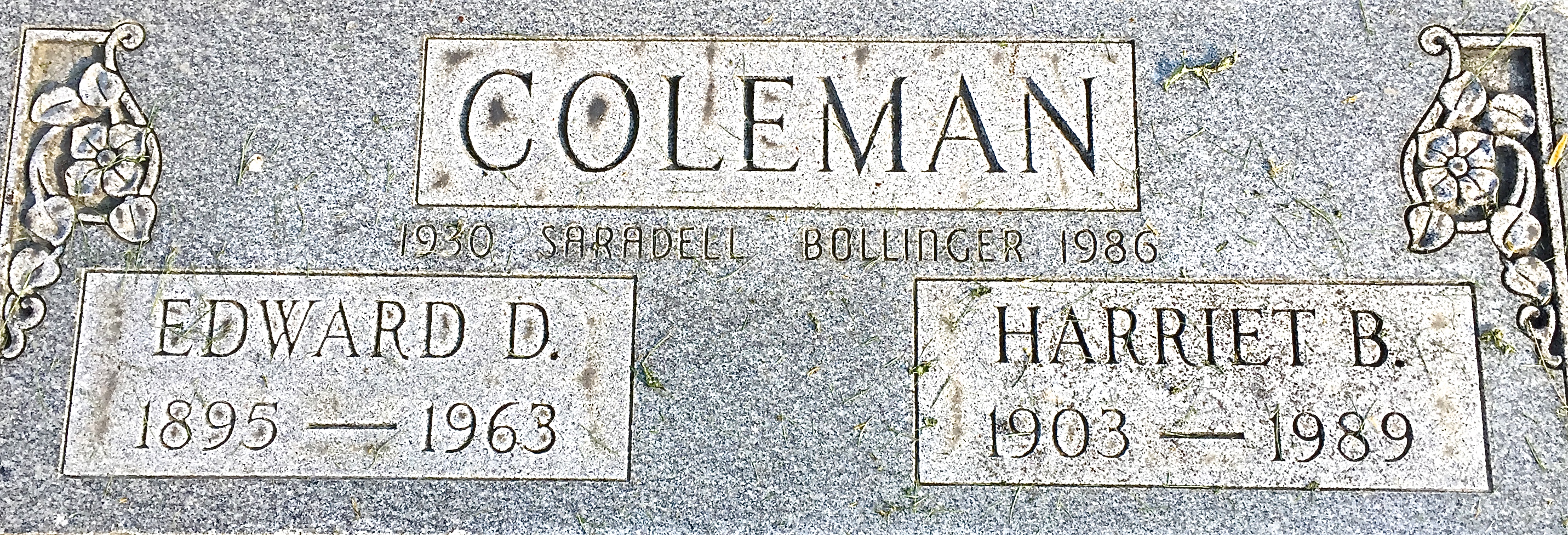
Aunt Sally’s (Saradell) resting place, a footnote on her parents’ gravestone. Her twin, Aunt Sue, will be somewhere nearby.

The weight of tears pressed from behind my eyes, but none came. Who knows why?

Eternal Love, prepare for us the other post. Gather us all there, our hurtful bullshit left behind. Our brains and bones wear out, so we return them to the earth. Give us what we need–only what we need–to know you at last.

I am crying now.

800px-Claude_Monet,_Le_Grand_Canal

Presque Isle Bay doesn’t shimmer like a Monet, but the waves are dear to my eyes. (Claude Monet, Grand Canal Venice, 1908. Credit: Wikipedia)

P. S. If you enjoyed this post, you might also like these (the first one is joyful, the other two not so much):

“A Letter to My Late Mother”:

https://anapperscompanion.com/2013/12/02/a-letter-to-my-late-mother/

“A Prayer for Philip Seymour Hoffman, Justin Bieber, and a Child in a Fire”:

https://anapperscompanion.com/2014/02/04/a-prayer-for-philip-seymour-hoffman-justin-bieber-and-a-child-in-a-fire/

“Viewing Dad’s Death Loop at Gethsemani”:

https://anapperscompanion.com/?s=Viewing+Dad%27s&submit=Search