Here’s Your Sign: In Memory of Joe Burgert

Here’s Your Sign: In Memory of Joe Burgert

Image-23615_20160628

Joe Burgert

Organist and devout Christian Joe Burgert died in his sleep on June 25th at the Lay School of Theology, which was held at Thiel College in Greenville, Pennsylvania. His friends, my wife Kathy included, were devastated and knew they wouldn’t be able to continue attending class sessions, so they headed for Erie. Since Kathy had hitched a ride with Joe, she drove his car, the hatch filled with his luggage and laundry.

Traveling east on Route 322, the women in the two-car caravan had just started to grieve. Joe was a big presence, but sensitive and thoughtful. His laughter was thunderous and infective. Although health issues tired him out, he always seemed to be overflowing with life. How could he be gone so suddenly?

Kathy was hit particularly hard by Joe’s passing. They rode together, sat side by side at dinner, worshiped together, and then, pow, he was gone. But there was something else: I don’t think Kathy realized how much she loved Joe until he died. That was my experience, too. Let’s just say, Joe Burgert was a great soul.

So great, in fact, that he has helped a skeptic like me to believe in signs. For good or ill, much as I embrace miracles and the workings of the Holy Spirit, I resist explaining mysteries. “Leave them be” is my approach.

1024px-Haliaeetus_leucocephalus_in_flight_over_KSC

Joe! (Credit: NASA/Gary Rothstein on Wikimedia Commons)

But it’s hard not to think that Joe reached out to his stunned friends on the highway. A bald eagle flew right at them, down the middle of the road, just at the treetops. The way Kathy tells it, they all saw the wings spread wide, almost close enough to touch, and thought the same thing: “Joe!”

He was considerate that way. If, in the governance of eternity, the dead can reach out to the bereaved, Joe would have put in a request for an eagle flyover. For days Kathy couldn’t share the story without crying. She loves eagles, scans the sky for them all the time.

Joe gave me a sign, too, I think, but to appreciate this, you have to know that I drove him crazy. He was meticulous and, even he would have admitted, kind of fussy. I’m more improvisational theater, as pastors go. We loved each other, but I tested the poor man’s patience.

A few days after Joe passed, I was running errands, my mind doing its normal noodling. Walking across a parking lot, I remembered that eagle and thought, “Hey, Joe, how about a sign for me.” No misty eyes were involved here at all. I might as well have been musing, “Boy, an ice cream cone would sure be good right now.”

800px-Twin_Valu_Dave's_Market_Giant_Eagle_Maple_Heights,_Ohio

Good one, Joe. (Credit: Niceckhart on Wikimedia Commons)

Then I looked up at the storefront: GIANT EAGLE. There was my sign, and it was vintage Joe Burgert—exactly his sense of humor and sharp mind.

“Here’s your eagle, Pastor,” I imagined him saying, followed by his great laugh.

In Joe Burgert’s memory and honor, I’m choosing to believe not only that he staged my sign, but that the Communion of Saints conspired with him, joyful to the point of tears.
Oniontown Pastoral #8: When the Student Is Ready the Teacher Will Appear

Oniontown Pastoral #8: When the Student Is Ready the Teacher Will Appear

My title here is widely attributed to the Buddha, but Bodhipaksa, host of the blog Fake Buddha Quotes, traces the idea to the 1886 book Light on the Path by Mabel Collins: “For when the disciple is ready the Master is ready also.”

IMG_4284Like any writer I want to be accurate, but in this case I’m busy learning and can’t afford to dwell on scholarship. In recent months, calmed and awakened by the pastures of Oniontown, I’ve found unexpected teachers, probably because I’m finally ready to receive their wisdom.

My teachers—the homebound, mostly—don’t recognize the lessons they’re lavishing upon me. I’m their pastor, after all, with a direct line to the Man Upstairs. When I pay them a visit, they expect to be on the receiving end of whatever insight and solace our time together yields. If only they could see how their fortitude blesses me.

Hopefully I have plenty of vitality ahead, but my teachers make me wonder if I will be strong in my final seasons, when the world grows painfully small. Afternoons bleed into evenings within the same four walls. Aches and frailties invite despair. Boredom and loneliness blanket even those blessed with visitors.

Wallowing would be understandable, but my teachers joke and ask after me and the St. John’s family. “It’s got to get discouraging,” I said to one man. “Well, sure,” he smiled, shifting in his recliner to ease a stab of hip pain, “but once you head down that road you’re done for.”

“What did you have for lunch today?” a parishioner with declining short-term memory often gets asked. “I don’t know,” he answers, “but it was good!”

Caregivers lift and wash and soothe hour after weary hour, unaware that they’re instructing my spirit in grace. How would I roll out of bed each morning with the knowledge that today will be just like yesterday? My teachers are heroic, their faces cleansing breaths of gentleness.

If my beloved Kathy no longer remembered our lives together, how would I cope? “You’re a hero,” I told a man who shows up at a nursing home every day to visit and eat dinner with his wife. “It’s what you sign up for,” he answered. For better or worse, indeed.

And could I endure infirmity, eyes dead to novels, ears deaf to sonatas, muscles slack, lungs spent?

IMG_4337

Faded-red castaway

Some of my teachers, their bodies like the elderly farm equipment castaways in the fields surrounding Oniontown, find ways to move forward without traveling anywhere at all.

One has model train tracks on a table in front of a window overlooking squirrels stealing from bird feeders. Imagine finding life in a locomotive with no destination!

Or how about turning old, brittle pedal sewing machines into shining end tables? One of my sweetest teachers did just this. On the morning his young daughter died recently, he and I sat at his kitchen table. Cancer and grief had knocked the wind out of him, but he mustered the stamina to look with me out a window.

“My God,” I said, “is that a Baltimore oriole?” I had never seen one up close before.

“They’re only here a couple weeks,” he explained, “and then they’re gone. They like jelly.”

Every time I drive to the church I see this man’s house. Less than a month after his daughter passed, he got his wish and followed her into the rest of everlasting peace.

Can I be like him and my other teachers? Can I witness beauty until my last breath? Can I endure and soothe, laugh and learn even when the future is four walls?

And when death is near, can I remember that someone may visit my small world—a student who is finally ready to receive the quiet treasure I have left to share?

Oniontown Pastoral #7: You Learn to Like It

Oniontown Pastoral #7: You Learn to Like It

“You learn to like it.” Grandma Coleman leaned hard into learn. She was talking about an instant mocha coffee powder, which she used at half strength. To me it tasted like stale water, but Gram, with her cherubic face, furrowed her brow and insisted. Raising children during the Great Depression taught her that she could decide what she wanted and needed. One teaspoon-full can taste better than two—but you have to work at it.

IMG_4552

Corn field: a great teacher if you work at listening

Gram’s wisdom echoes more with each passing year, mainly because what I want is often the opposite of what I need.

My latest lesson is, to tell the truth, plain silly. After fourteen years of ministry in Erie, I’ve settled nicely into the pulpit at St. John’s Lutheran Church in Oniontown. As I’ve said to parishioners and friends, “I’m having the time of my life. What a great place to be.” Since I showed up about six months ago, I’ve come to love the folks and the land—so much beauty.

But what’s embarrassing is this: although the scenery is soothing, I’m an impatient driver. The accelerator has a gravitational pull that I can’t resist. Come on, let’s go! On Route 19, District Road, and just about everywhere else, my brakes are getting a workout.

IMG_4358

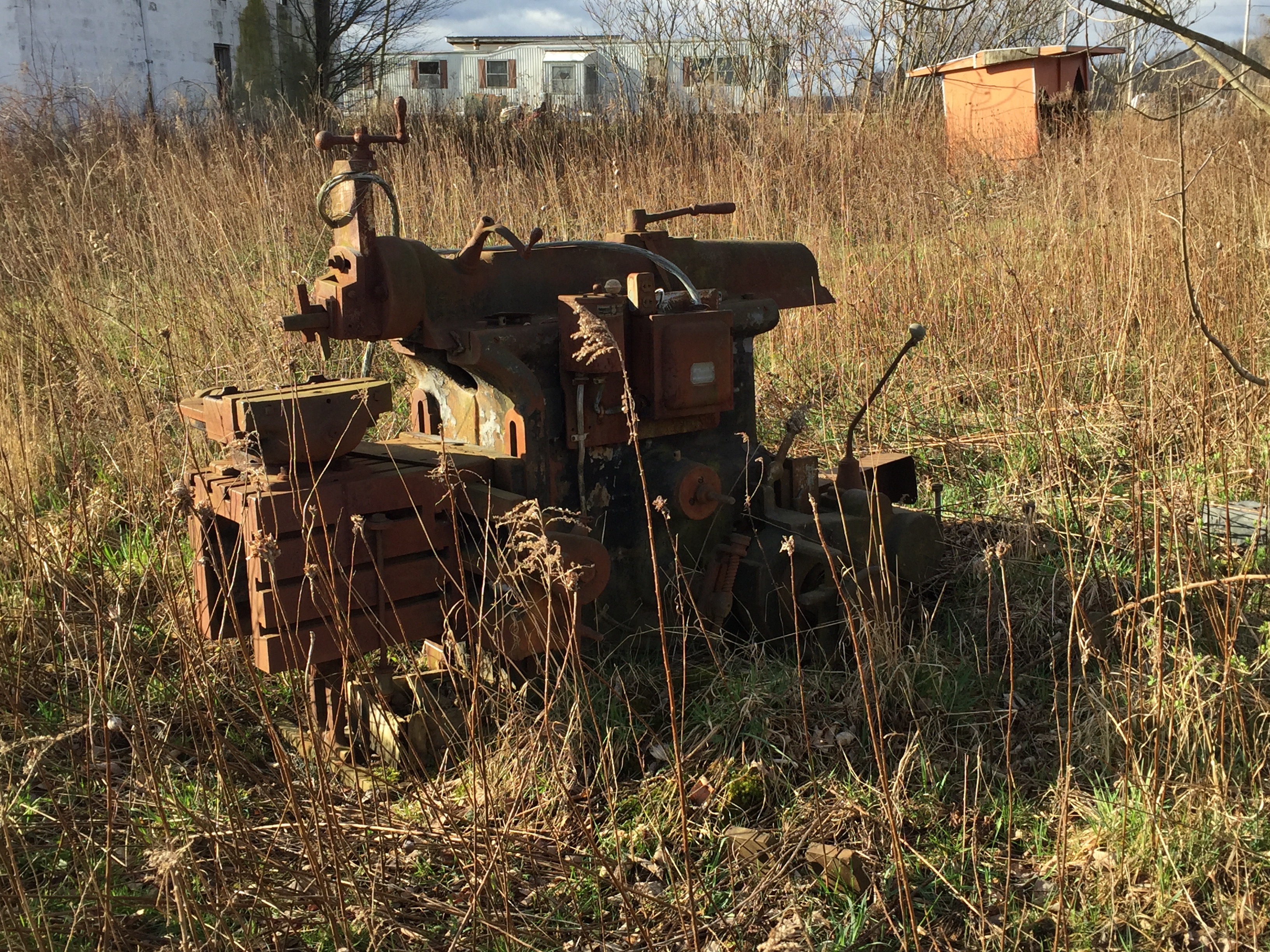
No clue what purpose this old machine served, but its repose in a field is soothing to me

I’ve lived most of my life in medium to large cities where drivers don’t dillydally on turns. In these parts, abundant caution, reconnaissance and perhaps a little prayer precede pulling into each driveway or parking lot.

The other day at the Stone Arch, the St. John’s Seniors and I had a good laugh over the matter. “It’s as if,” I explained, “drivers are afraid a Tyrannosaurus rex is around each corner, waiting to chomp into the roof their car.”

“But there might be!” several said at once. “Or a cow or a dog or a . . . senior citizen!”

Thank God for their good humor. They already understand what I’m still trying to learn: slow down, what’s the rush?

I didn’t bother mentioning that on my way to the restaurant, a navy blue sedan in front of me inched fearfully into a lot that was so clear a Concorde could have come in for a hot landing. No tumbleweed, no crickets, just acres of glorious, barren blacktop.

“Why?” I cried out behind my closed windows. “What are you waiting for?”

Of course, I’m not proud of my frustration, but it does hold a truth: taking my time doesn’t come naturally. I’ve got to lean into liking second gear as much as fourth. My father would add his words to Gram’s: “Take it ease, disease,” he used to say, and “simmer down, bub.”

I have been making incremental progress. Last week an Amish guy sat stock still in his buggy in the middle of District Road as his horse swung his head this way and that, like a city dweller searching for a taxi. As I crawled past, my neighbor looked at me with a whimsical expression and waved, as if to say, “Thanks for not crashing into me.”

The exchange was pleasant. So, too, was my encounter with a wide piece of farm equipment—many circular blades—on my way to visit Ellen the other day. Both the farmer and I hugged our thin berms, and as we passed his eyes told me, “Yeah, we’re good. We’ve got this.”

I’ll simmer down eventually. My folks and the rolling fields are great teachers. Now I need to be patient with myself.

IMG_4284

Oniontown Pastoral #6: Solace of the Red-Winged Blackbird

Oniontown Pastoral #6: Solace of the Red-Winged Blackbird

IMG_4284

The animals were out of sorts yesterday. I trust them to keep me company on Route 19 and District Road, the last third of my commute from Erie to Oniontown, but the cows and horses were standoffish—or maybe they didn’t want to be out and about.

The farmers may not have let them out of the barns. I don’t know. Having lived in cities all of my life, I’m still figuring out how things work in the country. The next time one of my farming parishioners is around, I’ll ask why no cows were eating breakfast at around 9:00 a.m. on Thursday, May 12, 2016—none. And why did I see only a few horses, and those a football field or more from District Road, which they normally hug?

I don’t know these animals personally, but they seem like neighbors. “Hey, there,” I sometimes say while speeding by. “Morning!”

IMG_4531

Lovely field . . . could use a few cows

With the windows rolled down and warm air rushing in, I couldn’t help wondering if my beloved companions weren’t shy, but bereaved. Did they somehow sense that my destination was the home of a woman who died much too young? Did they know that loved ones wheeled her to the porch the night before she died for ten last minutes of bird song? And did they see through some cosmic collective lens when her daughter held sweet lilacs up to her nose?

No, of course not. Such magical thinking is a little too flighty, even for me. Still, the congruence was irresistible. On a sad morning, the landscape itself seemed depressed.

And cows and horses weren’t the only ones behaving strangely. Other critters kept running across the road in front of my bulbous, orange Chevy. A brief inventory: a squirrel, rabbit, chipmunk, mole, scrawny white cat and a turtle as big around as a softball.

This last pilgrim was the only one I nearly hit. “No!” I hollered, realizing that turtles can’t hustle. Fortunately, a glance in the rearview mirror showed no turtle, squashed or sound—nothing but pavement.

Never have so many road kill candidates presented themselves to me in so short a span. My thought: “Has a portion of the small animal population gone bonkers?”

A metaphor shouted back at me: “Boy, if this isn’t life, I don’t know what is. Some ugly car is always barreling toward some man, woman or beast.” The roads around Oniontown prove that the vehicle often wins.”

Only one species on that choked up Thursday morning reached out to me: the red-winged blackbird, which is my favorite. Red can be sassy, a Joan Rivers in the family of colors, but this blackbird always makes me believe that the Great Mystery is singing hope.

This solace is only in my head, but I’m fine with that. A message doesn’t have to be factual to be true.

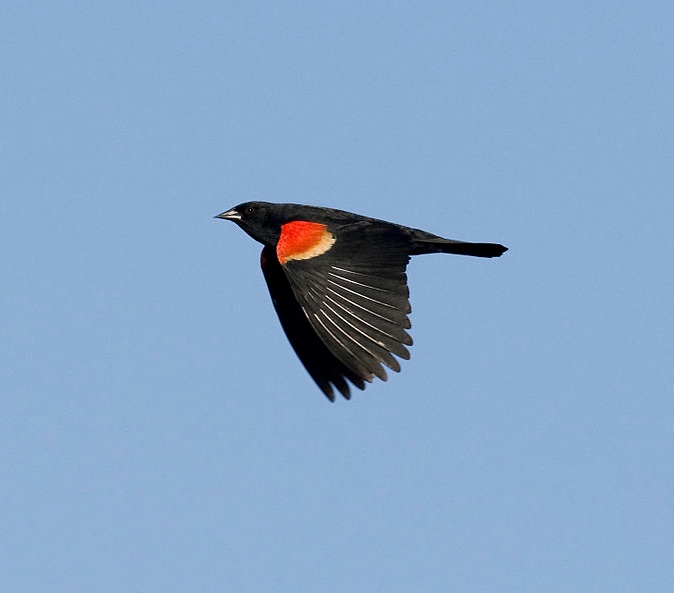
Red-winged_Blackbird_in_Flight_(8601173968)

Credit: USFWS Mountain-Prairie on Wikimedia Commons

Ten minutes before I reached my destination, four red-winged blackbirds passed just above my Chevy. I close my eyes now and see them again. Their red sashes at the shoulder are peace and gladness, maybe because their canvas is impossibly black. The yellow fringe is a smile and a wink.

How many of us gathered around the deathbed? Fifteen? And what exactly did we pray? I don’t remember. Words can do only so much when parents have to bury their child, short of fifty, and when a truck like cancer can be slowed down, but not stopped.

What do you say from a pitch-black heart-scape? The only prayer that makes sense is a promise. In the end, God will welcome us home.

This promise is a burst of color in the darkness, but that’s all it is, a promise. Why do we fold our hands for prayer? Because, let’s face it, what we have to hold onto sometimes feels slight—a hope that’s as humble as a kiss of red on a black bird. We weave our fingers together and hang on until our knuckles go white.

Or sometimes we join hands when we pray, borrowing bravery from each other.

On Thursday morning we neither folded nor clasped hands. Instead, we rested them on the body, touched the place every one of us has to go. The old promise was so vivid we cried.

Hope, thank God, doesn’t survive on facts. Seeing one red sash of it on a black wing brings on tears, an unlikely share of them joyful.

Message for a New Grandson

Message for a New Grandson

Friend Jan assures me that those in extremis can hear and understand. Son Micah told me once that when death is close, euphoric chemicals show up with kind words, beloved faces, and bright lights.

IMG_3600

Lake Erie light

I’m all for our glands throwing us a going-away party, but what Jan says feels right. Besides, she is wise and knows about deathbeds.

But I have my own reasons for hoping that words of love and care somehow get through. During parishioner Annie’s last minutes, I leaned in close and whispered Psalm 23. Thou art with me. Goodness and mercy. Forever. A single tear ran down her crow’s foot to the pillow. I saw it.

And I saw my mother’s hand lift and fall as I said goodbye to her eighteen years ago. Mom’s purposeful movement said, “I’d answer if I could, John.”

Since then, I’ve spoken freely to the almost-gone. In fact, I’ll speak to everybody and nobody. Words are good, so I say what should be said in hopes that if nothing else, the universe might hear.

Years ago wife Kathy raised monarch butterflies on our front porch. Occasionally, one would be hopelessly deformed, and before resting it underneath a stargazer lily and giving it a quick end, I said, “I’m sorry this life didn’t work out, but it will be over soon. Everything will be okay. You’ll see.”

When geese fly over, in a pair or by the dozens, I say, “Thank you.” Am I addressing the birds or God? Both, I guess.

My most recent monologue came out on—appropriately enough—April Fools’ Day. Killian Davis Thompson, grandson number two, arrived at 2:01 p.m., and within a few hours I got to see him.

IMG_4401

Kathy and Killian

Kathy helped with the birth, so she had already held him. I let Micah go first. After Kathy had seconds, it was my turn.

Time passes dreamlike when you’re looking at a baby you’ve been imagining month after month. I heard giddy voices—daughter Elena, son-in-law Matt, Kathy and Micah—but, I swear, no words.

Killian and I were in a bubble. Even now, I remember only a couple of details, which I report without exaggeration: I disappeared into his face; before I knew what was happening, I found myself whispering to him; and, on one lucid front, I hoped my breath wasn’t nasty. (The little nugget was defenseless, after all.)

IMG_4403

Killian and Pop in a bubble

I can’t bring back exactly what I said, but what I meant is still fresh. As much as I wanted Mom to hear my goodbye, I longed for some quiet room in Killian’s soul to hold in safe keeping his foolish Pop’s welcome. I meant . . .

You were so safe and warm. Now here you are. It’s so cold and bright. Don’t wake up. You must be exhausted. Being born is hard, isn’t it?

But, listen, don’t be afraid. You’re so lucky! We’ve all been waiting for you, wanting to meet you, wanting to see your face.

Don’t be afraid. You have a whole bunch of people who will take care of you. Your mom and dad are beautiful. You have a nice little home. It’s warm and dry. And you have a big brother.

IMG_4444

Lucky baby, lucky family

I named everybody in the family and told him about his tribe. Then Elena’s voice penetrated the bubble: “Are you talking to him?” “Yeah.”

This world is pretty good, but it might not be as great as where you came from. I don’t know. But I’m here, don’t forget. Whatever you need, I’m here. I’ll try to stay close.

Yes, I know, newborns don’t remember anything. And a dying woman doesn’t take green pastures and still waters with her into forever.

But maybe. I’m allowed to hope. All I know is, loving words are good, and if only the universe hears, I’ll keep trying to say them.

Oniontown Pastoral #4: The Late Imposition of Ashes

IMG_4284

Part 1: Holy Saturday Evening

Chopped pears bubbled with white raisins and honey—an improvisation to anoint vanilla ice cream for Easter dessert.

Morning would come early. Before wife Kathy and I headed out for the hour drive from Erie to St. John’s Lutheran Church in Oniontown, Pennsylvania, bacon and congealed fat, soaking potatoes and sliced onions had to get from refrigerator to crock pot, along with whatever else Grandma Coleman included in her German potato salad recipe.

While I cooked, Kathy went to the Vigil of Easter at Abiding Hope, the congregation I served for fourteen years and said Godspeed to five months ago. The gracious interim pastor invited me to come, too, but it was too soon to go back.

Ash Wednesday arrived at an awkward time for this pastor’s heart. The last fifteen years have been disproportionately penitential, my topography rich with Gethsemanes. These forty days being mostly unburdened, I haven’t felt like sweating in the garden or walking the lonesome valley.

My ingredients for happiness aren’t exotic. A couple of untroubled hours at home suffice. With clove and cinnamon taking over the smell of bacon and guitar solos leaning into the dark, I pulled up the footrest and closed my eyes. Breathe in, breathe out. Then, without warning, a suggestion of Lent rose into my throat.

How many times over the decades have I refused to cry? I’m not sure why deferred tears surface on warm spring days, when each breeze is the Sacred One cupping my face. Or on quiet evenings, when the moon passes through living room windows, when failure and regret are subjects of past calendars and my lungs fill with the air of glad memory.

Part 2: Easter Sunday

7:00 a.m.: Why the mess? Everything everywhere, owner’s manual and insurance card on the floor, napkins and dry pens by the gas pedal.

Some little expletive had rifled through our unlocked car overnight. Since nothing was missing, Kathy and I agreed drug money was the goal. But lesson learned.

Dinner on low, we left for Oniontown: breakfast at 9:00, worship at 10:00. All was in readiness. The tomb was empty; “the cloth that had been on Jesus’ head . . . [was] rolled up in a place by itself.”

As Kathy sipped coffee, I thought through the sermon story. Notes wouldn’t be necessary. I can never get far from my dad’s last trip to see wife Mary in her nursing home.

They kissed. He rested his lips on her hand. “Come on,” he finally said. “Let’s get out of here.”

In spite of shared dementia, they both realized the impossibility. Mary’s legs were dead. The only place Dad was going was back to assisted living.

“Well, maybe we can get together . . . .” Dad searched his evaporating vocabulary. “Maybe we can get together at the other post.”

“Wouldn’t it be nice to step out on a cloud?” Mary said. “But that can’t be.”

Dad’s eyebrows gathered down—his standard incredulous look. “Why not?”

Dad, who didn’t have one church-going hair in his wavy gray compliment, was proposing heaven: the other post.

My sermon, falling on the ears of many parishioners who had endured loss after loss, wouldn’t be buoyant with resurrection, but hushed with hope. The other post: oh, that we could all gather there, offenses forgiven, injuries healed, fears rocked to sleep like colicky babies.

We were making good time, and my sermon was rehearsed. I can’t remember a more fair Easter morning. The sun was waking up the pale land, telling it to live.

Then, suddenly, I remembered something that placed the fullness of Lent on my lap. Half an hour away from church, the betrayal and nails and the sponge soaked in sour wine lifted on a hyssop branch all caught up with me. If I had consented to tears at that point I might not have been able to recover in time for a triumphant Easter shout.

What I remembered was four years ago. My own beloved expletive—son Micah—was hooked on heroin and owed a dealer $200. Desperate, expecting to be flogged, he rifled through a couple of cars for stuff to sell and scored a laptop and something else that escapes me.

He got arrested, spent a couple hours in jail, then went out and injected melted down fentanyl patches with a friend, who overdosed and nearly died. Micah earned a felony for his trouble.

My son got clean shortly after his one-day crime spree and is now a joy. Anyone who dismisses the earthly poetry of death and resurrection can talk to me.

My teenage junkie once knelt in the middle of West 8th Street, waiting for a minivan to run him over. I have seen with my own eyes the junkie stand and reach honorable adulthood. On the way to Oniontown, though, a wadded Kleenex still next to the clutch, I imagined the punk who chanced upon the car in the Coleman driveway and made a frenzied search.

My boy came to such a place, and it occurred to me that Easter morning’s little expletive was probably loved by somebody. Maybe he or she was a boilerplate creep, but did a parent pray—with face buried in hands, as I did—for a miraculous healing, a decent path, anything?

Familiar landmarks on District Road were a private blur. I couldn’t afford to have Lent—creation aching with needles, wounds, and rancor, lost pilgrims wandering the lonesome valley—crack me open a couple miles away from St. John’s.

IMG_4359

District Road landmarks were a blur.

Breakfast was five-diamond Lutheran. We shouted and sang. When I talked about the other post, my tears behaved, but some of the folks cried on my behalf. I appreciated their help and knew unfinished ashes would rise in my throat again on a still evening of their own choosing.

Oniontown Pastoral #3: Hope Is an Old Tractor

Oniontown Pastoral #3: Hope Is an Old Tractor*

A few Mondays ago my friend’s son, forty-four, overdosed on heroin. The next day I took her stunned grief with me to the pastor’s study at St. John’s Lutheran Church in Oniontown, Pennsylvania.

IMG_4327

Farm art near Oniontown

My commute from Erie has four legs: I-79 South to US-19 South to District Road to Mercer Road. For seventy minutes gray trees and rolling fields heal me, but on this day my mind was on iffy roads and my friend. She and her husband had long anticipated the knock at the door and the crushing news. My wife and I used to have the same nightmares about our son, now thankfully clean.

As I thought about the numb terror of fresh loss, a line from Philippians visited me: “Your citizenship is in heaven.” Good sermon theme! I started to flesh it out. When political candidates carpet bomb each other, when explosive vests cut down the innocent, when El Nino and Zika lead the news, and when nasty heroin is as cheap as beer, then heavenly citizenship sounds, well, heavenly. My point, of course, wouldn’t be to reject this life, but to remember that we have a home over the horizon. Not particularly uplifting, but not all sermons can be sunbeams and dandelions.

I looked forward to getting to church and putting the ideas on paper. Alas, a snowy parking lot stood in my way. But since secretary Jodi’s truck was in its spot, I bravely punched the accelerator. Turns out my burnt-orange, bulbous Chevy HHR can’t compete with four-wheel drive.

“Man, am I stuck,” I reported to Jodi, who didn’t know when the plow guy would get to St. John’s. Might be evening. “We’ll get you out somehow,” she assured me.

I sulked at my desk. Wait-and-see isn’t my best mode. The sermon I pecked away at would sound whiny, I could tell.

Within half-an-hour Jodi said, “Do I hear a tractor?”

“I hear something,” I said. “Don’t know what.” Then out my window passed a bundled up man with a long beard pushing snow with an old tractor. The blade was behind the driver, a configuration I had never seen, but he was blazing me a trail.

“He lives over there,” Jodi pointed. He had seen my problem and arrived unbidden. Shoving snow this way and that, he kept at it, like a man subduing a wooly mammoth with a straight razor.

Watching him ride into and out of view, I came to love that tractor, pale red, faded by decades of sun and squalls. It must have been shiny once, but endurance gave it a different beauty. Hope, I think, is the color of my Samaritan’s tractor.

I finally understood why Jodi wasn’t concerned. And the sermon in process took on a glad color. “Our citizenship may be heavenly,” I now plan to say, “but God resides in Oniontown, too.” Then I’ll tell the folks about our neighbor and his tractor. And I’ll tell them about hope.

IMG_4284

*This essay first appeared a few weeks ago in Greenville, Pennsylvania’s, newspaper, the Record-Argus. 

Oniontown Pastoral #2: Visitation

IMG_4284

I don’t know anything sadder than a summer’s day.

(“The Geese” by E. B. White)

Who doesn’t love summer? Millions of northerners flock south each year in hopes of denying winter its due.

I accept the migration’s logic, but my attraction to summer or any mild weather is complicated. If the sky is flawless blue, I remember that for some folks, clouds block the light.

E. B. White’s summer sadness descended as he watched an old gander on his farm defeated by a young male. The Charlotte’s Web author, in his early seventies, sympathized with the displaced bird.

My ambivalence toward nice weather has its own causes. When I was a teenager my grandparents tried to outrun Gram’s arthritis by moving to Sun City, Arizona. While the dry climate was physically medicinal, the miles from children and grandchildren punished her heart.

My mother died in June of 1998 while I was doing chaplaincy training. At the end of each day of caring for others, I floated a city block to my car through a hot haze of grief.

So memories and disposition keep the unbridled joy of a beautiful day in check. I wouldn’t call my mood sad, though. Mindful is more accurate. I pray for people for whom getting from stoop to car is herculean or impossible. I dream them with me into the light.

Last week I visited homebound parishioners. Ah, the weather! Driving was a pleasure, windows down a couple of inches. Walking across parking lots was all Julie Andrews spinning and singing from the lively hills.

But it never takes long to recall that beauty depends on your perch. If walls and a non-compliant body keep you from taking in deep draughts of outside air and picking tomatoes with your own two hands, then whatever breeze sneaks in through the screen might bring out a sigh of resignation rather than delight.

IMG_4308

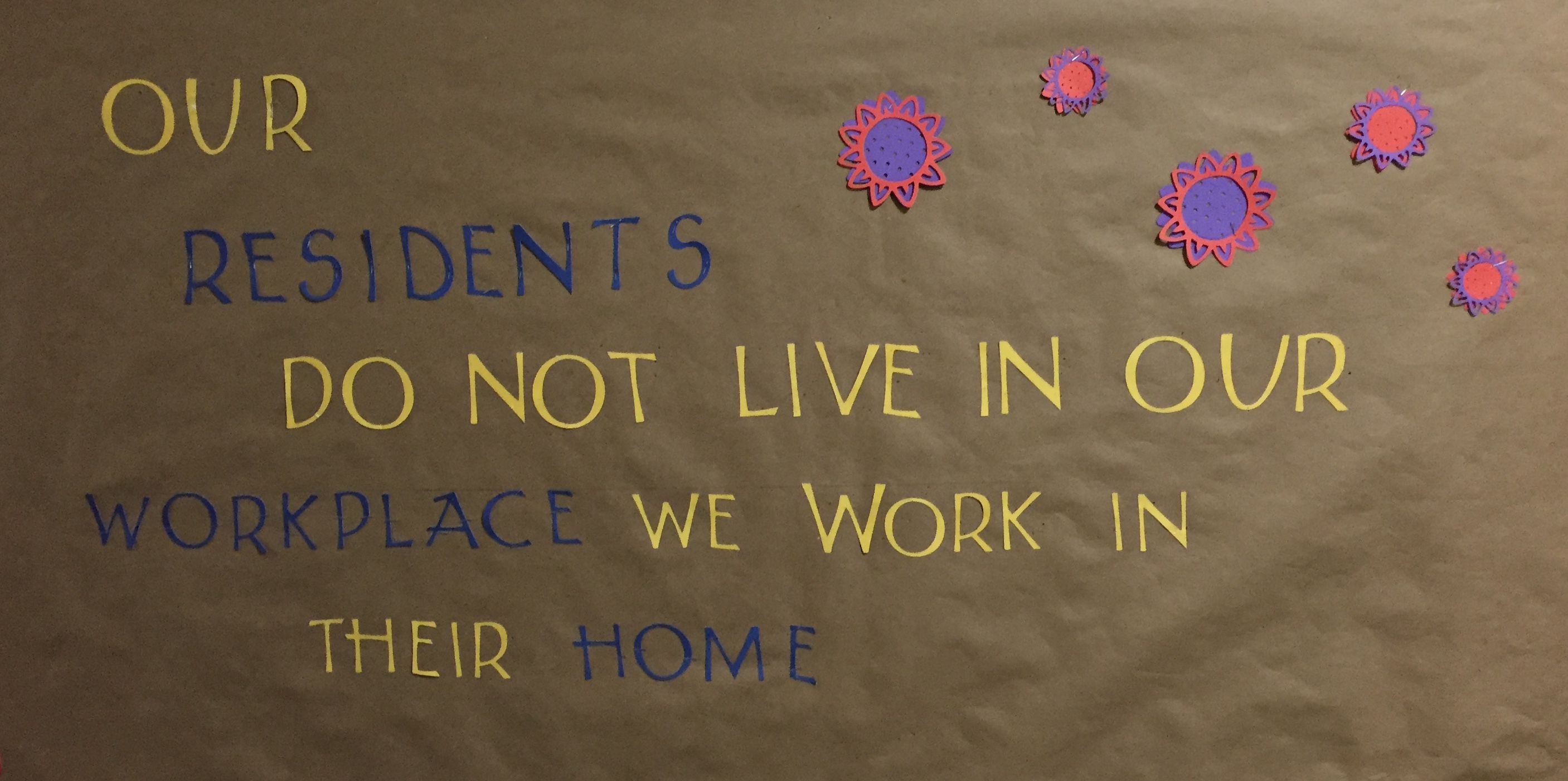
Bulletin board in an old folks’ home near Oniontown

This evening while enduring the television news, I’ll have a splash of pinot noir—just to gladden my human heart. What does a long-stem wine glass look like to an elderly child of God who shakes unpredictably? Or a chalice full of Sacred Presence? Spills waiting to happen?

Such questions should depress me, but they don’t. Seeing through homebound eyes is a lighter prayer than you might think. Anyway, I won’t dishonor them with sorrow. Maybe God can use my gratitude—for the filling of lungs, lifting a spoonful of broth, finding the Big Dipper—to bless my friends, to grant them an hour’s gladness.

My own joy is tender to the touch—only selfish joy isn’t bruised. I miss Mom now more than eighteen years ago when summer hung on me like wool.

But this March day is stunning, brilliant, 60 degrees. Chores are next on the list, then a walk. I’ll bring Mom and gather everyone I can remember as I go.

Dear God, please take the saints I forget by the hand and lead the way.

Words from the Dead in a Frightening Season

IMG_4105

Our beautiful country . . . out my office window.

Voting seasons are generally a drag, but the 2016 presidential primaries in advance of this fall’s general election are scary. In response to a long, humorless essay on the subject I posted on A Napper’s Companion a few days ago, friend Mary wrote, “I am sick and frightened and don’t know where our beautiful country is going.”

To her excellent words, I would add powerless. Today is Super Tuesday, and millions of Americans are looking around wildly for a pause button that doesn’t exist. Will our next president’s greatest gift be barroom brawling? And will the spectacle that is United States government morph from paralysis to legislative deliberations dominated by bellowing, spittle, and locker room insults?

I’m not the only citizen asking these questions and fearing these fears. Friend Judie wrote to me, “I am so ashamed of what we have become in politics.” Mary and Judie speak for thoughtful Americans and, obviously, for me. I’m weary with sick and frightened and ashamed.

As the first votes are being cast, I’m taking this moment to up my personal ante: Shame for others’ conduct is bad, but shame for my own thoughts and actions is worse.

When hitting below the belt is the order of the day, the temptation to counterpunch in like fashion is acute. If you call me a loser, I can call you whatever I please—and think even worse. But this way is neither Christian nor mindful. It’s the way of the lowest common denominator and the reptile brain.

Frightening times can bring out the worst in us, myself included. We’ve been scared before, though. I’m too young to recall vividly 1968, another year that America felt itself cracking to pieces. Think the Vietnam War and Civil Rights movement, the assassinations of Martin Luther King and Robert Kennedy.

In April of that year, monk Thomas Merton wrote in his journal while on the road: “So the murder of M. L. King—it lay on top of the traveling car like an animal, a beast of the apocalypse. And it finally confirmed all the apprehensions—the feeling that 1968 is a beast of a year. That the things are finally, inexorably, spelling themselves out. Why? Are things happening because people in desperation want them to happen? Or do they have to happen? Is the human race self-destructive? Is the Christian message of love a pitiful delusion? Or must one just “love” in an impossible situation?”

Anyone familiar with Merton’s life and work knows how he would have answered his own questions. One must love. In beastly times, love is the mindful person’s center of gravity. Such love is sometimes obliged to fight, but its arsenal is selective. Cruel or dehumanizing weapons, for example, are out. Such love is also sacrificial and can appear not only risky, but reckless.

How difficult to remember in an alarming season that assaulting my neighbor ends in wounding myself. In an informal address in Calcutta in October of 1968, Merton spoke indirectly of love: “And the deepest level of communication is not communication, but communion. It is wordless. It is beyond words, and it is beyond speech, and it is beyond concept. Not that we discover a new unity. We discover an older unity. My dear brothers, we are already one. But we imagine that we are not. And what we have to recover is our original unity. What we have to be is what we are.

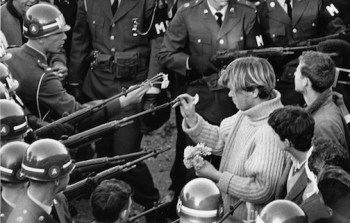
Flower_Power_by_Bernie_Boston

Flower Power, 1967 (Credit: Bernie Boston on Wikipedia)

Monks from various spiritual traditions, Western and Eastern, heard these words. In the context of what feels like a contemporary planetary crack up—campaign explosions, not to mention real bombs and climate change—Merton probably seems flighty, like a hippie sticking a flower in a rifle barrel. (And the monk himself added a tragic explanation point to 1968 on December 15th when he died of an accidental electrocution in Bangkok.)

If the human race is self-destructive, I want to be the weirdo holding out a daisy. If Christian love and human unity are pitiful delusions, nobody wake me up.

Wherever our beautiful country is going, history has taught us where hatred and fear lead. Call me a flake if I refuse to take the beastly path.

Oniontown Pastoral #1: My Wife Sleeping

Oniontown Pastoral #1: My Wife Sleeping

IMG_4284I’ve been going to bed by 9:00 p.m. lately and waking up several times during the night–changes in established rhythms. Wife Kathy and I have pruned home to 1000 square feet. My pastor work has slimmed to part-time to make room for writing. And Kathy cries out whenever she rolls over.

As our friends know, Kathy climbed to unfurl the royals on Brig Niagara. She put a new roof on our old house, remodeled the bathroom, fashioned a patio out of salvaged brick, and planted flowers I could never name.

When we bought our little house, which I call the hermitage, Kathy willed the dingy place into fresh order with elbow grease and doggedness. She has big plans: a vegetable and herb garden with raised beds; a deck cobbled together with wood from a backdoor ramp she will saw into pieces; and, of course, flowers.

Kathy has plans, but as we found out a few weeks ago, she also has rheumatoid arthritis. Questions still outnumber answers. Will medication help? Diet? Exercise? Can the condition be coaxed into remission?

She has swollen joints, particularly at the fingers and wrists, and pain all around. A steroid helps for now, but it’s not a long-term solution. Her spirit still sings. Just now she sent me this message: “I hope you are enjoying your morning writing time. You should try to get out for a walk today. What a lovely day. Love you.”

Lovely day, indeed. Lovely human being!

This morning at 1:48 I woke up, sipped some water, and watched Kathy sleep. She should win awards for the dexterity and variety of her snoring. A couple of exhales in a row, her throat sounded like a playing card being flip-flip-flipped by bicycle spokes.

When I smoothed hair away from her forehead, she started. “Oh, I’m sorry,” I said. For the first time in my life, I heard a complete, discernible sentence uttered in mmms. Cadence alone provided the words: “Oh, that’s okay. You can put your hand on my head.”

So I held her hair between the fingers of one hand, rested the other on her puffed out knuckles, and prayed—sort of. If wanting to draw pain out of my wife by touch, to take it upon myself, counts as prayer, then I prayed.

And if “Oh, my dear” counts, then I prayed without ceasing. How many times did moving a little bring rapid breaths and four or five ows out of her sleep?

“Your hands?” I asked.

“My leg,” she answered.

“Oh, my dear.”

She returned to snoring. I looked at her face and longed for a miracle, but I’m eccentric, a pastoral black sheep. You would expect articulate petitions from a trained theologian, but I pray best by breathing.

Each time Kathy resumed snoring, I drew close again and kept vigil. In our shadowy bedroom, we lay bathed in holy light.

One belief granted me sleep: every cry ripples in the waters of Eternal Love.

P. S. Please stay tuned for further Oniontown Pastoral posts and other explanations and solutions.