Oniontown Pastoral: One Morning Before Heading South

A guy who seems always to be at Country Fair didn’t look himself. He had lost a lot of weight and kept hiking up his drooping sweatpants. On this chilly morning, a red fleece blanket tied around his neck in cape fashion and a Pittsburgh Steelers stocking cap were his only warmth. Continue reading

Oniontown Pastoral: Trip to El Salvador, Part One

My drink finished, I notice the cool air on my arms and the silence, which is congested with circumstance, with the way things are, with roundabouts, blossoms and souls getting by on what they’ve got. That’s what we all do, I suppose. Continue reading

Oniontown Pastoral: Going Visiting

Oniontown Pastoral: Going Visiting My career in visitation began over 50 years ago with Mrs. Gillespie, who lived across the backyard. Johnny’s perch was a red metal step stool beside the kitchen counter. His usual was strawberry Nesquik. Who knows, … Continue reading

Oniontown Pastoral: The Orphan’s Question: Where Is Love?

This gallery contains 2 photos.

Oniontown Pastoral The Orphan’s Question: Where Is Love? Kathy’s breaths of sleep come and go. Awake at dawn, I’m in a high school choir concert 45 years ago, a musical’s lyrics forming behind my closed lips: Where is love? Does … Continue reading

Oniontown Pastoral: Supporting Cast at Grandma’s House

Oniontown Pastoral: Supporting Cast at Grandma’s House

When Cole and Killian arrived at Grandma Daffy’s house Saturday evening at 5:00, it was pouring down rain. Thunder and lightening were also in on the action, so the boys’ coveted dip in the splash pool seemed unlikely. 

Our seven-year-old redhead and five-year-old sandy-brown were sulking. Fortunately, bad moods are no match for my wife. In no time she had them shrieking in the basement play zone, having sold them on some alternative amusement. I was whipping up a pot of Pop’s Famous Mac and Cheese and a batch of curly dogs, a trick I stole from Jacques Pepin, who slices wieners so they turn into circles when fried.

In other words, the spell that Grandma Daffy casts on our grandsons was working its magic. As an aside, my beloved obviously does not share her given name with a cartoon duck.

Everybody knows that grandchildren claim the divine right to name their elders. Killian couldn’t manage Kathy, but Daffy worked. And she was the lucky one. Her counterpart should have been Grandma Janine, but the best Killian could do was “Dramamine.” How would you like to be known as a motion sickness prophylactic? And due to an unfathomable utterance by Cole, our son Micah goes by “Gak,” which is the phonetic spelling of “upchuck.” Poor Uncle Gak. 

Killian, Cole and Gavin, who will be joining Grandma Daffy’s Magic Queendom someday soon. (Credit: Elena Thompson)

But back to Grandma Daffy’s house. Nobody mentions that 402 Parkway Drive also belongs to Pop. No, when the subject of weeknight visits or sleepovers comes up, the venue is “Grandma Daffy’s.”

And it’s the truth. I’m the supporting cast for the queendom Kathy hath made, all aglow with virtuosity and improvisation. In the aforementioned basement, Kathy has a miniature, fully-appointed kitchen, where the wee chefs prepare gourmet meals. They also built a neighborhood out of cardboard appliance cartons and now hatch plots in their own row houses with secret entrances. A bit closer to heaven, our attic ceiling is lined with twinkly lights, so the boys can embark on make-believe adventures under the stars. 

My own cooking has to be four-star to compete with such attractions. Mac and cheese is a favorite. It’s salty, savory and rich enough that when adults partake, I insist that they schedule angioplasty before serving them dessert.

Cole was finishing his third helping of my heart-stopping starch on that rainy Saturday when Kathy pointed out the window and said, “Hey, guys, look!” 

The veil of clouds was rent in twain. The sun was out. Bellies full, the boys naturally ran out to trouble the chilly water. 

My favorite pool picture from 2020: Kathy made suds, Cole blasted himself in the face with the hose, while Killian looked on.

The moment Cole’s lower lip turned blue and quivered, intrepid Gram filled two plastic tubs with steamy tap water and dumped them into the pool. The placebo effect was in full force. I could have warmed the waves as much with a dirty look, but who cared? Cole was giddy, belly flopping and slipping down a stubby plastic sliding board.

Before long my character in this play was called on stage. I was made for the part. Killian stepped out of the pool and into a breeze, which got his teeth clattering. He fetched a towel from the deck railing, and I spun him into a cocoon, set him in my lap and surrounded him with big Pop arms.

For somebody who never was all on fire to have children, let alone grandchildren, I’m stunned time and again to discover that the highlight of this man’s sixth decade is when Grandma Daffy and I have the boys over for an evening or all night long. 

What the woman I now call “Daff” likes best is action—play in all of its gyrations and fascinations. What the man she calls “Pop” likes is when the boys lean into me as I read and tell stories. Best of all, I offer them a sustaining memory for when laps can no longer cradle them and assurances whispered into their ears won’t drive troubles away: Being embraced by a grandfather whose love alone could shelter them from a cold wind, but who doesn’t hesitate to use a beach towel warmed in the sun as well as a few kisses on top of their wet heads.

As if receiving a sacrament, I watch Daff give Cole and Killian a childhood that will leave her fingerprint on their souls. And with joy I await my cue and play my part, which is that of an extra. I look at their tender faces and think, “If for this moment alone I was born, I count this life a wonder. My portion of days runneth over.”    

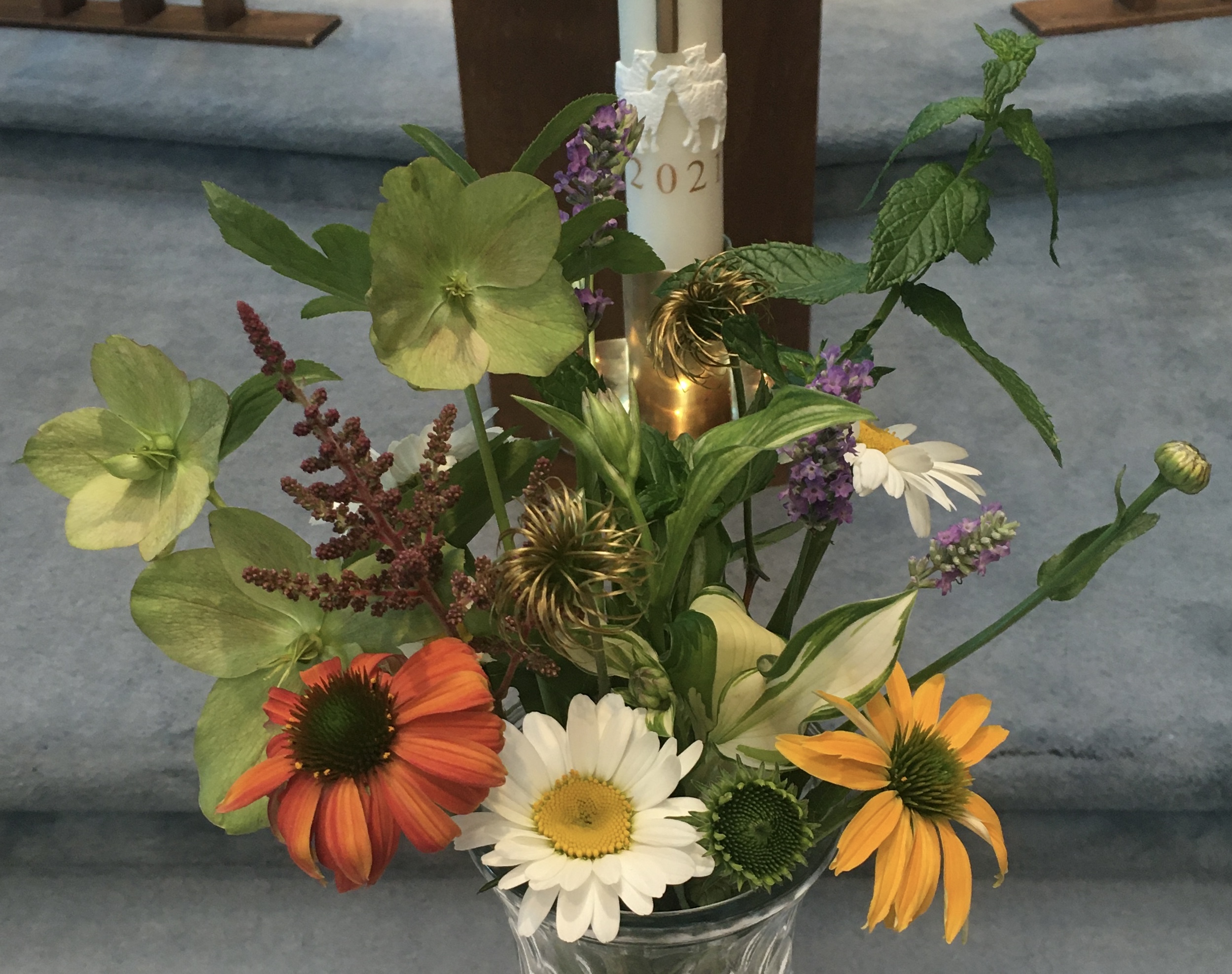
A vase of flowers from Daff’s garden. She wrought the wonders, and the author arranged them.

A Deep Breath and I’m Good Again

A Deep Breath and I’m Good Again

“It’s hell being nuts, Pastor,” Ray said over coffee. “I never know who I’m going to wake up to.”

My friend’s mental illness has been lifelong and ferocious. Hardly a day passes without one of his demons exacting misery. As I’ve mentioned in previous reports, we talk on the phone daily, usually more than once. Our conversations skip like records. He craves tobacco. He’s paranoid. He’s confused. Pray for him.

One of my many places for prayer over the years. I think of Ray and plenty of others and sit with what is.

Occasionally he comes out with a revelation. “I never know who I’m going to wake up to.” If anybody else said this, you’d think he was joking about boozy one-night stands, but not Ray. Every day at 8:53 or shortly thereafter, my cell phone rings—or, I should say, quacks. I’ve recently given Ray his own ringtone so that I don’t rush to answer, not out of insensitivity, but realism. He’ll call back in 20 minutes.

Just as he has no idea what his alarm clock will bring, neither can I predict the stability of the voice on the other end of the line.

“I really want to smoke bad this morning, Pastor.” That’s a common complaint.

“Oh, for God’s sake,” I think, “smoke already!” No, I don’t advocate bad habits, but obsessing might be as carcinogenic as tar and as addictive as nicotine. My annoyance doesn’t linger like it used to, though. A deep breath and I’m good again.

Friendship with Ray is an exercise in forbearance, but it comes with rewards, chief among them is that loving him precisely as he is nudges me into loving others as they are and, no kidding, accepting life as it is.

The latest beneficiary of John’s love fest is the Coleman’s foxhound Sherlock Holmes. The facts are these. Sherlock, as I have noted in the past, is loud. If you could hear him carry on when I get home from work, your guts would quiver. Hollering won’t change this. Ignoring him won’t change this. Filet mignon won’t change this.

Now, I can boil over, or I can remember what Ray taught me: You can’t—or, I insist, shouldn’t—train people or dogs to be something that they’re not. That’s pointless and unfair. Either track down what’s lovable or start kicking friends and pets out of your pack.

Obviously I’m not talking about, say, a woman staying with an abusive man because, oh bother, he can’t change. There are limits.

But if your foxhound goes nuts on the way to the dog park, sounding off with his head hanging out the window, you have choices. That is to say, I have choices. 1.) Stop taking Sherlock to the dog park. 2.) Roar shut up until a sore throat sets in. 3.) Bark along with him. Only one of these makes since. Once the spirit takes over, the chats I have with my sleuthhound are almost as instructive as the ones I have with Ray.

Sherlock’s vocabulary is stunted, but adequate. He’s got ruff, whoop and whimper as well as several variations. Wimper is phonetically impaired, but you get the idea. We drive by pedestrians, who grin or go slack jawed. Some must wonder, “Was that driver barking like the dog?” Why, yes, he was. The performance also includes an intimate exchange. “Rah, rah, roo,” Sherlock often says, undoubtedly meaning, “I love you.” So I respond, “Rah, rah, roo, roo.” “I love you, too.”

At the dog park with one of my friends, Alpine.

After dashing, frolicking and indiscreet sniffing, he hops in the backseat for the five minutes home. Tired into silence, he who sheds fiercely puts his paws on the console, thrusts his head beside mine and slobbers.

Nobody has ever accused me of being tidy, so my gearshift panel is a commotion of dog hair, dust and coffee stains. Thanks to Sherlock, this dry slurry is now cemented in place by K-9 shellac. The dog has a surplus of spit, especially after playtime, and when he pants, that paddle-shaped tongue flings the slime everywhere.

I could get grouchy, but what’s the use? Scolding will never subdue saliva glands. Neither will admonition make a troubled soul wait until 9:00 a.m. to call.

I have some experience with neuroses, so I can confide in you this blasphemy. Prayer won’t still Sherlock’s thrill of the chase or cure Ray’s ceaseless mind. It’s more blessed, if you ask me, to bay with the dog or answer the phone saying, “So who did you wake up to today? If he’s giving you trouble, let’s talk a while. Then I’ll bend God’s ear for you both.”

Sherlock Holmes with grandson Cole. And while I’m on a roll, I not a fan of asking children to be something that they’re not, either.


Oniontown Pastoral: I Mean to be Like Bill

Oniontown Pastoral: I Mean to be Like Bill

A dining room I left behind

Have you ever moved out of a home you loved? Before closing the door, you walked through the empty rooms. Your footsteps echoed. You could hear yourself breathe. Floating from space to space, you knew that you would never leave. Part of you must abide under the ceiling you stared at before getting up each morning and beside the wall you slid down to sit on the floor, crying over terrible news.

You finally drove away, though the weeks were off kilter until new walls became home again.

I find myself on such a road right now. In fact, I’m not going anywhere. St. John’s in Oniontown will be my pastoral perch for years to come—God willing and the creek don’t rise. A small house in Erie will remain the Coleman’s nest.

No, I’m talking about change. Hemispheres of my world are like the hollow home I once stood in, letting all it held and witnessed work joy and sorrow in me by turns.

It’s impossible to explain why certain passings bring on tears while others drift by like wispy clouds. Maybe the best we can do is acknowledge this reality and listen to each other.

Godspeed, Onslow.

What I want to tell you first is trivial to the universe. The blonde horse I named Onslow is missing in action. For a few years he occupied a yard along Route 19 all by his lonesome. He shared space with a comrade named Sandy for a while, then suddenly was gone, along with eight or ten other horses in an adjoining pasture. Two horses still roam the field, but Onslow and the others belonged to a person who took them to another location.

The fenced-in half acre or so my friend haunted is forlorn, especially in March, when the landscape sleeps. I visited him once and couldn’t get him to come close. Will I ever run my hand between his eyes and down his nose? Probably not.

At the same time Onslow departed, a parishioner died, leaving a deserted room in many Oniontown hearts. His name was Bill, and he was my buddy. I’ve never met a man who had such a huge presence and yet expected so little attention or recognition. He liked my “Report from Oniontown” and even watched for Onslow when his travels took him down Route 19. He said Onslow out of the corner of his mouth, then busted out that great smile. His belly laugh, it was the best sauce ever.

But the last thing Bill would want me to do is pace the bare floors, my footfall a sad tick tock. He was about moving on in good time and taking hold of each day’s possibilities.

Bill’s wife Connie passed in 2017 after a long illness. He grieved as his St. John’s family expected, but kept active. “The evenings are tough,” he told me.

“Well, sure, Bill,” I said. The house was quiet.

Then one afternoon he showed up at church and told me that he had a lady friend. I was overjoyed. As anybody who has lost a beloved and found another knows, it wasn’t that Bill was forgetting about Connie. He just had more living to do.

“Her name is Tye,” he said, “and she’s a great lady.”

What a joy it was to watch St. John’s and Bill’s family welcome Tye into the fold.

Those two did everything together, but as I learned after Bill’s death, they were cleared eyed. He was 80 and had all kinds of systems breaking down.

“I was hoping for a year, but we got a year and a half,” Tye said with a smile. It wasn’t enough, though. It never is.

Early on, Bill told her, “I don’t know how long we have, but we’re gonna give ‘er hell.”

I trust God knew what he meant. What they got was 18 months of heaven.

May God rest you, Bill. (Credit: Sherry Lesnett)

When I go by Bill’s house on Mercer Road, I remember that he’ll never again show up at my office for some chin wagging.

He would tell me not to fuss, so I’ll move on. None of us knows what will happen tomorrow, especially given how the world is spinning today. Onslow sure didn’t receive notice of his relocation.

So I mean to be like Bill, to give ‘er hell until the last moment, to close the door of the empty house behind me and light out for a new one, my spirit of good cheer and heart ready for more portions of love.

Oniontown Pastoral: Old Floyd and New Floyd

Oniontown Pastoral: Old Floyd and New Floyd

In Memory of Warren Redfoot

Three of us sat around the hospital bed in Warren’s living room: his wife Nancy, daughter Barb, and me. Under the covers was Warren, all 90 pounds of him. Sticking out were his head, shoulders and left arm, which rose and fell throughout our conversation, as if carried on a breeze.

Miracles were coming out of the man’s mouth. Not that all his words made sense, but never mind sense. Warren was speaking in poetry, which takes inscrutable turns and isn’t obliged to be linear.
“I wish I could make myself understood,” he said somewhere in the midst of the quirky grace he was bestowing on us. We assured him that he was doing fine.

What got Warren rolling was this. Barb said, “Dad, do you want to tell Pastor John about Old Floyd and New Floyd?”

He was game. The story, which had been birthed in his imagination the night before, evades transcription, but the gist is simple. The Floyds are either tractors or men, depending on Warren’s memory at the moment. Old Floyd is doing farm work, but eventually breaks down. Then New Floyd shows up and takes over.

As in the mysterious possibilities of dreams, however, the Old Floyd is, in fact, the New Floyd. “Not the same body,” Warren explained, “but the same.”

He was talking—for the love of God!—about resurrection.

Closing his parable with a flourish, Warren pushed aside imaginary clouds and said, “Then the sun came out.”

Then the sun came out.

“Boy,” I managed through a tight throat, “you could add another chapter to that story if you wanted.”

“Another chapter?” he replied, almost incredulous. “Another paragraph. Another sentence!”

I caught his meaning. This fragile man was schooling his pastor about life, death and everlasting hope. Sooner or later, life boils down to finding a good word, taking a single breath, or touching the cheek of your beloved, as Warren did to Nancy. All that this husband knew of tenderness shone forth as he reached for his wife, to ease her sorrow.

Old Floyd—Warren’s father’s name, incidentally—can see New Floyd coming. Time grows short. One more sentence means everything. One more hour. Another kiss.

These thoughts swept me away. My left hand held Warren’s while the right clamped over my mouth. Barb touched my shoulder. For the first time I was nearly undone at a bedside and thought I might have to excuse myself.

Can you understand? If God leads us to each other to give or receive what we need most, then God, indeed, sent me to Warren and Nancy’s house to receive the assurance of things hoped for, the conviction of things not seen.

Once I regained myself, we shared Holy Communion. Warren’s eyes locked on mine as I held up the bread and cup. No bashful glancing away for either of us, not with eternity so near.

Afterwards Warren asked for a decent swallow of wine to supplement the sliver of bread I had dipped in the chalice and rested on his tongue.

Even though his throat was constricted, I poured him a tiny portion. Never have I seen a believer drink more eagerly. He held the thimble-sized glass above his mouth, the last drop falling on his tongue.

Then Warren said, “I have an urge.”

“An urge?” Barb asked. “An urge for what, Dad?”

“For another Communion,” he said. “Not this one. Another Communion. The next one.”

And then he went on and on about how delicious that wine was. I couldn’t argue.

When Warren seemed to be flagging, I said my goodbyes, but as I reached the door, he called my name. Not “Pastor John” or “Pastor,” only “John,” the name I pray one day to hear God whisper into my ear.

I turned around to face Warren reaching skyward, like Atlas holding up the planet.

I did the same. We kept the silence together.

“Peace?” I finally asked.

He nodded, mighty under the weight of the world: “Peace.”

Driving home, I sighed to hold off tears. “The Spirit helps us in our weakness,” I remembered, “for we do not know how to pray as we ought, but that very Spirit intercedes for us with sighs too deep for words.”

Old and new.

Warren was every bit the Spirit to me. Maybe for a moment, like those Floyds, they were the same. I don’t know. But what I can say for sure is this: When my skinny old friend gave me a foretaste of the feast to come, the beauty almost made me go to pieces.
Oniontown Pastoral: A Season for Holding Hands

Oniontown Pastoral: A Season for Holding Hands

Dear Mom:

It’s been 21 years, and I miss you more than ever. Can you look over my shoulder and read my words from your place in glory? May it be so.

The urge to write you has been strong lately, and I know why. This is a season for holding hands. My St. John’s family has been saying goodbyes, glancing toward heaven and longing for miracles. When we’re not actually crying, tears still try to push out from behind our eyes.

My job, of course, is to show up at hospitals or nursing homes or, best of all, home-sweet-homes with a satchel full of hope. You know, Mom, the promises we foolish Christians bet our lives on, the prayers we remember even when our minds have left us stranded, psalms about “goodness and mercy,” the hills “from whence cometh our help” and the night that “shineth as the day.” And Holy Communion, for sure.

One zipper pouch is a crumbled mess of humor, like the loose Kleenex you stuffed into your purse. Life, I’ve learned, doesn’t stop being funny or absurd because time grows short. Anyway, laughter generally refuses to let weeping wander off alone. But you already knew that, didn’t you? How clear everything must be to you now.

What makes me think of you most is handholding. Again, I know why. As death draws near, prayers and Scripture want a special amen: one hand cradling another. No seminary education is required to do this part of my job. You taught me all I need to know, and for going on 20 years, I’ve been sharing your motherly touch with folks in my care. Gentle, light, quietly abiding, that’s how it is and has been.

Art. July of 2015. He decided to forgo dialysis and surrender. Settling back in the hospital bed, he said, “Now, help me through the door.” I held his hand, rough, smaller than mine, and cried without him noticing. He already had his eyes fixed on the Promise.

Quen. This October. Such big-boned hands, powerful in his prime. How many times did I hold them and say, “You’re a good man, Quen. You’ve been a good husband and father”?

“Well,” he said, his voice more faint and raspy by the month, “I sure have tried.”

He passed after his family and I joined hands around his bed and talked to God. Quen’s daughter drew on his forehead a cross with the perfumed oil of anointing, which marked him still when he breathed his last.

And Shirley. Last week. Her hands reminded me of you, Mom. Same soft, fragile skin, warm and giving as yours were. Shirley’s rested as if already in repose. I sheltered them under my own, leaned in close, whispered Psalm 23 and the Lord’s Prayer and told her it was OK for her to go. About four hours later she did just that.

Your Christmas cactus lives, Mom.

Your hand was pale purple, chilly and bloated the last time I held it. I spoke words of love and gratitude that will remain between us. A couple times you moved that clumsy, heavy hand, poked raw by needles and punished by arthritis. Were you trying to say that you could hear me?

When I left town, things could have gone either way. Maybe the sepsis would take you, but maybe not. I had to get back to seminary, back to Columbus. “What good can I do here?” I thought—a rationalization and a question.

Now I know. Honest to God, a couple days ago I almost had to pull off the road when the answer grabbed me by the throat: “Here’s what good you could have done, John. You could have held your mother’s hand until she died.”

Oh, Mom, you were so sick and senseless, fogged in by troubling dreams. Maybe you were out of touch, but that doesn’t matter. I should have stayed. I should have kept holding your hand.

In heaven unfinished business has to be checked at the gate. Right? Even so, I’m really sorry.

You wouldn’t want me to punish myself over this. But please understand, every time I hold a hand, I also reach out to where you are. And when I drive to Oniontown homes to comfort pilgrims on their last journey, part of me is a much younger man turning his car around and heading north, back to your bedside to help you through the door of a house with many mansions.

Love,

John