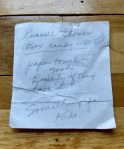
If only folks would pay as much attention to what they say and how they say it—whatever the medium—as yesteryear’s kids did mastering the stubborn capital “G” or lowercase “z,” how much better off humanity would be. Continue reading
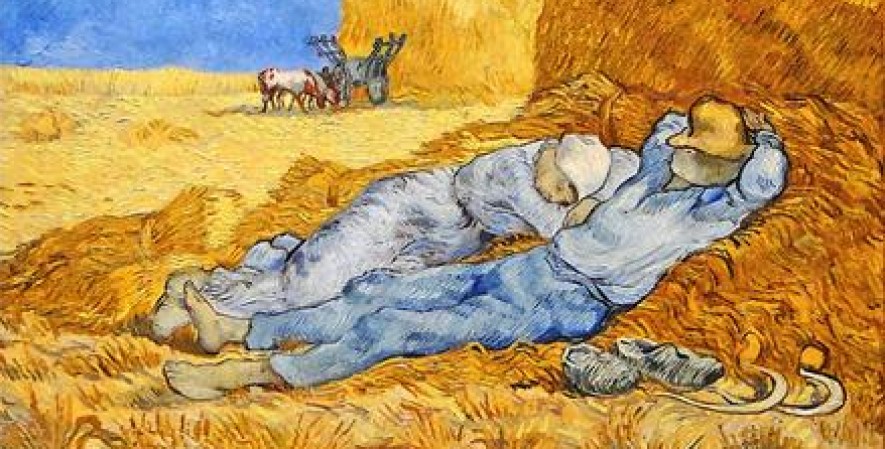
If only folks would pay as much attention to what they say and how they say it—whatever the medium—as yesteryear’s kids did mastering the stubborn capital “G” or lowercase “z,” how much better off humanity would be. Continue reading

Hardly anything is simple anymore. Children’s car seats now have expiration dates. Tiny screens are here to stay, but they anesthetize little brains. How long is too long? And, panning the camera for a global look, our climate is, like parents right now, under duress. Continue reading

Yes, Mom, I know it’s possible that I’ve written this letter only for myself—a hopeful, neurotic middle-aged man—and that you may be nothing more than the bone and cinder your children buried in June of 1998. But I can’t help hoping that existence is as abiding as your Christmas cactus and as fair as your great-grandson Cole. Continue reading
Oniontown Pastoral: Too Late Smart, Too Soon Old
Driving from Erie to Oniontown and back a few times per week, I have lots of time on my hands. I listen to podcasts that help me prepare sermons. Over my nearly seven years as pastor of St. John’s Lutheran Church, I’ve spent hundreds of hours on audiobooks, mostly biographies of United States Presidents. A month ago I met my goal of covering all of them—provided they are safely under the sod. When my brain needs to rest, Jussi Bjorling or Bach or Elizabeth Cotton takes the dashboard stage. Now and then, it’s just silence.
The common denominator is listening, which leads to thinking, even when James Buchanan is messing the country up before Lincoln takes the oath or Cotton strums her gentle guitar left-handed, upside down. My ears are open, mouth is usually shut, mind flirts with this idea or that and heart often migrates to my sleeve.
The other day, when the only sounds were the engine’s mumble and tires sighing on the road, longing came over me. Of all the exegesis, literature and music I take in and treasure, what I want to hear most is silent as soil.
I miss my Mom. I miss my Dad. Grandparents and aunts and uncles, too. But miss is a milquetoast word. My belly had the blues and my eyeballs were heavy. Dear God, let me ask them questions and receive their stories.

When folks say they have no regrets, I keep my own counsel. Regrets? You better believe I have them. A full accounting will have to wait for another day.
As retirement inches toward me, I realize in my blood, bones and tears how much I love my late elders and how starved I am for their company. Three or four decades ago it never occurred to me what a sacred use of time it would have been to sit close to, say, my mother or my Aunt Mart in their last years and gather the fullness of their lives up into embrace. But something always seemed pressing—a pleasure to chase down, a duty to meet. If only I had known that the biographies I needed far more than Andrews Jackson or Johnson were Grandmas Miller and Coleman. And if Uncle Kenny were alive, I’d have bottles of Koehler Lager on ice and a pack of Lucky Strikes at the ready. He and I would clink those glass bombers, and I’d gladly sit still for what he’d have to say.

Fortunately, my regret comes without recrimination. A parishioner of mine passed along to me a great saying one of his elders told him: “Too late smart. Too soon old.” Back when the voices I incline my ear toward in memory were talking, I had better things to do. That’s the sad truth. I know too much about human frailty and foolishness to punish myself. Anyway, those lovely faces—all the more dear to me for their wrinkles and jowls—would say, “Oh, John, don’t you worry.”
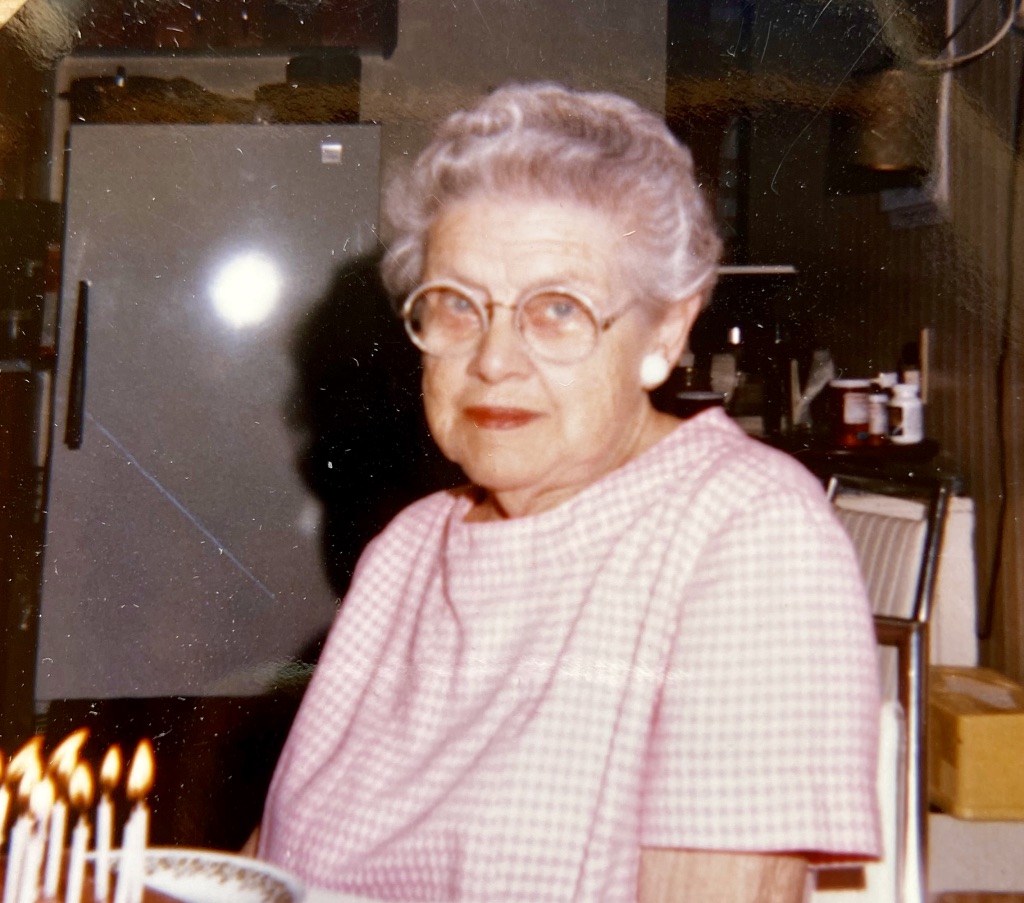
They’d probably also encourage me to relax, for heaven’s sake. I’m trying. For one thing, wise and vigilant advice from childhood no longer works for me: I now talk to strangers.
People asking, “How you doing?” don’t know what they’re getting themselves into. My recent responses are as follows: “Vertical,” “I think I’ll pull through,” or “Any better I’d be twins.” That last one is stolen, but I can’t remember from where.
Strangers having a casual conversation in public had better keep their voices down when I’m near. Just yesterday wife Kathy and I were in a toiletries store, and two young women were teasing a third that she thrusts her hip to one side when shifting her weight—like she was trying to look glamorous or cool or whatever. It was all in fun. After paying, I stopped and said to the glam girl, “You know, they’re just jealous because they didn’t go to finishing school.” A moment’s repartee ensued, which granted us the healthy exercise of laughter.
Best of all, during a recent heat wave, the dew point was 73 degrees, which is considered miserable. I was walking to my car and spotted a couple older than I making slow progress toward the store. They looked to be slogging under water, the man leaning hard on his walker.
“So, is it hot enough for you?” I said. Not exactly original but it earned a response.
The guy kept on walking, but looked over his shoulder at me: “No! In fact, I’m going home to put on a sweater.”
I thought immediately, “Lord, he sounds just like Dad.” For a minute the late Denny Coleman was near, and my soul felt light all the way home.

Oniontown Pastoral: Wakefulness at Twilight At first the term “sleep hygiene” confused me. Who relates laying your head down at night and hauling it upright in the morning with cleanliness, after all? But when scientists delve into an issue, language … Continue reading
Letter to My Grandson, for the Future
July 7, 2021
Dear Killian:
My five-year-old pal, you are having one rough time. In 10 years or more, you might find some value in your Pop’s thoughts about what your heart, mind and body are going through these days. I’m asking your mom and dad to hold onto this letter until you’re confused, stuck, maybe miserable, trying to figure yourself out—why you feel like you feel and tick like you tick.
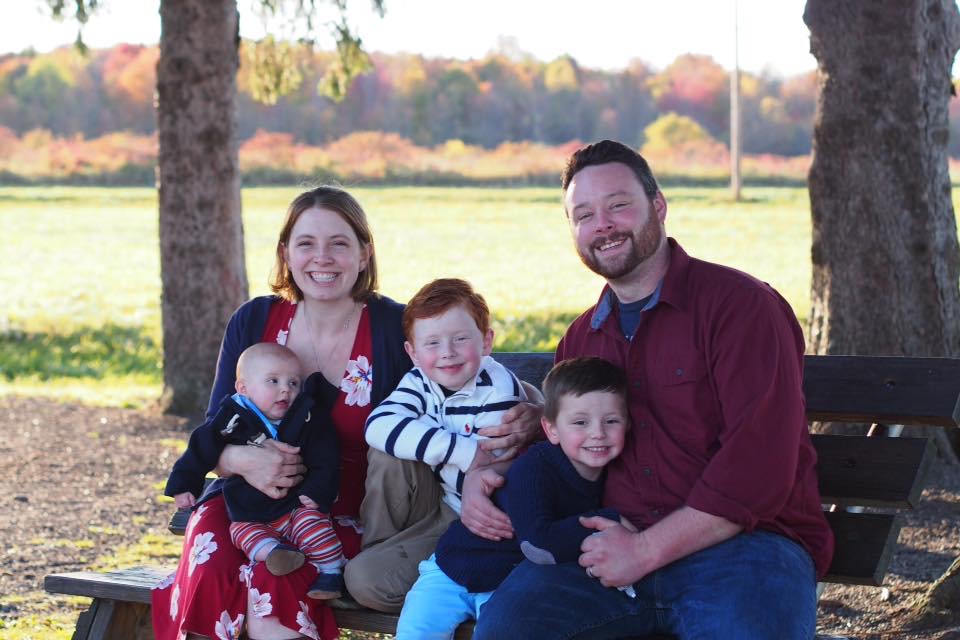
I’m almost 60 now, and for the whole stretch I’ve over-thought and over-felt nearly everything. I’m a genius at crippling myself with worry and concocting troubles that don’t exist. Just before your mother was born, I started to have panic attacks that raided my sense of self for a good five years. “Anxiety disorder,” that’s the box my therapist checked on my bill after each session.
Now at this point, listen closely. I’m not saying that someday you’ll go through what I went through. No, no, no. It’s just that the struggles you’re enduring tell me that you have a sensitive soul, like your Pop’s. If this is true, you’re in for a ride. Joy will take your breath away hour by hour. On the other hand, the wrongs you witness will bring on tears or—as my mother used to say—“make you so mad you could spit.”
The older you get, the less you’ll remember the preschool-aged Killian. I’m a reliable source, though, and you could do far worse than consider whether the boy you’ll now read about has turned out like his grandfather.
First, a caveat. Keep in mind that the last two years have been bat crazy. The Coronavirus, which has claimed over 600,000 lives in the United States alone, still has us frightened and confused. The social and political climate—to say nothing of our changing planetary climate—is brutish and wicked. In short, to be an American of any age in 2021 is to be hemmed in by exhausting absurdities.
Be assured, your mom and dad and both sets of grandparents are tender and mindful, doing everything possible to give you a safe, lively and fulfilling childhood. You and your brothers are lucky beyond measure. But I wonder if, despite much wise protection, you still manage to absorb how nasty and bonkers the world around you is without having the cognitive development to process it all.
Although your life with family and friends is charmed, you take deep breaths constantly. You’ve got a fiery, nameless burden in your chest that returns even as you blow it out through puffed lips.

For months now you’ve had a cranky stomach. You chew food, then chipmunk it in your cheeks, afraid to send it down for digestion.
Sometimes in the middle of the night you wake up with cramps in your foot. For a while your eyes were always itchy, and I thought you might rub them right off your fair face. Oh, and for another while you got sharp headaches while riding in the car. All of these concerns are improved, thanks to your mom and dad’s persistent efforts to find causes and treatments.
You’re now reading about your younger self and maybe saying, “Man, I was a mess.” Well, to tell the truth, kind of, yes. I would call you delicate. Your mom said, “Some kids are dandelions, some are orchids.”
So far, your older brother appears to be a dandelion, while it’s too early to predict what flower your younger brother will be. But you, sir, are a delicate orchid. Accept no blame on that account. Feel no shame. This is a comrade addressing you. If honorary doctorates were awarded for fragility, your Pop would have a wall full.
My list of your ailments isn’t offered to depress you, but to open you up to self-awareness and ultimately a growing sense of ease with the person you are. This moment’s cleansing breaths and bellyaches may well be outward signs of turmoil trapped inside you. Nobody knows for sure.
But since your folks have handed you this letter, what you went through so long ago is possibly paying you a return visit—in a new form, spurred by new circumstances, wearing a new mask. Then again, maybe nothing is wrong. Mysteriously you’re rubbing your eyes again for no good reason. Riding in the backseat hurts your head.
Mystery is the perfect word. Microscopes and test tubes teach us what truths they can divine, but human beings pretend to know more than we really do. In many ways, the person you are and the person I am are mysteries. We are tiny mysteries caught up in a loving, but ferocious, embrace of the Great Mystery.
Why is Killian Thompson the way he is? No matter how you answer that question, in dark valleys you might long to turn into a different person altogether—somebody stronger, braver than you are, some carefree guy whose troubles lift from his mind like morning mist.

If you are ever granted such a wish, you will find what’s left of me inconsolable in my writing hut. You will little remember how many times I sidled up to the troubled five-year-old you, pulled you toward me and kissed the sandy shock of hair behind your right ear. Nor will your hurting feet recall the heat your grandmother applied to them at 5:00 a.m. And how could you know that your mom and dad breathed in your every sigh to be sure you never worried alone?
I ask you now, Killian, to trust that your parents and grandparents have always had but one fervent intention: To help you give birth to yourself and to love you so fiercely and unconditionally that you will dare to love yourself—exactly as you are and much the same as you were in 2021, when you gave your Pop more gladness than you’ll ever know just by sitting in his lap.
With abiding love,
Pop

For starters, I expect snickers, snorts and eye rolls, and I’m prepared to be corrected, though I won’t concede without some back and forth. That said, I’ll present my case directly: The two most powerful agents in the world are … Continue reading
Oniontown Pastoral: Why I’ve Been Quiet Lately
Dear Friends:
It was tomatoes cooking, the kindly surprise of their smell, that brought me around, helped my spirit to its feet and pointed me in a good direction.

If you look forward to my column in Greenville, Pennsylvania’s daily, The Record Argus, or my posts at A Napper’s Companion, you may have noticed that I’ve been quiet lately. When world and native land are convulsing in myriad ways, of what account are tomato-perfumed wisps rising in a middle-class kitchen? When the television news serves up images of relentless rage and pandemic, mentioning the cleansing joy of wife Kathy’s sunflowers bending in the breeze feels intrusive. When we human beings are enduring the labor pains of birthing a new society—and meanwhile throwing tantrums over trivialities and wetting our pants—who wants to think about a couple dozen corn stalks rising from a raised bed, the soil a mix of household compost and manure from a dear friend’s cows?

Kathy’s corn, not a lot
Maybe you do. I now believe my silence in recent weeks has been misguided. “Don’t go all poetic on me, John,” I imagined you saying, “about standing at a stove or pulling blessings from a garden, about how basil makes a sauce sing, about how walking by a bush of spearmint touches a place inside you didn’t know was aching. No rhapsodizing at a time like this, when so many of us are at each others’ throats and hardly an hour passes without yielding fresh anxiety and confusion.”
Of course, you weren’t saying anything like this. The fact is, I had convinced myself that what normally moves me to make paragraphs wasn’t relevant anymore. We all have bigger fish to fry, as the cliché goes.
But then those tomatoes reminded me of last summer, before the complication and misery of 2020. Kathy’s crop necessitated daily decisions. Would I make spaghetti or chili for supper? Or would I core and simmer down yesterday’s basketful, let it cool and pour it into freezer bags? More often than not, when Kathy got home from a day of nursing cancer patients, she would pause just inside the backdoor, close her eyes and breathe in.
“Oh,” her mantra went, “I do love the smell of my tomatoes cooking.” And then we’d kiss.
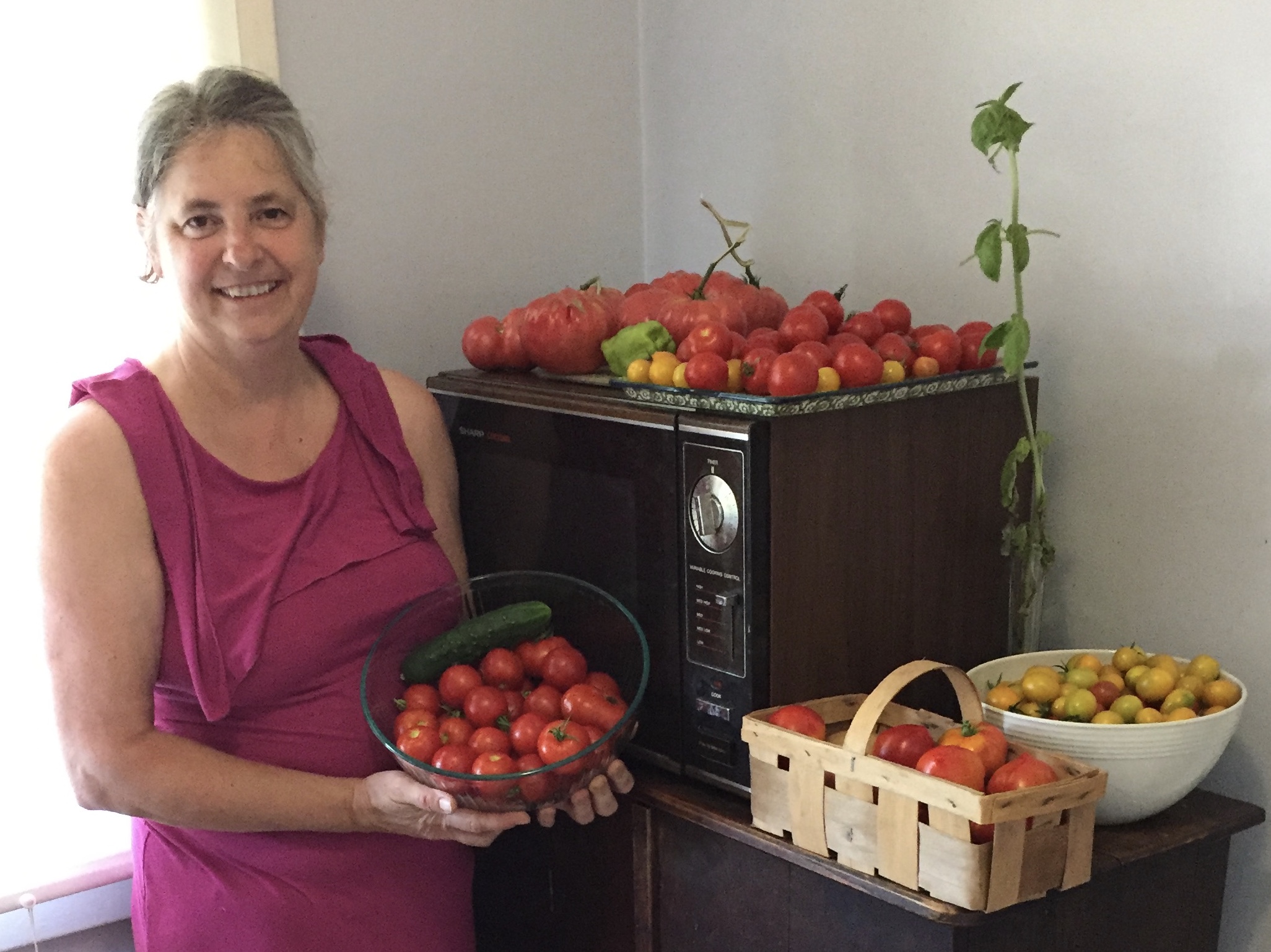
Kathy in August of 2016, with some work for me to do.
Yes, Norman Rockwell might have painted me wearing an apron and holding a wooden spoon straight up while Kathy looks on with rosy cheeks and a slight smile, but not one detail of the scene is embellished, honest. This was the start of our evening together. This was home and family and marriage. This was life and love.
All of these thoughts came to me wordlessly when, the other day, the pageantry of preserving my wife’s bounty started up again with the lovely scent I’ve described. She has already pulled garlic and onions, which I regularly help to fulfill their aromatic vocation, and canned some dilly beans. Cherry tomatoes are piling up, and, yes, I cook them along with the Better Boys and Romas and freeze them flat. That glad task will wait until tomorrow.
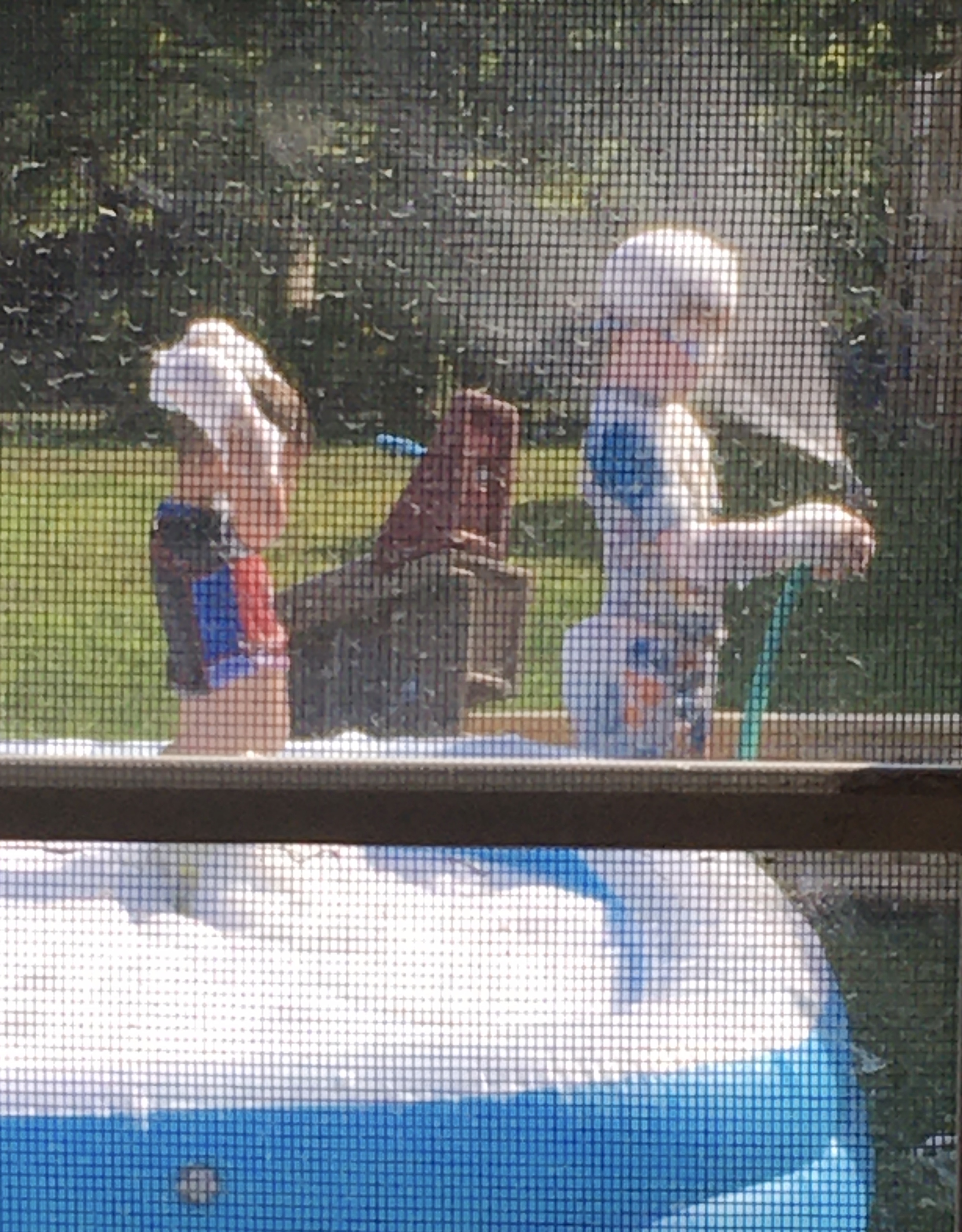
Out my writing hut window, grandsons and suds
At the moment Kathy is drizzling dish liquid into a slowly filling blowup pool. Grandsons Cole and Killian are staying over this Friday night. I’m watching them from my writing hut—more on this new outbuilding on the Coleman farmette soon. Killian is running the length of the yard and jumping into the shallow foot of water, emerging suds covered and delirious. The way Cole is waving the hose around to make water snakes in the air, the pool may never reach capacity. No matter.
Planet Earth may be going to Hades in a hand basket, but even the gates of hell shall not prevail against my grandsons’ wonders in this hour. Nor can powers and principalities stop Kathy’s sunflowers, soaring six feet above the corn, from waving at me.
Silence is a skillful teacher, but its students are lost unless they listen with the ear of their heart. That was my problem. I paid attention to the faculty members who scream and shout that their subjects, crucial though they may be—war, oppression and illness—are the only ones worth studying.

One of Kathy’s sunflowers
So I write to insist otherwise and resume interrupting our shared daily travail with promises. Tomatoes still ripen in August and will remind you of grace if you put them on to cook. And sunflowers will bow to you when the wind is right. Remember to breathe deeply and bow in return.
Love,
John
Oniontown Pastoral: Afternoon of the Gladdened Heart
If my blessing had a face, it would belong to a three-year-old as yet unpunished by disappointment. Time ages us all, but it’s toil that paints pale bruises under our eyes and sculpts wrinkles and jowls. Anyway, the darling cheeks of my blessing would be smeared with grass and mud. A mother would lick her thumb and go after the mess, but the child would twist loose before the job was done.
This is for the best. What catches my aging breath isn’t in the child’s face alone, but in the anointing of sweat, dirt and spit. And especially in what once annoyed me, but now returns as longing: Being pulled close by my mother, looked at with what only ancient Greek fully captures, agape, and gently tended.

Killian and Cole, ready to go play in Grandma’s backyard
The blessing was simple: Kathy and John Coleman’s grandsons, six and four, played in our muddy backyard. They filled milk jugs from the hose and made a pond behind our garage. Given enough time, they would have built a moat. As Cole and Killian troweled new layers of crud on their skin and jeans, son-in-law Matt and son Micah sunk posts in for a fence, and pregnant daughter Elena and Kathy kept an eye on the boys and talked. I sat on the steps, mindful of the sun. The shepherd’s pie I had labored over bubbled in the oven.
My efforts, I confess, were fortified by a splash of Cabernet Sauvignon. Having skipped lunch, I wasn’t drunk, but my heart was gladdened. In this condition, I watched with outsized pleasure Cole and Killian, whom Kathy and I hadn’t seen much during the Coronavirus pandemic, lose themselves in the possibilities and wonder of their grandparents’ yard. For good or ill, we adults had decided to loosen the restrictions within our family.
Many grandparents live far away from their grandchildren, an arrangement that would dig a ditch down the middle of our lives. As the weeks wore on, we saw the boys from six feet away. We didn’t hold their hands or kiss them on top of the head or pick them up. Kathy got weepy when the subject of being separated from Cole and Killian came up and crossed her arms in a hug that came up empty.
If having grandchildren were worship, then those boys perching on my lap and leaning into my chest would be Holy Communion. I never take for granted being Pop next to my wife’s Grandma Daffy and the good fortune of our adult children choosing to reside nearby.

Grandma Daffy and Cole: A sacrament
So the blessing was mostly this: Peace in the family, laughter in the yard, grandsons who come near again. Every once in a while a gathering of minutes is so right as to seem otherworldly. Friend Jodi told me about a day long ago when she and her brother were fishing on calm water. Leaning back in his seat and looking at the sky, he said, “I feel sorry for anybody that’s not us right now.”
That’s one way of putting it—grace tells the seconds to hush and mercy is perfect air passing over your arms and face.
Man, was I happy. Who knows why, then, my late father joined me on the steps? He would have rolled his eyes at my glass of red restorative. He was a Schlitz man, not an alcoholic, but in leisure hours he could dent a case.

Credit: Wikipedia
50 years ago I sat with Dad on Grandma and Grandpa Miller’s porch steps. No talk. The beers had gone down quickly, and Mom was mad that he had gotten a fat tongue before family dinner. He stared somewhere far off, beyond Horton Avenue. Dad was in the dog house for good reason, but I’ll never forget how licked he was. My parents weren’t made for each other, that’s all. Sad time stretched out in front of him–and Mom, too, I know–long loveless summers of little but getting by.
It was strange, but lovely, to recall my father’s saddened heart while the great-grandsons he never met ran carefree “in the sun that is young once only.” My unmerited joy rested Dad’s defeat on its shoulder and was the sweeter for it. Maybe this is why I thought of him. That could easily have been me decades ago, slack jawed and dazed on the in-laws’ steps, a son keeping vigil. Lucky is what I am.
The face of gladness is young, fresh with promise, but it’s not real without the streaks of earth and blades of grass. That’s how I know it belongs to me.

Killian digging a hole next to the house
Oniontown Pastoral: Story of a Hero in the Small Hours
“Elevander and Milkus,” grandson Cole said through tears from the foot of my bed. It must have been around 1:00 a.m.
Cole and his little brother Killian had landed at Grandma Kathy and Pop’s house at 6:00 p.m. for a sleepover, followed by our Sunday drive to Oniontown for church.

Half an hour later, Kathy and Cole were cuddling when she said he felt warm. I kissed our ginger’s forehead, the temperature-taking method my late mother used. The patient was not quite burning up.
Kathy encouraged grape ibuprofen, but was rebuffed. No surprise there. Our own daughter and son regarded any remedy for a fevered brow as outrageous, possibly unconstitutional.
By 7:30, Cole was ready for bed. A scant half of our enclosed front porch serves as a prayer corner for Pop, and the rest is “Cole’s Room,” dubbed by the lad himself with the same swagger Columbus displayed in claiming the West Indies for Ferdinand and Isabella. On sleepover nights, the sofa bed there gets pulled out, and Grandma and “those babies,” as she calls them, prop themselves up on an embarrassment of pillows, lean into each other and watch cartoons.
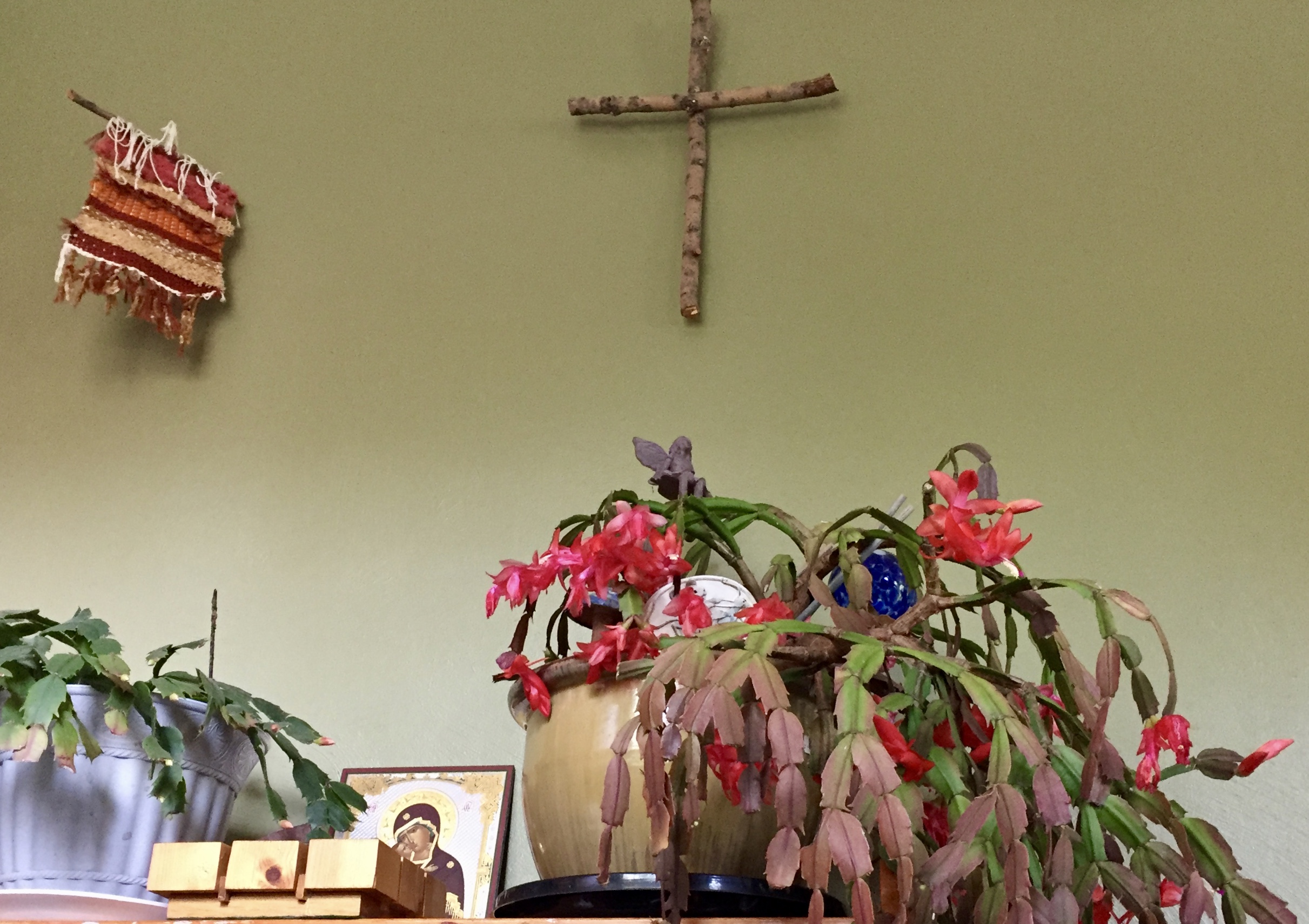
A scant space for prayer
Kathy, it must be noted, is no grandson’s fool. She goes for a soft sell. “Hey, best buddies,” she says, “it’s time to get ready for bed.” Not time to sleep, mind you. These things must be done delicately. First, get pajamas on, then slide under Grandma’s feather comforter with nightcap in hand—juice box, tortilla chips, rack of lamb, whatever it takes. Eventually, glad bellies and slapstick animation lower the boys’ defenses and slumber descends.
The routine is glorious, every crumb and dribble of it. On the night in question, Killian was clinging to wakefulness when I retired to Pop’s Room. Cole was long gone.
Having a queen-sized bed to myself ought to be glorious, but I’d just as soon keep our quartet together the whole night through. With Grandma Kathy between them, though, Cole and Killian’s last waking moments on that lumpy sofa bed seem an adventure, as if she is keeping watch as they sail over dark waves toward dreamland.
Whenever the boys stay over, my sleep is light, ears keen, especially to a child’s cries. Kathy can normally rock and coo her shipmates back to sleep, but occasionally Pop is called upon to sing a shanty of sorts.
That’s what brought Cole to the foot of my bed. He needed a story—not from a book but one of his very own. The protagonists of choice are Elevander and Milkus, stuffed brother and sister rabbits whose names Cole inexplicably blurted out to his mother one day.

From Left to Right: Elevander and Milkus
The plots of late are as unlikely as the characters’ names. A year ago a micro-tornado hit my daughter’s house, flinging the boys’ swing set over telephone wires a full block away.
In my yarns, Cole found Elevander and Milkus hiding behind the garage after the twister. He brought them into the house and cared for them until a climbing wall replaced the swings. Then he made them a home in its shelter. Hay from Grandma Kathy’s garden provided a sweet bed, and Cole asked Killian to get lettuce and carrots from Mama for his friends.
Telling Cole a new chapter, I knew Kathy and I wouldn’t be bringing those babies along to Oniontown in the morning. They would go home instead. Still, I was determined to remain at my post and finish my duty.
After surrendering to sips of grape medicine, my boy lay nose to nose with me as I recounted the arrival of two squirrels whose tree had blown down. They had heard rumors about the boy nearby who took in a couple of frightened rabbits.
Elevander and Milkus happily shared quarters with their bushy-tailed neighbors, and Killian ran to get them peanuts from the cupboard.

Killian, full of joy, whose name will be added to Cole’s Room soon enough (Credit: Elena Thompson)
The next day, of all things, a lost pony showed up. Cole figured the rabbits and squirrels could spare some hay for their new guest until Grandma brought more. Everyone had plenty to eat, a place to sleep and love enough to believe that tornados are no match for kindness.
Part way through my tale, Cole made a bathroom run. Pausing at the foot of the bed, he put up his finger and said, “I’ll be right back, Pop.” As if I would go on without him!
Cole doesn’t realize yet that he is the hero of every Elevander and Milkus story. I want him to fall asleep knowing that real heroes are most of all kind.
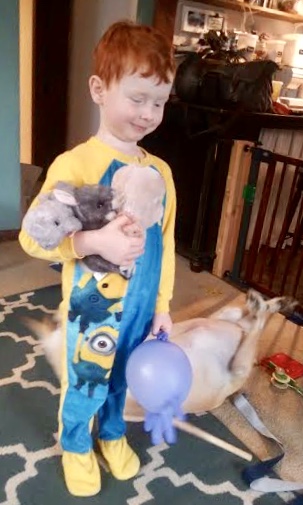
Cole, awash in antibiotics, holding Elevander and Milkus, with new arrival Bunny Bunny snuggled between.
 A Napper's Companion