A Case for Human Beings

A couple weeks ago an email from Mount Saint Benedict Monastery landed in the morning:

Sister Phyllis Weaver went to her Eternal Reward last night (Monday) around 9:00PM following a very brief illness. She was surrounded by her family and a number of Community members. S. Phyllis touched the lives and hearts of many through her years of ministry in education and hospitality.

IMG_1326

Posted on the wall of my room in the monastery’s guest wing.

Until a few years ago, Phyllis was the sister I called to reserve a room or hermitage. When my daughter and son, now grown, were going through terrible times, I crawled to the Mount for sanity. The place was—and still is—life! Phyllis was at the center for me, greeting me when I arrived and checking on me unobtrusively when we saw each other after worship or lunch. Near the end of her call as Hospitality Coordinator, Phyllis’ shuffle gave way to an electric scooter—no padding left on the soles of her feet, she explained, just bone and skin.

In retirement, Phyllis’ prayed for retreatants. I needed her petitions for their intention if nothing else and appreciated them as I rested like a crimson bruise in the light of the chapel’s stained-glass windows.

IMG_1339

A lamp in the chapel at Mount Saint Benedict Monastery.

Kids often outgrow problems. Most bruises fade. But Phyllis’ and her sisters’ gift during some raw years has grown in me and taken on more color than I can say: “Let my life be about loving people, one brother or sister at a time, moment by moment.”

If only I could be my own answer to this prayer. The best I can do some days is draw a meager smile from the deep well of mercy I’ve been granted. Still, Phyllis extended to me love based on the conviction that the Creator’s Spirit dwells within all people and nothing in daily life is more sacred than that moment when a person needs love in one of its countless forms and another person provides love gladly. “Let me recognize the Ultimate in you,” I say, “and may you find love in my eyes.” My namaste is ragged. If it gives warmth, it comes from a cold and broken hallelujah.

I do trust the Divine Mystery to lead us to security eventually, but for now, I feel the cold of a world order in which being human doesn’t count for much. As massacres and fiascos make a disturbing media racket, people–individual dwellings for the Ultimate–lose life quietly, invisibly. Society’s eye evaluates humans, and, increasingly, we are expected to defend our personal cog on the rim of an imposing, impersonal wheel.

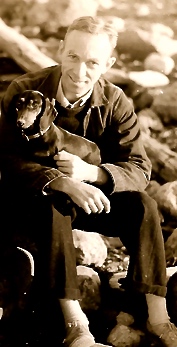
I’m talking about progress. E. B. White first drew my attention to the crooked assumption that the best way to improve life is to nudge human beings out of the picture. In a 1955 New Yorker essay, White grumbled that the telephone company “saddled us with dials and deprived us of our beloved operators, who used to know where everybody was and just what to do about everything.” Good thing he passed in 1985, before call waiting and voice mail joined our cultural lexicon.

EB_White_and_his_dog_Minnie

E. B. White holding his dachshund Minnie (Credit: Wikipedia).

I don’t think there was a religious bone in White’s body, but he and Sister Phyllis probably would have hit it off. She was all about taking care of pilgrims, and he wrote, “All that I hope to say in books, all that I ever hope to say, is that I love the world.” You can’t read one paragraph of E. B. White without recognizing that his world was human beings and animals. He was against whatever threatened either one.

In the last month I’ve heard stories that worry me. Andy, as White’s friends called him, would bristle. And I’m not sure, but Phyllis might have just shaken her head and returned to praying for retreatants.

–A December 14, 2014, New York Times article by Claire Cain Miller opens with a troubling trinity: “A machine that administers sedatives recently began treating patients at a Seattle hospital. At a Silicon Valley hotel, a bellhop robot delivers items to people’s rooms. Last spring, a software algorithm wrote a breaking news article about an earthquake that The Los Angeles Times published.” If somebody is going to sedate me, I want to look ‘em in the eye. And some of my friends are print journalists, a profession already in decline. I’m not sure what an algorithm is, but it’s a scab compared to Jennie, Gerry, and Erica.  

Vince_Plover,_working_as_a_bell_boy_at_Lennon's_Hotel,_Brisbane

A robot or young bellhop Vince Plover? I prefer the kid, even if I have to tip him. (Credit: Wikimedia Commons)

–Also from Miller’s article: “Ad sales agents and pilots are two jobs that the Bureau of Labor Statistics projects will decline in number over the next decade. Flying a plane is largely automated today and will become more so.” As a jittery flyer, I don’t want my plane piloted entirely by computers. They fail without warning, constantly leave the backdoor unlocked, and refuse to accept reason.

–NPR ran a story about computer chips being implanted in grape vines. This technology can take the guesswork—or artistry, depending on your point of view—out of watering and harvesting. When a commentator claimed that the chips’ grapes made better wine than the winemaker’s, I thought of poor Paul Bunyan being surpassed by a chainsaw.

unnamed

Cabernet Sauvignon at the Coleman dining room table: I would love to meet the winemaker.

–A couple of weeks ago NPR’s Marketplace reported on the sale of PetSmart to a private-equity firm. Amidst the chatter somebody commented that Walmart-type stores cut into PetSmart’s business by carrying lots of pet supplies. At once my White-ian fears took hold. How long will it be before you can accommodate all of life’s needs at a single destination? Get your Airedale bathed and groomed while your SUV gets snow tires put on. Pick up General Tso’s chicken for supper. Have cataracts removed and touch base with your life coach. Yes, I’m being silly, but a voice in the ear of my heart warns me that herding every specialty under one roof managed by one entity could make transactions more uniform and less personal.

Maybe I’m wrong, but for fun I just Googled “shoe repair erie pennsylvania” and discovered that in my hometown proper, one shoe repair shop survives. The idea to check came when I saw that Dom Bruno’s Shoe Repair in Little Italy had closed. Ten years ago I took a pair of black wingtips to Dom, who resoled them for $45. Sounds like a lot, but those refreshed throwbacks remain my only pair of black dress shoes.

IMG_2920

“Where have all Dom Brunos gone, long time passing?” The thin, corner shoe repair shop that healed my wingtips.

IMG_2919

The only grainy evidence that Dom Bruno ever had a shop on Brown Avenue–a cardboard poster.

According to Google, M. A. Krug and Son is now my only option, unless I want to drive fifteen miles west to Nick’s Shoe Repair in Girard. My wingtips need attention, and I wish for a redundancy of shoe repair shops in Erie, Pennsylvania–and at least one mom-and-pop corner store in every neighborhood.

photo-24

Good and faithful servants: seams splitting in a few places, soles wearing, gnarly inserts

On the way to Sister Phyllis’ viewing, I made a sad discovery. Unless somebody is tending shoes beneath an inconspicuous shingle, Erie, home of around 200,000 feet, is bereft of cobblers.

IMG_2905

Google is wrong. Mr. Krug no longer repairs shoes. Stereo equipment, old albums, and silly signs now fill his shop.

IMG_2906

Posted by the entrance: Mr. Krug had a gruff sense of humor?

IMG_2910

Across Peach Street from Krug’s place, another dead shoe repair shop. Seriously?

IMG_2914

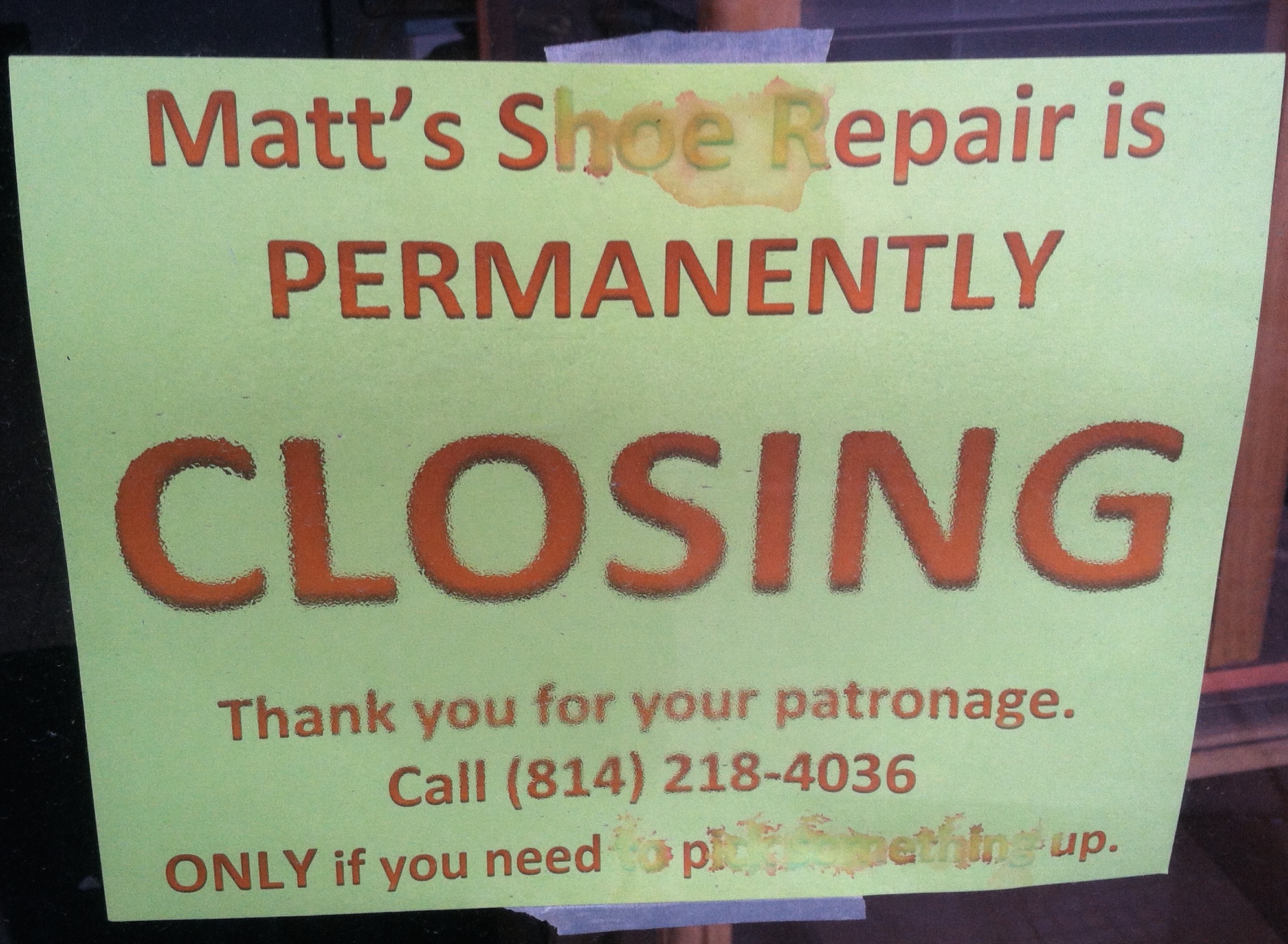
How long had the business been closed? Long enough for ink to run.

IMG_2917

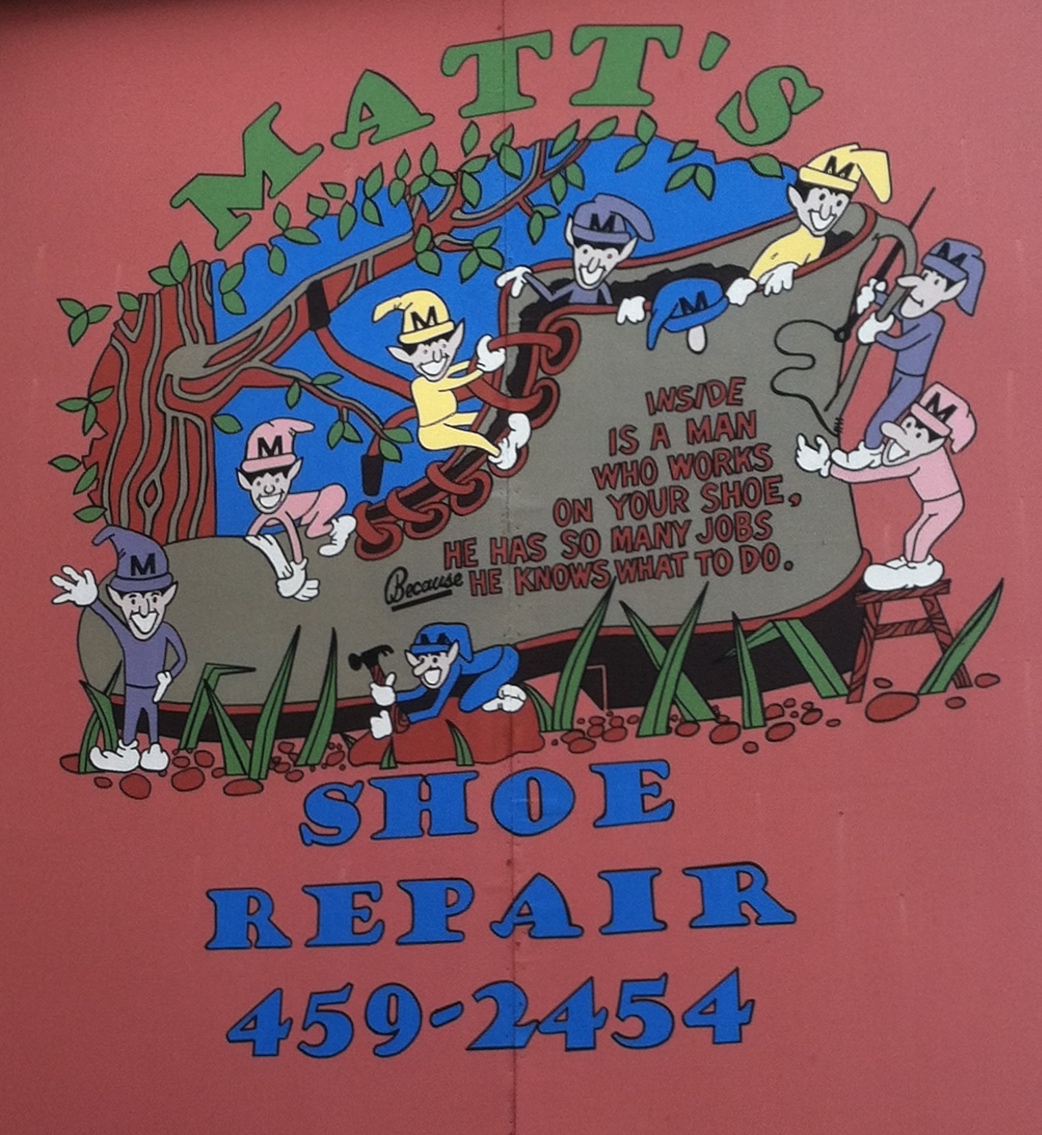
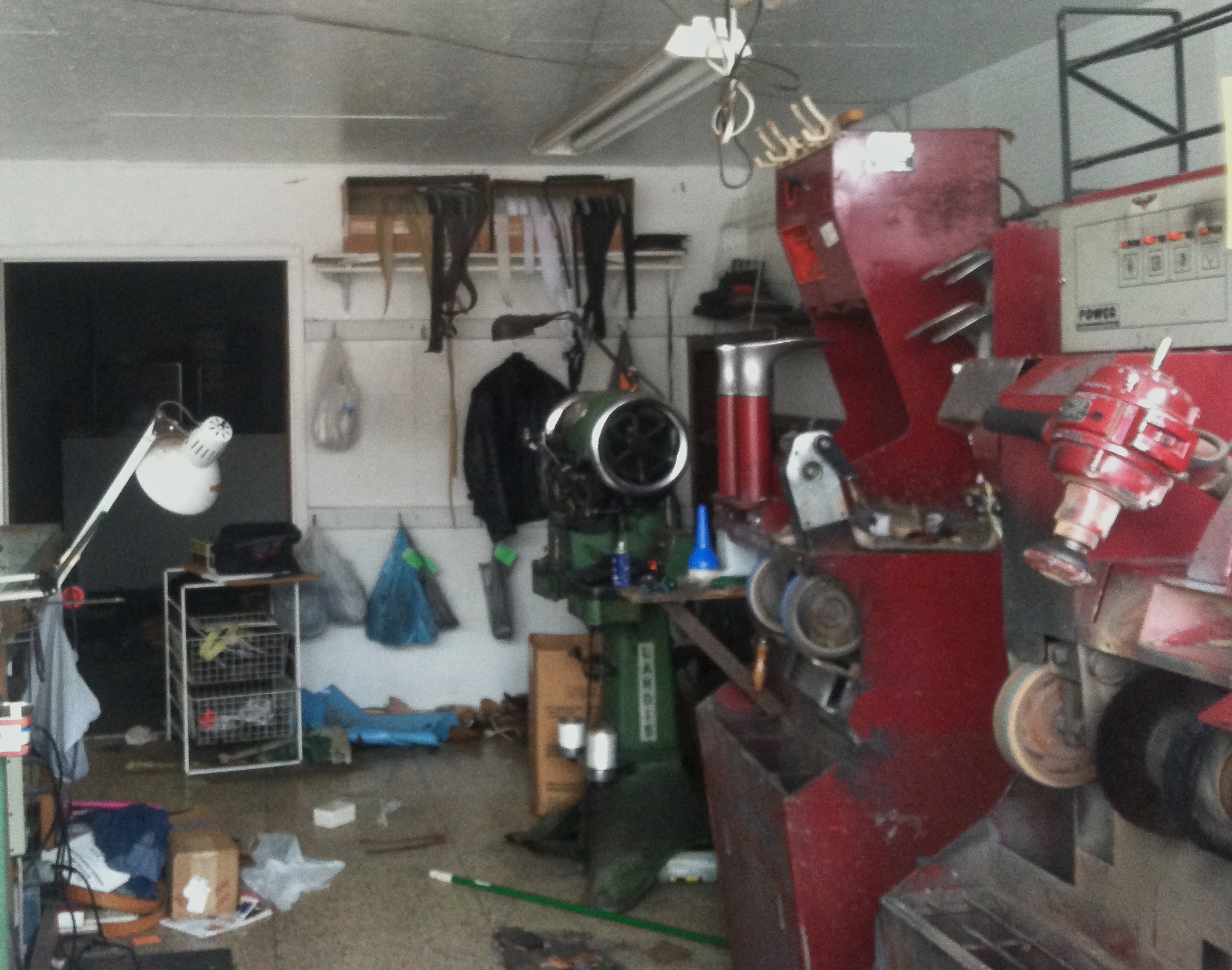
Matt’s machinery sleeps behind dusty windows. Goodbye to a vocation.

Actually, I’m not all that bugged about my wingtips being S.O.L. I’ll get a new pair. The trouble is, I’ve lost track of Dom Bruno, and it might have been nice to meet Mr. Krug and ask which kin started the shop in 1895. And anybody who makes a sign like Matt’s is bound to be good for a laugh or two.

Bottom line: the world’s best hope for health and gladness isn’t the robot, but the bellhop. There’s no way the former can look into a stranger’s eyes and recognize that a special word of kindness is needed. The latter not only carries luggage, but can also lighten a burden.

I might not be able to tell which wine was made by person or machine or which news story was written by an algorithm or a friend, but none of that matters. I want to be a Sister Phyllis receiving flawed, unpredictable, expensive human guests into the safety of my presence. I want to be an Andy White, betting my money and heart on women and men creating and mending the world over and over, messing up and starting again.

IMG_2698

Sanity: a nap in a monastery room as Sister Phyllis prays for you

When I reached the Mount and looked down at Phyllis, I was sobered. She didn’t look herself at all. Her face was oddly tanned, her hair flattened. But I’ve seen enough dear ones in coffins to give an interior shrug.

Before long Prioress Anne Wambach said hello and took my hand. At once I understood that my reason for paying respects to Phyllis wasn’t to honor the dead, but to receive life. Our conversation took less than a minute. I don’t remember what I said, but the idea was that Phyllis made me feel welcome. Clearly, Anne had heard this dozens of times already. She told me that Phyllis had done well until the end: a couple of falls, morphine, and confusion. Death came within a week.

IMG_1923

No Benedictine is forgotten. Every single sister matters.

Phyllis hadn’t suffered long; this gave me comfort. Anne took my hand and looked into my eyes; this gave me not only comfort, but a truth to live by. No software can estimate the value of a handshake or predict what healing and wisdom can result when two persons look into each others’ eyes.

Thanks, Anne. Thanks, Phyllis and Andy. I have my personal orders within the world order. I’m bound to mess it up, but I’ll try: take strangers by the hand, John, and see the Great Mystery in their eyes.


World News: A Napper’s Companion Christmas Letter

Dear Loved Ones:

Here’s a bulletin! Over the last few years I’ve been discouraged about the state of the world. World: language doesn’t get much bigger. Solar system, galaxy, universe, and eternity all out rank world. In addition to a couple of newspapers and websites, my source for Earth’s latest information is ABC’s World News with David Muir. On the surface, this makes sense. If I want the most important updates available, why not depend on one of the big three television networks still broadcasting free of charge?

On the other hand, what makes the American Broadcast Company so wise? A few days ago after prayer-meditation, I beat Jesus, Mary, Joseph, the shepherds, and the magi to the stable in Bethlehem and had an epiphany, joyous and liberating. The various media have much to report, but they can’t cover everything. This one man’s Teletype constantly receives breaking news deserving of airtime and headlines. World News isn’t only the latest financial collapse, governmental absurdity, or breathtaking slaughter. It’s also unseen sacrifice, modest dreams fulfilled, or simple tenderness.

800px-Magi_(1)

I beat the rush ahead of the Magi and received my Epiphany. (Credit: Sant’Apollinare Nuovo in Ravenna, Italy; on Wikimedia Commons)

As sickly as things seem these days, grace is everywhere, and probably more abundant than evil. But because I consume so much distressing information, I’m conned into believing that humanity is circling the drain. How foolish! My personal sources have told glad tidings of great joy lately. With love and hope, then, I offer A Napper’s Companion Christmas Letter made up of stories not covered by the mainstream media.

IMG_2941

My buddy Ray put up a Christmas tree for his eighty-six-year-old mother, who stopped decorating after her husband died around twenty years ago. No media outlet picked up this story.

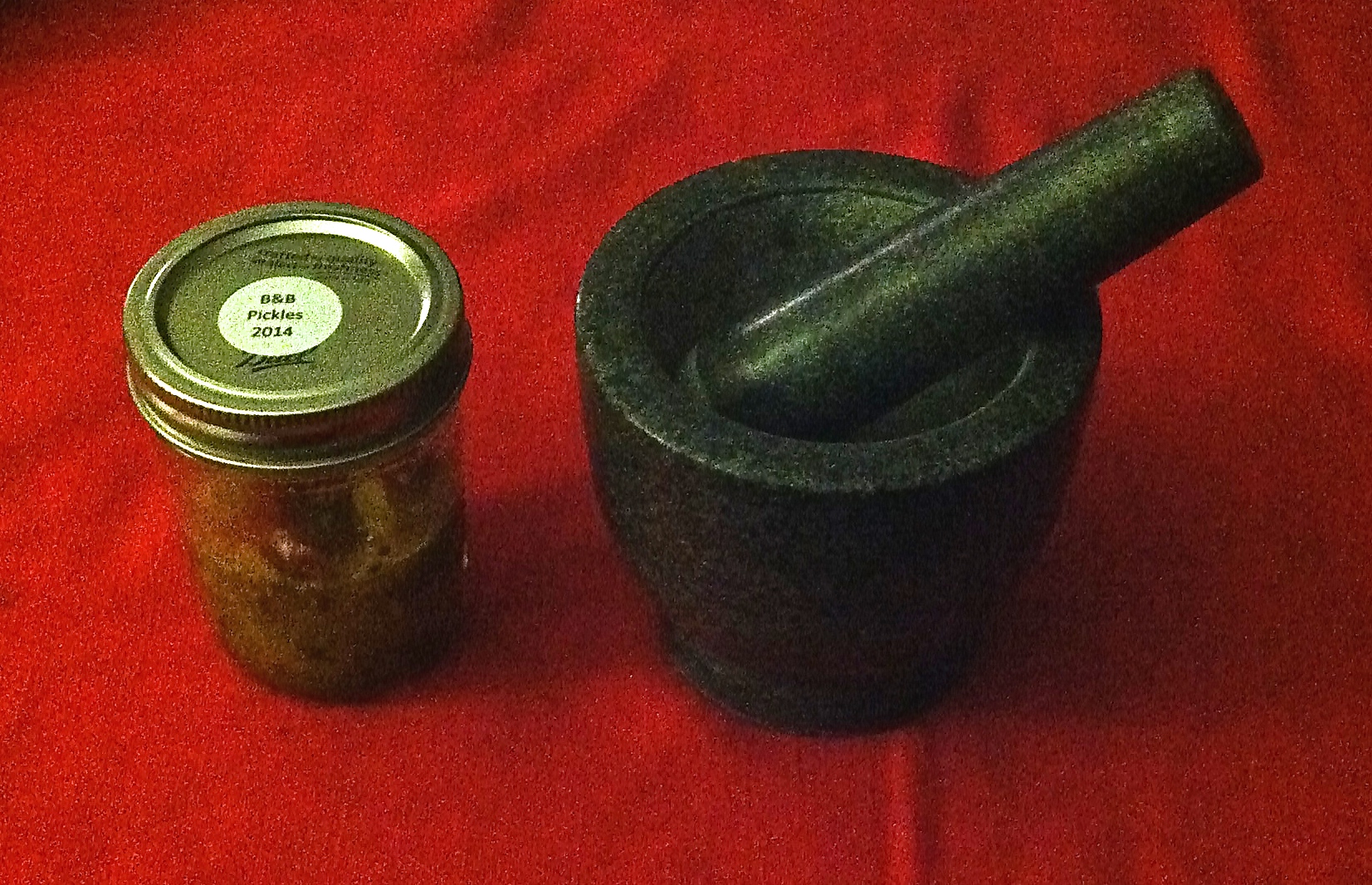
For Coleman family dinner, I was working so hard to perfect a chicken in a spirited mustard sauce that I neglected the corn chowder. I said to daughter Elena, “Hey, Len, would you mind trying to fix the chowder?” She hit it with nutmeg, salt, white pepper, a splash of hot sauce, and coriander ground with a new mortar and pestle from friend Mary. I contributed a stick of butter, and together we reached savory. Best of all, before we sat down to eat I hugged Elena and kissed her on top of the head. She said, “I love you, Daddy.”

In millions of kitchens, we help each other out with joy and speak of love. Snark and bicker visit, but I’ll wager overall we’re more kind than cranky.

photo-4

Elena, one of my favorite chefs, with her baby bump. Families everywhere embrace, coddle kiddos, and create masterpieces together. I now consider this reality “world news.”

At a party last week, I sipped wine in the kitchen with friends Karri and Joe and kibitzed. Two of their daughters sat off to the side talking. Lauren is about to graduate from college, and Emily is in high school. Rarely would I tell anybody to freeze for a picture, but I figured this one might win a Pulitzer. Yes, Virginia, siblings can get along and do better than that: they can take care of each other.

IMG_2923

Lauren and Emily . . . unposed. (My Pulitzer, please!)

I recently visited a severely ill man and his family. He sat on the couch with feet up on an ottoman. His wife patted his leg, spoke words of comfort, and kept his morphine ahead of pain and distress. The man’s brother wrote a prayer, which he asked me to read—no way he could get the words out. It was simple, humble, fervent. We sat in silence afterwards, passing around Kleenex.

“You’re a good man,” I said. “You know that right?”

A slight tear ran from the corner of his eye. “I’ve tried.”

We all put a hand on the man and entrusted him to God’s care. When I stood to leave, his wife said, “John, wait. He wants to give you a hug.”

For over thirteen years I’ve watched death. Driving away from this visit, I took an unexpected gift with me. What a loving, attentive end, as gentle as any I’ve been blessed to witness.

And I know that this day, in lands everywhere and all fifty states, the living hold the hands of the dying and whisper, “You can let go. We love you. We’ll be okay.”

800px-Partially_illuminated_Ac_with_shadows

Let go. (Credit: Simon Eugster on Wikimedia Commons)

I’ve received a couple of gifts lately that are particularly moving. Both made and bought, they remind me that people who celebrate Christmas are thinking of each other, finding a present that will be received like a kiss on the cheek and a moment’s cheer to the heart.

No doubt, Christmas is awfully commercial, but we’re trying, aren’t we? Most of us? We do want to bring joy. On the news you see Black Friday stampedes, but not the man standing alone in the store aisle, praying to find his beloved something pleasing.

IMG_2935

A handmade ornament–thanks, Barb!

IMG_2937

Bread and butter pickles and a mortar and pestle–thanks, Mary!

A young guy with low-slung jeans was waiting to cross the street as I drove up to the intersection. He started out, saw me, then held up. I motioned him on. At the curb he glanced back, smiled, and waved. I smiled back and shot him the peace sign.

Human by human, peace is sent out, received, and returned. I see it all around me.

800px-Iraqi_boys_giving_peace_sign

Iraqi boys giving the peace sign. Most of us human beings want peace, don’t we? (Credit: Wikimedia Commons)

I know an astute, witty, practical nine-year-old who still believes in Santa Claus. She leaves him a letter each Christmas Eve by the candy jar.

“What do you write him?” I asked.

“Things like ‘I hope you like bringing everybody presents.’”

Her father says, “She still believes in magic.”

I’m sure she is not alone.

Santa-eop2

I believe in Santa, too, especially if he looks a little like Robin Williams. (Credit:Jacob Windham on Wikimedia Commons)

Starbucks friend John and I talk about our dogs. In decent weather he brings his boxer Harley and has coffee outside. John and I both aspire to live like a dog—in the moment, not self-absorbed, often overjoyed.

John loves Harley and shows it. Every once in a while I see a news story about horses starving in barns, but, you know, I bet most pet owners are like John. Most of us are this way, right? We make sure our dogs and cats have enough to eat and drink, gush over their eccentricities, and treat them like our children?

IMG_2580

Starbucks friend John and his guru Harley

I know I love my dog. This morning old gimpy Watson hopped up on the bed with me as I was getting propped up for prayer-meditation. I’m not sure how much longer he’ll be with us. Like our two cats, Watson came to us as a stray. A clumsy soul, he tore both ACLs years ago. We fixed one, but couldn’t afford surgery for the other. He has fatty tumors on his flank, one the size of a tennis ball. We chase pills down his throat with treats. (I bet lots of you have stories just like this one.)

IMG_1180

Not my dog or John’s. A random pooch with an endearing fang I photographed at Presque Isle in Pennsylvania. Certainly the apple of some dog owner’s eye.

I set my Zen bell for twenty minutes, unpropped myself, lay down, and rested my face on Watson’s side. “I love you, buddy,” I said. He huffed and made the old mutt smacking sounds with his mouth I’ve come to love. “I’m glad you stopped by.” I rubbed his soft ear between my fingers. “You’re a good old pal.”

IMG_0017

My favorite picture of my old buddy, Watson. Do you have a buddy, too?

The world news tells us our home is in peril, with all of its explosions and arguments. This Christmas, sisters and brothers, I claim for us another world, one I recognize every way I turn. Join me. Everywhere I see souls unable to contain their love and sacred wishes.

Love,

John

An Advent Descant

Starbucks, 6:27 p.m.: Bing Crosby’s “White Christmas” keeps playing in my brain. His whistling descant during the second chorus always makes me think of Dad, God rest him, an All-American whistler with a spry warble. The only song more blue is “Christmas Time Is Here.”

In the 1954 film White Christmas, Crosby sings to soldiers far from home, and by the time he gets to “may your days be merry and bright,” their heads are sagging. About twenty years later in A Charlie Brown Christmas, “snowflakes [are] in the air” and “carols [are] everywhere.” As kids skate on a frozen pond, Linus tells a depressed Charlie Brown, “Of all the Charlie Browns in the world, you’re the Charlie Brown-iest.”

Charlie_Brown

Opinion: Charlie Brown understands Advent. (Credit: Wikipedia)

Both of these Christmas favorites sing about a complicated season. The lyrics are glad and wistful, but the music is melancholy, maybe for good reason. Does your Christmas spirit ever reach your mountaintop of expectation? As December 25th approaches, do you find yourself waiting for the doors of your soul to fly open and unfettered joy to blow in with snowflakes and sleigh bells? Never happens that way, right? (If your Christmas bliss is unbridled, I’m happy for you—honest.)

My Advent and Christmas moods follow the Buddy System. No emotion goes even to the lavatory alone. I’ve worn Khalil Gibran’s words from The Prophet thin because they fit:

Some of you say, “Joy is greater than sorrow,” and others say, “Nay, sorrow is the greater.” But I say unto you, they are inseparable. Together they come, and when one sits alone with you at your board, remember that the other is asleep upon your bed. 

IMG_2562

When sorrow sits alone with me at my dining room table, remembering that joy sleeps on my sofa saves me.

Last night at church, kids sang and made popsicle-stick Christmas trees. Cookies were everywhere. In my imagination Grandma Coleman’s molasses cookies joined the abundance. I could smell them. As children had fun, the beloved dead stirred in my soul.

Trees in the distance, snowless this December 5th, are bloodshot-gray veins against the Lake Erie sky—tender, lovely. A few hundred miles to my east, citizens under the Hudson River sky protest a guy choked to death for selling loose cigarettes. I receive the nonchalant blessing of an in-breath and an out-breath. Still, a cry echoes, “I can’t breathe!”

I’m stubborn enough to believe that joy will have the last cosmic word, but, man, is sorrow injecting anabolic steroids this Advent of 2014. (Blogger’s note: If you already know that creation is groaning in labor pains and don’t want details, skip to #4, which is a benign kvetch.) To wit . . .

1.) “Don’t shoot.” “I can’t breathe.” What will the next mantra be? How many wrongs can be packed into one historical narrative? Let’s see.

Birmingham_campaign_water_hoses

Birmingham high school students being hosed while on a peaceful walk, 1963. (Credit: Charles Moore on Wikipedia)

a.) No argument: throughout American history, blacks have been shat upon. Until the Civil Rights movement of the 1960s and 1970s, abuses were not only unapologetic, but lusty. Since then, slow progress has been lacerated in ways obvious to blacks and unconvincing to some whites. Most blacks, I gather, have misgivings about the police. They have either experienced unfair treatment (e.g. profiling) or know somebody who has. Or maybe they have been regarded by a cop with unwarranted suspicion. Or maybe they have been on the wrong end of a fire hose in Birmingham. Whatever the case, blacks of all levels of education and income aren’t feeling the love. Their convictions, of course, aren’t based solely on encounters with law enforcement. I bet every black citizen has absorbed the unprovoked disdain of a white stranger at least once. Such experiences must freezer-burn one’s DNA permanently.

b.) The news coverage of Ferguson, Staten Island, and Cleveland is muddy. The excerpt of George Stephanopoulos’ November 25, 2014, interview with Darren Wilson that ran on ABC Evening News was a slam-dunk for the Ferguson cop, at least to this viewer’s eyes. Some days later on PBS’s Democracy Now, which leans decidedly to the left, an interviewee noted that sixteen of eighteen eyewitnesses to Michael Brown’s shooting claimed the kid clearly had his hands up. In this case, a grand jury saw things Wilson’s way. But the treatment of Staten Island’s Eric Garner on July 17, 2014, is on YouTube for all to see, as is John Stewart’s rant about a grand jury’s decision not to indict the officer who administered what looks for all the world like a forbidden chokehold. (I’ll toss in that flattening Garner’s head into the sidewalk seems excessive, too.) So blacks who were pissed after Ferguson went berserk after Staten Island. Any white folks paying attention should start, well, paying attention.

Lt_Ray_Albers_points_rifle_in_Ferguson

Police Officer Ray Albers, who was captured on video pointing his weapon at peaceful protestors and cursing. Before he was identified, he was known on social media as “Officer Go Fuck Yourself.” He resigned soon thereafter. (Credit: Wikipedia)

c.) Speaking of understandabilities, looting businesses and torching real estate are perhaps predictable mob responses to injustice, but thievery and flames are self-mutilation taken to a community level. Innocents on the home team have lost much in what television news calls “protests.”

d.) I won’t parse the shooting of Cleveland twelve-year-old Tamir Rice other than to point out something I’ve not heard mentioned in the conversation. Why is it okay for manufacturers to make toy guns that look unmistakably like the real thing? All you have to do is cut the impotent little orange tip off and you’ve got a weapon. In the dark a squirt gun could look convincing, I suppose, but are realistic airsoft guns necessary? Don’t bother citing the First or Second Amendments. I’m tired of clever folks lining their pockets by exploiting the noble intentions of the Constitution.

e.) A-whole-nother side of wrong is the untenable situation police officers face each day. Nothing less than perfection is tolerable in the new millennium. Never mind that human beings are increasingly expected to maintain sparkling performance with dwindling resources. Punishment is an imposing presence. A teacher makes a knee-jerk, cruel remark to a student. A nurse administers the wrong medication. And, yes, a cop who has dealt on his shift with three noncompliant citizens pops his cork in subduing the fourth. I don’t mean to excuse any behavior, but to acknowledge what I see as a reality. In all professions, the margin for error is literally razor thin, and forgiveness is in short supply.

Bill_cosby_1969

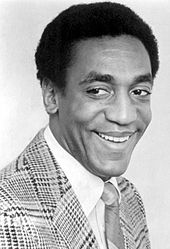
Bill Cosby in 1969. (Credit: Wikipedia)

2.) Oh, Bill Cosby! Oh, Dr. Huxtable, who wore Christmas sweaters so well! If he drugged and raped women, then, in the words of Queen, “Another one bites the dust.” If Cosby harmed any woman in one of the most profound ways possible, then who was he channeling when he complained about blacks “with pants down around the crack”? But if twenty-six women are out to lynch an entirely innocent Cosby–how likely is that?–then we have another lousy statement about the human condition. Whatever the case, there are no winners; only ugliness all around.

3.) Here’s an odd thought for the list. In an April 12, 2012 Washington Post editorial, Thomas E. Mann and Norman J. Ornstein—left and right, respectively, and both well respected—claim that the current G.O.P. is “ideologically extreme; scornful of compromise; [and] unmoved by conventional understanding of facts, evidence, and science.” More and more I get the feeling that Mann and Ornstein have their fingers on our collective pulse. I would love to be corrected on this, but it seems to me that lots of us have our rancorous heels dug in. We mistake our fancies and hunches for certainties. Actual facts are greased pigs, but if you manage to secure one, expect to be dismissed with a sniff and a Bronx cheer. The point: our foundation for societal negotiation is cracked, our collection of shared assumptions depleted.

4.) Finally, on an irrelevant, purely selfish front, I’m filing a complaint against restroom hand dryers. How can machine blow hot air at a velocity that makes your skin ripple and still not dry your hands? When deprived of the paper towel option, I always exit feeling unkempt. Yes, a few extra seconds of vigorous hand rubbing would finish the drying job, but I reserve the right to be petty in this small matter. The head gets enough of my time as it is.

IMG_2883

If this were a decent photograph of a hand dryer, you could see that the little arrow at the bottom says, “FEEL THE POWER.” I want to get a Dymowriter and cover “POWER” with “FRUSTRATION.” (Crappy Credit: John Coleman)

My last grievance notwithstanding, sorrow has one advantage over joy: sorrow tends to arrive like a freight train blasting its horn, whereas joy springs like a chocolate lab puppy from a Christmas box and quietly sniffs and licks your face. Sorrow carries a big stick; joy walks softly.

454px-ChocolateLabPup1

Joy happens by like this guy named Brownie. Yes, I, John Coleman, am trite! (Credit: Wikimedia Commons)

Consider twelve-year-old Devonte Hart of Portland, Oregon. At a protest about the death of Ferguson’s Michael Brown, the boy held a sign that said, “Free hugs.” The photograph of Portland Police Sgt. Bret Barnum and Hart hugging went viral.

Of course, as many an Internet cynic has claimed, the hug may have been staged. (I fell for a YouTube video showing a bicyclist being chased by a bear, so I’m not the most astute viewer.) Even so, I object to Jonathan Jones, a Brit who, writing in The Guardian, takes Facebook subscribers to the woodshed for their over 400,000 shares of the hug photograph: “Each one of those shares is a choice of what to see and what not to see. In the context of the completely unresolved and immensely troubling situation, not just in Ferguson but across the United States, where Ferguson has opened wounds that go back centuries, this picture is a blatant lie.”

Bret Barnum, Devonte Hart

Officer Bret Barnum and Devonte Hart in “the Hug” (Credit: Johnny Nguyen / AP Photograph in The Guardian)

One can’t help but envy Jones’ clairvoyance and nimble reasoning! As if he can see into my heart and mind and understand the meaning I assign to any photograph! As if sharing a photograph means that any Facebook viewer is in denial about what troubles America. As if—just one more—any roundhouse-throwing art critic gets to decide what muse speaks a helpful word to suffering citizens. I didn’t share the photograph on Facebook, but I’ll bet most of the 400,000 who did took the kid’s and the cop’s embrace not as a reflection of where American race relations now stand, but as a vision of where they ought to be. To me, the image doesn’t scream from atop a phony soapbox. It whispers hope into the patriotic dreamer’s ear. It’s the lab’s cold little nose brushed against America’s cheek. It’s a whistle over a familiar melody.

And consider Lori Burke. I mentioned a while back kids having cookies at church. The reason kids and adults showed up was to join in a sing-along led by Lori, which the latter enjoyed as much as the former. During snacks and crafts, she shared with me an idea in gestation. She already has a couple of CDs out as well as a popular parody of Meghan Trainor’s “All About That Bass” on YouTube.

IMG_0925

Lori Burke . . . sing it, sister! (Credit: loriburke.com)

Now, Lori would love to start a movement of sorts. She has got a name—For the Love—and is now fussing with how best to communicate it. For the Love is Lori’s developing vision for helping us all to grow into the habit of showing kindness and generosity to strangers. She mentioned a couple of possible For the Love logos and at one point said “hashtag,” which means she has Twitter thoughts. I’ve never quite understood hashtags, but I’m rooting for this sacred sister.

This is how joy happens: two people kibitz and think out loud. “What can I do?” Lori wonders, then decides to trying something. Maybe. We’ll see. No matter what happens, the impulse to encourage sisters and brothers to love each other is just a crumb. A mustard seed. A widow’s mite. In other words, Lori’s impulse is everything—a fragile wish, a helpless mutt, the Indwelling hope of the world. Salvation depends on crumbs.

Endnote

In recent days “White Christmas” and “Christmas Time Is Here” have been replaced by Dean “Dino” Martin’s rendition of “Rudolph the Red-Nosed Reindeer,” in which he calls the hero “Rudy.” In the last stanza, all the reindeer “shouted out with glee, Rudy the Red-Beaked Reindeer, you’ll go down in history.” Oh, Dino, you casual fellow! Your song goes into the complaint file with those hand dryers.

Merry_Christmas_(4202469533)

Don’t even think of calling me Rudy. And I can’t breathe out of my beak. What the hey? (Credit: aussiegall on Wikimedia Commons)


What I Hope My Grandson Will Remember

A Napper’s Companion love, love, love alert. If you’re tired of me going on about grandson Cole, you are hereby issued a pass. My next post, already in progress, will be the customary blend of joyful and brooding. For now, if you can’t get enough of bald babies, come on in.

553271_781574555246068_7032299533220255605_n

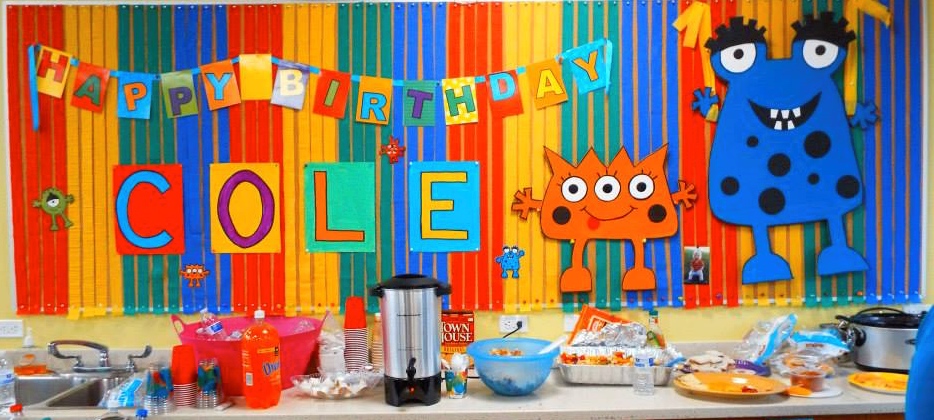
Cole’s friendly monster first birthday party . . . by Elena Thompson and Cole’s groupies

Following my last silly post, Naming Monsters on Black Friday, dear blogging friend NapTimeThoughts and I had a little exchange that basically ended this way:

934896_781572801912910_1453660791147893105_n

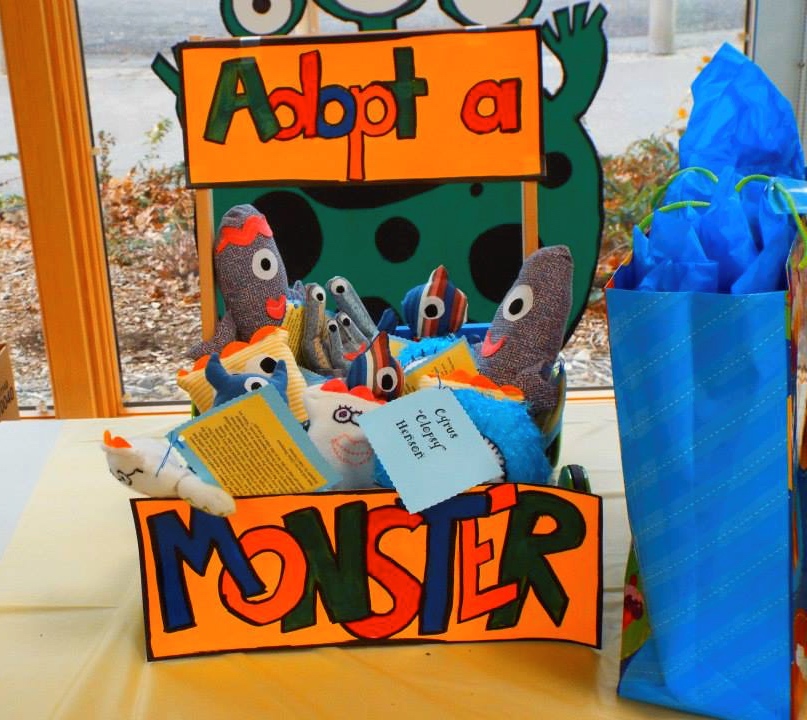
Fifteen little monsters up for adoption

I wrote: “Wouldn’t it be great to sit with our grandmas again? Mine would have Vernors ginger ale and big brown tins of pretzels. Heaven.”

NapTimeThoughts wrote: “Mine would have coffee ice cream and graham crackers with butter on them, and we’d be playing Chinese checkers in the den. Someday Cole is going to have this conversation with someone, you know. What do you want him to remember?”

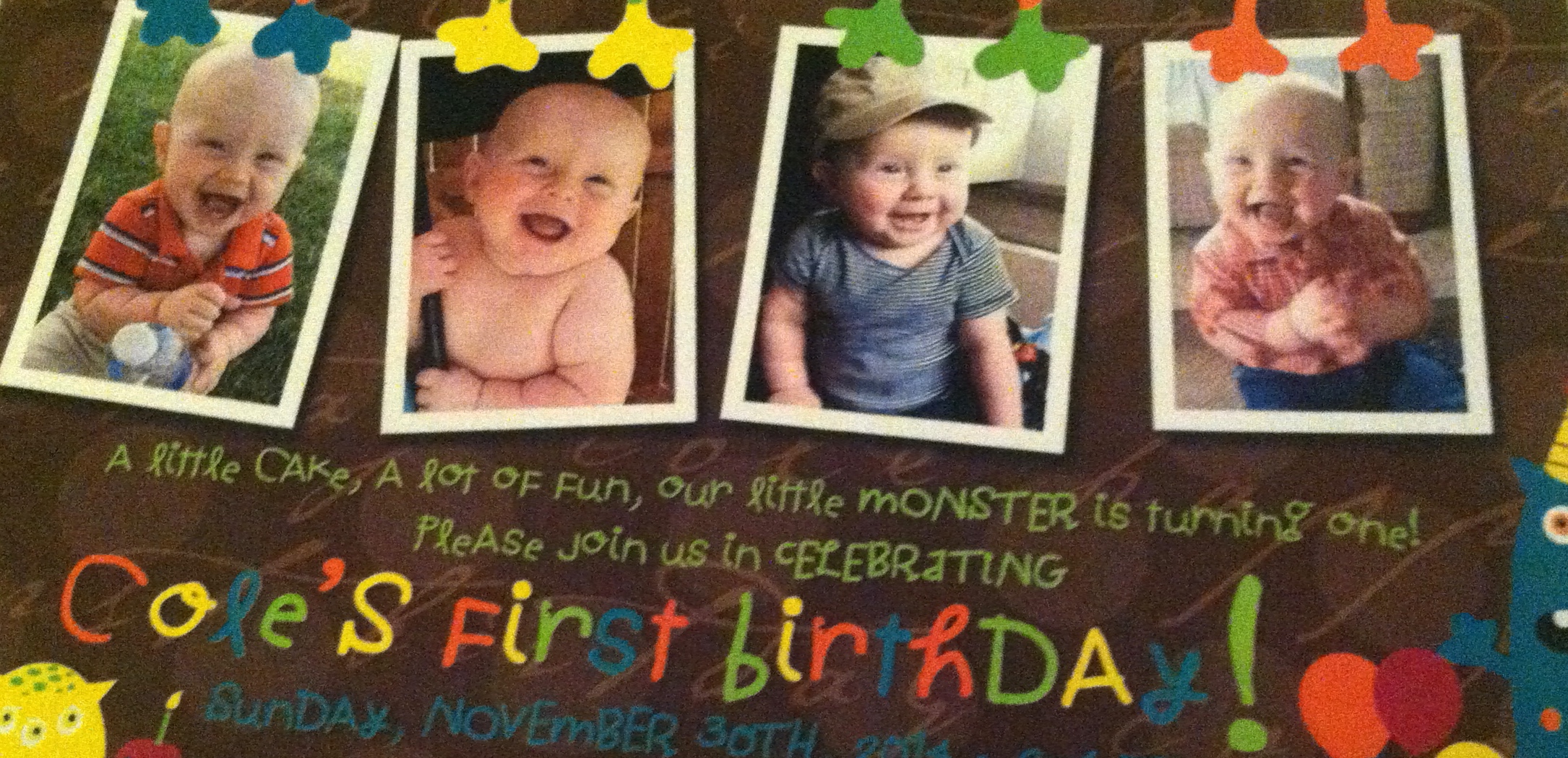
Not only does NapTimeThoughts have a belly-laughing, thoughtful blog, but she comments generously and genuinely on mine and others. Her question here has lingered with me in the days since she asked it. “What do you want [Cole] to remember?” My answer will change over time. Since Cole just celebrated his first birthday, he would be beyond genius if he remembered anything about me, should I cash in my chips in the near future.

10013678_781578038579053_6587079461691018366_n

Whatever you remember about your gramps, kiddo, be sure to include color!

But a grandfather can hope. My Vernors and pretzels and NapTimeThoughts’ coffee ice cream, graham crackers with butter, and Chinese checkers are details—as my friend well knows—that help resurrect our grandmothers. A soda pop bottle, a cool marble, that’s all it takes. Suddenly, a personal, particular love lives again.

300px-ChineseCheckersboard

Thanks, NapTime, for a question worth a couple days’ reflection. (Credit: Wikipedia)

Good old NapTime enjoys a bit of back and forth, thank God. Her query was a gift that led me to an answer. “What do I want Cole to remember?” Assuming at this point he won’t recall my feeding him broccoli cheddar soup or his kissing my cheek with a peck and a mmmwah, I do pray that this one piece of Gramps takes hold.

Here’s What Happened

This morning daughter Elena and Cole showed up at the house. As usual, wife Kathy and Elena had a plot to hatch, so Little Lord Cole and I had to find a way to amuse ourselves. Grandma’s ginger snaps and a walk around the dining room was the ticket. Already eager to embrace multi-tasking, Cole gummed bits of cookie and reached for my mother’s old teapot on top of the china cabinet. In response, I channeled Buddhist monk Thich Nhat Hanh—gently, without being heavy: “Cole, just enjoy the cookie. You don’t need to do anything else.”

IMG_2874

This is life, Cole: taste the cookie.

“Yeah, right, Gramps,” he probably thought. But Cole is a deep soul. Once he had a fresh piece of ginger snap on his tongue, I stopped roaming and looked at him. We were perfectly alone.  “Listen, Cole,” I said. “This is very important.”

He actually got still. Amazing. His only movement was the cookie lolling around in his mouth.

“You have to remember,” I said, “I love you. It doesn’t matter if things are really great or really bad, your gramps loves you. Nothing can change that.”

10846456_781574205246103_2080187702190951571_n

Schmutz face or pristine face. National Honor Society or way out of line. A life-time promise, sir. I’ll never give up on you, and when you stumble, I’ll remind you of the good I see in you. Take that!

After Cole and Elena left, I walked around the house for a while, looking at the commonplace–the wilted blossoms of Cole’s great-grandmother’s Christmas cactus–through a watery blur of blessing.

Here’s What I Hope:

Cole will remember neither the cookie nor my words. And on glad days, he won’t need a rearview mirror to make do. But, my dear NapTimeThoughts, my answer to your question on my grandson’s first birthday is this: when he is old enough to shave and has done himself stupid harm, let spirit-memory bring back what I gave him this morning. Let him know that he is worthy of love. Let his shoulders recall these old arms drawing him close and let his cheek still feel the kiss of unconditional grace.

IMG_2876

You won’t always be this cute, birthday bucko. No worries. When you get pimples and smell like sweaty socks, you’ll still be okay with me.

P. S. Thanks, NapTime. And Elena, could you put this one in Cole’s memory book, please?


Naming Monsters on Black Friday

1488069_770029026400621_5346441143956460071_n

Birthday-boy Cole and his sister Layla catching a nap

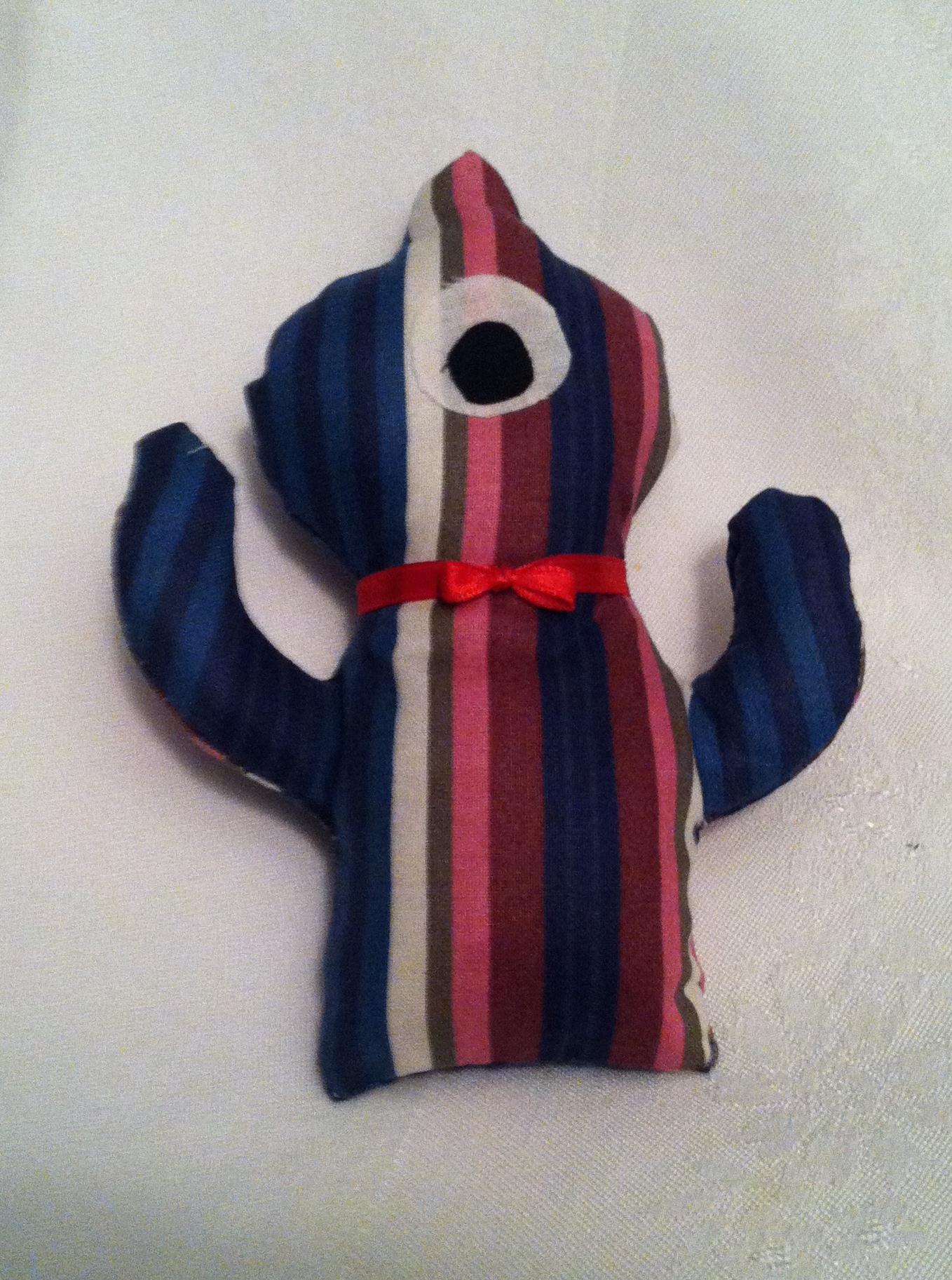
Friday, November 28, 2014: While millions of Americans fed this day’s gaping maw of capitalism, I engaged in my own form of madness. For seven hours I sipped decaf redeye after decaf redeye at a Starbucks miles away from the shopping traffic and named monsters. Daughter Elena sewed and stuffed fifteen of the little weirdos, and my charge was to come up with biographical snippets for each of them. My motivation was compelling: each monster would be given to a young guest at grandson Cole’s first birthday party this coming Sunday. Parents would read the bio; kids would squeeze, lick, and gnaw on Elena’s handiwork. In the midst of much online research, I informed my erudite table mates of incidentals (e.g. kangaroos do not, in fact, burp) and learned, stifling laughter, what “upper decking” means. When at last I looked up from the screen to see the patrons spinning–no lie!–I knew it was time to go home for a nap. When I awoke, I had a Philly cheesesteak with handsome Cole and family, then sent the following to Elena in preparation for Sunday. Enjoy . . . if you dare.

IMG_2851

Battersby “Juano” de Vamp

Battersby “Juano” de Vamp: Battersby’s love for the night life and chatting with the ladies led to the first part of his nickname, Juan—this being Don Juan, a fictional character who enjoys hanging out with women. The “o” part of his nickname came from his buddies, who discovered that “Juano” rhymes with “guano,” which is bat poo. But don’t worry about Battersby. He gets his pals back by sneaking bites of their cheesecake—when they go out for dinner—and leaving his distinctive single tooth mark in their dessert. Juano’s favorite Maya Angelou quote: “I don’t trust any [monster] who doesn’t laugh.”

IMG_2852

Babbatte “Hang” de Vamp

Babbatte “Hang” de Vamp: Babbatte’s nickname, which she would gladly lose, comes from her childhood inability to say “fang.” “Listen, young lady,” her mother would say, “get back into that bathroom and brush and floss your fang.” Babbatte would insist that she already “bussed her hang,” the “f” sound being painful for little de Vamps, until they build up a callous on their lower lip. Hang wears ribbons on her ear and bats her eyelashes to make a point: “There’s a lot more to me than this pearly white fang!” Babbatte’s favorite Katherine Hepburn quote: “If you obey all the rules, you miss all the fun.”

IMG_2857

Kenneth “Ken” Knipmeier

Kenneth “Ken” Knipmeier: Everyone thinks “Ken’s” nickname is short for “Kenneth.” Not so. Ken grew up playing with his older sister Babs’ Ken dolls. When his friends played “snow wars” with G. I. Joes, Ken brought a Ken doll to the battle, insisting his Ken’s ski outfit would keep him warmer than the soldiers’ thin layer of olive and black camo. From childhood on, Ken always made it a point to follow his own instincts. Kenneth’s favorite Chinese proverb: “A wise [monster] makes his own decisions, an ignorant [monster] follows the public opinion.”

IMG_2856

Barbra “Babs” Knipmeier

Barbra “Babs” Knipmeier: The unusual spelling of Barbra’s first name can be blamed on singer Barbra Streisand, after whom she was named. From the time she could hold something and babble at it, she clutched a Barbie doll. For a short time, Barbra’s parents called her Barbie. At her first birthday party, however, Dad put on a bootleg Streisand’s Greatest Hits CD. When “[Monsters, monsters] who need [monsters], are the luckiest [monsters] in the world,” tears ran down Barbra’s cheeks. She wasn’t sad or hungry or poopy. She was verklempt. “Oh,” Mom said, remembering the singer’s nickname, “our little Babs is crying. My word, how sensitive she is!” During her rebellious teenage years, Babs was crazy for Madonna, but now considers her namesake the best female artist now living. Barbra’s favorite Barbra Streisand quote: “There is nothing more important in life than love.”

IMG_2858

Rosalyn “Ozzie” Hightower

Rosalyn “Ozzie” Hightower: How many monsters have nicknames because other monsters mess up their regular names? Rosalyn—born an identical twin—got stuck with “Ozzie” because her sister Jocelyn couldn’t say “Rozie.” Ozzie doesn’t hold a grudge, though, since she has other challenges to overcome. Even with all the odd appearances in the monster world, Ozzie, with eyes perched on arm-towers and baby in a pouch, gets teased by other monsters. She wears a smile because she refuses to be bummed out by smart remarks. And you’ll never hear a mean word come out of her mouth. Her baby’s name: Jillian. Her favorite Chinese proverb: “A bit of fragrance clings to the hand that gives flowers.”

IMG_2859

Jocelyn “Joey” Hightower (and Jack)

Jocelyn “Joey” Hightower: Jocelyn, born an identical twin, gave sister Rosalyn her nickname, but “Ozzie” returned the favor. Jocelyn’s parents chose her name because it rhymes with Rosalyn—sort of—and planned to call her “Josey,” but “Joey” was the best her sister could do. At first it was “Doughy,” so Jocelyn was at least grateful she escaped being thought of as a dinner roll. Joey is a brave marsupial in a sometimes unkind world, giving lippy monsters a little what-for when they talk smack, especially against Ozzie. She doesn’t go looking for trouble, but she doesn’t hide from it, either. Her baby’s name: Jack. Her favorite proverb: “One can easily judge the character of a [monster] by the way they treat [monsters] who can do nothing for them.”

IMG_2850

Boris “Chops” Pillosevic

Boris “Chops” Pillosevic: Of Serbian descent, Boris got his nickname not from his razor-sharp bottom canines, but from his cheerful, steady nerves in the face of danger and his favorite dish: lamb with a mint, yellow tomato, and sweet corn salsa. In high school, Chops won “The Guy You Want Most in Your Foxhole” Award. Today, he is an interior decorator. His favorite Charles Atlas quote: “Nobody picks on a strong [monster].”

IMG_2848

Nevena “Marigold” Pillosevic

Nevena “Marigold” Pillosevic: Sunny and cheerful by nature, Nevena’s nickname comes from her given name, which is Serbian for “marigold.” Lovely Nevena is easily surprised, which led to school classmates always jumping out from hiding places to scare her. “Ohhh,” she would squeal, then have a giggling fit. No longer in school, Marigold still can’t help watching out of the corners of her eyes for the next prank. Poor girl. Watchfulness is tiring, so she loves to nap, though she spends the rest of the afternoon yawning. Nevena’s favorite Chinese proverb: “You cannot prevent the [monsters] of sorrow from flying over your head, but you can prevent them from building nests in your hair.”

IMG_2854

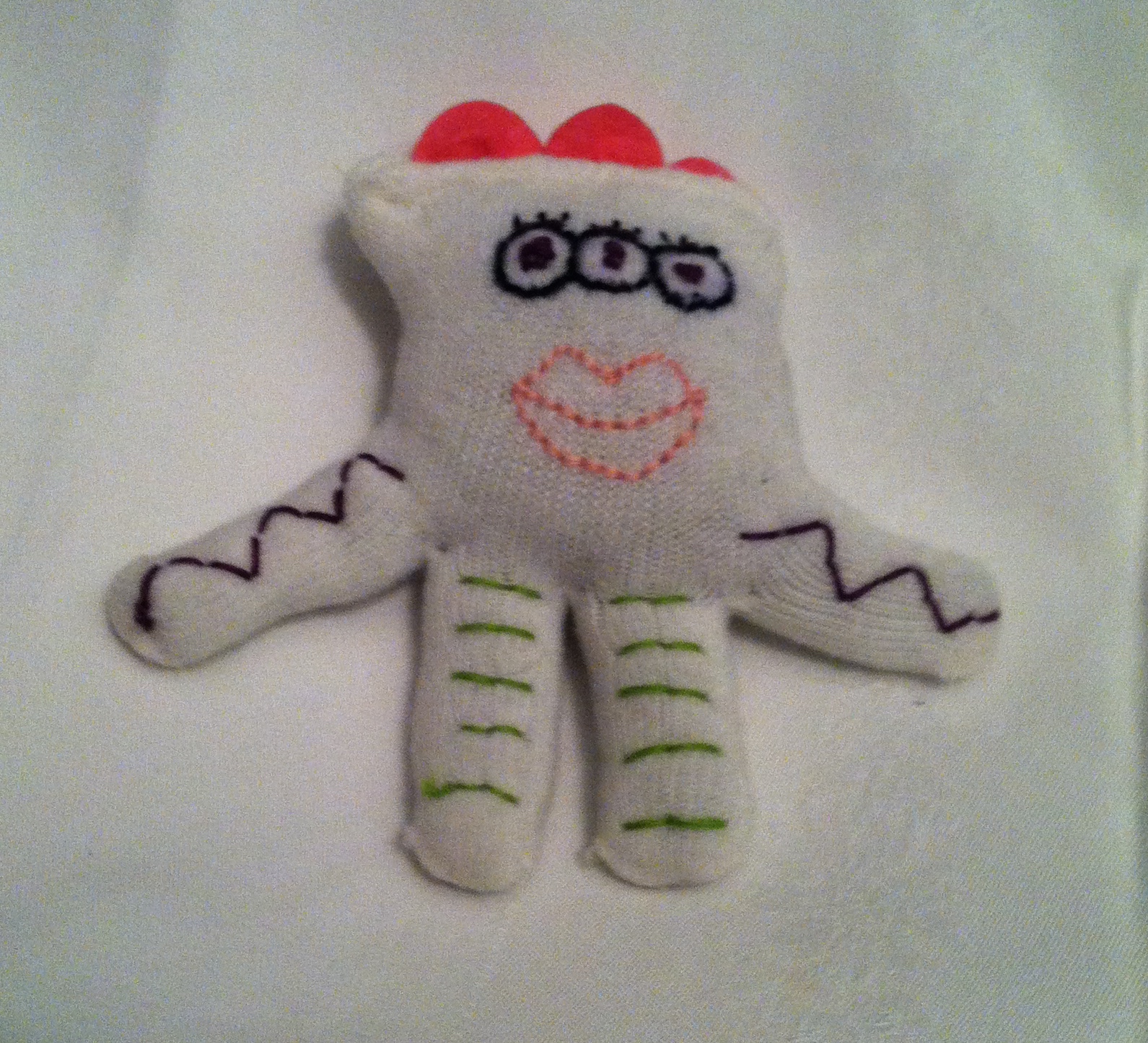
Retina “Lovey” Glover

Retina “Lovey” Glover: Retina’s nickname comes from many years ago. Her first love, Leonard Palmer, called her “Lovey” because her lips always seemed to be puckered for a kiss, and he couldn’t stop looking into her eyes, all three of them. The name fit then and still does today. If you ever need a monster to talk to, Lovey is the one. No matter your age, she’ll bounce you on one of her knees, kiss your cheek, wink three times, and give you a little hope. Lovey’s favorite Chinese proverb: “One joy scatters a hundred griefs.”

IMG_2855

Leonard “Lensie Poo” Palmer

Leonard “Lensie Poo” Palmer: Leonard’s nickname comes from many years ago. His first love, Retina Glover, called him “Lensie Poo” in a moment of awkwardness. He was so gushy with her, calling her “Lovey” and staring into her eyes, that she said the first cute thing that came into her mind: “Lensie Poo.” Once their circle of friends passed around this juicy gossip, Leonard—a bright, bookish kid—was forever after “Lensie Poo.” He was a little disappointed when, at a monster class reunion, Lovey confessed that nothing in particular was behind his nickname. But Lensie Poo worked with what he had been given, using his warm-and-fuzzy nickname was an ice breaker with strangers. Leonard’s favorite Spanish proverb: “Since we cannot get what we like, let us like what we can get.”

IMG_2862

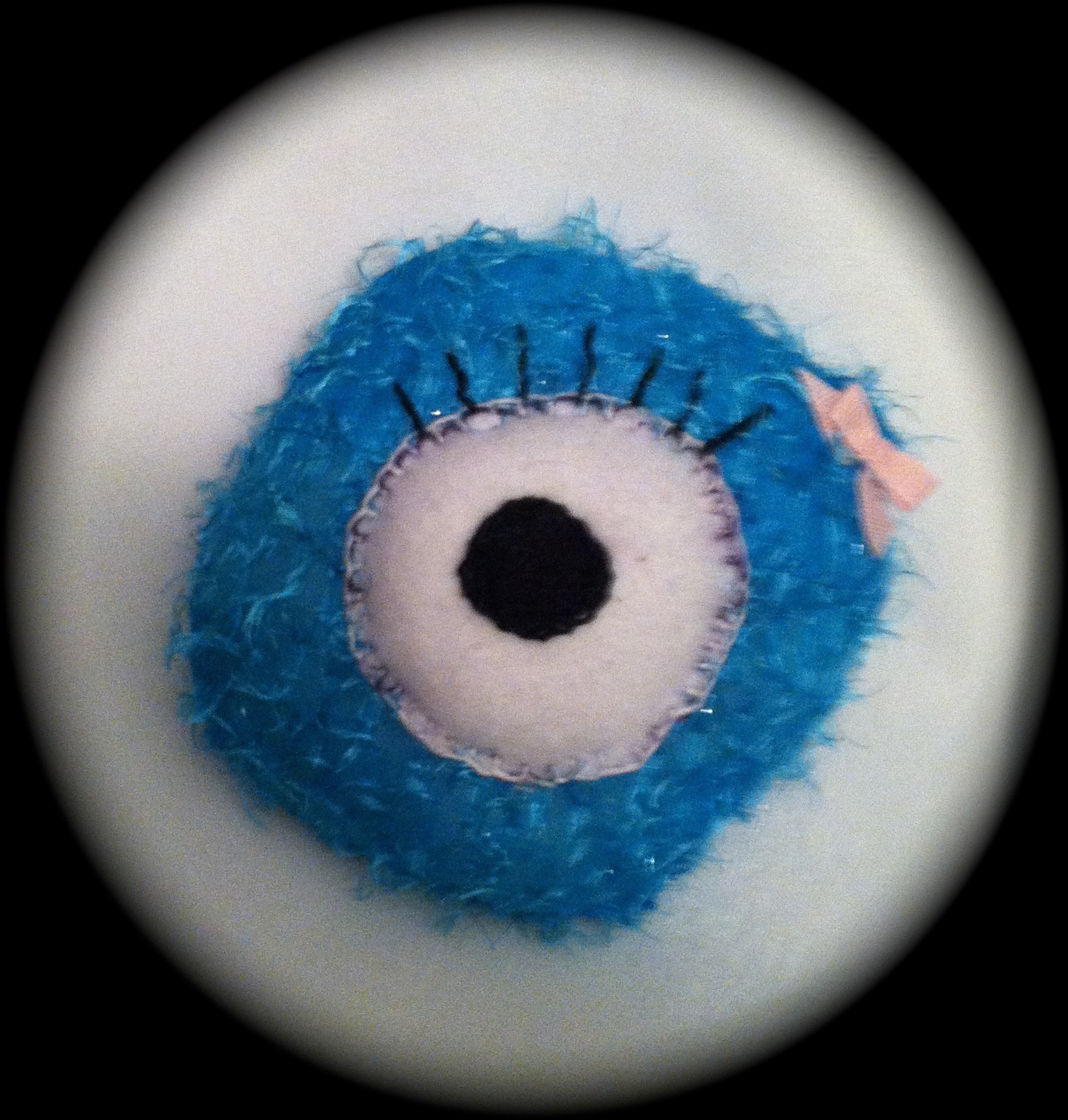
Cyrus “Clopsy” Henson

Cyrus “Clopsy” Henson: Cyrus, Cyrus, Cyrus! It’s not easy for any monster to grow up perfectly round, but Cyrus’ early life was awkward, indeed, before he learned to roll. Until the age of four, Cyrus moved about the world by flipping himself forward like a pancake. Each time his big, wet eyeball hit sidewalks or hardwood floors, it sounded like a horse stepping in a mud puddle. “Clop. Clop. Clop” So, the other monsters declared, “Clopsy” it was. “Cy,” as his sister is kind enough to call him, doesn’t show his emotions easily. He is the strong, silent type. The only way you know that Cyrus is sad is when he leaves tear drops on his way from point A to point B. Cyrus’ favorite Chinese proverb: “The journey of a thousand miles must begin with a single [roll].”

IMG_2864

Sydney “Cookie” Henson

Sydney “Cookie” Henson: Not many youthful dreams come to pass. So it was with Sydney, who long ago aspired to be an actress. Roles for round, blue characters being rare, she was over-the moon about reading for the role of Cookie Monster on Sesame Street. “The part is mine,” she said, rolling home. Ah, Sydney. Years passed before she stopped complaining about that amiable oaf’s fame. “He is bulky, blue, and hairy,” she would say to anybody who would listen. “So spray paint him white and cast him as the Abominable Snowman!” Her family loved her a lot and told her, “You know, you’ll always be our ‘Cookie.’” The older she got, the more she understood that being her family’s Cookie is better than being a television star. Sydney’s favorite Chinese proverb: “Not until just before dawn do [monsters] sleep best; not until [monsters] get old do they become wise.”

IMG_2860

Rudolph “Rudy” Tuberski

Rudolph “Rudy” Tuberski: There’s absolutely nothing interesting about Rudolph’s nickname. Monsters with his name get called “Rudy,” and he’s fine with that. As any of his buds will tell you Rudy is a real meat-and-potatoes guy, very grounded, no-nonsense. His philosophy is simple: smile, laugh a lot, keep an eye out for your fellow monster, and don’t hog all the gravy in life. Rudolph’s favorite Charles Schultz quote: “Good grief, Charlie Brown!”

IMG_2861

Eartha “Yammy” Tuberski

Eartha “Yammy” Tuberski: Some monsters dislike their given names. Growing up, Eartha complained to her parents: “Eartha! Eartha! Where in the world did you get that name? It makes me sound like a clump of dirt.” In truth, Eartha was a great kid. Her parents were loving and gentle. And she did her chores, minded her manners, got good grades, and was about as happy and playful as the next monster. Still she couldn’t stop griping about her cloddish name. Patient as her parents were, her brother Rudy reached his breaking point. “Good grief,” he hollered one day, “will you quit your yammering.” Thereafter, in his youthful insensitivity, he called her “Yammer,” and in tender moments, “Yammy.” “Well,” Eartha thought, “at least Yammy sounds cheerful, kind of sweet.” When she introduces herself, monsters figure she is saying, “Tammy,” and, blessed with the wisdom of years, she doesn’t generally correct them. Eartha’s favorite Beatles song: “Let It Be”.

IMG_2846

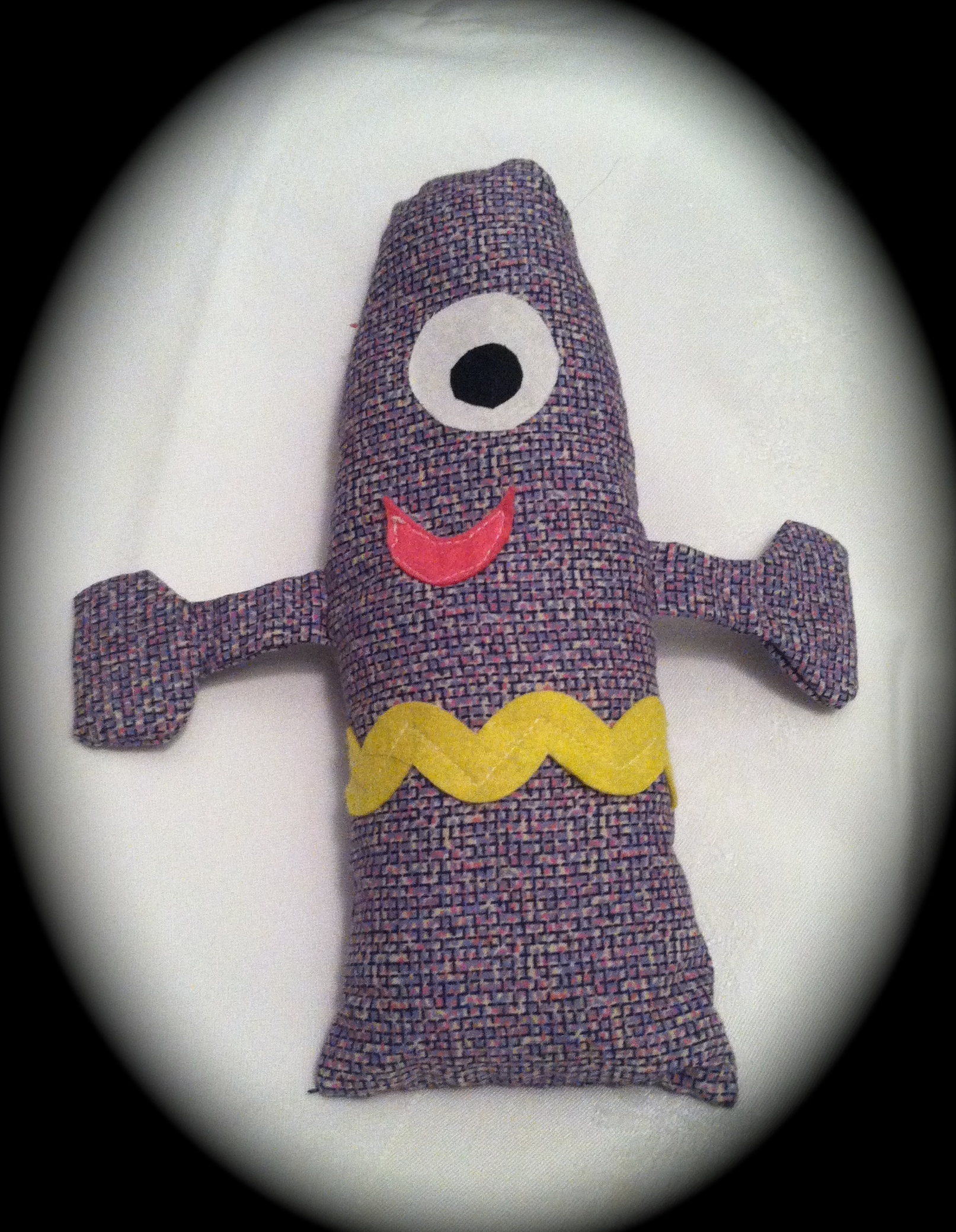
The first-ever, formal portrait of Loxi “Picabo” Nessor

Loxi “Picabo” Nessor: In spite of Loxi’s endearing smile and welcoming blue eye, she is extremely shy. Her nickname has nothing to do with the old baby “I see you” game. She loves to water ski, but prefers snow, since for mysterious reasons she ends up under the waves rather than on top of them when water is the venue. Loxi watched so many hours of the 1988 Winter Olympics in Calgary that friends started calling her “Picabo” after the winner of the Super G, Picabo Street. The cute handle embarrasses her, so she closes her eye and dips down her head when she hears it. Loxi’s favorite Rosanne Barr quote: “I’m mostly introspective and don’t talk to [other monsters]. I get into a real quiet, meditative place.”

It’s 11:10 as I sign off. Black Friday of 2014 is almost over. My nap has worn off, and the monsters and Cole are tucked in, the latter until tomorrow morning, the former until Sunday afternoon, when monsters and humans will sing, eat cake, and wish a happy baby many more.

A Soul Message to My Regulars

Dear Regulars:

Europe_orthographic_Caucasus_Urals_boundary.svg

Elena’s old teacher notes that some students can’t find Europe on a map. You never know what the Starbucks regulars will kibitz about. (Credit: Wikipedia)

So what else would I be doing at 8:21 on a Monday morning? I’m at Starbucks, surrounded by regulars: a couple of lawyers dressed for court; a retiree who by coincidence was daughter Elena’s social studies teacher; a young artist who sketches fairies and dragons and buzzes half her skull down to stubble; an engineer numbed by an online meeting; and a woman who pours out her life for children and grandchildren. I’ve talked to all of them, some more than others. They feel like beloved cousins. Such goodness in these folks.

All tables are taken. The guy in my seat tries to pull the reigns on aging and negotiates with a temporarily bum shoulder. “Shoveling snow really did this to you? Do you need three ibuprofen or four?” “Make it four.”

As I sip a refill, the sun shines, then hides, then shines again. Breathing in and out, I think of you, whenever and wherever we inhabited each others’ days:

childhood

high school

college

graduate schools

seminary

old neighborhoods

and

jobs

grocery stores

coffee houses no longer

offices and waiting rooms

220px-Gilman_Hall,_Johns_Hopkins_University,_Baltimore,_MD

Gilman Hall at Johns Hopkins: it’s been thirty years. Herb and Rosemary, hi! Armand and Lynda, I’ll see you on the other side, right? (Credit: Wikipedia)

You aren’t showing up all at once. No, I receive you one-by-one, gratefully. Caroline. Bill. Jeff. Nancy. A procession of Garys. Because I know others by your names, namesakes straggle in. Welcome, everyone.

Hello, Becky, sister of Steven from Diehl Elementary School. (She had her leg amputated below the knee, then later—I don’t remember how long—she died, ten or twelve. Cancer.) Look into the eyes of glory, Becky. Belly laugh with the other children.

You don’t have to walk among the quick to be one of my regulars.

220px-Hyacinth_-_Anglesey_Abbey

Hyacinths always remind me of you, Gram–the curls of your wig.

Grandma Miller, your fingers are folded back into knuckled wings! I see your hair curled like hyacinths and your swollen face, but I can’t hear your voice anymore. I was sixteen. If it is permitted, Gram, please be there to receive me.

Hi, Alice, a wealth of Johns (that sounds wrong in a couple of ways), an embarrassment of Marys, more Kathys than I know what to do with. Matthews and Marks.

Now a tangible Patty shows up to share my table. That’s fine. She brings other Ps with her. Pauls, Pegs, Phils, one Penelope, and a lone Poopsie.

So many Richards and Elizabeths!

200px-Anne_Frank

Why have you arrived here, Anne Frank? No matter. All kids’ faces are sweet in my eyes. All are welcome. (Credit: Wikimedia)

What’s this? Jesse? I never knew you, but here you are, a sweet obituary face. Those who love you still dream you in their arms–your dear smile alone tells me this. I wasn’t expecting to welcome strangers to this gathering, but my plans seldom work out. So come in, Jesse. Stand glad with me in this warm light. Thich Nhat Hanh, wake up and bow to me. I’m listening. Rise, Ann Frank. Find your way home, Nigerian school girls. All of you, join Patty and me at this table.

Oh, my Lord, friends I’ve never seen or held are asking to join me in this public grace–names beginning with S, N, R, D, K, C, M. The alphabet isn’t long enough, though, miraculously, there’s room at this table, in this column of sun, for all of you, my regulars of many initials.

I don’t want to pretend. During these coffees in this now constant light, you haven’t all arrived. But wherever you are, I’m waiting. If mornings and afternoons are bitter and twilight is fretful, I’ll sit with you in safety. And if you have too many blessings to carry, hand me a few. We’ll give thanks together and I’ll share what you’ve given with others and probably hang on to one for myself.

I love you, friends. Your faces—skin creased by decades or still fair, eyebrows raised in surprise, or cheeks flushed with excitement or trouble—are dear to me.

Photo on 10-10-14 at 10.02 AM

This face, such as it is, welcomes you. Come share the light, rest a while.

If you haven’t visited today, don’t worry. You will soon. Meanwhile, know that whether this day is good enough to travel by its own steam or so lousy it refuses to budge, call on me for a visit. The shoulder pain has eased enough for me to put an arm around you.

We’ll be calm and glad. If clouds take over, so be it. Present to each other–just two or three gathered–we can shine anyway.

Peace and love,

John

Dreaming My Way into an Old Lady House

In the early 1970s writer May Sarton moved from her beloved home in Nelson, New Hampshire, to The House by the Sea (her journal of those days). Like some lucky pilgrims, Sarton had ample time to make her move. “I had two years in which to dream myself into the change,” she writes, “sell Nelson, and pull up roots.”

Kathy and I are in the process of dreaming ourselves not into a spacious home on the coast of Maine, but into a 1,000 square foot house on Erie, Pennsylvania’s east side. Our zip code will go up six digits, but our space will shrink by over half. Downsizing, we’re calling it. We closed on the place a few days ago, but we’ve been picturing what will go where and what will disappear. Kathy is lobbying for an ambitious kitchen remodel; I’m smiling at the corner on the enclosed front porch where my desk and prayer/meditation chair will squat; both of us are imagining.

IMG_2814

A little light in the hallway–just enough

Last evening I said, “You know, we’re going to have to get used to the loss of space and no upstairs.” Kathy agreed, and as I’ve wandered about, distances seem abbreviated. I’m not concerned, though. The rooms are already endearing themselves to me, mainly because I see signs of the former owners everywhere. I’m guessing the husband and wife–the latter perhaps passing recently, the former having departed some years ago–were my parents age, born in the 1920s, shaped by the Great Depression and forged by World War II. Admittedly, all of this is guesswork.

I’ve been calling our new home, which the former owners purchased in 1949, an old lady house. She and her husband could easily have been curmudgeonly and strange, but signs of their thrift and good stewardship have me thinking they were upright folk. He–I’ll name him Ernest–nailed lids to the basement studs and kept screws and nuts in jars twisted secure. He also recycled cabinets, lining them up and keeping, what, half-used cans of paint and turpentine inside. One door near Ernest’s workbench was set up for a padlock, and a mirror strategically angled so he could see who was coming down the steps makes me wonder if he liked to keep a bottle of Gibson’s 8 handy for a secret pick-me-up on boring afternoons.

unnamed

Is this what Ernest kept locked up?

IMG_2824

Ernest didn’t have to venture more than five feet from his workbench if the “great whiskey” got to be too much for him.

She–Arlouine, let’s say–kept the well-worn carpets vacuumed. Grab bars in the bathroom suggest she tried to stay in her home as long as possible? But eventually raised toilet seats don’t help much. I imagine her, thin and brittle with iron gray hair, propped up in a nursing home bed, staring into the distance. Was she a fearful soul? I ask only because of something odd left behind in a hall closet.

IMG_2812

Sacred water in profane hands

So Arlouine was Roman Catholic. (We Lutherans don’t go in for Holy Water, our idea being that God has blessed that life source far above our poor power to add or detract.) For a couple days I laughed at the idea of Holy Water in a spray bottle, but Starbucks friend Sean, also a Catholic, gave me a compassionate nudge, probably without realizing it. I don’t remember his exact waords, but when I showed him the photograph he acknowledged the old practice of keeping Holy Water around the house. His take was kind, though, along the lines of “sometimes you’ll try anything that might help.” Point taken. Our fears hide in plain sight, like cobwebs near the ceiling or rust in the medicine cabinet; a spray of blessed water can do no harm.

Arlouine and Ernest’s bedrooms have tile that is so ugly it’s kind of charming.

IMG_2817

I’m not sure what all those tile plants are, but they look to be in pain.

Besides the Holy Water, the best find in the old lady house is the newspaper under the tile. I lifted up a corner to be sure the floors are hardwood–yes!–and found The Erie Daily Times (Night Final) dated November 8, 1949. My own parents’ firstborn, Cathy, was not yet a year old. Mom and Dad are both gone now, and my sister can retire any time she is ready.

unnamed-1

37-cent matinee

unnamed-4

Okay, so skinny depictions of women aren’t exactly new.

unnamed-2

Liquors, a Hammond, and Hazel Lowry’s smooth vocals: 1949 Erie, Pennsylvania, at its most refined

unnamed-3

Captain von Trapp’s first fiancé? I’m not going to lie: I’m frightened.

Oh, Arlouine and Ernest! You put that paper down sixty-five years ago, a prudent layer between the tile and wood. I’ll grant you, there’s no pressing need to update that flooring. Of course, Kathy and I will refinish the hardwood, probably put down a faux Persian rug, something tasteful. If I’m the one who slices your old drab leaves down to trash-bag size with a drywall blade, part of me won’t be happy.

IMG_2815

Possibly more thermometers than electrical outlets in our new home; maybe Kathy and I will keep this one to remind us of Arlouine, Ernest, and all those who have sailed on to glory.

I believe your way is for the best and will try to remember it as I dream my way into your home: Be sure to finish those leftovers. Put that old metal table in the basement and fold laundry on it. Don’t pull up perfectly good tile. And–I confess it makes sense–keep Holy Water in a spray bottle. A mist is more than enough.

IMG_2819

Tabernacle for the Holy Water; all woodwork in the house is like this


Thanksgiving Letter to My Late Mother

Dear Mom:

November 8, 2014: your Christmas cactus is in full bloom. It may be my imagination, but every year the blossoms seem to show up a little earlier. We could now call your beloved old plant a Halloween cactus. How many holidays will pass before the pink flowers open up at Easter?

IMG_1190

Your matriarch of Christmas cacti

You know, Mom, you’ve been gone sixteen years, and I always figured that the older I got, the less I would miss you. Actually, the opposite seems to be true. The heaviness in my throat in this moment is greater than when I wrote you last year. The reason is your great-grandson Cole. I imagine the deep gladness you would know in holding him, talking to him as I do, sitting quietly as the minutes pass, watching him in ceaseless motion. You would say the same thing as we do: “He’s so busy.”

10665803_761152390621618_7552667270178936418_n

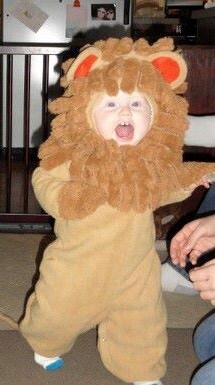
Your busy great-grandson in his Halloween costume–grrrr!

Most Sundays we have family dinner, Mom. I’m not sure why as your son I didn’t insist on this practice years ago, but I didn’t. I’m sorry. People who say that they have no regrets in life probably aren’t looking closely enough. Anyway, after we finished eating, Cole got fussy. Had you been there and not been burdened with arthritis, you would have picked him up and walked around the house, talking to him. I can see you telling your great-grandson about this and that. The decades glow and soften in my mind: there you are, my late mother holding my beloved grandson. It’s nice to see you.

But since you aren’t here—not really—and weren’t there after dinner to occupy Cole, I did. Our first stop was your Christmas cactus. I told him a little about the plant, but before I knew it I was telling him about you. Of course, I said you would love him like crazy and other things you would expect. But as he looked on momentary peace at your plant, I told him that when his mother was a toddler, you peeled grapes for her. Peeling grapes: that’s love. “Your great-grandma would do the same for you,” I said, imagining you putting bits of the pulp into his mouth.

IMG_2789

Was Cole looking at that glow in the center, Mom, the light of forever?

Next stop: the photograph of you in your wedding dress. “My gosh, Cole,” I said, “look at how beautiful your Great-Grandma Coleman was.” I was focused on you and Cole, but was also aware of somebody looking over my shoulder and saying, “Oh, yeah! She was beautiful.”

IMG_2795

You are younger here, Mom, than both of my children are now. It’s hard to make the years stay in the right order.

Tours with tired babies last only so long, so that was about it. Elena, Matt, and Cole packed up and headed home. Tomorrow being Sunday, we’ll go through the same ritual, and most likely I’ll use the spatula from home. No kidding, Mom, every time I pick it up, I remember you. Maybe I’ll show Cole, tell him it was yours.

IMG_2797

Still my favorite spatula

I wish you could be with us. We would sit at the dining room table and look at pictures. This afternoon I was missing you, so I went upstairs and pulled out some albums. Time passed. Two photographs held me up a while: one of Elena and one of Micah. I could see Cole in both of them.

IMG_2803

That’s Elena, Mom. I caught her, promise. That’s also Cole’s face.

IMG_2801

Here’s Micah, Mom, foreshadowing his nephew’s two front teeth and swagger.

I said before you were beautiful, but I’ve become suspicious of time, reluctant to accept its authority over us, covetous of eternity. More must await us beyond this lovely, troubled land, where early we toddle on fair-skinned, sausage legs and late travel tentatively, afraid of the fall that might crack our aching bones. There must be more because you deserve to hold this child, to kiss his promise of red hair—however this can happen in the Eternal Calm and Splendor.

IMG_2799

Kathy used to raise monarchs, Mom, and Elena used to wear them. Wish you could have seen.

So, Mom, I’ll correct myself: you are beautiful. I don’t visit your grave often, with its pound or two of ash and bone the required number of feet below. Better: I exchange this earthly chronology for one I compose myself. I close my eyes. Now, you pass your hands over my children’s cheeks as you did decades ago and speak to them gently. Cole sits on your lap. You bounce him and lean forward to look at his round face. Like the rest of us, you get lost there.

10641212_759719550764902_2925033126610744009_n

Cole on pumpkin carving day. We would have rinsed him off and handed him to you.

As you and I sit together, I hold your hand, still the softest I’ve ever known. Since this is my time, your knuckles and joints don’t blossom with arthritis—no pain. I’m looking at your skin and veins, Mom, and kissing your hand. Your eyes are closed. You hear me say, “You live.”

Love,

John

Humility Needed as the New Millennium Clears Its Throat

800px-Chili_con_carne_1234

It’s chili. You eat it. (Credit: Wikimedia Commons)

Last week while eating lunch at Coffee Culture courtesy of a parishioner’s gift card, I felt them: the twitches of meaningless impulse. Open up the MacBook. Check the iPhone. Write a few notes. Skim the newspaper. These twitches were both mental and physical: adrenaline-fueled, microbursts of habit energy. I saw Ronald Reagan smiling and delivering his famous 1980 debate line to me: “There you go again.”

This is Mindfulness 101! When you eat, eat. When you read, read. As Thich Nhat Hanh writes, “Don’t just do something. Sit there.” I know all this stuff, but even with pray-meditating twenty minutes twice or thrice daily, I constantly forget. Early into my huge Caesar salad and spicy ambush chili, I remembered, “John, you’re allowed to just eat. You don’t have to be doing something else.” As I replay that moment, the image of my late dad pops up, his fussy dementia hands going: fidget, fix, reach, button, smooth, worry. Madness.

IMG_2704

Ahhh. In the chapel at Mount Saint Benedict Monastery.

Don’t be afraid. This is not a rant, kvetch, or lament. Like everybody else, I’m responsible for the state of my own interior, which is getting some special attention these days. This morning I sip coffee and release my old inventory of anxiety, breath by breath. I’m good—well, getting better, let’s say. By 10:00 a.m. I’ll be at Mount Saint Benedict Monastery, trying to stay ahead of worries in progress.

In the words of the recently departed Joan Rivers, “Can we talk?” Is it just me, or is it quite a chore to remain centered as this new millennium clears its throat? Assemble the following ingredients: middle-class income, spiffy technology, and submission to contemporary attitudes toward time and labor; then, bam, like Emeril Lagasse, add pinches of garden-variety stress and a personal crisis or two. What do you get? You get a guy with an expanding torso, irritated tongue, jerking brain and muscles, and pleading spirit: For God’s sake, relax, will you.

The first thirty or so years of my life weren’t jerky. When I think about growing up and even college and graduate studies, 2014’s brisk march of time and frenzy of labor comes into clear view. For years I’ve had Han Solo’s bad feeling about this. Recently I happened upon an article by Dr. Peter Gray, who put some good words to my concerns. He graduated from high school in 1962, a year after I was born, but his description of childhood sounds a lot like mine:

In the 1950s, when I was a child, we had ample opportunity to play. We had school, but school was not the big deal that it is today. Some people might not remember, but the school year then was five weeks shorter than it is today. The school day was six hours long, but at least in elementary school, two of those hours were outdoors playing. We had half-hour recess in the morning, half-hour recess in the afternoon, a full hour lunch. We could go wherever we wanted during that period. We were never in the classroom more than an hour at a time or for four hours a day. It just wasn’t the big deal, and homework for elementary school children was essentially unheard of. There was some homework for high school students, but much, much less than today. Out of school, we had chores. Some of us had part-time jobs, but for the most part, we were free to play for hours a day after school, all day on weekends, all summer long.

IMG_2722

Beloved wife Kathy is still in touch with the power of play. This is our front yard on Halloween. The trick-or-treaters were slack-jawed with wonder.

I don’t know about the shorter school year, but Gray nails it for the 60s and 70s. I neither noticed nor appreciated the wide fields of time that opened up after school and in the summer. My single academic stress was trigonometry. Bless his heart, teacher Chet—an old anomaly who went by his first name—gave me a passing D one quarter to save my National Honor Society hide. Beyond that, my turmoil had to do with divorced parents and withering nerves with the ladies. But when my twenty-two-year-old Micah was in school, the whole family was constantly stressed. The homework was oppressive, especially for a kid who didn’t engage well with books and worksheets. I’m out of the loop now, but can’t imagine the expectations have eased much, if at all.

One of my favorite memories is of Micah’s fourth-grade teacher talking to wife Kathy and me about our son’s messy daily planner. “Daily planner?” I thought, “Micah’s follow through with toilet paper is sketchy, and you want him to keep a to do list? You’ve got to be &^%$# kidding me!” Of course, we nodded politely. Twenty-six-year-old daughter Elena faired much better academically, knocking off homework in study hall and devoting her teenage suffering to bi-polar disorder—at least we think that’s what it was. For me, 1988 through 2012 was a long stretch of parental confusion and convulsion peppered generously with joy.

IMG_2787

Micah in, what, kindergarten? His first grade teacher didn’t have much use for him, with his silly heart.

It would be whiney of me to blame academics for Micah’s troubles growing up, but I saw in his school experience seeds that have grown into the view of life that had me jangled over my lunch last week. I should first say that my son had many wonderful, skillful, appropriately affectionate teachers. My only gripe is with a few along the way who seemed to dislike children.

I get the impression that lots of teachers are frustrated by the Weltanschauung that stresses kids out and has adults multi-tasking themselves into hemorrhages. (Check out the excellent reflections of my blogging friend Beachmum for some insights on how some teachers feel.) We’re caught in a powerful current, a way of being that constantly vexes gladness. This way, the delight of pharmaceuticals, is driven by hubris and faulty assumptions.

We humans are overconfident in our knowledge. It’s an attitude thing. How many of us got pudgy twenty years ago because we watched our fat intake and gorged at the carbohydrate trough? One at least. Today, we’re assured that the sophistication and competence of the United States health care system make an Ebola outbreak here highly unlikely. Forgive my dis-ease. This has nothing to do with researchers, doctors, and nurses, who no doubt take their work seriously and have good intentions. But what seem to me to be preliminary findings are regarded as conclusive.

I may be in the minority, but the precaution of requiring people who have worked closely with Ebola patients to lay low for three weeks seems reasonable to me. Zipping Kaci Hickox into a tent was perhaps unwarranted—even though the tent was inside a hospital building, not outside as I foolishly first thought—but asking her to avoid contact with folks for a while is prudent. Given the ferocity of Ebola, the fuss over a twenty-one-day quarantine is surprising. Is that really a burdensome sentence, even if all the evidence suggests that a health care professional isn’t contagious? I suppose if you’re absolutely positive that we know all there is to know about Ebola, then ¾ of a month feels like a year. (More on time later.)

200px-Harland_Sanders

How sad: a “really inhumane” recipe. (Credit: Wikipedia)

Kaci Hickox could probably use a port-a-potty, not wash her hands, and stick her fingers in thousands of Maine residences’ mouths and not pass along a single case of Ebola. In fact, I’m not worried, but I do harrumph at the prevailing lack of humility, any sense that our knowledge might be incomplete, indignation toward those who maintain skepticism, and willingness to sling lawsuits so quickly. And Hickox’s comment that her treatment was “really inhumane” may be a stretch. Newark’s University Hospital didn’t shove her adrift on an ice flow; they put her in an indoor tent and brought her Kentucky Fried Chicken.

My point with the examples of carbohydrates and Ebola is that once we’ve decided we know something about science, we dig in our heels. According to Peter Gray, what we know about education and child psychology might also be mucking up future adults. In his aforementioned article, he identifies . . .

a “school-ish view of child development” – the view that children learn best everything from adults; that children’s own, self-directed activities with other children are wastes of time. We don’t often say it that way, but that’s the implicit understanding that underlies so much of our policy with regard to children, so childhood has turned from a time of freedom to a time of resume-building. 

Gray presents convincing evidence that our adult impulse to micro-manage childhood learning and development (i.e. not letting kids play, make up their own rules, work out their own conflicts, and generally not getting the hell out of the way and leave them be) is burdening a generation. Depression, anxiety, and suicide have been on the rise in recent decades. (Here’s a link to his article, “Kids Today Are More Depressed Than They Were During the Great Depression. Here’s Why” if you want his numbers.) My concern: like Gray, I remember when my habit energy wasn’t jangled and so have a shot at making changes to restore my peace. But what if all you’ve ever known is a relentless impulse to accomplish something and a haunting sense that if you’re playing or resting, then you’re wasting time? Gray argues that there is a crucial, “evolutionary function of play.” Again, follow that link if you want to explore his reasoning.

Our experience of time is irrationally rushed and troubled. Isn’t this really the impulse that drives multi-tasking, texting while driving perhaps being the most hazardous example? On his television show Phil Donahue used to hold the microphone in audience members’ faces and say, “So little time.” Those words knuckle our heads and slap our asses. You need to perform several actions at once because you don’t feel like you have enough time.

I offer one flimsy piece of evidence, a phrase that is regularly spoken by my adult children: real quick. Catch the urgency? “Dad, can I see your laptop real quick?” “Dad, can you hold [grandson] Cole real quick?” My thought is generally, “No.” I want you to use my laptop for as long as you need it. And, damn it, you hand me that baby, it ain’t going to be real quick.

IMG_0846

A painting by the late, self-educated Milton Sontheimer, whose work helps me to center myself

As proof that we can safely slow down, I present Milton Sontheimer of blessed memory. Toward the end of his life, which came about a month ago, congestive heart failure had reduced his pace to a crawl, but Milton always moved as if he had more time than he needed. The walls of his home with now-widowed Mary are crowded with his paintings. For years, he baked Communion bread for our church and wrapped it in foil, using and reusing the same piece until wrinkles rendered it flimsy. Wise Milton: no rush—and no waste.

We assume that because technology exists, we should make full use of it. Many thoughtful people are aware of this observation, but I want to credit the last two sages who have brought it to my attention: Beachmum, whom I’ve already referenced (I read back some ways, Mum, and couldn’t find the citation; I know you wrote it, though), and Dr. Brad Binau, a professor from my days at Trinity Lutheran Seminary, whom I mentioned in a recent post. Smart phones, tablets, notebooks, and laptops exercise centripetal force—literally, almost, considering how often my ear and nose are smashed up against my iPhone.

Birnau_Uhr_Sonnenzeituhr

Our opulent enemy? Why? (Credit: Saberhagen on Wikimedia Commons)

We peer over our reading glasses at people who are apparently lost, confused, or just making up their minds. I’ve learned to be watchful for what I call periods of discernment both in myself and others. In thirteen years as a parish pastor I’ve sat with scores of pilgrims on their way to new lands of the spirit. They wonder what to tell loved ones who want to know what’s up. I suggest, “Tell them you’re taking some time to figure things out.” These are stretches of months, even years, to honor, not stampede through. A couple days ago I heard the following what-I’m-saying story on The Writer’s Almanac about the poet C. K. Williams:

His two greatest passions in high school were girls and basketball. He was a good basketball player, 6 feet 5 inches, and he was recruited to play in college. But then he wrote a poem for a girl he was trying to impress, and she was actually impressed, and so he decided he should be a poet instead. He dropped out of college to move to Paris because that’s where he thought a poet ought to live. He didn’t write at all while he was there, but he did realize that he didn’t know anything and should probably go back to college. He said: “It was an incredibly important time. Not much happened and yet my life began then. I discovered the limits of loneliness.”

My point, I guess: if I’m not willing to be lost, I might not ever be found.

IMG_2699

A three-hour nap in a monastery guest room–a remarkable blessing

Endnote: I did make it to Mount Saint Benedict Monastery. (Obviously I wrote much of this post after my retreat.) I won’t bore you with the whole day, other than to pass along two details. 1.) I took a three-hour nap in the afternoon; the twitches of habit energy wear a guy out. And 2.) I noticed while reciting psalms with the sisters that they spoke more quickly than in the past. Their recitation is still spacious, but the gentle silence between verses is now thin. I don’t know why.

Lord, spare the sisters and us all from contemporary adrenaline and grant us mindful, humble impulses.
Rawhide, Love, and Happy Trails!

Dearly Beloved:

As the pastor of a small parish, I’m accustomed to what lots of ministers would consider a light wedding schedule. Well, in 2014 either “Trumpet Voluntary” is in the water or word is leaking out that my wedding homilies are pithy and I’ll give you your vows in nibbles so you don’t fumble them and the Lutheran service for marriage includes minimal fluff. If you’re not lighting candles or pouring colored sand or passing out roses or “there is love[ing],” I can get you hitched in fifteen minutes.

10568810_743627749040749_7461846994419812150_n

Daughter Elena and son-in-law Matt: I officiated their nuptials in around twenty minutes ago on October 2, 2010. No fuss, no muss.

Whatever the reason, this coming Saturday will mark my eighth wedding of the season, with four out of town and this last one twenty miles from my doorstep. The “Rawhide” song is rollin’ through my head, not the Frankie Laine version, but the Blues Brothers’ rendition with John Belushi deadpanning “head ‘em up, move ‘em on, head ‘em up,” and grabbing a barely plausible whip hanging by the stage for a couple of rousing cracks and “haws!”

Rollin’, rollin’, rollin’, keep them vows a rollin’, rawhide . . . to Saxonburg, Pennsylvania. Rain and wind and weather . . . to Shippenville, Pennsylvania. Hell bent for [tether] . . . to Findley Lake, New York. Wishin’ my gal was by my side . . . to Columbiana, Ohio.

With some personal struggles making my horse gimpy in recent months, my trail time has often been taken up with wound licking and obsessing. The weddings themselves have all been joyful, even gleeful. No bridezillas, no fussy parents, no bizarre requests. Good stuff. But, sheesh, the back and forth, with miles of staring at concrete, provided the perfect venue for what Brother Lawrence called useless thoughts. Ugh! (I’m like a doggie that remedies an itch on its flank by chewing open a crater. It is possible to ruminate yourself raw.)

But last Saturday as I was driving through Ohio, minding my own business, the dying leaves got through to me. Trees lining the highway sang out every lovely cliché of autumn. It was as if creation cleared scales from my eyes, and I saw colors. Pandora’s “Zen Garden” station—serenity now!—had my ears calmed down. And as the miles unraveled, I traveled into thanksgiving. Turns out the space behind my chest that shelters laughter and tears also rents out a secret loft to a tenant who has become unkempt and dusty lately: gratitude.

DSC_0067_(8187971025)

You get the idea–fall leaves along the road. (Credit: Albert Herring on Wikimedia Commons)

All the way to Columbiana I was whelmed in thanks. (Not overwhelmed, just pleasantly, peacefully whelmed.)

Thanks for Don and Janine Thompson, grandson Cole’s other grandparents. The little man spends a lot of time at their place, in part because they live a few doors up on the same street as Elena and Matt. Janine is always chasing the Cole-meister while full-time-mom Elena runs errands or takes an exit for some rest. I’ve seen with my eyes and felt in my bones their bottomless, gentle love for our boy. Knowing that he toddles around at Don and Janine’s house invites in me a cleansing breath. He is safe, spoken to with tenderness, and regarded with patience and generosity.

10294336_662639617139563_239592625100158740_n

Grandma Janine at Cole’s baptism

As a bonus, Cole is picking up a couple of fantastic lessons for life from his other grandparents.

unnamed

A big bonus at Grandma and Grandpa Thompson’s is cousin Shaylee, who loves Cole like crazy and comes to play.

1.) The Thompson house is trippy. Every time I drive by I chuckle a loving, admiring chuckle. It’s a typical ranch house, very well kept and attractive, but it has an addition on the roof that makes the place look like a thick letter “L” lying on its back. But here’s the thing: Don pretty much built the whole place himself. When the family needed more room, he added where he could. I dig that and am glad Cole is doing part of his growing up there because he can learn that what matters most isn’t the way a home is shaped on the outside, but the grace and care that fills the inside.

10246330_662639733806218_8215035329571795693_n

Grandpa Don at Cole’s baptism

2.) Along these same lines, Matt told me that his dad painted his car or truck with, well, a paint brush. You can hardly tell. Every summer the Thompsons have a bodywork day when all the cars in the family get what they need. I love this! Don once told Matt never to buy a new car when you can fix an old one. He’s right. I want my little Cole-mobile to grow up believing that a car’s primary job is to roll him somewhere.

3.) Rounding a bend here: During Elena and Matt’s engagement, there was a brief point of tension between Elena and Janine. I don’t even know what it was about, but I know how it ended. They talked it out and learned from each other. So a mother-in-law genuinely listened to her perky whippersnapper future daughter-in-law, took a look within, and was vulnerable and open. Now, this is a woman I want in my grandson’s life! A healthy, wise presence.

4.) When you put together everything in the Thompson’s cool-beans household, you also get another piece of first-rate craftsmanship.

Thanks for Matt Thompson! Son-in-law Matt is like his old man: intelligent, thoughtful, conversant on an amazing number of topics, but at the same time doesn’t take up a lot of space. When he comes into a room, his countenance doesn’t shout, “Here I am!” It smiles, “There you are!” All of my neighbors once agreed—the men, too—that we want to marry Matt. This Renaissance Man could build aircraft carrier out of gravel, twigs, hair, and boogers, and, in fact, he and Elena bought what was essentially a 800-square-foot dog kennel, gutted the yuck out of it, and made it their home. Matt knows everything about inventor Nicola Tesla, including I believe the circumference of his nostrils, and quotes Carl Sagan all the time. He refurbished the 1980 electric Commuticar wife Kathy drives to work and once explained how the batteries charge and alternate their responsibilities. I listened politely as Charlie Brown’s teacher’s wha, wha, wha, ah, ah, wha, wha came out of his mouth.

1897937_752930574777133_1408999987381090525_n

Matt and Cole: lucky man, lucky boy!

However, the fact that Matt Alan Thompson could perform brain surgery in the dark with balsa wood instruments is beside the point. He is a good man with a conscience and a large soul. Best of all, when he holds my grandson, he knows that he is in possession of a fragile blessing. I can tell. Matt’s thick hands loosen rusty bolts, but their grip on that baby is soft and kind. And he talks to Cole the same way he carries him.

10393825_466008580169501_6619881170819810570_n

The 1980 Electric Commuticar, which the Coleman family dubbed the Goudalet because one person observed that it looks like a wedge of gouda cheese rolling down the street. It lay dormant for over twenty years, but Matt willed it back to life.

Well, enough about my son-in-law. He chose to marry my daughter, so my neighbors and I have to accept that we don’t stand a chance with him.

1545926_616798758390316_1955422069_n

Matt and baby Cole watching an old episode of “Cosmos”–no kidding!

With another forty minutes to go on Route 6, I seemed to herd other reasons for thanks ahead of me like doggies. Don’t try to understand ‘em, just rope and throw and brand ‘em. Right, then, just enjoy the yips of gratitude.

Thanks for Kathy, Elena, and Micah. I’ve fussed over them in other posts. I remain grateful.

Thanks for my church kids. Most Sundays they’re a mosh pit of rosy-cheeked silliness. We love each other.

10177936_10154735974090384_8409962631402609596_n-1

Austin sees Pastor John sit down with the kids to listen to music. Austin puts his Halloween costume in reverse and sits down on Pastor John’s lap. Pastor John looks like he is frowning, but he is not. His eyes are closed because he is sitting in God’s lap.

Thanks for my blogging friends. Beyond their sincere care for me and each other, I appreciate my fellow bloggers’ patience. We seem to understand and accept when one or another of us drops off the grid for a while because good vittles, love, [or] kissin’ has somehow gone a-missin’. They are unseen guests in my days—great company.

And thanks for the leaves. Gorgeous, yet in extremis. Their reality gives me hope. On the doorstep of dust, they sing their loudest. Do they see something we don’t? Maybe as they fall to earth, they know they’ll go on living high and wide.

800px-Autumn_mountain_trail

Wishing you glad trails, height and breadth and depth. (Credit: Wikimedia Commons)

Rawhide, love, and happy trails!

John