Belated Happy National Napping Day!

Belated Happy National Napping Day!

Blogger’s Note: I had this post almost ready to go yesterday. Events conspired against me, though. Since A Napper’s Companion is thus far a gratis gig, the scrumptious words that follow had to wait until this morning. Enjoy a day late. Peace, John

IMG_3021

Grandson Cole practicing sanity and wisdom . . . before his red hair came in

Thirty-five years ago at Behrend College in Erie, Pennsylvania, Mr. Michael Tkach did me a life-changing service. His persuasive writing class convinced me to become an English major. I was a milquetoast Business Management student, but once Tkach—pronounced tack—made me wrestle with fallacies, my major took a hairpin left–English it would be.

My former professor is now a friend, and today I owe him a second, albeit more quiet, thank you. The following Facebook message from Mike just landed in my box: “National Napping Day! I didn’t know about this, but I thought you might.”

A.Cortina_El_sueño

“Joven Dormida” (Sleeping Girl) by Antonio Cortina Farinos on Wikimedia Commons

I do, in fact, know about today’s sane and gentle observance, always the day after our clocks spring forward an hour, but without fail I forget. According to wowktv.com, “William Anthony, Ph.D., a Boston University Professor and his wife, Camille Anthony, created National Napping Day in 1999 as an effort to spotlight the health benefits to catching up on quality sleep. ‘We chose this particular Monday because Americans are more ‘nap-ready’ than usual after losing an hour of sleep to daylight saving time,’” said Dr. Anthony, also known as the Napmaster General, in a BU press release.

The host of a blog called A Napper’s Companion should have this date circled in red on the calendar. I have one defense: for me, every day is National Napping Day. Thanks, Mike, not only for giving me a great steer decades ago, but also for sounding the alarm about this holiday.

“National Napping Day is probably for amateurs anyway,” Mike concluded. “You’re a pro.” I wish, old friend. Dedicated volunteer is more like.

When I started www.ANappersCompanion.com almost three years ago, I shared piles of information to defend and encourage napping. If you’re intolerably bored, you can dial back many months and find more benefits of the blessed oblivion of midday than any reader could wish for.

800px-Andrea_Mantegna_022

Jesus pleads. His disciples nap. “Christus am Olberge” (Christ on the Mount of Olives) by Andrea Mantegna (Wikimedia Commons)

But I don’t write much about napping anymore. First, the practice no longer needs any defense. Research rendered in snappy graphics are all over the Internet. Facebook crackles with exhortations and celebrations. Big business has slowly caught on to the wisdom of not only allowing naps but also dedicating space to them. Bill and Camille Anthony have served us well.

To date I’ve posted 179 essays on A Napper’s Companion, and one entitled “Napping Pods for $12,985: A Commentary” has been visited more than any other. By far! And much to my chagrin. I wish a couple of my other posts had attracted such numbers. WordPress sent me an alert yesterday that my stats were soaring. Cool beans, but nearly all the interest was in napping pods.

I’ve never even seen a pod in person, by the way. I remain a garden-variety napper who finds that a couch or bed works fine. A floor is okay, too, as long as I have a fluffy pillow. My siesta strategies haven’t changed over the years.

Nap-Strydonck

“The Nap” by Guillaume Van Strydonck. Time was I could relate, sister. (Wikimedia Commons)

But circumstances have eased. Pitiful as it sounds, napping used to be serious. The last fifteen years or so have included intense, excruciating stretches, some of which regular visitors to this blog know about. During the worst times, knocking off for an hour in the middle of the day was essential. I either stepped off the planet into oblivion or imploded. Heck, I almost broke down anyway.

It would be nice to say that I’ve grown or gotten stronger, but I’m as vulnerable as ever, unequal to many gauntlets humans must run. But for whatever reason, swords and clubs are fewer these days, challenges that slash at my spirit mostly disarmed.

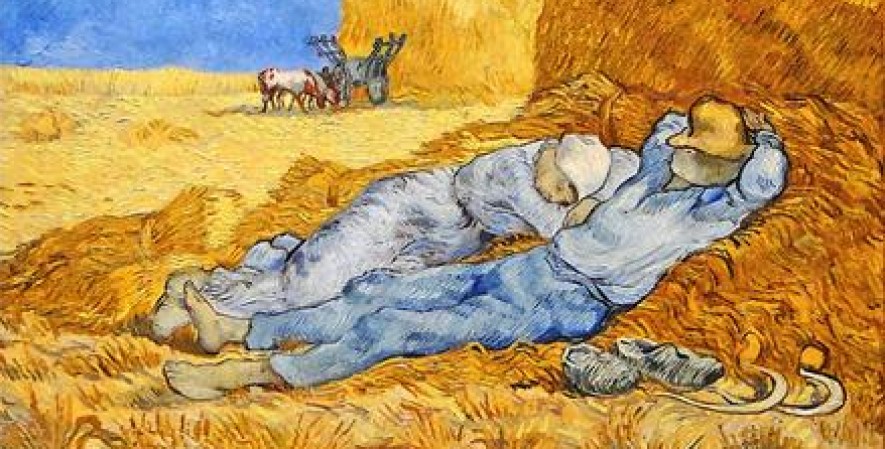
the-siesta_med

Van Gogh’s “Mittagsrast (nach Millet)” (Wikimedia Commons)

I’m still devoted to naps not because I’ll fall apart without them but because they’re good for me. Some folks do well sleeping in one long session over twenty-four hours. I’m happy for them—really. Others’ schedules don’t allow a siesta, which is a shame if they’re tired.

National Napping Day has plenty of scientific support. I’m buoyed by the fact that my daily rest is blessed by research, but I’ll close my eyes in an hour mostly for subjective reasons. Napping is my way of kissing myself on the forehead and saying, “You’re trying to be a good man, John. Lie down and breathe.”

Happy National Napping Day and love to you all.

On My Mother’s 90th Birthday

On My Mother’s 90th Birthday

img_2795

Dolores Coleman, younger than my daughter and son are now

March 11, 2016: My mother would have turned ninety today. She died on June 8, 1998, of sepsis, the result of a reattached ileostomy. Our goodbye still feels like a door left ajar. She was unconscious by the time I reached her hospital room, so the best I could do was whisper and pat her bloated, purple hand.

She was gentle and loving. I thanked her for that. And I said she gave motherhood everything. She lost sleep and sweated small stuff. I didn’t use those exact words, but that was the gist.

The only sign that she could hear me was her fat hand lifted a little, then fell. Maybe she didn’t catch every detail, but I hoped that she sensed my attempt to surround her with kindness and affirmation.

The trouble was, Mom’s end was not certain at that point. I held out hope for a turnaround, so my deathbed blessing was a precaution.

But it would have to do. She passed within a couple of days, while I was at seminary in Columbus. By the time I got back to Erie, she was bone and ash in a beige plastic urn. No tender moment with Mom in repose, no soliloquy.

And no private crying. Those came at her funeral service, called forth by a hymn, probably my favorite: “Abide with Me, Fast Falls the Eventide.” I was loud and sloppy. It couldn’t be helped.

But this was almost eighteen years ago—my Lord! Grief has aged along with me, tears giving way to a longing that visits now and then. I don’t just miss Mom, but also myself as her kid, when life wasn’t perfect, but mostly good and glad.

Much as a hymn cracked me open when I was a younger man, music now makes me feel an emptiness in my chest that can only be filled by the past. Give me communion with those who would now be a hundred or more. Let me break bread with the living scattered by the centrifugal force of passing time.

465px-Cissy_king_bobby_burgess_welk_show_1969

Lawrence with ah Bobby and ah Cissy, 1969 (credit: Wikimedia Commons)

Last week Lawrence Welk—of all musicians!—had me pining. At the family gatherings of my youth, elders wanted big band and bubbles on the television. Enduring Bobby and Cissy and token black tap dancer Arthur Duncan was a tariff imposed on us before we pre-pubescents could watch Mutual of Omaha’s Wild Kingdom with Marlin Perkins and Jim Fowler and, of course, The Wonderful World of Disney.

My cousins and I regarded the burden as onerous, but now when “It’s The Lawrence Welk Show” belts out from the television and the accordion starts up, my mind and body want to be at Aunt Mart and Uncle Kenny’s house, in the always amiable commotion of generations.

The desire for this slice of the past is physical. I swear, when Welk goes “Ah one and ah two and ah,” my heart stirs. Even Joe Feeney’s nasally tenor makes my eyes smile.

Mom was in that joyful air, in the rise and fall of voices I can’t remember all that well anymore. I miss her. I miss bumping into those decent old souls and getting overheated running around with cousins.

The whole champagne rerun (Public Broadcasting Service) played out as I washed dishes and cooked and let a lovely ache move through me.

lossy-page1-800px-Nixon_meeting_with_Karen_and_Richard_Carpenter_-_NARA_-_194770.tif

Karen and Richard Carpenter with President Nixon (Credit: Robert L. Knudsen on Wikimedia Commons)

Not too many days later Karen and Richard Carpenter played the same trick on me—a PBS fundraiser retrospective. Admitting you like the Carpenters is for some people right up there with digging Barry Manilow. Confession: part of me loves them. Karen Carpenter’s voice puts me in another corner of my past’s attic. Family friends stayed late, played cards, gorged on long-gone Armand’s thin pizzas, and laughed until dizzy. I had just hit double digits, and the scene was so loosey-goosey that I scored a fair amount of beer out of the deal. All the grownups loved and played Carpenter’s albums and 8-track tapes.

Mom, who was built a little like Karen before the anorexia took over, was at the center of my memory’s comforting song. I can still see “We’ve Only Just Begun” in calligraphy at the bottom of our friends’ wedding photograph, their giddy features pinched against the flying rice. Who says “Goodbye to Love” and “Rainy Days and Mondays” aren’t happy songs? Those years weren’t too shabby, nestled in between my parents’ divorce and the ravages of Mom’s arthritis.

Part of my longing is to go back, before I knew how fragile and bruised elderly skin could be, how worry and disappointment can hunch your back, how some dreams end as wisps of smoke.

But that’s not all. I want to dunk my Grandma Coleman’s molasses cookies again, sit on the floor of a room packed with relatives as Tinkerbell blesses the Magic Kingdom with pixie dust and Fowler saves Perkins from a boa constrictor, and watch Mom tease her hair, then set it in curls with Dippity Do and bobby pins.

I wish for Karen Carpenter to sing again. I want to rewind Lawrence Welk’s sign-off and listen back when I couldn’t wait for it to finish.

Good night, good night, until we meet again,

Adios, au revoir, auf wiedersehn till then.

And though it’s always sweet sorrow to part,

You know you’ll always remain in my heart.

Good night, sleep tight, and pleasant dreams to you.

Here’s a wish and a prayer that ev’ry dream comes true.

And now till we meet again,

Adios, au revoir, auf wiedersehn.

Good night!

I’m not wiping away tears. My hand is drawn to my chest, though, and I’m sighing. Sadness and gratitude sit together. This is the best happy birthday I can say to Mom right now.

Oniontown Pastoral #3: Hope Is an Old Tractor

Oniontown Pastoral #3: Hope Is an Old Tractor*

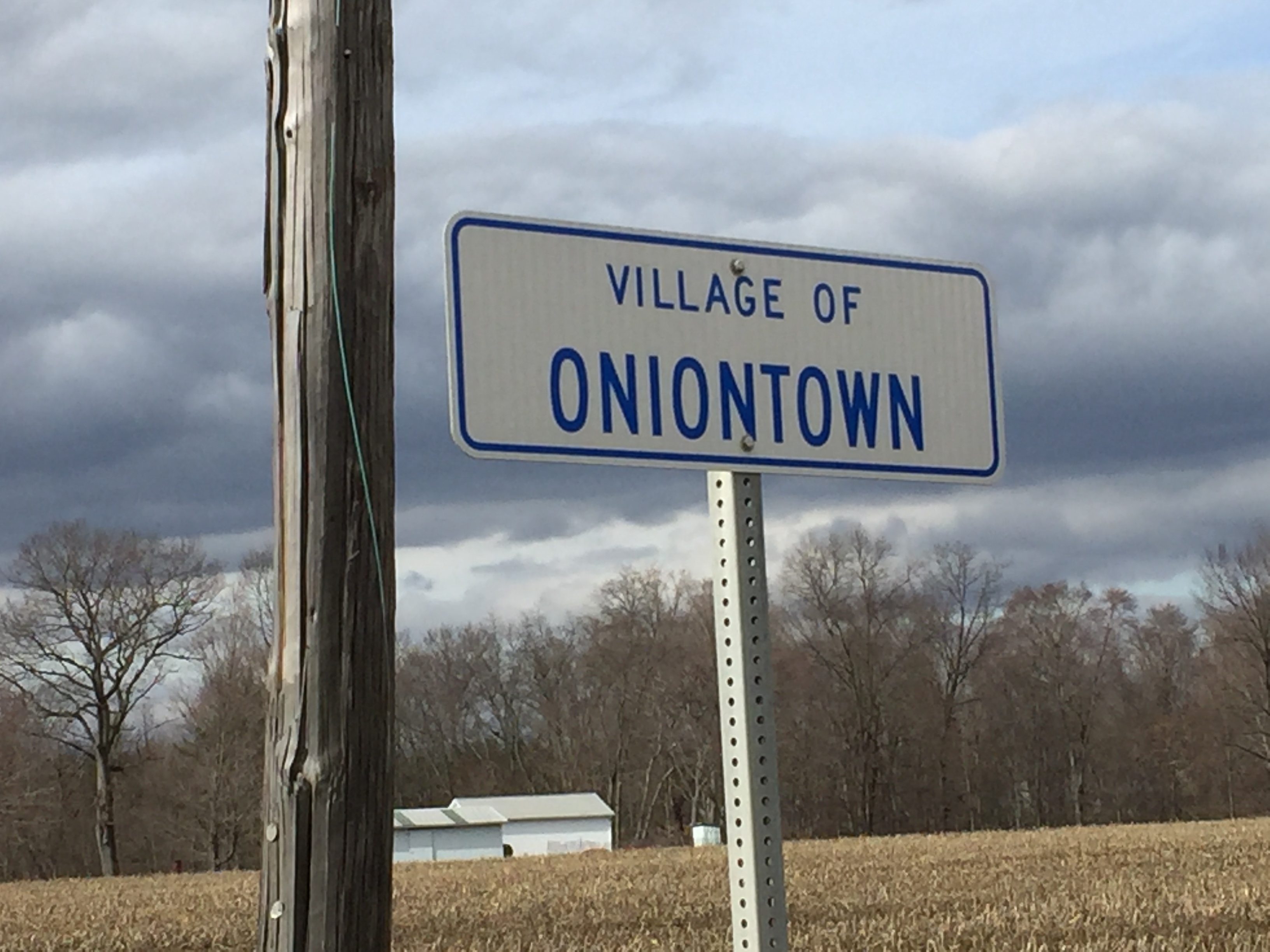
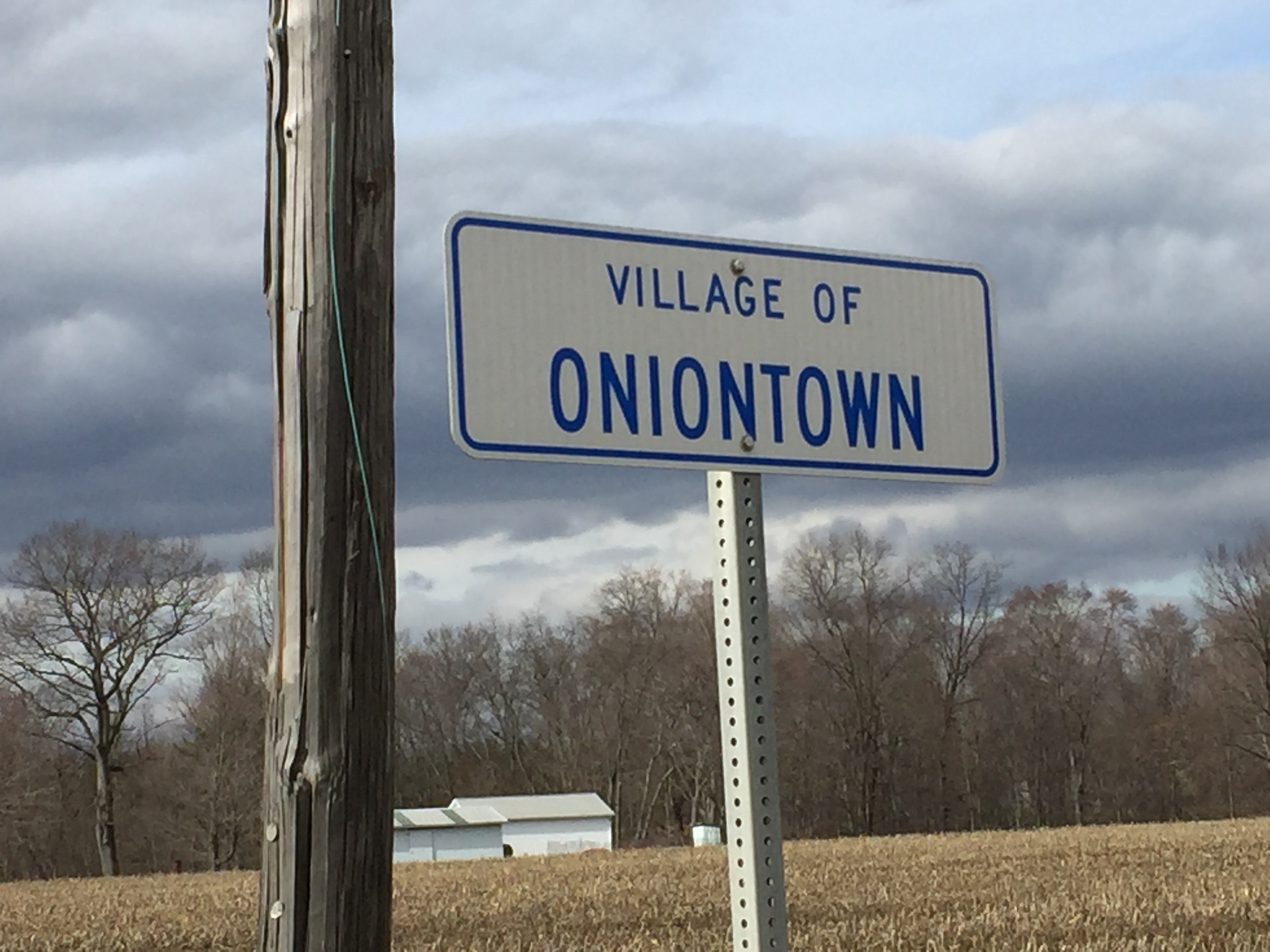
A few Mondays ago my friend’s son, forty-four, overdosed on heroin. The next day I took her stunned grief with me to the pastor’s study at St. John’s Lutheran Church in Oniontown, Pennsylvania.

IMG_4327

Farm art near Oniontown

My commute from Erie has four legs: I-79 South to US-19 South to District Road to Mercer Road. For seventy minutes gray trees and rolling fields heal me, but on this day my mind was on iffy roads and my friend. She and her husband had long anticipated the knock at the door and the crushing news. My wife and I used to have the same nightmares about our son, now thankfully clean.

As I thought about the numb terror of fresh loss, a line from Philippians visited me: “Your citizenship is in heaven.” Good sermon theme! I started to flesh it out. When political candidates carpet bomb each other, when explosive vests cut down the innocent, when El Nino and Zika lead the news, and when nasty heroin is as cheap as beer, then heavenly citizenship sounds, well, heavenly. My point, of course, wouldn’t be to reject this life, but to remember that we have a home over the horizon. Not particularly uplifting, but not all sermons can be sunbeams and dandelions.

I looked forward to getting to church and putting the ideas on paper. Alas, a snowy parking lot stood in my way. But since secretary Jodi’s truck was in its spot, I bravely punched the accelerator. Turns out my burnt-orange, bulbous Chevy HHR can’t compete with four-wheel drive.

“Man, am I stuck,” I reported to Jodi, who didn’t know when the plow guy would get to St. John’s. Might be evening. “We’ll get you out somehow,” she assured me.

I sulked at my desk. Wait-and-see isn’t my best mode. The sermon I pecked away at would sound whiny, I could tell.

Within half-an-hour Jodi said, “Do I hear a tractor?”

“I hear something,” I said. “Don’t know what.” Then out my window passed a bundled up man with a long beard pushing snow with an old tractor. The blade was behind the driver, a configuration I had never seen, but he was blazing me a trail.

“He lives over there,” Jodi pointed. He had seen my problem and arrived unbidden. Shoving snow this way and that, he kept at it, like a man subduing a wooly mammoth with a straight razor.

Watching him ride into and out of view, I came to love that tractor, pale red, faded by decades of sun and squalls. It must have been shiny once, but endurance gave it a different beauty. Hope, I think, is the color of my Samaritan’s tractor.

I finally understood why Jodi wasn’t concerned. And the sermon in process took on a glad color. “Our citizenship may be heavenly,” I now plan to say, “but God resides in Oniontown, too.” Then I’ll tell the folks about our neighbor and his tractor. And I’ll tell them about hope.

IMG_4284

*This essay first appeared a few weeks ago in Greenville, Pennsylvania’s, newspaper, the Record-Argus. 

Oniontown Pastoral #2: Visitation

IMG_4284

I don’t know anything sadder than a summer’s day.

(“The Geese” by E. B. White)

Who doesn’t love summer? Millions of northerners flock south each year in hopes of denying winter its due.

I accept the migration’s logic, but my attraction to summer or any mild weather is complicated. If the sky is flawless blue, I remember that for some folks, clouds block the light.

E. B. White’s summer sadness descended as he watched an old gander on his farm defeated by a young male. The Charlotte’s Web author, in his early seventies, sympathized with the displaced bird.

My ambivalence toward nice weather has its own causes. When I was a teenager my grandparents tried to outrun Gram’s arthritis by moving to Sun City, Arizona. While the dry climate was physically medicinal, the miles from children and grandchildren punished her heart.

My mother died in June of 1998 while I was doing chaplaincy training. At the end of each day of caring for others, I floated a city block to my car through a hot haze of grief.

So memories and disposition keep the unbridled joy of a beautiful day in check. I wouldn’t call my mood sad, though. Mindful is more accurate. I pray for people for whom getting from stoop to car is herculean or impossible. I dream them with me into the light.

Last week I visited homebound parishioners. Ah, the weather! Driving was a pleasure, windows down a couple of inches. Walking across parking lots was all Julie Andrews spinning and singing from the lively hills.

But it never takes long to recall that beauty depends on your perch. If walls and a non-compliant body keep you from taking in deep draughts of outside air and picking tomatoes with your own two hands, then whatever breeze sneaks in through the screen might bring out a sigh of resignation rather than delight.

IMG_4308

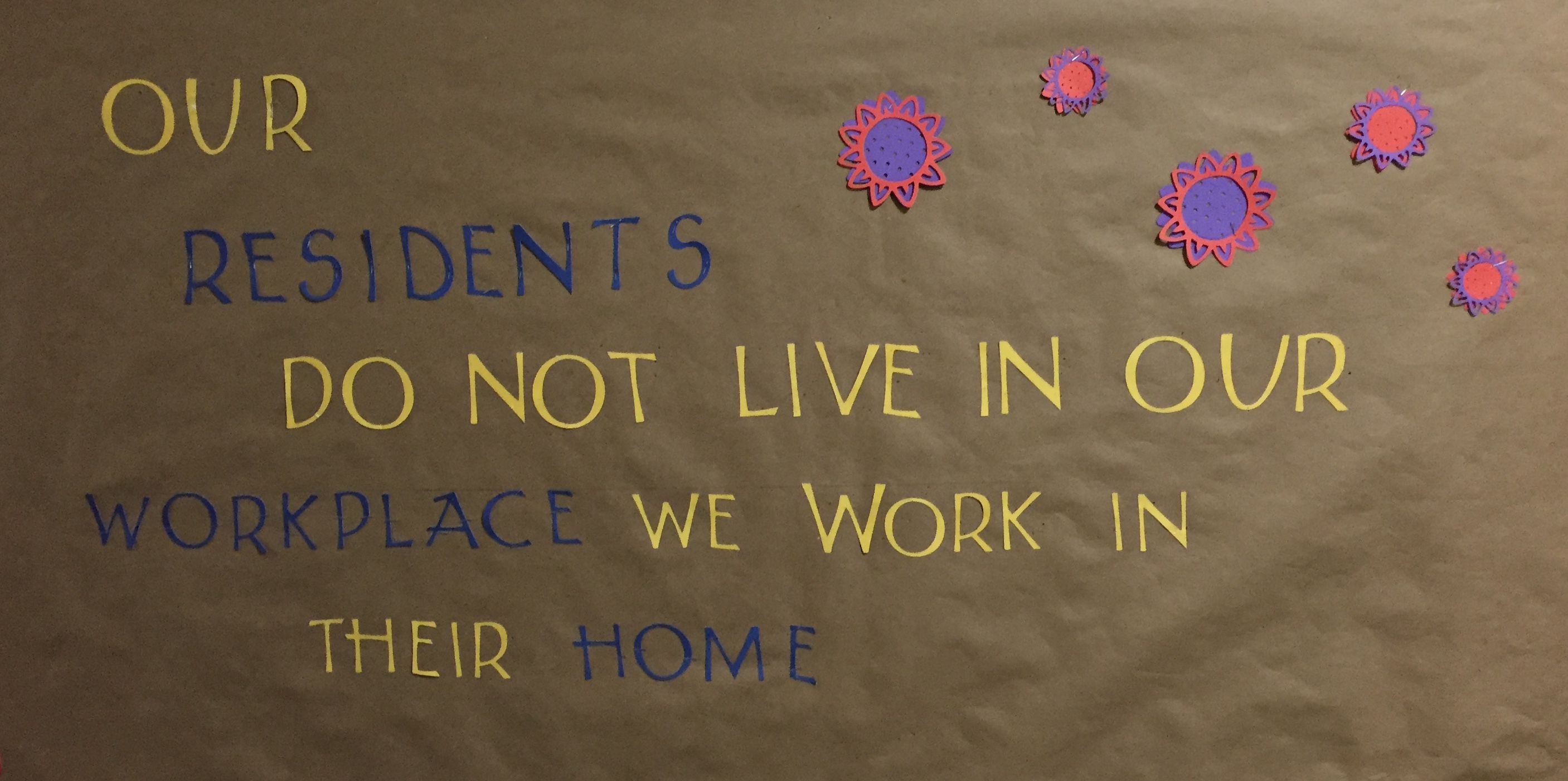
Bulletin board in an old folks’ home near Oniontown

This evening while enduring the television news, I’ll have a splash of pinot noir—just to gladden my human heart. What does a long-stem wine glass look like to an elderly child of God who shakes unpredictably? Or a chalice full of Sacred Presence? Spills waiting to happen?

Such questions should depress me, but they don’t. Seeing through homebound eyes is a lighter prayer than you might think. Anyway, I won’t dishonor them with sorrow. Maybe God can use my gratitude—for the filling of lungs, lifting a spoonful of broth, finding the Big Dipper—to bless my friends, to grant them an hour’s gladness.

My own joy is tender to the touch—only selfish joy isn’t bruised. I miss Mom now more than eighteen years ago when summer hung on me like wool.

But this March day is stunning, brilliant, 60 degrees. Chores are next on the list, then a walk. I’ll bring Mom and gather everyone I can remember as I go.

Dear God, please take the saints I forget by the hand and lead the way.

Words from the Dead in a Frightening Season

IMG_4105

Our beautiful country . . . out my office window.

Voting seasons are generally a drag, but the 2016 presidential primaries in advance of this fall’s general election are scary. In response to a long, humorless essay on the subject I posted on A Napper’s Companion a few days ago, friend Mary wrote, “I am sick and frightened and don’t know where our beautiful country is going.”

To her excellent words, I would add powerless. Today is Super Tuesday, and millions of Americans are looking around wildly for a pause button that doesn’t exist. Will our next president’s greatest gift be barroom brawling? And will the spectacle that is United States government morph from paralysis to legislative deliberations dominated by bellowing, spittle, and locker room insults?

I’m not the only citizen asking these questions and fearing these fears. Friend Judie wrote to me, “I am so ashamed of what we have become in politics.” Mary and Judie speak for thoughtful Americans and, obviously, for me. I’m weary with sick and frightened and ashamed.

As the first votes are being cast, I’m taking this moment to up my personal ante: Shame for others’ conduct is bad, but shame for my own thoughts and actions is worse.

When hitting below the belt is the order of the day, the temptation to counterpunch in like fashion is acute. If you call me a loser, I can call you whatever I please—and think even worse. But this way is neither Christian nor mindful. It’s the way of the lowest common denominator and the reptile brain.

Frightening times can bring out the worst in us, myself included. We’ve been scared before, though. I’m too young to recall vividly 1968, another year that America felt itself cracking to pieces. Think the Vietnam War and Civil Rights movement, the assassinations of Martin Luther King and Robert Kennedy.

In April of that year, monk Thomas Merton wrote in his journal while on the road: “So the murder of M. L. King—it lay on top of the traveling car like an animal, a beast of the apocalypse. And it finally confirmed all the apprehensions—the feeling that 1968 is a beast of a year. That the things are finally, inexorably, spelling themselves out. Why? Are things happening because people in desperation want them to happen? Or do they have to happen? Is the human race self-destructive? Is the Christian message of love a pitiful delusion? Or must one just “love” in an impossible situation?”

Anyone familiar with Merton’s life and work knows how he would have answered his own questions. One must love. In beastly times, love is the mindful person’s center of gravity. Such love is sometimes obliged to fight, but its arsenal is selective. Cruel or dehumanizing weapons, for example, are out. Such love is also sacrificial and can appear not only risky, but reckless.

How difficult to remember in an alarming season that assaulting my neighbor ends in wounding myself. In an informal address in Calcutta in October of 1968, Merton spoke indirectly of love: “And the deepest level of communication is not communication, but communion. It is wordless. It is beyond words, and it is beyond speech, and it is beyond concept. Not that we discover a new unity. We discover an older unity. My dear brothers, we are already one. But we imagine that we are not. And what we have to recover is our original unity. What we have to be is what we are.

Flower_Power_by_Bernie_Boston

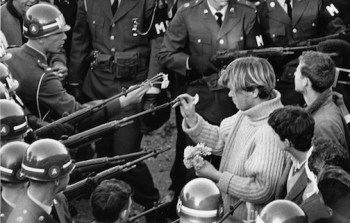
Flower Power, 1967 (Credit: Bernie Boston on Wikipedia)

Monks from various spiritual traditions, Western and Eastern, heard these words. In the context of what feels like a contemporary planetary crack up—campaign explosions, not to mention real bombs and climate change—Merton probably seems flighty, like a hippie sticking a flower in a rifle barrel. (And the monk himself added a tragic explanation point to 1968 on December 15th when he died of an accidental electrocution in Bangkok.)

If the human race is self-destructive, I want to be the weirdo holding out a daisy. If Christian love and human unity are pitiful delusions, nobody wake me up.

Wherever our beautiful country is going, history has taught us where hatred and fear lead. Call me a flake if I refuse to take the beastly path.

A Matter of Conscience: An Open Letter to Moderate Republicans

Blogger’s Note: This post is not only long, but upsetting. As the title suggests, I’m writing about politics. If you visit A Napper’s Companion for a lift, you may want to skip what follows. Please know that I feel compelled to share this letter.
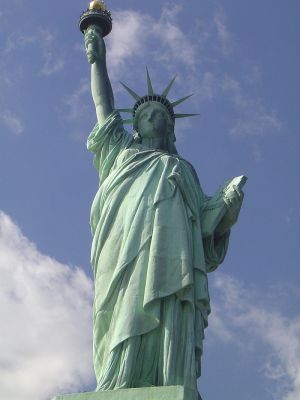
800px-116_NYC_(Liberty_Island)

Mr. Trump, tear down this statue. (Credit: Wikimedia Commons)

February 26, 2016

Dear Moderate Republicans:

“If I were to remain silent,” Albert Einstein said, “I’d be guilty of complicity.” I’m neither a public figure nor a genius, but I borrow the iconic physicist’s words to make clear the reason for this letter. I don’t write as a Lutheran pastor, which I happen to be, but as a regular guy who feels not only sick, but under a moral obligation to speak.

I’m sick that half of the voting Republicans in Nevada believe that Donald Trump is the best available pick for President of the United States—49.6%. Half!

Sick that Trump appears poised to mop up delegates on Super Tuesday, now four days away.

Sick that the two youthful candidates seriously challenging Trump have ironic qualifications. One tried in 2013 to shut down the government he aspires to lead and is by all accounts reviled by his colleagues. The other has essentially given up on his elected responsibilities before his first term of service is finished. Why is he missing about 1/3 of votes? “Because I am leaving the Senate,” he replied, “I am not running for re-election.” If he thinks Senate duty is an insufferable slog, how well suited is he for the Oval Office, really?

Before going on—and you can stop reading any time—I want to qualify the word sick. I’m heartsick. The optimist in me says that most conservatives are troubled with how the Republican primaries are unfolding and embarrassed by the current candidates’ behavior. For what it’s worth, I write in the spirit of loving intervention. What I am compelled to point out pains me, as I have many dear friends who are Republicans, but the matter is urgent.

In less than a year, the next President will take office. What exactly is at stake?

Donald Trump promises to build a wall between the United States and Mexico, one foot taller than the Great Wall of China. “I want it to be so beautiful,” he says, “because maybe someday they’re going to call it the Trump wall.”

If Trump fails to get Mexico to pay for this project, he might fund it by selling the copper lady lifting her torch over New York Harbor. A nation that solves problems with walls won’t have much use for the words on her pedestal:

Give me your tired, your poor,

Your huddled masses yearning to breathe free,

The wretched refuse of your teeming shore.

Send these, the homeless, the tempest-tost to me.

Of course, a wall by any name may prevent wretched refuse from entering the United States, but it won’t get rid of those already here illegally. Trump remains steadfast in his intention to muster a deportation force, which will track down 11 million undocumented immigrants—a term he rejects as politically correct—and return them to Mexico. That figure is under dispute, but it does notably include the immigrants’ children, who are by law U.S. citizens. Through “good management,” the exodus will be accomplished in a year and a half, maybe two.

Could any compassionate American bear to witness the spectacle from round up to drop off. Picture those flippantly called anchor babies, hundreds of thousands of little kids, herded onto busses with their families and dumped, my God, who knows where. We’re talking about millions of people. What sane adult can’t foresee a humanitarian crisis?

Mark Krikorian, Director for the conservative Center for Immigration Studies, says what some Republicans must be hoping, that Trump’s deportation statements are a “gimmick’: “He’s just making it up as he goes along. Whatever goes into his mind comes out of his mouth. There’s no way to deport 11 or 12 million people in a short period of time.”

I must be a prude where campaign gimmicks are concerned. Blustering about the deportation of what would amount roughly to the populations of New York City and Chicago combined isn’t strategic, it’s obscene.

Maybe other campaign promises are primarily attention getters, too.

Ted Cruz says he’ll carpet bomb ISIS, which sounds hawkishly sexy until you reckon the term’s meaning. Having been corrected, the Texas Senator now knows that he is calling for what Business Insider defines as “large-scale, unguided bombing,” which military experts insist would be a horrible strategy. You don’t remove warts with bulldozers.

Cruz also claims that Trump is actually weaker on immigration than he is. What does that say? “I’ll see your gimmick and raise it by a million . . . people!”

And Rubio, poor Rubio, seems like he is trying to stay out of trouble until voters come to their senses. The Republican Party establishment is hastily huddling around him. If Rubio can find within himself what he lacks, grace under pressure, he offers perhaps the best shot at derailing Trump. In last evening’s debate in Houston, the part-time Florida Senator seemed unscripted, even nimble, in his engagement with the front-runner, so there may be hope.

But time grows short, not only for Republicans, but for all Americans. Sick with the urgency of Super Tuesday, I state directly what is a matter of conscience: setting aside for a moment the criticisms Democrats richly deserve, moderate Republicans need to reclaim their party’s integrity and live up to its claim to be the Party of Lincoln.

I wish these harsh words applied only to the primaries in the months ahead, but the mere conceivability of a Trump or Cruz presidency is the result of Republican conduct in recent years. (Again, I admit that my party’s transgressions are abundant, but Democrats aren’t lustily casting ballots for a candidate who routinely uses vulgar language on the stump and threatens his opposition with frivolous lawsuits.)

800px-Flickr_-_Shinrya_-_The_Great_Wall_of_China

Name that country. (Credit: Wikimedia Commons)

In 2012 Thomas E. Mann and Norman J. Ornstein, one Republican and the other Democrat, published an article in the Washington Post with a provocative title: “Let’s Just Say It: Republicans Are the Problem.” An excerpt summarizes their argument:

“We have been studying Washington politics and Congress for more than 40 years, and never have we seen them this dysfunctional. In our past writings, we have criticized both parties when we believed it was warranted. Today, however, we have no choice but to acknowledge that the core of the problem lies with the Republican Party. The GOP has become an insurgent outlier in American politics. It is ideologically extreme; scornful of compromise; unmoved by conventional understanding of facts, evidence and science; and dismissive of the legitimacy of its political opposition.”

Examples of Mann and Ornstein’s charges are legion, but for brevity’s sake I’ll limit myself to two.

It’s no secret that Republicans are hell-bent on repealing Obama’s Affordable Care Act. All Republican candidates for President are locked and loaded. Gone are the days of accepting congressional votes as laws of the land and moving on—long gone. Since the ACA became law on March 23, 2010, “The House GOP has voted over 50 times to repeal all or parts of the health bill. Almost all of the bills died in the Senate” (AP report). Any bill reaching the President’s desk would get a swift veto. In other words, the House has held over four dozen symbolic votes, which seem little more than a silly waste of time until you consider what a House vote costs taxpayers. CBS News estimated in 2013, when the symbols stood at 33, that each vote cost about $1.45 million. So today, $1,450,000 x 50 = $72,500,000. Contemplate this. We’re talking about $75 million-worth of chest puffing and foot stomping, and we funded it. What’s more, we all know the definition of insanity (never mind understanding and accepting mathematical facts).

The other example I’ll mention of toxic Republican conduct is fresh, not yet played out. Antonin Scalia’s body was still warm—only a slight exaggeration—when Senate Majority Leader Mitch McConnell said a replacement shouldn’t be named until after a new President takes office. A couple days ago Senate Republican leaders announced that shouldn’t has solidified into won’t. The New York Times reports McConnell’s edict: “This nomination will be determined by whoever wins the presidency in the polls. I agree with the Judiciary Committee’s recommendation that we not have hearings. In short, there will not be action taken.”

Why not? When I sort through the answers, what I hear is Bartleby the Scrivener’s response: “I would prefer not to.” Or “you can’t make me.”

So this is where we stand. The constitutional and traditional duties of governance can be simply waved off. Given the strategy of obstruction employed by Republicans since President Barack Hussein Obama took office in 2009, should anyone be surprised that the party establishment is betting its farm on a Senator who shirked his responsibilities before the paint in his Capital Hill office was dry?

In fact, the thus-far successful candidacy of Donald Trump is built upon the Republican Party’s recent performance reduced to a sophomoric gesture. Conservative columnist Michael Gerson calls the front-runner’s way “the political philosophy of the middle finger.” These are words, not mine:

This philosophy “assumes that practices we know are wrong in our private lives—contempt, mockery, cruelty, prejudice—are somehow justified in our political lives. It requires us to embrace views and tactics that we would never teach our children—but do, in fact, teach them through ethically degraded politics. Imagine your teenage son (or daughter, for that matter) calling a woman a ‘fat pig,’ ‘dog,’ ‘disgusting animal’ or ‘bimbo.’ Imagine your child labeling someone he or she knows as a ‘loser,’ ‘moron’ or ‘dummy.’

This is the evidence of poor character, in any context. For Christians, the price of entry to the Trump movement is to abandon their commitments to kindness and love of neighbor. Which would mean their faith has no public consequence at all.

I can imagine how maddening it must be to feel lectured about something as massive and abstract as one’s political party, but I risk being a scold for the sake of conscience. Hardly ever do I hear Republicans admitting that their party’s actions in recent years have done great damage and their leading candidate for the highest office in the land is unacceptable. (And, now, endorsed by Chris Christie. I’m stunned.)

Any effective intervention begins with accepting responsibility. As a private citizen and a Democrat—and out of love for you and country—I call upon moderate Republicans for the moment to resist attacking me and accept their party’s role in our current national situation.

And I promise to take seriously any appropriately-worded, well-substantiated criticism of the Democratic Party. My party may well need an intervention, which I’ll endure with a light heart, on one condition: given present circumstances, you go first, please.

Respectfully yours,

John Coleman

Erie, Pennsylvania
Oniontown Pastoral #1: My Wife Sleeping

Oniontown Pastoral #1: My Wife Sleeping

IMG_4284I’ve been going to bed by 9:00 p.m. lately and waking up several times during the night–changes in established rhythms. Wife Kathy and I have pruned home to 1000 square feet. My pastor work has slimmed to part-time to make room for writing. And Kathy cries out whenever she rolls over.

As our friends know, Kathy climbed to unfurl the royals on Brig Niagara. She put a new roof on our old house, remodeled the bathroom, fashioned a patio out of salvaged brick, and planted flowers I could never name.

When we bought our little house, which I call the hermitage, Kathy willed the dingy place into fresh order with elbow grease and doggedness. She has big plans: a vegetable and herb garden with raised beds; a deck cobbled together with wood from a backdoor ramp she will saw into pieces; and, of course, flowers.

Kathy has plans, but as we found out a few weeks ago, she also has rheumatoid arthritis. Questions still outnumber answers. Will medication help? Diet? Exercise? Can the condition be coaxed into remission?

She has swollen joints, particularly at the fingers and wrists, and pain all around. A steroid helps for now, but it’s not a long-term solution. Her spirit still sings. Just now she sent me this message: “I hope you are enjoying your morning writing time. You should try to get out for a walk today. What a lovely day. Love you.”

Lovely day, indeed. Lovely human being!

This morning at 1:48 I woke up, sipped some water, and watched Kathy sleep. She should win awards for the dexterity and variety of her snoring. A couple of exhales in a row, her throat sounded like a playing card being flip-flip-flipped by bicycle spokes.

When I smoothed hair away from her forehead, she started. “Oh, I’m sorry,” I said. For the first time in my life, I heard a complete, discernible sentence uttered in mmms. Cadence alone provided the words: “Oh, that’s okay. You can put your hand on my head.”

So I held her hair between the fingers of one hand, rested the other on her puffed out knuckles, and prayed—sort of. If wanting to draw pain out of my wife by touch, to take it upon myself, counts as prayer, then I prayed.

And if “Oh, my dear” counts, then I prayed without ceasing. How many times did moving a little bring rapid breaths and four or five ows out of her sleep?

“Your hands?” I asked.

“My leg,” she answered.

“Oh, my dear.”

She returned to snoring. I looked at her face and longed for a miracle, but I’m eccentric, a pastoral black sheep. You would expect articulate petitions from a trained theologian, but I pray best by breathing.

Each time Kathy resumed snoring, I drew close again and kept vigil. In our shadowy bedroom, we lay bathed in holy light.

One belief granted me sleep: every cry ripples in the waters of Eternal Love.

P. S. Please stay tuned for further Oniontown Pastoral posts and other explanations and solutions.

I Want to Be “Decisive” When I Grow Up

I guess decisive is the word. Maybe it’s convinced. Or certain. But since I’m fifty-something, the question of what I’ll be when I grow up is academic.

I am what I am, which is discerning. Discernment’s pace toward decisions is stately. It’s focused, but patient. That’s me. I’m comfortable with interesting and hmm. No need to stampede toward conclusions.

Practically speaking, I’m how rich and what poor. I know, for example, how to sit with people and listen, but am nearly clueless when it comes to what they should do. I can figure out how to string sentences together, but readers these days pay to be told what to do, and I suck at that. After “secure that smartphone and pay attention to your kid, wife, husband, and ferret Rafael,” my prescriptions run out.

Ferret_2008

Raphael (Credit: Wikipedia)

My life-management skills are sketchy. Walking with you? That I can do. Giving you a plan or grid or diet? Don’t look at me. This is a suspect orientation for a Lutheran pastor and writer. Men who get paid to wag their chins on Sunday mornings and volunteer their personal essays for Internet consumption should clarify more often than mystify.

Here’s a brief study in what I’m bleating about. If I were a decisive grown up, you would be reading a compelling case for one of the characters currently plotting to be President of the United States of America. What a rush it would be to write with the conviction of, say, former Secretary of Labor Robert Reich, who can tell you exactly whom to vote for and why.

I wish. Like hundreds of thoughtful citizens, I’ve been grazing in the unkempt fields of campaign coverage and punditry. Two states into the meal, I’ve strayed into gray pastures, nauseous with uncertainty. What I’ve got to say may feel good, but mostly as a purgative.

  • Does the news media manufacture—or at least feed—nerved up realities? Why the breathless, urgent reactions to voting in two Wonder Bread states—no insult intended (Iowa: 92.1% white; New Hampshire: 94% white)? Talk about racism! The suggestion that any candidate is already washed up comes from a malnourished perspective. Would Harry Carry have declared the game over if the Cubs gave up a couple of runs in the first inning? Do cancer patients call off chemotherapy when hair starts to fall out? Come on.
  • What is the most important consideration in voting for President of the United States? Platform? Experience? Promises? Charisma? The older I get, the more I care about intelligence and integrity. Maybe this concern grows out of my cynical hunch that some candidates don’t believe in much of anything—a whoredom that trumps all other prostitutions. I remember decades ago elders saying that they would vote for somebody from the other party; they rooted for the best person for the job. The sentiment is worth revisiting. How much stock should we place in a candidate’s humanity? You can study up on economics. But can you acquire character?
  • Is a revolution really the best corrective to our current governmental dysfunction? I acknowledge the appeal of a righteous battle, the blood rush and passion, the idealism and purity, the triumph of justice and common sense. There’s no shortage of revolts being proposed as we all pant for the results in South Carolina and Nevada. Bernie Sanders has employed the r-word itself. Other candidates vary the diction but stump in the same genre. Although I’m not without sympathy for Sanders’ uprising and even saw merit in Ron Paul’s long-shot crusade, revolutions have drawbacks. The Tea Party has been throwing everything not bolted down into the Potomac for a few years now, which has done nothing but dam up the government. How likely is it, then, that another revolution would yield better results? Nothing beats the language of war for whipping voters into a bloody foam, but if brawling remains our go-to legislative strategy, we’ll have to name Mathew Brady our Capital Hill Photographer. And 2.) losers in a revolution—and there can’t not be losers—go home pissed off and start plotting their revenge.

I could happily go on, speculating about the place of objective truth (what little there is) and manners in politics, but who really wants to follow me further into what started as a dreary example of one Lutheran pastor’s turn of mind?

The point, for anybody still awake, is me—by which I mean, maybe you, too. I’ll put myself in your shoes. Let’s see if I’m warm.

  • Every day is a litany of fast judgments and flawless answers. Television knows the best seat for surviving a plane crash and how to weave to escape a shooter. Family-friends-whoever cure timeless worldly ills with one flippant sentence. The lovely can transform the normal for three easy payments. You say, “I wish I were so sure.” Or “How can anybody be so impossibly full of crap?”
  • You’re overwhelmed, weary with information, each expert shaking you by the lapels. Even as you purchase another plan, your own wisdom speaks: “Tend first to your troubled heart, beloved.” “Hush up,” you respond, for the hundredth time, and swipe your credit card.
  • Part of you hangs onto the belief that you’ll feel settled eventually, at peace and complete. You’ll be grown up, a finished human being.
  • Then, sweet then: questions and doubts will fall silent. You won’t be vulnerable anymore. You won’t have to be humble either, but you will.
  • Long before the polls open, your choice will be set.

If your shoes don’t fit me, please forgive my presumption. But if they do, I’m guessing you have balm for humanity in your soul. If only somebody would listen, you would say, “Let’s pay attention to how we treat each other. Then what we should do to fix the world would be clear.”

As for me, I’m not decisive enough to speak up–afraid of sounding frivilous. Until I grow up, I’ll just say that I’m discerning.

Thus Spake the Rabbi

My stride has been ragged lately, my groove flummoxed. As the poet said, “Nothing is plumb, level, or square.” Or the politician: “What a terrible thing it is to lose one’s mind. Or not to have a mind at all. How true that is.”

f503eb5a-2d90-44f2-ba21-32f9914a488a

Old buddy Watson, twelve years of family joy

Joy is largely to blame. Wife Kathy and I had friends over the other night to catch up. When eyes turned toward me, I said, “I’m happy,” which took some explaining. During the last couple of years, though surrounded by more love and support than anyone deserves, I have been tired and stressed. Maybe burnout is the word. Against all worldly good sense, Kathy and I raided my retirement funds and bought a hermit-sized home. (“You might come to regret that,” an old colleague said, and I couldn’t disagree.) I left a fourteen-year, full-time pastorate and accepted a part-time call seventy miles south of Erie, right through the region’s snow belt. Oh, and we haven’t sold our big house yet.

We Colemans have either lost our minds or found them. It could be that you have to lose one mind to find another. Since gladness and good sense seldom form right angles, I’m not surprised that my stride and groove—constructs of a neurotic brain—are stepping lightly these days.

I didn’t use these words exactly to unpack “I’m happy” for my friends, but they understood. Forced to choose between weary, anxious circumstances standing in crisp formation or calm ambiguity weaving like a drunkard, I’ll take the latter.

That is to say, I have taken the latter and am learning to embrace uncertainty and surprises. Lately sleep has been whimsical. A new work schedule has taken issue with my long-standing afternoon habit of napping. Like an AARP veteran, I’m reading in bed at 8:30 p.m. and surrendering by 9:00 or 9:30. The result: I wake up at 2:00 a.m., float to the bathroom, return to bed, and abide in a space that is to sleep what free association is to therapy.

Neither refreshed enough to get up nor drowsy enough to disappear, I breathe. Deep breaths, yes, but not those of my past, taken to lift a burden just enough to endure another hour or hush a remark that can’t be retrieved. If insomnia is an enemy, my peculiar wakefulness is a bearer of gifts.

60ab5db4-5da1-4824-95fc-0fde4cc86b6d

A bulge on the forehead: “soon and very soon,” Watson

Darkness is upsetting if you’re trying to find something, but it’s a gentle companion if you’re waiting to be found. A few nights ago snoring found me, not my own, but wife’s and dog’s. The sounds, joining for a moment then going their own ways, were blessings. Kathy has been swollen, weak, and achy for the last couple of months, and neither we nor the doctors know why. No matter what noise it makes, her sleep is medicinal. I welcome it. And Watson has weeks rather than months to live. The fatty tumor on his flank is getting hard. The growth on his forehead pains him more by the day. I now hope to come home and find that he has slipped away while dreaming that he and I are going for a run like we did years ago. His snore means that we don’t have to say goodbye quite yet. God bless his kind soul, even our walls and floors will miss him. I think now of his eyes, alive and expectant when Kathy and I left him this morning, and am close to undone.

The first decoration I nailed up in the Coleman’s new home is wisdom from a rabbi, Abraham Joshua Heschel.

7cc731dd-b219-4700-b2ee-3f9cdca525b4

Thus spake the rabbi

“Just to be” in a warm bed next to Kathy; “just to live” one more day with Watson: these are the teachings of wakefulness. My chest rises and falls, each in-breath a blessing, each out-breath sacred.

But my darkness isn’t deceptive. It would never say to a lost soul, “Just to be is a blessing.”

Instead I hear, “One corner of your joy will always be uneven, cracked with grief. Whatever mind you possess, it will never be satisfied.”

In this moment, I close my eyes to learn, invite the 2:00 a.m. wakefulness, and hear the rabbi more clearly. Breathing is grace. I survive on love. And I pray: “When my dog dies, Holy One, please help him not to be afraid.”

Fats Waller and the Frosted Trees

Fats_Waller_edit

Fats Waller (Credit: Alan Fisher on Wikimedia Commons)

Fats Waller and the Frosted Trees

Jelly Roll Morton, Scott Joplin, and Fats Waller make me grateful. As Steve Martin said decades ago, “You just can’t sing a depressing song when you’re playing the banjo.” Same with driving in the country and listening to piano rolls, rags, and strides.

This past week Fats, the color white, and gratitude owned my commute from Erie to St. John’s Lutheran Church in Oniontown, Pennsylvania. The hour south on I-79, Route 19, and District Road was a hot damn of thanksgiving–“Handful of Keys,” “Lulu’s Back in Town,” “When Someone Thinks You’re Wonderful.”

d8ab0138-1236-43ad-a8dc-a930a0642a7f

Grandson Cole, wonderful kid with a new lid

Why did pianos and frosted branches make me take inventory? I don’t understand myself all that well, so who knows? My list wrote itself slowly and silently.

  • I have a surplus of love. One step in any direction, there it is. Wife, grown kids, one grandson and another on the way, more family and a ton of friends. An absolute wonder of wonderful souls.
  • Those closest to me are holding together okay. No crises going down or chops busting in process.
  • I have a home, warm or cool as desired, so much food that possibilities have to be eliminated, and a king’s ransom of clean water.
  • My closet holds wardrobes for varying weight classes with acquisitions I’ve forgotten.
  • Bill collectors are not breaking down the door.
  • I dig the bookends of my commute—solace to the north and good purpose to the south.

As the miles clicked away, as Fats sparkled, as the snowy trees formed cathedrals surreal with beauty, Gershwin lyrics came to me: “Got my gal, got my Lawd, got my song.”

IMG_4148

Beloved Watson with the mother of fatty tumors

“No use complaining,” Porgy says as an aside, though he didn’t know about the Coleman family’s dog Watson, weary, arthritic, laden with tumors. He is our hobbling source of agape—unconditional love. A month ago, a lump appeared in the middle of his forehead. Its rapid growth foreshadows his absence, even as he manages a fetch or two. He snorts constantly, trying to clear a mass that won’t budge.

Nearing the end of my commute, I allowed that happiness isn’t a prerequisite for gratitude. Twelve years of Watson’s mild presence has been extravagant by any measure.

IMG_4150I would say that my inventory was a prayer, but Fats alone was that, as were the frosted trees and a line from a musical. I received the wide mercy—alpha to omega—of giving thanks for miles with my eyes, ears, and lungs and not once calling God by name.