A Pastor’s Goodbye Letter

Dear Abiding Hope Family:

If you’ve been by my office lately, I understand your amazement. You’ve taken in the clutter and generally said boy or wow. The pastor’s study can be like my late mother’s junk drawer. Any object without a clear, immediate destination goes in the junk drawer (a lonely C battery, a half-used packet of mini Kleenex, a ceramic hippopotamus from a box of teabags) or the pastor’s study (a floppy sunhat, an old bag of Swedish fish, an unopened pack of small Depends–someone might be able to use them). One of you winked and mentioned that a huddle formed recently over the need for an intervention.

And you see only part of the squalor. Yesterday I filled five trash bags by emptying out a filing cabinet hidden behind my closet door. Notes from seminary might be interesting as artifacts, but if their contents haven’t already been put in my heart and written on my mind, then I’m in trouble, as is anybody who would call me Pastor.

I’ve gone through hundreds of books and filled two boxes with keepers. Over the years a formidable theological library has happened my way, one collection from a studious pastor ready to retire and another from one who left behind an apartment groaning with bound ideas and counsel. The titles displayed on bookcases look learned, but as gray overcomes the final evidence of brown on my chin, the day has come to admit I’m much more writer than scholar (or theologian in residence, as parish pastors are supposed to be) and more fellow pilgrim than wise guide.

My mess and excess have let these realizations sink in and sharpen my awareness that most of what I’m moving out of the pastor’s study will be stored in my chest along with all I own in bliss and sadness, in the space that holds rants, laughter, and sighs.

IMG_3953

Baby Jesus, bless it all: the old candy canes, the banner, books I’ve never read, the mirror Elena looked into as she put on her wedding gown before I walked her down the aisle, then turned around and did the wedding.

Herbie was a bricklayer disabled young by heart disease. The whole time I knew him he had oxygen slung over this shoulder. Doctors tried everything, even a procedure that included poking holes in his heart. Weary, often in pain, he and his wife Loretta thought and prayed. We were visiting in their living room when she said that Herbie had decided to stop taking medication. The enough moment had arrived.

I sat beside him on his hospital bed, put my arm around his shoulder, and he let go. I’ll never forget the feeling. He cried and sagged against me, and I knew that his soul beheld a journey that starts with surrender. Surrender, that’s what we shared, the final human consent.

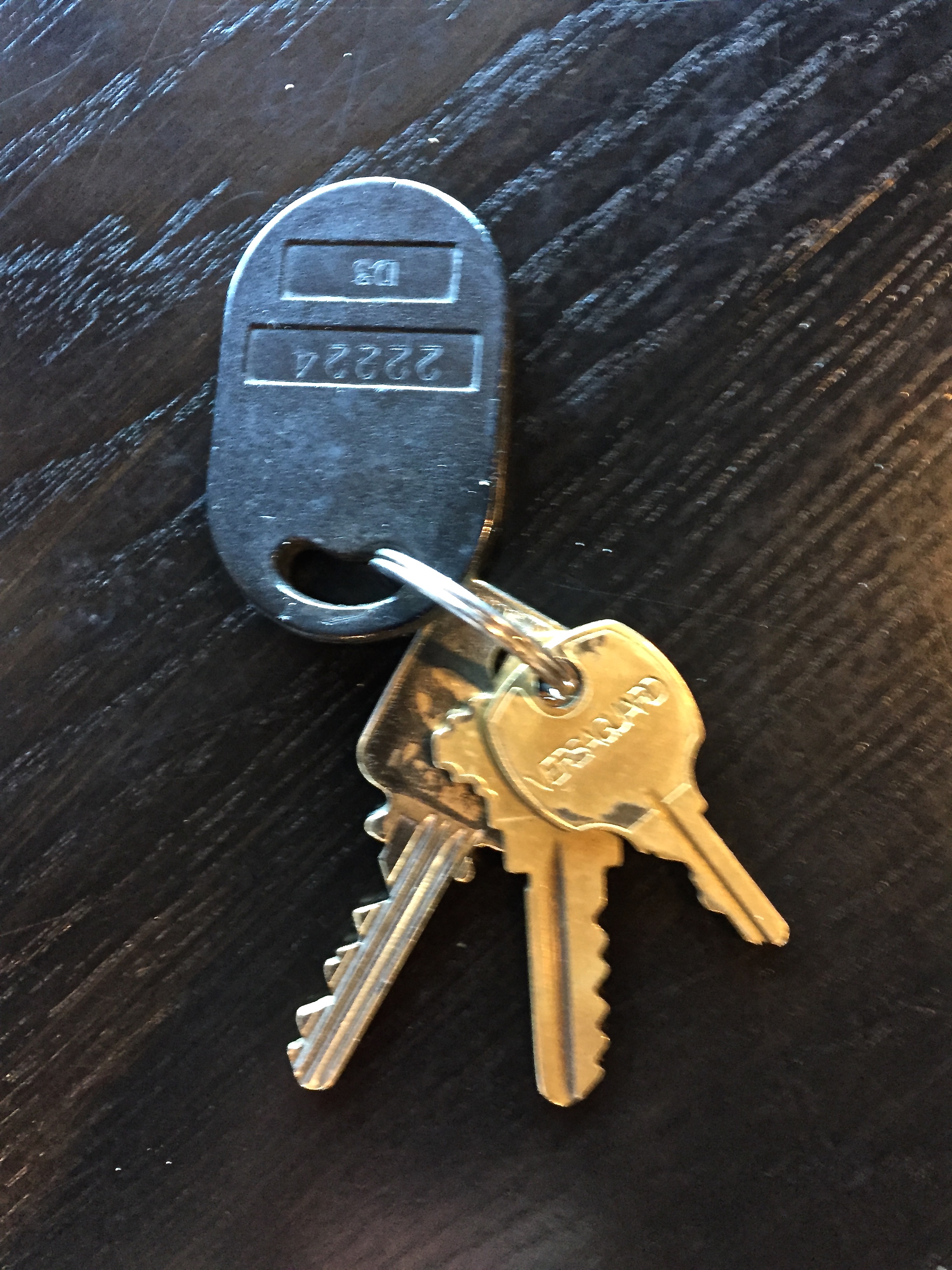
I held Herbie around a dozen years ago. When I leave my keys on the desk and walk out of Abiding Hope this coming Sunday, my arm will still be around his shoulder.
IMG_3957

The little key is for the thermostat.

On Sundays during Holy Communion, children come forward for a piece of bread and a blessing. I cheat. Some argue that little ones don’t understand the Sacrament, which may or may not be true, but I’m certain they know what it means not to share what everybody else receives with such reverence and devotion. So I break off a little piece, a foretaste.

I get down in their faces and say, “Now you need to remember, Jesus loves you exactly the way you are.” I don’t pretend to know the mind of God, but if this isn’t true, my ship is going down in boiling water. Anyway, the world devotes much time and effort convincing us to improve, so I figure hearing a word of unconditional love over and over can’t hurt.

When I stand back up from each blessing my knees crack, but I don’t feel a thing. The sacred space in my chest can’t forget the expectant eyes, the whispers of yeah or okay when I tell them to remember.

IMG_2605

“Go in peace! Serve the Lord!” I’ve had this photograph taped on my office door. These kiddos go with me.

Your life is coming in for a hot landing. There might be debris, flames and black smoke. Nothing to do but hang on, so you show up at my messy office, where you predict the devastation, anticipate the casualties. You need Kleenex.

Cancer. Betrayal. Death. Joy, too, babies and victories. But whether you’re in a free fall or glad flight, the pastor’s study is mainly a place to search through the box of answers you bring with you and to remember, always remember: In messes or atop mountains, we’re never alone. Our Unseen Guest, as my Grandpa Miller called Him in table grace, is with us, but when you and I hold hands and pray, we’re way beyond caring whether God is a boy or girl. We believe in the One in whom we live and move and have our being: God. Those three letters are plenty. The wreck may end up worse than you fear. We look at the cross and recall that Jesus crashed hard. With uncertainty scattered everywhere, we breathe in God’s old promise: “I will not leave you or forsake you.”

A promise and each other, that’s what we’ve got. When you walk out of my office, you leave me a gift that I’ll always hang on to: the image of your face as we crossed the valley of shadows and how it brightened when you felt the Unseen One traveling with us.

IMG_3954

Your chair, holding a box of keepers. It will still be waiting for you when the next pastor arrives.

Your face. Abiding Hope faces. I keep them all in a safe place. And I want you to know, I have the faces of those you love and have gone on to glory.

At the funeral home, after everybody passes by the body, I stay behind. The funeral directors close the doors, then lower your loved one into the coffin and fold in the fabric. I watch. I want to be the last person to see that face because love should consume the moment. I see to that. Before the lid clicks shut, I say inside, “I’m still here. You matter.”

IMG_0992

Beloved Abiding Hope faces, the quick and the dead. Old brother Earl (front row) has gone on to blessed rest.

Of course, I will carry with me some objects that bear weight. The two most important are t-shirts that have a story behind them. They came from you, though you may know nothing about them.

During my first few years at Abiding Hope we had a fair number of teenagers, my daughter Elena and son Micah among them. Our youth group was lively, and two adult advisors made t-shirts for everyone. The trouble was, Micah wasn’t much interested in participating, heading as he was down a dark path that involved black clothes and a volcanic temper.

One evening when I showed up for an activity, Karri handed me a white shirt with “Pastor John” embroidered under “Abiding Hope.” White was our color. But then she handed me a black one with “Micah” and “Abiding Hope” in a barely visible dark purple: “If he won’t wear white, maybe he’ll wear black.” Mary did the stitching, I believe, but I don’t know who came up with the idea.

Over the years I’ve grown to understand that all of Abiding Hope handed me those t-shirts. You have always said, each in your own way, “Show up in your own color. You might find love here, maybe grace and hope, too. And an arm around your shoulder.”

IMG_3945

All are welcome at the Table of the Lord! This is Abiding Hope.

My soul can no more leave you behind than my body can bury its own shadow. We belong to each other.

But now I’m off to another church family, where I’ll come to love more faces. I’ve got a couple days to finish boxing up the pastor’s mess. Thank God you and all we’ve shared are already packed in my safe place–no rust or moth there. For a while I’ll be putting some tears next to you, then sighs, and eventually, joy and gratitude.

Love, peace, thanks, and so long,

Pastor John
TBT: So . . . Was I Right about Iraq?

I’m often slow on the uptake. Facebook friends keep posting photographs with the comment “TBT.” What the hey? Since my policy is not to put much thought into cryptic messages, ignorance has enjoyed its long day. I finally broke the code, but can’t remember how. If ever a brain needed a laxative, it’s mine. A cheap Cabernet may have cleared enough obstructions for the obvious to snap into focus, the way the Eiffel Tower or Sebastian Cabot appear in 3D glory after you zone out looking at one of those dizzying posters that used to populate restaurant waiting areas. (Mr. French may be available only through special order.)

Throwback Thursday! Of course. UrbanDictionary.com updates my revelation by noting that TBT may also indicate Throwback To . . . . So every day of the week we can gorge ourselves with impunity on grainy images of our unfortunate 1980s hairstyles. I love it.

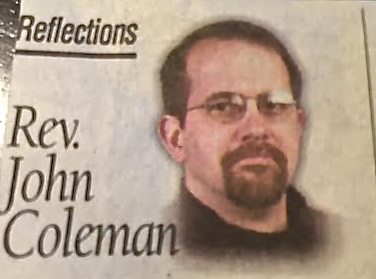
Since I got my hair cut roughly the same way today as I did thirty years ago, I don’t have much to add to TBT in the way of embarrassing photographs. In the process of junk sorting, however, I found an opinion piece I wrote for the Erie Times-News between 9/11/2001 and the U.S. attack on Iraq on 3/19/2003.

This particular TBT is short on humor, but it is interesting to revisit old convictions.

unnamed

Sad when your throwback photograph from a dozen years ago makes people say, “Geez, he’s let himself go.”

What would Jesus say about Iraq? (This title and the paragraphing are not mine.)

For the United States, September 11, 2001, was a series of unimaginable sucker punches. In a few hours, terrorists placed on our country’s hearthrug a new reality: the “gentleman’s agreement” as to the rules of war had been altered.

The “enemy” isn’t necessarily a specific country anymore, and rather than sticking their chins out for a retaliatory punch, attackers blow themselves up.

The question is, how should we respond to this new set of rules—or lack thereof? Or more to the point for me, what is a faithful way of responding to terrorism within our borders?

President Bush isn’t hiding his take on the matter. He thinks that the United States, either alone or in cooperation with other nations, should bomb Iraq with the goal of eliminating Saddam Hussein.

I haven’t heard any of television’s talking heads dispute the Bush administration’s claims that Iraq supports terrorism, so I guess if we’re going to wage war on terrorism, Iraq is as good a place to start as any.

My concern isn’t where the bombing should begin, but when it will (or won’t) end.

I don’t pretend to know what course of action will best protect our national interests or rid the world of the fanatical inclination to fly jets into skyscrapers.

Even as a pastor, I don’t know that I could win a theological argument for peace. Many intelligent, scripturally literate people believe that the time for seeking peace with terrorists has passed.

But I do feel increasingly sure about the voice of my own conscience, and the word I’ve been hearing lately is enough.

As I write this, my kids are close by. One is tying up the phone lines by gabbing on AOL, and the other is wearing a pair of goggles and pretending to swim across my study floor. My wife is at a class on home repair. I love these three.

Here’s the deal. If we start down the wrenching, potentially endless path of incinerating the world’s sucker punchers, people every bit as dear as my beloved three would also burn because they happen to be in the way.

Enough! Enough lives lost. Enough grieving. Enough violence.

Like I said, these are only the words of my own conscience. I’m probably wrong and simplistic, but I try to imagine Jesus standing beside me. What would he say? I can’t hear “bomb ‘em” or “acceptable collateral damage” coming from his lips.

What I hear is more like “figure out something else.”

IMG_3280

Grizzled and pudgy, I imagine my beloved grandson under the bomb. I guess I’m parked in the same spot I was years ago.

An Understanding of Prayer

7:39 a.m. at the downtown Starbucks. 7° with a wind chill factor of misery. A burly guy I’ll call Constance lumbered in ten minutes ago carrying his taut duffle bag. It looks like he’s lugging around a four-foot section of big telephone pole. Who knows what’s in there? The pockets of his fisherman’s vest are tumors of valuables.

After a trip to the restroom, Constance resumes his animated discussion with State Street, jabbing the table with his pointer finger and staring down the swirls of snow. His negotiations are urgent, relentless.

I see Constance a couple times a month. My daughter said years ago that he goes by a woman’s name and sometimes dresses in drag. I’ve only seen him dressed for weather, even in summer, but his name is none of my business. Only death will end his wandering and lonely arguments.

What locks await the cluster of keys hanging around his neck and resting on his gut? Mirage homes? And now, he is pissed: “No! No! You will not!” Silence, then, “I . . . didn’t . . . know! Why are we talking about this?”

IMG_1297

Oh, Constance, may one of those keys open up a home of warm color, a cat waiting for you, and loved ones who agree with your argument.

I pray for Constance. I also pray for the guy who picks up garbage and shovels snow outside my primary Starbucks haunt near the Millcreek Mall. Yesterday was nearly as severe as today. He was bundled beyond recognition when I drove by him on my way to work. I could make out a slit of flesh from his eyebrows to the bridge of his nose. That was it.

“God,” I said. More and more I’m finding that is prayer enough.

I pray all the time, and I mean all the time. This statement is frankly uncomfortable, not because I’m ashamed of prayer. As Constance just said, “No, no, no, no, no!” My squirming comes because I suspect folks would find my practice of prayer weird and pointless.

IMG_0384

The point of prayer: to be spirit still, to let light shine into and through me? (Balcony of chapel at the Abbey of Gethsemani)

In The New Seeds of Contemplation, Trappist monk Thomas Merton describes my context for prayer:

For the world and time are the dance of the Lord in emptiness. The silence of the spheres is the music of a wedding feast. The more we persist in misunderstanding the phenomena of life, the more we analyze them out into strange finalities and complex purposes of our own, the more we involve ourselves in sadness, absurdity and despair. But it does not matter much, because no despair of ours can alter the reality of things, or stain the joy of the cosmic dance which is always there. Indeed we are in the midst of it, and it is in the midst of us, for it beats in our very blood, whether we want it to or not.

Yet the fact remains that we are invited to forget ourselves on purpose, cast our awful solemnity to the wind and join in the general dance.

200px-TMertonStudy

Thomas Merton (Father Louis) (Credit: Wikipedia)

As a spiritual master, Merton dares speak of mysteries with certainty. I avoid that. Who am I? But Father Louis, as he was known at the Abbey of Gethsemani, comes up with words that work for me—as much as language can take hold of the Ultimate, anyway.

If “the world and time are the dance of the Lord in emptiness,” then prayer is my daring to join in. I’ve spent years “analyzing the phenomena of life out into strange finalities and complex purposes of [my] own” and have had enough of that absurdity. The best prayer I can offer, then, is impoverished and goes like this: “I don’t know anything. But please fill me. I’m here.”

Intercessions are important, of course, but I hold an unconventional view of them. My prayer for the garbage-snow removal guy was monosyllabic because of what I believe about God. Of course the Creator wants everybody to be sane, healthy, warm, fed, clothed, and loved. So saying anything more than the Sacred Name isn’t essential—like asking snow to make its way to the ground. It’s what snow wants to do!

800px-Snow_crystals_on_car

Dear Snow, Almighty and Everlasting, fall to earth, cover our cars and houses. Amen. (Credit: Barasoaindarra on Wikimedia Commons)

If God wants the whole world taken care of, then why the hell doesn’t God do it? We’re heading for the good old theodicy conundrum: If God is infinitely good, where does evil come from and why does it exist? My answer is the spiritual foundation of my prayer life: “I don’t know anything.”

Some believers might tap me on the shoulder with familiar answers: “God answers all prayer, but sometimes the answer is ‘no.’” Or “God knows what’s best for you, even when what’s happening is terrible.” Or “God is testing you.” Or “It’s all part of God’s plan.” Or, the one I find most irksome: “God never gives you more than you can bear.”

Tell that to the man I hugged whose father died a few months ago and whose mother was going into surgery—anesthesia when you’re sneaking up on ninety is sketchy. Imagine losing both your parents four months apart. Serving up a platitude might get you a well-deserved knuckle sandwich.

After a few thousand hugs like this, I refuse to reduce prayer to a crapshoot. “Dear Lord, please bring So and So through this surgery and grant a speedy recovery.” I might actually say something like this, but I would never do so with a what-the-heck-it-can’t-hurt attitude. And I would never think to myself, “Well, gosh, I’ve prayed like this over and over. Maybe God will hear me this time.” And I won’t try to explain the ways of the Eternal Mystery. The presumption!

IMG_0369

Prayer: whatever I am, whatever I wish, open and vulnerable with the Ultimate Truth? (Figure at the Abbey of Gethsemani)

But as I wait for my cell phone to ring, I pray for the woman in surgery and her son, not because I expect to influence the outcome. I say “help,” sigh, and look beyond these walls, windows, and patrons because my present reality is this: I wish for a dear old soul’s return to health, if nothing else so her son can catch his breath before adding another layer to his mourning. My prayer is, “Please, Lord, please.” At the moment, I am this prayer.

If I’m to join in the general dance, I can only do so as myself—a duffle bag fat with frailty and fear, longing and gladness.

Not surprisingly, most of my prayers are silent. Abide in what is, John. Swim in grace. Dance in peace. Every now and then, I’m aware that I’m praying for everybody who has ever lived, every creature. And though my hands rest in my lap, my spirit arms are open wide, lifting up all of our laughter and lament—yours, too—as if God doesn’t already see!

I’m quiet. My wordlessness says, “Here we are, God, right here in my arms. Beat in our blood. Fill us. We are yours.”

Earth_Western_Hemisphere

“Here we are–the Western Hemisphere, at least. Fill us. We are yours.” (Credit: Wikimedia Commons)


Reconsidering 2014

“You humans. When’re you gonna learn that size doesn’t matter? Just ’cause something’s important, doesn’t mean it’s not very, very small” (Frank the Pug in the movie Men in Black).

Merry Christmas, 2014! Happy New Year, 2015! For months I’ve been stuck in sleep. The last time I felt this way was Christmas of 1998, six months after my mother died. I had no idea that my soul had been smothering until my lungs snapped full in late December, and I thought, “Oh, so that’s what grief is.” Mom had passed, but she would have asked me to keep living. And now, I’m granted an epiphany, something probably obvious to everybody else, but hidden from me.

10922551_801819956554861_553225707324982969_n

Grandson Cole: my expression for way too much of 2014. (Credit: Elena Thompson)

After a tough year, the Christmas story has awakened me, but not because it can be historically proven. Haggling over facts makes me want to take a nap. It’s the truth of a story that has roused me from sleep. If you’re not a Christian, please listen anyway. Play along. The Creator of All visits humanity as an infant, absolutely defenseless, not as a warrior and not majestic. “And so it was, that, while [Mary and Joseph] were [in Bethlehem], the days were accomplished that she should be delivered. And she brought forth her firstborn son, and wrapped him in swaddling clothes, and laid him in a manger; because there was no room for them in the inn.” These familiar details from the Gospel of Luke are small, so very, very small that they’re heartbreaking–a baby wrapped in rags and laid in a feed box. No room for him, except with the animals.

But Frank the Pug’s gravelly voice grabs the scruff of my neck and carries me away from sadness. “When’re you humans going to learn that size doesn’t matter?” (Yes, yes, go ahead and chuckle.) Size not only doesn’t matter, but it can be deceiving. Example: ants weigh as much as humans do. I can’t recall when I first learned this, but son Micah verified it for me: “When combined, all ants in the world taken together weigh about as much as all human beings.” And so, wake up, John! Sure, lousy, big, heavy stories have lots of us making Cole’s crying face, but when you place all the flecks of grace and good spirits on the scales, the world doesn’t look so bad. In fact, it shines.

Thank you, Infant Lowly, for restoring my hope, putting a little steam back in my stride, and updating the prescription for my spiritual glasses. Rubbing the bad news out of my waking eyes, I see beauty and fun clearly now.

Dear loved ones, please accept these holy, lowly flecks from my 2014. May they help you and me receive 2015’s ants of grace and good spirits.

IMG_2943

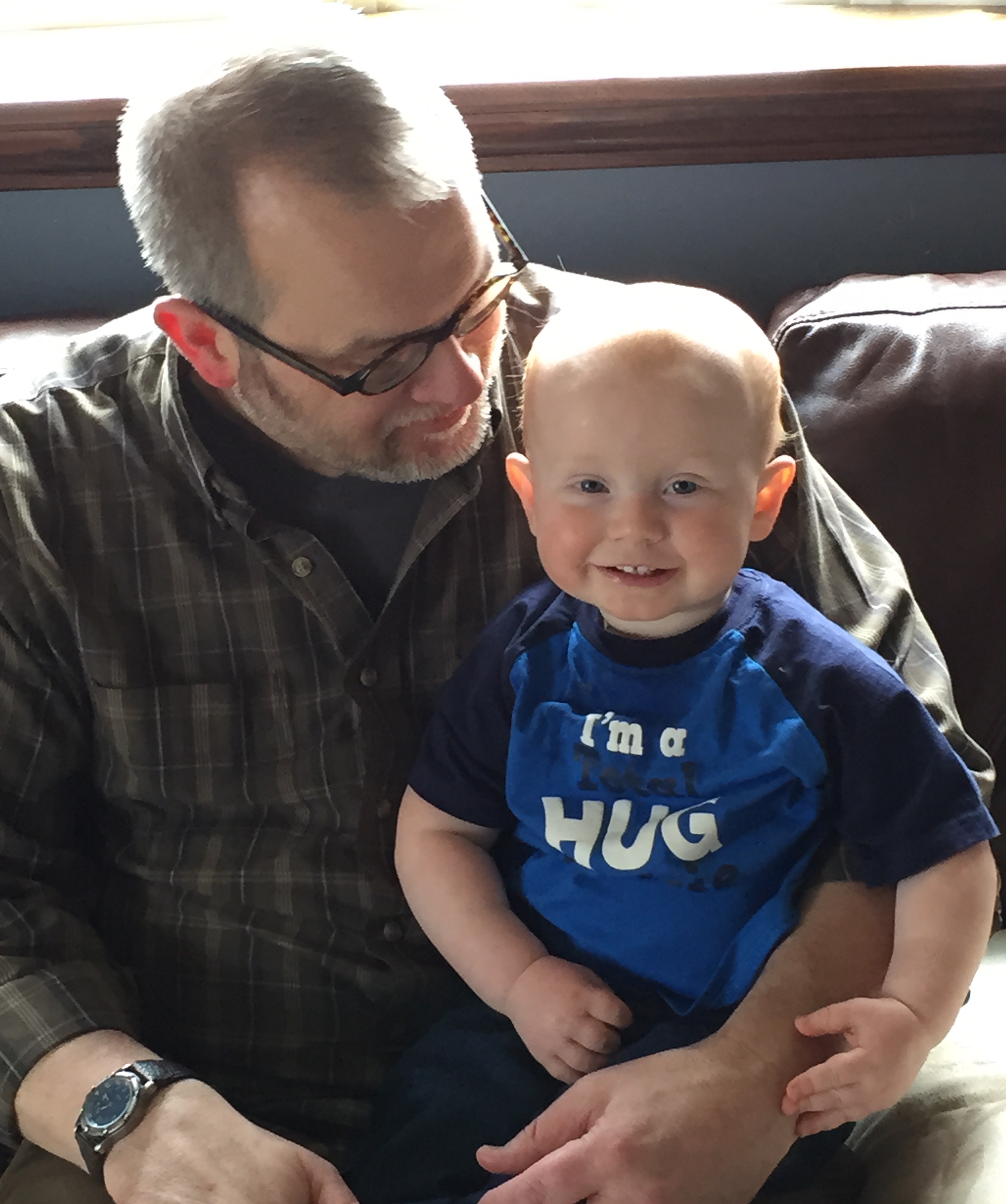
Wife Kathy and neighbor Patrick–a wise, Down’s boy who said, without even lifting his head, “I love you, Kathy Coleman.”

IMG_2790

My late mother’s Christmas cactus now blooms in early November, so I figured it would be bare come December 25th. Not so. A couple of flowers opened late, but they’re no less lovely for that.

IMG_2884

This one is probably an over-share: Over twenty years ago dentist friend Tom built a tooth for me out of filling material. Money was scarce at the time, so Tom worked his magic, which lasted until Advent of 2014. When I was in seminary, a dentist in Columbus said, “This one was made by a master.” Thanks for two decades of good service.

IMG_2841

In downtown Erie, an old gas street lamp still burns in front of Gannon University’s Gitnik Manse on West 6th Street. I have no idea why this gave me a sip of joy, but it did.

Screen Shot 2014-06-12 at 8.55.58 AM

My book came out in 2014 as an indie publication. People seem to find out about it a person at a time–kind of like A Napper’s Companion. No thousands of readers, but a kindred spirit here and there.

unnamed-2

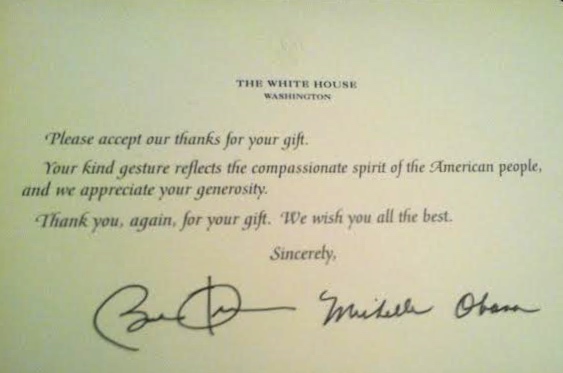
Oddball that I am, I sent a copy of “Your Grandmother Raised Monarchs” to the President and First Lady. What the hell? They sent a thank you note, though I’m sure the book itself was ground into a fine powder to be sure it wasn’t laced with anthrax.

I call myself a writer, yet my vocabulary is embarrassingly slim. When I encounter an unfamiliar word, I look it up. In 2014, I read carbuncle, which I knew is a precious stone from reading Sherlock Holmes stories, but the context told me there must be another meaning. A carbuncle, it turns out, “is [also] a red, swollen, and painful cluster of boils that are connected to each other under the skin.” Why, thank you for that update. I also stumbled on sycophant, who is a “servile self-seeking flatterer.” The synonyms tickle my teenage sense of humor: “apple-polisher, bootlicker, brownnoser, fawner, flunky, lickspittle, suckup, toady.” Lickspittle! I can’t wait to toss that one out in a conversation. I love words and consider them a blessing, though I don’t retain them very well.

I also love quotations, in part because I compiled 365 of them for a collection of daily meditations, Questions from Your Cosmic Dance, which came out in 1997. I jotted down one of my favorites from the past year on a scrap of paper and still have it. It voices wisdom I need to hear and follow.

IMG_2821

This quote comes courtesy of Belief.net’s “Jewish Wisdom,” which lands in my email-box each day. The older I get, the more I choose not to say. Thank you, Solomon Ibn Gabirol.

unnamed-1

Words are flecks of goodness, as are quotations. Laughter also places weight on the scale to counter despair. Daughter Elena and son-in-law Matt gave me a Jesus Pan for Christmas. Little do they know they’ll be eating Jesus French toast someday soon.

photo-23

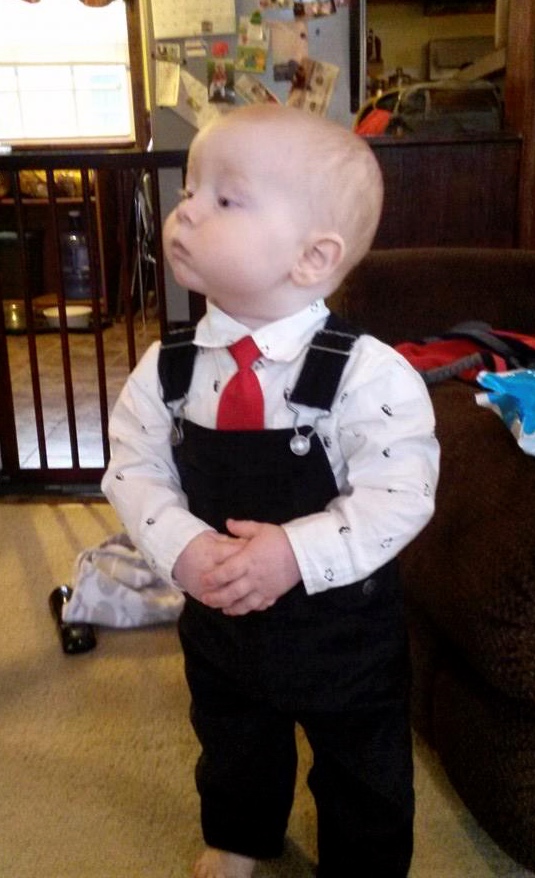
No other small gift from 2014 comes close to my grandson Cole, shown here in his Wagnerian knit cap. He helps me to understand the Christmas story. Why would the Great Mystery visit humanity as a child? Behold! (Credit: Elena Thompson)

10891492_801819689888221_3465058071233830785_n

What does 2015 hold for you, me, and planet Earth? Cole looks at the horizon with wonder as do we all. (Credit: Elena Thompson)

One thing I know about the months ahead: unless I get lost completely, don’t expect me to repeat the tired grief of 2014. Sure, I’ll get sad and discouraged, but nothing can change the fact that ants weigh as much as humans. You have to look closely for very, very small flecks of grace and good spirits, but once your eyes learn to spot them, the size of the bad news doesn’t matter so much anymore.

IMG_2808

May this fortune be so for you in 2015, my loved ones.


World News: A Napper’s Companion Christmas Letter

Dear Loved Ones:

Here’s a bulletin! Over the last few years I’ve been discouraged about the state of the world. World: language doesn’t get much bigger. Solar system, galaxy, universe, and eternity all out rank world. In addition to a couple of newspapers and websites, my source for Earth’s latest information is ABC’s World News with David Muir. On the surface, this makes sense. If I want the most important updates available, why not depend on one of the big three television networks still broadcasting free of charge?

On the other hand, what makes the American Broadcast Company so wise? A few days ago after prayer-meditation, I beat Jesus, Mary, Joseph, the shepherds, and the magi to the stable in Bethlehem and had an epiphany, joyous and liberating. The various media have much to report, but they can’t cover everything. This one man’s Teletype constantly receives breaking news deserving of airtime and headlines. World News isn’t only the latest financial collapse, governmental absurdity, or breathtaking slaughter. It’s also unseen sacrifice, modest dreams fulfilled, or simple tenderness.

800px-Magi_(1)

I beat the rush ahead of the Magi and received my Epiphany. (Credit: Sant’Apollinare Nuovo in Ravenna, Italy; on Wikimedia Commons)

As sickly as things seem these days, grace is everywhere, and probably more abundant than evil. But because I consume so much distressing information, I’m conned into believing that humanity is circling the drain. How foolish! My personal sources have told glad tidings of great joy lately. With love and hope, then, I offer A Napper’s Companion Christmas Letter made up of stories not covered by the mainstream media.

IMG_2941

My buddy Ray put up a Christmas tree for his eighty-six-year-old mother, who stopped decorating after her husband died around twenty years ago. No media outlet picked up this story.

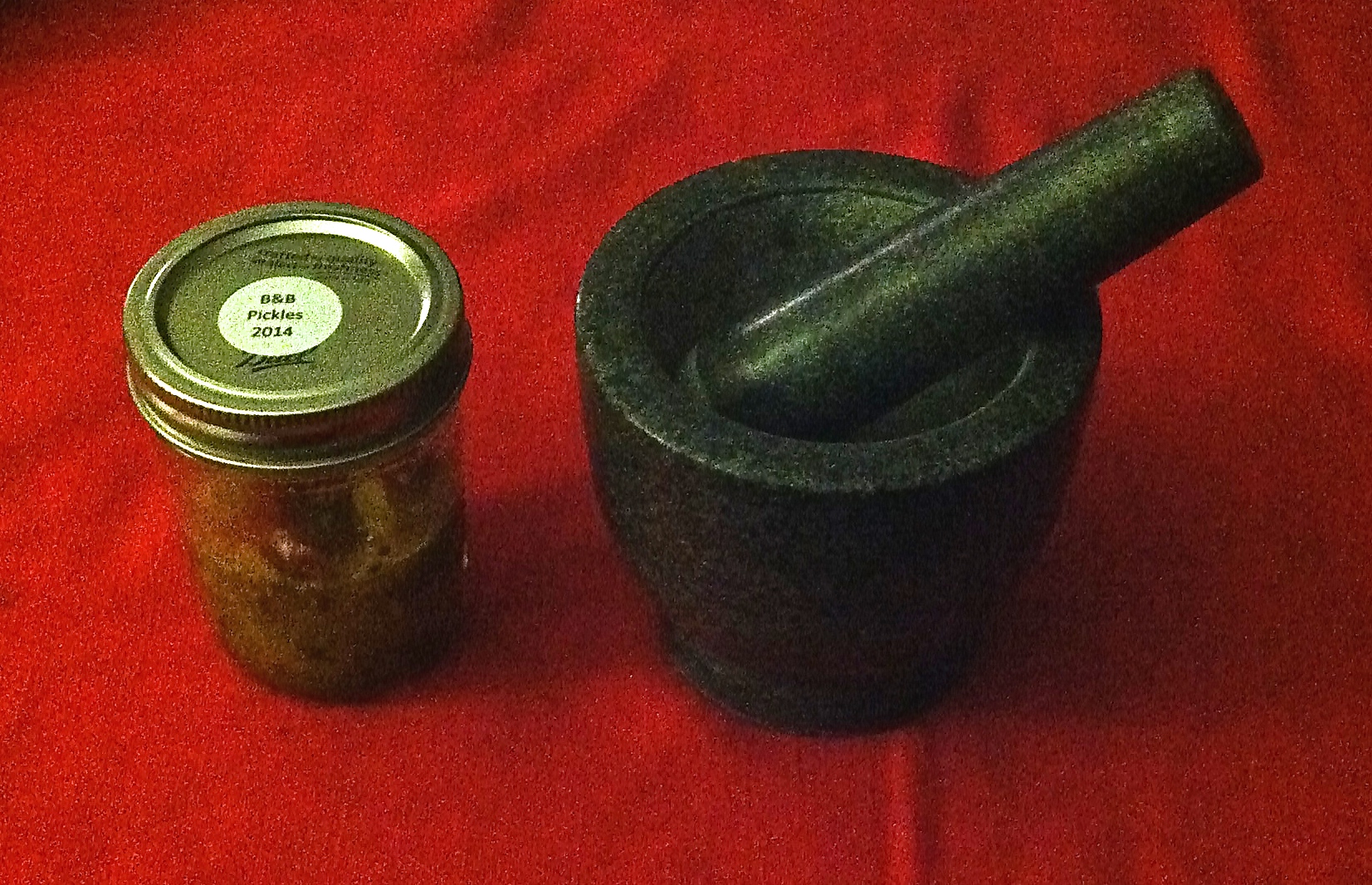
For Coleman family dinner, I was working so hard to perfect a chicken in a spirited mustard sauce that I neglected the corn chowder. I said to daughter Elena, “Hey, Len, would you mind trying to fix the chowder?” She hit it with nutmeg, salt, white pepper, a splash of hot sauce, and coriander ground with a new mortar and pestle from friend Mary. I contributed a stick of butter, and together we reached savory. Best of all, before we sat down to eat I hugged Elena and kissed her on top of the head. She said, “I love you, Daddy.”

In millions of kitchens, we help each other out with joy and speak of love. Snark and bicker visit, but I’ll wager overall we’re more kind than cranky.

photo-4

Elena, one of my favorite chefs, with her baby bump. Families everywhere embrace, coddle kiddos, and create masterpieces together. I now consider this reality “world news.”

At a party last week, I sipped wine in the kitchen with friends Karri and Joe and kibitzed. Two of their daughters sat off to the side talking. Lauren is about to graduate from college, and Emily is in high school. Rarely would I tell anybody to freeze for a picture, but I figured this one might win a Pulitzer. Yes, Virginia, siblings can get along and do better than that: they can take care of each other.

IMG_2923

Lauren and Emily . . . unposed. (My Pulitzer, please!)

I recently visited a severely ill man and his family. He sat on the couch with feet up on an ottoman. His wife patted his leg, spoke words of comfort, and kept his morphine ahead of pain and distress. The man’s brother wrote a prayer, which he asked me to read—no way he could get the words out. It was simple, humble, fervent. We sat in silence afterwards, passing around Kleenex.

“You’re a good man,” I said. “You know that right?”

A slight tear ran from the corner of his eye. “I’ve tried.”

We all put a hand on the man and entrusted him to God’s care. When I stood to leave, his wife said, “John, wait. He wants to give you a hug.”

For over thirteen years I’ve watched death. Driving away from this visit, I took an unexpected gift with me. What a loving, attentive end, as gentle as any I’ve been blessed to witness.

And I know that this day, in lands everywhere and all fifty states, the living hold the hands of the dying and whisper, “You can let go. We love you. We’ll be okay.”

800px-Partially_illuminated_Ac_with_shadows

Let go. (Credit: Simon Eugster on Wikimedia Commons)

I’ve received a couple of gifts lately that are particularly moving. Both made and bought, they remind me that people who celebrate Christmas are thinking of each other, finding a present that will be received like a kiss on the cheek and a moment’s cheer to the heart.

No doubt, Christmas is awfully commercial, but we’re trying, aren’t we? Most of us? We do want to bring joy. On the news you see Black Friday stampedes, but not the man standing alone in the store aisle, praying to find his beloved something pleasing.

IMG_2935

A handmade ornament–thanks, Barb!

IMG_2937

Bread and butter pickles and a mortar and pestle–thanks, Mary!

A young guy with low-slung jeans was waiting to cross the street as I drove up to the intersection. He started out, saw me, then held up. I motioned him on. At the curb he glanced back, smiled, and waved. I smiled back and shot him the peace sign.

Human by human, peace is sent out, received, and returned. I see it all around me.

800px-Iraqi_boys_giving_peace_sign

Iraqi boys giving the peace sign. Most of us human beings want peace, don’t we? (Credit: Wikimedia Commons)

I know an astute, witty, practical nine-year-old who still believes in Santa Claus. She leaves him a letter each Christmas Eve by the candy jar.

“What do you write him?” I asked.

“Things like ‘I hope you like bringing everybody presents.’”

Her father says, “She still believes in magic.”

I’m sure she is not alone.

Santa-eop2

I believe in Santa, too, especially if he looks a little like Robin Williams. (Credit:Jacob Windham on Wikimedia Commons)

Starbucks friend John and I talk about our dogs. In decent weather he brings his boxer Harley and has coffee outside. John and I both aspire to live like a dog—in the moment, not self-absorbed, often overjoyed.

John loves Harley and shows it. Every once in a while I see a news story about horses starving in barns, but, you know, I bet most pet owners are like John. Most of us are this way, right? We make sure our dogs and cats have enough to eat and drink, gush over their eccentricities, and treat them like our children?

IMG_2580

Starbucks friend John and his guru Harley

I know I love my dog. This morning old gimpy Watson hopped up on the bed with me as I was getting propped up for prayer-meditation. I’m not sure how much longer he’ll be with us. Like our two cats, Watson came to us as a stray. A clumsy soul, he tore both ACLs years ago. We fixed one, but couldn’t afford surgery for the other. He has fatty tumors on his flank, one the size of a tennis ball. We chase pills down his throat with treats. (I bet lots of you have stories just like this one.)

IMG_1180

Not my dog or John’s. A random pooch with an endearing fang I photographed at Presque Isle in Pennsylvania. Certainly the apple of some dog owner’s eye.

I set my Zen bell for twenty minutes, unpropped myself, lay down, and rested my face on Watson’s side. “I love you, buddy,” I said. He huffed and made the old mutt smacking sounds with his mouth I’ve come to love. “I’m glad you stopped by.” I rubbed his soft ear between my fingers. “You’re a good old pal.”

IMG_0017

My favorite picture of my old buddy, Watson. Do you have a buddy, too?

The world news tells us our home is in peril, with all of its explosions and arguments. This Christmas, sisters and brothers, I claim for us another world, one I recognize every way I turn. Join me. Everywhere I see souls unable to contain their love and sacred wishes.

Love,

John

Dreaming My Way into an Old Lady House

In the early 1970s writer May Sarton moved from her beloved home in Nelson, New Hampshire, to The House by the Sea (her journal of those days). Like some lucky pilgrims, Sarton had ample time to make her move. “I had two years in which to dream myself into the change,” she writes, “sell Nelson, and pull up roots.”

Kathy and I are in the process of dreaming ourselves not into a spacious home on the coast of Maine, but into a 1,000 square foot house on Erie, Pennsylvania’s east side. Our zip code will go up six digits, but our space will shrink by over half. Downsizing, we’re calling it. We closed on the place a few days ago, but we’ve been picturing what will go where and what will disappear. Kathy is lobbying for an ambitious kitchen remodel; I’m smiling at the corner on the enclosed front porch where my desk and prayer/meditation chair will squat; both of us are imagining.

IMG_2814

A little light in the hallway–just enough

Last evening I said, “You know, we’re going to have to get used to the loss of space and no upstairs.” Kathy agreed, and as I’ve wandered about, distances seem abbreviated. I’m not concerned, though. The rooms are already endearing themselves to me, mainly because I see signs of the former owners everywhere. I’m guessing the husband and wife–the latter perhaps passing recently, the former having departed some years ago–were my parents age, born in the 1920s, shaped by the Great Depression and forged by World War II. Admittedly, all of this is guesswork.

I’ve been calling our new home, which the former owners purchased in 1949, an old lady house. She and her husband could easily have been curmudgeonly and strange, but signs of their thrift and good stewardship have me thinking they were upright folk. He–I’ll name him Ernest–nailed lids to the basement studs and kept screws and nuts in jars twisted secure. He also recycled cabinets, lining them up and keeping, what, half-used cans of paint and turpentine inside. One door near Ernest’s workbench was set up for a padlock, and a mirror strategically angled so he could see who was coming down the steps makes me wonder if he liked to keep a bottle of Gibson’s 8 handy for a secret pick-me-up on boring afternoons.

unnamed

Is this what Ernest kept locked up?

IMG_2824

Ernest didn’t have to venture more than five feet from his workbench if the “great whiskey” got to be too much for him.

She–Arlouine, let’s say–kept the well-worn carpets vacuumed. Grab bars in the bathroom suggest she tried to stay in her home as long as possible? But eventually raised toilet seats don’t help much. I imagine her, thin and brittle with iron gray hair, propped up in a nursing home bed, staring into the distance. Was she a fearful soul? I ask only because of something odd left behind in a hall closet.

IMG_2812

Sacred water in profane hands

So Arlouine was Roman Catholic. (We Lutherans don’t go in for Holy Water, our idea being that God has blessed that life source far above our poor power to add or detract.) For a couple days I laughed at the idea of Holy Water in a spray bottle, but Starbucks friend Sean, also a Catholic, gave me a compassionate nudge, probably without realizing it. I don’t remember his exact waords, but when I showed him the photograph he acknowledged the old practice of keeping Holy Water around the house. His take was kind, though, along the lines of “sometimes you’ll try anything that might help.” Point taken. Our fears hide in plain sight, like cobwebs near the ceiling or rust in the medicine cabinet; a spray of blessed water can do no harm.

Arlouine and Ernest’s bedrooms have tile that is so ugly it’s kind of charming.

IMG_2817

I’m not sure what all those tile plants are, but they look to be in pain.

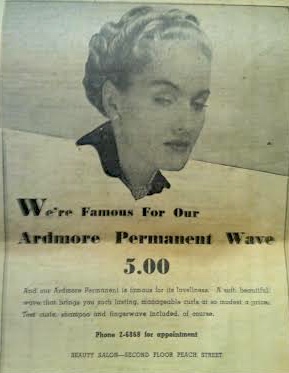
Besides the Holy Water, the best find in the old lady house is the newspaper under the tile. I lifted up a corner to be sure the floors are hardwood–yes!–and found The Erie Daily Times (Night Final) dated November 8, 1949. My own parents’ firstborn, Cathy, was not yet a year old. Mom and Dad are both gone now, and my sister can retire any time she is ready.

unnamed-1

37-cent matinee

unnamed-4

Okay, so skinny depictions of women aren’t exactly new.

unnamed-2

Liquors, a Hammond, and Hazel Lowry’s smooth vocals: 1949 Erie, Pennsylvania, at its most refined

unnamed-3

Captain von Trapp’s first fiancé? I’m not going to lie: I’m frightened.

Oh, Arlouine and Ernest! You put that paper down sixty-five years ago, a prudent layer between the tile and wood. I’ll grant you, there’s no pressing need to update that flooring. Of course, Kathy and I will refinish the hardwood, probably put down a faux Persian rug, something tasteful. If I’m the one who slices your old drab leaves down to trash-bag size with a drywall blade, part of me won’t be happy.

IMG_2815

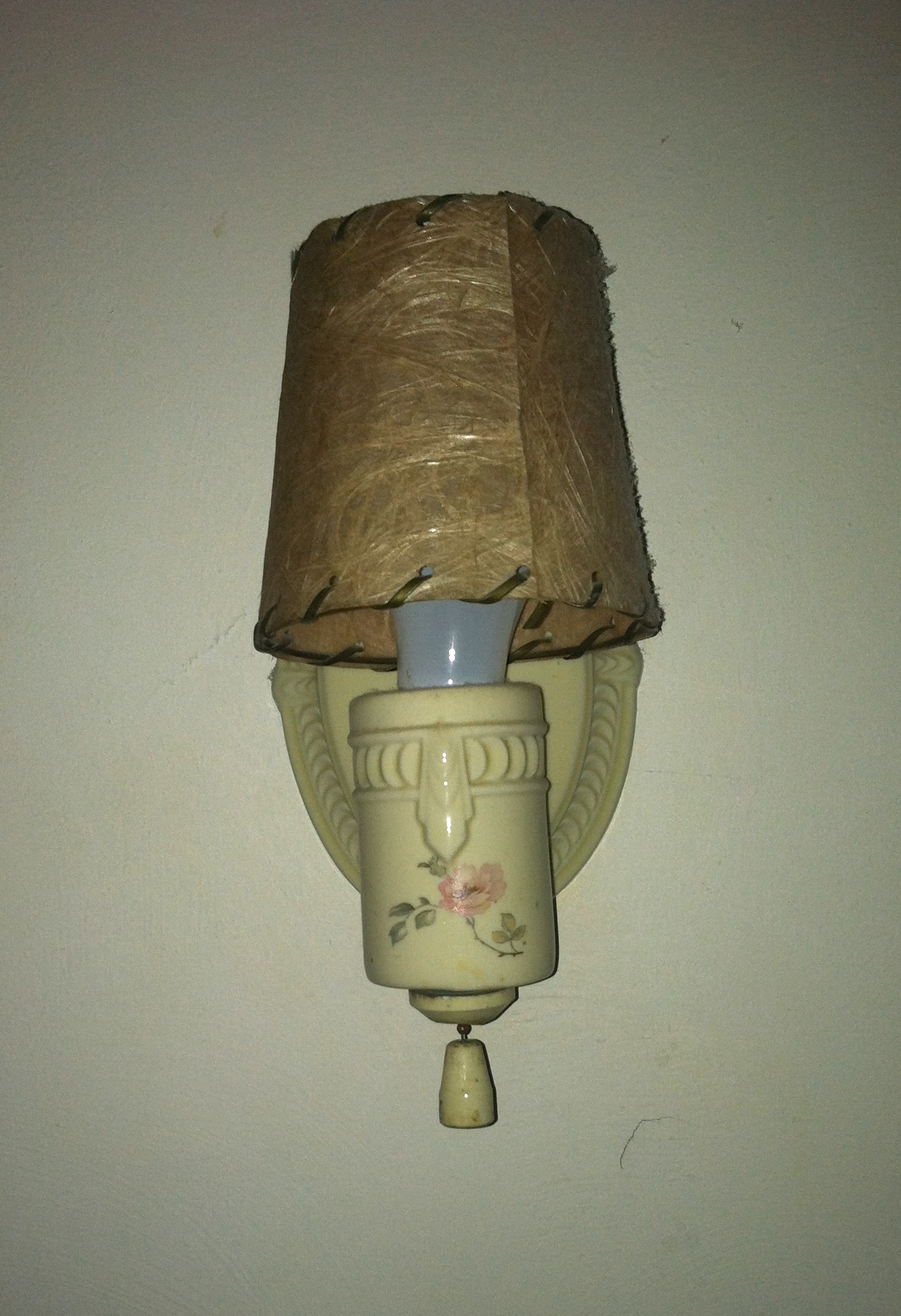
Possibly more thermometers than electrical outlets in our new home; maybe Kathy and I will keep this one to remind us of Arlouine, Ernest, and all those who have sailed on to glory.

I believe your way is for the best and will try to remember it as I dream my way into your home: Be sure to finish those leftovers. Put that old metal table in the basement and fold laundry on it. Don’t pull up perfectly good tile. And–I confess it makes sense–keep Holy Water in a spray bottle. A mist is more than enough.

IMG_2819

Tabernacle for the Holy Water; all woodwork in the house is like this


Thanksgiving Letter to My Late Mother

Dear Mom:

November 8, 2014: your Christmas cactus is in full bloom. It may be my imagination, but every year the blossoms seem to show up a little earlier. We could now call your beloved old plant a Halloween cactus. How many holidays will pass before the pink flowers open up at Easter?

IMG_1190

Your matriarch of Christmas cacti

You know, Mom, you’ve been gone sixteen years, and I always figured that the older I got, the less I would miss you. Actually, the opposite seems to be true. The heaviness in my throat in this moment is greater than when I wrote you last year. The reason is your great-grandson Cole. I imagine the deep gladness you would know in holding him, talking to him as I do, sitting quietly as the minutes pass, watching him in ceaseless motion. You would say the same thing as we do: “He’s so busy.”

10665803_761152390621618_7552667270178936418_n

Your busy great-grandson in his Halloween costume–grrrr!

Most Sundays we have family dinner, Mom. I’m not sure why as your son I didn’t insist on this practice years ago, but I didn’t. I’m sorry. People who say that they have no regrets in life probably aren’t looking closely enough. Anyway, after we finished eating, Cole got fussy. Had you been there and not been burdened with arthritis, you would have picked him up and walked around the house, talking to him. I can see you telling your great-grandson about this and that. The decades glow and soften in my mind: there you are, my late mother holding my beloved grandson. It’s nice to see you.

But since you aren’t here—not really—and weren’t there after dinner to occupy Cole, I did. Our first stop was your Christmas cactus. I told him a little about the plant, but before I knew it I was telling him about you. Of course, I said you would love him like crazy and other things you would expect. But as he looked on momentary peace at your plant, I told him that when his mother was a toddler, you peeled grapes for her. Peeling grapes: that’s love. “Your great-grandma would do the same for you,” I said, imagining you putting bits of the pulp into his mouth.

IMG_2789

Was Cole looking at that glow in the center, Mom, the light of forever?

Next stop: the photograph of you in your wedding dress. “My gosh, Cole,” I said, “look at how beautiful your Great-Grandma Coleman was.” I was focused on you and Cole, but was also aware of somebody looking over my shoulder and saying, “Oh, yeah! She was beautiful.”

IMG_2795

You are younger here, Mom, than both of my children are now. It’s hard to make the years stay in the right order.

Tours with tired babies last only so long, so that was about it. Elena, Matt, and Cole packed up and headed home. Tomorrow being Sunday, we’ll go through the same ritual, and most likely I’ll use the spatula from home. No kidding, Mom, every time I pick it up, I remember you. Maybe I’ll show Cole, tell him it was yours.

IMG_2797

Still my favorite spatula

I wish you could be with us. We would sit at the dining room table and look at pictures. This afternoon I was missing you, so I went upstairs and pulled out some albums. Time passed. Two photographs held me up a while: one of Elena and one of Micah. I could see Cole in both of them.

IMG_2803

That’s Elena, Mom. I caught her, promise. That’s also Cole’s face.

IMG_2801

Here’s Micah, Mom, foreshadowing his nephew’s two front teeth and swagger.

I said before you were beautiful, but I’ve become suspicious of time, reluctant to accept its authority over us, covetous of eternity. More must await us beyond this lovely, troubled land, where early we toddle on fair-skinned, sausage legs and late travel tentatively, afraid of the fall that might crack our aching bones. There must be more because you deserve to hold this child, to kiss his promise of red hair—however this can happen in the Eternal Calm and Splendor.

IMG_2799

Kathy used to raise monarchs, Mom, and Elena used to wear them. Wish you could have seen.

So, Mom, I’ll correct myself: you are beautiful. I don’t visit your grave often, with its pound or two of ash and bone the required number of feet below. Better: I exchange this earthly chronology for one I compose myself. I close my eyes. Now, you pass your hands over my children’s cheeks as you did decades ago and speak to them gently. Cole sits on your lap. You bounce him and lean forward to look at his round face. Like the rest of us, you get lost there.

10641212_759719550764902_2925033126610744009_n

Cole on pumpkin carving day. We would have rinsed him off and handed him to you.

As you and I sit together, I hold your hand, still the softest I’ve ever known. Since this is my time, your knuckles and joints don’t blossom with arthritis—no pain. I’m looking at your skin and veins, Mom, and kissing your hand. Your eyes are closed. You hear me say, “You live.”

Love,

John

Humility Needed as the New Millennium Clears Its Throat

800px-Chili_con_carne_1234

It’s chili. You eat it. (Credit: Wikimedia Commons)

Last week while eating lunch at Coffee Culture courtesy of a parishioner’s gift card, I felt them: the twitches of meaningless impulse. Open up the MacBook. Check the iPhone. Write a few notes. Skim the newspaper. These twitches were both mental and physical: adrenaline-fueled, microbursts of habit energy. I saw Ronald Reagan smiling and delivering his famous 1980 debate line to me: “There you go again.”

This is Mindfulness 101! When you eat, eat. When you read, read. As Thich Nhat Hanh writes, “Don’t just do something. Sit there.” I know all this stuff, but even with pray-meditating twenty minutes twice or thrice daily, I constantly forget. Early into my huge Caesar salad and spicy ambush chili, I remembered, “John, you’re allowed to just eat. You don’t have to be doing something else.” As I replay that moment, the image of my late dad pops up, his fussy dementia hands going: fidget, fix, reach, button, smooth, worry. Madness.

IMG_2704

Ahhh. In the chapel at Mount Saint Benedict Monastery.

Don’t be afraid. This is not a rant, kvetch, or lament. Like everybody else, I’m responsible for the state of my own interior, which is getting some special attention these days. This morning I sip coffee and release my old inventory of anxiety, breath by breath. I’m good—well, getting better, let’s say. By 10:00 a.m. I’ll be at Mount Saint Benedict Monastery, trying to stay ahead of worries in progress.

In the words of the recently departed Joan Rivers, “Can we talk?” Is it just me, or is it quite a chore to remain centered as this new millennium clears its throat? Assemble the following ingredients: middle-class income, spiffy technology, and submission to contemporary attitudes toward time and labor; then, bam, like Emeril Lagasse, add pinches of garden-variety stress and a personal crisis or two. What do you get? You get a guy with an expanding torso, irritated tongue, jerking brain and muscles, and pleading spirit: For God’s sake, relax, will you.

The first thirty or so years of my life weren’t jerky. When I think about growing up and even college and graduate studies, 2014’s brisk march of time and frenzy of labor comes into clear view. For years I’ve had Han Solo’s bad feeling about this. Recently I happened upon an article by Dr. Peter Gray, who put some good words to my concerns. He graduated from high school in 1962, a year after I was born, but his description of childhood sounds a lot like mine:

In the 1950s, when I was a child, we had ample opportunity to play. We had school, but school was not the big deal that it is today. Some people might not remember, but the school year then was five weeks shorter than it is today. The school day was six hours long, but at least in elementary school, two of those hours were outdoors playing. We had half-hour recess in the morning, half-hour recess in the afternoon, a full hour lunch. We could go wherever we wanted during that period. We were never in the classroom more than an hour at a time or for four hours a day. It just wasn’t the big deal, and homework for elementary school children was essentially unheard of. There was some homework for high school students, but much, much less than today. Out of school, we had chores. Some of us had part-time jobs, but for the most part, we were free to play for hours a day after school, all day on weekends, all summer long.

IMG_2722

Beloved wife Kathy is still in touch with the power of play. This is our front yard on Halloween. The trick-or-treaters were slack-jawed with wonder.

I don’t know about the shorter school year, but Gray nails it for the 60s and 70s. I neither noticed nor appreciated the wide fields of time that opened up after school and in the summer. My single academic stress was trigonometry. Bless his heart, teacher Chet—an old anomaly who went by his first name—gave me a passing D one quarter to save my National Honor Society hide. Beyond that, my turmoil had to do with divorced parents and withering nerves with the ladies. But when my twenty-two-year-old Micah was in school, the whole family was constantly stressed. The homework was oppressive, especially for a kid who didn’t engage well with books and worksheets. I’m out of the loop now, but can’t imagine the expectations have eased much, if at all.

One of my favorite memories is of Micah’s fourth-grade teacher talking to wife Kathy and me about our son’s messy daily planner. “Daily planner?” I thought, “Micah’s follow through with toilet paper is sketchy, and you want him to keep a to do list? You’ve got to be &^%$# kidding me!” Of course, we nodded politely. Twenty-six-year-old daughter Elena faired much better academically, knocking off homework in study hall and devoting her teenage suffering to bi-polar disorder—at least we think that’s what it was. For me, 1988 through 2012 was a long stretch of parental confusion and convulsion peppered generously with joy.

IMG_2787

Micah in, what, kindergarten? His first grade teacher didn’t have much use for him, with his silly heart.

It would be whiney of me to blame academics for Micah’s troubles growing up, but I saw in his school experience seeds that have grown into the view of life that had me jangled over my lunch last week. I should first say that my son had many wonderful, skillful, appropriately affectionate teachers. My only gripe is with a few along the way who seemed to dislike children.

I get the impression that lots of teachers are frustrated by the Weltanschauung that stresses kids out and has adults multi-tasking themselves into hemorrhages. (Check out the excellent reflections of my blogging friend Beachmum for some insights on how some teachers feel.) We’re caught in a powerful current, a way of being that constantly vexes gladness. This way, the delight of pharmaceuticals, is driven by hubris and faulty assumptions.

We humans are overconfident in our knowledge. It’s an attitude thing. How many of us got pudgy twenty years ago because we watched our fat intake and gorged at the carbohydrate trough? One at least. Today, we’re assured that the sophistication and competence of the United States health care system make an Ebola outbreak here highly unlikely. Forgive my dis-ease. This has nothing to do with researchers, doctors, and nurses, who no doubt take their work seriously and have good intentions. But what seem to me to be preliminary findings are regarded as conclusive.

I may be in the minority, but the precaution of requiring people who have worked closely with Ebola patients to lay low for three weeks seems reasonable to me. Zipping Kaci Hickox into a tent was perhaps unwarranted—even though the tent was inside a hospital building, not outside as I foolishly first thought—but asking her to avoid contact with folks for a while is prudent. Given the ferocity of Ebola, the fuss over a twenty-one-day quarantine is surprising. Is that really a burdensome sentence, even if all the evidence suggests that a health care professional isn’t contagious? I suppose if you’re absolutely positive that we know all there is to know about Ebola, then ¾ of a month feels like a year. (More on time later.)

200px-Harland_Sanders

How sad: a “really inhumane” recipe. (Credit: Wikipedia)

Kaci Hickox could probably use a port-a-potty, not wash her hands, and stick her fingers in thousands of Maine residences’ mouths and not pass along a single case of Ebola. In fact, I’m not worried, but I do harrumph at the prevailing lack of humility, any sense that our knowledge might be incomplete, indignation toward those who maintain skepticism, and willingness to sling lawsuits so quickly. And Hickox’s comment that her treatment was “really inhumane” may be a stretch. Newark’s University Hospital didn’t shove her adrift on an ice flow; they put her in an indoor tent and brought her Kentucky Fried Chicken.

My point with the examples of carbohydrates and Ebola is that once we’ve decided we know something about science, we dig in our heels. According to Peter Gray, what we know about education and child psychology might also be mucking up future adults. In his aforementioned article, he identifies . . .

a “school-ish view of child development” – the view that children learn best everything from adults; that children’s own, self-directed activities with other children are wastes of time. We don’t often say it that way, but that’s the implicit understanding that underlies so much of our policy with regard to children, so childhood has turned from a time of freedom to a time of resume-building. 

Gray presents convincing evidence that our adult impulse to micro-manage childhood learning and development (i.e. not letting kids play, make up their own rules, work out their own conflicts, and generally not getting the hell out of the way and leave them be) is burdening a generation. Depression, anxiety, and suicide have been on the rise in recent decades. (Here’s a link to his article, “Kids Today Are More Depressed Than They Were During the Great Depression. Here’s Why” if you want his numbers.) My concern: like Gray, I remember when my habit energy wasn’t jangled and so have a shot at making changes to restore my peace. But what if all you’ve ever known is a relentless impulse to accomplish something and a haunting sense that if you’re playing or resting, then you’re wasting time? Gray argues that there is a crucial, “evolutionary function of play.” Again, follow that link if you want to explore his reasoning.

Our experience of time is irrationally rushed and troubled. Isn’t this really the impulse that drives multi-tasking, texting while driving perhaps being the most hazardous example? On his television show Phil Donahue used to hold the microphone in audience members’ faces and say, “So little time.” Those words knuckle our heads and slap our asses. You need to perform several actions at once because you don’t feel like you have enough time.

I offer one flimsy piece of evidence, a phrase that is regularly spoken by my adult children: real quick. Catch the urgency? “Dad, can I see your laptop real quick?” “Dad, can you hold [grandson] Cole real quick?” My thought is generally, “No.” I want you to use my laptop for as long as you need it. And, damn it, you hand me that baby, it ain’t going to be real quick.

IMG_0846

A painting by the late, self-educated Milton Sontheimer, whose work helps me to center myself

As proof that we can safely slow down, I present Milton Sontheimer of blessed memory. Toward the end of his life, which came about a month ago, congestive heart failure had reduced his pace to a crawl, but Milton always moved as if he had more time than he needed. The walls of his home with now-widowed Mary are crowded with his paintings. For years, he baked Communion bread for our church and wrapped it in foil, using and reusing the same piece until wrinkles rendered it flimsy. Wise Milton: no rush—and no waste.

We assume that because technology exists, we should make full use of it. Many thoughtful people are aware of this observation, but I want to credit the last two sages who have brought it to my attention: Beachmum, whom I’ve already referenced (I read back some ways, Mum, and couldn’t find the citation; I know you wrote it, though), and Dr. Brad Binau, a professor from my days at Trinity Lutheran Seminary, whom I mentioned in a recent post. Smart phones, tablets, notebooks, and laptops exercise centripetal force—literally, almost, considering how often my ear and nose are smashed up against my iPhone.

Birnau_Uhr_Sonnenzeituhr

Our opulent enemy? Why? (Credit: Saberhagen on Wikimedia Commons)

We peer over our reading glasses at people who are apparently lost, confused, or just making up their minds. I’ve learned to be watchful for what I call periods of discernment both in myself and others. In thirteen years as a parish pastor I’ve sat with scores of pilgrims on their way to new lands of the spirit. They wonder what to tell loved ones who want to know what’s up. I suggest, “Tell them you’re taking some time to figure things out.” These are stretches of months, even years, to honor, not stampede through. A couple days ago I heard the following what-I’m-saying story on The Writer’s Almanac about the poet C. K. Williams:

His two greatest passions in high school were girls and basketball. He was a good basketball player, 6 feet 5 inches, and he was recruited to play in college. But then he wrote a poem for a girl he was trying to impress, and she was actually impressed, and so he decided he should be a poet instead. He dropped out of college to move to Paris because that’s where he thought a poet ought to live. He didn’t write at all while he was there, but he did realize that he didn’t know anything and should probably go back to college. He said: “It was an incredibly important time. Not much happened and yet my life began then. I discovered the limits of loneliness.”

My point, I guess: if I’m not willing to be lost, I might not ever be found.

IMG_2699

A three-hour nap in a monastery guest room–a remarkable blessing

Endnote: I did make it to Mount Saint Benedict Monastery. (Obviously I wrote much of this post after my retreat.) I won’t bore you with the whole day, other than to pass along two details. 1.) I took a three-hour nap in the afternoon; the twitches of habit energy wear a guy out. And 2.) I noticed while reciting psalms with the sisters that they spoke more quickly than in the past. Their recitation is still spacious, but the gentle silence between verses is now thin. I don’t know why.

Lord, spare the sisters and us all from contemporary adrenaline and grant us mindful, humble impulses.

Coming to Myself from a Distant Country

Then Jesus said, “There was a man who had two sons. The younger of them said to his father, ‘Father, give me the share of the property that will belong to me.’ So he divided his property between them. A few days later the younger son gathered all he had and traveled to a distant country, and there he squandered his property in dissolute living. When he had spent everything, a severe famine took place throughout that country, and he began to be in need. So he went and hired himself out to one of the citizens of that country, who sent him to his fields to feed the pigs. He would gladly have filled himself with the pods that the pigs were eating; and no one gave him anything. But when he came to himself he said, ‘How many of my father’s hired hands have bread enough and to spare, but here I am dying of hunger! I will get up and go to my father, and I will say to him, “Father, I have sinned against heaven and before you; I am no longer worthy to be called your son; treat me like one of your hired hands.”’ So he set off and went to his father. But while he was still far off, his father saw him and was filled with compassion; he ran and put his arms around him and kissed him. Then the son said to him, ‘Father, I have sinned against heaven and before you; I am no longer worthy to be called your son.’ But the father said to his slaves, ‘Quickly, bring out a robe—the best one—and put it on him; put a ring on his finger and sandals on his feet. And get the fatted calf and kill it, and let us eat and celebrate; for this son of mine was dead and is alive again; he was lost and is found!’ And they began to celebrate. (The Gospel of Luke 15:11-24)

220px-Pompeo_Batoni_003

The Return of the Prodigal Son (1773) by Pompeo Batoni (Credit: Wikipedia)

Most Christians I know read this Parable of the Prodigal Son from the perspective of the faithful son, whose verses I didn’t include. He worked hard for his father “all these years” and stomps off, resentful that his narcissistic punk brother is about to enjoy some “fatted calf.”

I understand the faithful son, but more often I feel sympathy for the Prodigal son. Now let’s be clear: for the first part of the parable, he is—to employ a theological term—an asshole. Imagine proposing to your folks that they hand over your inheritance before they die. It’s amazing that the father doesn’t simply have his son flogged or thrown off a cliff. But he doesn’t, and off the kid goes to get sozzled and satisfied.

800px-Johann_Wolfgang_Baumgartner_-_The_Prodigal_Son_Living_with_Harlots_-_Google_Art_Project

The Prodigal Son Living with Harlots by Johann Wolfgang Baumgartner (1712-1761) (Credit: Wikimedia Commons)

Having missed any early-adult period of drunkenness, debauchery, and licentiousness, I don’t relate to that side of the Prodigal son. Instead, I find myself standing with the hungry kid and the pigs at that moment “when he came to himself.” What gorgeous phrasing! The New International Version of the Bible says, “when he came to his senses,” but “came to himself” more accurately describes a universal human experience. At least it resonates with me.

Here’s my prodigal process. In the parable, the son, wanting to party and get horizontal, leaves behind his best self, the self he comes to recognize only by getting his face rubbed in pig sludge. He also happens to travel to a different country. My story works differently, but ends the same. I stay right where I am and come to understanding not dallying with prostitutes—I do drink some wine—but frittering away my inheritance by succumbing to stressors that seem perfectly matched to my weaknesses.

Anxiety

If I looked this good anxious, I might not complain. (Credit: Wikimedia Commons)

I don’t know what the Prodigal’s household was like. (Yes, it’s a parable, so there’s no real background, but work with me here.) Maybe he was pampered. Maybe he got away with everything. His big brother probably hated him from the start. And since nothing was ever good enough for the Prodigal, the second he passed puberty a hedonistic frenzy was inevitable.

The Coleman household for me, the youngest of four children, was full of love, but like so many families of my generation, we panicked at any rocking of the boat. Many people my age know exactly what I’m talking about, and whole disciplines and vocabularies have evolved to explicate and heal family systems and all the frazzled, wounded boomers they’ve produced.

Don’t rock the boat: the colloquial mantra of 2225 Wagner Avenue. Of course, I didn’t have the maturity to realize it at the time, but being outwardly upset or angry was not acceptable. When it happened, everyone’s guts turned to water. A top priority, then, wasn’t to be happy and well-adjusted (who knew what that meant back then?). Just let the waters be calm! As long as we were acting okay, then everything was okay. Yeah, sure.

2011-03-03-pano

Ah, still waters! Might be Three Mile Island, Love Canal, and Vesuvius underneath, but as long as there aren’t any whitecaps, we’re solid. (Credit: Thomas Bresson on Wikimedia Commons)

I can’t speak for my siblings, but this fallacy has followed me into adulthood and climbed the walls of my psyche like ivy. Over the last thirty years, this plant has been ferocious. Whereas the Prodigal got lost in harlots, booze, and hunger, I’ve found myself lost dozens of times over the years when people don’t act okay. Nothing different than back home. When someone isn’t being normal, then do something to get ‘em normal again! Don’t fix the problem, mind you, but get ‘em normal. (Let me state, again, my home when I was growing up had much to praise. Everyday wasn’t a dysentery epidemic. And on a different subject, I’ll also toss out, if you’re going to get lost in something bad, reckless sex and drunkenness might be more fun than crippling anxiety and paralysis, but I can only speculate here.)

Live_in_an_ivy_tower_(8059746783)_(2)

Sometimes ivy takes over so it seems like there’s more plant than stone. (Credit: Psyberartist on Wikimedia Commons)

So the Prodigal “comes to himself” standing in a field with pigs and staring longingly at what one blogger says are carob pods. Hunger has granted him an epiphany: “What in God’s name are you doing? Go back to yourself. Whatever is good and wise within you, return to that. Now!” I envision him taking those first steps back toward himself. The parable teaches that the young man is going back to his father (God), but I choose to hang onto those words, “when he came to himself,” and let God and the son marry. The long walk toward God is the walk toward himself.

800px-Ceratonia_siliqua_MHNT.BOT.2011.3.89

Mmm! An overripe, dehydrated banana? A used, sunbaked . . . ? Oh, never mind? Carob pods. (Credit: Roger Culos on Wikimedia Commons)

A few twilights ago at 4:10 a.m., my walk began, not away from squandering inherited wealth, but from squandering myself. I awoke content. For the most part, this isn’t how things have been going over the last couple of years. I’ve been feeling the crack, sting, and ache of ivy digging into my brick and mortar. So what do you do when you’ve been hurting lately, and contentment shows up a couple hours before the alarm goes off?

Pee. That was my first decision. My second was to prop myself up in bed next to sleeping Kathy and pray. And breathe. And enjoy. Then, like the Prodigal, I came to myself. I have no clue why. All I know is that I somehow saw clearly the fallacy I’ve been living under for far too long. Weakened by the pull and weight of my personal ivy, I’ve gotten lost. Prayer, running, and dietary sanity—outward signs of the inner John—have shrunk or ceased altogether. I used to get up before dawn to pray and write, then jump into company time. Most days included four or five miles on the track. Meals weren’t perfect, but they were generally mindful.

Well, in recent months you can forget all that shit. So why, as I sat straight up with the cool, dark air touching my arms, did I come to myself? “What in God’s name are you doing? Go back to yourself. Whatever is good and wise within you, return to that. Now!”

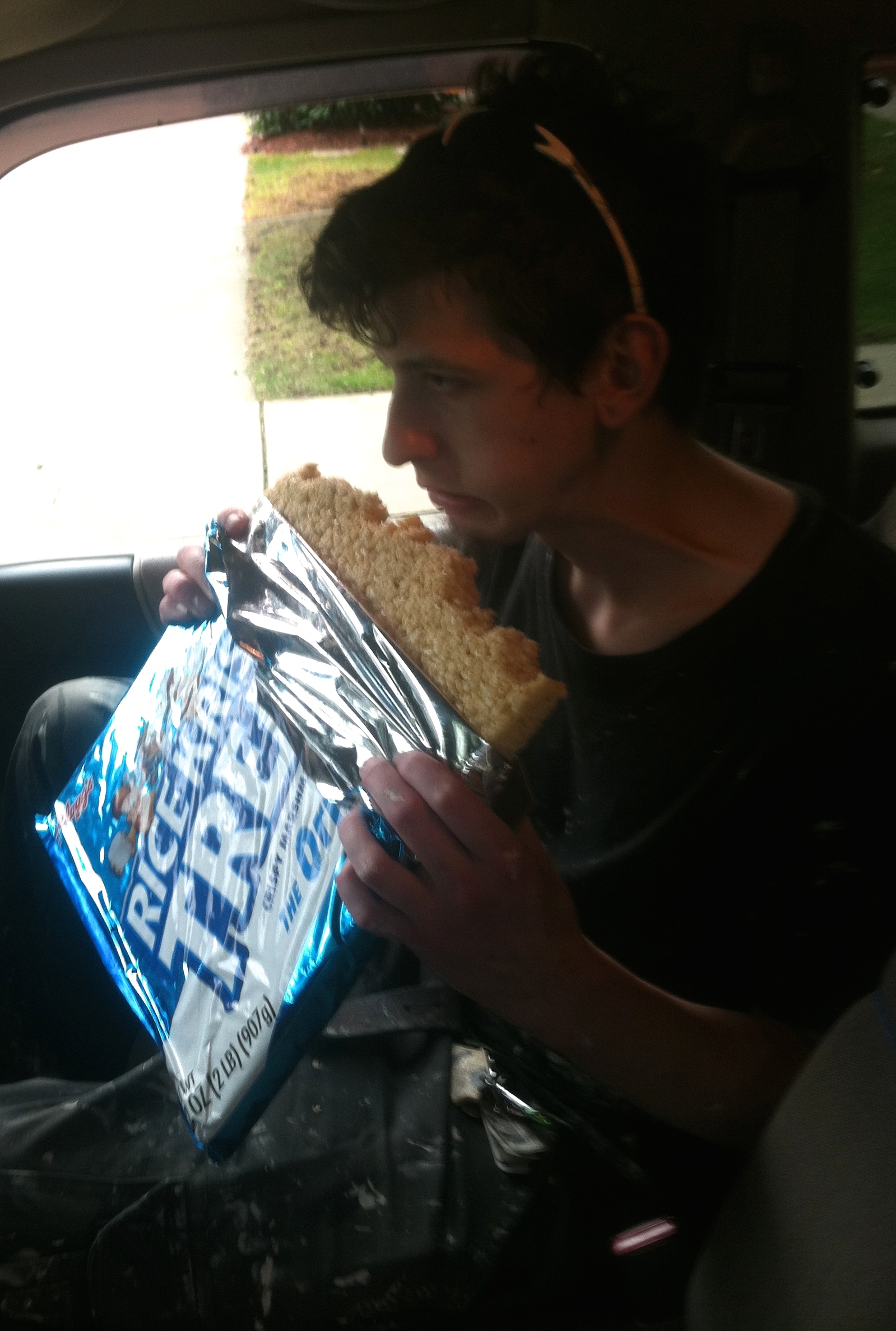
IMG_2610

Son Micah working on a two-pound Rice Crispy Treat after a hard day of painting. Laughter comes more easily after I find myself

I guess the timing of my Prodigal moment doesn’t matter. Nor do I need a reason that I felt welcomed and embraced, as if I had left myself for a distant country and returned. An embrace. My body received it, as when your chest meets another chest and you rest your cheek on a beloved shoulder and know you’re not lost anymore.

In the parable, the father sees his son in the distance and runs out to hug and kiss him. Then they finish the walk home. I got hugged and kissed, too. Maybe it didn’t come from God, but it sure seemed like a greater “Welcome home, son!” than I could have given myself.

This home isn’t on Wagner Avenue or Shenley Drive. It’s the home I believe we all have to find for ourselves over and over again. For me, it’s about “coming to myself”: held close by One who rejoices that I’m found, sitting next to my sleeping wife, putting my soul’s arms around all those I love, and believing that Mystery has ways of making weak brick and mortar strong again.

IMG_2564

My soul’s arms hold Cole when I come to myself

A Study of Justice

I have to clean my room,

I’m saying, “Not fair!”

Even though I make the mess,

That’s neither here not there,

Because I’m talking about justice,

I’m going to make you aware,

When you’re five years old,

Well, it’s just not fair!

(“Not Fair” by Joe Scruggs from the CD Ants)

640px-Tears_

“Just not fair”: sometimes imagined, sometimes real. (Credit: Reji Jacob on Wikimedia Commons)

Wife Kathy’s been downsizing lately. Children’s books and CDs from when our own kids, Elena and Micah, were young are migrating toward grandson Cole, nine months old and already getting ears-full of songs and stories. He’s heard over and over “I Been Workin’ on the Railroad,” including the “Someone’s in the Kitchen with Dinah” part, “Nessun Dorma,” and another tenor aria I can never remember. Pavarotti calms him down in the car. Soon he’ll be ready for the lessons and play of Rafi and Joe Scruggs, whose music Micah was singing (poor “Joshua Giraffe,” “stuck in a zoo with buffalo poo”) on Saturday as he helped his mother put in a new basement window and I considered justice.

Giraffa_camelopardalis_rothschildi_(young)

A little guy like Joshua. Micah’s singing about him was a blessing. (Credit: Chrumps on Wikimedia Commons)

The Gospel yesterday from Matthew was Jesus’ “Parable of the Householder Who Hired the Laborers.” Summary: the householder pays those who worked only one hour the same as those who toiled in the sun all day. As the children’s song repeats, “Not fair, not fair, not fair.” If I had busted my hump all day, the householder’s lapels would have been wrinkled and torn. I would have yanked his beard right out of his loving, generous, foolish, unfair head.

Benedict_of_Nursia_(painting)

Some beard on Benedict of Nursia. If the houseowner had such a beard and paid me the same as people who worked an hour, he might have come out of the tussle with a Fu Manchu and not much else. (Credit: photograph by Eugenio Hansen, OFS, on Wikipedia)

In the parable, the householder obviously represents God, and the teaching is that God isn’t fair. God is loving. But I don’t intend to talk about God. The world is so full of beauty that I get verklempt occasionally, but its blood-ugliness has the same effect on me, too. God for me is above all Mystery. I have neither the nerve nor desire to explain or even speculate much about how God dwells in the here and now. God is first-string in my heart, but I’m letting God ride the bench for a thousand words or so today. All I want to do is think about justice (or as Joe Scruggs puts it, fairness).

I got in a fender-bender this morning. (Nobody hurt, both vehicles just fine. Thanks for asking.) I was merging into traffic, checked to be sure the coast was clear, and hit the accelerator. Sadly, the woman in front of me was carefully assessing the traffic—waiting for her embossed invitation to arrive—so I gave her a stout “good morning.” It took her a long time to pull to the berm, and when I looked in her window, she was crying, face in hands. She rolled down the back window, got her bearings, then rolled down the front. No, she didn’t hit her head. No, I hadn’t given her whiplash. She may change her mind about that tomorrow.

After we exchanged information, I numbly drove to Starbucks, where I’m licking this immediate wound, speculating on the rise in my premium, and tending a couple of other bumps and bruises. I really couldn’t see any damage to my truck, but her bumper, made of that wonderfully durable plastic that ripples if somebody in the backseat farts, sports a horizontal crack down the middle.

IMG_2604

Ah, a dimple on the chrome to the left. A 1998 with over 200,000 miles on it. Think I’ll pass on repairs.

The morning’s gravity is pulling toward the blues. Poor John! Actually, poor driver in her seventies with an Eastern Bloc name sorely in need of a vowel or two and an unfair jolt of adrenaline to work off. I’ve got no worthy complaints against fairness. Although I’ve been something of a mess lately, that’s my own problem. I like to say that I’ve got a great life, but sometimes I suck at it.

Where fairness is concerned, I’m the defendant, not the plaintiff. The evidence against me is damning:

1.) I have four weeks of vacation each year, and I’m taking one day today. Two Xanax will soon have my jittery soul calmed down. I’m on my third free refill of deliciously bitter iced decaf. Nobody’s got a knife to my throat. I don’t live, in the words of Thich Nhat Hanh, “under the bomb.”

2.) When I head home, I’ll have to decide what not to have for lunch. The house is dry and warm or cool as necessary. Bills paid.

IMG_2170

Too much clutter at 322 Shenley Drive, but never too many flowers.

3.) The perils I face are mostly my own doing. Too much debt. Health risks to be brought under control. All this, so far as I know, is on me.

4.) My family has come through tough times I’ve already chronicled to death. Saying more about the past here would be tiresome, but last evening is worth a comment. Kathy, Micah, and I took family dinner to Elena and Matt’s: sauerkraut and pork and cream of cucumber and avocado soup with pearl onions. We sat in their postage stamp back yard and talked as Micah pushed grandson Cole around in his play car. The soup was savory, garnished with cherry tomatoes, raw cucumber, and avocado. Nobody but Matt had any, but down to my last culinary bone, I didn’t care. I tasted the hint of cheyenne and cilantro, sipped red wine, and received the cool air and love around me. When rain blew in, I didn’t give a thousandth of a solitary damn. I stood where it was sheltered and breathed, by now shoveling in kraut and mashed potatoes. Soon, Cole needed a bath, which he entered joyfully and immediately gave his business a tug. Atta boy, just don’t be too much of an overachiever here. Dinner, holding grandson, rain, peace, and laughter. Mercy within mercy within mercy.

IMG_2596

Cole playing Grrrrrr with Gramps. What did I do to deserve this love? Not fair.

5.) At 5:30 this morning, Kathy said, “You’re snoring.” I rolled this way and that for ten minutes, trying to comply, but finally was informed, “Your snoring is incessant!” It takes brains to say incessant before 6:00 a.m. What to do? I wanted to stay in bed with my wife and feel the healing breezes through the screens, but the rattling of my glottis was messing with her last hour of life. So I decided to remain and let myself get only to the edge of sleep. I don’t remember ever doing this before, but it’s what I wanted. This isn’t about me, but about Kathy. She deserves such love. Until just before 7:00, then, we lay together, me keeping vigil over myself and rising to consciousness at the first sound of sleep and wet head-flesh’s gargly duet. Just before she got up, I issued a last, faint caw. She touched my cheek and said, “I’ve got to get up.” She wasn’t mad. Where’s the justice?

IMG_2601

Lovely Kathy’s approach to life: don’t hold a grudge; let’s get on board and get going!

6.) I emailed Kathy at work about my accident this morning. Her response landed an hour later: “Oh John Coleman, what am I gonna do with you? I might have to ground you from Starbucks. Glad you are ok. Bet little old lady gonna be sore tomorrow. Love you.” No annoyance, even though she has warned me about that stupid merge many times before. When the insurance premium goes up, Kathy will frown, shrug her shoulders, and kiss me.

IMG_2600

My Starbucks? No, anything but my Starbucks!

There’s more, but the prosecution has gone on long enough. Fairness has a litany of complaints against me. My only statement is this: Justice or the world or the universe owes me nothing, so I’ll try to receive indulgent love and all family dinners in the rain with a humble and grateful heart.

IMG_0904

Not fair that I live in such a house, but I’ll take it.