Oniontown Pastoral #3: Hope Is an Old Tractor

Oniontown Pastoral #3: Hope Is an Old Tractor*

A few Mondays ago my friend’s son, forty-four, overdosed on heroin. The next day I took her stunned grief with me to the pastor’s study at St. John’s Lutheran Church in Oniontown, Pennsylvania.

IMG_4327

Farm art near Oniontown

My commute from Erie has four legs: I-79 South to US-19 South to District Road to Mercer Road. For seventy minutes gray trees and rolling fields heal me, but on this day my mind was on iffy roads and my friend. She and her husband had long anticipated the knock at the door and the crushing news. My wife and I used to have the same nightmares about our son, now thankfully clean.

As I thought about the numb terror of fresh loss, a line from Philippians visited me: “Your citizenship is in heaven.” Good sermon theme! I started to flesh it out. When political candidates carpet bomb each other, when explosive vests cut down the innocent, when El Nino and Zika lead the news, and when nasty heroin is as cheap as beer, then heavenly citizenship sounds, well, heavenly. My point, of course, wouldn’t be to reject this life, but to remember that we have a home over the horizon. Not particularly uplifting, but not all sermons can be sunbeams and dandelions.

I looked forward to getting to church and putting the ideas on paper. Alas, a snowy parking lot stood in my way. But since secretary Jodi’s truck was in its spot, I bravely punched the accelerator. Turns out my burnt-orange, bulbous Chevy HHR can’t compete with four-wheel drive.

“Man, am I stuck,” I reported to Jodi, who didn’t know when the plow guy would get to St. John’s. Might be evening. “We’ll get you out somehow,” she assured me.

I sulked at my desk. Wait-and-see isn’t my best mode. The sermon I pecked away at would sound whiny, I could tell.

Within half-an-hour Jodi said, “Do I hear a tractor?”

“I hear something,” I said. “Don’t know what.” Then out my window passed a bundled up man with a long beard pushing snow with an old tractor. The blade was behind the driver, a configuration I had never seen, but he was blazing me a trail.

“He lives over there,” Jodi pointed. He had seen my problem and arrived unbidden. Shoving snow this way and that, he kept at it, like a man subduing a wooly mammoth with a straight razor.

Watching him ride into and out of view, I came to love that tractor, pale red, faded by decades of sun and squalls. It must have been shiny once, but endurance gave it a different beauty. Hope, I think, is the color of my Samaritan’s tractor.

I finally understood why Jodi wasn’t concerned. And the sermon in process took on a glad color. “Our citizenship may be heavenly,” I now plan to say, “but God resides in Oniontown, too.” Then I’ll tell the folks about our neighbor and his tractor. And I’ll tell them about hope.

IMG_4284

*This essay first appeared a few weeks ago in Greenville, Pennsylvania’s, newspaper, the Record-Argus. 

Oniontown Pastoral #2: Visitation

IMG_4284

I don’t know anything sadder than a summer’s day.

(“The Geese” by E. B. White)

Who doesn’t love summer? Millions of northerners flock south each year in hopes of denying winter its due.

I accept the migration’s logic, but my attraction to summer or any mild weather is complicated. If the sky is flawless blue, I remember that for some folks, clouds block the light.

E. B. White’s summer sadness descended as he watched an old gander on his farm defeated by a young male. The Charlotte’s Web author, in his early seventies, sympathized with the displaced bird.

My ambivalence toward nice weather has its own causes. When I was a teenager my grandparents tried to outrun Gram’s arthritis by moving to Sun City, Arizona. While the dry climate was physically medicinal, the miles from children and grandchildren punished her heart.

My mother died in June of 1998 while I was doing chaplaincy training. At the end of each day of caring for others, I floated a city block to my car through a hot haze of grief.

So memories and disposition keep the unbridled joy of a beautiful day in check. I wouldn’t call my mood sad, though. Mindful is more accurate. I pray for people for whom getting from stoop to car is herculean or impossible. I dream them with me into the light.

Last week I visited homebound parishioners. Ah, the weather! Driving was a pleasure, windows down a couple of inches. Walking across parking lots was all Julie Andrews spinning and singing from the lively hills.

But it never takes long to recall that beauty depends on your perch. If walls and a non-compliant body keep you from taking in deep draughts of outside air and picking tomatoes with your own two hands, then whatever breeze sneaks in through the screen might bring out a sigh of resignation rather than delight.

IMG_4308

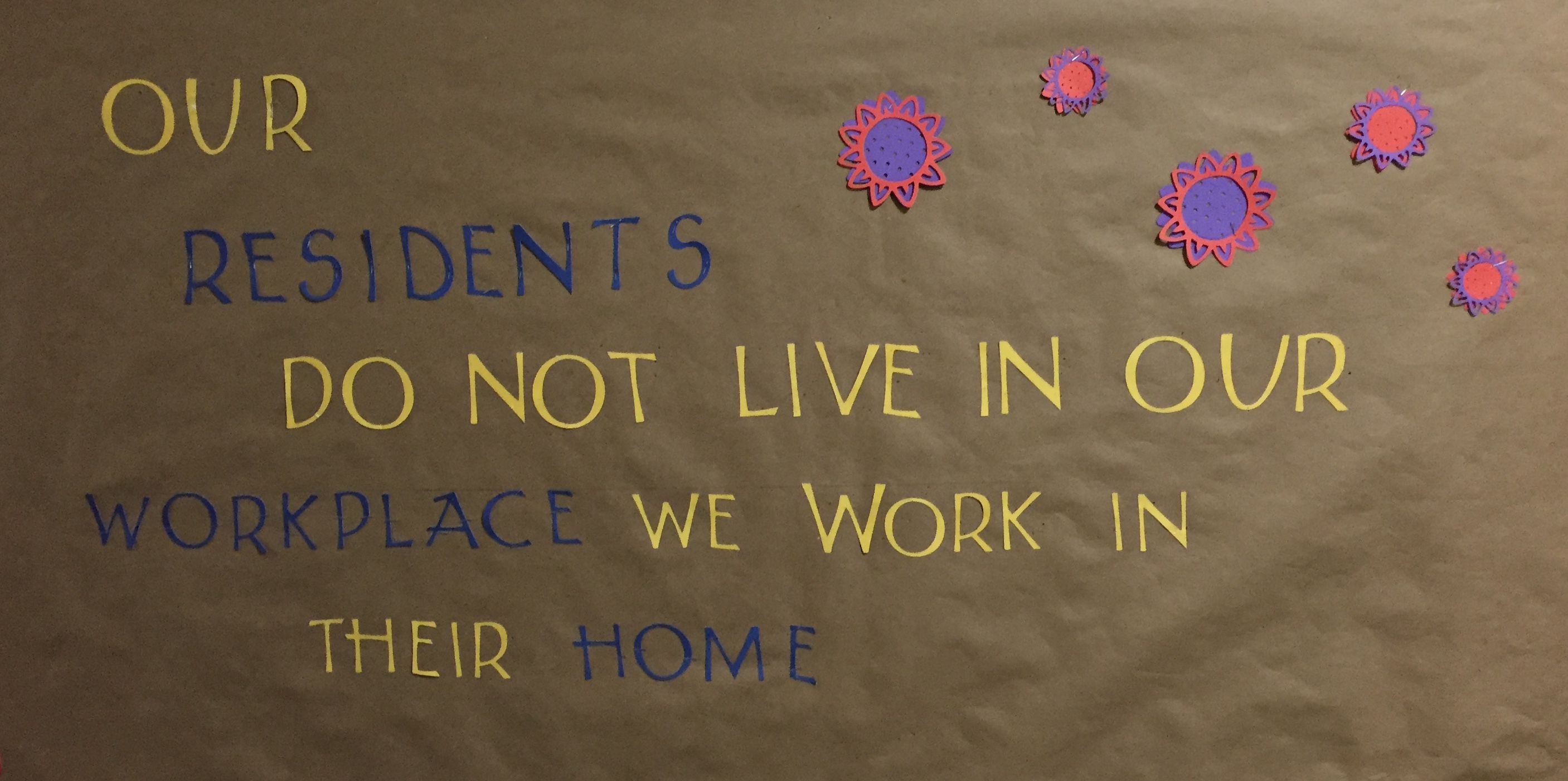
Bulletin board in an old folks’ home near Oniontown

This evening while enduring the television news, I’ll have a splash of pinot noir—just to gladden my human heart. What does a long-stem wine glass look like to an elderly child of God who shakes unpredictably? Or a chalice full of Sacred Presence? Spills waiting to happen?

Such questions should depress me, but they don’t. Seeing through homebound eyes is a lighter prayer than you might think. Anyway, I won’t dishonor them with sorrow. Maybe God can use my gratitude—for the filling of lungs, lifting a spoonful of broth, finding the Big Dipper—to bless my friends, to grant them an hour’s gladness.

My own joy is tender to the touch—only selfish joy isn’t bruised. I miss Mom now more than eighteen years ago when summer hung on me like wool.

But this March day is stunning, brilliant, 60 degrees. Chores are next on the list, then a walk. I’ll bring Mom and gather everyone I can remember as I go.

Dear God, please take the saints I forget by the hand and lead the way.

Words from the Dead in a Frightening Season

IMG_4105

Our beautiful country . . . out my office window.

Voting seasons are generally a drag, but the 2016 presidential primaries in advance of this fall’s general election are scary. In response to a long, humorless essay on the subject I posted on A Napper’s Companion a few days ago, friend Mary wrote, “I am sick and frightened and don’t know where our beautiful country is going.”

To her excellent words, I would add powerless. Today is Super Tuesday, and millions of Americans are looking around wildly for a pause button that doesn’t exist. Will our next president’s greatest gift be barroom brawling? And will the spectacle that is United States government morph from paralysis to legislative deliberations dominated by bellowing, spittle, and locker room insults?

I’m not the only citizen asking these questions and fearing these fears. Friend Judie wrote to me, “I am so ashamed of what we have become in politics.” Mary and Judie speak for thoughtful Americans and, obviously, for me. I’m weary with sick and frightened and ashamed.

As the first votes are being cast, I’m taking this moment to up my personal ante: Shame for others’ conduct is bad, but shame for my own thoughts and actions is worse.

When hitting below the belt is the order of the day, the temptation to counterpunch in like fashion is acute. If you call me a loser, I can call you whatever I please—and think even worse. But this way is neither Christian nor mindful. It’s the way of the lowest common denominator and the reptile brain.

Frightening times can bring out the worst in us, myself included. We’ve been scared before, though. I’m too young to recall vividly 1968, another year that America felt itself cracking to pieces. Think the Vietnam War and Civil Rights movement, the assassinations of Martin Luther King and Robert Kennedy.

In April of that year, monk Thomas Merton wrote in his journal while on the road: “So the murder of M. L. King—it lay on top of the traveling car like an animal, a beast of the apocalypse. And it finally confirmed all the apprehensions—the feeling that 1968 is a beast of a year. That the things are finally, inexorably, spelling themselves out. Why? Are things happening because people in desperation want them to happen? Or do they have to happen? Is the human race self-destructive? Is the Christian message of love a pitiful delusion? Or must one just “love” in an impossible situation?”

Anyone familiar with Merton’s life and work knows how he would have answered his own questions. One must love. In beastly times, love is the mindful person’s center of gravity. Such love is sometimes obliged to fight, but its arsenal is selective. Cruel or dehumanizing weapons, for example, are out. Such love is also sacrificial and can appear not only risky, but reckless.

How difficult to remember in an alarming season that assaulting my neighbor ends in wounding myself. In an informal address in Calcutta in October of 1968, Merton spoke indirectly of love: “And the deepest level of communication is not communication, but communion. It is wordless. It is beyond words, and it is beyond speech, and it is beyond concept. Not that we discover a new unity. We discover an older unity. My dear brothers, we are already one. But we imagine that we are not. And what we have to recover is our original unity. What we have to be is what we are.

Flower_Power_by_Bernie_Boston

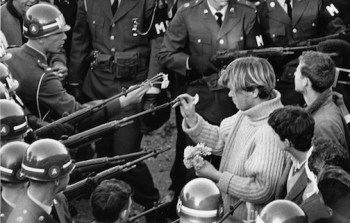
Flower Power, 1967 (Credit: Bernie Boston on Wikipedia)

Monks from various spiritual traditions, Western and Eastern, heard these words. In the context of what feels like a contemporary planetary crack up—campaign explosions, not to mention real bombs and climate change—Merton probably seems flighty, like a hippie sticking a flower in a rifle barrel. (And the monk himself added a tragic explanation point to 1968 on December 15th when he died of an accidental electrocution in Bangkok.)

If the human race is self-destructive, I want to be the weirdo holding out a daisy. If Christian love and human unity are pitiful delusions, nobody wake me up.

Wherever our beautiful country is going, history has taught us where hatred and fear lead. Call me a flake if I refuse to take the beastly path.

Dreaming My Way into an Old Lady House

In the early 1970s writer May Sarton moved from her beloved home in Nelson, New Hampshire, to The House by the Sea (her journal of those days). Like some lucky pilgrims, Sarton had ample time to make her move. “I had two years in which to dream myself into the change,” she writes, “sell Nelson, and pull up roots.”

Kathy and I are in the process of dreaming ourselves not into a spacious home on the coast of Maine, but into a 1,000 square foot house on Erie, Pennsylvania’s east side. Our zip code will go up six digits, but our space will shrink by over half. Downsizing, we’re calling it. We closed on the place a few days ago, but we’ve been picturing what will go where and what will disappear. Kathy is lobbying for an ambitious kitchen remodel; I’m smiling at the corner on the enclosed front porch where my desk and prayer/meditation chair will squat; both of us are imagining.

IMG_2814

A little light in the hallway–just enough

Last evening I said, “You know, we’re going to have to get used to the loss of space and no upstairs.” Kathy agreed, and as I’ve wandered about, distances seem abbreviated. I’m not concerned, though. The rooms are already endearing themselves to me, mainly because I see signs of the former owners everywhere. I’m guessing the husband and wife–the latter perhaps passing recently, the former having departed some years ago–were my parents age, born in the 1920s, shaped by the Great Depression and forged by World War II. Admittedly, all of this is guesswork.

I’ve been calling our new home, which the former owners purchased in 1949, an old lady house. She and her husband could easily have been curmudgeonly and strange, but signs of their thrift and good stewardship have me thinking they were upright folk. He–I’ll name him Ernest–nailed lids to the basement studs and kept screws and nuts in jars twisted secure. He also recycled cabinets, lining them up and keeping, what, half-used cans of paint and turpentine inside. One door near Ernest’s workbench was set up for a padlock, and a mirror strategically angled so he could see who was coming down the steps makes me wonder if he liked to keep a bottle of Gibson’s 8 handy for a secret pick-me-up on boring afternoons.

unnamed

Is this what Ernest kept locked up?

IMG_2824

Ernest didn’t have to venture more than five feet from his workbench if the “great whiskey” got to be too much for him.

She–Arlouine, let’s say–kept the well-worn carpets vacuumed. Grab bars in the bathroom suggest she tried to stay in her home as long as possible? But eventually raised toilet seats don’t help much. I imagine her, thin and brittle with iron gray hair, propped up in a nursing home bed, staring into the distance. Was she a fearful soul? I ask only because of something odd left behind in a hall closet.

IMG_2812

Sacred water in profane hands

So Arlouine was Roman Catholic. (We Lutherans don’t go in for Holy Water, our idea being that God has blessed that life source far above our poor power to add or detract.) For a couple days I laughed at the idea of Holy Water in a spray bottle, but Starbucks friend Sean, also a Catholic, gave me a compassionate nudge, probably without realizing it. I don’t remember his exact waords, but when I showed him the photograph he acknowledged the old practice of keeping Holy Water around the house. His take was kind, though, along the lines of “sometimes you’ll try anything that might help.” Point taken. Our fears hide in plain sight, like cobwebs near the ceiling or rust in the medicine cabinet; a spray of blessed water can do no harm.

Arlouine and Ernest’s bedrooms have tile that is so ugly it’s kind of charming.

IMG_2817

I’m not sure what all those tile plants are, but they look to be in pain.

Besides the Holy Water, the best find in the old lady house is the newspaper under the tile. I lifted up a corner to be sure the floors are hardwood–yes!–and found The Erie Daily Times (Night Final) dated November 8, 1949. My own parents’ firstborn, Cathy, was not yet a year old. Mom and Dad are both gone now, and my sister can retire any time she is ready.

unnamed-1

37-cent matinee

unnamed-4

Okay, so skinny depictions of women aren’t exactly new.

unnamed-2

Liquors, a Hammond, and Hazel Lowry’s smooth vocals: 1949 Erie, Pennsylvania, at its most refined

unnamed-3

Captain von Trapp’s first fiancé? I’m not going to lie: I’m frightened.

Oh, Arlouine and Ernest! You put that paper down sixty-five years ago, a prudent layer between the tile and wood. I’ll grant you, there’s no pressing need to update that flooring. Of course, Kathy and I will refinish the hardwood, probably put down a faux Persian rug, something tasteful. If I’m the one who slices your old drab leaves down to trash-bag size with a drywall blade, part of me won’t be happy.

IMG_2815

Possibly more thermometers than electrical outlets in our new home; maybe Kathy and I will keep this one to remind us of Arlouine, Ernest, and all those who have sailed on to glory.

I believe your way is for the best and will try to remember it as I dream my way into your home: Be sure to finish those leftovers. Put that old metal table in the basement and fold laundry on it. Don’t pull up perfectly good tile. And–I confess it makes sense–keep Holy Water in a spray bottle. A mist is more than enough.

IMG_2819

Tabernacle for the Holy Water; all woodwork in the house is like this


An Overcast Sky Sings My Revelation

Note: All photographs in this post appear courtesy of Giuseppe Colarusso. Mr. Colarusso, I’m in your debt. Thank you.

395-074

Have you ever had a morning when the environment collaborated with your spirit to yield a revelation?

A gentle rain persists out Starbucks’ window—looks like all-day. The Neil Young songs playing are mostly unfamiliar, but his voice, mournful and easy, soothes me. Milan, the manager of a tuxedo store in the Millcreek Mall, just showed me some absurd photographs by Giuseppe Colarusso, and laughs poured out of my tears reservoir. Damn, it felt good! (I’m convinced, by the way, that sorrow and joy swim in the same waters.)

253-040

Inside my fifty-two-year-old soul, rain also falls, a voice that sounds a bit like crying sings, and here and there, cleansing laughter comes out, inappropriately loud, and turns heads toward me. I’m having a revelation, at once comforting, sad, and playful.

There’s a popular saying these days: It is what it is. Like all maxims it will fall out of favor soon enough, but I plan to appreciate It is what it is (IIWII: pronounced eye-why) while it’s around. IIWII says, “Okay, everybody, the time for acceptance has arrived. We can talk lots more about the situation at hand, complain, dissect, laugh, kvetch, wrestle, curse, and so on. But we should understand that, despite our best efforts, some things aren’t going to change. So let’s just deal. Let’s move on.”

264-051

In this same spirit, a voice like Neil Young’s sings loving words into the ear of my heart. They sound like this overcast sky looks—pale gray pillows: “John, you are who you are.”

Has your life run like mine? Do you struggle to change characteristics that seem, as the years unfold, like matters of wiring? Do you promise yourself that the next time such and so happens, you’ll do better? You’ll be stronger, calmer, smarter, more centered, less sensitive, or whatever more or less you need to be? If your life hasn’t gone this way, you may want to escape and read something more in line with your reality. But if my questions resonate with you, I have one more for the list: At what point in the progression of decades is it best to say, “I am who I am. It’s time to make decisions based on the person I am, not on the person I would like to be”?

191-031

In March of 2006, I wrote in my book Your Grandmother Raised Monarchs to my future children’s—Elena’s and Micah’s—children about identity:

Be warned: the blood in your veins will predispose you to Coleman attributes, some of which you’ll like, and some you won’t. I would like to pick which of my qualities you’ll inherit and which ones will pass you by, but we both know fate doesn’t work that way.

Elena and Micah got your grandmother’s strong, crooked teeth rather than my straight, weak ones, which is to their advantage. Braces can align smiles, but the only cure for rotten teeth is pliers. Micah, who at fourteen brushes his teeth only when I remind him, had zero cavities at his checkup a couple weeks ago. Elena, who at seventeen brushes like a grown up, had two puny cavities. By the time I was their age, I had a couple dozen fillings. If your teeth fall apart, blame me.

Elena inherited my hips, which were wide even when I was running forty miles a week, but Micah got a skinny frame. If you carry extra pounds from the waist down and end up with pants tight at the hips but baggy at the waist, blame me.

When you glance at your reflection in a storefront window and wonder how you got to be who you are, you’ll have plenty to blame me for.

254-041

Mark Twain was supposed to have said, “I’ve had lots of worries in my life, most of which never happened.” If you squander days fretting about problems that never materialize, blame me. If you have bottomless patience, too much patience, occasionally stupid patience, blame me. If you’re smart enough to spot brilliance in others, but aren’t brilliant yourself, blame me. If you endure inexplicable anxiety and depression, blame me. If arguments leave you weary and shaken, blame me. If anything gorgeous makes your spirit ache, blame me. Blame me and forgive me.

506-04

In the eight years that have passed, little has changed. If anything, I may have lost ground where inner-strength and tranquility are concerned, and I’m just as vulnerable in relationships as ever. I am what I am. So, in this moment, Neil Young sings me a question: “Is it time shape your circumstances around the person you are rather than force the person you are to strain and stretch around your circumstances?”

212-001

Does that make any sense? Does there come a point in the maturation process at which you decide to stop trying to muscle your way again and again through situations you weren’t designed to endure? Can there come a revelation when you see clearly that loving and embracing the person you know yourself to be requires that you say goodbye to the person you would prefer to be?

271-059

Such a moment descended on me with this morning’s precipitation. For most of my adult life, I’ve been trying to transcend troubles like a levitating bodhisattva or Jesus asleep in the stern during the storm. Turns out I’m as loving and compassionate as they come, but I’m in equal measure fragile and nervous. I’m not enlightened. And a mustard seed is a boulder next to my faith—if, indeed, faith means an abiding sense of peaceful trust.

I’m a guy sitting in a coffee shop full of pilgrims on a gray day—a guy with more years behind than ahead who has finally, mercifully, gently realized that I am who I am needs to prune IIWII, plant fresh manure around its roots, and dance prayers for rain and sunlight.

267-055

This damp Monday is nurse-wife Kathy’s day off from trying to kick cancer’s butt. Obituaries of her patients say day-by-day, “IIWII.” She loves me in spite of my snoring, recognizes that IIWII is spanking me good, and agrees that it’s time to dance and pray. We’ve made an offer on a fixer-upper, 854 square feet, on the other side of town. Maybe we’ll hear something this week. Boy oh boy, will we have to trim away at what our present 2,100-square-foot house holds—if our bid tops the flipper we’re up against.

282-070

No matter. Who cares if the clouds sprinkle me on the way to the truck? I’ll head for church work, knowing that IIWII often has the last word, but not today. (Does IIWII have you by the throat? I’m thinking strength your way!) Lovely Kathy and I may move into a puny house–or not. Either way, I will toast the bodhisattva Jesus I would prefer to be, give him a kiss, and tell him it’s time to move along.

P.S. The flipper won this round.

1-immagine-02-b

Giuseppe Colarusso