
Dear Fellow Nappers, For some time now I’ve tried to keep A Napper’s Companion clear of controversy. The trouble is, our American system of government is in peril. As a writer I feel obligated to share ideas that may be … Continue reading
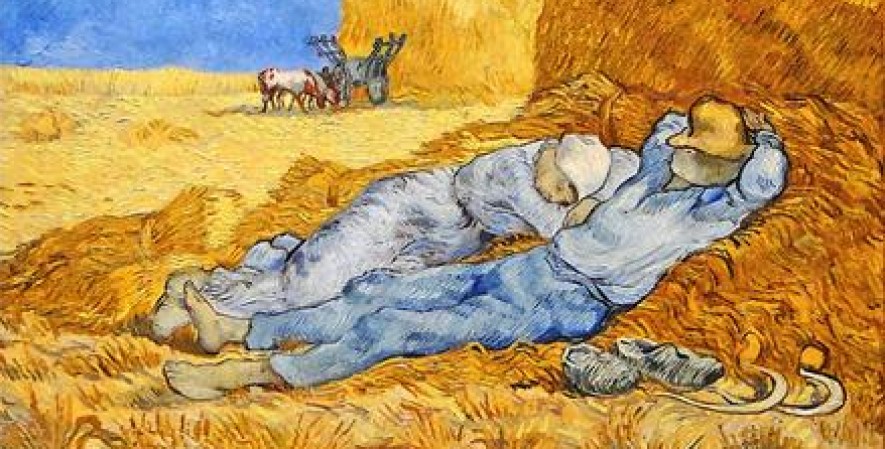
Dear Fellow Nappers, For some time now I’ve tried to keep A Napper’s Companion clear of controversy. The trouble is, our American system of government is in peril. As a writer I feel obligated to share ideas that may be … Continue reading
Matters of Conscience
As some of you may know, I have a second blog, Matters of Conscience, where I fence in essays on controversial subjects, as one might contain a puppy not yet house broken. Today I posted “Thoughts and Prayers and Motives” on that site. The subject isn’t quite right for A Napper’s Companion, but I doubt it will ruffle many feathers. The piece–with a link below–is essentially my take on precision where word choice is concerned. Please know ahead of time that my thoughts are gloomy, but not hopeless. 800 words.
Peace,
John Coleman

Believers and doubters alike can worship shoulder to shoulder in any year or circumstance by “stopping and listening.” Such a wise and generous mantra. Continue reading
Dear Friends of A Napper’s Companion:
I posted on my Matters of Conscience blog a piece about writing in the aftermath of the massacre in Uvalde, Texas, on May 24th. I won’t inflict the content on you here, since you don’t come to Napper’s to encounter controversial subjects. But if you want to read it, I’m pasting in below a link to “The Act of Writing: From My Hut After Uvalde.
Peace and Love,
John

I’ve seen him before: a hulking man probably younger than he looks, dressed in stained layers, even in the summer. He paces outside a convenience store, stops and turns as if a shadow has called his name. His countenance is rage, barely mastered.
I always figure he is going to roar at me or ask for spare change. His base is in one of Erie’s rough areas, so being panhandled or hassled wouldn’t be unexpected. His bench is at the intersection 30 yards away. He sleeps on his side.
My mother raised me to avoid such neighborhoods. In fact, there’s one street in Erie that she refused to travel, and that’s where I was this morning, buying my newspaper and iced tea.
Getting back in my car, I glanced his way and thought, “Just like me.” Not the homelessness, thankfully. Not the dirty clothes, not what I take to be the fury on simmer. I’ve lost some weight recently, but remain hulking.
Still, I’m a lot like this guy. I want to be loved and understood. I want to be comfortable, sheltered, clothed and fed. I want a mind that functions, friends to laugh with and a decent portion of gladness.
The American Tibetan Buddhist nun Pema Chodron deserves credit for “just like me.” She told Oprah Winfrey about it, and I overheard. Admittedly, you probably don’t need to engage in this contemplative practice with folks you love, though it can’t hurt. No, realistically, Chodron’s phrase has to do with those you find objectionable, often strangers.

But even the first woman ordained a Buddhist monk in the United States didn’t come up with “just like me.” In the novel To Kill a Mockingbird, novelist Harper Lee famously put an echo of the notion into Atticus Finch’s mouth. His daughter has had a rough first day of elementary school and disapproves of her teacher. “Well, maybe she was just nervous,” Gregory Peck explains in the film adaptation. “After all, it’s her first day, too, teaching school and being new here.” Then comes Lee’s gem: “Just learn a single trick, Scout, and you’ll get along better with all kinds of folks. You never really understand a person until you consider things from his point of view, until you climb into his skin and walk around in it.”
In the novel’s last chapter, Scout recalls the lesson: “Atticus was right. One time he said you never really know a man until you stand in his shoes and walk around in them.”
Delivered in Peck’s legendary baritone, empathy comes across as warm and folksy, but American poet Walt Whitman knew better. Of his experience nursing Civil War soldiers, he writes in Leaves of Grass, “I do not ask the wounded person how he feels, I myself become the wounded person.”
All of this imagery points toward pain. Saying “just like me” demands that I set aside the fine appointments of my days and recognize that but for bad luck, an unfortunate decision or the curse of mental illness, I might have no roof to call my own. Climbing into another person’s skin implies that I first peel off my own. To become the wounded soldier—or the person I’m inclined to hate—means that I receive another’s gut shot, that I dare to trade places with a broken soul, that I claim a sister or brother’s graceless desert as my own.
Empathy is easy on occasion, but most often it’s exasperating, like a riddle that’s beyond my patience or capacity. Anyway, stewing in ill will is easier than reflection and over time gets to be addictive. And prior to my self-explication, the person who has triggered my brain stem is nothing like me, damn it.
 Northern Mockingbird (Credit: Wikipedia)
Walking for a time in someone’s stilettos or loafers doesn’t mean that I condone a single chapter of her or his story. On the other hand, until I put into practice the raw, chafing wisdom of Chodron, Lee and Whitman, I’ve no business peddling criticism. In fact, if I review other people’s lives while still abiding in my own skin, I’m apt to kill a mockingbird.
“Mockingbirds don’t do one thing but make music for us to enjoy,” Atticus Finch says. “They don’t eat up people’s gardens, don’t nest in corncribs. They don’t do one thing but sing their hearts out for us.”
The older I get, the more I’m convinced that most people just want to be mockingbirds, in a fashion: To do no harm and sing their hearts out. Of course, if my supposition is true only of folks I love, then it isn’t true at all.
I Won’t Be Ashamed of Love
The 1993 movie Philadelphia teaches the powerful lesson that love is something to be proud of, even though folks may find certain expressions of it hard to honor at first. On the soundtrack, a Neil Young song, also named after the City of Brotherly Love, resonates with me, especially the line “I won’t be ashamed of love.” The protagonist is a gay lawyer dying of AIDS. My sister Cathy is married to Betsy Ann, and sister Cindy is married to Linda. Far from feeling shame, these kind and upright women ought to be proud.

One of my favorite photographs of all time: Cathy and Betsy Ann
But as moving as Neil Young’s words are in context, their message begs to be taken down from the screen and worn like a wedding ring. Love isn’t something you put on when it feels good and take off when it proves inconvenient.
Here in 2018 the temptation to compartmentalize love and all the rest of our emotions is great. Our tear ducts, for example, work overtime for YouTube videos of Christmas puppies and soldiers returning home to surprise loved ones, but an emotional voice in a political debate is often persona non grata. Two Facebook comments show what I’m getting at:
Awww did the bad man hurt ur feewings again
and
You need a safe pwace with a blanky
These responses landed in a sparring match over recent news developments, with one side expressing genuine concern and the other sticking with locker room towel snapping.
I don’t mention specifics here because I’m not looking for a fight. My point is directed to the whole sociopolitical spectrum. Not only won’t I be ashamed of love, I want to be its champion. Americans from many quarters insist that something essential to their identity is under attack, which may explain why we’re always putting up our dukes.

While my own rhetorical fists aren’t raised, my arms are crossed. I admit it, I need a safe pwace with a blanky. Some folks take pleasure in calling people like me a “snowflake.” Nothing new here. Those who drag kindness and compassion into the debate hall used be “pinkos” and “bleeding hearts.” Today, a merely descriptive term, “liberal,” is being wielded as a slur.
Such language is weaponry in what I believe is a war on love. Emotions, the reasoning goes, have no place in policy formation, and those who suggest otherwise deserve a good mansplaining.
I disagree, so with a blanky on my lap, I’ll speak only for myself. Tease the worried and teary-eyed if you like, but you’ll not shame this old softy for a few love-inspired convictions:
As you can imagine, my commitment to love reaches beyond the controversial issues of a given season. Love means putting my iPhone away when somebody is talking to me. It means thanking police officers and soldiers for their service. It means remembering that nothing makes me better than the guy at Erie’s State Street Starbucks who has loud arguments with himself. Nothing. I’m one chromosomal kink, chemical hiccup or bad decision from being in his shoes.
Come to think of it, he hasn’t been around in quite a while. I hope he is OK. He might not understand my concern for him, but I’m sure you can. I’m not ashamed to say that he is worthy of my love.

Oniontown Pastoral: The Trouble with Talking Eggs
Announcement: I’ve drawn my line in the sand. I’m on one side, and technology is on the other.
For the record, I have an iPhone 6, a Samsung Galaxy tablet and a MacBook Air laptop computer. I send text messages and “chat” with tech support to shoot all kinds of troubles. After years of resistance, the Colemans now have cable television. So nobody can say that I’m sour on gadgets or progress.
What tastes foul, though, is technology designed to boss me around. One exception is the navigational feature (“GPS”—Global Positioning System) on my iPhone. A woman’s cheerful voice tells me where and when to turn, thus keeping my eyes on the road and not on scribbled directions. She repeats herself incessantly, but wins points for not being as snarky with me as I am with her.
 Driving around Oniontown the other day, I heard on the radio about Google’s plans to extend the GPS from my car all the way to my living room. My inner curmudgeon grimaced.
Welcome to “ambient computing” and the surprisingly affordable “Google Home” computer. This “personal assistant” can recognize all voices in your household and do each individual’s bidding. “Call Joe,” you can say, and your buddy Joe will answer—as opposed to your sister’s boyfriend of the same name. Google Home has no keyboard and resembles an egg. At 5.62” tall, it’s almost cute.
But give it access to your contacts, calendar, favorite websites, etc., and the trouble begins. National Public Radio’s Aarti Shahani described what sounds like a nasally relative moving in and interfering. In “virtual” fashion, Google Home will “follow you and study you and tell you what you need before you even ask.” Shahani promised that my assistant will be “all around [me] all the time.”
In a word, “Whoa!” I treasure my wife Kathy, but don’t want to be around even her “all the time.” After thirty-three years of marriage, my relationship advice is, “Learn how to be silent together and give each other space.”

The smart variety of eggs (Credit: Wikimedia Commons)
Granted, my message is beige compared to Google Home’s. It can warn you that your flight is late. It can define mysterious terms like “covfefe.” It can bark out the Browns versus Steelers score.
But what could possibly be wrong with getting instant answers? Who would object to eliminating inconvenience? Why not let technology “tell me what I need before I even ask”?
I guess there’s no harm in confirming right away that Cleveland is careening toward another loss, but inconvenience is a great teacher. Human experience would be impoverished without it.
The other day, for example, unbeknownst to my iPhone, Kidds Mill Road was closed. When I took Methodist Road instead, my navigational lady went berserk. To save my sanity and hers, I pulled the plug.
In the end her ignorance proved my blessing. I passed the Jughandle and made a mental note to stop soon for pizza and a beer. Further down Route 18 stood a family of three silver silos. Daddy was a massive wonder of the farming world, dizzying to behold. As usual, amazement appeared on a detour.
And the inconvenient detour’s fraternal twin, chance, is generous beyond measure. Most of what shines in my life has come to pass not by design, but luck. Kathy and I are married due to an impulsive high school classmate’s matchmaking improvisation. Thanks, Denise! Thanks, God!
No, Google Home isn’t for me, nor is Google Lens, available soon. Just point my Samsung Galaxy at flowers and Google Lens will speak their names. Or point it at a restaurant and get reviews.
Software already exists that will translate spoken German into English, thereby saving me the trouble of digging out my college flash cards and exercising my brain.

A route to bother and amazement (Credit: Wikimedia Commons)
These marvels aren’t all bad, but as a collection they make me uneasy. If we don’t learn to wait for answers, smile through detours and make up our own minds, where will patience, endurance and wisdom come from in matters of life and death?
Most important, can ambient computing “tell us what we need before we even ask”? Please. What I need makes so little sense that I trust one voice above all others to guide me, and it doesn’t come from an egg.
American Lament
Dear Friends,
I just posted an essay called “American Lament” on my buzzkill of a second blog, Matters of Conscience. This primary blog, A Napper’s Companion, will probably be quiet a little longer–until I can write about beauty again.
I alert my Nappers to this lament because I know some of you will be interested. But I’m not encouraging or asking anybody to read. This was something I felt compelled to write.
Peace and love,
John

Grandson Cole
Dear Friends,
I’ve written a letter to my daughter that some of you might appreciate and posted it on my other blog, Matters of Conscience. Although what I have to say is ultimately hopeful–I think!–it’s dark enough that I don’t want it casting gloom here on A Napper’s Companion.
Please click here if you would like to read the letter.
Peace, love and best,
John
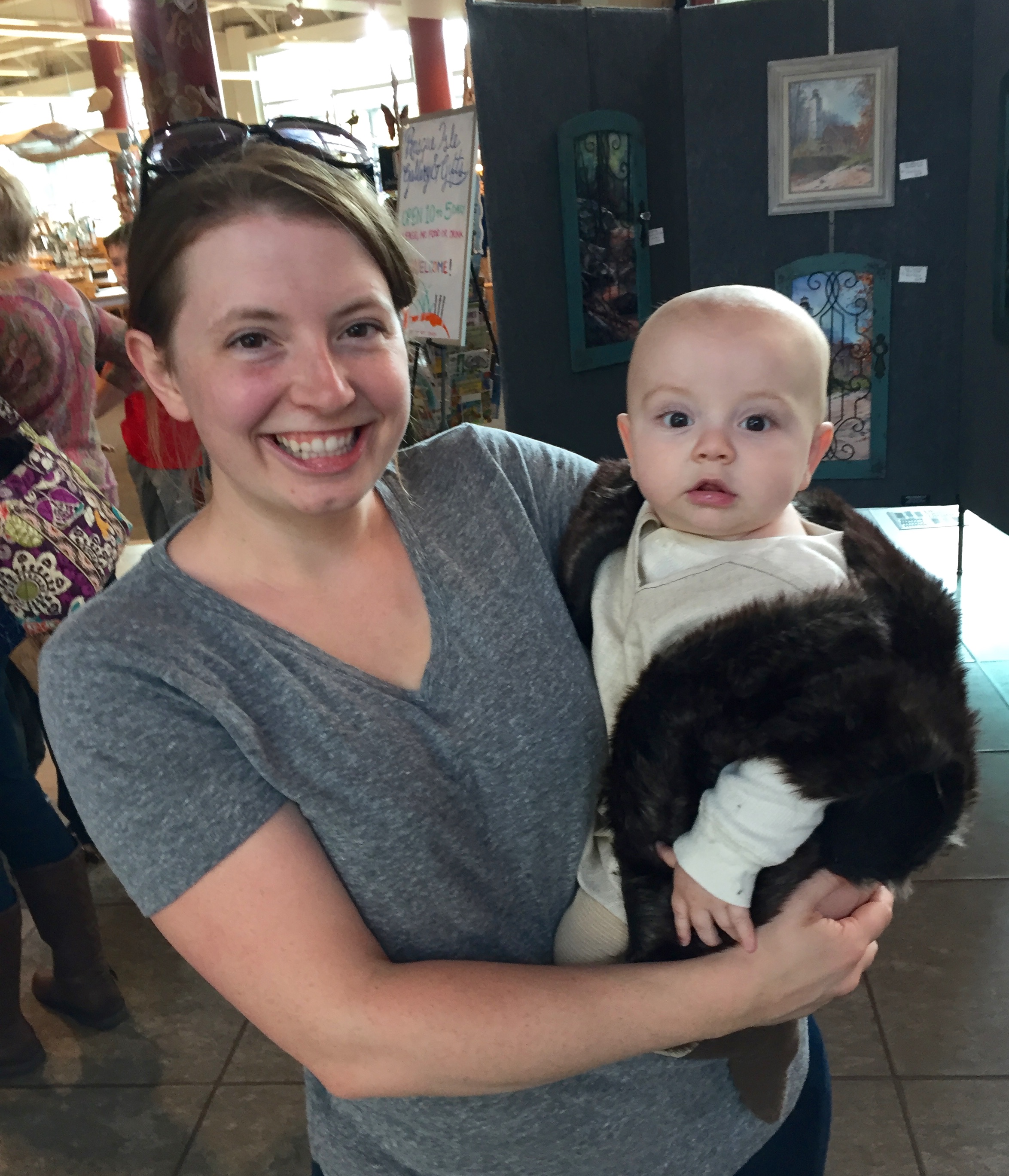
Elena and Killian–in his Halloween viking fur!
Dear Friends:
I’ve been thinking for a while of starting a second blog in order to keep my buzzkill social and political posts from skunking up A Napper’s Companion. Today I finally took the leap and set up Matters of Conscience.
It’s a work in progress, so if you’re interested in reading, please be patient as I work out the kinks. If you’re not interested, then please know that I value your opinions and made this move especially for you.
You may notice that I removed a couple of posts from this blog and sent them to the new digs. If you’ve been meaning to check out a post and can’t find it here, please try Matters of Conscience.
Peace and love,
John
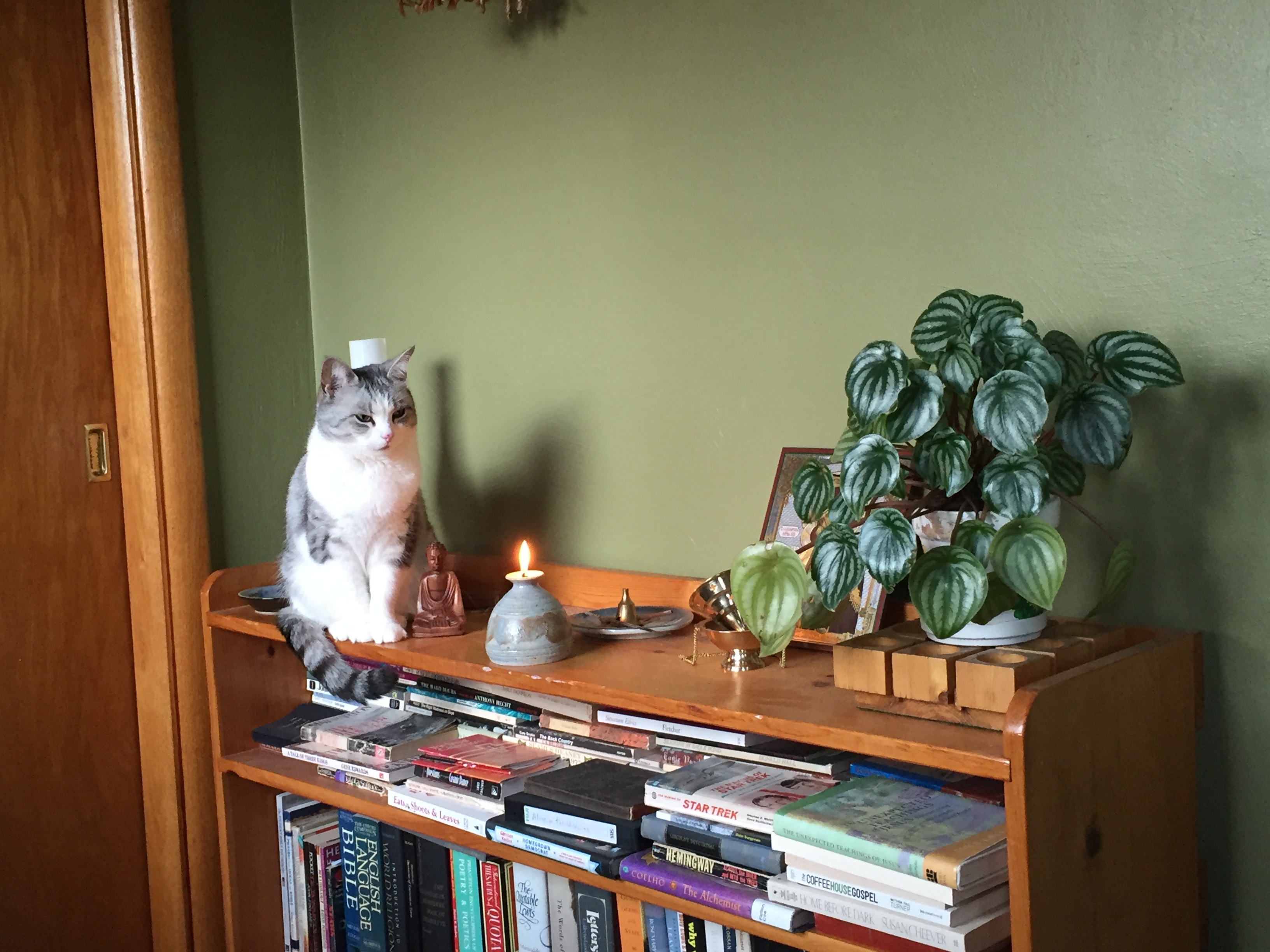
The “cover” photograph for Matters of Conscience
 A Napper's Companion