
Dear Fellow Nappers, For some time now I’ve tried to keep A Napper’s Companion clear of controversy. The trouble is, our American system of government is in peril. As a writer I feel obligated to share ideas that may be … Continue reading
Dear Fellow Nappers, For some time now I’ve tried to keep A Napper’s Companion clear of controversy. The trouble is, our American system of government is in peril. As a writer I feel obligated to share ideas that may be … Continue reading

Dear Blog Followers: If you enjoy A Napper’s Companion and are interested in my views on politics and society, I invite you to visit my other blog, Matters of Conscience. And if you appreciate what you read there, please consider … Continue reading

Far more than decent, the day verged on merry. Kathy and I safely traversed the afternoon, walked foxhound Sherlock Holmes, and settled in for ABC’s World News Tonight with David Muir. That last step was a mistake. Continue reading

This gallery contains 2 photos.
Oniontown Pastoral The Orphan’s Question: Where Is Love? Kathy’s breaths of sleep come and go. Awake at dawn, I’m in a high school choir concert 45 years ago, a musical’s lyrics forming behind my closed lips: Where is love? Does … Continue reading

I’ve seen him before: a hulking man probably younger than he looks, dressed in stained layers, even in the summer. He paces outside a convenience store, stops and turns as if a shadow has called his name. His countenance is rage, barely mastered.
I always figure he is going to roar at me or ask for spare change. His base is in one of Erie’s rough areas, so being panhandled or hassled wouldn’t be unexpected. His bench is at the intersection 30 yards away. He sleeps on his side.
My mother raised me to avoid such neighborhoods. In fact, there’s one street in Erie that she refused to travel, and that’s where I was this morning, buying my newspaper and iced tea.
Getting back in my car, I glanced his way and thought, “Just like me.” Not the homelessness, thankfully. Not the dirty clothes, not what I take to be the fury on simmer. I’ve lost some weight recently, but remain hulking.
Still, I’m a lot like this guy. I want to be loved and understood. I want to be comfortable, sheltered, clothed and fed. I want a mind that functions, friends to laugh with and a decent portion of gladness.
The American Tibetan Buddhist nun Pema Chodron deserves credit for “just like me.” She told Oprah Winfrey about it, and I overheard. Admittedly, you probably don’t need to engage in this contemplative practice with folks you love, though it can’t hurt. No, realistically, Chodron’s phrase has to do with those you find objectionable, often strangers.

But even the first woman ordained a Buddhist monk in the United States didn’t come up with “just like me.” In the novel To Kill a Mockingbird, novelist Harper Lee famously put an echo of the notion into Atticus Finch’s mouth. His daughter has had a rough first day of elementary school and disapproves of her teacher. “Well, maybe she was just nervous,” Gregory Peck explains in the film adaptation. “After all, it’s her first day, too, teaching school and being new here.” Then comes Lee’s gem: “Just learn a single trick, Scout, and you’ll get along better with all kinds of folks. You never really understand a person until you consider things from his point of view, until you climb into his skin and walk around in it.”
In the novel’s last chapter, Scout recalls the lesson: “Atticus was right. One time he said you never really know a man until you stand in his shoes and walk around in them.”
Delivered in Peck’s legendary baritone, empathy comes across as warm and folksy, but American poet Walt Whitman knew better. Of his experience nursing Civil War soldiers, he writes in Leaves of Grass, “I do not ask the wounded person how he feels, I myself become the wounded person.”
All of this imagery points toward pain. Saying “just like me” demands that I set aside the fine appointments of my days and recognize that but for bad luck, an unfortunate decision or the curse of mental illness, I might have no roof to call my own. Climbing into another person’s skin implies that I first peel off my own. To become the wounded soldier—or the person I’m inclined to hate—means that I receive another’s gut shot, that I dare to trade places with a broken soul, that I claim a sister or brother’s graceless desert as my own.
Empathy is easy on occasion, but most often it’s exasperating, like a riddle that’s beyond my patience or capacity. Anyway, stewing in ill will is easier than reflection and over time gets to be addictive. And prior to my self-explication, the person who has triggered my brain stem is nothing like me, damn it.
 Northern Mockingbird (Credit: Wikipedia)
Walking for a time in someone’s stilettos or loafers doesn’t mean that I condone a single chapter of her or his story. On the other hand, until I put into practice the raw, chafing wisdom of Chodron, Lee and Whitman, I’ve no business peddling criticism. In fact, if I review other people’s lives while still abiding in my own skin, I’m apt to kill a mockingbird.
“Mockingbirds don’t do one thing but make music for us to enjoy,” Atticus Finch says. “They don’t eat up people’s gardens, don’t nest in corncribs. They don’t do one thing but sing their hearts out for us.”
The older I get, the more I’m convinced that most people just want to be mockingbirds, in a fashion: To do no harm and sing their hearts out. Of course, if my supposition is true only of folks I love, then it isn’t true at all.
Oniontown Pastoral: A Lutheran Response to COVID-19
Sometimes I’m particularly proud to be a Lutheran. When I read a pastoral letter about the Corona Virus from Elizabeth Eaton, Bishop of the Evangelical Lutheran Church in America, I was so grounded and refreshed I can hardly tell you. Before sharing what Bishop Eaton wrote, I’ll set the stage.

Bishop Elizabeth Eaton of the ELCA. Chicago, IL 2019
Wife Kathy was just checking the latest news across the table from me in our den—the tongue-in-cheek name of the room where both of us are working from home during COVID-19’s deadly fuss. She exclaimed something from behind her computer screen. (I feel like television’s Tim “The Toolman” Taylor peering over his privacy fence at neighbor Wilson’s forehead on Home Improvement.)
My beloved may have used colorful language, but I can’t swear to it—groan. She passed along a report from NBC News about a Louisiana pastor who persisted in holding worship services in defiance of Governor John Bell Edwards’ executive order against gatherings of more than 50 people. The Reverend Tony Spell, however, packs in around 500 at Life Tabernacle Church. The trouble is, songs and amens are accompanied by airborne spittle, which passes infection.
Don’t be deceived if I sound momentarily whimsical. According to the Los Angeles Times, on March 10th a choir of 60 asymptomatic voices in Skagit County, Washington, assembled for a practice complete with social distancing and hand sanitizer, and now 45 of them have tested positive for COVID-19. Two have died.
Faith gives life, but mindless faith can also snatch life away. I don’t fault members of the Shagit Valley Chorale for rehearsing, as no restrictions had yet been announced for their county. Tony Spell’s faith, on the other hand, is dangerous. I’m sorry, it just is. “The virus, we believe, is politically motivated,” he stated. “We hold our religious rights dear and we are going to assemble no matter what someone says.”

The Luther Seal at St. John’s Lutheran Church in Oniontown, Pennsylvania.
Lutheranism rejects such arrogance. Bishop Eaton rightly referenced Martin Luther, who wrote his own pastoral letter in 1527 on a topic that hits home today. “Whether One May Flee from a Deadly Plague” addressed a population still mindful of a scourge that killed over 23 million people in Europe 200 years before:
“I shall ask God mercifully to protect us. Then I shall fumigate, help purify the air, administer medicine and take it. I shall avoid places and persons where my presence is not needed in order not to become contaminated and thus perchance inflict and pollute others and so cause their death as a result of my negligence. If God should wish to take me He will surely find me and I have done what He has expected of me and so I am not responsible for either my own death or the death of others. If my neighbor needs me however I shall not avoid place or person I shall go freely as stated above. See this is such a God-fearing faith because it is neither brash nor foolhardy and does not tempt God.”
_workshop_-_Martin_Luther_(Uffizi).jpg)
Martin Luther in 1529, Portrait by Lucas Cranach the Elder (Credit: Wikimedia Commons)
I am not a Luther scholar, nor do I possess any insight about 16th Century Germany. For this reason, I trust the ELCA Bishop’s knowledge and direction:
“Many of our [parishioners] have the same concerns as those in Luther’s day. Many of our people are anxious. Luther’s counsel, based on Scripture, is still sound. Respect the disease. Do not take unnecessary risks. Provide for the spiritual and physical needs of the neighbor. Make use of medical aid. Care for one another, especially the most vulnerable.”
This exhortation is neither soaring nor inspiring, which is why I love it. Discipleship looks pale compared to the flash and fluorescence that hypnotizes our culture. The acts of belief that move me most are nonchalant: swallowing an unkind word; listening to a loved one without glancing at the smartphone or television; shoveling a neighbor’s steps after a snow storm.
Most of all, in current circumstances, calling myself a Christian has a lot to do with using the brain God gave me. Health care professionals are begging Americans through their exhaustion and tears to stay home. Communicable disease experts say that COVID-19 is stealthy—and doesn’t the poor Skagit Valley Chorale know it?
Tell you what, as a diabetic, I’m going to listen to smart people. I don’t want to be infected or, what’s worse, pass along misery to an innocent bystander. Unless I must go into public places, you’ll find me at the Coleman house, praying for our protection and fumigating, my faith and intellect sitting peaceably side by side.

Be safe, Oniontown, until my return!
The Trouble with Love
“Our job is to love others without stopping to inquire whether or not they are worthy.” (Thomas Merton in Disputed Questions).
Most often breathtaking is used figuratively, but in recent days I’ve said to myself, “John, you’re not breathing. Stop and breathe.” Mass murders, hatred, relentless falsehoods and absurdities arrive in torrents.
Saturday, October 27th: Tree of Life Synagogue in Pittsburgh, eleven dead. Tuesday, November 6th: The scorched earth of midterm elections. Wednesday, November 7th: Thirteen dead—most of them younger than my own children—in Thousand Oaks, California. To these news items add that state’s wildfires, which according to latest reports are 35% contained.

Credit: skeeze on Pixabay
But let’s set aside Mother Nature for the moment. Disasters of human agency take everyone’s breath away, and many Americans are further deflated by the likelihood that governmental leaders won’t lift a finger to prevent further loss of life.
Political motivations are legion, the bottom-line being that innocents’ safety ranks far below constituents’ hobbies and proclivities. Transparent lies, lame as a crumb-dusted child denying raiding the cookie jar, are piled so high that responsible citizens grow disoriented and exhausted.
Any spare energy may well be absorbed by hatred, which is eager to throw off its gloves and start swinging. Present circumstances are practically designed to bring out the fighters in everybody. Some of us struggle to hold rage against the ropes while others gleefully talk trash and punch below the belt.
Sad to say, you can sometimes find me in the ring, too. In my mind I heap insults and ridicule on my fellow citizens’ heads before remembering Thomas Merton’s instruction: “Our job is to love others without stopping to inquire whether or not they are worthy.”
As I pause over these words, anger rises in my chest. The exhortation to love is Pollyannaish. The task is difficult. Who can accept it? There’s a physiological response when you look at folks you really want to punch in the face and remember you’re supposed to love them.
My mother, God rest her, took her upset out on doors. As a teenager I once made her so mad that she slammed the basement door, took two steps away, then returned for seconds.

Mom could have used this room when I was growing up. (Credit: Arek Socha–“qimono”–on Pixabay)
Even in the closest of relationships, love is trying. It can be like digging a pointless ditch with a swizzle stick when all you want to do is put said ditch to good purpose by shoving the person you can’t stand into it and shoveling in wet dirt?
Yet we know that this isn’t the Christian way. Actually, millions across the belief spectrum would say that they are called by conscience to love of neighbor and rejection of hatred. The problem is, anyone who has walked the path of understanding and compassion for long knows that confusion dominates comfort, deprivation overwhelms fulfillment. Being steadfast takes stamina.
This is why my gait appears drunken. Every fork tempts me toward a destination that rolls out the red carpet for my worst impulses: “Nobody deserves your consideration. They’re not really your neighbors. Put yourself first, others can pound salt. Let your tongue be barbed wire.”
All that keeps me from staggering hopelessly far in the wrong direction is one crucial insight and a whisper of grace. Love is a roomy term. Contrary to popular thought, “love” and “affectionate regard” aren’t attached at the hip. The latter simply can’t be commanded, which is convenient, since the love humanity now starves for has nothing to do with cuddling or playing footsie.
In Conjectures of a Guilty Bystander, Merton has a revelation about his earthly brothers and sisters while visiting Louisville, Kentucky: “At the corner of Fourth and Walnut, in the center of the shopping district, I was suddenly overwhelmed with the realization that I loved all these people, that they were mine and I theirs, that we could not be alien to one another even though we were total strangers.”

A plaque in Louisville to mark the spot of Merton’s revelation. (Credit: Wikipedia)
Merton recognized in the city’s shoppers “the secret beauty of their hearts.” He knew that they were children of the same Creator, beloved of the same God, and wanted to tell them that they were “all walking around shining like the sun.” They could also be monumental pains in the neck or far worse.
I occasionally want to give Thomas Merton’s hermitage door a few slams, but a quiet grace visits, filling me with belief: God calls me to love without reservation, especially when the effort seems foolish, even embarrassing—a little like supposing that some good might come from a man hanging on a cross.

Thomas Merton in his cinderblock hermitage. (Credit: Wikipedia)
I Won’t Be Ashamed of Love
The 1993 movie Philadelphia teaches the powerful lesson that love is something to be proud of, even though folks may find certain expressions of it hard to honor at first. On the soundtrack, a Neil Young song, also named after the City of Brotherly Love, resonates with me, especially the line “I won’t be ashamed of love.” The protagonist is a gay lawyer dying of AIDS. My sister Cathy is married to Betsy Ann, and sister Cindy is married to Linda. Far from feeling shame, these kind and upright women ought to be proud.

One of my favorite photographs of all time: Cathy and Betsy Ann
But as moving as Neil Young’s words are in context, their message begs to be taken down from the screen and worn like a wedding ring. Love isn’t something you put on when it feels good and take off when it proves inconvenient.
Here in 2018 the temptation to compartmentalize love and all the rest of our emotions is great. Our tear ducts, for example, work overtime for YouTube videos of Christmas puppies and soldiers returning home to surprise loved ones, but an emotional voice in a political debate is often persona non grata. Two Facebook comments show what I’m getting at:
Awww did the bad man hurt ur feewings again
and
You need a safe pwace with a blanky
These responses landed in a sparring match over recent news developments, with one side expressing genuine concern and the other sticking with locker room towel snapping.
I don’t mention specifics here because I’m not looking for a fight. My point is directed to the whole sociopolitical spectrum. Not only won’t I be ashamed of love, I want to be its champion. Americans from many quarters insist that something essential to their identity is under attack, which may explain why we’re always putting up our dukes.

While my own rhetorical fists aren’t raised, my arms are crossed. I admit it, I need a safe pwace with a blanky. Some folks take pleasure in calling people like me a “snowflake.” Nothing new here. Those who drag kindness and compassion into the debate hall used be “pinkos” and “bleeding hearts.” Today, a merely descriptive term, “liberal,” is being wielded as a slur.
Such language is weaponry in what I believe is a war on love. Emotions, the reasoning goes, have no place in policy formation, and those who suggest otherwise deserve a good mansplaining.
I disagree, so with a blanky on my lap, I’ll speak only for myself. Tease the worried and teary-eyed if you like, but you’ll not shame this old softy for a few love-inspired convictions:
As you can imagine, my commitment to love reaches beyond the controversial issues of a given season. Love means putting my iPhone away when somebody is talking to me. It means thanking police officers and soldiers for their service. It means remembering that nothing makes me better than the guy at Erie’s State Street Starbucks who has loud arguments with himself. Nothing. I’m one chromosomal kink, chemical hiccup or bad decision from being in his shoes.
Come to think of it, he hasn’t been around in quite a while. I hope he is OK. He might not understand my concern for him, but I’m sure you can. I’m not ashamed to say that he is worthy of my love.

 This evening before the dreaded presidential election, wife Kathy and I are heading back to Pennsylvania after visiting my sisters in North Carolina. Our objective was simple: relax!
Yesterday we awoke in the joyful home of sister Cindy and her spouse Linda. We didn’t get out of bed right away, but breathed and gave thanks for the view out the guest room window: clear sky, hanging plants and American flag rising and falling with an occasional breeze.
We also gave thanks for other loved ones who stayed the night: eldest sister Cathy and her spouse Betsy Ann; and Linda’s daughter Tina, her spouse Rebecca, their toddler son Liam and infant daughter Renley. Four affectionate and slightly spastic dogs and a mellow cat named Hermione added diversity and commotion to the gathering.
As we talked off and on about what is consuming millions of Americans at the moment, I learned that one voter’s presidential election can be another’s painfully personal referendum.
Thus far my anxiety about our country’s future has been generalized. The women I listened to over breakfast yesterday share my concern about the economy, foreign relations, immigration and the planet, but they also fear the threat a Trump administration might pose to who they are as human beings.

Cathy and Betsy Ann
With a Supreme Court fortified by judges favored by the Republican Party, will their marriages be under assault? Will the acceptance they’ve found recently as citizens be repealed? And what about the health insurance one married partner often provides for the other? Is there any way that same-sex couples could be denied that benefit all over again? After all, if Roe vs. Wade might be up for debate after forty-three years, why not the legality of gay marriage?
Kathy and I celebrated our thirty-third anniversary this year, and we’ve never had to contemplate our vows being cancelled by the Supreme Court.
My wife shares roughly the same profile as the Democratic Presidential nominee. If she wins, I imagine Kathy and other women will feel a burden lifted and an inexcusably overdue affirmation bestowed.
What will I feel? I’m a white, heterosexual male. My validation has been grandfathered in for centuries. I can’t remember ever being denied anything because of my packaging. Nobody has ever suggested that the person I understand myself to be is uniquely lacking, broken or abhorrent. Where social stability is concerned, I’m close to the top of the food chain.
But Cindy, Linda, Cathy, Betsy Ann, Tina and Rebecca face tomorrow with a fear I recognize but can never really know.

A safe place
I can name beauty when I see it, though, and these women are among the kindest, smartest, most upright and beautiful people in my life. The warm North Carolina air was refreshing, but Kathy and I don’t drive ten hours for the southern climate. We take time to visit our unorthodox family because we find overflowing goodness and safety with them.
If you think that gay marriage is sinful and should be illegal, I wish you could meet my gay sisters and witness their tenderness and compassion. I wish you could hear how they struggled to find peace within themselves and how falling in love turned their landscapes into rich expanses of grace.
Their troubled sleep this night is difficult to bear for love’s sake. Of course, millions may lie awake in the small hours of this morning, wondering how many of the votes cast will say, “America is not your home. You have to leave. Your language is an annoyance. Your skin is ugly and so is your soul. You’re being checked out, and this we can tell you, we’re not impressed.”
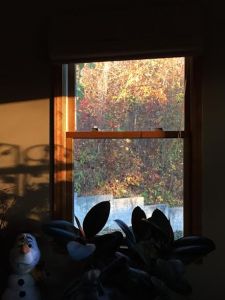
View from Guest Room Window . . . Gay Household.
When I vote tomorrow, I’ll be thinking of my family in North Carolina and every other sister and brother who want nothing more than to run into the open arms of a compassionate country.
Now, checked into a hotel in Summersville, West Virginia, I sip privileged wine. Kathy tells me the pizza just delivered is really good. And I make this promise: “Whatever happens tomorrow, the years ahead are sure to hurt, but you’re not alone. Plenty of Americans like me–especially those who don’t pretend to know what all you’ve gone through–love you and stand with you. When you were born, the cosmos rejoiced.”
Grandma Kathy Home
So the Cleveland Indians hold a 3-2 edge over the Chicago Cubs as the World Series moves back to Cleveland for at least another game. One particularly sweet spot here is my sentiment that if the Tribe loses, I can be glad for the Cubbies. Both teams are long overdue for a championship.
Alas, the Fall Classic holds diminished interest for me this year. I’m in a space that is best described by a phrase my childhood friend Vince used a lot: tons of bummage.
Joy isn’t in short supply these days; in fact, I have a surplus, more than anybody deserves. The problem is my reaction to our present American season of bummage.
“Do not lose your inner peace for anything whatsoever,” Saint Francis de Sales said, “even if your whole world seems upset.”
Sorry, Francis, but my peace comes and goes. It goes when I assume my fears about the future are predestined. It comes when I forget myself long enough to be touched by grace.
—
“I want to go home,” grandson Cole said.
“But, Cole,” my daughter Elena answered, “you are home.”
“No, I want to go to Grandma Kathy home.”

At Grandma Kathy Home. Cole checks Pop. (Credit: Kathleen Coleman)
—
Grandma Kathy and Pop have bored our friends slack-jawed with Cole’s words, but it’s hard to keep quiet. Sometimes a moment kisses your soul and brings hope within reach again.
Cole thinks of Grandma Kathy’s house as home. Do I care that he doesn’t include Pop on the deed? Actually, I like his name better. Kathy drops everything for Cole. They play in her garden and go to the basement and make repairs at her workbench. If she cooks dinner, he stands on a chair at the sink and does a few dishes with a whole bottle of soap.
He calls our den “my room,” and he and Grandma Kathy bunk there when he stays the night, as he did last Saturday. On church mornings, she sits beside him in the backseat for the hour drive to Oniontown.
Yesterday my sluggish sermon knocked the kid out, so he crawled under the pew and nodded off at her feet. After worship she let him sleep on, and friends stopped by to chat.

Got insomnia? Come listen to one of my sermons. Bring a pillow, join Cole. (Credit: Kathleen Coleman)
Cole was safe. Grandma Kathy was there.
He didn’t say, “Grandma Kathy’s home.” He said, “Grandma Kathy home.” My wife is home to him. The dwelling and garden are incidental.
Kathy helps Cole sew. He leans against her, watches a movie and eats pretzels and dip. She hustles him off to use the potty like a big boy.
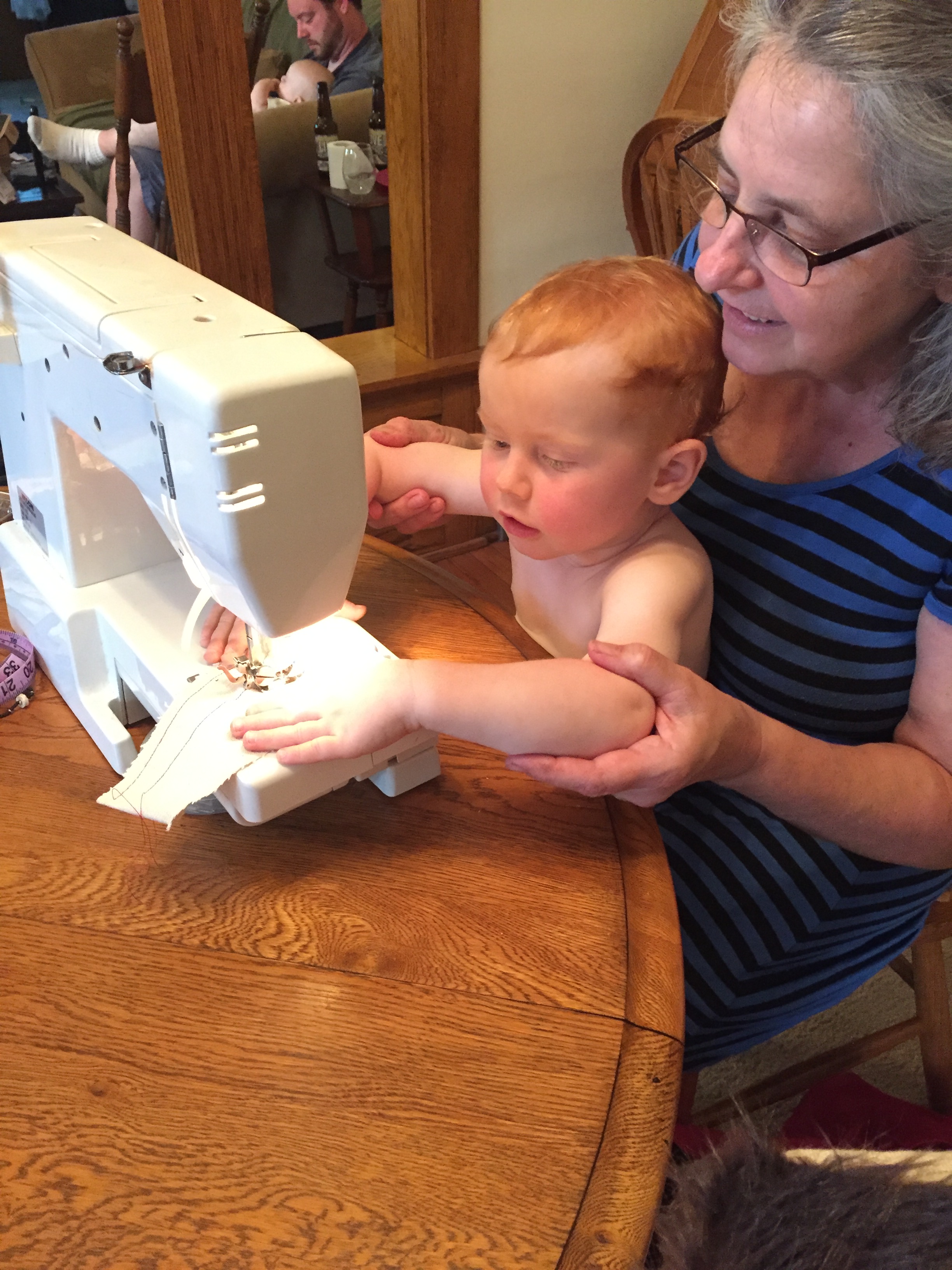
Hope
Watching them together, I’m positive of at least one thing that’s right with the world.
—
Fifteen years ago I copied a Bible verse on strips of paper and during a sermon suggested that parishioners put them on their refrigerators.
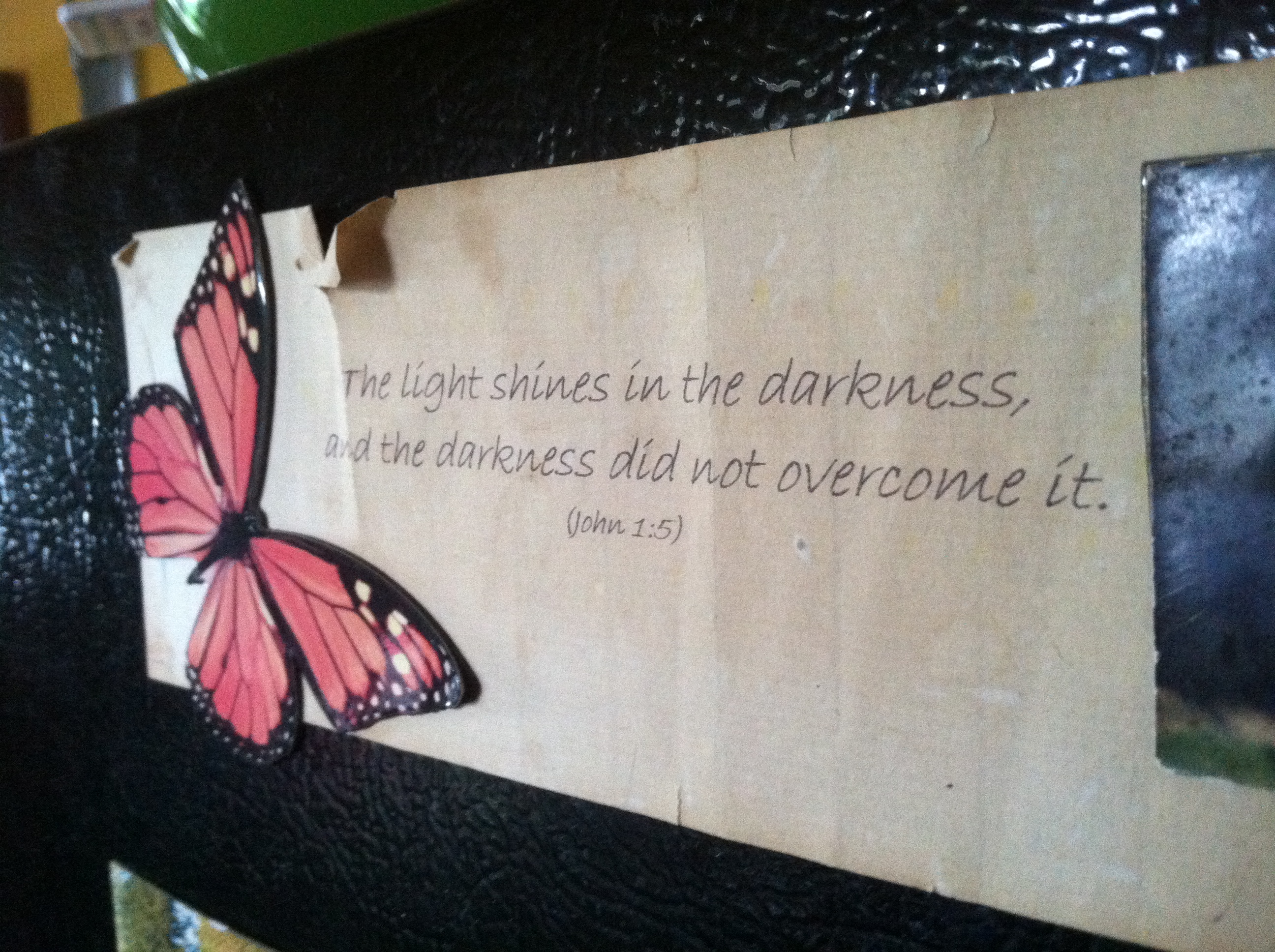
The light shines in the darkness, and the darkness did not overcome it. (John 1:5)
The light is love. I bet my life that it will win in the end. That doesn’t mean, of course, that my Indians will whip the Cubs. And it especially doesn’t mean that my candidate will prevail.
I don’t for a moment believe that God gives us clean sheets when we’ve messed the bed.
What I do believe is this: love is the only way out of human bummage.
In 1968, during another ugly season, Thomas Merton asked, “Is the Christian message of love a pitiful delusion? Or must one ‘love’ in an impossible situation?”
When I watch a woman and a boy not yet three together, peace fills my lungs. The only way I know to abide in impossible situations is to love.
It seems like hour-by-hour I get hopeless and angry, then hear Saint Francis speaking and try to find my way back to love again. All signs are that I’m delusional.
I want to go to Grandma Kathy home, too, Cole. Let’s live there together.
 A Napper's Companion