Thus Spake the Rabbi

My stride has been ragged lately, my groove flummoxed. As the poet said, “Nothing is plumb, level, or square.” Or the politician: “What a terrible thing it is to lose one’s mind. Or not to have a mind at all. How true that is.”

f503eb5a-2d90-44f2-ba21-32f9914a488a

Old buddy Watson, twelve years of family joy

Joy is largely to blame. Wife Kathy and I had friends over the other night to catch up. When eyes turned toward me, I said, “I’m happy,” which took some explaining. During the last couple of years, though surrounded by more love and support than anyone deserves, I have been tired and stressed. Maybe burnout is the word. Against all worldly good sense, Kathy and I raided my retirement funds and bought a hermit-sized home. (“You might come to regret that,” an old colleague said, and I couldn’t disagree.) I left a fourteen-year, full-time pastorate and accepted a part-time call seventy miles south of Erie, right through the region’s snow belt. Oh, and we haven’t sold our big house yet.

We Colemans have either lost our minds or found them. It could be that you have to lose one mind to find another. Since gladness and good sense seldom form right angles, I’m not surprised that my stride and groove—constructs of a neurotic brain—are stepping lightly these days.

I didn’t use these words exactly to unpack “I’m happy” for my friends, but they understood. Forced to choose between weary, anxious circumstances standing in crisp formation or calm ambiguity weaving like a drunkard, I’ll take the latter.

That is to say, I have taken the latter and am learning to embrace uncertainty and surprises. Lately sleep has been whimsical. A new work schedule has taken issue with my long-standing afternoon habit of napping. Like an AARP veteran, I’m reading in bed at 8:30 p.m. and surrendering by 9:00 or 9:30. The result: I wake up at 2:00 a.m., float to the bathroom, return to bed, and abide in a space that is to sleep what free association is to therapy.

Neither refreshed enough to get up nor drowsy enough to disappear, I breathe. Deep breaths, yes, but not those of my past, taken to lift a burden just enough to endure another hour or hush a remark that can’t be retrieved. If insomnia is an enemy, my peculiar wakefulness is a bearer of gifts.

60ab5db4-5da1-4824-95fc-0fde4cc86b6d

A bulge on the forehead: “soon and very soon,” Watson

Darkness is upsetting if you’re trying to find something, but it’s a gentle companion if you’re waiting to be found. A few nights ago snoring found me, not my own, but wife’s and dog’s. The sounds, joining for a moment then going their own ways, were blessings. Kathy has been swollen, weak, and achy for the last couple of months, and neither we nor the doctors know why. No matter what noise it makes, her sleep is medicinal. I welcome it. And Watson has weeks rather than months to live. The fatty tumor on his flank is getting hard. The growth on his forehead pains him more by the day. I now hope to come home and find that he has slipped away while dreaming that he and I are going for a run like we did years ago. His snore means that we don’t have to say goodbye quite yet. God bless his kind soul, even our walls and floors will miss him. I think now of his eyes, alive and expectant when Kathy and I left him this morning, and am close to undone.

The first decoration I nailed up in the Coleman’s new home is wisdom from a rabbi, Abraham Joshua Heschel.

7cc731dd-b219-4700-b2ee-3f9cdca525b4

Thus spake the rabbi

“Just to be” in a warm bed next to Kathy; “just to live” one more day with Watson: these are the teachings of wakefulness. My chest rises and falls, each in-breath a blessing, each out-breath sacred.

But my darkness isn’t deceptive. It would never say to a lost soul, “Just to be is a blessing.”

Instead I hear, “One corner of your joy will always be uneven, cracked with grief. Whatever mind you possess, it will never be satisfied.”

In this moment, I close my eyes to learn, invite the 2:00 a.m. wakefulness, and hear the rabbi more clearly. Breathing is grace. I survive on love. And I pray: “When my dog dies, Holy One, please help him not to be afraid.”

Fats Waller and the Frosted Trees

Fats_Waller_edit

Fats Waller (Credit: Alan Fisher on Wikimedia Commons)

Fats Waller and the Frosted Trees

Jelly Roll Morton, Scott Joplin, and Fats Waller make me grateful. As Steve Martin said decades ago, “You just can’t sing a depressing song when you’re playing the banjo.” Same with driving in the country and listening to piano rolls, rags, and strides.

This past week Fats, the color white, and gratitude owned my commute from Erie to St. John’s Lutheran Church in Oniontown, Pennsylvania. The hour south on I-79, Route 19, and District Road was a hot damn of thanksgiving–“Handful of Keys,” “Lulu’s Back in Town,” “When Someone Thinks You’re Wonderful.”

d8ab0138-1236-43ad-a8dc-a930a0642a7f

Grandson Cole, wonderful kid with a new lid

Why did pianos and frosted branches make me take inventory? I don’t understand myself all that well, so who knows? My list wrote itself slowly and silently.

  • I have a surplus of love. One step in any direction, there it is. Wife, grown kids, one grandson and another on the way, more family and a ton of friends. An absolute wonder of wonderful souls.
  • Those closest to me are holding together okay. No crises going down or chops busting in process.
  • I have a home, warm or cool as desired, so much food that possibilities have to be eliminated, and a king’s ransom of clean water.
  • My closet holds wardrobes for varying weight classes with acquisitions I’ve forgotten.
  • Bill collectors are not breaking down the door.
  • I dig the bookends of my commute—solace to the north and good purpose to the south.

As the miles clicked away, as Fats sparkled, as the snowy trees formed cathedrals surreal with beauty, Gershwin lyrics came to me: “Got my gal, got my Lawd, got my song.”

IMG_4148

Beloved Watson with the mother of fatty tumors

“No use complaining,” Porgy says as an aside, though he didn’t know about the Coleman family’s dog Watson, weary, arthritic, laden with tumors. He is our hobbling source of agape—unconditional love. A month ago, a lump appeared in the middle of his forehead. Its rapid growth foreshadows his absence, even as he manages a fetch or two. He snorts constantly, trying to clear a mass that won’t budge.

Nearing the end of my commute, I allowed that happiness isn’t a prerequisite for gratitude. Twelve years of Watson’s mild presence has been extravagant by any measure.

IMG_4150I would say that my inventory was a prayer, but Fats alone was that, as were the frosted trees and a line from a musical. I received the wide mercy—alpha to omega—of giving thanks for miles with my eyes, ears, and lungs and not once calling God by name.


A Witness for Richard

I’m used to burying strangers. Plenty of deceased and their families believe in God, but the church not so much. That’s when pastors get a call from a funeral director. Not much explanation is necessary: “Are you available to do a service on such and such a date and time?”

If nothing is going, I’m in. Details are provided, name, next of kin, a phone number. From there I watch for an obituary and make the visitation if possible, talk to loved ones, gather some sense of the departed.

But my latest burial was a first: no name, no contacts, just when and where. I did reconnaissance in Section B of the paper and found one possibility, a man with a brother and a couple of nieces. Maybe the brother wanted a prayer and “ashes to ashes” at the grave. No fuss, just a man of the cloth and a few words. At the appointed hour I fishtailed to my commitment, confident I would find a seventy-something man in the casket.

Instead I found Richard, a fifty-something resident of a group home, where he lived with other adults in need of supervision and care. Some of them were sitting with their caregivers, waiting for an unfamiliar face to bring comfort and hope.

The funeral director pointed me toward Richard’s primary caregiver, who didn’t quite know what to tell me. Richard didn’t speak. He loved to look at artwork. “He loved to eat,” she said, raising her eyebrows and drawing out loved, making the vowel sound delicious. He expressed disapproval by screaming.

Others told me that he insisted on being called Richard and looked forward to his morning routine of chocolate milk.

Twenty minutes before the service, I stood with Richard: African-American guy about my age; chin drawn in; fingers showing some atrophy, I believe; passable suit jacket and tie; favorite afghan across his legs.

In certain situations I take it as my responsibility to witness, to pay attention and make a silent announcement to creation. Or maybe my job is to confess a belief consisting of equal parts tears, hope, and wonder. I don’t know.

But staring at an embalmed man whose life was nearly invisible, I put words in God’s mouth. Doing this has always felt dangerous. I don’t know the mind of God. I can’t even put together a sound argument that God exists. Anyway, words were in my mouth. I didn’t invite them. I heard them in my head as true beyond debate. It was as if I were not their author:

You’re as important as anybody in the world, Richard. Nobody is more loved than you are.

I imagined that Richard’s face, the lip puffed out over teeth that never got braces and his fingers bent at the last knuckle, were dear to God—as when a parent watches an infant sleep, each feature counted as a miracle. And to God’s ear, were Richard’s screams music?

I did my best with the service. Some lives make for scant eulogies, but that’s only if you forget that one person’s chocolate milk in the morning deserves mention as much as another’s Fulbright. “Richard was a charming, and funny man,” his obituary read. “He had a loving, caring soul and his smile would light up a room.” His friends, a dozen or so, cried for him. They wiped away tears, too, at the suggestion that God beheld Richard loving food and in him was well pleased.

A soul’s resume lists sacred trivia: knowing how to taste chocolate milk, getting lost in a painting, demanding to be called by name, caring for others with a smile or a scream. Richard’s accomplishments don’t shine up very well, but those who loved him in the world appreciated them and loved him to the end—from the group home to the funeral home to the cutting cold of the cemetery.

In under ten minutes, we had spoken the final amen and were back into our warm vehicles. Not many days later now, I sip routine coffee. Richard reminds me to taste it. His face, as clear in my eyes as when I stood by his body, doesn’t belong to a stranger. His features are fine the way they are. May God and all the quick and the dead remember to call him Richard.

A Dream Yields, A Blessing Takes Hold

IMG_3479

Field near Prospect, Pennsylvania: a dream view

Solitude, unmasked stars and planets, the shocking cold before dawn, generous draughts of silence: decades ago I wanted this world. Someday, for sure, I would own a house in the sticks with some acres. But—one season following another—age can plow old dreams under, let longing lay fallow, and call a soul to entertain wishes again at the right time or to give them up all together.

The catch is, living more than a holler away from the nearest neighbor is perfect for me. I should want to wind up in the country. I’ve had plenty of great neighbors, some of them like family, but population-density can be a nuisance, right? One former neighbor always fired up her leaf blower whenever I lay down for a nap. It sounded like Carol Channing trying to clear her sinuses. Another neighbor enhanced home security with a nuclear front-yard lamp—impossibly bright. In a step of first-string, All American effrontery, he installed a black shield on the panel facing his house. Why sear every retina on the boulevard, after all? One guy tried to save us by covering the light with a sombrero, only to find it returned to his stoop the next morning.

But such annoyances never drove me from Erie, Pennsylvania, with its 99,542 residents. Columbus and Baltimore, two real cities I’ve called home, were fantastic. So why the persistent sense that I should hear a creek running outside my window? I’ve been thinking in recent years that my dream of rural living was not, in fact, stirred by desire, but by obligation. As a writer who prays a lot, I should want to live a couple hours to the east in Potter County, where deer outnumber humans. Why wouldn’t I want the Coleman home to breathe like the hermitages of my many spiritual retreats in the woods?

This question has occupied me ever since I accepted a call to serve a rural congregation a couple of months ago. The hour’s drive from Erie, where I continue to live, to St. John’s Lutheran Church outside Greenville, Pennsylvania, provides time to sort things out. I listen to tenor arias or fingerstyle guitar or nothing, watch the gray land roll toward the horizon, and let my mind do anything but worry—its default mode.

Wouldn’t the horses I pass on Route 19 be a better routine for my eyes than the strip mall before me at the moment? Shouldn’t I want to move close to the Amish, whose black buggies on District Road tell me to slow down?

I don’t know where “Don’t should on yourself” came from, but the earthy advice points my way. Maybe my closest neighbors should be black bears, but my fifty-four-year-old joys and aches rest easy in a neighborhood, within a stone’s throw of a lady who uses electricity to herd leaves and a better-safe-than-sorry man whose light insults the stars. Being a few minutes away from a ripe avocado, a bottle of cheap red wine, and coffee in a clean, well-lighted place fits me.

Truth: As the days flow by, my old dream yields to a small house in Erie, where I regularly smack my head on the basement ductwork. Less than half the size of the house Kathy and I raised Elena and Micah in, this blue-collar hermitage a mile from my high school feels just right. I don’t want to be anywhere else.

IMG_4105

Out the Pastor’s Study window at St. John’s

But the story doesn’t end here. Even as Parkway Drive becomes home, a blessing takes hold when I head south to St. John’s. It fills me as I wonder why some horses wear blankets and others don’t. It abides with me as I work in the pastor’s study, try to offer the folks a good word on Sunday morning, and eat chicken pie with the seniors at the Stone Arch Restaurant: The land and its stewards reach out and pull me in, as if to rest against the bosom of the Lord.

Winter is being coy with us in northwestern Pennsylvania, but my view of the blonde corn stubble out my study window calms my heart. And the parishioners I’ve gotten to know wear their goodness without pretense.

The other day Parish Secretary Jodi got a call reporting that we have roof leaks dripping into the church lounge. She hadn’t finished passing along the news when Anne and Dave’s car pulled up in the parking lot. They had also received word and were coming to check things out.

The problem and temporary fix were quickly settled, but in a fifteen-minute crevice of the morning, Dave and I talked. More importantly, I listened. Amazing what you can learn in a quarter of an hour.

Dave is a retired veterinarian who restricted his practice to cows. He still has twenty of them, three of which are calving. You can take the veterinarian out of the cattle, but apparently you can’t take the cattle out of the veterinarian. I mention this detail because Dave had been overseeing developments before showing up at church and had work clothes on: think dusty Carhartt-type coat and a long-punished hat with earflaps aspiring to be wings. Anne tried unsuccessfully to smooth those flaps, but Dave said, “I like it this way.”

Confession #1: I want to be like this guy. If his hat looks poised for flight, so what. It feels right on his head. And, really, isn’t that what counts when you’re making sure cows get off to a good start in life?

Confession #2: It took me a few seconds to open up my ears. How long have I known that wisdom isn’t restricted to the monk’s cell or the desert hermit’s cave or the scholar’s podium? Riches for mind and soul can also germinate under a quirky lid. Fortunately, I forget easily, but remember with light speed.

Confession #3: The instructions I gave myself wouldn’t suit a sermon, so I’ll give the G (all ages admitted) version: “Listen up, pal,” I thought, “this man has something to teach you.” I caught two lessons in five minutes, not a bad return on the time investment.

Lesson #1: Dave said, “Everything is born to die.” I recalled at once some years ago asking farmer and author Joel Salatin about vegetarianism, and his response was similar. Dave brought me back again to the possibility that death’s inevitability is less important than how it’s attended. He described slaughterhouses he had visited where the cows walked a curved chute toward a pitch-black elevator. Cows will hug an outside wall following a curve—natural to them, I guess. And when they emerge from the darkness, their end comes immediately. No fear or trauma, no months of anxiety about diagnoses and treatments and the dying of the light.

Everything is born to die: not a callous statement or lazy rationalization, but a confession. Salatin pointed out to me the arrogant assumption that the death of a pig is necessarily more noteworthy than the cooking of a carrot. Sounds silly until you understand that the observation lies far down the anthropocentric path. Salatin didn’t use that fancy word, but that’s what he meant. Parishioner Dave can speak for himself, but I bet he knows more about life and death than I do. His days involve walking land I only visit and touching animals I know from a distance. Best to learn from him with an open, humble spirit.

Lesson #2: Dave cares about those twenty cows. His words, voice and manner had a tenderness about them. An animal’s suffering or an injury to the land would pain him. He doesn’t emote as I do, but I know love when I see it—not the love shown in a photograph of an infant in a boot, but the love visible in a retired veterinarian keeping vigil to be sure a calf gets on its feet. The calf will grow and be sold someday, but it’s loved no less for that.

I gathered all this from a man wearing a hat with wings and speaking softly. Acreage in counties close to St. John’s wouldn’t suit me, but traveling there a few times a week is healing my spirit in ways I’m only beginning to understand. And I didn’t count on being edified by folks like Dave and Anne, who would read this and probably tell me to quit fussing.

104badc4-0d57-4873-990b-71a4a76467fe

Rooftops and bare trees on Parkway Drive

But I’m going to fuss. Tonight I’ll fall asleep next to beloved Kathy in a blue-collar hermitage. And tomorrow morning I’ll drive an hour to tend my flock in a place where you can see the stars.

Right now, across Parkway Drive, a neighbor puts away fake garland. Kathy just lay down on the couch and mentioned that from her angle, all you can see is rooftops and bare trees.

I thought, “You could almost be in the country.”

Christmas Time Is (Still) Here

Christmas Time Is (Still) Here

Bing Crosby’s “White Christmas” playing in my ear buds is barely overcoming the percussive assault on Starbucks’ speakers—over which my beloved baristas have no control. The Mother Ship picks, I guess.

Our Advent binge on “Have Yourself a Merry Little Christmas” and “Blue Christmas” and “I’ll Be Home for Christmas” and “Christmas Time Is Here” and “The Christmas Song” and “Please Come Home for Christmas” and “What Christmas Means to Me” and “Merry Christmas (I Don’t Want to Fight Tonight)” has lots of folks hung over as of December 26th.

Not me. Music of the Nativity will decorate the Coleman house until the Epiphany, our idea being that it’s impolite to close down the celebration before the magi have arrived with their gold, frankincense, and myrrh. The tree is lovely. Leave it up. The songs are soothing. Keep listening.

Honestly, though, my reason for lingering in the yuletide has more to do with what has filled my soul’s stocking lately than with the Christian calendar. Over my fifty-four gift-giving seasons (good grief!), my thoughts have turned from what I hope to receive to what I’m fortunate to have. Much as I loved the packages I opened on Christmas day, never have I cared less about what would be in them.

A man would be greedy to expect more from his portion of years than I have right now. This understanding settled upon me as I lay in bed some nights ago while wife Kathy made doll clothes at the dining room table. Her sewing machine hums and whirs regularly in our Parkway Drive home, but hearing it embraced by the warm promise of sleep returned me to Wagner Avenue, where I grew up.

A sewing machine’s singing, like other music, is sweetened by rests. The gift being stitched together breathes, as does the whole dwelling.

My mother made her own skirts and alterations to our family’s clothes. It never occurred to me before that the sound of a sewing machine holds for me what was loving and healthy on Wagner Avenue.

IMG_4031

My mother’s Christmas cactus, once on Wagner Avenue, now on Parkway Drive

As I opened my eyes a crack to taste the hallway’s dim light and groaned at a throb of bursitis in my shoulder, the joy and affection that fed me long ago kept company with current blessings.

The Colemans are housed, fed, clothed, adequately employed, and reasonably healthy. In other words, we’re all okay at the moment.

Most of our life-stealing troubles have passed away or at least gone on hiatus.

Like many Americans, I wouldn’t protest if somebody threw unexpected fists-full of cash at me, but, thank goodness, money and possessions aren’t obsessions.

I’ve known the gladness of being a husband, father, grandfather, friend, and pastor. The people closest to me tolerate my shortcomings.

After thirty-two years, I love my wife more than ever.

I believe in a God of grace and mercy.

In the quiet between Kathy’s stitches, such unmerited gifts hemmed me in, behind and before. “Enough,” I thought, “much more than enough. More than plenty.”

But there was still more. There was Christmas day. Daughter Elena and son-in-law Matt donated immunizations and medicine in my name for Third World children. They thought about who I am and came up with that idea.

Son Micah made us close our eyes. After a minute, he told us to look. On our laps rested stockings. With 2015 being tight, we told the kids we would be skipping this tradition temporarily. “It’s not much,” Micah said, “but we’ve got to have stockings on Christmas.” Mary Janes never tasted so good.

Grandson Cole handed each of us a homemade ornament made out of some baked flour concoction. Like the others, mine bore a few smears of watercolor. “Cole paint that,” he said. Three words and earthly elements: a sacrament stirred in my chest.

When everybody headed home, Kathy said over and over again, “I had so much fun. That was the best Christmas.”

Just one more: Cole and I sat on the couch and shared peach pie a la mode. I got to watch him open his mouth for every bite as the Grinch and his rein-dog trumpeted their way back into Whoville to pass out gifts and share roast beast.

I’ve memorized all the kids’ Christmas shows. These days I would rather stay with my grandson’s eyes—merry and bright!—until I know them both by heart.

A Letter to Parents from a Middle-Aged Pop

A Letter to Parents from a Middle-Aged Pop

Dear Parents (Especially New Ones):

I’m a Christian-Buddhist-pastor mutt in my mid-fifties, married to Kathy for thirty-two years. Daughter Elena and son Micah are grown, the former and her husband Matt having given us grandson Cole and promising us another grand-someone in the spring.

Yesterday Elena, Cole, and I (Pop) went to a nature center for a toddle in the woods. Nearly two, the boy is steady, but the path was strewn with branches and limbs from a recent windstorm. I kept close, spotting his steps, saying in my head, “Don’t fall! Don’t fall! Don’t fall!” My mother did this with me, too, so the anxious parent-grandparent impulse has genetic force behind it.

IMG_3966

Watch out! Don’t get poked in the eye.

Or is the force my childhood home, which was loving and attentive but nerved up? I’m certainly not the first to observe that children take family vibes along when they grow up and move out. I’ve spent much of my adult life trying to love in healthy ways and navigate through anxiety. In my late twenties it was full-blown panic attacks. In middle-age, it’s mostly trying to distinguish love from appeasement and not to turn every emotional speck of stardust into a blackhole. I pray-meditate a lot.

Lately my spiritual practice has drawn me to Tibetan-Buddhist Pema Chodron, whose teachings are weaving themselves into my thoughts and actions. In a recent post, Writing and the Narrative of Suffering, I offer a brief summary of my novice understanding of some key concepts Ani Pema works with. If what follows is interesting, I invite you to have a look.

I was watching one of Pema’s videos this morning when I was grabbed by her flawless diagnosis of my parenting experience:

Trungpa Rimpoche coined the phrase idiot compassion, or you could say idiot loving-kindness. Some of you may have tried raising your children this way and you’re wishing you hadn’t. You can’t bear to see them in any kind of pain, so you give them whatever they want. [Doing this] is like trying to assuage someone’s thirst by giving them saltwater.

I’m overjoyed to report that Elena (27) and Micah (23) are doing well these days, but my unintended lesson about suffering sometimes made their journey a walk on glowing coals. By regularly showing them idiot compassion, I taught them that pain can be eliminated.

Let’s be clear about my motivation. I could claim that I wanted to spare them disappointment, sadness, frustration, whatever, but that was only 25% true. More pressing, say 75% true, was my need to overcome a father’s discomfort. This is idiot compassion, idiot loving-kindness. It could also be called selfish compassion or artificial loving-kindness. I try to make myself better by denying my child the reality every human being has to confront sooner or later: Life is sweet, but it also slaps your heart and punches your spirit.

Years ago in seminary, my Enneagram results indicated that conflict in close proximity could be crippling. Conflict, pissing and moaning kids, discipline and tough calls: It was all crippling, so much so that to find relief I undercut wife Kathy’s strength, wisdom, and wishes.

So Elena wore black makeup, dated guys I should have shown the door, and watched and listened to what she damn-well pleased. And Micah bought weed with money I gave him, dropped out of high school, and put less effort into my feeble attempt at home schooling than I did.

There’s more, some of it worse, but you get the idea. All my reasoning sounded convincing at the time, but now I look back at myself. That younger man was doubled over, rendered frantic and sick by the need to steady the ship, to calm the waters. If you think I was stupid, you’re right.

Given this scathing review of my parenting skills, you might imagine me constantly ripping myself a new one. Other than sighing, I don’t do much self-reproach. What compassion I possess also extends to myself. I mistook indulgence for insight. The glasses I saw through were, in fact, blinders.

So I put down these ideas. I’m not telling you what to do, but mistakes are great teachers. What I believe now is this: Allowing children to experience necessary suffering may well be the highest form of love.

And I’m glad that it’s not too late for me to learn. Cole fell three times on one patch of slick leaves–two near-splits and one averted face plant. I stayed back. He was fine, of course. Someday he’ll get a fat lip or a bruised soul. When he does, I’ll pick him up and tell him the truth: “I know you’re hurt. Sorry I couldn’t stop it. The best Pop can do is stay close and hurt with you.”

IMG_3975

Elena and Cole–three spills later and belly laughing

Peace and love,

John Coleman

A Pastor’s Goodbye Letter

Dear Abiding Hope Family:

If you’ve been by my office lately, I understand your amazement. You’ve taken in the clutter and generally said boy or wow. The pastor’s study can be like my late mother’s junk drawer. Any object without a clear, immediate destination goes in the junk drawer (a lonely C battery, a half-used packet of mini Kleenex, a ceramic hippopotamus from a box of teabags) or the pastor’s study (a floppy sunhat, an old bag of Swedish fish, an unopened pack of small Depends–someone might be able to use them). One of you winked and mentioned that a huddle formed recently over the need for an intervention.

And you see only part of the squalor. Yesterday I filled five trash bags by emptying out a filing cabinet hidden behind my closet door. Notes from seminary might be interesting as artifacts, but if their contents haven’t already been put in my heart and written on my mind, then I’m in trouble, as is anybody who would call me Pastor.

I’ve gone through hundreds of books and filled two boxes with keepers. Over the years a formidable theological library has happened my way, one collection from a studious pastor ready to retire and another from one who left behind an apartment groaning with bound ideas and counsel. The titles displayed on bookcases look learned, but as gray overcomes the final evidence of brown on my chin, the day has come to admit I’m much more writer than scholar (or theologian in residence, as parish pastors are supposed to be) and more fellow pilgrim than wise guide.

My mess and excess have let these realizations sink in and sharpen my awareness that most of what I’m moving out of the pastor’s study will be stored in my chest along with all I own in bliss and sadness, in the space that holds rants, laughter, and sighs.

IMG_3953

Baby Jesus, bless it all: the old candy canes, the banner, books I’ve never read, the mirror Elena looked into as she put on her wedding gown before I walked her down the aisle, then turned around and did the wedding.

Herbie was a bricklayer disabled young by heart disease. The whole time I knew him he had oxygen slung over this shoulder. Doctors tried everything, even a procedure that included poking holes in his heart. Weary, often in pain, he and his wife Loretta thought and prayed. We were visiting in their living room when she said that Herbie had decided to stop taking medication. The enough moment had arrived.

I sat beside him on his hospital bed, put my arm around his shoulder, and he let go. I’ll never forget the feeling. He cried and sagged against me, and I knew that his soul beheld a journey that starts with surrender. Surrender, that’s what we shared, the final human consent.

I held Herbie around a dozen years ago. When I leave my keys on the desk and walk out of Abiding Hope this coming Sunday, my arm will still be around his shoulder.

IMG_3957

The little key is for the thermostat.

On Sundays during Holy Communion, children come forward for a piece of bread and a blessing. I cheat. Some argue that little ones don’t understand the Sacrament, which may or may not be true, but I’m certain they know what it means not to share what everybody else receives with such reverence and devotion. So I break off a little piece, a foretaste.

I get down in their faces and say, “Now you need to remember, Jesus loves you exactly the way you are.” I don’t pretend to know the mind of God, but if this isn’t true, my ship is going down in boiling water. Anyway, the world devotes much time and effort convincing us to improve, so I figure hearing a word of unconditional love over and over can’t hurt.

When I stand back up from each blessing my knees crack, but I don’t feel a thing. The sacred space in my chest can’t forget the expectant eyes, the whispers of yeah or okay when I tell them to remember.

IMG_2605

“Go in peace! Serve the Lord!” I’ve had this photograph taped on my office door. These kiddos go with me.

Your life is coming in for a hot landing. There might be debris, flames and black smoke. Nothing to do but hang on, so you show up at my messy office, where you predict the devastation, anticipate the casualties. You need Kleenex.

Cancer. Betrayal. Death. Joy, too, babies and victories. But whether you’re in a free fall or glad flight, the pastor’s study is mainly a place to search through the box of answers you bring with you and to remember, always remember: In messes or atop mountains, we’re never alone. Our Unseen Guest, as my Grandpa Miller called Him in table grace, is with us, but when you and I hold hands and pray, we’re way beyond caring whether God is a boy or girl. We believe in the One in whom we live and move and have our being: God. Those three letters are plenty. The wreck may end up worse than you fear. We look at the cross and recall that Jesus crashed hard. With uncertainty scattered everywhere, we breathe in God’s old promise: “I will not leave you or forsake you.”

A promise and each other, that’s what we’ve got. When you walk out of my office, you leave me a gift that I’ll always hang on to: the image of your face as we crossed the valley of shadows and how it brightened when you felt the Unseen One traveling with us.

IMG_3954

Your chair, holding a box of keepers. It will still be waiting for you when the next pastor arrives.

Your face. Abiding Hope faces. I keep them all in a safe place. And I want you to know, I have the faces of those you love and have gone on to glory.

At the funeral home, after everybody passes by the body, I stay behind. The funeral directors close the doors, then lower your loved one into the coffin and fold in the fabric. I watch. I want to be the last person to see that face because love should consume the moment. I see to that. Before the lid clicks shut, I say inside, “I’m still here. You matter.”

IMG_0992

Beloved Abiding Hope faces, the quick and the dead. Old brother Earl (front row) has gone on to blessed rest.

Of course, I will carry with me some objects that bear weight. The two most important are t-shirts that have a story behind them. They came from you, though you may know nothing about them.

During my first few years at Abiding Hope we had a fair number of teenagers, my daughter Elena and son Micah among them. Our youth group was lively, and two adult advisors made t-shirts for everyone. The trouble was, Micah wasn’t much interested in participating, heading as he was down a dark path that involved black clothes and a volcanic temper.

One evening when I showed up for an activity, Karri handed me a white shirt with “Pastor John” embroidered under “Abiding Hope.” White was our color. But then she handed me a black one with “Micah” and “Abiding Hope” in a barely visible dark purple: “If he won’t wear white, maybe he’ll wear black.” Mary did the stitching, I believe, but I don’t know who came up with the idea.

Over the years I’ve grown to understand that all of Abiding Hope handed me those t-shirts. You have always said, each in your own way, “Show up in your own color. You might find love here, maybe grace and hope, too. And an arm around your shoulder.”

IMG_3945

All are welcome at the Table of the Lord! This is Abiding Hope.

My soul can no more leave you behind than my body can bury its own shadow. We belong to each other.

But now I’m off to another church family, where I’ll come to love more faces. I’ve got a couple days to finish boxing up the pastor’s mess. Thank God you and all we’ve shared are already packed in my safe place–no rust or moth there. For a while I’ll be putting some tears next to you, then sighs, and eventually, joy and gratitude.

Love, peace, thanks, and so long,

Pastor John

Well It’s All Right: An Open Letter

Dear Everyone,

I woke up singing this morning, a losing-weight-but-still-fluffy guy sliding into jeans and the Baja hoodie Kathy lovingly de-hooded for me years ago. Gimpy Watson had to pee, so out we went, the song coming along:

Somewhere beyond the sea

Somewhere waiting for me . . .

IMG_3911

Out back, where Watson kills the grass with his pee, where I hum Bobby Darin.

The trouble with this swaggery Bobby Darin thing, which I both love and hate, is I don’t know all the words. Back inside, I finished putting myself together and noodled around with the signature lines:

I know beyond a doubt (HA!)

My heart will lead me there soon

HA! is the best part—so dated, so got-the-world-by-the-stones, so satisfying. Darin could walk on stage, say, “HA!” and I would cheer. Forget the lover on golden sands and birds flying on high. HA! and a smirk are plenty.

I crooned these juicy lines a few times, each HA! rattling the windows.

“Somebody’s peppy this morning,” Kathy called from the bathroom.

“That’s right,” I said, praying another song would break into my head. Yelping out HA! eventually triggers the gag reflex and makes you light-headed.

If your home has its standard measure of weirdness, a family member turning twelve lyrical words into a mantra might not be noteworthy, but in the midst of my heart dragging my smarm around the house, I noticed: I was singing. This hasn’t happened much recently, and certainly not upon waking, which generally amounts to a twenty-minute game of drag-ass.

About this singing, I’ll observe only that it’s not because I’m leaving one pastoral call and moving to another. Nothing is ever simple, is it? It’s possible to be both excited about a destination and bone-sad over a departure. My heart doesn’t know how to beat right now.

Which is why I appreciate the present singing. Before morning coffee, “Beyond the Sea” was relieved of duty by “End of the Line” by the Traveling Wilburys. Ah, Roy Orbison’s sweet warble, Tom Petty’s blessed assurance kissing me in my plump Chevy HHR:

Don’t have to be ashamed of the car I drive

I’m happy to be here, happy to be alive

“This is most certainly true,” my Lutheran-Zen brain answered. Ashamed of the car I drive? Ha! I have better shames than transportation. Happy to be alive? Why, yes, don’t mind if I am. Happy to be here and receive all kinds of music.

In the last couple of weeks I’ve realized a beauty that has always been offering itself to me. When I walk from the house to the car, at least one bird is in the sky or on a wire or atop a tree. Friend Mary could tell me all their names, just as Kathy can identify nearly every flower. My memory is Teflon with such details, but I can witness and give thanks.

220px-Cardinalis_cardinalis_-Columbus,_Ohio,_USA-male-8_(1)

A bird that friend Mary can certainly identify (Credit: Wikipedia)

I make that forty-foot trip from house to car and back again multiple times a day, and only once has a bird not accompanied me. Sometimes it’s a tiny, lone eye-song flying on high. Why have these companions been invisible for so long? A hardened heart and blinded eyes, maybe, projects of my own doing?

But gladness improves vision. As peace increases, the commonplace comes alive. Right before Kathy and I headed out the door a few hours ago, the kitchen windowsill said hosanna.

IMG_3910

Tomatoes from Kathy’s garden ripen, only after I had given up and decided to make cream of green tomato soup out of them.

IMG_3909

Rosemary from friend Denise, basil in water experiment, a ripening peach–each one a “hosanna.”

And yesterday Elena, Cole, and I had homemade vegetable soup and bread for lunch. As my wonder-of-a daughter poached eggs, my savior-grandson walked toward his bedroom and said, “Pop, come. Pop, come.” The message was of burning-bush proportions. I followed.

Cole is into hammering these days, so we went at rubber balls and his miniature electronic drum set, which said “Let’s jam again soon” each of the hundred times he turned it off. After lunch Elena got out his new piggy bank, and we all counted as he slipped in coins.

IMG_3908

Each time Cole says “Pop,” I stand on holy ground.

When I said, “Pop has to leave now,” Cole said, “Cole leave.” Referring to yourself in the third person is not only charming when you’re almost two, but also infectious.

“Oh, you want to go with Pop?” Elena said. “No, Cole has to stay here.”

My little buddy sagged at the screen door, his face widening into a pitiful toddler cry as I waved goodbye. By the time I reached the Chevy, I could see he was on to the next attraction, tears already drying.

“Pop, come.” Cole is calling me. Birds and songs are, too, as is the Lover of Souls: “Wake up, child,” Love whispers to me, “greet your sky-neighbors and sing. Two lines are enough. Even a HA! of joy will do.”

Love,

John

Coming Soon: Your Grandmother Raised Monarchs

Dear Friends,

I want to share with you the cover of my book, Your Grandmother Raised Monarchs, which, if all goes well, should be released in a month, maybe sooner.

Screen Shot 2014-06-09 at 9.55.05 AM

Front cover and spine with a lovely photograph entitled “Devotion” by Mary G. Birdsong

Mary was patient and generous with me in trying to get the photograph just right, and I’m grateful for her talent and spirit. She is also, by the way, a talented writer and editor who has steered me in the right direction more than once. Thanks, Mary!

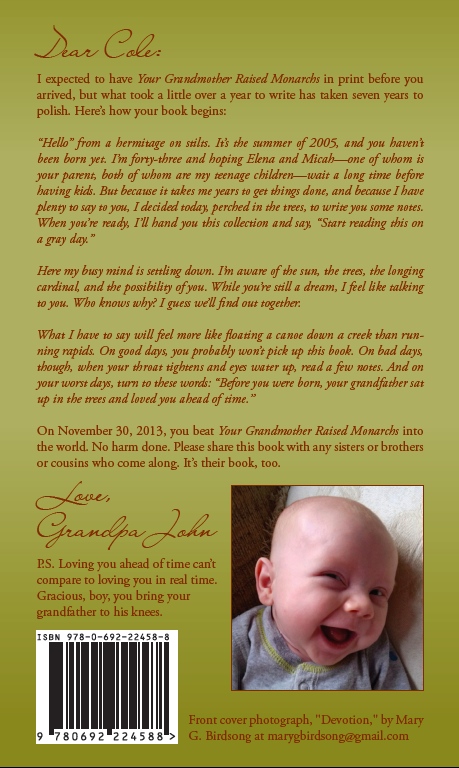
And now for the back cover:

Screen Shot 2014-06-09 at 9.55.05 AM

A rather unconventional back cover, but since I’m the publisher, I wrote what I thought best. The photograph of Cole Martin Thompson was taken by my daughter Elena Thompson. I’ll sneak that credit in on the copyright page.

And I am the publisher. The imprint is Shamatha House, but, of course, that’s me. I wrote in a previous post about how I came to the decision to get Your Grandmother Raised Monarchs (formerly entitled Darwin’s Beetle and before that Oh! Be Joyful) into print via Create Space. In short, here’s the deal: I write a lot, not unlike an old guy making wooden chairs in his workshop. After a long struggle to get this baby published conventionally, I thought, “I just want to get my work in front of people who might appreciate it”–in the same way the old carpenter would take a few bucks for his chairs so that they can live out their purpose.

When Your Grandmother Raised Monarchs is released, I’ll make a big fuss. The paperback will be available on Amazon first, then an inexpensive Kindle version will quickly follow. I’ll keep you posted about my success in getting the book into bookstores. I’m not quite settled on the pricing yet, but trust me, it will be affordable.

That’s enough for now. Peace and love,

John