Dear Friend:
If you came here looking for my defense of Hillary Clinton, I’ve moved it to my new blog, Matters of Conscience. Please follow the link to get there.
Peace and best,
John

Dear Friend:
If you came here looking for my defense of Hillary Clinton, I’ve moved it to my new blog, Matters of Conscience. Please follow the link to get there.
Peace and best,
John
Dear Friend:
If you came here looking for “American Pastoral,” I’ve moved it to my new blog, Matters of Conscience. Please follow the link to get there.
Peace and best,
John

In Defense of Justice Ruth Bader Ginsburg
Blogger’s Note: The scope of the opinion piece that follows is narrow. I have views about nearly every tangential topic imaginable, but I’m speaking here only to The New York Times‘ recent editorial board opinion about Ruth Bader Ginsburg’s statements about Donald Trump.
If you’re looking for the normal fare served by A Napper’s Companion, please feel free to order another entree.

Justice Ruth Bader Ginsburg (Credit: Wikipedia)
Spirits of the coffee drinkers at Brew Ha Ha are merry this noontide, but I’m negotiating with a troubled heart. Former teaching colleagues Alice and Mary and I reacquainted and dissected one of our national obsessions, November’s presidential election. Since they left an hour ago, I’ve been palpating available Internet information and opinions in hopes of easing my suspicion of a terrible prognosis. The possibilities paralyze my brain and sour my gut.
The New York Times normally steadies me, but, oh, my precious, the editorial board has just poked at my gag reflex with this opinion: “Donald Trump Is Right About Justice Ruth Bader Ginsburg.” Whew! Pause. Breathe.
In a recent interview with Adam Liptak of the very newspaper that smacked her knuckles, Ginsburg had the impudence to say, “I can’t imagine what the country would be — with Donald Trump as our president.” A couple of other remarks added color to her opinions and probably set off editors’ subjectivity detectors.
Asked if she also thought that the Senate should act on Obama’s nomination of Merrick Garland to the Court, Ginsburg practically got hysterical: “That’s their job.” Please, somebody get this woman into a straightjacket.
The board’s assessment is terse: “Justice Ruth Bader Ginsburg needs to drop the political punditry and the name-calling.”
Okay, she did call Trump a faker. Bad Justice. Bad Justice. But punditry? Rising from my nausea are a litany of questions, summarized by one: “Where does punditry end and truth begin?”
Other words pose essentially the same question. “At what point does objective neutrality deny the obvious?” “When is bullshit given the full weight of fact?” And “When is denigration mistaken for discussion?”
Yes, these are dangerous questions. Whoever successfully lays claim to facts and truths has hold of power and moral high ground.
But these are perilous times. At least in politics, the historically accepted rules of engagement have been trodden under wingtips. I’m hardly the first to observe that even the pretense of civility and fair play in governmental chambers and circles is gone. And reality, fluid in the best of social climates, is now nothing but fog. Where are the brakes?
Americans who share Ruth Bader Ginsburg’s opinion about Donald Trump aren’t so much despondent about the candidate himself, but about the destination of “I, Donald John Trump, do solemnly swear that I will execute the Office of President of the United States.”
Trump will, indeed, execute the Office, and felled in the firing squad’s aim will be the languishing assumptions about how we Americans communicate with each other and come to agreements and define the world we live in. This is my dread, at least.
Adding insult to injury, the just, charitable identity we have struggled to embody—the “lamp [lifted] beside the golden door”—may give way to the hateful, fearful “angels of our nature.”
Our society has already taken many steps down a rancorous, violent path. Do we honestly suppose that we’ll find remedies to what ails America if we crown a man who delights in riling followers into stampede?
Pause. Breathe.
Am I being alarmist? Hyperbolic? Gosh, I hope so. But I don’t think so.
Ruth Bader Ginsburg knows that “the exception proves the rule.” Supreme Court Justices should keep their noses out of political controversies. Good rule. Good good rule.
But what Donald Trump says he would do as Commander in Chief—bluster though his every word may be—requires the assassination of what is most honorable in the people and the deportation of the Constitution Justice Ginsburg is sworn to interpret and uphold.
She was obliged to break a generally wise rule. She gets a pass.
April Fools’ Day, 2016: A Stimulation Junkie Waits for a Second Grandson
The impulse to check my iPhone has been wicked lately. Of course, today I have good cause.
This very instant (10:42 a.m.) a text message from wife Kathy landed: “Contractions are picking up.” Daughter Elena is the contractor, and grandson Killian Davis Thompson is the contractee. I suppose that would be the arrangement.
The previous update rolled in at 9:22: “They just broke her water. All is well.”

First grandson Cole listens for his little brother, Killian
Present circumstances are compelling, but I’m checking my iPhone now only a little more often than usual, which is idiotically, pathetically, embarrassingly often. It’s as if the 4.7-inch screen—yes, I looked up the dimensions on the devise itself—will give me what I’m after, which is . . . what?
I could say that I want to calm spiritual restlessness or escape mortal ennui, but the truth is mundane and unflattering and, I believe, pandemic. I’m so confident of the affliction that I won’t bother confirming the commonality of what follows with even a whiff of evidence.
I’m a stimulation junkie. And I don’t like it one bit. Seriously, I’ve got some work to do. How can a middle-aged man who has practiced prayer-meditation for over twenty-five years be so easily and frequently uncentered?
For the last few days, Kathy and I have dog-sat Layla, Elena and son-in-law Matt’s yellow Lab, who is affectionate, but as tranquil as a panicked doe. On our afternoon walks, Layla zigzags as though she is fleeing gunfire. The point: sometimes my soul looks like my grand-dog, aquiver with indecision about where to sprinkle her next droplets of pee. I’m looking wildly about for nothing in particular, or so it feels.
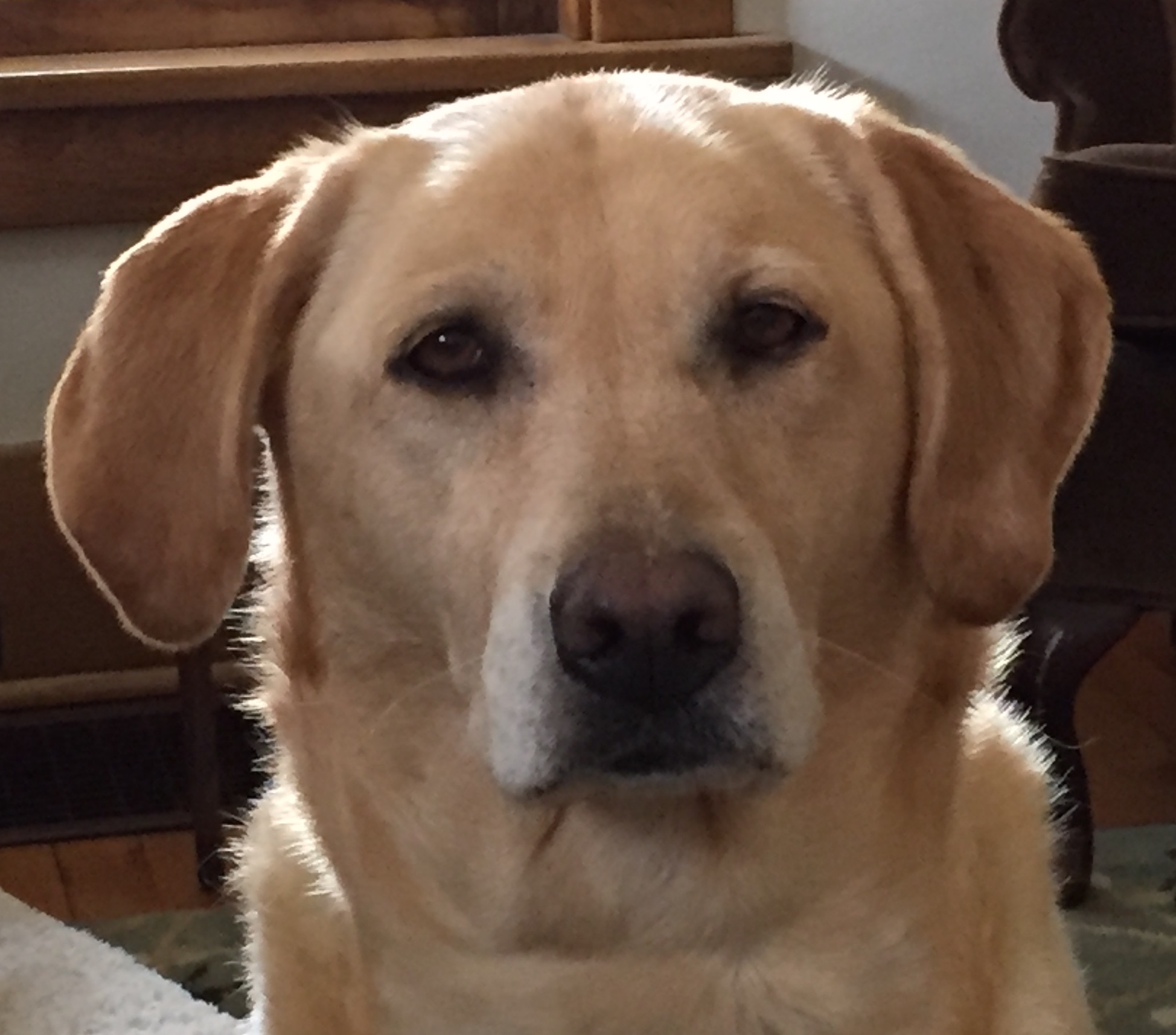
Layla attempting the old K-9 mind trick: “Pop, you don’t want the rest of your sandwich.”
11:39, and I just checked for updates, even though my iPhone plays a come-hither, noir saxophone wah waaaah when Kathy sends a text. But, hey, I might not have heard.
In fairness, updates are always tapping me on the shoulder or landing like mosquitoes on my ankles. Heaven forbid I should miss something.
I have 568 Facebook friends, which means at any moment a photograph of food porn or an unsexy kissy-lips selfie might show up. Fortunately I have enough self-control to shut off the bee boop alert for each new post.
I don’t do Twitter because the whole hashtag lingo is lost on me. Thank God for small blessings.
But, really, these early years of the 21st century conspire to distract, rush and over-stimulate all of us who let technology and the media govern our habits. Consider:
And so on. It’s hard to imagine what harm there might be in getting what I want when I want it, but I think the pace is injecting my disposition full of adrenaline. When nothing is going, when my head is left hanging with “shave and a hair cut . . . ,” I bob my leg.

Leg bobbing in coffee shop
This is not good—not for me, not for us. Get ready to roll your eyes, but I suspect that our collective stimulation addiction has fueled the rise of at least one presidential contender, Donald Trump. I keep asking myself why his frightening behavior isn’t blasting him out of contention for the highest office in the land.
Why? Because every day he stimulates us out of our wits. What will the twit Tweet next? Stay tuned. As long as he accumulates delegates, there’s no way we can get bored.
But enough of this sad digression. It’s 12:32, and I’m jonesing for Kathy’s alluring sax and a second grandson.
My Killian is about to arrive! Now that’s a great reason to stare at an iPhone screen. But a goof gnawing on a ghost pepper? Or television news bloopers from 2014? Or worse? Why do I cram my head full of such diversional potato chips?
Later on, when I kiss my grandson’s head and smell the perfume all newborns wear, maybe he’ll birth a new grandfather—a man who enjoys deep breaths and looks at the sky.
Come on, kiddo. You’ll still have the wise before-world on your skin when I hold you. Share a little with your Pop.

Pop receives before-world wisdom

Killian suits her. I can’t remember when I’ve seen Kathy quite this beautiful.

Our beautiful country . . . out my office window.
Voting seasons are generally a drag, but the 2016 presidential primaries in advance of this fall’s general election are scary. In response to a long, humorless essay on the subject I posted on A Napper’s Companion a few days ago, friend Mary wrote, “I am sick and frightened and don’t know where our beautiful country is going.”
To her excellent words, I would add powerless. Today is Super Tuesday, and millions of Americans are looking around wildly for a pause button that doesn’t exist. Will our next president’s greatest gift be barroom brawling? And will the spectacle that is United States government morph from paralysis to legislative deliberations dominated by bellowing, spittle, and locker room insults?
I’m not the only citizen asking these questions and fearing these fears. Friend Judie wrote to me, “I am so ashamed of what we have become in politics.” Mary and Judie speak for thoughtful Americans and, obviously, for me. I’m weary with sick and frightened and ashamed.
As the first votes are being cast, I’m taking this moment to up my personal ante: Shame for others’ conduct is bad, but shame for my own thoughts and actions is worse.
When hitting below the belt is the order of the day, the temptation to counterpunch in like fashion is acute. If you call me a loser, I can call you whatever I please—and think even worse. But this way is neither Christian nor mindful. It’s the way of the lowest common denominator and the reptile brain.
Frightening times can bring out the worst in us, myself included. We’ve been scared before, though. I’m too young to recall vividly 1968, another year that America felt itself cracking to pieces. Think the Vietnam War and Civil Rights movement, the assassinations of Martin Luther King and Robert Kennedy.
In April of that year, monk Thomas Merton wrote in his journal while on the road: “So the murder of M. L. King—it lay on top of the traveling car like an animal, a beast of the apocalypse. And it finally confirmed all the apprehensions—the feeling that 1968 is a beast of a year. That the things are finally, inexorably, spelling themselves out. Why? Are things happening because people in desperation want them to happen? Or do they have to happen? Is the human race self-destructive? Is the Christian message of love a pitiful delusion? Or must one just “love” in an impossible situation?”
Anyone familiar with Merton’s life and work knows how he would have answered his own questions. One must love. In beastly times, love is the mindful person’s center of gravity. Such love is sometimes obliged to fight, but its arsenal is selective. Cruel or dehumanizing weapons, for example, are out. Such love is also sacrificial and can appear not only risky, but reckless.
How difficult to remember in an alarming season that assaulting my neighbor ends in wounding myself. In an informal address in Calcutta in October of 1968, Merton spoke indirectly of love: “And the deepest level of communication is not communication, but communion. It is wordless. It is beyond words, and it is beyond speech, and it is beyond concept. Not that we discover a new unity. We discover an older unity. My dear brothers, we are already one. But we imagine that we are not. And what we have to recover is our original unity. What we have to be is what we are.”
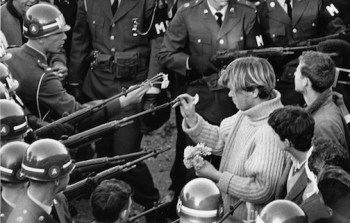
Flower Power, 1967 (Credit: Bernie Boston on Wikipedia)
Monks from various spiritual traditions, Western and Eastern, heard these words. In the context of what feels like a contemporary planetary crack up—campaign explosions, not to mention real bombs and climate change—Merton probably seems flighty, like a hippie sticking a flower in a rifle barrel. (And the monk himself added a tragic explanation point to 1968 on December 15th when he died of an accidental electrocution in Bangkok.)
If the human race is self-destructive, I want to be the weirdo holding out a daisy. If Christian love and human unity are pitiful delusions, nobody wake me up.
Wherever our beautiful country is going, history has taught us where hatred and fear lead. Call me a flake if I refuse to take the beastly path.
Blogger’s Note: This post is not only long, but upsetting. As the title suggests, I’m writing about politics. If you visit A Napper’s Companion for a lift, you may want to skip what follows. Please know that I feel compelled to share this letter.
.jpg)
Mr. Trump, tear down this statue. (Credit: Wikimedia Commons)
February 26, 2016
Dear Moderate Republicans:
“If I were to remain silent,” Albert Einstein said, “I’d be guilty of complicity.” I’m neither a public figure nor a genius, but I borrow the iconic physicist’s words to make clear the reason for this letter. I don’t write as a Lutheran pastor, which I happen to be, but as a regular guy who feels not only sick, but under a moral obligation to speak.
I’m sick that half of the voting Republicans in Nevada believe that Donald Trump is the best available pick for President of the United States—49.6%. Half!
Sick that Trump appears poised to mop up delegates on Super Tuesday, now four days away.
Sick that the two youthful candidates seriously challenging Trump have ironic qualifications. One tried in 2013 to shut down the government he aspires to lead and is by all accounts reviled by his colleagues. The other has essentially given up on his elected responsibilities before his first term of service is finished. Why is he missing about 1/3 of votes? “Because I am leaving the Senate,” he replied, “I am not running for re-election.” If he thinks Senate duty is an insufferable slog, how well suited is he for the Oval Office, really?
Before going on—and you can stop reading any time—I want to qualify the word sick. I’m heartsick. The optimist in me says that most conservatives are troubled with how the Republican primaries are unfolding and embarrassed by the current candidates’ behavior. For what it’s worth, I write in the spirit of loving intervention. What I am compelled to point out pains me, as I have many dear friends who are Republicans, but the matter is urgent.
In less than a year, the next President will take office. What exactly is at stake?
Donald Trump promises to build a wall between the United States and Mexico, one foot taller than the Great Wall of China. “I want it to be so beautiful,” he says, “because maybe someday they’re going to call it the Trump wall.”
If Trump fails to get Mexico to pay for this project, he might fund it by selling the copper lady lifting her torch over New York Harbor. A nation that solves problems with walls won’t have much use for the words on her pedestal:
Give me your tired, your poor,
Your huddled masses yearning to breathe free,
The wretched refuse of your teeming shore.
Send these, the homeless, the tempest-tost to me.
Of course, a wall by any name may prevent wretched refuse from entering the United States, but it won’t get rid of those already here illegally. Trump remains steadfast in his intention to muster a deportation force, which will track down 11 million undocumented immigrants—a term he rejects as politically correct—and return them to Mexico. That figure is under dispute, but it does notably include the immigrants’ children, who are by law U.S. citizens. Through “good management,” the exodus will be accomplished in a year and a half, maybe two.
Could any compassionate American bear to witness the spectacle from round up to drop off. Picture those flippantly called anchor babies, hundreds of thousands of little kids, herded onto busses with their families and dumped, my God, who knows where. We’re talking about millions of people. What sane adult can’t foresee a humanitarian crisis?
Mark Krikorian, Director for the conservative Center for Immigration Studies, says what some Republicans must be hoping, that Trump’s deportation statements are a “gimmick’: “He’s just making it up as he goes along. Whatever goes into his mind comes out of his mouth. There’s no way to deport 11 or 12 million people in a short period of time.”
I must be a prude where campaign gimmicks are concerned. Blustering about the deportation of what would amount roughly to the populations of New York City and Chicago combined isn’t strategic, it’s obscene.
Maybe other campaign promises are primarily attention getters, too.
Ted Cruz says he’ll carpet bomb ISIS, which sounds hawkishly sexy until you reckon the term’s meaning. Having been corrected, the Texas Senator now knows that he is calling for what Business Insider defines as “large-scale, unguided bombing,” which military experts insist would be a horrible strategy. You don’t remove warts with bulldozers.
Cruz also claims that Trump is actually weaker on immigration than he is. What does that say? “I’ll see your gimmick and raise it by a million . . . people!”
And Rubio, poor Rubio, seems like he is trying to stay out of trouble until voters come to their senses. The Republican Party establishment is hastily huddling around him. If Rubio can find within himself what he lacks, grace under pressure, he offers perhaps the best shot at derailing Trump. In last evening’s debate in Houston, the part-time Florida Senator seemed unscripted, even nimble, in his engagement with the front-runner, so there may be hope.
But time grows short, not only for Republicans, but for all Americans. Sick with the urgency of Super Tuesday, I state directly what is a matter of conscience: setting aside for a moment the criticisms Democrats richly deserve, moderate Republicans need to reclaim their party’s integrity and live up to its claim to be the Party of Lincoln.
I wish these harsh words applied only to the primaries in the months ahead, but the mere conceivability of a Trump or Cruz presidency is the result of Republican conduct in recent years. (Again, I admit that my party’s transgressions are abundant, but Democrats aren’t lustily casting ballots for a candidate who routinely uses vulgar language on the stump and threatens his opposition with frivolous lawsuits.)

Name that country. (Credit: Wikimedia Commons)
In 2012 Thomas E. Mann and Norman J. Ornstein, one Republican and the other Democrat, published an article in the Washington Post with a provocative title: “Let’s Just Say It: Republicans Are the Problem.” An excerpt summarizes their argument:
“We have been studying Washington politics and Congress for more than 40 years, and never have we seen them this dysfunctional. In our past writings, we have criticized both parties when we believed it was warranted. Today, however, we have no choice but to acknowledge that the core of the problem lies with the Republican Party. The GOP has become an insurgent outlier in American politics. It is ideologically extreme; scornful of compromise; unmoved by conventional understanding of facts, evidence and science; and dismissive of the legitimacy of its political opposition.”
Examples of Mann and Ornstein’s charges are legion, but for brevity’s sake I’ll limit myself to two.
It’s no secret that Republicans are hell-bent on repealing Obama’s Affordable Care Act. All Republican candidates for President are locked and loaded. Gone are the days of accepting congressional votes as laws of the land and moving on—long gone. Since the ACA became law on March 23, 2010, “The House GOP has voted over 50 times to repeal all or parts of the health bill. Almost all of the bills died in the Senate” (AP report). Any bill reaching the President’s desk would get a swift veto. In other words, the House has held over four dozen symbolic votes, which seem little more than a silly waste of time until you consider what a House vote costs taxpayers. CBS News estimated in 2013, when the symbols stood at 33, that each vote cost about $1.45 million. So today, $1,450,000 x 50 = $72,500,000. Contemplate this. We’re talking about $75 million-worth of chest puffing and foot stomping, and we funded it. What’s more, we all know the definition of insanity (never mind understanding and accepting mathematical facts).
The other example I’ll mention of toxic Republican conduct is fresh, not yet played out. Antonin Scalia’s body was still warm—only a slight exaggeration—when Senate Majority Leader Mitch McConnell said a replacement shouldn’t be named until after a new President takes office. A couple days ago Senate Republican leaders announced that shouldn’t has solidified into won’t. The New York Times reports McConnell’s edict: “This nomination will be determined by whoever wins the presidency in the polls. I agree with the Judiciary Committee’s recommendation that we not have hearings. In short, there will not be action taken.”
Why not? When I sort through the answers, what I hear is Bartleby the Scrivener’s response: “I would prefer not to.” Or “you can’t make me.”
So this is where we stand. The constitutional and traditional duties of governance can be simply waved off. Given the strategy of obstruction employed by Republicans since President Barack Hussein Obama took office in 2009, should anyone be surprised that the party establishment is betting its farm on a Senator who shirked his responsibilities before the paint in his Capital Hill office was dry?
In fact, the thus-far successful candidacy of Donald Trump is built upon the Republican Party’s recent performance reduced to a sophomoric gesture. Conservative columnist Michael Gerson calls the front-runner’s way “the political philosophy of the middle finger.” These are words, not mine:
This philosophy “assumes that practices we know are wrong in our private lives—contempt, mockery, cruelty, prejudice—are somehow justified in our political lives. It requires us to embrace views and tactics that we would never teach our children—but do, in fact, teach them through ethically degraded politics. Imagine your teenage son (or daughter, for that matter) calling a woman a ‘fat pig,’ ‘dog,’ ‘disgusting animal’ or ‘bimbo.’ Imagine your child labeling someone he or she knows as a ‘loser,’ ‘moron’ or ‘dummy.’
“This is the evidence of poor character, in any context. For Christians, the price of entry to the Trump movement is to abandon their commitments to kindness and love of neighbor. Which would mean their faith has no public consequence at all.”
I can imagine how maddening it must be to feel lectured about something as massive and abstract as one’s political party, but I risk being a scold for the sake of conscience. Hardly ever do I hear Republicans admitting that their party’s actions in recent years have done great damage and their leading candidate for the highest office in the land is unacceptable. (And, now, endorsed by Chris Christie. I’m stunned.)
Any effective intervention begins with accepting responsibility. As a private citizen and a Democrat—and out of love for you and country—I call upon moderate Republicans for the moment to resist attacking me and accept their party’s role in our current national situation.
And I promise to take seriously any appropriately-worded, well-substantiated criticism of the Democratic Party. My party may well need an intervention, which I’ll endure with a light heart, on one condition: given present circumstances, you go first, please.
Respectfully yours,
John Coleman
Erie, Pennsylvania
I guess decisive is the word. Maybe it’s convinced. Or certain. But since I’m fifty-something, the question of what I’ll be when I grow up is academic.
I am what I am, which is discerning. Discernment’s pace toward decisions is stately. It’s focused, but patient. That’s me. I’m comfortable with interesting and hmm. No need to stampede toward conclusions.
Practically speaking, I’m how rich and what poor. I know, for example, how to sit with people and listen, but am nearly clueless when it comes to what they should do. I can figure out how to string sentences together, but readers these days pay to be told what to do, and I suck at that. After “secure that smartphone and pay attention to your kid, wife, husband, and ferret Rafael,” my prescriptions run out.

Raphael (Credit: Wikipedia)
My life-management skills are sketchy. Walking with you? That I can do. Giving you a plan or grid or diet? Don’t look at me. This is a suspect orientation for a Lutheran pastor and writer. Men who get paid to wag their chins on Sunday mornings and volunteer their personal essays for Internet consumption should clarify more often than mystify.
Here’s a brief study in what I’m bleating about. If I were a decisive grown up, you would be reading a compelling case for one of the characters currently plotting to be President of the United States of America. What a rush it would be to write with the conviction of, say, former Secretary of Labor Robert Reich, who can tell you exactly whom to vote for and why.
I wish. Like hundreds of thoughtful citizens, I’ve been grazing in the unkempt fields of campaign coverage and punditry. Two states into the meal, I’ve strayed into gray pastures, nauseous with uncertainty. What I’ve got to say may feel good, but mostly as a purgative.
I could happily go on, speculating about the place of objective truth (what little there is) and manners in politics, but who really wants to follow me further into what started as a dreary example of one Lutheran pastor’s turn of mind?
The point, for anybody still awake, is me—by which I mean, maybe you, too. I’ll put myself in your shoes. Let’s see if I’m warm.
If your shoes don’t fit me, please forgive my presumption. But if they do, I’m guessing you have balm for humanity in your soul. If only somebody would listen, you would say, “Let’s pay attention to how we treat each other. Then what we should do to fix the world would be clear.”
As for me, I’m not decisive enough to speak up–afraid of sounding frivilous. Until I grow up, I’ll just say that I’m discerning.
 A Napper's Companion