Dear Friend:
If you came here looking for “American Pastoral,” I’ve moved it to my new blog, Matters of Conscience. Please follow the link to get there.
Peace and best,
John

Dear Friend:
If you came here looking for “American Pastoral,” I’ve moved it to my new blog, Matters of Conscience. Please follow the link to get there.
Peace and best,
John
Oniontown Pastoral: Listen to Your Grandma
Dear Cole and Killian:
 Last week your Grandma Kathy came in all sweated up from picking vegetables and said, “Oh, John, there’s one of those tomato hornworms in the garden with eggs on its back, probably wasp eggs.” Her bottom lip wasn’t quivering, but tears weren’t far off. Poor bug.
I don’t want to see any creature suffer, but I’ve never been a fan of hornworms. First, they’re gross; they look like a bald, glossy-green, plump, juicy caterpillar. Second, they never finish their meals. I would be glad to share if they didn’t go from tomato to tomato, munching a portion and ruining the rest. And third, they leave pellet droppings called frass. Most of it falls into the soil unseen, but a little plastic table Grandma Kathy situated near a tomato plant got covered with it. The guilty insect frassed so much I couldn’t help thinking it chuckled to itself, pellet by pellet.
Your grandmother, who is on strangely good terms with the wastrels, wanted to send me on a rescue mission, but not by plucking the larvae off the hornworm or ending its suffering.
“You write about these things,” she said. “Maybe you could write about it.”
Grandma Kathy was right, boys. For whatever reason, your pop thinks a lot about sadness, and some likeminded folks like to read what I come up with. She was right, too, that in hopeless cases, one sympathetic witness can be a saving grace.
The trouble is, I don’t have much to say about future wasps dining on a hornworm, other than to note, “That’s life for you.” One being’s grilled chicken is another’s raw caterpillar. The main difference is presentation.

Listen to your grandma, boys.
On the other hand, I do have something to say about Grandma Kathy. You won’t read this letter for another ten years, but as you grow I’ll be steering you toward this advice: “Grandma Kathy has a big soul. She knows how to live. Listen to her.”
I’m only trying to save you time and trouble. If my math skills are still operational, your grandmother and I have spent 2/3 of our lives together. Only in the last three years have I figured out that most of the time she knows best. Since 1980, then, I’ve been letting her steer 1/10 of the time, which is silly.
And I’ll tell you why. Grandma Kathy was right about that hornworm from the beginning. It’s as much a resident of the earth as I am and worthy of consideration.
“Don’t you think we ought to kill it?” I asked. “The last thing we need is a wasp infestation.”
“No, we’re too quick to kill things,” she answered. “Besides, I think wasps might be beneficial.”
I swallowed my response, which would have been, “Hey, I’m not too quick to kill things.”
But she was half right. I checked an almanac and learned that you shouldn’t squash the hornworm and its passengers. Wasps are—and I quote—“beneficial” for a garden.
 Only in the last few weeks have I decided that Grandma Kathy also knows best where the garden hose is concerned. All our marriage long she has left it snaking around the yard rather than coiling it up. I bring the matter up once every decade, though not anymore. When I walk out the back door, my glance goes immediately to the hose and my mind says, “Unkempt.” Your grandmother looks first to the sunflowers, and her mind says, “Ah, beautiful.”

The better part
She has chosen the better part, and I won’t take it from her.
When Grandma Kathy plays with you, Cole, she lets you decide what to do and where to go. That’s because you know how to play better than anybody else. By watching her, I’m learning to be a good pop.
And Killian, you’re just a few months old, but it already seems that you’re going to be quieter and more reserved than your big brother. You watch, kiddo, Grandma Kathy will look into your brown eyes and see how to help you love yourself and feel so happy you’ll want to fly.
Someday you’ll be able to understand that big souls make big sacrifices. When you’re ready, I’ll explain that Pop owes his life to Grandma Kathy.
 But I’ll wait for later to tell you just how. It’s enough for now to say that when I was weary and lost unto despair, your grandmother left a few of her dreams behind as if they were frass to help me find myself again.
Grandma Kathy knows how best to love you and me and the rest of creation. Please, save yourself trouble and spend more than a sliver of your years following her lead and trusting her example.
Care for the tomato hornworm. Look first to the sunflower. Give yourself away for the sake of love.
We’ll talk before you know it,
Pop
Oniontown Pastoral: What I’m Looking For
Cashiers at Wine and Spirits Stores always ask the same question before scanning my bottle: “Did you find everything you were looking for?”
I say a lazy “yes, thanks” because an honest answer requires a treatise. Rarely, when nobody else is in line, the thesis comes out: “Well, I didn’t know what I was looking for, so I’m good.”
After a polite chuckle, the cashier carries on with no idea that a confessional transaction has also taken place.
I seldom know what I’m looking for. Call me slack, but purposeful searching generally yields frustration. The quotation residing warmly in memory is elusive, impossible to verify. And never go hunting for epiphanies. Those gems hide in desert caves until the seeker has forgotten that they exist.
But when I look for nothing, wonder ends up finding me. Of course, sometimes we’re all assigned a specific mission. There’s no avoiding, for example, the Thanksgiving curse of tracking down nomadic French fried onions in the grocery store for the sake of green bean casserole.
Obligations aside, though, I live like my late dog Watson, who was clueless as to what he was sniffing for, but overjoyed to discover it. What am I after? I’ll know when I find it.
Case study: Parishioner Barb invited me to her neighborhood. About twenty minutes from Oniontown, her neighbors are Amish. She introduced me to a couple of young guys working in their family’s lumber mill and walked me to points of interest, which on dirt roads can be beautiful, but nonchalant: houses with curtains pulled to one side, a sugar shack tucked back in the woods, a one-room school house, and one thing I wasn’t expecting.

Amish phone booth
A phone booth. The Amish, it turns out, have a nuanced relationship with telephones. They can use them, but they can’t own them. So in her front yard, Barb collaborates to provide them with phone service. The booth, built with their wood and running off of her lines, gets used six or eight times each day.
An obvious question occurred to me: “What sense does it make to use a phone, but be forbidden to own one?” But hush. My faith can’t stand up to logic, either.
When Barb and I returned from our walk, a horse and buggy was parked by the phone booth. The father indulged in technology while his kids waited. The horse worried its bit and nodded as we rubbed its long face.
Since the Amish don’t allow photographs, I snapped only a shot of the booth. It says something about caring for people you don’t quite understand and keeping a spare room open in your heart for guests.
This is why I love Oniontown so much: it always teaches me. A village an hour south of Erie has even helped me to look at home and everything nearby with fresh eyes.
Days ago at Starbucks, I chatted with a boy, maybe six or seven, and his mother. The kid was a whip, his mom cheerfully resigned to having a child able to talk the bark off a tree. His segue between topics was “by the way.”
Our conversation ballooned to ninety minutes and included his Gentleman Claptrap toy, requests for the family shopping list, and some kiddie movie. I was weary, but sensed the approach of wisdom.
As Mom loaded her purse, I said, “I’ve never heard of that movie before.”
He looked at me in disbelief and said, “You have a lot to learn.”
Mom gave him a tame rebuke, but I interrupted: “Well, actually, he’s right.”
And he was. As a lifelong novice, I learn best by opening my eyes and holding out my hands.
Oniontown Pastoral: The Plain Old Here and Now
“How do you perform an intervention for an entire society?”Author and film critic Marshall Fine asks this astute question in his essay “Fighting Our Addiction to Empty Stimulation.” He refers mostly to the way electronic devices compromise users’ ability to focus and concentrate, and “addiction” is the perfect descriptor. We’re hooked. Technology developed to simplify and enrich life dims our wits like an opiate.
Of course, some folks are clean. Many of my Oniontown parishioners couldn’t send a text message even if it meant saving the Titanic. In their landline-blessed homes, conversations complete with uninterrupted eye contact occur every day. Amazing!

A field in Oniontown, right behind St. John’s Lutheran Church, that deserves undivided attention
Personally, I’m not guiltless. My addiction is mild, yet active enough that judgment from me would be hypocritical. Any societal invention getting my vote would have to show understanding and compassion and resist browbeating.
Why? Because addictions won’t be shamed away and don’t surrender to good sense. Smokers with pneumonia still light up. Slack-jawed drivers gaze at screens the size of playing cards while zigzagging through traffic. That’s being hooked—repeatedly engaging in a practice you pretend can’t get you killed.
Distraction isn’t as lethal as some drugs, but the contest is just getting started.
This last figure sounds benign, but it provides the central insight about our societal addiction: You really cannot do two things at the same time.
Okay, chewing gum while walking is possible, but trying to watch the news and listen to your wife talk about her day insures you’ll do both tasks poorly. Read a text message as well, and you’ve hit a trifecta: flummoxed mind, angry spouse, and bad manners.
The trouble is, technology, especially the mighty capabilities of smart phones, has conned us into acting like just about anything is more needful than chatting with the friends across the table from us or noticing how a field of oats and the clear sky can put a gorgeous frame around the road.
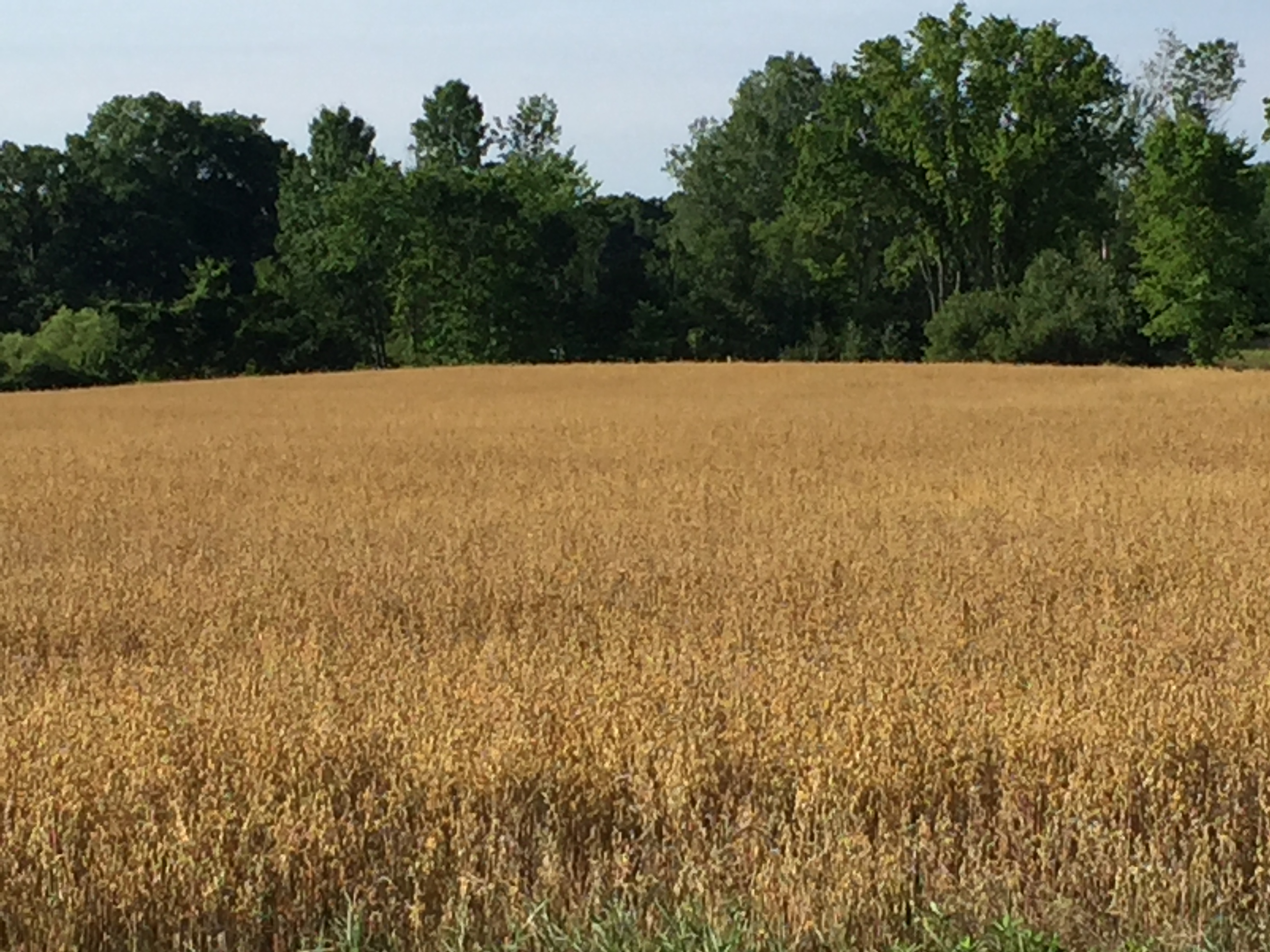
Framing the road to Oniontown
Our adrenal glands go wild over everything but the plain old here and now, where loved ones need to bend an ear and clowns on unicycles offer us a laugh.
Joan Chittister writes in Reading the Sacred in Everyday Life about a disciple who asks an elder, “Where shall I look for enlightenment?”
The elder explains that the disciple needs simply to look.
“But what do I need to look for?” he asks.
“Nothing,” the elders says, “just look.”
Finally the elder shares the reality that escapes not only the exasperated disciple but also many of us over-stimulated pilgrims these days: “To look you must be here. You are mostly somewhere else.”
Oniontown Pastoral: A County Tour

Prescription for discouragement: a look out at the soybean field behind St. John’s Lutheran Church and a dose of E. B. White’s wisdom
When I get discouraged about the civilized world, I often turn to E. B. “Andy” White, essayist for The New Yorker and Harper’s and author of Charlotte’s Web. White was not only a great prose stylist, but the last century’s most devoted naysayer to change.
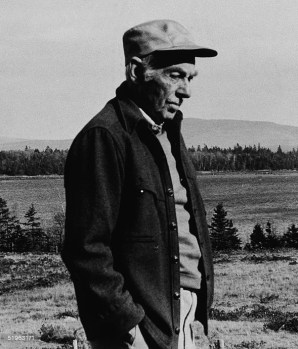
E. B. White at his Maine farm in 1977 (Credit: Getty Images)
He frowned upon atomic energy: “I would feel more optimistic about a bright future for man if he spent less time proving he can outwit Nature and more time tasting her sweetness and respecting her seniority.”
He rejected conventional wisdom: “Many of the commonest assumptions, it seems to me, are arbitrary ones: that the new is better than the old, the untried superior to the tried, the complex more advantageous than the simple, the fast quicker than the slow, [and] the big greater than the small.”
And he challenged orthodoxy—and got my mind working just the other day: “Our whole economy hangs precariously on the assumption that the higher you go the better off you are, and that unless more stuff is produced in 1958 than was produced in 1957, . . . you are headed for trouble, living in danger and maybe in squalor.”
I agree, but wondered, “Is growth necessary for a healthy United States economy?” Actually, I hoped the investigation might lead to existential insights—my habitual trajectory of thought.
The Internet ambushed me with economic principles. Turns out experts disagree so diametrically that Andy could be heard laughing from the curmudgeons’ bleachers in heaven.
I also received a wave of nausea for my research efforts. In 2014, Forbes printed Peter Ferrara’s “Why Economic Growth Is Exponentially More Important Than Income Inequality,” which presents dizzying statistics and a blueprint for our technological future.
The author rhapsodizes over futuristic physicist Michio Kaku, who claims, “When you need to see a doctor, you’ll talk to a wall in your home, and an animated artificially intelligent doctor will appear. You’ll scan your body with a hand-held MRI machine, the ‘Robodoc’ will analyze the results, and you’ll receive a diagnosis that is 99% accurate.”
My AI doc better be more skillful than my smart phone. Siri, my allegedly intelligent assistant, can’t locate a Dunkin Donuts. Why should I trust a virtual endocrinologist with my pancreas?
More to the point, why would I ever confide in a wall? In 1955, White grumbled at his telephone company “for having saddled us with dials and deprived us of our beloved operators.” My misgivings about healthcare via hologram will seem similarly quaint in eighty years.
Still, I have a quick response for Ferrara and Kaku: “I’ll pass!”
Give me Andy instead. He was never a churchgoer, but he held a divining rod for the sacred. And he would have delighted in the county tour parishioner Dave, a retired cow veterinarian, took me on last week.
We wandered a 4-H Club show, where I visited Jocelyn and her prize-winning cows and greeted pigs, goats, a llama and an alpaca.

St. John’s Lutheran Church’s very own Jocelyn with Dilly and Luci
We browsed at McCartney’s Feed and Hardware, which is packed with implements exotic to my city eyes and operates without cash registers. The clerks make change directly out of their pockets.
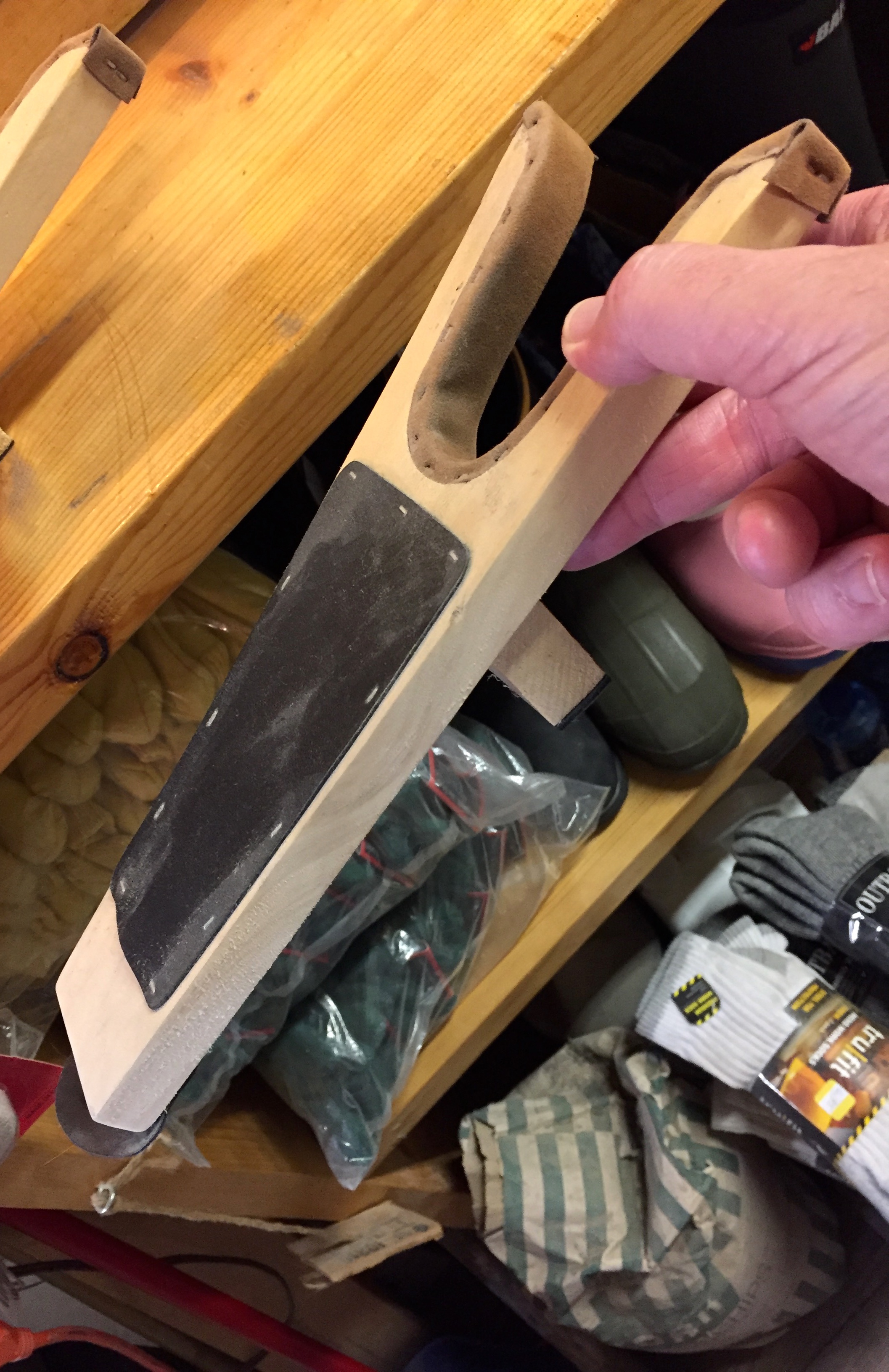
Exotic to my eyes, anyway: a “boot jack”
And Dave took me to the farmland he owns with wife Anne, where I got a primer on round bales and found out that cows can sleep out under the stars.
Andy would have pronounced the tour medicinal. Even now, his commentary on the wondrous land and skepticism about progress persist in my imagination. “A 99% accurate Robodoc might increase longevity,” he might ask, “but will the extra years hold any savor?”
While pastoring in my beloved Oniontown, I’ll honor E. B. White’s words and devote myself to “living itself, a task of such immediacy, variety, beauty, and excitement that one is powerless to resist its wild embrace.”
Oniontown Pastoral #10: Mom, Please Tell Me About the Glammazombies
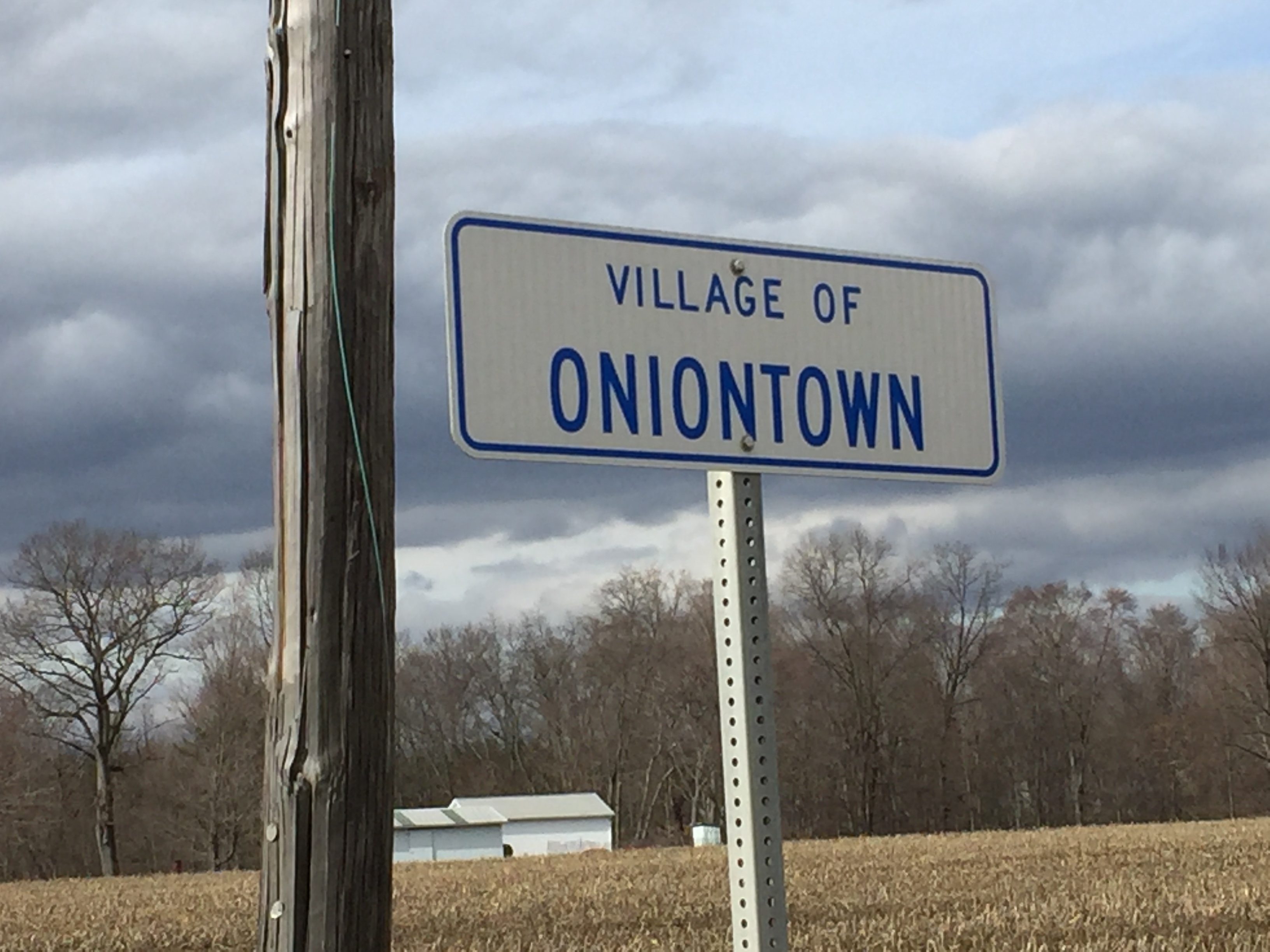 My drive from Erie to St. John’s in Oniontown is never wasted. If nothing else, thoughts wander, graze and lie around with other sympathetic thoughts.
Halfway to church the other day, a tongue-in-cheek remark returned to me: “Your kids grow up and move out just as they start to get interesting.” I forget where I heard this and, in fact, disagree, but the ideas started moving.
I was remembering my mother and listening to Glenn Miller. No sniffles or tight throat, just a speculation: “By the time children want to listen to their parents, it’s too late. Mom and Dad are gone.”
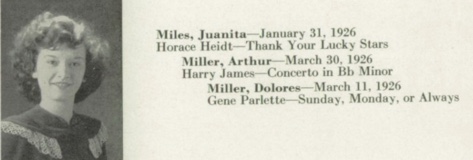
Dolores Miller
“A String of Pearls” made me think of Mom’s 1944 high school yearbook, which notes that her favorite song was “Sunday, Monday, or Always.” Crosby and Sinatra covered it, but Mom liked a version by Gene Parlette, who worked the Erie region back then.
In my imagination, Mom went to a dance, before my dad came along. Who was her date? She wore the dress from her graduation photograph, dark with bone-white lace. “I want you near every day in the year.” Was that the line of lyrics that spoke to her, Parlette singing and conducting his band? Did she dance, a bit awkward?
Then, with “Moonlight Serenade,” wonders came along.
“What was it like at home when you were growing up? What kind of a mother was Gram? What about Gramp? Did you and Uncle Earl and Uncle Ed fight? What were your chores?”
“Tell me about your friends in high school? What did you do for fun? Did you date a lot?”
I wished Mom were in the passenger seat, filling in the picture I never troubled to ask about before she passed eighteen years ago. Comings and goings in this life aren’t cordial to the past and the hours it takes to welcome stories. Some miscellaneous task always seems pressing.
But as years gather round, so does longing. Here I am, then, fifty-five pretty soon, with my wonderment pressing like a deep hunger.
I can see Mom with three or four friends, sitting on a log, probably on a beach at Presque Isle. Maybe one of my sisters or brother still has the photograph in an old hat box. The girls, smiling and carefree, are dressed in white sweatshirts and khaki pants—slacks, Mom would have called them. On the back she wrote, “The Glammazombies.”
“Mom, please tell me about the Glammazombies. Where did you get that name?”
Why do my ears finally open up when the only response is a sweet, slow clarinet over a car’s speakers as it speeds by crops and cows?
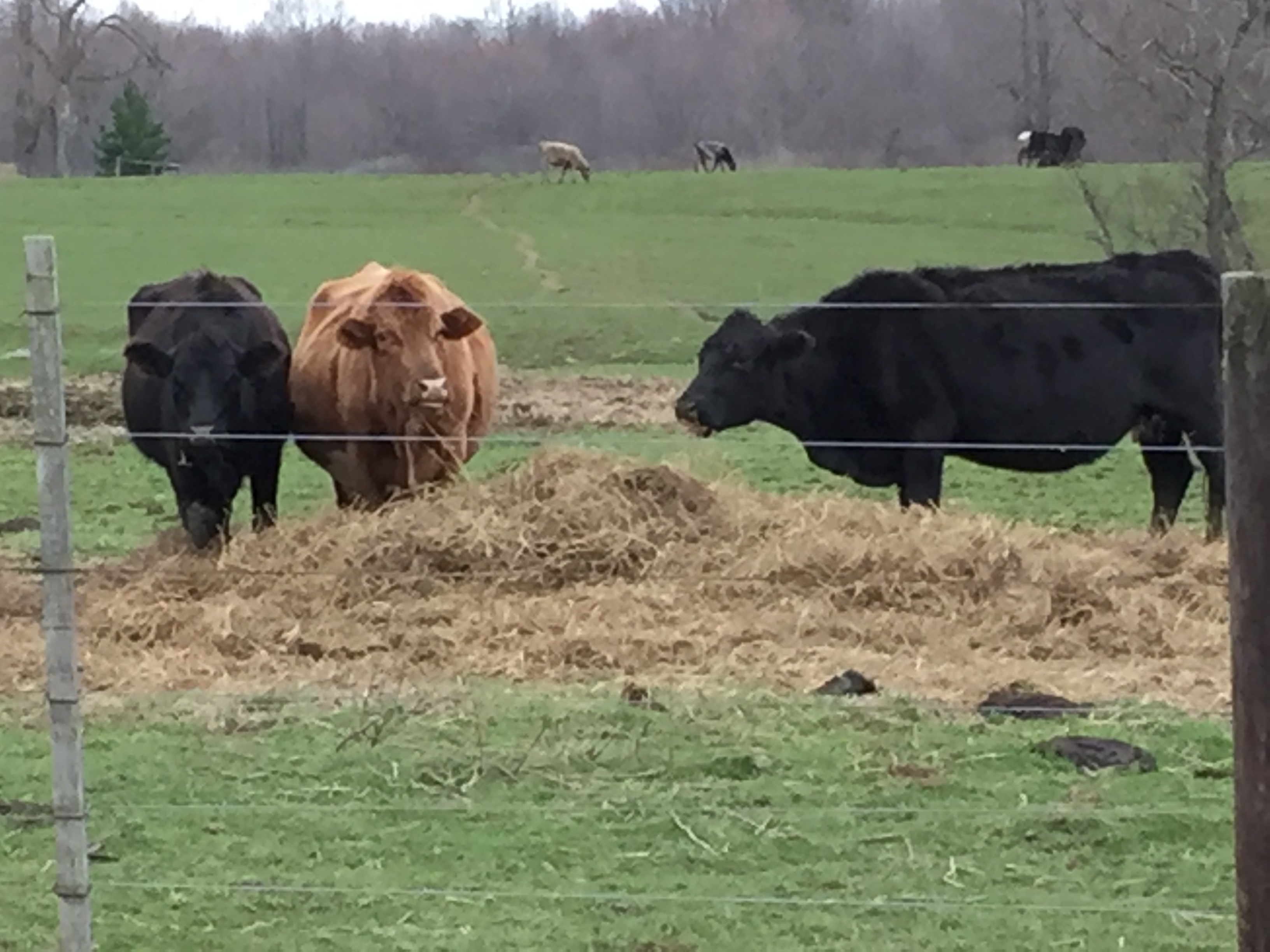
Good questions
The truth is, all my questions wander and graze. A few lucky ones rest in the sun, full and glad, but most remain hungry, needing more.
I take in longing when it visits, but sometimes lost conversations echo in my own breath. Sentences move silently past my lips into the empty space of the passenger seat.
“Mom, tell me what gave you joy. You loved being pregnant, I know that. But what were your dreams? Some of them came true, right? And you got hurt. What brought you to your knees?
“At least tell me about the Glammazombies. You looked so happy in that picture. Tell me about that day at the beach. And you couldn’t stand your own singing voice, but let me hear “Sunday, Monday, or Always.”
“One day long ago you sang to yourself, faintly. You had a lovely voice, Mom. I should have said so right away, but I was a kid and didn’t use words like lovely back then.”
Hope and Joy in a Roaring Wave
Every year Erie, Pennsylvania, hosts Roar on the Shore, a gathering of approximately 165,000 motorcycle enthusiasts that makes my hometown rumble for a few days. According to the Roar’s website, its mission is “to raise money for a worthwhile charity while encouraging motorcycle riding, safety and fellowship.”
I’ll state directly that motorcycles aren’t my thing. Harley-Davidsons and their many cousins are like rollercoasters, lime Jell-o with chopped celery and carrots, romance novels and turtleneck sweaters. You can like them. I’m not against them, just parked in the eh category.
But hope and joy are my things, and generally they find me by surprise.
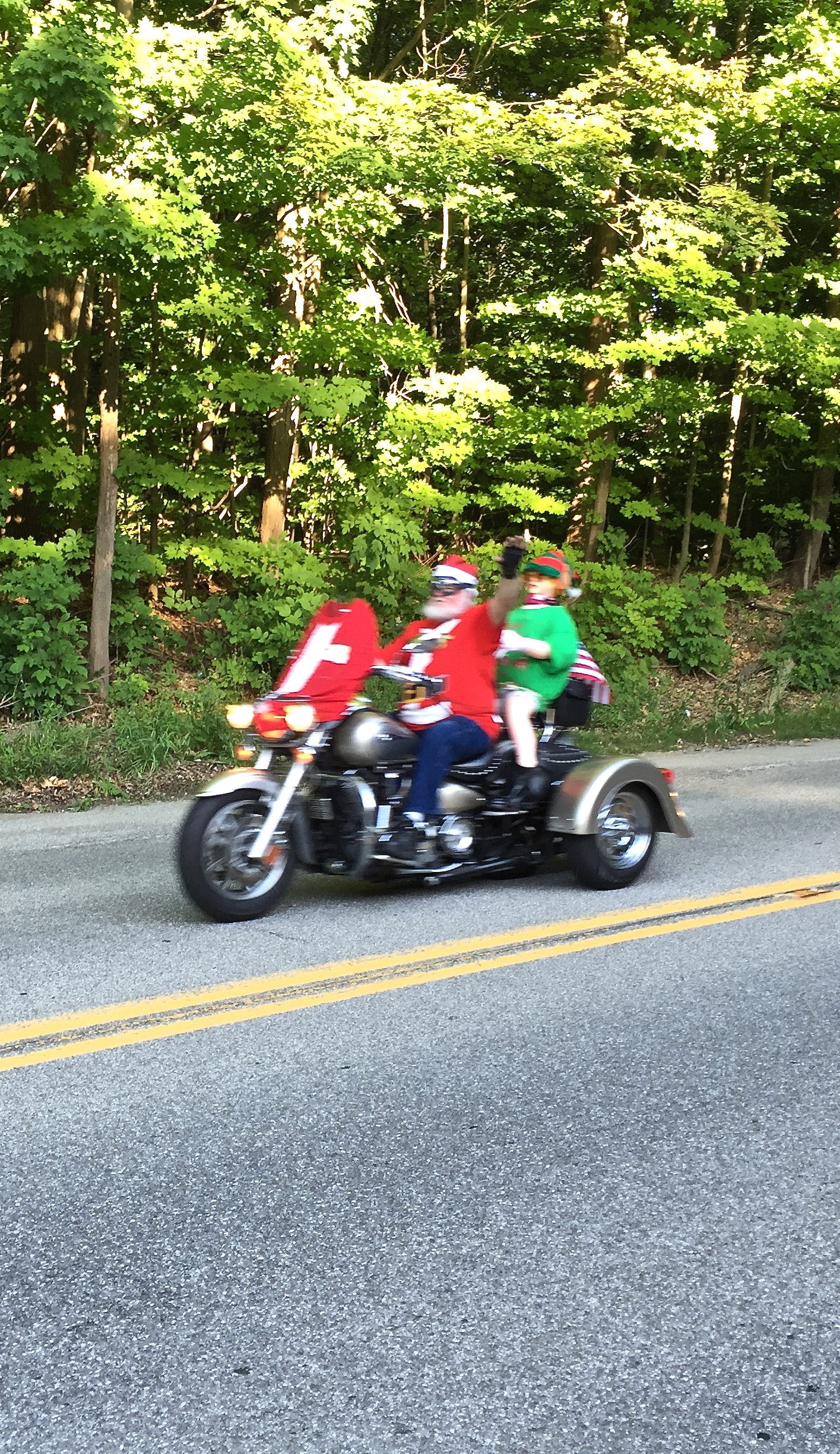
Hi, kind of blurry Santa and Mrs. Claus
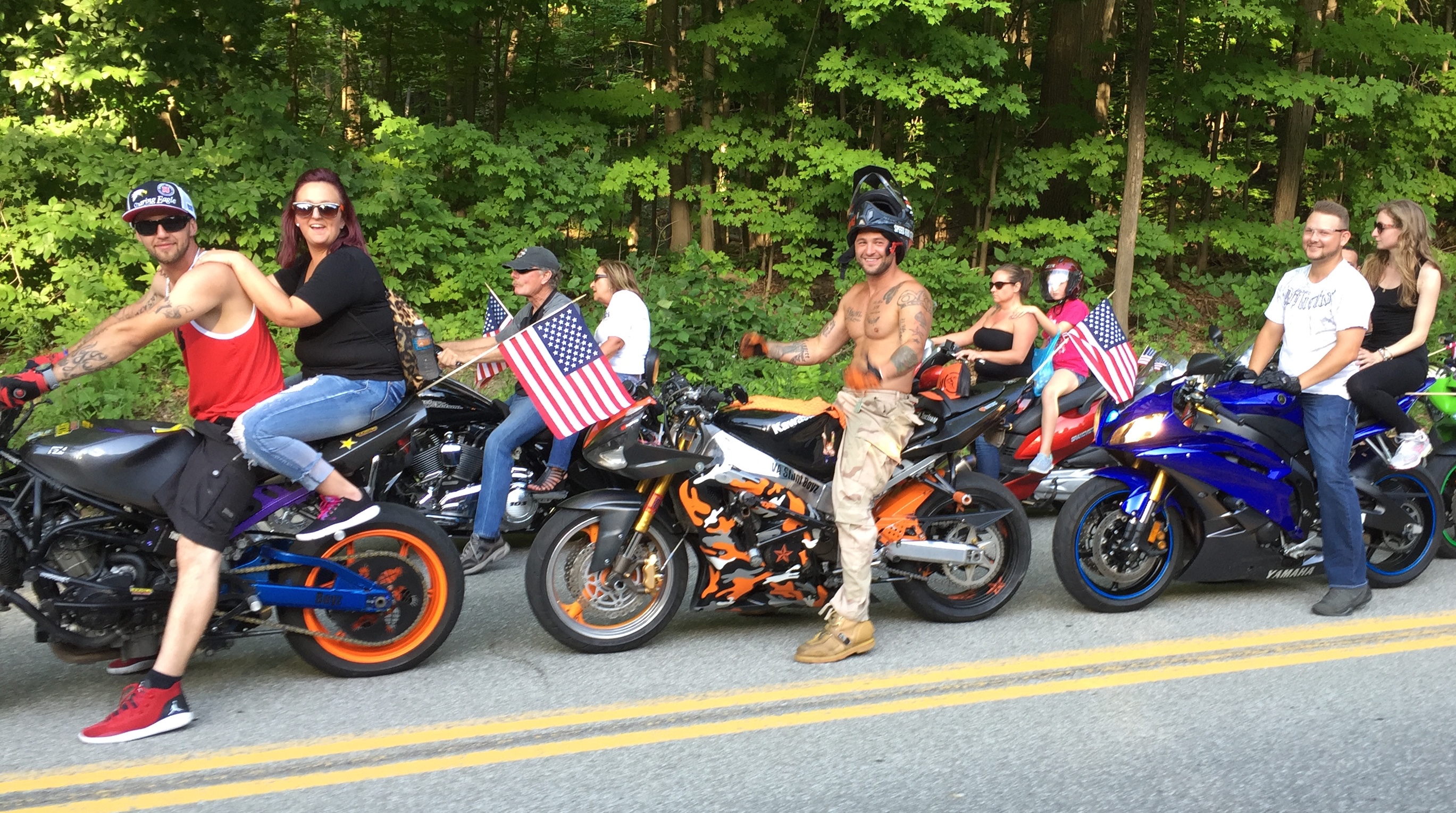
I was minding my own business, standing along Glenwood Park Avenue with wife Kathy and grandson Cole. The Roar’s parade of motorcycles was going by, the riders vroom vrooming—such delight in engine flexing.
Cole needed to get used to the volume, so he sat in the car, peering out the open window. My body fat, from arm bingo to wine gut to muffin tops to saddlebags, trembled in the racket. The bikes were interesting, a smorgasbord of shiny eccentricity and plain weirdness. The air was a brew of exhaust and grilled hot dogs from nearby picnic shelters.
Such sensory overload would normally have me looking for an escape route, but this loud, funky scene was rendered gorgeous—every smell, sound, and sight, I swear—by human faces.

Happy dudes in a happy brood: one of these guys let out a vroom that sent Cole diving for cover.
Watching them rev by, I felt like crying. I should have cried. (Yes, I’m way too in touch with my tear ducts. Guilty as charged.) Face after face saw my face, and we waved at each other, human beings exchanging something pretty modest, if you stop and think about it.
What does a wave between strangers mean, after all? “You’re a person. Hey, I’m a person, too. And I see you.” That’s it.
But it wasn’t the waves alone that moved my old soul. The bikers’ dear faces were blissed out. And what an assortment: grizzly, metrosexual, young and fair, toothless, weathered, cherubic and gaunt; skin colors, check; genders, check; ages, check; orientations, check.
In other words, motorcycles marching to their guttural tunes presented me with a nice collection of humanity that, as near as I could tell, found a few miles of heaven rolling along together as a tribe.
“Why are you so choked up?” I asked myself.
“They’re so happy,” I said, out loud a couple times, almost in disbelief. “For as long as this ride lasts, they get to be happy.”

Cole, the recipient of scores of smiles and waves
On the way home, Cole said, in as clear a sentence as his toddler tongue has yet uttered, “That was so much fun”—a perfect little word for what I’ve decided is a saving truth.
Why did 5000 bikers wave to over 20,000 spectators? Why did the eyes of those in motion shine like the sun? Why were those standing still so often laughing? Because when human beings see each other, smile and wave, some of the gladness each of us keeps inside comes out of hiding.
Lest you accuse me floating off into rosy clouds, I’ll acknowledge that a few beers and a conversation about politics and religion might ugly up lots of those silly parade grins. But then, Old Milwaukee and opinions can furrow brows in my very own family. Rancor and ridicule are always as close as our elbows.
But the joy of a smile and a wave lies in the truth that we are all more than our passions, righteous though they may be. My personhood begins with roots: I love; with luck, I am loved back; a woman gave birth to me; I can never put down my life, a heavy satchel of stories that could make you dance and cry; I’m afraid; I suffer; I have dreams.
Tell me your dreams and stories.
I chatted this morning with Stacey, a Starbucks friend who rode and roared. She was moved, she said, by the flags and folks sometimes a dozen deep lining the route. Words couldn’t quite get at the power she felt in thousands waving.
I actually spotted Stacey and her wife in the procession and recognized their awe, which may be the best word to describe the simple, elusive hope I found in Roar on the Shore.
If only we could see each other! Not what we believe or whom we love or how genetics sculpt our bodies and color our skin.
Imagine the fragile world if our smiles and waves meant, “Hey, there, fellow person. I won’t hurt you. Let me hear all about your mother. Tell me a story to make me dance.”
Okay, I am in the clouds. But I believe in awe. Would you help me bring some clouds to earth, to where we’re standing?
Or maybe we can just look each other in the eyes. That’s not too much to ask. Good Lord, we can do that much, right?
In Defense of Justice Ruth Bader Ginsburg
Blogger’s Note: The scope of the opinion piece that follows is narrow. I have views about nearly every tangential topic imaginable, but I’m speaking here only to The New York Times‘ recent editorial board opinion about Ruth Bader Ginsburg’s statements about Donald Trump.
If you’re looking for the normal fare served by A Napper’s Companion, please feel free to order another entree.

Justice Ruth Bader Ginsburg (Credit: Wikipedia)
Spirits of the coffee drinkers at Brew Ha Ha are merry this noontide, but I’m negotiating with a troubled heart. Former teaching colleagues Alice and Mary and I reacquainted and dissected one of our national obsessions, November’s presidential election. Since they left an hour ago, I’ve been palpating available Internet information and opinions in hopes of easing my suspicion of a terrible prognosis. The possibilities paralyze my brain and sour my gut.
The New York Times normally steadies me, but, oh, my precious, the editorial board has just poked at my gag reflex with this opinion: “Donald Trump Is Right About Justice Ruth Bader Ginsburg.” Whew! Pause. Breathe.
In a recent interview with Adam Liptak of the very newspaper that smacked her knuckles, Ginsburg had the impudence to say, “I can’t imagine what the country would be — with Donald Trump as our president.” A couple of other remarks added color to her opinions and probably set off editors’ subjectivity detectors.
Asked if she also thought that the Senate should act on Obama’s nomination of Merrick Garland to the Court, Ginsburg practically got hysterical: “That’s their job.” Please, somebody get this woman into a straightjacket.
The board’s assessment is terse: “Justice Ruth Bader Ginsburg needs to drop the political punditry and the name-calling.”
Okay, she did call Trump a faker. Bad Justice. Bad Justice. But punditry? Rising from my nausea are a litany of questions, summarized by one: “Where does punditry end and truth begin?”
Other words pose essentially the same question. “At what point does objective neutrality deny the obvious?” “When is bullshit given the full weight of fact?” And “When is denigration mistaken for discussion?”
Yes, these are dangerous questions. Whoever successfully lays claim to facts and truths has hold of power and moral high ground.
But these are perilous times. At least in politics, the historically accepted rules of engagement have been trodden under wingtips. I’m hardly the first to observe that even the pretense of civility and fair play in governmental chambers and circles is gone. And reality, fluid in the best of social climates, is now nothing but fog. Where are the brakes?
Americans who share Ruth Bader Ginsburg’s opinion about Donald Trump aren’t so much despondent about the candidate himself, but about the destination of “I, Donald John Trump, do solemnly swear that I will execute the Office of President of the United States.”
Trump will, indeed, execute the Office, and felled in the firing squad’s aim will be the languishing assumptions about how we Americans communicate with each other and come to agreements and define the world we live in. This is my dread, at least.
Adding insult to injury, the just, charitable identity we have struggled to embody—the “lamp [lifted] beside the golden door”—may give way to the hateful, fearful “angels of our nature.”
Our society has already taken many steps down a rancorous, violent path. Do we honestly suppose that we’ll find remedies to what ails America if we crown a man who delights in riling followers into stampede?
Pause. Breathe.
Am I being alarmist? Hyperbolic? Gosh, I hope so. But I don’t think so.
Ruth Bader Ginsburg knows that “the exception proves the rule.” Supreme Court Justices should keep their noses out of political controversies. Good rule. Good good rule.
But what Donald Trump says he would do as Commander in Chief—bluster though his every word may be—requires the assassination of what is most honorable in the people and the deportation of the Constitution Justice Ginsburg is sworn to interpret and uphold.
She was obliged to break a generally wise rule. She gets a pass.
The Counterintuitive Truth About Violence: The Day After Dallas
Begin with speculation: Why do mass murderers often finish their missions by committing suicide, either by cop or their own hand? Various sources suggest self-loathing, hopelessness, a weird attempt at revenge, and a refusal to endure the consequences of their actions.
All of those reasons make sense, more or less, but this morning, riding out the dismay of yet another mass shooting, another explanation occurred to me.
After you kill people, you are in great measure dead already. Suicide is the end punctuation of the truth.
This basic idea—the violence you do to others returns home to you—is hardly new, but it is so unpalatable, abstract, and counterintuitive that we reject it, if we acknowledge it at all.
The Psalmist writes of his enemy, but speaks a universal reality: “He made a pit, and digged it, and is fallen into the ditch which he made. His mischief shall return upon his own head, and his violent dealing shall come down upon his own pate”(Psalm 7:15-16).
Arthur Conan Doyle certainly borrows from Psalm 7 when his Sherlock Holmes observes, “Violence does, in truth, recoil upon the violent, and the schemer falls into the pit which he digs for another” (“The Adventure of the Speckled Band”).
Buddhist teachings also acknowledge the result of letting yourself be consumed by anger and violence: “By doing [violence] you are like a man who wants to hit another and picks up a burning ember or excrement in his hand and so first burns himself or makes himself stink” (Visuddhimagga IX, 23).
The temptation is to domesticate such wisdom by restricting it only to terrorists and crazies. But anger is wild, violence a delinquent student. And, no revelation here, we human beings can all get pissed and throw haymakers. Who among us doesn’t take life from others, blood cell by blood cell, hour by hour? The unkind word recoils upon the speaker as surely as the shooter is wounded in his own crossfire.
Of course, not all violence is driven by anger. A soldier, for example, might wish to do anything rather than kill. Unfortunately, taking another person’s life, even for a just cause, can still be lethal for the most stable of soldiers. Some in military service die in battle, obviously. Others return home with beating hearts and tortured spirits. From 1999 to 2010, one veteran committed suicide every 65 minutes, 22 of them each day. In 2012, active-duty suicides ever-so-slightly outpaced deaths in engagement (177 to 176).
I regard members of the United States armed forces as heroes. They risk life and limb out of a deep, difficult calling. They carry out orders they may not like in conflicts perhaps troubling to them in hopes of defending their country.
It’s unfair that a noble person can survive a battle only to discover in the aftermath invisible, self-inflicted wounds. A glowing coal doesn’t care whether the hand about to throw it is right or wrong, good or evil. It burns whatever it touches.
I’m prepared to be corrected in my speculations. I’ve never taken a human life. But why did many veterans of my father’s generation remain silent about what they saw and did in World War II? Why was the scorn Vietnam vets endured so personally and spiritually devastating? Why are those serving in today’s military taking their own lives in record numbers?
Because killing kills. Failing that, it maims. The recoil of violence is so strong that even those of us who lash out only in insults and dirty looks bruise ourselves.
The sniper who murdered five police officers in Dallas was killed by a robot reaching toward him with an explosive—the fruit of his evening’s labors. But he was dead already.
And what about the rest of us? Is there any hope of stopping what has become our planetary routine of violence?
My kingdom for selfless love pandemic! But that wish amounts to whistling into the wind. What we have right now is rage, which, though understandable, is not inclined toward the Golden Rule.
Any suggestion these days ends up sounding impotent, but I’ll offer mine just the same: We ought to teach our children right from the start that any blood they shed in this life will generally include an equal share of their own.
Here’s Your Sign: In Memory of Joe Burgert

Joe Burgert
Organist and devout Christian Joe Burgert died in his sleep on June 25th at the Lay School of Theology, which was held at Thiel College in Greenville, Pennsylvania. His friends, my wife Kathy included, were devastated and knew they wouldn’t be able to continue attending class sessions, so they headed for Erie. Since Kathy had hitched a ride with Joe, she drove his car, the hatch filled with his luggage and laundry.
Traveling east on Route 322, the women in the two-car caravan had just started to grieve. Joe was a big presence, but sensitive and thoughtful. His laughter was thunderous and infective. Although health issues tired him out, he always seemed to be overflowing with life. How could he be gone so suddenly?
Kathy was hit particularly hard by Joe’s passing. They rode together, sat side by side at dinner, worshiped together, and then, pow, he was gone. But there was something else: I don’t think Kathy realized how much she loved Joe until he died. That was my experience, too. Let’s just say, Joe Burgert was a great soul.
So great, in fact, that he has helped a skeptic like me to believe in signs. For good or ill, much as I embrace miracles and the workings of the Holy Spirit, I resist explaining mysteries. “Leave them be” is my approach.

Joe! (Credit: NASA/Gary Rothstein on Wikimedia Commons)
But it’s hard not to think that Joe reached out to his stunned friends on the highway. A bald eagle flew right at them, down the middle of the road, just at the treetops. The way Kathy tells it, they all saw the wings spread wide, almost close enough to touch, and thought the same thing: “Joe!”
He was considerate that way. If, in the governance of eternity, the dead can reach out to the bereaved, Joe would have put in a request for an eagle flyover. For days Kathy couldn’t share the story without crying. She loves eagles, scans the sky for them all the time.
Joe gave me a sign, too, I think, but to appreciate this, you have to know that I drove him crazy. He was meticulous and, even he would have admitted, kind of fussy. I’m more improvisational theater, as pastors go. We loved each other, but I tested the poor man’s patience.
A few days after Joe passed, I was running errands, my mind doing its normal noodling. Walking across a parking lot, I remembered that eagle and thought, “Hey, Joe, how about a sign for me.” No misty eyes were involved here at all. I might as well have been musing, “Boy, an ice cream cone would sure be good right now.”

Good one, Joe. (Credit: Niceckhart on Wikimedia Commons)
Then I looked up at the storefront: GIANT EAGLE. There was my sign, and it was vintage Joe Burgert—exactly his sense of humor and sharp mind.
“Here’s your eagle, Pastor,” I imagined him saying, followed by his great laugh.
In Joe Burgert’s memory and honor, I’m choosing to believe not only that he staged my sign, but that the Communion of Saints conspired with him, joyful to the point of tears.

