Blogger’s Note: If you’ve read this blog over the years, you may have noticed that my activity has declined recently. In April of 2025 I retired from parish ministry. A project unrelated to A Napper’s Companion took up two years and is now fermenting in a drawer as I determine how best to revise it. Meanwhile, I’ve been freelancing for senior citizen publications and am glad to report that my columns have appeared in or are forthcoming in fourteen states–and counting. I’m now preparing a collection of my essays tentatively entitled An Old Soul’s Reader. Cross your fingers for me. I’ll keep you posted. (I’m guessing what follows is a ten-minute read.)
Ephemera and Holy Water
Just after Easter in 2015, wife Kathy and I downsized from roomy to snug—the kind of move some folks make when they spot retirement approaching. Our new, built-in-1926 house was quirky, with a laughably long ramp up to the back door. I can imagine the situation. Mrs. Kaminski wanted to live at home until the end, and her adult children did all they could to make it so. Plenteous handholds in the bathroom. Hooks everywhere. Mrs. K. obviously liked to hang items where they’d be within reach.

The interior was shabby, though not filthy. Tears here and there in the carpeting throughout, cracking and curling tile—a nightmare of flowers and leaves, olive, ivory and rust—on the enclosed front porch. The walls wore a pallor of dust.
Odds and ends greeted us on move-in day: a jalopy exercise bike in the basement; jars of screws on the late Mister’s workbench; an accordion file of documents re: furnace, roofing, etc.; and holy water in a hall closet. So the Kaminskis were Roman Catholic. I held the yellow spray bottle up to my cheek and played the wiseacre for a photograph. The idea was silly: holy water on hand to spritz mischief as it arose.

I look into my younger face and acknowledge a regrettable moment. I accepted the pastor’s collar in 2001, so you should expect compassion, insight and maturity from me. Employing tap water that a priest has blessed to shoo away evil warrants a double take and conversation, but ridicule turns the camera away from Mrs. Kaminski and towards Pastor Coleman.
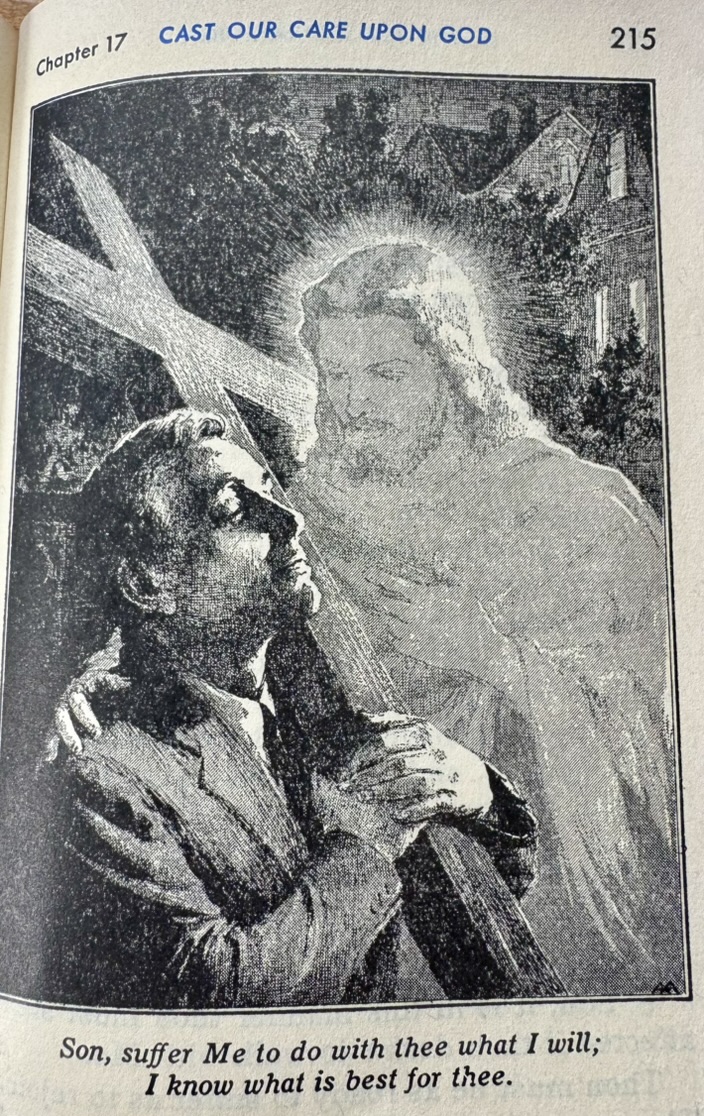
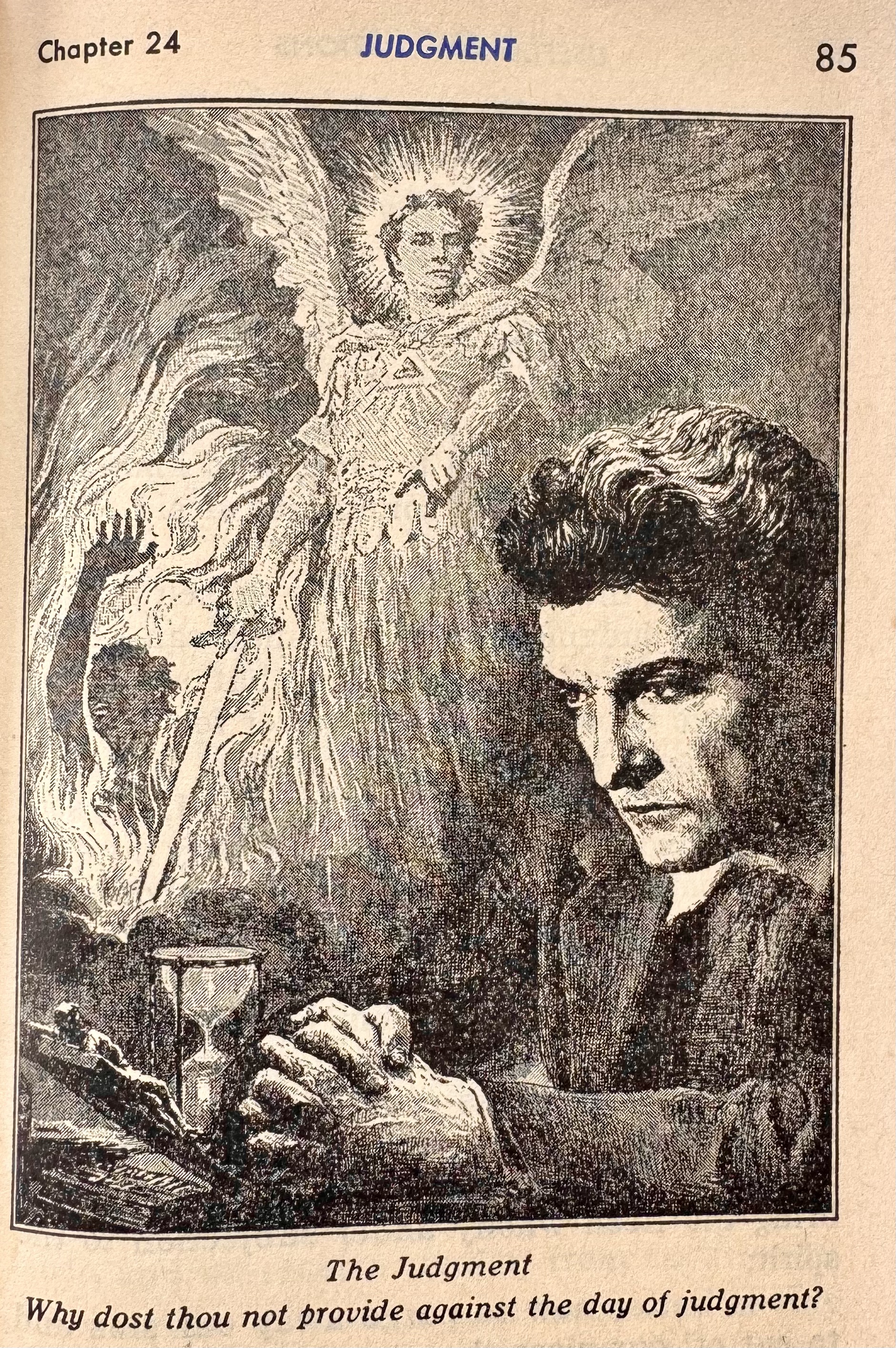
What made me reconsider my victimless teasing was a barn sale in rural Pennsylvania and a musty cigar box of what the guy taking money called ephemera: several prayers copied in disciplined cursive; a Novena to St. Jude Thaddeus; a funeral card from 1973 for Ruth; a hospital discharge instruction sheet for Helen dated 1993; and a pocket My Imitation of Christ by Thomas a Kempis, illustrated “by the noted Armenian Artist, Ariel Agemian, K. S. G. [Knight of the Order of Saint Gregory the Great].” The Rt. Rev. Msgr. Joseph B. Frey signed off on the edition in 1954.

The artwork often shows a businessman of the “Father Knows Best” era carrying a cross or clutching one to his breast. A quotation provides context, something like, “If thou wilt reign with Me, bear the cross with Me.” This caption represents the feel of the work as a whole: “If I be tempted and afflicted with many tribulations I will fear no evil whilst Thy grace is with me.”

This booklet ought not be laughed at or dismissed. Years ago I was afflicted with depression and anxiety and remember well turning to Thomas a Kempis, other religious classics and the Bible to gain a handhold against anguish. Panic attacks are an exquisite form of suffering. It never occurred to me to mist my dread with holy water, but, believe me, if I thought it might have helped, my whole environment would have been as damp as a grocery store produce cooler.
Folded and tucked within My Imitation of Christ was that page of hospital discharge instructions. Oh, my dear Helen. Judging from the list of medications, she contended with acid reflux, high blood pressure, irregular heartbeat, anxiety, and perhaps bipolar disorder. Turns out I’ve got all but the last of these complaints covered. Helen and I could have started a support group.
Mrs. Kaminski would have fit right in, which brings me back to my clownish sarcasm. I’ll turn 65 in the days ahead. Retirement from parish ministry arrived last year, and I’m increasingly aware of the next big destination on the itinerary. Many Christians insist they’re not afraid of death, but I am—not as terrified as in the past, but the inevitability of this life’s end, in the words of the late atheist Christopher Hitchens, “does concentrate the mind.” Meaning: The great mysteries assemble before thoughtful people, who either take their best guesses or find within themselves negative capability, that quality poet John Keats envied in Shakespeare: dwelling in “uncertainties, Mysteries, doubts, without any irritable reaching after fact and reason.”
Although I’m an ordained Lutheran minister who has wandered out to pasture, I resist every kind of “irritable reaching.” What happens when we die? Anybody who swaggers or blusters when answering this query deserves to be put in timeout. In my own fashion, I stand guilty.
Weighing Helen’s ephemera and recalling my smirk at Mrs. K.’s holy water have sat me down in a corner to think matters over. What likely prompted the former lady of my home to keep blessed Erie water beside her Comet Cleaner? Why did Helen take plenteous medications and copy down prayers and keep Thomas a Kempis nearby? And what do my litany of prescriptions and fervent pleas to God over the years demonstrate? Just this: The three of us are/were scared.
Ours is no small fear. In addition to daily assaults and tribulations, with each passing season we reckon the eventual disposition of our souls—if, indeed, any echo of human beings still sounds beyond this vale of tears. It’s easy to let eternity be frightful. Some of us can’t resist.
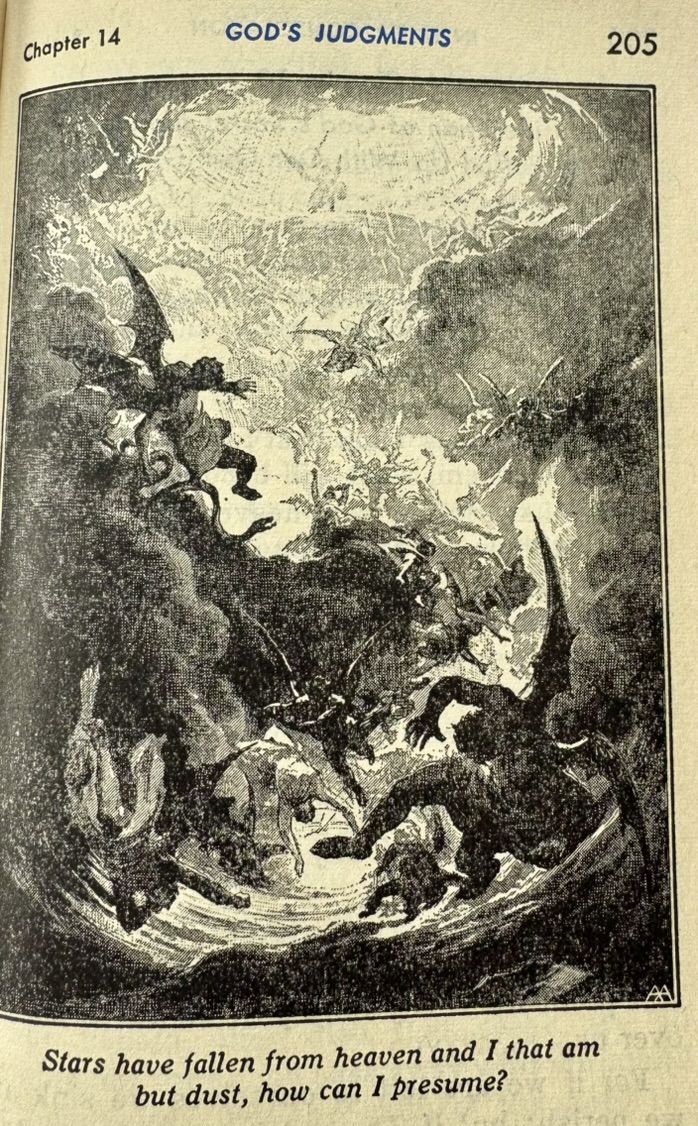
Comforting as a fretting Christian might find My Imitation of Christ, Ariel Agemian saw fit to include hellscapes in his illustrations. Even the gospel images are beset behind and before with dark shadows. Mrs. K. and Helen have, as I like to say, gone on to glory. I’ve no business engaging in the hypocrisy of judging what they did to hold themselves together. I join them in clutching my pearls and falling to my knees. My burning incense is the same as placing hope in sacred dew. I take pills much like Helen’s. They deserve better of me.
Now, in my wishful imagination I take their hands and say, “Dear sisters, I was afraid just like you. May our trembling be no more.”

Note: Names and some details have been changed.


This “My Imitation of Christ,” especially the illustrious illustrations, are put to their most proper use here in your own regretful and loving act of contrition, toward all those you once felt amused by. And i agree with the spirit of all you’ve said, and of course i’m at least Helen’s own agemate, though still hanging around mostly healthy–i too am age-in-placing my house and i too take most of her meds and have it all covered except Bipolar –that part is covered by at least one grandchild.
But now let me point to other uses of this book of the Father Knows Best era that i know you already know, but you were pointing in other directions. i dunno about the text, but i’m sure it fits the illustrations–part of our everyday lived nightmare right now in American gender and race politics–this is white Christian nationalism without the formal label, this is Pete Hegseth’s dream, Vance’s too, this is the stuff that the current administration is trying to make national policy, whether of the Catholic or Protestant variety–the throwback version of The American Family, white, male-run, with a trad-wife in the background. So there’s that. Wheeeeee!
Greetings. Thanks for the thoughtful comment. I really appreciate it. A bashfully admit that I have added of few of my own to Helen’s list of complaints–alas. You make a wonderfully interesting point about relating our current creeping crud to Thomas a Kempis’s fifteenth century spiritual classic. Those 1950s illustrations sure do foreshadow Christian nationalism and the twenty-first century version of family values run amuck–actually, I should say, festering and rotting. You’ve given me worthy food for thought. Thanks much. BTW, I feel as though I should know you, but my WordPress blog feed just identifies you as “Someone.” Let me know if you feel comfortable doing so. Shalom, John
i wrote a long comment, john. i don’t see it here tho
I had to approve it. It should show up not. Will comment soon.
*now.
Greetings, Pastor John. Now that I am 10 years post-retirement, I have the same drift of thought that you do. I am easing my concerns by learning more about the scriptures and gleaning knowledge from a Lutheran minister. Pastor Lynne conducts a scholarly Bible study that encourages me to improve my relationship with God. Equally important is finding joy in my daughter (so much the good mix of Herbie and me) and my three grandchildren, who at 13, 15, and 17 need my stories and love. The end of life may come whenever, but I know whose I am. I look forward to meeting Him someday!
Loretta