Oniontown Pastoral: Holy Trifles

Oniontown Pastoral: Holy Trifles

This post is dedicated to my colleagues in ministry.

Just now, I finally got it. I understand why those of us long in the tooth are loath to part with our treasures. The matter is clouded by television programs about hoarders who clutch last week’s pizza box to their chest because the cardboard might come in handy. Also fogging up the conversation are youngsters with hearts of flint who categorize objects without a practical purpose as “all that junk.” Well, I keep trifles, and the reason has become clear.

I feel low this Friday, which promises rain later on. Its wispy sound will be welcome, as I have work to do and will be sitting where I am now when it falls—this report has to get written along with a sermon. The tasks are agreeable, though melancholy leans against my chest, in the hollow where tears come from.

St. John’s Lutheran Church in Oniontown, Pennsylvania, is like many mainline Christian congregations. We’re aging quickly, and the faithful whose sturdy souls and frames gave richly to the church are disappearing one by one, over the horizon and into glory. Neal’s funeral was this past Wednesday. Bill’s was in late January.

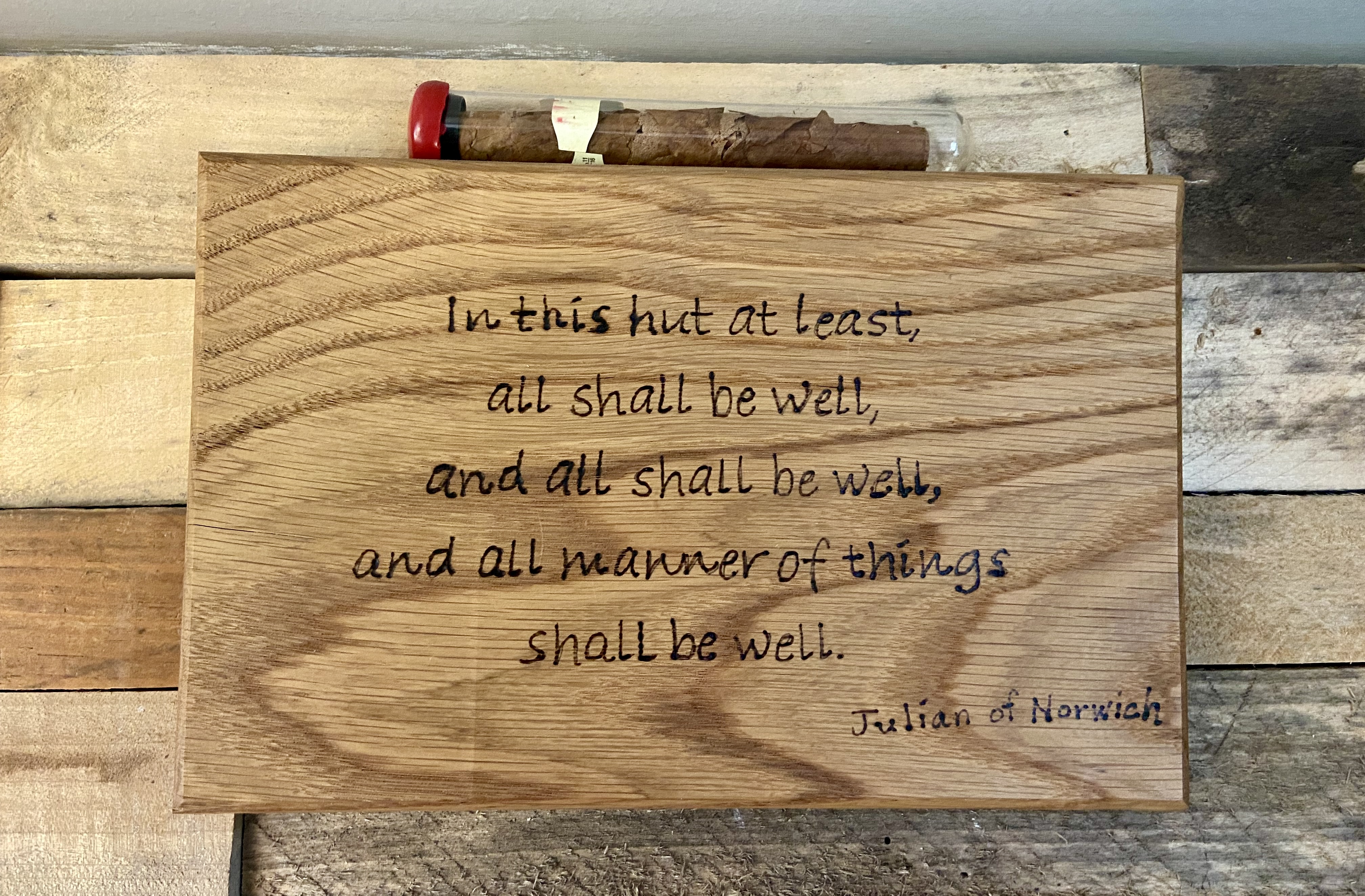
Friend Ray’s cigar resting on wise words

Please know, I’m neither crying in my morning tea nor looking for sympathy. A pastor’s call involves baptizing, marrying and burying. Like my colleagues, I put shoulder to wheel. Pastors do love their folks, however, not theoretically or by obligation, but with plain old human love. This reality makes the vocation by turns buoyant and weighty. Downstream from baptismal waters are ashes and dust. This is life, right?

But just now, sighing and imagining light perpetual, I looked at the bicycle pump needle on my windowsill. Fred, who died two years ago come June, gave it to me. One afternoon I tried to inflate his car tire with some electronic device. It should have been cake, but I floundered. My next visit he handed me the needle and went on a laughing jag. I pick it up, close my eyes and listen to Fred’s joy. He had the greatest laugh. I see him there across from me, and in my mind, dry bones rise and dance.

Fred’s needle

The needle helps me keep Fred close by. It occurs to me that both here in my writing hut in Erie and in the pastor’s study in Oniontown, I’ve surrounded myself with relics of a sort.

The tin my mother packed full of sewing machine bobbins now contains quarters, dimes and nickels. I run my fingers over the lid faded by decades and hear her mighty Singer hum again downstairs as I fall asleep.

Mom’s bobbin tin

Dad’s Hall’s Excelsior Bank—a small iron piece—holds pennies, which my grandsons shake out on the floor now and then. His father’s pocket watch resides to my left and can be coaxed briefly to life with tender winding. The cigar friend Ray gave me sheds its leaf, kept together only by a glass tube. As before, he and his sagging jeans flop into my passenger seat for an afternoon of errands. “Ah shucks, Pastor,” he says, “I’m tired.”

Dad’s bank

Me, too, Ray. In my case, I’m tired of goodbyes. When at St. John’s I scan the study’s landscape. Deanie’s cardboard Vacation Bible School giraffe peaks out from behind the filing cabinet. In my top desk drawer reclines a pack of matches that says, “If there’s an umbrella in my drink, it better be raining.” My hunch is this was left behind by a pastor or two ago, and I’d like nothing more than to clink mugs with that guy. And Sadie’s portrait from early in the past century suns itself near the window. For a time, she will remind me of Bill, whom I mentioned earlier. They were related. Bill was the purveyor of much St. John’s mischief. His passing is still fresh, as is his memory. I’ll work my way to laughing soon enough, but for now, I just miss him.

Are the holy trifles I keep at hand my way of coping? Ah well, so be it. My mother’s red Paper Mate pen rides in my shirt pocket. Putting down a signature, I say something like, “You’re dead, Mom, but not entirely. Not to me.” Her cursive was lovely.

Mom’s Paper Mate and John’s pencil

Behold, I’ve taken my appreciation of objects with a negligible purpose to a new level. Last week I received a shipment of 100 mechanical pencils from a retired man who tells me he has a couple hundred more to sell, along with a handful of fountain pens.

Beside Mom’s Paper Mate I carry a pencil from John K. Denlinger Service Station in Lancaster, Pa. The proprietor may well have been looking over my shoulder as I wrote down today’s duties. I never met John, but I hereby take the liberty of calling him my brother.

Oniontown Pastoral: Happy Anniversary, St. John’s Lutheran Church

In the beginning the faithful arrived by horse and buggy. Staring out again at the waving stalks—in a daze almost—I imagine sloppy dirt roads, driving rain, wind chills calculated only by stinging cheeks. If not for these hearty souls, there would be no pastor’s study, snug in winter and cool in summer. There would be an Oniontown, but no “Oniontown Pastoral.” Continue reading

Intercessory Prayer in an Age of Malice

Intercessory Prayer in an Age of Malice by John Coleman “You have heard that it was said, ‘You shall love your neighbor and hate your enemy.’ But I say to you, Love your enemies and pray for those who persecute … Continue reading

Oniontown Pastoral: A Lutheran Response to COVID-19

Oniontown Pastoral: A Lutheran Response to COVID-19

Sometimes I’m particularly proud to be a Lutheran. When I read a pastoral letter about the Corona Virus from Elizabeth Eaton, Bishop of the Evangelical Lutheran Church in America, I was so grounded and refreshed I can hardly tell you. Before sharing what Bishop Eaton wrote, I’ll set the stage.

Bishop Elizabeth Eaton of the ELCA. Chicago, IL 2019

Wife Kathy was just checking the latest news across the table from me in our den—the tongue-in-cheek name of the room where both of us are working from home during COVID-19’s deadly fuss. She exclaimed something from behind her computer screen. (I feel like television’s Tim “The Toolman” Taylor peering over his privacy fence at neighbor Wilson’s forehead on Home Improvement.)

My beloved may have used colorful language, but I can’t swear to it—groan. She passed along a report from NBC News about a Louisiana pastor who persisted in holding worship services in defiance of Governor John Bell Edwards’ executive order against gatherings of more than 50 people. The Reverend Tony Spell, however, packs in around 500 at Life Tabernacle Church. The trouble is, songs and amens are accompanied by airborne spittle, which passes infection.

Don’t be deceived if I sound momentarily whimsical. According to the Los Angeles Times, on March 10th a choir of 60 asymptomatic voices in Skagit County, Washington, assembled for a practice complete with social distancing and hand sanitizer, and now 45 of them have tested positive for COVID-19. Two have died.

Faith gives life, but mindless faith can also snatch life away. I don’t fault members of the Shagit Valley Chorale for rehearsing, as no restrictions had yet been announced for their county. Tony Spell’s faith, on the other hand, is dangerous. I’m sorry, it just is. “The virus, we believe, is politically motivated,” he stated. “We hold our religious rights dear and we are going to assemble no matter what someone says.”

The Luther Seal at St. John’s Lutheran Church in Oniontown, Pennsylvania.

Lutheranism rejects such arrogance. Bishop Eaton rightly referenced Martin Luther, who wrote his own pastoral letter in 1527 on a topic that hits home today. “Whether One May Flee from a Deadly Plague” addressed a population still mindful of a scourge that killed over 23 million people in Europe 200 years before:

I shall ask God mercifully to protect us. Then I shall fumigate, help purify the air, administer medicine and take it. I shall avoid places and persons where my presence is not needed in order not to become contaminated and thus perchance inflict and pollute others and so cause their death as a result of my negligence. If God should wish to take me He will surely find me and I have done what He has expected of me and so I am not responsible for either my own death or the death of others. If my neighbor needs me however I shall not avoid place or person I shall go freely as stated above. See this is such a God-fearing faith because it is neither brash nor foolhardy and does not tempt God.”

Martin Luther in 1529, Portrait by Lucas Cranach the Elder (Credit: Wikimedia Commons)

I am not a Luther scholar, nor do I possess any insight about 16th Century Germany. For this reason, I trust the ELCA Bishop’s knowledge and direction:

Many of our [parishioners] have the same concerns as those in Luther’s day. Many of our people are anxious. Luther’s counsel, based on Scripture, is still sound. Respect the disease. Do not take unnecessary risks. Provide for the spiritual and physical needs of the neighbor. Make use of medical aid. Care for one another, especially the most vulnerable.”

This exhortation is neither soaring nor inspiring, which is why I love it. Discipleship looks pale compared to the flash and fluorescence that hypnotizes our culture. The acts of belief that move me most are nonchalant: swallowing an unkind word; listening to a loved one without glancing at the smartphone or television; shoveling a neighbor’s steps after a snow storm.

Most of all, in current circumstances, calling myself a Christian has a lot to do with using the brain God gave me. Health care professionals are begging Americans through their exhaustion and tears to stay home. Communicable disease experts say that COVID-19 is stealthy—and doesn’t the poor Skagit Valley Chorale know it?

Tell you what, as a diabetic, I’m going to listen to smart people. I don’t want to be infected or, what’s worse, pass along misery to an innocent bystander. Unless I must go into public places, you’ll find me at the Coleman house, praying for our protection and fumigating, my faith and intellect sitting peaceably side by side.

Be safe, Oniontown, until my return!

Oniontown Pastoral: Old Floyd and New Floyd

Oniontown Pastoral: Old Floyd and New Floyd

In Memory of Warren Redfoot

Three of us sat around the hospital bed in Warren’s living room: his wife Nancy, daughter Barb, and me. Under the covers was Warren, all 90 pounds of him. Sticking out were his head, shoulders and left arm, which rose and fell throughout our conversation, as if carried on a breeze.

Miracles were coming out of the man’s mouth. Not that all his words made sense, but never mind sense. Warren was speaking in poetry, which takes inscrutable turns and isn’t obliged to be linear.
“I wish I could make myself understood,” he said somewhere in the midst of the quirky grace he was bestowing on us. We assured him that he was doing fine.

What got Warren rolling was this. Barb said, “Dad, do you want to tell Pastor John about Old Floyd and New Floyd?”

He was game. The story, which had been birthed in his imagination the night before, evades transcription, but the gist is simple. The Floyds are either tractors or men, depending on Warren’s memory at the moment. Old Floyd is doing farm work, but eventually breaks down. Then New Floyd shows up and takes over.

As in the mysterious possibilities of dreams, however, the Old Floyd is, in fact, the New Floyd. “Not the same body,” Warren explained, “but the same.”

He was talking—for the love of God!—about resurrection.

Closing his parable with a flourish, Warren pushed aside imaginary clouds and said, “Then the sun came out.”

Then the sun came out.

“Boy,” I managed through a tight throat, “you could add another chapter to that story if you wanted.”

“Another chapter?” he replied, almost incredulous. “Another paragraph. Another sentence!”

I caught his meaning. This fragile man was schooling his pastor about life, death and everlasting hope. Sooner or later, life boils down to finding a good word, taking a single breath, or touching the cheek of your beloved, as Warren did to Nancy. All that this husband knew of tenderness shone forth as he reached for his wife, to ease her sorrow.

Old Floyd—Warren’s father’s name, incidentally—can see New Floyd coming. Time grows short. One more sentence means everything. One more hour. Another kiss.

These thoughts swept me away. My left hand held Warren’s while the right clamped over my mouth. Barb touched my shoulder. For the first time I was nearly undone at a bedside and thought I might have to excuse myself.

Can you understand? If God leads us to each other to give or receive what we need most, then God, indeed, sent me to Warren and Nancy’s house to receive the assurance of things hoped for, the conviction of things not seen.

Once I regained myself, we shared Holy Communion. Warren’s eyes locked on mine as I held up the bread and cup. No bashful glancing away for either of us, not with eternity so near.

Afterwards Warren asked for a decent swallow of wine to supplement the sliver of bread I had dipped in the chalice and rested on his tongue.

Even though his throat was constricted, I poured him a tiny portion. Never have I seen a believer drink more eagerly. He held the thimble-sized glass above his mouth, the last drop falling on his tongue.

Then Warren said, “I have an urge.”

“An urge?” Barb asked. “An urge for what, Dad?”

“For another Communion,” he said. “Not this one. Another Communion. The next one.”

And then he went on and on about how delicious that wine was. I couldn’t argue.

When Warren seemed to be flagging, I said my goodbyes, but as I reached the door, he called my name. Not “Pastor John” or “Pastor,” only “John,” the name I pray one day to hear God whisper into my ear.

I turned around to face Warren reaching skyward, like Atlas holding up the planet.

I did the same. We kept the silence together.

“Peace?” I finally asked.

He nodded, mighty under the weight of the world: “Peace.”

Driving home, I sighed to hold off tears. “The Spirit helps us in our weakness,” I remembered, “for we do not know how to pray as we ought, but that very Spirit intercedes for us with sighs too deep for words.”

Old and new.

Warren was every bit the Spirit to me. Maybe for a moment, like those Floyds, they were the same. I don’t know. But what I can say for sure is this: When my skinny old friend gave me a foretaste of the feast to come, the beauty almost made me go to pieces.
Oniontown Pastoral: Holy Ground

Oniontown Pastoral: Holy Ground

The real question is, “Why don’t I get up and go some place else?”

IMG_0027.jpeg

(Credit: Brian Snelson on Wikimedia Commons)

My morning at Starbucks in downtown Erie, Pennsylvania, began with a man shouting into his smartphone. Every word in The Drunken Sailor’s Handbook was deployed with such speed and spittle that the manager—courageous woman!—went over and told him to quiet down.

I thought we patrons might end up on the local news, but he apologized and soon walked calmly outside.

And is it ever cold out there, with the wind chill at 14 degrees. Sure, the weather could be worse, could be a blizzard stinging faces. Even in the still air, though, if you have nowhere in particular to be, the situation gets serious in a New York minute.

Erie is no Big Apple, but this is the urban scene playing out before me. In addition to students staring at their laptops, business types picking up their café whatevers, and readers and writers like me lost in words and white noise, there are folks who are homeless and/or mentally ill. Some seem like lost souls.

Of course, I’m doing guesswork. “All those who wander are not lost,” a popular saying goes. The pilgrim wearing a torn, mustard smeared parka might be a college professor for all I know. The guy who gets into heated discussions with his duffle bag and repeatedly sorts scraps of paper into stacks might have a cozy loft nearby. Clearly some live on the streets or in shelters.

A controversial Starbucks policy adopted in 2018 has made possible the spectacle I’ve described. A Philadelphia barista wrongly kicked out a couple of customers who hadn’t yet made a purchase, and the whole ugly episode played on TV. In response Starbucks wrote to employees, “Any person who enters our spaces, including patios, cafes and restrooms, regardless of whether they make a purchase, is considered a customer.”

The company obviously has protocols to deal with people who act up, but the intent here is otherwise. First, Starbucks wants to avoid further bad press—I’m not naive. But second, I do believe there’s some genuine hospitality in what is a risky business decision. As Gene Marks wrote on entrepreneur.com, “Do you sympathize so much [with the homeless] that you would sit next to someone who’s been living rough (and smells like it) after spending six bucks on a Frappuccino?”

(By Jan Georg van der Vilet, c. 1632 on Wikimedia Commons)

Yeah, I hear him. I’ll even confess to a similar frustration an hour ago when a drunk man staggered in to use the rest room, but couldn’t resist working the room and making like a mime while checking out the pricey travel cups. The same annoyance takes hold, too, when guys who—doggone it—look sketchy slouch for hours at prime tables and thumb out text messages.

“Why don’t I get up and go some place else?” Well, I certainly could leave and not be kept awake tonight by guilt. In fact, I wouldn’t think ill of anyone who said, “This is nuts. I’ve got to get out of here.”

As it happens, the man who was railing away on his smartphone when I first arrived has returned with several companions in tow. Meanwhile, traffic through the front door, down the hallway to the rest room and back outside again has been steady.

I’ll mention one thing more. I’m no superhero, but my spidey sense—or is it my prejudice?—tells me that this person or that is up to no good.

By now you must be screaming, “Hey, Oniontown Pastor, so leave already.”

I’ll respond first with a request. Go ahead and consider me a fool, but don’t call me “holier than thou.” My duffle bag of sin often has me weak in the knees.

What also weighs on me is a truth that I’ve given my life to: The people here—from the unfailingly friendly baristas to the studious young ladies beside me to the pale, tattered procession that needs only to pee and warm up—are God’s children, equals in the ways that matter most.

(Moses and the Burning Bush by Bourdon Sebastien, 1616-1671, on Wikimedia Commons)

A whisper tells me to abide with these sisters and brothers. It may well be that in eternity’s eyes, this Starbucks isn’t here so much to sell me beverages as it is to comfort those with no particular place to be.

In fact, as the arguing man paces around, making proclamations non-stop and itching for more trouble, that same whisper both shames and edifies me: “John,” I hear in the ear of my heart, “the place on which you are standing is holy ground.”

Letter to My Grandson, Who Is Afraid to Die

Letter to My Grandson, Who Is Afraid to Die

Dear Cole:

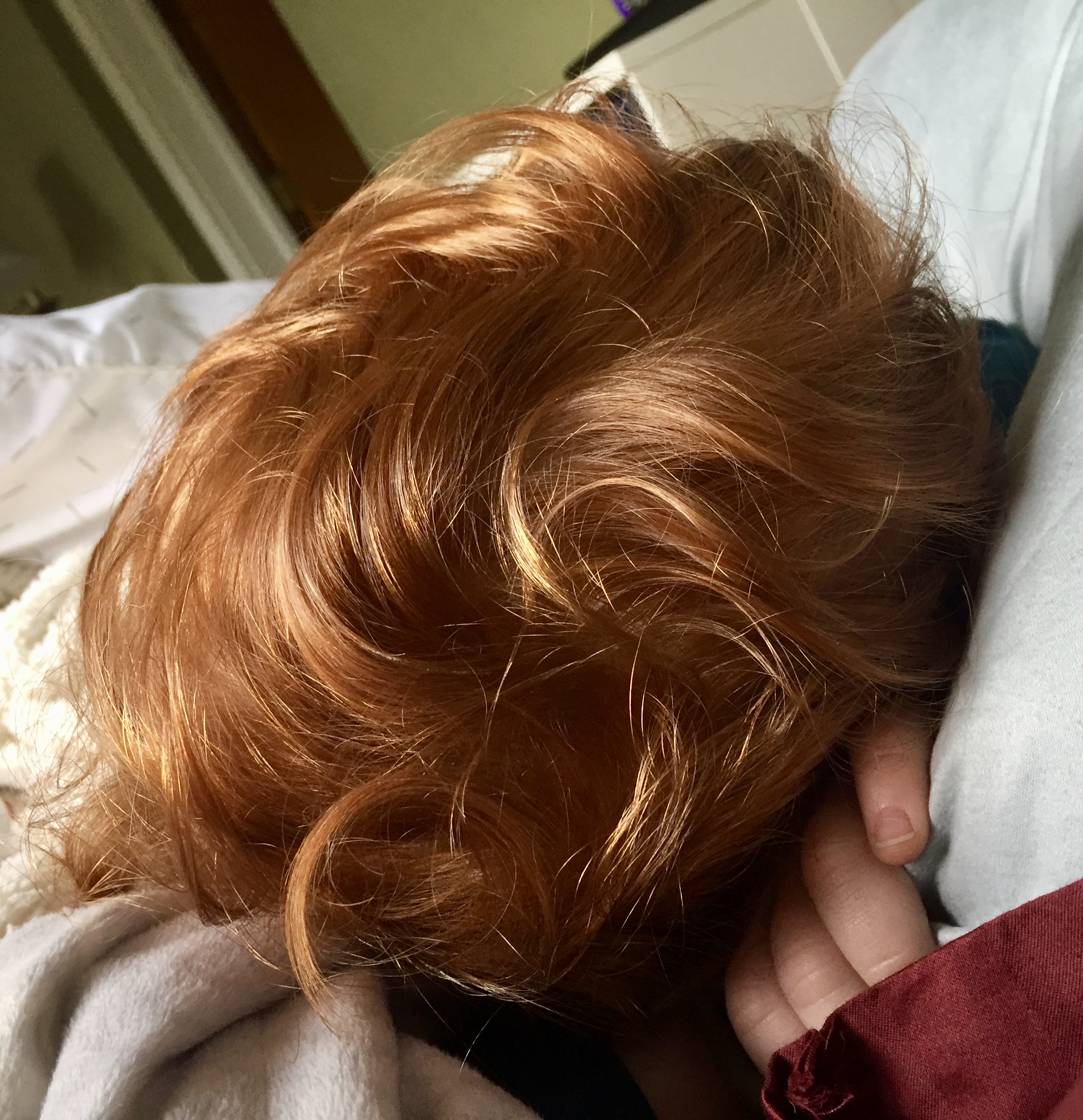
Your wild red hair before waking on Sunday morning and heading to St. John’s in Oniontown

You’re only four and a half years old now, but I’m writing to preserve the thoughts under your wild red hair until the day comes for you to retrieve them. Of course, nobody really knows what another person thinks. Let’s call this letter a gift of love, then, flawed like everything else in the world.

A few months ago you said something curious to your Grandma Kathy: “I don’t want to grow up. I’ll miss my beautiful voice.” She and I tell our friends about your words, which we find funny, but also haunting and sad. Kids like you say things so fresh and insightful that adults laugh through their tears.

Saint John’s Lutheran Church, where you are loved

Your voice is beautiful, Cole. In fact, everything about you is so beautiful that, truth be told, your parents, grandparents, relatives and dozens of other folks, like your church family at St. John’s in Oniontown, wish time would stop here and now. How could you ever be more beautiful than you are today?

Clocks break, though, and watches stop, but the present hour leads to the next, and no prayer can change this fact. It’s incredible to us—the grown ups who love you—that you have reckoned so young the relentless passing of life. Good Lord, pal, I wish you wouldn’t rush that pretty head of yours into eternal mysteries.

But here you are, telling your mom and dad that you don’t want to grow up because if you grow up you’re going to die. You’re asking if dinner is healthy because food that’s good for you will make you grow up. You want junk food instead, which won’t make your body big and strong. Your parents have explained that eating crap will only make you a sickly adult, but this logic hasn’t helped.

“What happens when I die?” you’ve been asking. We ache with longing to ease your mind. Your mom said, “We believe you go to be with Jesus,” and she was speaking our truth.

The trouble is, Cole, we say “believe” for good reasons. We also say “faith” and “hope” a lot, too. The word we shouldn’t say is “know,” and even though I’m a Lutheran pastor, you should ignore anybody who presumes to understand the mind of God and the terms and conditions of eternity.

The last time we had family dinner, your fear and suffering was overwhelming. You had already cried a couple of times that day and picked at your food, though we had a couple of unhealthy options for you. After clearing the table, we sat in the living room.

A cute little cry before you grew hair, Cole.

I’ll never forget what happened next. You stood in front of your father, your hands on his knees, and suddenly sobbed. These weren’t normal little boy tears, like the ones that fall when you don’t get your way or you smash your toe. These were “save me” tears, “I can’t breathe” tears. I recognized the terror washing over you. It happened to your Pop when he was about twice your age.

This fear has a couple of fancy names, “ontological shock” and “mortal dread” among them. They all mean the same thing: You understand the possibility that long ago you didn’t exist and someday you might not exist anymore. Notice I used another flimsy word, “possibility.” I’m sorry. We just don’t know.

You probably won’t remember that on a Sunday evening years ago when you were terrified, your mom and dad comforted you. Nobody denied the abyss you were staring into or dismissed your fear or told you to hush.

“Cole,” I said, “I believe that when we die we’ll all be together and safe.” That’s my sustaining truth, but much as I would like to plant certainty into your soul, you’ve started the spiritual work of a lifetime early. Nobody can do this job for you or say anything to make it easy.

I’m still doing my work and remember well waking up in the dark in a panic about what must happen to you, me and everyone else. We all die, and I no longer wish to be an exception to this rule. I’m less afraid than I used to be.

When you read this letter, please think back. If your Pop ever saw you crying “save me” tears, I hope you remember me saying, “I’m scared, too, Cole. We all are. Let’s hold each other and imagine this is what it feels like to rest in God’s arms. ”

Love,

Pop

Oniontown Pastoral: Wearing Marc Snell on Holy Saturday

Oniontown Pastoral:

Wearing Marc Snell on Holy Saturday

March 31, 2018

I’ve never worn a compulsory smile, so I thanked a Starbucks barista a few minutes ago for the perky expression she is no doubt required to sport. “I know looking happy must be tiring,” I said, “but it really matters. I appreciate it.”

You should have seen the young lady’s wide eyes and pearly whites. No kidding, she parted the clouds on this drizzly day before Easter.

I now have in front of me another dear face, one that I have not seen for fifty years and figured never to see again. I often wear a leather bracelet bearing his name:

SP4 MARC E. SNELL

USA 03 SEP 68 SVN

This soldier, who was killed in Vietnam soon after his nineteenth birthday and a month before I turned seven, accompanies my comings and goings—not as a dark cloud, but as a ray of truth.

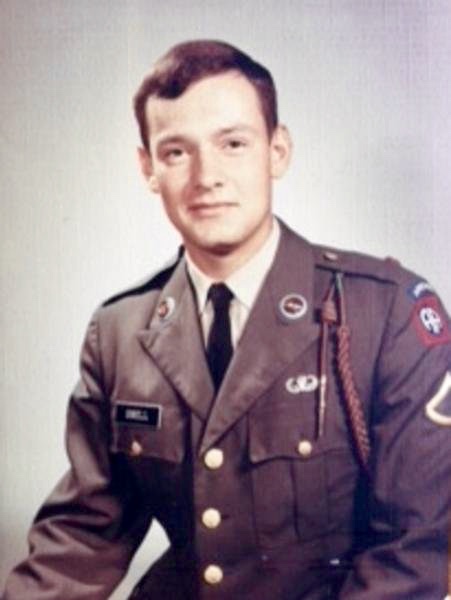
Marc E. Snell

The Snells lived two doors down from the Colemans for decades, and the memory of standing on our front porch when word came of Marc’s death still has ahold of me. Even at my young age, I felt all the houses across the street tilt to one side. The fair weather turned surreal, as if warmth and normalcy had no business on Wagner Avenue that day.

I ordered Marc’s bracelet a couple years back and wear him to remind me that a person can be doing nothing much, like consuming C Rations, when an explosion changes everything—fade to black.

That was the story I heard. Marc was eating lunch. I’ve always imagined him still sitting alone, leaning against a tree. His Casualty Data Report doesn’t help much:

Start Tour: Tuesday, 07/23/1968

Cas Date: Tuesday, 09/03/1968

Age at Loss: 19

Remains: Body Recovered

Location: Long An, South Vietnam

Type: Hostile, Died

Reason: Artillery, Rocket, Mortar – Ground Casualty

Strange, I can’t bring into focus a single image of the living Marc Snell. What I do recall is paying respects at Duscas Funeral Home with my family.

“Johnny,” Mr. Snell said. “Come up and see my boy.” He took my hand.

I was terrified. Marc died of a head wound—or so I believed. Would I have to look at something ghastly?

Of course, the casket was closed, and Marc’s military portrait—the very one I tracked down on the Internet—sat on top of it.

“Come up and see my boy.” Decades have passed, yet I never again expect to hear an invitation spoken so proudly. His voice was hoarse from unfiltered Pall Malls and devastation. Nineteen year olds have no business dying.

Only now, with Marc’s portrait in front of me, can I tell how much the son took after the father. In the many Septembers since the Snell’s heartbreak, I’ve held a morbid, though loving, question: “Did Mr. and Mrs. Snell have to look at their boy’s body?” The answer, either way, is too much to bear.

I shot hoops as a teenager in the Snell’s driveway and can name each member of the family: Fred (father), Lillian (mother), Marc, Alan, Mary, Earl and Jane.

Earl and I palled around some. We bought gold Stingray bikes with banana seats on the same day from Kmart. The shimmering memory of riding around the neighborhood together bumps into the wretchedness of a boy’s violent end after only forty-eight days in action. Did Marc have enough time to be afraid?

Tomorrow is Easter Sunday, when “alleluias” will ring out from Christian churches everywhere, including St. John’s Lutheran in Oniontown. You can bet I’ll be wearing Marc’s bracelet. No celebration of mine will leave Marc out in the cold. Inspired by his father’s WWII service, Marc voluntarily enlisted.

Alleluias at St. John’s Lutheran Church

Understand, I’m not gloomy. If you hear a person laughing like a buffoon in public, even-money it’s me, and I make friendly eye contact with strangers, at the risk of being called “creepy.”

The thing is, my joy doesn’t ignore artillery. In the here and now, tombs are overflowing. Marc Snell is in the ground. So, by the way, are his parents and mine.

If I forget Gethsemane and Golgotha, Easter’s “alleluia” is nothing but smoke.

So what have I got to smile about? I believe in wide eyes and pearly whites. I believe that every kid killed in Long An and every other province of Vietnam has been recovered, indeed, once and for all.

I believe that the clouds will part tomorrow morning.

Sunny in Oniontown