Letter to a Man on a Motorized Bicycle

Dear John:

I don’t know your name, so we may as well both use mine.

The first time I saw you, my wife Kathy was with me, and I confess, you gave us a laugh. We didn’t object to your chosen transportation, but you’re not a small man, and your bike is low slung. It reminded me of an old motorcycle with a sidecar. Bundled against November, you were out of proportion to your ride, like President Lincoln on the back of a Shetland pony.

I saw you again yesterday on the way home from picking up a bottle of Crane Lake Petite Sirah. The temperature was stuck in the thirties, cold weather for buzzing around Harborcreek, Pennsylvania, with your face uncovered. Still, maybe you like the wind against your skin. Maybe you’re wisdom in disguise, your one lonely horsepower a choice rather than a consequence. What the hell do I know?

1921_Quadrant_motorcycle_with_sidecar

Your bike reminds me of this old 4.5 horsepower, John. (Credit: Wikimedia Commons)

Not much is the short answer. I’ve already laid out my total knowledge of you. Everything else is a guess. I guess you would prefer a car to bike powered by, what, a lawn mower engine? I guess you made mistakes or ran up against bad luck or both. You have what I’ll euphemistically call some issues? You’re on meds or not. And you’re mostly alone, right?

It seems like I’m trying to excuse you and your ride, but if we were shooting the breeze over coffee, I would tell you about myself. Then you would know that I’m in no position to defend, explain, condemn, or absolve anybody. I’m on meds. My years are punctuated by silly choices. And like lots of citizens we both pass on Buffalo Road, I’m not far from needing dirt-cheap wheels.

I would explain, too, that as you disappeared from my rear view mirror yesterday, I didn’t say, “There but for the grace of God go I.” The sentiment is humble, but I’m not sipping an overpriced Americano because God has been gracious to me. And it makes me nauseous to think that your knuckles get raw when you ride in the rain because God has denied you grace.

If we were together I would laugh and say, “Boy, John, shit happens, doesn’t it?” That’s as much explanation as I have.

There’s a lot I couldn’t share, at least not until cup three or four. I live on God’s grace, but that has nothing to do with my pudgy Chevy or your bike, my excess or your need. I bet neither one of us merits much in the way of blessing or curse. “It is what it is” would have to be enough from me for today.

2112b394-c7d2-4f0d-8857-6e34e1594191

Are my wheels better than yours? I’m not at all sure, John.

Down the line, if we got to be friends, I would ask if you’re okay. The truth is, you might be way more okay than I am. A man who doesn’t mind being seen traveling on a contraption when snow is forecast probably has a thing or two to teach me.

Better still, I would say that sharing my name with you would be a privilege. And maybe you would look into my eyes, past the dark circles, and understand I was guessing about you not because you need my approval, but because you already have all the grace that’s mine to give.

Peace,

John

Waking from a Dream of Separateness

Waking from a Dream of Separateness*

In the midst of shamatha—calm abiding—lately, I’ve been having Fourth-and-Walnut moments. Thomas Merton (1915-1968) enthusiasts know what I’m talking about. One of the famous monk’s most beloved writings comes from Conjectures of a Guilty Bystander, which Thomas Moore calls a “mind-bending collection of short pieces”:

In Louisville, at the corner of Fourth and Walnut, in the center of the shopping district, I was suddenly overwhelmed with the realization that I loved all these people, that they were mine and I theirs, that we could not be alien to one another even though we were total strangers. It was like waking from a dream of separateness . . . .

As if the sorrows and stupidities of the human condition could overwhelm me, now I realize what we all are. And if only everybody could realize this! But it cannot be explained. There is no way of telling people that they are all walking around shining like the sun.

But even if it were possible to tell a friend or stranger, “You know, I see past your skin and know we’re family. Do you understand that you’re beautiful?” it wouldn’t be advisable. First, I would appear to be on an acid trip. And second, I would stomp all over the moment with my inadequate words.

It’s better to stay quiet, as I did last evening over a few Lucifer Belgian ales at the Tap House with old college teaching colleagues. One guy, who has been retired for over ten years but looks in better shape than I do, nursed his beer and held forth at length. But this wasn’t a self-indulgent, drunken monologue. Behind my friend’s animation I witnessed his soul’s lightening. He is engaged in a life-long lover’s quarrel with the world: what he loves, he loves recklessly; when he rails, he rails through clenched teeth. He has got the universe caught up in a fierce embrace.

Another shining spirit is a woman I saw at church this morning. I won’t name her because she would be embarrassed, but as she volunteers with more efforts than I probably realize, she gives off life. We had a belly laugh when she showed me a potless plant. Obviously somebody had broken the pot and put the dirt and root system back in the stand. There’s no way I can imagine being alien from this friend.

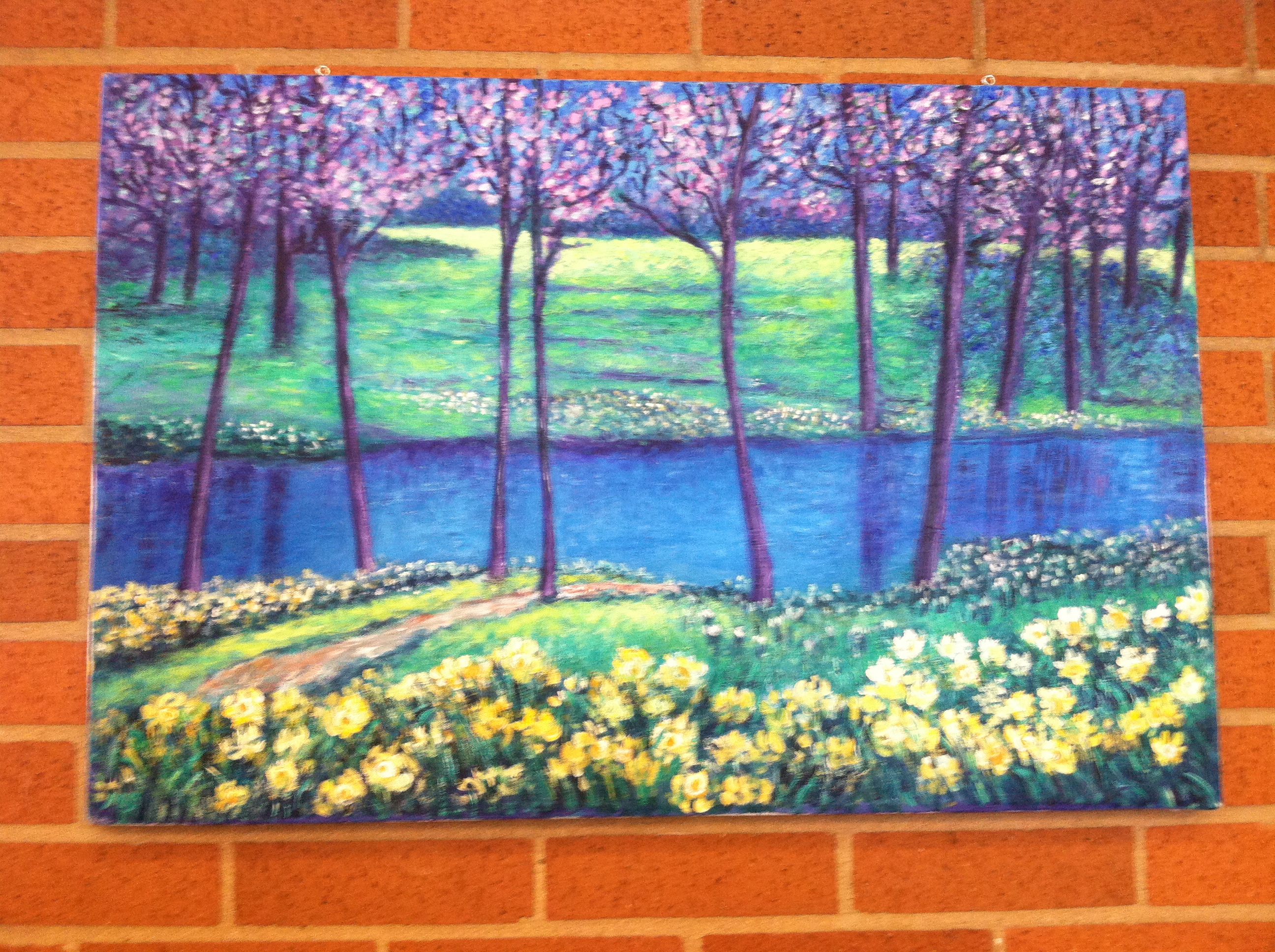
Yet another church friend hangs his paintings in the office. Parish Administrator Michelle and I love the work of this self-taught guy whose basement is full of decades of canvasses. He and his wife are getting on in years, but their gentleness glows. Being with them for ten minutes can bless a whole morning.

IMG_0846

Hanging on the church office at Abiding Hope

IMG_0850

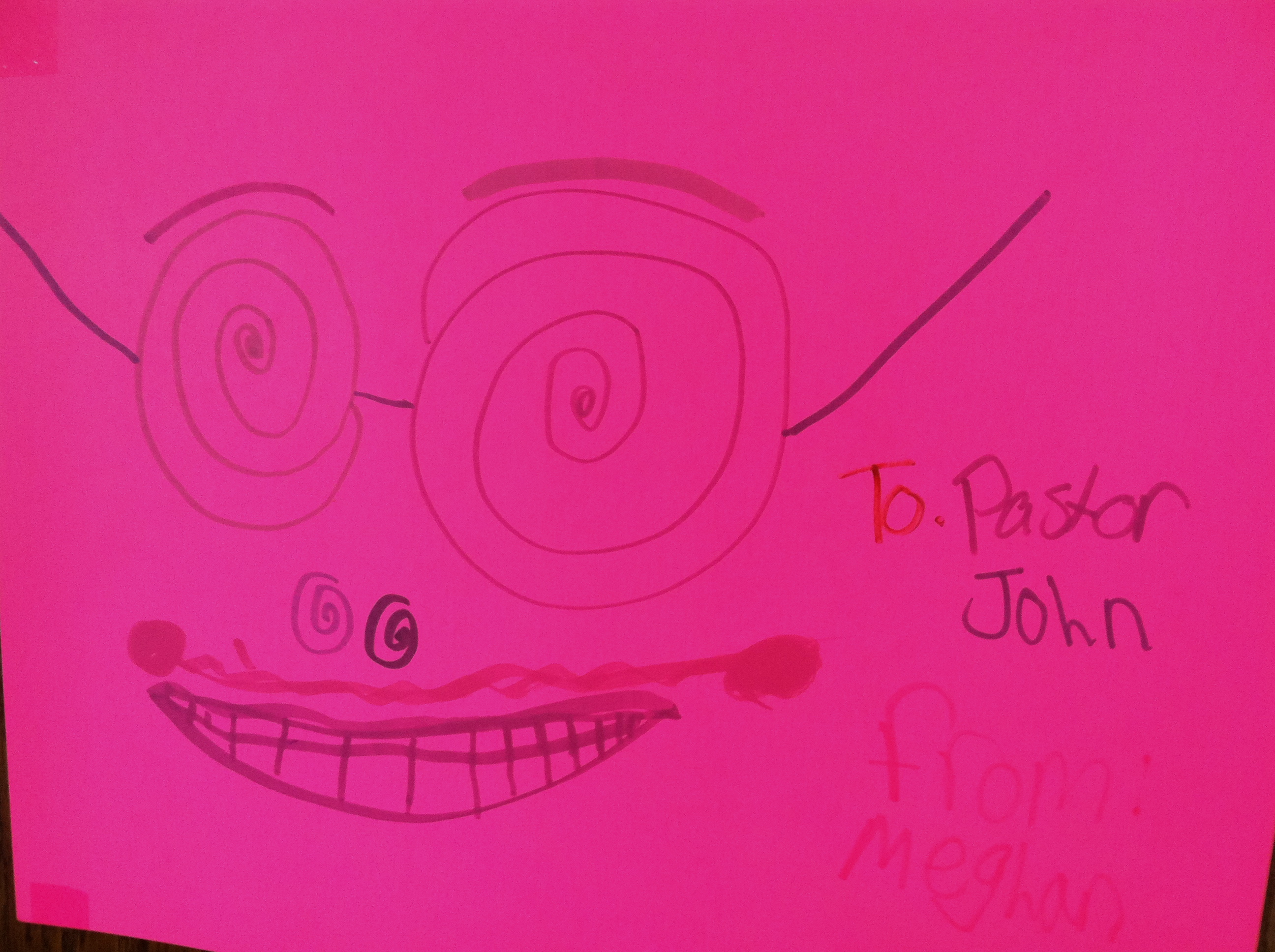
Taped to my office door, a portrait of me by Meghan, a kid who emits showers of sparks. I especially like my nostrils.

IMG_0729

Barista Abbey wearing a little girl’s crown

Of course, Thomas Merton was talking mostly about strangers in his Fourth-and-Walnut epiphany, and the more I’m able to give myself to the refreshment of siestas and the sanity of prayer, the more I notice great light all around me. Some time ago here at Starbucks, I saw barista Abbey knitting as a young friend made crowns. The kid was happy, proud of trying to fashion power and might out of construction paper. As I talked to them for a few seconds, we belonged to each other.

Unfortunately, sometimes shining people cause sunburn. A young woman here at Starbucks just had a lover’s quarrel of her own via cell phone. After a short, tearful fight, she retreated to the restroom, where I imagine she is crying some more. I’ve never seen her before, but have an empathetic pit in my stomach for her. And now she is gone, out into the 90-degree swelter with her puffy eyes, damp cheeks, and upset heart.

I’m still here in the air-conditioned shamatha of 4:02 p.m., glad that the sad girl was mine and I was hers (though she knew nothing about it). Most of all, I’m grateful not to suffer from the dream of separateness. I belong to everyone. Everyone belongs to me.

*This post first appeared in slightly different form on A Napper’s Companion in July of 2013.

Mindfulness in a Driving Rain

The foundation of happiness is mindfulness. The basic condition for being happy is our consciousness of being happy. If we are not aware that we are happy, we are not really happy. When we have a toothache, we know that not having a toothache is a wonderful thing. But when we do not have a toothache, we are still not happy. A non-toothache is very pleasant. There are so many things that are enjoyable, but when we don’t practice mindfulness, we don’t appreciate them. (From Peace Is Every Step by Thich Nhat Hanh)

unnamed-1

Baby Crash watching common rain, the Buddha looking in

Just now I closed my eyes and paid attention to my non-toothache. My mouth looks like a demolition derby in there, so I can vouch for the venerable Buddhist monk’s counsel. And sometimes I think my soul looks like my teeth—cracked, patched up, cavernous, important pieces missing.

Just now, with open eyes, I took in a full breath and enjoyed the air flowing back out past my throat and through my nose. My body, relaxed and light, isn’t cramped with any of the absurdities my mind habitually puts it through by narrating potholes into sinkholes and possibilities into finalities.

Happiness is fantastic, but okay will do. Hold the drama-trauma, blue cheese, and skydiving, and I’ll likely be fine. My job is to pray-meditate, walk mindfully, and swaddle Overthinking, kiss its spongy head, and shush it to sleep.

Even inclement days are sweet when my chops aren’t being busted and when I refuse to itch old scars open. Last Friday was one of those days. Weather has never bothered me, but Friday, November 13, 2015, was stern. Each chilly, gust-whipped raindrop was a slap on the cheek.

Poor daughter Elena couldn’t take Cole, now a Ninja of motion, to the playground, which is why I received a call at 10:11 a.m. Toddlers can turn homes into Thunderdomes.

“Hi, Daddy.” Was that a quiver of desperation in her soft greeting? “I was just wondering what your schedule was like today, if maybe you wanted to do lunch or something.”

Here’s a summary of our negotiations:

1.) Elena: Could we please not have lunch at my house? [X]

2.) Elena: There’s a play place at the [Millcreek] Mall. Maybe we could get a Starbucks and let Cole play there for a while. [X]

3.) Daddy: Then we could find somewhere to have lunch. [X]

4.) Elena: There is a God. [X]

We met at noon-ish, fed quarters to a fire truck and convertible, picked up coffee, and settled in at the official play place—and by settled in I mean kept Cole from making a break for the concourse, which he did four times, and from dispensing hand sanitizer until his fingers were raw.

After ten minutes of crawling through tunnels and nearly colliding with a dozen or so children of other desperate parents, he announced “Cole done” and copped a few sips of Pop’s decaf latte. Next he gnawed an eggroll and noodles while Elena and I had bourbon chicken.

IMG_4014

Cole likes coffee and spicy food

Then it was time to go. An hour with a toddler doesn’t allow for segues: ride the choo choo train, slip and almost fall on the padded turtle, get hurt feelings because the thick-boned boy hopped on the tug boat ahead of you, sample coffee, squeeze duck sauce on your egg roll, and refuse to hold Pop’s hand when it’s time to go home.

So we ran together, my little buddy’s jelly bones all akimbo. Before we reached the door, Elena insisted: “Do you want to ride in the stroller or let Pop carry you?”

“Pop!”

Bullets of rain got us right away. Cole’s face pinched in, and two steps later I felt his head settle on my shoulder.

“Aw, are you getting tired, buddy?” I said.

“No,” Elena said. “That’s what he does when it’s too windy.”

I must say, mindfulness is getting to be a habit for me, and it’s not for nothing. My bald spot and glasses were getting pelted, but so-the-hell what? A grandparent is made for the moment when the grandchild leans in. Love, fatigue, or safety could be the reason, but who cares? I still haven’t figured out exactly what a parent is made for, mainly because I was a trembling neurotic in that role. But Pop, I’m meant to be a shoulder for my grandson. The rest of me—I sometimes believe—is vestment.

“You okay, pal?” I said.

“Yeah.” One lilting syllable, almost a chirp.

Thich Nhat Hanh says that mindfulness can turn neutral into joyful. A non-toothache is hardly noteworthy. Neither is being able to breathe through your nose. Standard operations, that’s all. A two-year-old using his grandfather’s shoulder to hide from cold rain is about the same—thirty unremarkable seconds across the parking lot to the car.

Commonplace but for one truth: while my embrace kept Cole dry and warm, I found my own shelter from the elements.

If You Were My Daughter

By the time you took your first sip of coffee, a cop had already shown up, taken information from barista Tony, and loaded two pet carriers and bag of cat food into his cruiser. I didn’t see the woman pacing in the parking lot, trying to stay calm through a frantic phone call. I didn’t see her throw her arms up in the air, hop into her car, and speed off. Somebody else did, though, and got her license plate number. Now she is in trouble. You don’t leave a cat, dog, and Meow Mix in Starbucks’ parking lot and hope for the best.

If you were my daughter, I would have told you the whole story as soon as you sat down, ending with how sorry I felt not only for the pets, but also the woman. As if thinking out loud, I would ask what crisis led her to that moment and say as an aside, “Ah, hell, I guess we all do things we can’t take back.”

If you were my daughter, you would already know that I always want love and understanding to have the last word, which often makes my heart like a mutt the neighbors let bark outside hour after hour, the temperature sinking on a December night.

But you’re not my daughter. You spoke on your phone so quietly I could tell only that the language wasn’t English. The likelihood of my offspring randomly sitting down next to me and having a conversation in, say, French, is remote. And, of course, I wouldn’t have been stopped short at first by your beauty. I would know your birthday, where you are in your twenties.

You didn’t stay long, ten minutes and out the door. I watched and wondered. What car is yours? Where are you off to? But you walked so aimlessly, taking pictures of God-knows-what, I figured maybe you weren’t headed anywhere. Not to the bulky old Buick or maroon minivan, not to the Fox and Hound English Pub and Grille or Shoe Carnival or Ollie’s Bargain Outlet.

I stood to see you off. Your leather knapsack—almost empty?—was finally a black dot against your jean jacket. Then you were gone, and I couldn’t decide whether to be happy or worry. Going no place in particular can feel like grace if you know how to be alone and you’re not shouldering much weight.

If you were my daughter, I would be glad we didn’t talk about what you missed: the woman now rushing from suffering to punishment; the long-haired cat with eyes wide and still, waiting to slip from a carrier to the warm, bright sleeping spot on the back of the couch; the cop transporting animals, both trying not to be thrown by sharp turns, both able to remember and love.

If you were my daughter, you would probably say, “Damn, Daddy, lighten up.”

“Yeah,” I would say, “you’re right.”

But I might not be clueless about your next stop. Hopeful? Desolate? Either way, we could meet for lunch, and I would say, as if thinking out loud, “When a father loves his daughter, she always has at least one good place to be.”

A Letter to Parents from a Middle-Aged Pop

A Letter to Parents from a Middle-Aged Pop

Dear Parents (Especially New Ones):

I’m a Christian-Buddhist-pastor mutt in my mid-fifties, married to Kathy for thirty-two years. Daughter Elena and son Micah are grown, the former and her husband Matt having given us grandson Cole and promising us another grand-someone in the spring.

Yesterday Elena, Cole, and I (Pop) went to a nature center for a toddle in the woods. Nearly two, the boy is steady, but the path was strewn with branches and limbs from a recent windstorm. I kept close, spotting his steps, saying in my head, “Don’t fall! Don’t fall! Don’t fall!” My mother did this with me, too, so the anxious parent-grandparent impulse has genetic force behind it.

IMG_3966

Watch out! Don’t get poked in the eye.

Or is the force my childhood home, which was loving and attentive but nerved up? I’m certainly not the first to observe that children take family vibes along when they grow up and move out. I’ve spent much of my adult life trying to love in healthy ways and navigate through anxiety. In my late twenties it was full-blown panic attacks. In middle-age, it’s mostly trying to distinguish love from appeasement and not to turn every emotional speck of stardust into a blackhole. I pray-meditate a lot.

Lately my spiritual practice has drawn me to Tibetan-Buddhist Pema Chodron, whose teachings are weaving themselves into my thoughts and actions. In a recent post, Writing and the Narrative of Suffering, I offer a brief summary of my novice understanding of some key concepts Ani Pema works with. If what follows is interesting, I invite you to have a look.

I was watching one of Pema’s videos this morning when I was grabbed by her flawless diagnosis of my parenting experience:

Trungpa Rimpoche coined the phrase idiot compassion, or you could say idiot loving-kindness. Some of you may have tried raising your children this way and you’re wishing you hadn’t. You can’t bear to see them in any kind of pain, so you give them whatever they want. [Doing this] is like trying to assuage someone’s thirst by giving them saltwater.

I’m overjoyed to report that Elena (27) and Micah (23) are doing well these days, but my unintended lesson about suffering sometimes made their journey a walk on glowing coals. By regularly showing them idiot compassion, I taught them that pain can be eliminated.

Let’s be clear about my motivation. I could claim that I wanted to spare them disappointment, sadness, frustration, whatever, but that was only 25% true. More pressing, say 75% true, was my need to overcome a father’s discomfort. This is idiot compassion, idiot loving-kindness. It could also be called selfish compassion or artificial loving-kindness. I try to make myself better by denying my child the reality every human being has to confront sooner or later: Life is sweet, but it also slaps your heart and punches your spirit.

Years ago in seminary, my Enneagram results indicated that conflict in close proximity could be crippling. Conflict, pissing and moaning kids, discipline and tough calls: It was all crippling, so much so that to find relief I undercut wife Kathy’s strength, wisdom, and wishes.

So Elena wore black makeup, dated guys I should have shown the door, and watched and listened to what she damn-well pleased. And Micah bought weed with money I gave him, dropped out of high school, and put less effort into my feeble attempt at home schooling than I did.

There’s more, some of it worse, but you get the idea. All my reasoning sounded convincing at the time, but now I look back at myself. That younger man was doubled over, rendered frantic and sick by the need to steady the ship, to calm the waters. If you think I was stupid, you’re right.

Given this scathing review of my parenting skills, you might imagine me constantly ripping myself a new one. Other than sighing, I don’t do much self-reproach. What compassion I possess also extends to myself. I mistook indulgence for insight. The glasses I saw through were, in fact, blinders.

So I put down these ideas. I’m not telling you what to do, but mistakes are great teachers. What I believe now is this: Allowing children to experience necessary suffering may well be the highest form of love.

And I’m glad that it’s not too late for me to learn. Cole fell three times on one patch of slick leaves–two near-splits and one averted face plant. I stayed back. He was fine, of course. Someday he’ll get a fat lip or a bruised soul. When he does, I’ll pick him up and tell him the truth: “I know you’re hurt. Sorry I couldn’t stop it. The best Pop can do is stay close and hurt with you.”

IMG_3975

Elena and Cole–three spills later and belly laughing

Peace and love,

John Coleman

A Pastor’s Goodbye Letter

Dear Abiding Hope Family:

If you’ve been by my office lately, I understand your amazement. You’ve taken in the clutter and generally said boy or wow. The pastor’s study can be like my late mother’s junk drawer. Any object without a clear, immediate destination goes in the junk drawer (a lonely C battery, a half-used packet of mini Kleenex, a ceramic hippopotamus from a box of teabags) or the pastor’s study (a floppy sunhat, an old bag of Swedish fish, an unopened pack of small Depends–someone might be able to use them). One of you winked and mentioned that a huddle formed recently over the need for an intervention.

And you see only part of the squalor. Yesterday I filled five trash bags by emptying out a filing cabinet hidden behind my closet door. Notes from seminary might be interesting as artifacts, but if their contents haven’t already been put in my heart and written on my mind, then I’m in trouble, as is anybody who would call me Pastor.

I’ve gone through hundreds of books and filled two boxes with keepers. Over the years a formidable theological library has happened my way, one collection from a studious pastor ready to retire and another from one who left behind an apartment groaning with bound ideas and counsel. The titles displayed on bookcases look learned, but as gray overcomes the final evidence of brown on my chin, the day has come to admit I’m much more writer than scholar (or theologian in residence, as parish pastors are supposed to be) and more fellow pilgrim than wise guide.

My mess and excess have let these realizations sink in and sharpen my awareness that most of what I’m moving out of the pastor’s study will be stored in my chest along with all I own in bliss and sadness, in the space that holds rants, laughter, and sighs.

IMG_3953

Baby Jesus, bless it all: the old candy canes, the banner, books I’ve never read, the mirror Elena looked into as she put on her wedding gown before I walked her down the aisle, then turned around and did the wedding.

Herbie was a bricklayer disabled young by heart disease. The whole time I knew him he had oxygen slung over this shoulder. Doctors tried everything, even a procedure that included poking holes in his heart. Weary, often in pain, he and his wife Loretta thought and prayed. We were visiting in their living room when she said that Herbie had decided to stop taking medication. The enough moment had arrived.

I sat beside him on his hospital bed, put my arm around his shoulder, and he let go. I’ll never forget the feeling. He cried and sagged against me, and I knew that his soul beheld a journey that starts with surrender. Surrender, that’s what we shared, the final human consent.

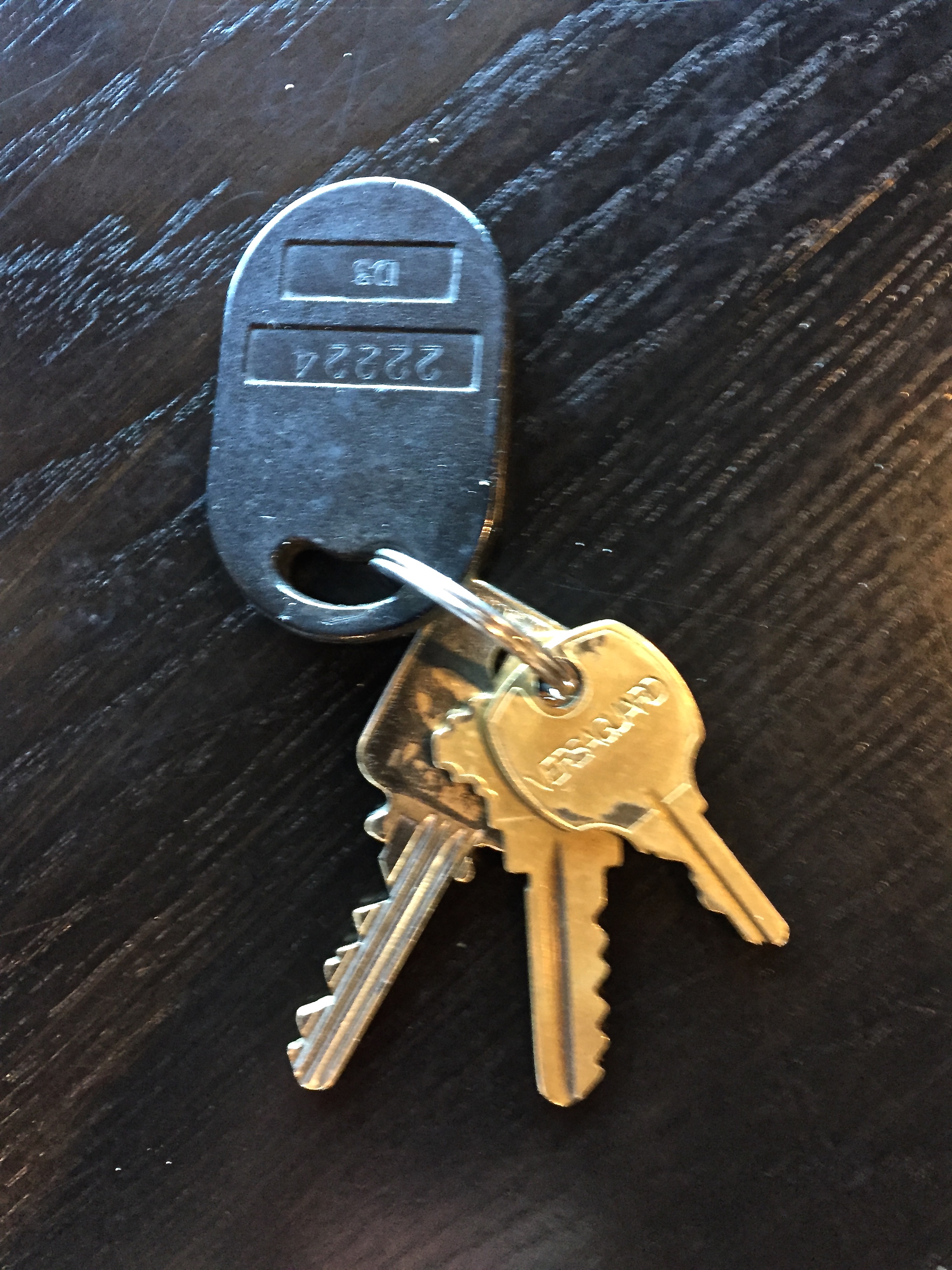
I held Herbie around a dozen years ago. When I leave my keys on the desk and walk out of Abiding Hope this coming Sunday, my arm will still be around his shoulder.
IMG_3957

The little key is for the thermostat.

On Sundays during Holy Communion, children come forward for a piece of bread and a blessing. I cheat. Some argue that little ones don’t understand the Sacrament, which may or may not be true, but I’m certain they know what it means not to share what everybody else receives with such reverence and devotion. So I break off a little piece, a foretaste.

I get down in their faces and say, “Now you need to remember, Jesus loves you exactly the way you are.” I don’t pretend to know the mind of God, but if this isn’t true, my ship is going down in boiling water. Anyway, the world devotes much time and effort convincing us to improve, so I figure hearing a word of unconditional love over and over can’t hurt.

When I stand back up from each blessing my knees crack, but I don’t feel a thing. The sacred space in my chest can’t forget the expectant eyes, the whispers of yeah or okay when I tell them to remember.

IMG_2605

“Go in peace! Serve the Lord!” I’ve had this photograph taped on my office door. These kiddos go with me.

Your life is coming in for a hot landing. There might be debris, flames and black smoke. Nothing to do but hang on, so you show up at my messy office, where you predict the devastation, anticipate the casualties. You need Kleenex.

Cancer. Betrayal. Death. Joy, too, babies and victories. But whether you’re in a free fall or glad flight, the pastor’s study is mainly a place to search through the box of answers you bring with you and to remember, always remember: In messes or atop mountains, we’re never alone. Our Unseen Guest, as my Grandpa Miller called Him in table grace, is with us, but when you and I hold hands and pray, we’re way beyond caring whether God is a boy or girl. We believe in the One in whom we live and move and have our being: God. Those three letters are plenty. The wreck may end up worse than you fear. We look at the cross and recall that Jesus crashed hard. With uncertainty scattered everywhere, we breathe in God’s old promise: “I will not leave you or forsake you.”

A promise and each other, that’s what we’ve got. When you walk out of my office, you leave me a gift that I’ll always hang on to: the image of your face as we crossed the valley of shadows and how it brightened when you felt the Unseen One traveling with us.
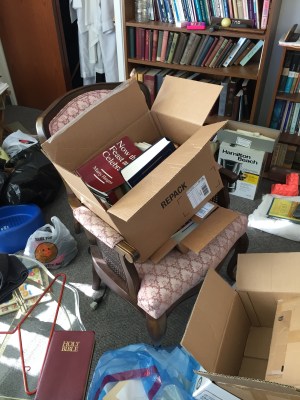
IMG_3954

Your chair, holding a box of keepers. It will still be waiting for you when the next pastor arrives.

Your face. Abiding Hope faces. I keep them all in a safe place. And I want you to know, I have the faces of those you love and have gone on to glory.

At the funeral home, after everybody passes by the body, I stay behind. The funeral directors close the doors, then lower your loved one into the coffin and fold in the fabric. I watch. I want to be the last person to see that face because love should consume the moment. I see to that. Before the lid clicks shut, I say inside, “I’m still here. You matter.”
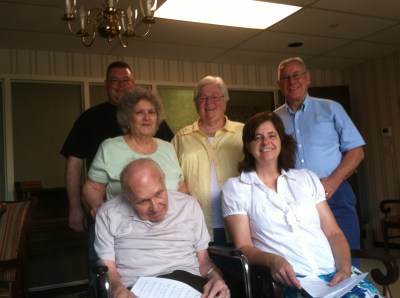
IMG_0992

Beloved Abiding Hope faces, the quick and the dead. Old brother Earl (front row) has gone on to blessed rest.

Of course, I will carry with me some objects that bear weight. The two most important are t-shirts that have a story behind them. They came from you, though you may know nothing about them.

During my first few years at Abiding Hope we had a fair number of teenagers, my daughter Elena and son Micah among them. Our youth group was lively, and two adult advisors made t-shirts for everyone. The trouble was, Micah wasn’t much interested in participating, heading as he was down a dark path that involved black clothes and a volcanic temper.

One evening when I showed up for an activity, Karri handed me a white shirt with “Pastor John” embroidered under “Abiding Hope.” White was our color. But then she handed me a black one with “Micah” and “Abiding Hope” in a barely visible dark purple: “If he won’t wear white, maybe he’ll wear black.” Mary did the stitching, I believe, but I don’t know who came up with the idea.

Over the years I’ve grown to understand that all of Abiding Hope handed me those t-shirts. You have always said, each in your own way, “Show up in your own color. You might find love here, maybe grace and hope, too. And an arm around your shoulder.”

IMG_3945

All are welcome at the Table of the Lord! This is Abiding Hope.

My soul can no more leave you behind than my body can bury its own shadow. We belong to each other.

But now I’m off to another church family, where I’ll come to love more faces. I’ve got a couple days to finish boxing up the pastor’s mess. Thank God you and all we’ve shared are already packed in my safe place–no rust or moth there. For a while I’ll be putting some tears next to you, then sighs, and eventually, joy and gratitude.

Love, peace, thanks, and so long,

Pastor John
Well It’s All Right: An Open Letter

Dear Everyone,

I woke up singing this morning, a losing-weight-but-still-fluffy guy sliding into jeans and the Baja hoodie Kathy lovingly de-hooded for me years ago. Gimpy Watson had to pee, so out we went, the song coming along:

Somewhere beyond the sea

Somewhere waiting for me . . .

IMG_3911

Out back, where Watson kills the grass with his pee, where I hum Bobby Darin.

The trouble with this swaggery Bobby Darin thing, which I both love and hate, is I don’t know all the words. Back inside, I finished putting myself together and noodled around with the signature lines:

I know beyond a doubt (HA!)

My heart will lead me there soon

HA! is the best part—so dated, so got-the-world-by-the-stones, so satisfying. Darin could walk on stage, say, “HA!” and I would cheer. Forget the lover on golden sands and birds flying on high. HA! and a smirk are plenty.

I crooned these juicy lines a few times, each HA! rattling the windows.

“Somebody’s peppy this morning,” Kathy called from the bathroom.

“That’s right,” I said, praying another song would break into my head. Yelping out HA! eventually triggers the gag reflex and makes you light-headed.

If your home has its standard measure of weirdness, a family member turning twelve lyrical words into a mantra might not be noteworthy, but in the midst of my heart dragging my smarm around the house, I noticed: I was singing. This hasn’t happened much recently, and certainly not upon waking, which generally amounts to a twenty-minute game of drag-ass.

About this singing, I’ll observe only that it’s not because I’m leaving one pastoral call and moving to another. Nothing is ever simple, is it? It’s possible to be both excited about a destination and bone-sad over a departure. My heart doesn’t know how to beat right now.

Which is why I appreciate the present singing. Before morning coffee, “Beyond the Sea” was relieved of duty by “End of the Line” by the Traveling Wilburys. Ah, Roy Orbison’s sweet warble, Tom Petty’s blessed assurance kissing me in my plump Chevy HHR:

Don’t have to be ashamed of the car I drive

I’m happy to be here, happy to be alive

“This is most certainly true,” my Lutheran-Zen brain answered. Ashamed of the car I drive? Ha! I have better shames than transportation. Happy to be alive? Why, yes, don’t mind if I am. Happy to be here and receive all kinds of music.

In the last couple of weeks I’ve realized a beauty that has always been offering itself to me. When I walk from the house to the car, at least one bird is in the sky or on a wire or atop a tree. Friend Mary could tell me all their names, just as Kathy can identify nearly every flower. My memory is Teflon with such details, but I can witness and give thanks.

220px-Cardinalis_cardinalis_-Columbus,_Ohio,_USA-male-8_(1)

A bird that friend Mary can certainly identify (Credit: Wikipedia)

I make that forty-foot trip from house to car and back again multiple times a day, and only once has a bird not accompanied me. Sometimes it’s a tiny, lone eye-song flying on high. Why have these companions been invisible for so long? A hardened heart and blinded eyes, maybe, projects of my own doing?

But gladness improves vision. As peace increases, the commonplace comes alive. Right before Kathy and I headed out the door a few hours ago, the kitchen windowsill said hosanna.

IMG_3910

Tomatoes from Kathy’s garden ripen, only after I had given up and decided to make cream of green tomato soup out of them.

IMG_3909

Rosemary from friend Denise, basil in water experiment, a ripening peach–each one a “hosanna.”

And yesterday Elena, Cole, and I had homemade vegetable soup and bread for lunch. As my wonder-of-a daughter poached eggs, my savior-grandson walked toward his bedroom and said, “Pop, come. Pop, come.” The message was of burning-bush proportions. I followed.

Cole is into hammering these days, so we went at rubber balls and his miniature electronic drum set, which said “Let’s jam again soon” each of the hundred times he turned it off. After lunch Elena got out his new piggy bank, and we all counted as he slipped in coins.

IMG_3908

Each time Cole says “Pop,” I stand on holy ground.

When I said, “Pop has to leave now,” Cole said, “Cole leave.” Referring to yourself in the third person is not only charming when you’re almost two, but also infectious.

“Oh, you want to go with Pop?” Elena said. “No, Cole has to stay here.”

My little buddy sagged at the screen door, his face widening into a pitiful toddler cry as I waved goodbye. By the time I reached the Chevy, I could see he was on to the next attraction, tears already drying.

“Pop, come.” Cole is calling me. Birds and songs are, too, as is the Lover of Souls: “Wake up, child,” Love whispers to me, “greet your sky-neighbors and sing. Two lines are enough. Even a HA! of joy will do.”

Love,

John

Writing and the Narrative of Suffering

I’ve never thought much about where my writing comes from, maybe because time for it is constrained. For over a dozen years, my habit has been to drop wife Kathy off at work or children Elena and Micah at school, then land at Starbucks or some other coffee house and peck away at a keyboard. Words have shown up faithfully, and the twenty to thirty to sixty minutes I manage most mornings are blissful, though my subjects sometimes involve torment.

Some people escape to their woodshop to make lamps shaped like whales, others prefer quilting, still others take photographs. To borrow from Stephen King, “I just flail away” at paragraphs—happily. In my experience, joy isn’t the best motivation for reflection. Why dig around my insides to figure out what makes me write? Does an old guy who has yards and yards of miniature train tracks set up in his basement sort out his aesthetic?

But now, after thirty years of fussing with books, poems, stories, and essays, I finally have good reason to ask myself, “Why do you write?”

Pema Chodron is to blame. Better put, I’m to blame for inviting this Tibetan-Buddhist monk into my soul. Pema, the first American woman to be fully ordained, directs Gampo Abbey in Nova Scotia. She writes books with titles like The Places That Scare You and Smile at Fear. I’ve known about Ani (sister) Pema for a while now, but not being a big fan of fear, I’ve resisted getting close to her teachings.

439px-Pema_chodron_2007_cropped

Pema Chodron in 2007 (Credit: flicker.com on Wikimedia Commons)

I am interested in Buddhism, though, and Facebook obviously knows this. A video course called “The Freedom to Choose Something Different” kept popping up on my News Feed, accompanied by Pema’s face. I finally watched a sample and thought, “Oh, crud, this sounds like advice I need to hear”—needful enough that my credit card took a $67 hit.

The presentation was spartan. A nearly eighty-year-old nun in a maroon robe talked, answered questions, and sipped water. And it’s way too early to tell, but she may have significantly reduced my neurotic load.

I won’t presume to offer here a detailed summary of her seven hours of lectures, but the key concept is shenpa. The word is already dear to me. Pema describes the shenpa phenomenon as “getting hooked.” Minute by minute, day by day, people and events yank our chains, sucker punch us, break our hearts, or merely Taser us with annoyance. Mild: being cut off in traffic. Major: getting fired. Whatever the instigation, human nature is to think about the pain, explain it to ourselves, create stories about it, argue against it, and brainstorm the demise of those responsible.

We hope that letting our obsessing and verbalizing run their course will ease our suffering, but actually the opposite happens. As the storyline (Pema’s term) gains momentum and energy, we feed the fire of our anger, fear, jealousy, whatever.

Pema’s central teaching is that continuing to develop the storyline in hopes of feeling better is like trying to put out a fire with kerosene. The best action is to shush the shenpa-speak gently, without self-reproach, and focus on your in-breath and out-breath.

In case this all sounds like transcending suffering, well, sorry. No levitating in the lotus position. When the storyline is silenced, the physical sensations that accompany anger, sadness, and so on remain: the lead in the stomach, stiff neck, lump in the throat, fury rising in the chest. Pema’s counsel is to breathe with the feelings, to touch them instead of running away. Referring to her own panic attacks of the past, she said one of her teachers told her to lean into them.

Hush. Lean in. Yes, yes, I know, this is nothing new, especially the hush part. Don’t dwell on your problems. Do something to take your mind off things. Let it go. Lots of ways to say it.

But for whatever reason, Pema’s situating the practice of quieting shenpa within the context of meditation works for me. For years I’ve doused my inner coals with lighter fluid, thinking that they would eventually burn out. It’s sobering, though liberating, to learn that those emotional embers have the density of a black hole. Some of them might glow forever.

There’s just one complication with Pema’s sanity saving lesson: I’m in the storyline business. Words are allies, not enemies. For the first week I tried to be mindful of getting hooked and not starting up the potentially endless narration, I lost all desire to write. Nothing would come to me.

Oh, boy. “Is my writing essentially shenpa-speak?” I worried. For a couple of years, I’ve concentrated on A Napper’s Companion, and while gladness and wonder are frequent visitors, much—maybe most?—of the work begins with suffering. The death-resurrection pattern is well worn here.

The impulse to peck away returned quickly, but now I’m left with discernment. Writing and shenpa are unquestionably neighbors. The former has brought decades of gratification and comfort. Negotiating with the latter, away from the desk at least, has been a spiritual and physical sinkhole. Much anguish.

Most of the time I’m self-aware enough to know when my words are kerosene. But I’ve also teased, harassed, and howled on paper at my injuries, frustrations, and sadness.

Flailing away at paragraphs is a vocation, so I’ll have to lean into ambiguity: When does creation give healing and clarity? And when does creation pick at the scabs of suffering, keeping the mind’s wounds fresh, the body weary and shaken?

I imagine the answer to both questions will sometimes be, in the same breath, “Right now.”