Light and Life Versus the Execution of a Shadow

42-19675563

Santa Claus on Black Friday (Credit: Jason Stang)

Crying sits in my chest and leans on my throat. Zoloft be damned, I’ll be wiping away tears before this Black Friday of 2013 is over—tears and snot.

(Blogger’s Note: I apologize in advance for some of what follows. This post should be an outburst of  joy, but if you’ve been sticking with me any length of time, you know I try hard to be emotionally honest. So I’m going to tell the truth.)

I’d planned on being a curmudgeon today about Black Friday’s syphilitic insanity infecting Thanksgiving. I have lots to say about that but will hold off for a while. Instead, I’ll share the e-mail and Erie Times-News story that are making this 8:50 a.m. at Starbucks complicated. Bad news first.

Alois_Alzheimer_003

Alois Alzheimer, official sponsor of Alzheimer’s disease (Credit: Wikimedia Commons)

Headline on page 2-A of the Erie Times-News on November 29, 2013, right under a lovely piece by Kevin Cuneo about the luscious scents of Thanksgiving cooking overcoming his dog’s skunking of the family home: “Man fatally shoots roving Alzheimer’s patient.” Here’s the story (skipping paragraph breaks):

CHICKAMAUGA, Ga. – Authorities in northwest Georgia said a man shot and killed a 72-year-old he thought might be an intruder but turned out to be a wandering Alzheimer’s patient. Walker County police told the Chattanooga Times Free Press that Ronald Westbrook had walked about 3 miles in the sub-freezing temperatures before knocking on Joe Hendrix’s door just before 4 a.m. Wednesday. Hendrix’s fiancée didn’t answer, instead calling the police. Sheriff Steve Wilson said before deputies arrived, Hendrix went into the backyard with his handgun, where he saw Westbrook in silhouette. Wilson said the 34-year-old Hendrix recalled giving Westbrook several verbal commands, but the advanced Alzheimer’s patient didn’t respond. Hendrix then fired four shots. Wilson said charges could be filed but that Hendrix didn’t violate any laws by walking out into his own yard.

© Copyright 2010 CorbisCorporation

Robber! Rapist! Murderer! Oops, sorry. Just an old guy. (Credit: Jesse Reardon / Twila Reardon)

I don’t think walking out into his yard was the objectionable part! Some months ago I shared a post entitled Viewing Dad’s Death Loop at Gethsemani in which I described my father’s dementia. I’m the proud owner of a I Survived My Parent Going Bat Crap t-shirt. For me, it wasn’t Ronald Westbrook knocking at Joe Hendrix’s door. The man’s name was Denny Coleman, he was eighty-five, and he was so far gone that while staying at my house, he wandered into the wrong room in the middle of the night and pissed in my clothes basket. It was my confused, tormented dad who, lost and freezing, knocked on a door. When nobody answered, Dad walked into the backyard and stood in the corner, in the dark. Some guy started screaming at him, but since he couldn’t even remember whether his son was his son or uncle or brother or father, he stood there silently. Then Hendrix shot my dad’s silhouette four times. Then Dad wasn’t flummoxed or agonized anymore.

IMG_1183

That should about cover it.

That’s how I processed the article. Conveniently, as I sat breathing, “White Christmas” played in the background, with Bing Crosby whistling like my dad used to. Of course, I also immediately thought of the woman in suburban Detroit who knocked on a door in the middle of the night because her car broke down and ate lead for the effrontery. God didn’t make enough tears and the devil didn’t make enough expletives to communicate my sadness and rage. If Hendrix had actually shot my dad, the upset would rise to another terrible height, but I’m just saying that 133-word story out of Chickamauga has sucker punched a once-in-a-lifetime morning. No worries. I’ll work the ache out of my jaw, pop four ibuprofen, and move on to today’s best news story, which showed up via e-mail:

Hi John Coleman,

Did Elena call you? She is in early labor, dilated three, probably gonna have the little guy today. If you feel the love, would you bring me a Starbucks after you leave? How am I gonna concentrate today?????????????????????????????????

Love you, soon to be grandpa

IMG_1184

Yes, soon-to-be grandma, I’m feeling the love.

(Yes, my wife calls me John Coleman.) If question marks are any indication, Kathy is giggling and jitterbugging at work, The Regional Cancer Center. As soon as I read her note, that cry I mentioned rose in my chest. It will come out in its own time.

Like Dr. John Watson, I’m guilty of telling this story wrong-end foremost. As it happened, I read Kathy’s sweetness-and-light message, imagined holding my grandson and kissing him on the head, then opened the newspaper, where a befuddled old man’s killing had me staring at my father, scared in the darkness.

photo-10

Elena on Thanksgiving. I think my turkey gravy induced labor.

So what wins? The execution of a shadow? Or light and life? It seems like the former is always throwing a haymaker at the latter, meaning to knock it out of the ring.

My money’s on light and life. The light shines in the darkness, and the darkness did not overcome it. That’s what the Gospel of John claims, and even if I weren’t a Christian, I’d still believe it. Sorry for being a fool, but the alternative is too much to bear.

With luck, light will shine this Black Friday. My grandson may enter a bright land he couldn’t have imagined and be embraced immediately by dazzling love. Let that also be so for Ronald Westbrook, Denny Coleman, and one day, you and me.

The Sacrament of Trying on Boots

Yes, yes, I know: Mother Teresa was accused of financial impropriety and of accepting contributions for her ministry to the poor from questionable sources. Her defense was that the poor were more important than the motives or morals of benefactors.

220px-MotherTeresa_094

Mother Teresa of Calcutta (Credit: Wikipedia)

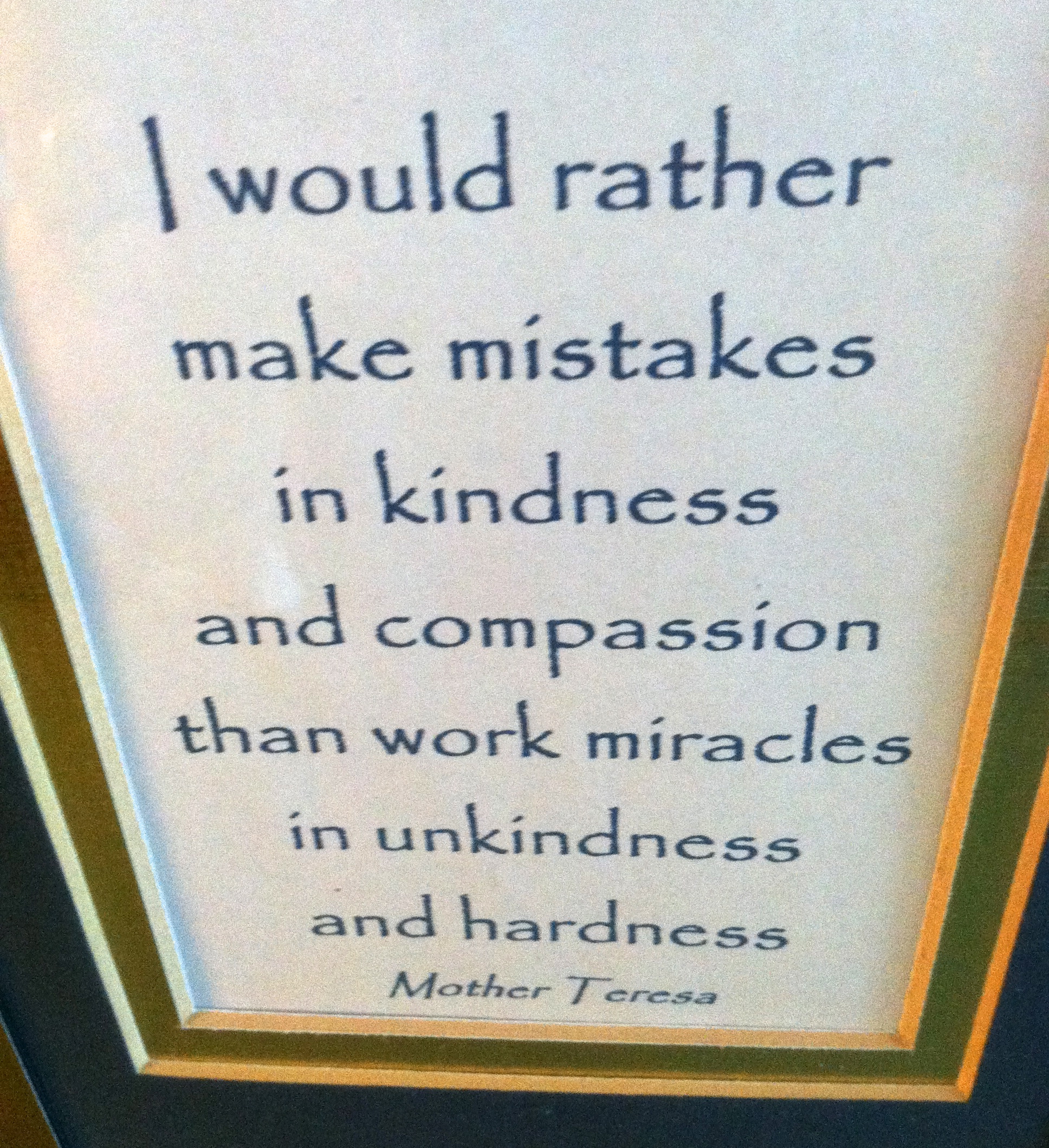
Say what you will, I love Mother Teresa. She was a saint—or will be soon enough. Two of her quotations guide my thinking. Friend Michelle had the first printed and framed for me as a gift: “I would rather make mistakes in kindness and compassion than work miracles in unkindness and hardness.” I keep these words on the wall in front of my desk. The second quote is just as powerful: “There should be less talk; a preaching point is not a meeting point. What do you do then? Take a broom and clean someone’s house. That says enough.”

IMG_1172

Amen

Underneath all of Pastor John’s patience and compassion is selfishness. I don’t like to sweep floors, not even my own, and I covet time. Andrew Marvell’s lines often haunt me: “But at my back I always hear, / Time’s winged chariot hurrying near.”

For reasons I don’t understand, Mother Teresa’s words have visited me lately to remind me that her broom is a metaphor and many days my most useful, loving action is invisible, inconspicuous, known only to a person or two and a gray sky or a lonely afternoon.

A couple days ago a friend—let’s call him Gene—asked if I’d take him to buy a new pair of winter boots. He laughed as he told me about one sole of his old pair flopping around like a drunk’s tongue as he walked home. Finally he gave up, took off the wounded boot, and hobbled up his gravel driveway, one socked foot wet and tender.

IMG_1162

Some glue might have fixed Gene’s boot, but oh well.

So I picked Gene up, and within fifteen minutes he was trying on boots. One problem: health issues render him listless sometimes; tying his shoes or buckling a seatbelt can be exhausting. Though it was a bad day, Gene, as always, was aware of my time. He tried to hurry, but our footwear errand had him sagging to the Walmart floor. Every movement was a labor: tugging the wad of tissue paper from the toe of the boot; unraveling the laces and flipping down the tongue; and—my Lord—pulling on the boot.

After watching for a minute, I said, “I got you, Gene.” So I helped him find the right size, get the boots out of the box and onto his feet, each time pulling up his weary white socks, and watched silently as he did test runs. He tried on four pairs, finally settling on ones without laces, like cowboy boots with chunky treads and generous toes.

The second pair into this process it occurred to me—breathing, shamatha—that helping Gene in, ugh, Walmart, was sacred. He droops from the effort of taking money out of his wallet, and all he needs to make his life significantly easier is somebody to take forty-five minutes and spot him as he buys boots that won’t rub a sore on his ankle.

I also knew that Gene needed more than new boots. He needed to know that I wasn’t impatient or annoyed. So I put my hand his arm and said, “How about I help you get that on?” And, “Don’t worry, Gene. I’m not in a hurry.” And, in the case of a pair with a dozen eyelets, “Hmm. You’ll be an hour getting into these. By the time you get them tied, you’ll be too tired to go anywhere.” Like I said, Gene and I are friends. We had a good laugh.

© Copyright 2011 CorbisCorporation

Prescription for joy. (Credit: corbisimages.com)

A couple minutes after I dropped him back off at home, my cell phone’s Sherwood Forest ringtone sounded. It was Gene, but since I was driving, his call went to voicemail. The message: “I just wanted to say thanks again for helping me, John. See you.”

Mother Teresa also said, “We cannot do great things on this earth, only small things with great love.” I’m not sharing Gene’s and my excursion because I’m a great guy. I’m a normal guy with the usual human portion of self-absorption, a guy with an aversion to brooms, but I got lucky. In a moment of potential frustration I was blessed with a visitation of the Spirit.

© Copyright 2010 CorbisCorporation

You’re holding gladness in your hands, little sister. (Credit: corbisimages.com)

A friend’s boots broke down. We got him a new pair. We did it together with love. I close my eyes, breathe, and days later the sacrament of trying on boots still cradles my soul. This is gladness.

The Healing Properties of Sleep and “Tuxedo Junction”

4409349002_09c1d34092

A crested duck, which I first encountered in Camden, Maine, where a flock of these darlings outside our hotel room kept wife Kathy and me up at night with their gossiping. (Credit: Anna Barberis)

Yesterday I felt like I was—as wise colleague Roy once put it—being pecked to death by ducks. The roads were populated by drivers who had cold lard for blood and cud for brains. Or they were staring at cell phones with that dazed, dunderheaded expression people wear when texting. Or they were fussing with the bag of frozen haddock or whatever in their backseat and assuming that the 153 cars behind them would gladly wait until all was situated.

I have a patience surplus everywhere except in the car, where I growl, grunt, sigh, squeal, sputter, and in moments of high upset, speak in Technicolor. You don’t have to count five 1000’s before reacting to the turning arrow. The %$&!# accelerator’s on the right! If you press your foot against it, your delightful Nissan Cube will get out of my crappy 1998 Mazda 626’s way. You’ll reach your destination. My sophomoric, un-centered spirit will unclench. It’s a win-win. Please. (Philosophical question: If you curse in your car and nobody hears, does it count against you?)

I’m ashamed of my traffic-temper, but take comfort that my ranting occurs in a contained space. And I don’t give people the finger or the skunk eye, either. But, boy, auto-John doesn’t gaze at humanity with compassionate eyes.

Of course, I can’t control the ducks behind other cars’ wheels, but I can silence the quacking from my radio—and did so this morning for sanity’s sake. On November 6th, as usual, Micah and I listened to National Public Radio for the ten minutes it took to get him to the day’s painting job, and the half-hour home, including a stop or two. The stories were newsworthy, but they struck me as crazy layered on crazy.

Story One

Woman holding her forehead

So tired! (Credit: corbisimages.com)

“During the last few decades the average American has lost an hour and a half of sleep per night,” Marketplace’s Ashley Milne Tyte reports. “Sleep researchers at Harvard say the workplace is suffering to the tune of $63 billion a year as a result of insomnia, and all the health and productivity problems that go with it.” Gail DeBoer, a credit union president in Omaha, has felt the pain. “Her restless nights began when she got her first smartphone a few years ago. She’d look at email just before she went to bed. But it didn’t end there. ‘I’d wake up at two or three in the morning thinking about work situations,’ says DeBoer. ‘I’d start sending emails because it was on my mind.’ After that, she never really got back to sleep. She began having regular headaches. Still, she told herself she was fine on about five hours a night.” Eventually, she wised up, quit checking e-mail before bed, got eight hours of sleep, and—go figure—the headaches stopped.

We are such suckers! Notice I say we, as in me, too. Where did we ambitious Americans get the idea that we ought to be checking in with the office at 11:00 p.m.? And what denial are we in that e-mailing or texting at 2:00 a.m. on a regular basis seems healthy? Most of all, what makes us think our minds and bodies are going to comply with a 20% reduction in sleep? Huh?

300px-Hammock_nap_on_patio

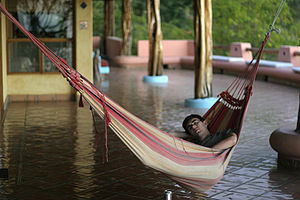
Napping in Costa Rica. (Credit: Wikipedia)

The news crackles lately with revelations not only of sleep’s necessity, but also its healing, restorative power. When I hear such reports, plump with research, I think to myself, “Yeah, no kidding.” It’s like hearing scientific evidence that your head’s going to hurt if you smack it against a cinder block. I’m glad that sleeping—and, therefore, napping—is slowly becoming smart and hip, but is our task-oriented tunnel vision so severe that we need to be convinced to get some sleep? I guess so.

Story Two

Investigating payday lenders, who do $49,000,000,000 in business each year, Planet Money’s Pam Fessler decided she’d go online, type in mostly fake personal information, and ask for $500. She didn’t really want a loan, only to see what the application process was like. Within a minute of clicking send, she got an offer of a loan up to $750. She’d have to pay it back within a week and the charge would be $224. That would be an annual rate of 1300%. No thanks. She logged off, but was hounded with phone calls from various lenders for months.

Fessler notes that if you take out such a loan, lenders require your bank account number, and whether you like it or not, you’re paying on time. They simply suck the dollars right out of your checkbook, ahead of your rent if necessary. They don’t care.

One comment/question: A 1300% yearly interest rate! Why is this practice legal?

Story Three

IMG_1151

From the Coleman family pantry. Don’t remember when we got them, but I guarantee they’re crispy.

According to Audie Cornish of All Things Considered, the Food and Drug Administration proposes that we do away with trans fats, also known as partially hydrogenated vegetable oil. The reason: people’s hearts are going bad. Adding “hydrogen atoms to a molecule of oil” keeps food from spoiling, but what’s more important, a box of Ritz Crackers that stays fresh for a decade or the cardiac health of the American public? The FDA says the latter.

I’m on the FDA’s side, but can’t help thinking that if we’re worried about the condition of people’s internal organs, we should take advantage of a two-for-one special and protect thousands of hearts and lungs by getting rid of cigarettes, which also harm bystanders. No innocent ever got heart disease from the second-hand partially hydrogenated vegetable oil of a Chips Ahoy.

Story Four

Another NPR report, which I’m not going to look up: an undocumented farm worker described through a translator how her boss made her go with him to an isolated field to get her paycheck. Before handing it over, he demanded her panties and oral sex. Such workers are reluctant to go to the police for fear of being deported or blackballed. What the hell?

Story Five

“Washington State Says ‘No’ to GMO Labels.” This report on whether we should be informed if our food has been genetically modified upsets me not because I care a great deal about the issue, but because of who’s in the fight. “Out of state companies such as Monsanto, Coca-Cola, PepsiCo and Nestle poured millions of dollars into the campaign against labeling, which argued that adding GMO designations would make food more expensive and confuse customers.” Ah yes, consumers need to be protected against their own stupidity. “In ads, they said that the labels would increase the price of food for a three-person household by $350 to $400 per year.”

42-34267055

Soybeans: Bet you cash dollars they’re Monsanto’s. (Credit: corbisimages.com)

I first heard of Monsanto in the 2008 documentary Food, Inc., which you should watch only if you never want to look at your dinner plate the same way again. I seldom subscribe to guilt by association, but if Monsanto is on one side, I’m probably on the other. This agricultural giant was in the news recently because, according to techdirt.com, the Supreme Court decided in its favor that farmers “planting their own legally purchased and harvested seeds can be infringing” on Monsanto’s patent. Don’t believe me? Check it out. I honestly believe the company is evil.

There were other stories, but you get the point. I’ve mentioned in at least one previous post that I’ve cut back some on news consumption. What’s different about this particular day of underwear as ransom for a paycheck and our poor, sleep-deprived country was the physical effects listening had on me. My neck was tight, my throat made guttural comments, and the spot beneath my sternum that wants to push out a holler when I get mad was about to let loose.

220px-Millposter1

The single-engine plane Glenn Miller was flying in was lost over the English Channel in 1944. (Credit: Wikipedia)

I want to be an informed, responsible citizen, but Thich Nhat Hanh is right in observing that the media we ingest have as much of an impact on us as the food we eat. So I’m counting news calories today. The definition of the term is arbitrarily slanted toward the negative, as if it’s more urgent for us to know what’s tortured in the world than what’s redeeming. Until the pendulum swings the other way, I’m planning to preserve my mind and body and listen to the Glenn Miller station on Pandora.

After my nap, which is just ahead, I have to go pick up Micah. “Tuxedo Junction” will wake me up without bringing me down.

An Embarrassing Measure of Blessing

IMG_1139

Baby Crash, who must be fed.

A Saturday morning routine has taken hold by surprise. As Kathy and I wake up at leisure—the one day that doesn’t begin with the aria of Bach’s Goldberg Variations set as the alarm on my snotty iPhone—we stay in bed, talking, breathing, warming to the hours ahead. “What do you have up for today?” We have friendly negotiations, then when she heads downstairs to feed dog Watson and cats Baby Crash and Shadow, I pray/meditate for half an hour. After paying bills, we run on separate rails until suppertime. It’s a calm, sane arrangement.

Yesterday I had a shamatha moment—calm abiding, clear awareness—before Kathy got out of bed. As she lay against me, her hair was all over my face. I breathed in its scent—a glad habit—and looked out through its wild lattice at the turning trees on the Shenley Drive boulevard. Sun and fall leaves behind my wife’s brown hair—a double blessing.

IMG_1129

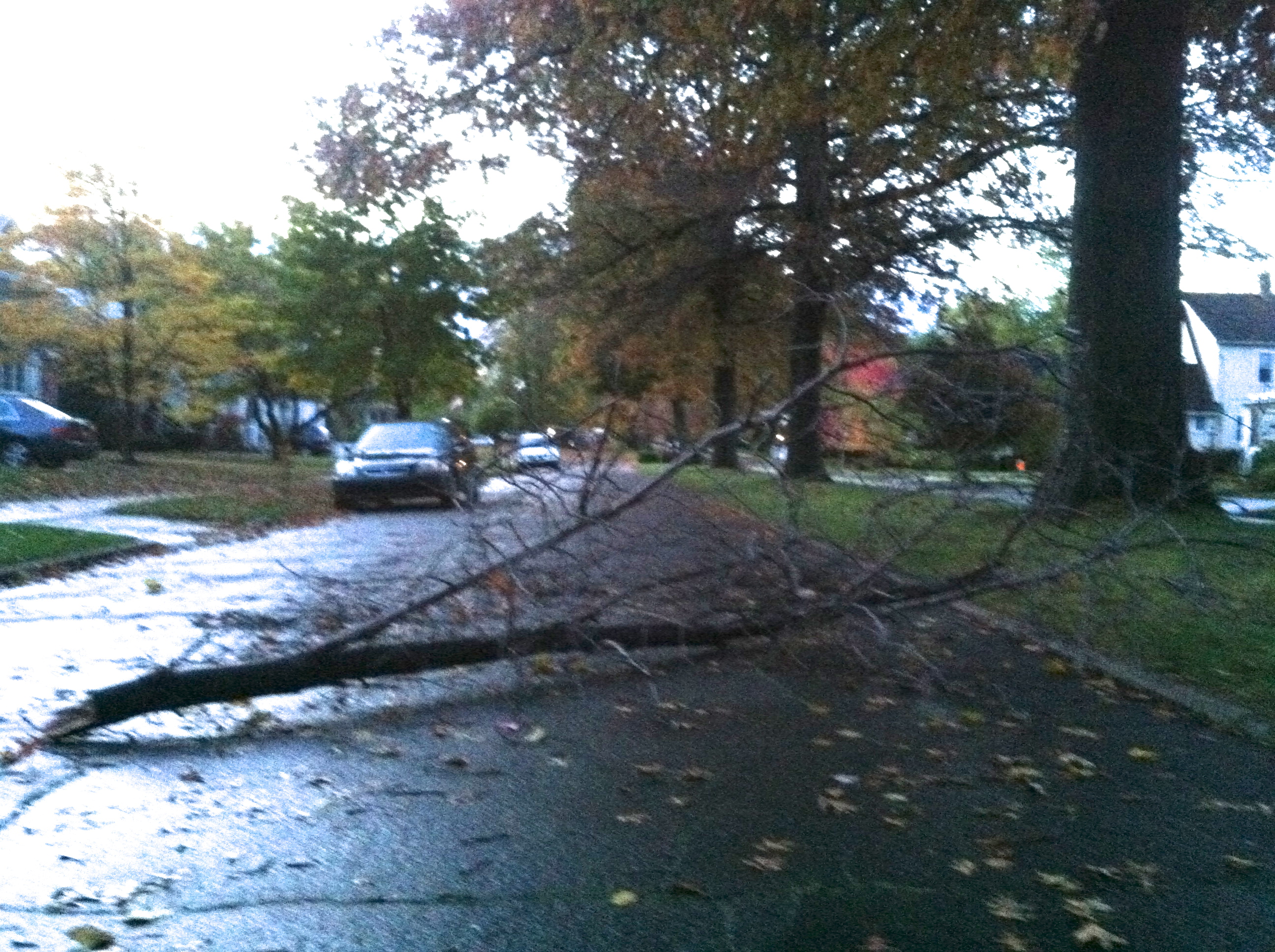
When I woke up, the storm had passed, leaving the Coleman family with firewood.

Another day last week as I settled into my nap, I watched those same beloved trees get thrashed by wind and rain. Though the temperature was in the forties, I opened one window about a foot so the hiss and deep ah of the weather could sing me to my rest beneath a feather quilt. Before sleep came, inhaling and exhaling the joyous riot outside, I remembered the fortunate position I’m in.

Each day I can take the Siesta Exit off of Interstate Absurdity and rest for an hour. Even during hectic stretches, I can usually pull to the berm for a twenty-minute power nap. The world is catching on to the restorative benefits of midday oblivion, but most people I know don’t have the liberty to do what has become central to my spiritual practice—stop, halt, cease and desist, for just a little while. The twenty to sixty minutes of repose isn’t counted as company time—as my brilliant grad school professor John Barth was fond of saying. When I add up work hours to make sure I’m earning my pay, nap isn’t part of the tally. Folding sleep minutes into compensated minutes would be sane, but at this point in our assumed societal covenant, it would be unethical. (Google and the Huffington Post provide napping pods, but I don’t know if they actually pay employees to nap. After a cluster of near misses, baggy-eyed air traffic controllers are cleared to close their eyes as long as the friendly skies are adequately monitored.)

corbis-u146396inp

Even Thomas Edison napped in his midday valley.

No, my blessing is a flexible schedule. I regularly work from 4:00 to 5:00 a.m. shaping programming for the church, then go back to sleep. Or I catch up on e-mails between 9:00 – 10:00 p.m. In a certain respect I’m always working, praying/meditating without ceasing, dreaming about what’s possible, opening myself to the Spirit’s leading. So at 2:30 p.m., when my forehead gets heavy, I surrender.

IMG_1144

The Shenley Drive maples that bless my siestas.

If I’m at church, the siesta kit finds its place on the floor of the pastor’s study, and I set my alarm for an hour ahead. At home, I lie on my left side in bed, look out the window at the Shenley Drive maples, and remember Kathy, who nurses cancer patients all day long and can’t stop to rest, son-in-law Matt, who nurses machines and has to slog through his midday valley, or son Micah, who paints with minimal breaks and comes home sweaty. I watch the maples from the barren branches of February to the swollen greens of July to the fiery leaves of October and reverence people who have no beloved brown hair to kiss or no bed at all. Then, especially when the weather plays against the trees, I nod off, embraced by an embarrassing measure of blessing.

A Guitar in the Sky Brings Me Back to Myself

I’m not sure how to describe the last month. An awakening? A healing? Whatever. All I know is my spirit feels like my eyes do in the morning, after I rub them and the world comes into focus. What little truth I know has been closer to me than it has in years. The clarity hasn’t given itself all at once, but in instants of inconspicuous awareness.

IMG_1121

Amiable English professor Kirk and his pup Ryan.

One month ago today—September 19, 2013—while perched at Starbucks, I read a short piece in the Erie Times-News: “Coffee? Leave your gun at home.” “Starbucks,” the report begins, “says guns are no longer welcome in its cafes, though it is stopping short of an outright ban on firearms.” Whew. Glad I hadn’t brought my glock with me. My immediate thought: What’s the big deal? I understand the need for Starbucks to issue a press release to announce this—what?—friendly request, but what have we come to when a coffee shop has to ask patrons not to show up packing? A confederacy of dunces? I tore the article out and slipped it into my bag. A truth was being lifted up to me, something obvious when seen under a certain light. (Note: I happen to be writing this at Starbucks, where Kirk Nesset happily works away with Pomeranian pup Ryan on his lap. I suggest Starbucks put out word that well-behaved dogs are welcome.)

Mike_Webster

“Iron Mike” Webster, who died at 50. His autopsy revealed chronic traumatic encephalopathy. Some doctors estimate that his brain had suffered the equivalent of 25,000 car crashes. (Credit: Wikipedia)

Then I watched “A League of Denial: The NFL’s Concussion Crisis” on PBS’s Frontline, my jaw growing more slack by the moment. Everybody’s affronted by clear evidence that the National Football League has been playing dumb for years and covering up what it knew about how unhealthy it can be for a man to have his clock cleaned every Sunday. Seriously? The NFL deserves to get its knuckles cracked—more than 765,000,000 times—for letting its lucrative human demolition derby go on and on, but we’re not dealing with a league of denial here. We live on a planet of denial. What sane player or fan would suppose that you could repeatedly slam your head against other heads, bodies, and the ground and not spend your retirement dazed or worse? And don’t say, “Oh, but they wear helmets.” Um, okay, but no protection is going to prevent your brain from smashing about your skull if your head smacks into a hard surface. My point: this Frontline program holds a truth, but it’s not about football. It’s about a society’s capacity for reason. I love to watch football, but how compassionate is it to watch men risk destroying themselves? Time to give it up.

Rolodex.agr

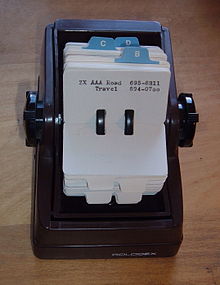
A Rolodex like Mom’s, except hers was an ugly orange. (Credit: Wikipedia)

Next: on October 10, 2013, the Erie Times-News carried a short article by Patrick May of the San Jose Mercury News: “Tech stress: With proliferation of digital devices, we’re freaking out.” (Side note: Nobody forwarded me the memorandum announcing the change in practice of capitalizing first letters of words in a title. I’m not against it, but it looks wrong.) Mike Kushner, co-owner of Palo Alto, California’s Bay Area Computer Solutions, describes the rabid stress techno-junkies live with: “We see people crying; we see people angry; we have people lash out at us because we can’t recover what they lost . . . . People are under incredible pressure these days because of how dependent everybody is on their computers and especially their smart phones.” Boy, I’ll tell you, all this iTechnology is, in the words of Rick Postma of Holland, Michigan, “slicker than a harpooned hippo in a banana tree.” My mother of blessed memory kept a $1.99 K-Mart Rolodex on her end table and never once cried or lashed out over lost contacts. Meanwhile, I and thousands of others suffer from, as May puts it, “’phantom vibration syndrome,’ that creepy sensation that your smart phone is buzzing in your purse or pocket when in fact it isn’t.” As an iPhone owner, I ask members of the tribe, “Have we lost all good sense?” Suspected truth: We have.

Aime-Morot-Le-bon-Samaritain

“”The Good Samaritan” by Amie Morot.

Next: A few days ago fellow Starbucks barfly Alan stepped out outside on the porch where I was sitting, raised his closed eyes to the clouds, and took in a cosmic breath. “Yeah,” I said, “things could be a lot worse, huh?” Alan is Zen2 (tall, lanky, constant half-smile, slightly wild gray hair). He told me about a twenty-year-old guy he met at the Regional Cancer Center: “My throat cancer was nothing compared to what that guy had.” We breathed together a few times, then he bowed slightly and walked to his car, chewing his scone on the way. Truth: at every possible opportunity, close my eyes, breathe, and bow to my neighbor. (“And who is my neighbor?”)

© Copyright 2010 CorbisCorporation

“I want a human being.” (Credit: Wisson/Jordan)

Next: I was standing in line at the bank. An old guy sat in an armchair and voiced a single desire into his cell phone:  “No, I want to talk to a human being. No, I want a human being. Any human being who’s there. No, I want a human being.” Of course, he was speaking to an automaton, but speaking a sane truth all the same. Is it too much to ask for a human being? On the phone? At the grocery store check out? On the front porch? I’d like to invent a social media just for this man. I wouldn’t (and couldn’t) name it Facebook. I’d just call it Face.

IMG_1117

A guitar in the sky brings me back to myself.

Finally: Micah needed a drum pad, so we stopped at Erie’s World of Music. As he walked to the door, I stayed in the car and reached for my iPhone—a habit, impulse. For no particular reason, as I thumbed my phone’s snotty leather cover, I looked out my window at the sky and saw a guitar. I used to park in that lot once a week for Micah’s drum lessons and never noticed that guitar next to the World of Music sign. A wordless question brought me to myself: John, aren’t there better things to look at than text messages, e-mails, and ABC’s news stories? Check out the guitar in the sky and while you’re at it, receive the sky.

I’ve don’t think objectivity exists, but I do believe in truths. Though I’m not smart enough to define them, I now have sightings. Truths rest at my feet or hover in the sky when I’m aware, when I breathe. I see them and give thanks. I feel like myself. I feel at home.

Kilimanjaro Dancing on the Head of a Pin

photo

Elena a couple weeks ago

“Who would have ever thought we would get to this day and that it would be so joyful?” wife Kathy said from the kitchen doorway. Her question embraced me so completely that I didn’t even say goodbye. I just stood there in the quiet, mixing up Greek potato salad, my contribution to daughter Elena’s baby shower.

Well-meaning friends tell you that your teenage kids will outgrow their problems and turn out fine, but, of course, sometimes they don’t. Everybody knows this, but when you have good cause to wonder whether your daughter or son will live to see legal drinking age, folks who love you want to offer hope. I don’t blame them. When Elena was a Goth chick carving LOVE and HATE into her wrist, disappearing in the middle of winter nights, and gobbling a cocktail of pills, I knew enough to translate all words of comfort. “I love you,” was the real message. “I see what you’re going through. Don’t lose heart.” I never came close to giving up on Elena, but I never let myself wander far from the truth, either. When you attempt suicide as a way of calling out for help, you might die. Happens all the time. When you sneak out at 3:00 a.m. to trek across town through slush to a creepy boyfriend’s house, you might get hurt in ways you can’t yet imagine.

As Kathy stood in the doorway, I’m sure she was remembering those four or five years when worry about Elena constantly had us by the throat: “Who would have ever thought we would get to this day and that it would be so joyful?”

0-7

Go ahead, tell me this old sanctuary doesn’t glow!

When the Greek potato salad was ready, I took it to the church fellowship hall, which Elena, Kathy, and a herd of helpers had decorated within an inch of its life. I’d led hundreds of worship services in that hall, formerly the Abiding Hope Lutheran Church sanctuary, but never have I seen that simple Cracker Jack box room glow more than it did when I put my bowl on the buffet table and stood still as if in a dream.

If all goes well Kathy and I will be grandparents toward the end of November. Holding my grandson for the first time, I may think, “Who would have ever thought . . . ?” After what the Coleman family went through when both Elena and son Micah were teenagers, I regard every joy as a miracle—Kilimanjaro balanced on the head of a pin. Witness the wonder through tears, but, baby, don’t forget it could tip over.

IMG_0767

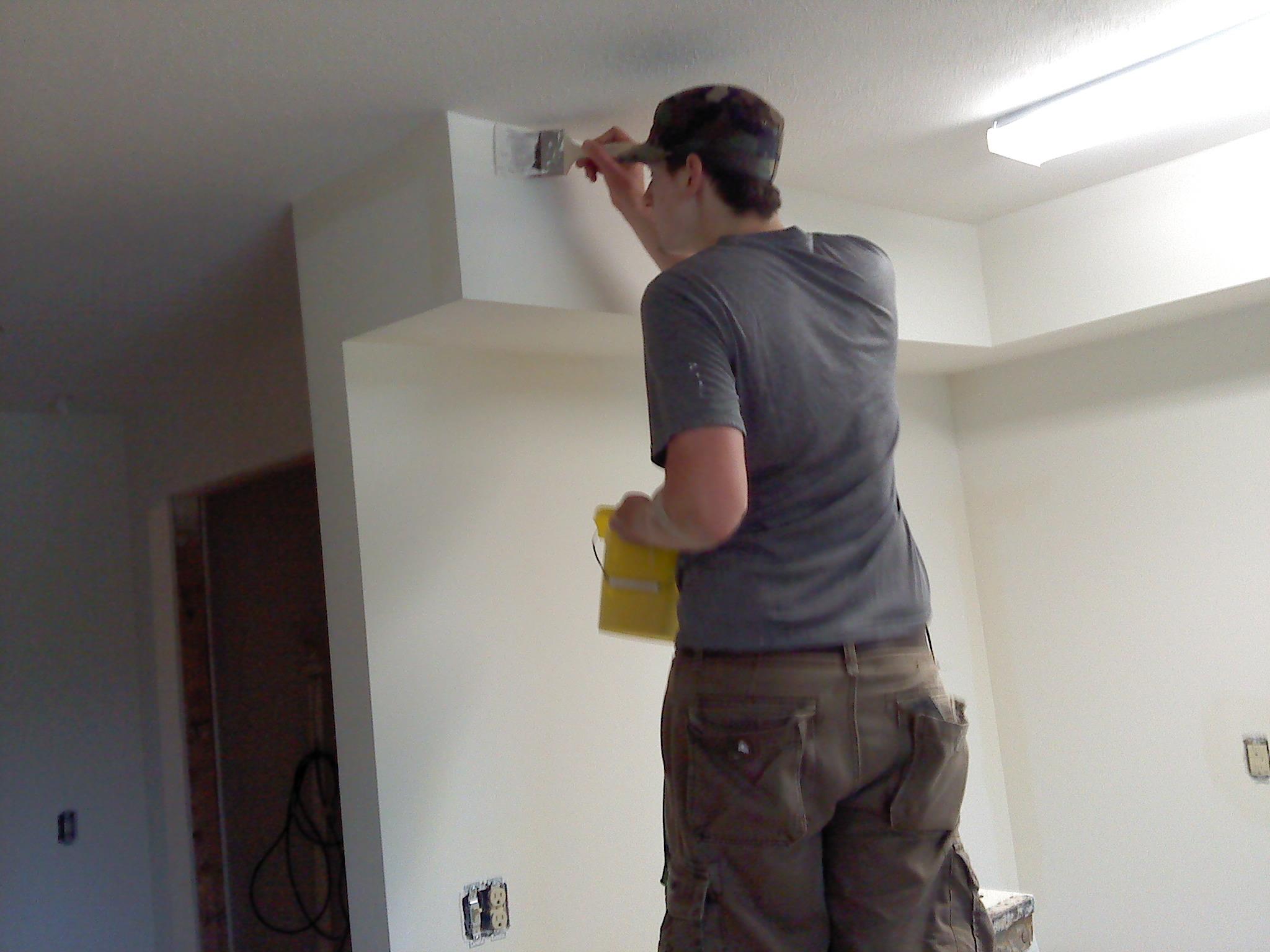
Micah, making me proud every day from 8:00 a.m. – 4:30 p.m.

While Elena, her husband Matt, and our future grandson seem solidly on the path to okayness, Micah also has Kathy and me saying, “Who would have ever thought . . . ?”  When he was going through his wall-smashing, heroin-shooting days, Kathy and I questioned whether he or we would make it to joyful. Now, not only did he report this morning to his full-time painting job with snot-jammed sinuses, but he’s been going over to his grandmother’s house lately. He who once stuck with a job a couple months at best enjoys helping her with chores and hanging out with her, watching movies and kibitzing. He’s been clean well over a year and is about to turn in his 401(k) paperwork. Somebody pinch me!

An old volcano dances on a pin: that’s the Zen half-smile I took with me into the Pastor’s Study as the ladies ate, laughed, and whooped for a couple of hours in the glowing fellowship hall. I put my mats, blanket, and pillows on the floor and took a delicious, mediocre nap. A couple text messages joined with laughter forte to hold me on the edge of sleep. No matter. When I got up and checked on the party, nothing had tipped over.

0-6

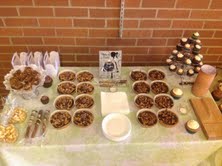
Dear Lord, Join me for a turtle brownie? Amen

For me, shamatha—calm abiding—in the presence of fragile joy is the best way I know to be grateful. I did thank God for Elena’s great day. I do thank God for Micah peeing clean and grappling with his grandmother’s weeds. But my thanksgiving is complicated: it’s about inviting God to celebrate with me; it’s not about thanking God for easing up on me and setting my kids straight. Maybe this is the way to say it: I don’t give thanks; I am thanks.

390px-Siddhartha_Sanskrit

Cover of Sanskrit translation of Hermann Hesse’s “Siddhartha.” (Credit: Wikipedia)

During Elena’s and Micah’s crazy days, I found comfort in Hermann Hesse’s novel Siddhartha when the ferryman smiles and comforts a suffering father, Siddhartha:

Ask the river about it, my friend! Listen to it, laugh about it! Do you then really think that you have committed your follies in order to spare your son them? Can you then protect your son from Samsara? How? Through instruction, through prayers, through exhortation? My dear friend, have you forgotten that instructive story about Siddhartha, the Brahmin’s son, which you once told me here? Who protected Siddhartha the Samana from Samsara, from sin, greed and folly? Could his father’s piety, his teacher’s exhortations, his own knowledge, his own seeking, protect him? Which father, which teacher, could prevent him from living his own life, from soiling himself with life, from loading himself with sin, from swallowing the bitter drink himself, from finding his own path? Do you think, my dear friend, that anybody is spared this path? Perhaps your little son, because you would like to see him spared sorrow and pain and disillusionment? But if you were to die ten times for him, you would not alter his destiny in the slightest.

280px-Mount_Kilimanjaro

Kibo summit of Kilimanjaro (Credit: Wikipedia)

Of course, it’s not as though the path of samsara—the life journey of death, suffering, and rebirth—ends with a first child or a full-time job. Kilimanjaro is always losing its balance.

“Who would have ever thought we would see this day and that it would be so joyful?” How many nights did I stare into the darkness, wondering, trying to breathe? We all have to walk our own path, and for Elena and Micah, at the moment, the footing seems good. What I’m trying to say is, “I am thanks.”

photo

Elena ready to welcome our grandson to the world.

A Zen-Christian Night Teaching

Running into Thich Nhat Hanh is always cause for celebration. I’ve never visited Plum Village, his community in France, never heard him speak in person. Still, like millions of his mindful followers, I consider him family.

Thich_Nhat_Hanh_12_(cropped)-1

Thich Nhat Hanh in Paris in 2006. (Credit: Wikipedia)

Last night he showed up in a short dream. Thay, as he’s known to his students, and I stood in the Coleman family kitchen. I can’t remember his exact words, but he said that in his family they drink tea from small cups. He smiled, gently rested his hand on my forearm, then placed a tea pot and a cup on the counter. He smiled again. That was it.

42-38174673

Credit: Michele Constantini

In this moment, I breathe in and out and savor Thay’s night teaching. Most of my dreams are anxious, like I’m enrolled in a college calculus class and forget to attend all semester. But I receive Thay’s visitation as a blessing from my Judeo-Christian God. “Drink slowly from the little cup,” both say. “Why are you always rushing?” Thank you, Thay. Thank you, Lord. Your spiritual hybrid gratefully accepts the healing lesson.

IMG_1055

Stop to notice the spider plant blossoms reaching to the sink in the church bathroom.

A week ago Thich Nhat Hanh showed up in the form of words: “To be is to inter-be,” he writes. “We cannot just be by ourselves alone. We have to inter-be with every other thing.” For Thay, garbage and flowers inter-are. “The affluent society and the deprived society inter-are. The wealth of one society is made of the poverty of the other.” The same goes for people. Reflecting on the suffering of a young prostitute in Manila, Thay observes, “Looking deeply into ourselves, we see her, and we will share her pain and the pain of the whole world. Then we can begin to be of real help.”

IMG_0982

Neighborhood sage Patrick with well-loved Tin Man. This Down’s syndrome kid’s a master at inter-being.

Half an hour ago, sipping a Starbucks redeye, I was inter-are with a tall, skinny guy standing in the long line: shaved head, felt newsboy cap, great puff of a graying beard, black long-john shirt, corduroy pants. For all I know he may have been the most neurotic soul in the coffee shop, but he appeared so overwhelmingly corduroy that I thought to myself, “That dude. I want to be like that dude.” And now, darned if I’m not relaxed—chunky, tight-bearded, balding, but relaxed. I’ll take it, thankful that inter-being is concrete, tangible.

Hund-hut

A dog channels my corduroy brother. I want to be like this dog. (Credit: Wikimedia Commons)

Five minutes more and I’m off to the church for office time. In prayer this morning, I leaned everything I had into the loving bosom of I Am. In the night, Thay touched my arm. I can still feel I Am and Thay. I’ll take them both with me, along with the corduroy man who blessed me with his peace.

The General Dance

When we are alone on a starlit night; when by chance we see the migrating birds of autumn descending on a grove of junipers to rest and eat; when we see children in a moment when they are really children; when we know love in our own heart; or when, like the Japanese poet Basho we hear an old frog land in a quiet pond with a solitary splash—at such times the awakening, the turning inside out of all values, the “newness,” the emptiness and the purity of vision that make themselves evident, provide a glimpse of the cosmic dance.

42-25254327

Credit: Gyro Photography

For the world and time are the dance of the Lord in emptiness. The silence of the spheres is the music of a wedding feast. The more we persist in misunderstanding the phenomena of life, the more we analyze them out into strange finalities and complex purposes of our own, the more we involve ourselves in sadness, absurdity and despair. But it does not matter much, because no despair of ours can alter the reality of things, or stain the joy of the cosmic dance which is always there. Indeed, we are in the midst of it, and it is in the midst of us, for it beats in our very blood, whether we want it to or not. 

Yet the fact remains that we are invited to forget ourselves on purpose, cast our awful solemnity to the winds and join in the general dance. (Thomas Merton, The New Seeds of Contemplation)

42-17792809

Credit: Bill Byrne

My wife Kathy is not a napper. I’ve sung her praises in at least one previous blog post, but she and I differ on the matter of midday oblivion. It occurs to me that she and I also approach shamatha differently. My calm abiding tends to be self-referential (i.e. naval gazing), while Kathy mostly looks outward at the world and others to find meaning. This is not to say that she lacks self-awareness and I am captive to my own reflection; rather, we have different spiritual styles.

It helps to acknowledge this. For a couple weeks my karma’s been cramped and bitter, and it may be because I’m stuck in my own awful solemnity, analyzing the phenomenon of my life into strange finalities. In other words, I need to get out of my naval and out into the general dance, which has been going on around me all these days of my funkification.

In fact, the cosmic or general dance—whatever you want to call it—has been getting a bit out of hand, especially in Kathy’s land of shamatha, the Coleman backyard. Check out this short gallery I took a couple weeks ago of God and Kathy dancing.

IMG_1085

Evidence of this being the Coleman’s driveway? A garage at the end; that’s about it.

IMG_1081

A clematis vine taking over the hedge and gardening tool shelf.

IMG_1080

Behind the foliage is a grill. When I cook, I look like Arte Johnson on “Laugh In.”

IMG_1079

Getting in the backdoor requires dancing with greenery.

IMG_1095

The dance isn’t restricted to the backyard. It plays inside, too, on the kitchen windowsill. You have to move plants to open the window.

IMG_1107

An orange tree took over the breakfast table until friend Claudia adopted it last week.

As plant life took over our property inside and out, pineapple-sized grandson-to-be has been shaking his groove thing under the firmament of daughter Elena’s belly.

photo

Elena with dancing future grandson.

No matter how much I try to turn the joy beating in my very blood to hot dog water, frogs keep inviting me to splash into ponds with them. Mint leaves wait for me to pick them and lift them to my nose. The clematis overtaking the hedge hopes I’ll stand still and receive its gladness. My future grandson is generally dancing and wants his gramps to join him. Kathy says, “You need to go outside and look!”

Forget yourself, Coleman. Go outside. Breathe. Know shamatha. Cast yourself dancing to the winds.

Getting Past Reptilian, Waiting for Grateful

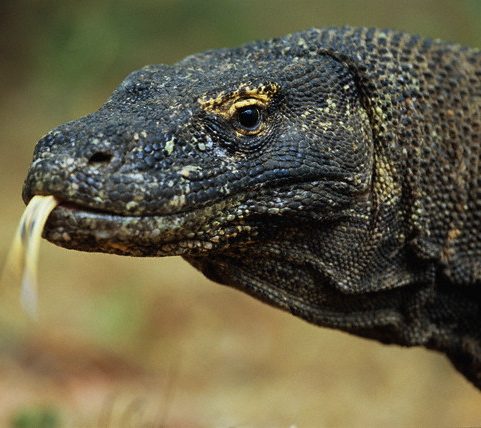
In a week or two I may be grateful for yesterday, but this morning I feel beaten up. Grateful: I reached a new level of understanding my personal call as a world citizen. Beaten up: several brushes with reptilian anger. That’s ungenerous, I guess. Reptiles are people, too.

42-18135016

Keep your nasty tongue off my book. (Credit: http://www.corbisimages.com)

Brush #1 didn’t have much effect on me, other than starting the day on a rancorous note. I rarely read book reviews, mostly because mine have been crappy, but while sipping coffee and warming to my writing hour, I checked out Michiko Kakutani’s assessment of Norman Rush’s novel Subtle Bodies. Why would the New York Times publish such a slaughter? Kakutani went after Rush like Hannibal Lector sliced up that poor jail guard in Silence of the Lambs: the lovely aria of Bach’s “Goldberg Variations” playing as a blood-smeared Anthony Hopkins basks in his kill. I’ve never read Norman Rush and never heard of Michiko Kakutani, but it’s hard to imagine a novel that deserves komodo dragon treatment like this:

  • “an eye-rollingly awful read”
  • “Readers given to writing comments in their books are likely to find themselves repeatedly scrawling words like ‘narcissistic,’ ‘ridiculous,’ ‘irritating’ and ‘pretentious’ in the margins.”
  • Adjectives employed: “cloying”; “claustrophobic”; “totally annoying”; “insufferable”; “flimsy”; “tiresome”; “solipsistic”
Heyes

I ate the author with fava beans and a nice Chianti. Anthony Hopkins as Hannibal Lecter (Credit: Wikipedia)

Geez! As you might expect, writers don’t cozy up to such savagery. Jonathan Franzen has called Kakutani “the stupidest person in New York” and “an international embarrassment.” Ha. Take that! A nasty book review is no skin off my nose, but when I left Starbucks and headed off to church work, I wasn’t thinking, “Ah, how sweet the morning air is.”

220px-Cyclops_P6110086

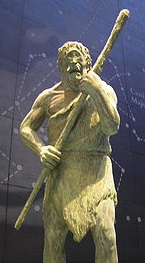
And how may I assist you today? Statue of Cyclops at the Natural History Museum in London (Credit: Wikipedia)

Cut to late afternoon for brush #2: Micah called to report that at long last he received a response to repeated phone messages about fines associated with his drug-related felony conviction. In short, the kid’s been trying to set up a payment plan and eating weeks and week of courthouse static. Far from apologizing for failing to get back to Micah, the Cyclops who finally called ripped him a new one in loud, deep mumbles. I have only my son’s word to go on, but it sounded to me like a verbal Rodney King ass-whipping–this for someone who’s been clean for over a year, following all the rules with bowels aquiver, and holding down a full-time job.

$%&*@! I don’t remember the last time I’d been so enraged. The evening was a controlled train wreck as I strained through a meeting and a short worship service and washed the day down with a couple of splashes from an econo-box of burgundy. (By the way, for a fun piece on capitalizing wine names, check out this by William Safire.)

This morning, my prayer was like a car out of alignment. I’d written a letter to the local probation office—probably never to be sent—to drain off some of my anger yesterday afternoon, but my prayer a few hours ago kept pulling toward the conversation I’d like have with the Cyclops. I’ve named him this, by the way, because he didn’t have the courtesy to identify himself when he called.

Much as I’m uncomfortable with anger, it’s not all bad. The late Christopher Hitchens once said in an interview that he found hate to be a wonderfully motivating force for his writing. Upset people can accomplish a lot. But now for my gratefulness: anger is not my calling; it’s not what I have to contribute as a planetary resident; though fury is having its way with me now, I know what I ought to be about. In the flawed silence of prayer, the Spirit helped me learn a couple of things: 1.) I’m not going to deny the rage residing in my chest, which has me gulping in cleansing breaths. 2.) I consume my earthly share of oxygen, avocados, fossil fuel, and beverages for a single reason: to regard everybody and everything with loving eyes. That’s it. That’s the ball game.

200px-Phyllis_Diller_Allan_Warren

I’d like to place an order for twenty-seven Phyllis Dillers, please. (Credit: Allan Warren)

Of course, I specialize in messing up this calling. Naming my son’s caller the Cyclops is a failure, but I’m still operating out of my own reptilian brain. I want to let out a rant against the guy from probation like Chevy Chases’ tirade against his boss in “Christmas Vacation.” I want to give him a turbo purple nurple, a burlap wedgie, a swirly in a ballpark toilet after One Dollar Succotash and Sauerkraut Night. I want to fill his house with clones of Joan Rivers, Don Rickles, Carol Channing, Sam Kinison, Mr. T., Pee Wee Herman, Phyllis Diller, Gilbert Gottfried, Tiny Tim, Roseanne Roseannadanna, and the cast of “Gilligan’s Island.” You get the idea: my heart’s pumping crocodile blood at the moment.

Noodling around with creative revenge is fun, but it’s not what I’m about. I’ll get past this cruddy karma. What I won’t get past is love. Most of my wells are shallow or fetid, but for whatever reason, I have love to spare. So, thankfully, when shamatha gets my brain human again, I’ll get back to work. Eventually, in my imagination I’ll have a compassionate conversation with the Cyclops, taking into account the probability that he listens to a dozen people a day lying, playing stupid, or making excuses. His red voicemail light is hot to the touch.

I’m eye-rollingly awful at some jobs, but most days I can hold what’s before my eyes in a kind embrace. I’m grateful to have words to put to such a life purpose. Pray for me that I understand myself.

42-26259167

Corny? Yes. I want to hug the world or at least rub noses. (Credit: FotoFeeling)

A Syrian Invasion of Presence

Yesterday at 5:35 p.m. I lay down in my air conditioned bedroom, set the iPhone alarm for 6:30, and closed my eyes. Naps after 5:00 are rare because they can mess with night sleep, but I was tired, boss, dog tired. On top of all the usual bothers that wear a soul out, a catchy promise had been attacking me repeatedly: no boots on the ground—namely, Syrian ground. Please, enough with the no boots on the ground. Shut up! I preempted the alarm at 6:27 and got up.

© Copyright 2013 CorbisCorporation

A perfect addition to the “boots on the ground” campaign. (Credit: Catherine Leblanc)

For the record, I’m for putting boots on Syrian ground, millions of them if that would solve the toxic problem. I don’t know the specifications of combat boots these days, but let’s start with a million of those. We should also have a million of those trendy powder puff boots girls now wear even with shorts. If the ground is going to be dusty, a couple million should be cowboy boots. To jazz things up, I’d like to see 750k red stiletto boots. What the hey?

I love the idea of boots in the Middle East, but if we put any soldiers in them, I’m slipping on my old guy gardening sneakers and marching with a “Make Love, Not War” placard. No boots on the ground is horse crap for two reasons: 1.) Yes, it’s fun to say, especially if you add a cackle and W-style grin. But we’re not talking about boots; we’re talking about human beings. So stop calling them boots. It’s like calling a woman a skirt. 2.) Remember H. W.’s “Read my lips. No new taxes”? Careful what you promise. How wise is it to rain Tomahawk missiles on Bashar al Assad while assuring him that you won’t follow up with troops if he doesn’t get the message—even if you don’t intend to? In football terms, quarterbacks shouldn’t telegraph their passes.

I propose a new promise in place of the boots deal: No Tomahawks in the sky. I voted for Barack Obama and generally support him, but come on, let’s get a clue. Expecting violence to promote peace is madness. My astute ten-year-old neighbor Patrick, who has Down’s syndrome and doesn’t bother with state-of-being verbs, describes how well shock and awe ends conflict: It not working!

Syria1_large

Credit: blog.orlandoweekly.com

Photographs of dead Syrian kids make lots of us want to take a vintage tomahawk to Bashar al Assad and company. I can even understand those who say in frustration, “Just bomb them off the map, all of them,” though this is a curious response to indiscriminate gassing in which children are collateral damage.

Just as America’s collective outrage twelve years ago at precisely this time was warranted and righteous, so too Assad’s saran gas ought to have us bloodshot with anger. If we want to make ourselves less pissed off, then bombs and boots might do some good. But if we want to make the world more peaceful, then we have to find within ourselves forms of bravery and valor that at first glance look like impotence.

You’ll ridicule me all the way to Damascus, but I believe an invasion of presence would be a much more effective response to Assad than weaponry. Instead of launching missiles, what about sending citizens? I’m not kidding. Let’s not put boots on the ground, let’s put loafers and sandals. Instead of guns, let’s carry cell phones and camcorders. Instead of Kevlar, let’s wear luau shirts.

250px-Birmingham_campaign_water_hoses

Birmingham, 1963. (Credit: Charles Moore)

Our mission? If we really want to stop tyrants from massacring their people with gas and machetes—I mean want to stop them enough to risk personal harm—then I bet thousands of civilians from dozens of countries standing beside vulnerable children and their parents and grandparents would deter brutality much more decisively than military action. Obviously, the danger would be enormous, but nothing magnifies the rotten face of violence like witnesses and testimony. Remember the fire hoses of Birmingham? Or Gandhi’s march on the Dharasana Salt Works? Mindful, strategic non-violence can be effective.

The trouble is, peaceful invaders have to be willing to inhale saran gas. Or maybe we can just bring gas masks for everybody. Forgive me; I haven’t fleshed out all the details of this campaign.

A soldier from the U.S. Army's 1st Platoon, 18th Engineer Company, Task Force Arrowhead wakes from his bed on the back of an armoured truck at FOB Mizan in Afghanistan

Somebody has to wear the boots. (Credit: Tim Wimborne)

Go ahead, call me naïve, a crazy pinko. But I challenge people of conscience to speculate about the pragmatism and morality of a Syrian invasion of presence. How can the United States and other countries best demonstrate that Bashar al Assad’s use of chemical weapons on his own people won’t be tolerated? What speaks with the greater clarity and wisdom: Tomahawk cruise missiles and no boots on the ground or thousands of courageous warriors armed with their eyes and voices? My money’s on the eyes and voices.