An Unorthodox Peace

IMG_3646This past Sunday the church I serve, Abiding Hope Lutheran in Erie, Pennsylvania, held a groundbreaking ceremony at the site of our new church building, the foundation of which is already well underway. After morning worship at the old place, we all got into our cars and headed the mile or so to our future home.

For mundane reasons I had to drive son Micah’s car, which is always in unapologetic squalor. Almost to the end of the parking lot, I had to double back: the processional cross was still on its perch in the sanctuary. After fetching it, I looked at the backseat and paused: Should I put the cross down on that mess? Because I realized that entirely different questions were on my mind—ones I could answer right away—I rested the cross on my son’s work clipboard, toilet paper, hoody, etc., no food debris, thankfully.

The groundbreaking was meaningful and fun and didn’t seem at all redundant. No silver shovels for us. Everybody who wanted to turn some dirt brought a shovel from home, especially our kids. The ground was packed down by construction vehicle traffic and hard as the cinderblock foundation. We found a soft patch for the young ones with sandbox shovels and let them have at it, sang with gusto, and said our prayers and good intentions. The adults chipped loose teaspoons of gray crust.

When we finished, I lay the cross over the chaos for its ride to the Coleman house, where it leaned overnight in the dining room.

IMG_3650

Processional cross

“Ooh,” Micah said, spotting what he actually carried years ago as an acolyte. His question was implicit: “What’s the deal with the cross here?”

I explained.

He held it like a shovel—Christ at the top—and pretended to chip at the floor: “So did you dig with it?”

“It would have been fitting,” I said, “but, no, a couple of kids held it for the ceremony.”

As Micah has grown, we’ve developed an understanding. He gently teases me, but knows that my faith is spacious and merciful, blinding white with Mystery. And I take his searching seriously and don’t meddle with his atheism.

The purest image of my spirit’s posture is this: I don’t fear for my son. I don’t fear for anybody.

My Creator isn’t abstract. Often when I close my eyes and breathe, a love that feels bestowed rises in my throat—as when a parent watches a child disappear through the school doors. My chest is drawn toward a planetary embrace. The longing is physical.

It may be nothing more than my own middle-aged chemicals inducing some weird prayer-meditation high. I’m probably bat-crap crazy. I can’t offer a defense, only a description of the love that I bet my life on. God is what I call this love, but the older I get, the more I’m drawn to the ancient Jewish tradition of not vocalizing Yahweh. Shh. Only know and breathe compassion—for all, for self. I want to name the Holy One with my flawed heart and hands. My voice can’t be trusted entirely.

How far is the reach of Sacred Love? Whom and what does it rest upon? On Sunday, when I lay the cross on Micah’s slop in the backseat—nothing compared to the past squalor of heroin, arrest, and rage—I spoke my Christian answers to the questions behind my question. The universe is composed of beloved daughters and sons. Who am I to send anyone into exile? Helpless before grace as I am, how can I presume to stand in the way of Love?

IMG_3648

Christ’s metal blessing upon the chaos

This might not be the most convenient parking place for a pastor. Love’s current in the Bible is strong, but troubling blood flows there, too. I will only say that I’ve made an unorthodox peace with Egypt’s firstborn and Israel’s young women lacking evidence of their virginity, stoned to death on their family’s doorstep—we have a private understanding.

It’s enough, I guess, to admit that in resting a processional cross on the backseat of tired old Mazda sedan, I was confessing my belief: the risen Christ bestows a metal blessing on every mess in every land, on every soul aching with belief and disbelief.

Home Is When I Come to Rest

IMG_3043

The wall of my Shenley Drive study

A couple evenings ago, while walking our beloved gimp Watson to the end of Shenley Drive, wife Kathy and I counted the number of times I’ve moved since my sophomore year of college, when I rented my first apartment. I narrated, and she revised here and there.

In twenty-three years, I’ve moved twenty times, with Kathy along for most of them. We married young (I was twenty-one, she was twenty) and amazingly we’re still together. Three bouts with graduate school, daunting challenges with our now-adult daughter Elena and son Micah, my nervous breakdown and struggle to be a good household helpmate: such realities beat up a marriage. We’ll celebrate our thirty-second anniversary this July because Kathy is forgiving. I’m a nice guy and patient to a fault, but we’re embarking on yet another move as husband and wife because the latter gives the former endless second chances.

My twenty-first move, Kathy’s twentieth. This one is from Erie, Pennsylvania’s west to east side, fifteen minutes, five or six miles. 2200 square feet to 1000. Two stories to one. Upper middleclass to middleclass. Shenley Drive to Parkway Drive. 16505 to 16511.

IMG_3014

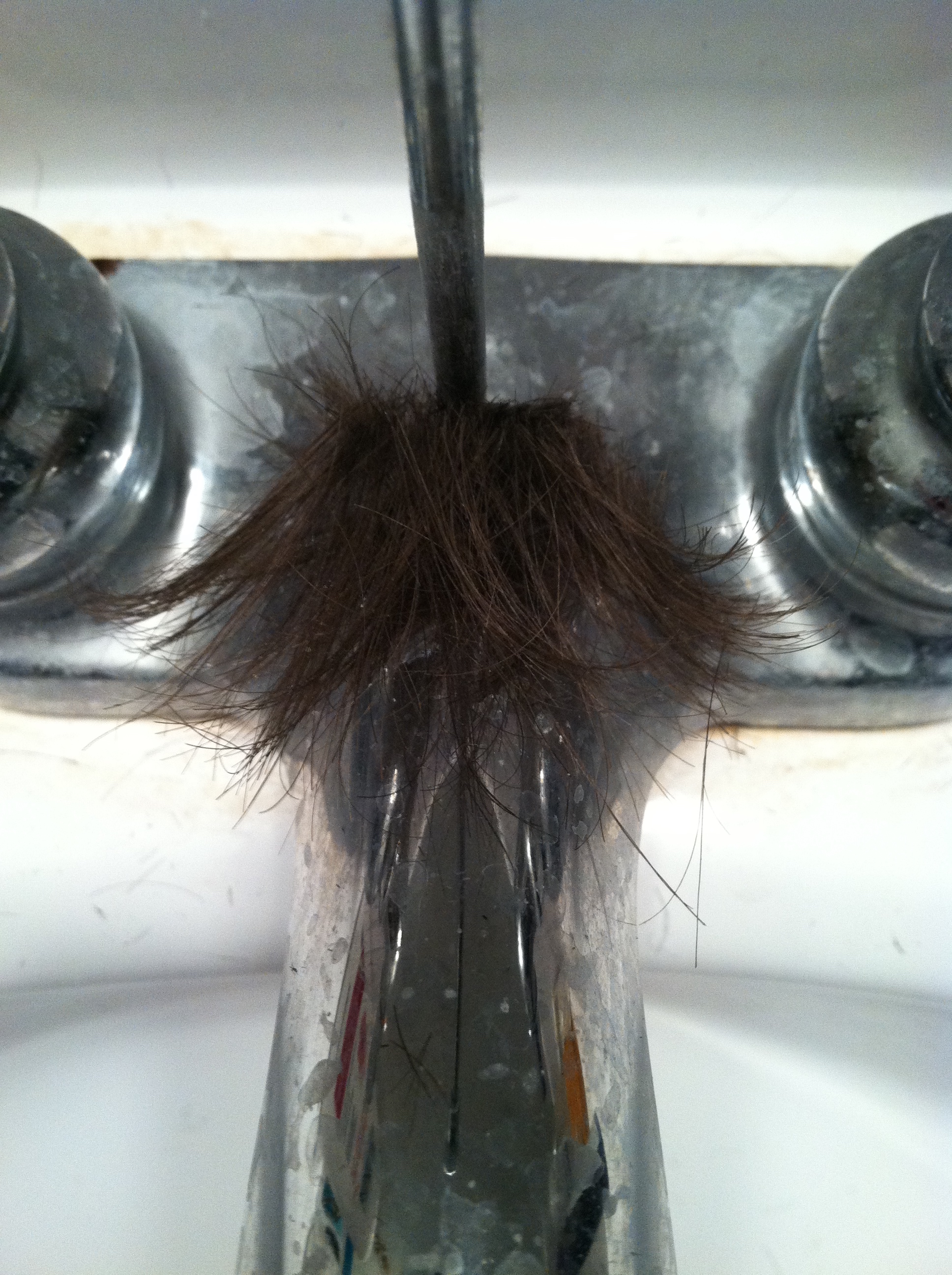
Micah cut his hair at the dirty bathroom sink and unintentionally gave the faucet a generous mustache. 322 Shenley is crowded with such incidental joy.

Of course, there’s the emotional part of the move. Kathy is beyond ready, having spent countless hours painting, plastering, and planning the new place. Micah has fourteen years of testosterone, fury, and healing invested in his home; he sulks and sighs. I don’t get attached to dwellings much, but leaving Shenley Drive has me negotiating with a funk. Having gone through several episodes of hell there, I find the hardwood floors and views out the windows have taken on sweetness in these better times. And I came to rest at 322 Shenley. Lying in bed with Kathy and looking out at the boulevard’s old maples in all seasons, I thought many times, “I don’t need to be anyplace else. When my hour comes, I could die here, this woman beside me, my eyes on the trees.”

It’s easy to move when you’re ready, another when your heart won’t quite let you say goodbye: to a yard crowded with flowers and herbs, to neighbors as close as family, to walls you’ve leaned against and cried.

Dear as Shenley is to the Colemans, I know from the scars of leave-taking that bulbs and seeds grow in other gardens, friends appear on every avenue, and new walls can become trusted shoulders.

IMG_3212

A new route to the bathroom

Anyway, Shenley isn’t my home, nor will Parkway be. I remembered this the first night Kathy and I spent in our new bedroom. Flummoxed Watson clicked on the hardwood from my side of the bed to Kathy’s, back and forth, ad infinitum. The route to the bathroom was odd, short and direct. But I wasn’t sad. For me, home is saying “Kiss goodnight?” to Kathy and resting my hand on her warm belly as we fall asleep. Home is her saying “I love you, John Coleman” after the alarm goes off. (Yes, Kathy calls me by my first and last name.)

photo-5

Home is kibitzing with my son. The functional kitchen is a bonus.

Home is also standing with Micah as he tells me about a wrinkle in his day or about the mantis scrimp, which punches its prey. Before he goes to off to watch television, I say, “Spare a hug for the old man?” He does and means it. That’s home.

Home is Elena calling me Daddy and rescuing my bland refried beans and son-in-law Matt explaining that a truck’s clutch requires oil and toddler grandson Cole nodding and saying “yeah” when I ask if he wants to chew my watch.

Home is singing with my church family on a Sunday morning:

I ask no dream, no prophet ecstasies,

no sudden rending of the veil of clay,

no angel visitant, no opening skies;

but take the dimness of my soul away.

Home is when I close my eyes, sit still, and sense—no evidence other than longing—the presence of the Loving Mystery.

Home is when I come to rest, held close by infinite variations of mercy.

unnamed-1

As long as my grandson is nearby, I’m home. The Loving Mystery looks at me with Cole’s eyes. His smile is mercy.


Joy Whispers to a Cracked Rib

Think the movie Home Alone. Think Joe Pesci’s character slipping on icy concrete, going airborne, and slamming down on his back.

That was me two Sundays ago, on my way to church, where I had to breathe and make sense. The difference was, Pesci’s stuntman actually took his fall. As a middle-class, middle-aged man, I personally came down on a step and cracked a rib. Before the echo of my shout died, I thought, “Wow, that was loud. Neighbors will come running.”

A couple of them did hear, I learned later, but thought nothing of it. I lay there, unaware that old #12, that southern most of ribs connected to the spine but not the cage, was compromised. “Did you puncture a lung, Mr. Wingtips?” I wondered. After thirty seconds, I said, “Well, I guess we’ll find out.” I rolled to my feet, staggered to my truck, and drove to clergy work, which included crouching to look toddlers in the eye and telling them that Jesus loves them just the way they are. Doesn’t matter if they’re autistic, hyper, or angelic. Whatever. Jesus loves them. (Don’t ask me how I know this. I just know!)

In the nearly two weeks since my slapstick, my cracked rib has led to a couple of insights.

1.) Yes, the stabbing pain is inconvenient, but I’ll take it over bronchitis, the flu, or even the common cold. Sitting still works wonders for rib pain but does nothing to stop coughing and sniffling.

2.) Cleansing breaths are a blessing. At no point did taking great lungs full of air hurt, so I figure I got off easy. Coughs, sneezes, laughs, yawns, and—of all things—burps were followed by yelps or arghs.

3.) Slow down and wise up! The icy step that got the better of me was clearly slippery. I could see as much and thought, “I’m going to text [wife] Kathy when I get to church and ask her to salt the steps.” I was in a hurry; even so, I put my left foot down with slow-motion, geriatric caution, like I was testing pool water with my toe. No matter: away I went. Starting with that moment I looked up at the leaden sky and wondered about the damage, I’ve been trying to pay attention. “Curl your fingers back when you chop celery, John.” “Take your time walking across that freshly mopped floor.” And even, “Slow down and taste your food.” If only I were half as much a gourmet as a gourmand!

4.) Losing a little weight would go a long way. I’m not sure whether my back fat cushioned my landing, but I know belly blubber makes me lumbering—not to mention I can hear carbon dioxide hissing from my lips when I tie my shoes.

Important as all these lessons are, I’m most grateful that my cracked rib continues to reinforce an observation I wrote about recently, one that has made me feel light and hopeful at least as often as bummed and brooding: Disaster and injury shout. Joy whispers. Crap shines a klieg light in your face. Blessing relies on stick matches.

On that Sunday of the fall, with my roar still sounding over Erie’s bayfront, the family (that would be Kathy, son Micah, daughter Elena, son-in-law Matt, and grandson Cole) had dinner at Cole’s house. When Kathy and I walked in the door, we found the little man asleep on the couch.

IMG_3021

This face wouldn’t be cherubic much longer.

Since it was around 5:30, Cole needed to get up so he would have some tired left for bedtime. Elena woke him up, which led to a case of the grumps and snivels. Grandma Kathy took a bullet for the unit and distracted Cole with her iPad—poor Kathy!

IMG_3023

I have no idea why Cole is naked. When I saw this, I thought, “So what if he goes.” That’s love, I guess.

When food time arrived, Micah took over, feeding Cole toddler friendly bits from his antipasto. They sat together for what seemed a long time to me, spaced out on the recliner as ibuprofen conversed with sassy #12. I remember thinking that at twenty-three, sharing my salad with a wee squirm-ster would have held zero interest. Micah gleefully babysits his nephew and plays with him until Cole squeals and Unka Mike is sagging.

image1

Cole, wearing the bathrobe Grandma Kathy made for him, poaching Uncle Micah’s salad.

Two days later, just as the ancillary sites I’d offended were registering their complaints, I received a short via text message from Julie, who recently moved with her husband and three daughters from Erie to Lexington, Kentucky. I had posted my antics on Facebook, and the girls had something to tell me.

It can be hard to hear the well wishes of children and a grandson who can now say please, baaaa, uh oh, bye, hi, and I you (I love you). Rage and rancor are such bigmouths. Blessing won’t bluster. I have to be mindful, listen, and refuse to let the world’s volume trick me. Peace and gladness thrive only if I take the trouble to look.

One more piece of evidence: late the other night as I was driving home after church work, the gravitational pull of 322 Shenley Drive made me want to lean on the gas pedal. I didn’t speed, but I wanted to. Why? My urgency was about going to bed. Kathy and I would get under the covers, maybe watch a little TV and talk for a while. Then we would sleep. Our skin would touch along our bodies. I would kiss her shoulder.

Now don’t start hearing “Brick House” in your head. No singing—and I quote—“Chicka bow chicka bow bow.” Think overweight, pasty man with cracked rib. Seriously, cut it out!

The tug I felt on I-79 was love. How quiet and blessed is this? I wanted to get home to be with my wife, fall asleep next to her, and draw her close. Creation’s groans never let up, but, I knew, grace would whisper us to sleep. I intended to listen.

In Gratitude for Annoyance

There’s no denying, over the last two years I’ve been out of sorts. A Napper’s Companion has often been a long-suffering sounding board as I’ve droned, waxed, and howled. Sure, joy has visited for long spells, but if life were a bar graph measuring months, more than a few of them would dip below emotional zero.

When feeling sorry for yourself becomes a habit, it’s actually refreshing to find yourself merely annoyed rather than crestfallen. Narcissus stared into a pool of water and beheld his beauty. I’ve only recently pulled my gaze away from my navel, which is a deepening pool of the unspeakable—I speak literally here. Weight loss is in my future. Anyway, events that would have reduced me to curses and sighs a few months ago now hardly register on my graph. In fact, I’ve been laughing.

220px-Narcissus-Caravaggio_(1594-96)_edited

Narcissus by Caravaggio (Credit: Wikipedia)

“Laughing? The hell you say, John!” Yes, from the belly right into the crevasses of existential paper cuts. Feels good.

I’ve mentioned in previous posts that wife Kathy and I bought a 1000 square foot house. Downsize and all that. Kathy loves me, but doesn’t fully trust me to do grown-up quality work on the new place. So far I’ve been cleared to wipe down shelves and cabinets with Murphy’s Oil Soap, prime old thirsty walls and our bedroom closet, and scrub and sweep the basement. Fans of physical comedy would pay up if I could produce a video of my efforts.

Painting a closet is like doing calisthenics in a phone booth. I got flat white prints everywhere on my person, not from my brush, but from bumping into what I just painted. The language was mild but repetitive, damn it after damn it plunking as if from a leaky faucet. The worst part was tapping all quarters of my head against wet shelves. (Former owners, Mr. and Mrs. Tyler, God rest them, were a shelf- and hook-happy Depression-era couple. Random hooks and shelves stick out from walls, woodwork, and crannies like Betty White flipping me the bird. How many items can you actually hang up? Used and washed Saran Wrap to dry? Lonely socks?)

When the job was finished, I expected to see in the mirror a balding man with ridiculous blotches of paint all over his head. The sad fact was, aside from an Ash Wednesday-level smudge on my forehead, nothing much had changed. Turns out flat-white primer is a good match for my hair. I can apply Just for Men Touch of Gray, paint another closet, or go natural? It’s good to have options. My policy is to refrain from laughing at my reflection, but in this case I gave in.

Video of basement duty would appeal to folks comfortable laughing at actual pain. The space is clean, dry, and stand-up-friendly, mostly. A couple of fixtures make this six-foot man dip, and one run of ductwork can be cleared only by a hobbit. Of course, units of especially dusty shelves ran parallel to the damn it ductwork. During the three hours I spent bobbing, weaving, push-brooming, scrubbing, and absorbing the perfume of Murphy’s Oil Soap, I forgot to limbo ten times. Ten matches of fathead versus galvanized steel. Two knocks resulted in language. A few got harrumphs, and the rest snorts. A week later, my head still looks like a wounded cantaloupe.

IMG_3016

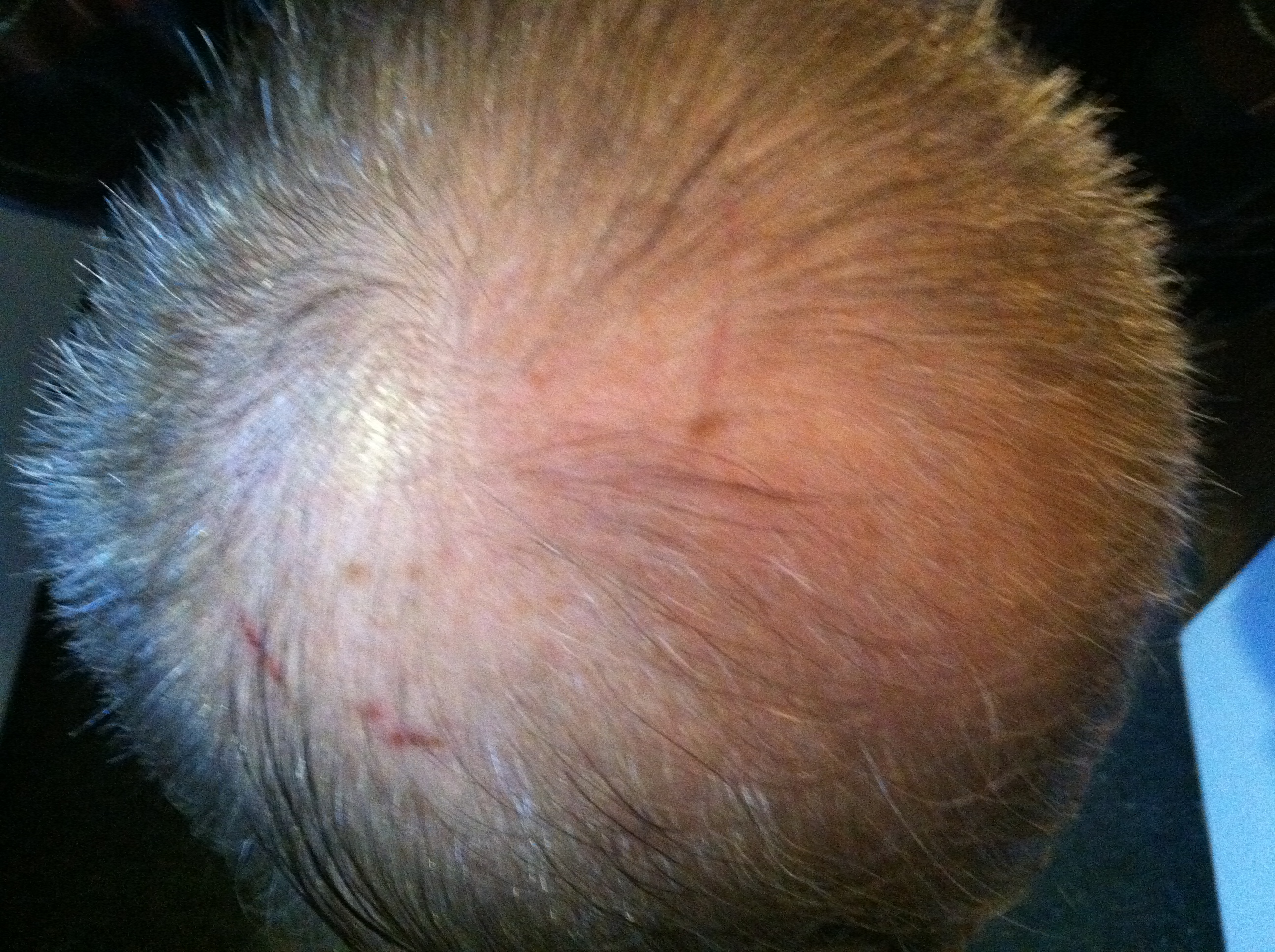
Yes, this is my scalp. God help me. And, heck, why not an age spot or two?

Fortunately, I don’t have any goose eggs as big as our black Lab-terrier mix Watson’s. The fatty tumor on his left flank is so ridiculous we finally took him thirty minutes from Erie to a veterinarian who specializes in animal homeopathy and chiropractic. As I wrote recently, the old mutt is gimpy, and the present steroids and NSAIDs don’t seem to be helping much.

When the veterinarian entered the examination room, I liked him before he said a word—a skinny old guy wearing jeans, a craze of wiry gray hair, and a bushy mustache. He could have been Clem Kadiddlehopper’s brother. (I mean that as a compliment.)

459px-Skelton_clem_1970

Red Skelton (center) as Clem Kadiddlehopper. (Credit: NBC TV on Wikimedia Commons)

He talked rapidly and passionately, flitted in and out of the room to mix potions, and finally poured out on the counter bottles, an envelope, and a medicine dropper. With no other social segue than “okay, bye” he was back into his homeopathic sanctum. We paid, hoisted Watson into the truck, and headed for home.

On the way down, in the vet’s office, and on the way back to Erie, Watson was calm. As soon as we were in the door, Kathy administered the first dropper full of homeopathic pain relief. Did the new experience send a ripple along Watson’s bowel? Make him feel momentarily tipsy? I’m not sure what he felt, but I know squirtle when I smell it. That’s what we call doggy fear fluid in the Coleman household. I’m used to dogs squirtling in the car or at the vet’s office, but safe at home, the ordeal passed?

He lay beside me at the dining room table, dazed and wretched. His eyes said, “Yeah, yeah, I know. Sorry.”

Dear blogging friend naptimethoughts explained to me in a generous comment the anatomical cause for squirtle and described how the sacs in question sometimes have to be manually expressed. My grand-dog Layla occasionally gets plugged up, and her vet offered to show daughter Elena how to glove up and give relief right at home for free. “Ah, no.”

Last evening Kathy and I made a run to the new house and took Watson along. Was it that my lift into the truck squeezed his belly? Or has he acquired a hair trigger? Whatever the case, the cab hazed over with Eau de Sacs. Today in frigid Erie, Pennsylvania, the sun warmed the truck seats, normally a bonus. Obviously, nature toasted the spots where my old pal pressed his rumpus against the fabric, freeing up the squirtle for continued enjoyment.

Ah, if the day’s worst ambush is a dropper-full of Watson’s anxiety juice, I’m golden. Is it possible to find an elderly dog’s harmless infirmity endearing? I think so.

It’s at least as possible as enjoying the supreme annoyance that is football’s Super Bowl. The family was over, and we took in the Seattle Seahawks’ last offensive play, when team strategists squirtled away the game by passing from the one yard line rather than handing the ball to Media Day wag Marshawn Lynch.

The highlight of the game for me was halftime. Katy Perry rode a twinkling gold behemoth and ascended into artificial fog, but grandson Cole stole the show. Sitting in Kathy’s lap, he made the best possible use of the spectacle: his fine eyelids slipped, slipped, slipped.

As I watched Cole’s commentary, I thought something that might seem dark at first: if somehow we humans aren’t suited for eternity, if an arbitrary sac of years in the here and now is all we get, then I might be okay with that. I hope for forever, but I got to watch this boy in his grandmother’s lap, as treasured and lovely as can be. Katy Perry fell quiet, or may as well have, and I figured that witnessing such love was more than enough justification for a lifetime.

10923211_815321731871350_4158983250869382664_n

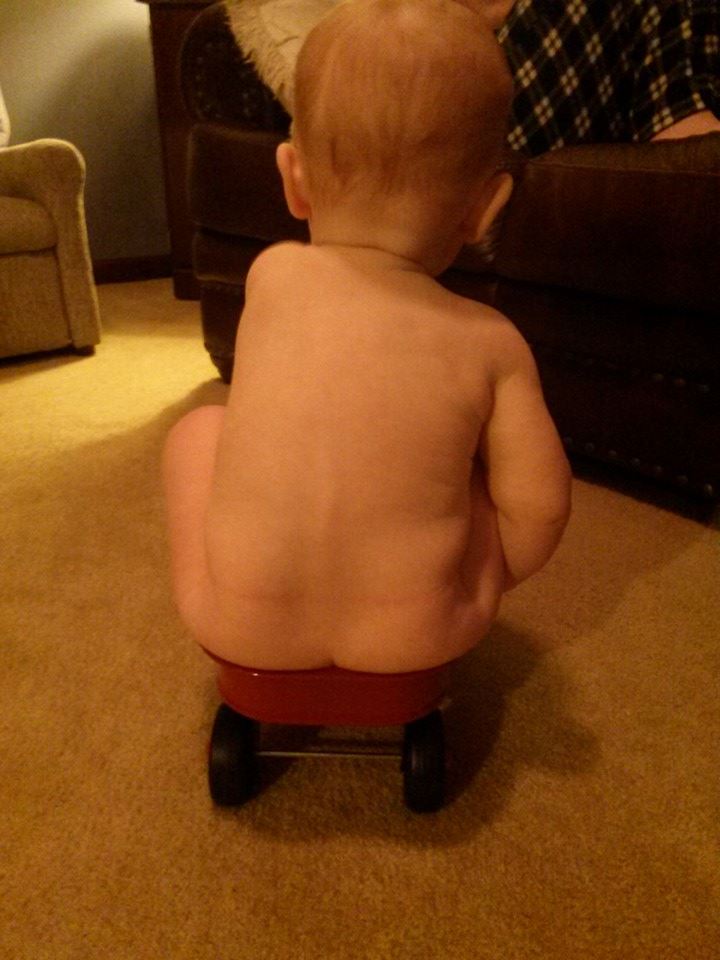
My grandson in his wagon: take that, Katy Perry! (Credit: Elena Thompson)

In the annoyance and blessing of recent days, I’m starting to feel whole again. I guess that’s what I’ve been trying to say. I could learn to like this.

An Understanding of Prayer

7:39 a.m. at the downtown Starbucks. 7° with a wind chill factor of misery. A burly guy I’ll call Constance lumbered in ten minutes ago carrying his taut duffle bag. It looks like he’s lugging around a four-foot section of big telephone pole. Who knows what’s in there? The pockets of his fisherman’s vest are tumors of valuables.

After a trip to the restroom, Constance resumes his animated discussion with State Street, jabbing the table with his pointer finger and staring down the swirls of snow. His negotiations are urgent, relentless.

I see Constance a couple times a month. My daughter said years ago that he goes by a woman’s name and sometimes dresses in drag. I’ve only seen him dressed for weather, even in summer, but his name is none of my business. Only death will end his wandering and lonely arguments.

What locks await the cluster of keys hanging around his neck and resting on his gut? Mirage homes? And now, he is pissed: “No! No! You will not!” Silence, then, “I . . . didn’t . . . know! Why are we talking about this?”

IMG_1297

Oh, Constance, may one of those keys open up a home of warm color, a cat waiting for you, and loved ones who agree with your argument.

I pray for Constance. I also pray for the guy who picks up garbage and shovels snow outside my primary Starbucks haunt near the Millcreek Mall. Yesterday was nearly as severe as today. He was bundled beyond recognition when I drove by him on my way to work. I could make out a slit of flesh from his eyebrows to the bridge of his nose. That was it.

“God,” I said. More and more I’m finding that is prayer enough.

I pray all the time, and I mean all the time. This statement is frankly uncomfortable, not because I’m ashamed of prayer. As Constance just said, “No, no, no, no, no!” My squirming comes because I suspect folks would find my practice of prayer weird and pointless.

IMG_0384

The point of prayer: to be spirit still, to let light shine into and through me? (Balcony of chapel at the Abbey of Gethsemani)

In The New Seeds of Contemplation, Trappist monk Thomas Merton describes my context for prayer:

For the world and time are the dance of the Lord in emptiness. The silence of the spheres is the music of a wedding feast. The more we persist in misunderstanding the phenomena of life, the more we analyze them out into strange finalities and complex purposes of our own, the more we involve ourselves in sadness, absurdity and despair. But it does not matter much, because no despair of ours can alter the reality of things, or stain the joy of the cosmic dance which is always there. Indeed we are in the midst of it, and it is in the midst of us, for it beats in our very blood, whether we want it to or not.

Yet the fact remains that we are invited to forget ourselves on purpose, cast our awful solemnity to the wind and join in the general dance.

200px-TMertonStudy

Thomas Merton (Father Louis) (Credit: Wikipedia)

As a spiritual master, Merton dares speak of mysteries with certainty. I avoid that. Who am I? But Father Louis, as he was known at the Abbey of Gethsemani, comes up with words that work for me—as much as language can take hold of the Ultimate, anyway.

If “the world and time are the dance of the Lord in emptiness,” then prayer is my daring to join in. I’ve spent years “analyzing the phenomena of life out into strange finalities and complex purposes of [my] own” and have had enough of that absurdity. The best prayer I can offer, then, is impoverished and goes like this: “I don’t know anything. But please fill me. I’m here.”

Intercessions are important, of course, but I hold an unconventional view of them. My prayer for the garbage-snow removal guy was monosyllabic because of what I believe about God. Of course the Creator wants everybody to be sane, healthy, warm, fed, clothed, and loved. So saying anything more than the Sacred Name isn’t essential—like asking snow to make its way to the ground. It’s what snow wants to do!

800px-Snow_crystals_on_car

Dear Snow, Almighty and Everlasting, fall to earth, cover our cars and houses. Amen. (Credit: Barasoaindarra on Wikimedia Commons)

If God wants the whole world taken care of, then why the hell doesn’t God do it? We’re heading for the good old theodicy conundrum: If God is infinitely good, where does evil come from and why does it exist? My answer is the spiritual foundation of my prayer life: “I don’t know anything.”

Some believers might tap me on the shoulder with familiar answers: “God answers all prayer, but sometimes the answer is ‘no.’” Or “God knows what’s best for you, even when what’s happening is terrible.” Or “God is testing you.” Or “It’s all part of God’s plan.” Or, the one I find most irksome: “God never gives you more than you can bear.”

Tell that to the man I hugged whose father died a few months ago and whose mother was going into surgery—anesthesia when you’re sneaking up on ninety is sketchy. Imagine losing both your parents four months apart. Serving up a platitude might get you a well-deserved knuckle sandwich.

After a few thousand hugs like this, I refuse to reduce prayer to a crapshoot. “Dear Lord, please bring So and So through this surgery and grant a speedy recovery.” I might actually say something like this, but I would never do so with a what-the-heck-it-can’t-hurt attitude. And I would never think to myself, “Well, gosh, I’ve prayed like this over and over. Maybe God will hear me this time.” And I won’t try to explain the ways of the Eternal Mystery. The presumption!

IMG_0369

Prayer: whatever I am, whatever I wish, open and vulnerable with the Ultimate Truth? (Figure at the Abbey of Gethsemani)

But as I wait for my cell phone to ring, I pray for the woman in surgery and her son, not because I expect to influence the outcome. I say “help,” sigh, and look beyond these walls, windows, and patrons because my present reality is this: I wish for a dear old soul’s return to health, if nothing else so her son can catch his breath before adding another layer to his mourning. My prayer is, “Please, Lord, please.” At the moment, I am this prayer.

If I’m to join in the general dance, I can only do so as myself—a duffle bag fat with frailty and fear, longing and gladness.

Not surprisingly, most of my prayers are silent. Abide in what is, John. Swim in grace. Dance in peace. Every now and then, I’m aware that I’m praying for everybody who has ever lived, every creature. And though my hands rest in my lap, my spirit arms are open wide, lifting up all of our laughter and lament—yours, too—as if God doesn’t already see!

I’m quiet. My wordlessness says, “Here we are, God, right here in my arms. Beat in our blood. Fill us. We are yours.”

Earth_Western_Hemisphere

“Here we are–the Western Hemisphere, at least. Fill us. We are yours.” (Credit: Wikimedia Commons)


A Case for Human Beings

A couple weeks ago an email from Mount Saint Benedict Monastery landed in the morning:

Sister Phyllis Weaver went to her Eternal Reward last night (Monday) around 9:00PM following a very brief illness. She was surrounded by her family and a number of Community members. S. Phyllis touched the lives and hearts of many through her years of ministry in education and hospitality.

IMG_1326

Posted on the wall of my room in the monastery’s guest wing.

Until a few years ago, Phyllis was the sister I called to reserve a room or hermitage. When my daughter and son, now grown, were going through terrible times, I crawled to the Mount for sanity. The place was—and still is—life! Phyllis was at the center for me, greeting me when I arrived and checking on me unobtrusively when we saw each other after worship or lunch. Near the end of her call as Hospitality Coordinator, Phyllis’ shuffle gave way to an electric scooter—no padding left on the soles of her feet, she explained, just bone and skin.

In retirement, Phyllis’ prayed for retreatants. I needed her petitions for their intention if nothing else and appreciated them as I rested like a crimson bruise in the light of the chapel’s stained-glass windows.

IMG_1339

A lamp in the chapel at Mount Saint Benedict Monastery.

Kids often outgrow problems. Most bruises fade. But Phyllis’ and her sisters’ gift during some raw years has grown in me and taken on more color than I can say: “Let my life be about loving people, one brother or sister at a time, moment by moment.”

If only I could be my own answer to this prayer. The best I can do some days is draw a meager smile from the deep well of mercy I’ve been granted. Still, Phyllis extended to me love based on the conviction that the Creator’s Spirit dwells within all people and nothing in daily life is more sacred than that moment when a person needs love in one of its countless forms and another person provides love gladly. “Let me recognize the Ultimate in you,” I say, “and may you find love in my eyes.” My namaste is ragged. If it gives warmth, it comes from a cold and broken hallelujah.

I do trust the Divine Mystery to lead us to security eventually, but for now, I feel the cold of a world order in which being human doesn’t count for much. As massacres and fiascos make a disturbing media racket, people–individual dwellings for the Ultimate–lose life quietly, invisibly. Society’s eye evaluates humans, and, increasingly, we are expected to defend our personal cog on the rim of an imposing, impersonal wheel.

I’m talking about progress. E. B. White first drew my attention to the crooked assumption that the best way to improve life is to nudge human beings out of the picture. In a 1955 New Yorker essay, White grumbled that the telephone company “saddled us with dials and deprived us of our beloved operators, who used to know where everybody was and just what to do about everything.” Good thing he passed in 1985, before call waiting and voice mail joined our cultural lexicon.

EB_White_and_his_dog_Minnie

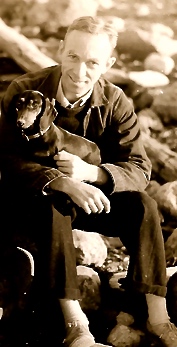
E. B. White holding his dachshund Minnie (Credit: Wikipedia).

I don’t think there was a religious bone in White’s body, but he and Sister Phyllis probably would have hit it off. She was all about taking care of pilgrims, and he wrote, “All that I hope to say in books, all that I ever hope to say, is that I love the world.” You can’t read one paragraph of E. B. White without recognizing that his world was human beings and animals. He was against whatever threatened either one.

In the last month I’ve heard stories that worry me. Andy, as White’s friends called him, would bristle. And I’m not sure, but Phyllis might have just shaken her head and returned to praying for retreatants.

–A December 14, 2014, New York Times article by Claire Cain Miller opens with a troubling trinity: “A machine that administers sedatives recently began treating patients at a Seattle hospital. At a Silicon Valley hotel, a bellhop robot delivers items to people’s rooms. Last spring, a software algorithm wrote a breaking news article about an earthquake that The Los Angeles Times published.” If somebody is going to sedate me, I want to look ‘em in the eye. And some of my friends are print journalists, a profession already in decline. I’m not sure what an algorithm is, but it’s a scab compared to Jennie, Gerry, and Erica.  

Vince_Plover,_working_as_a_bell_boy_at_Lennon's_Hotel,_Brisbane

A robot or young bellhop Vince Plover? I prefer the kid, even if I have to tip him. (Credit: Wikimedia Commons)

–Also from Miller’s article: “Ad sales agents and pilots are two jobs that the Bureau of Labor Statistics projects will decline in number over the next decade. Flying a plane is largely automated today and will become more so.” As a jittery flyer, I don’t want my plane piloted entirely by computers. They fail without warning, constantly leave the backdoor unlocked, and refuse to accept reason.

–NPR ran a story about computer chips being implanted in grape vines. This technology can take the guesswork—or artistry, depending on your point of view—out of watering and harvesting. When a commentator claimed that the chips’ grapes made better wine than the winemaker’s, I thought of poor Paul Bunyan being surpassed by a chainsaw.

unnamed

Cabernet Sauvignon at the Coleman dining room table: I would love to meet the winemaker.

–A couple of weeks ago NPR’s Marketplace reported on the sale of PetSmart to a private-equity firm. Amidst the chatter somebody commented that Walmart-type stores cut into PetSmart’s business by carrying lots of pet supplies. At once my White-ian fears took hold. How long will it be before you can accommodate all of life’s needs at a single destination? Get your Airedale bathed and groomed while your SUV gets snow tires put on. Pick up General Tso’s chicken for supper. Have cataracts removed and touch base with your life coach. Yes, I’m being silly, but a voice in the ear of my heart warns me that herding every specialty under one roof managed by one entity could make transactions more uniform and less personal.

Maybe I’m wrong, but for fun I just Googled “shoe repair erie pennsylvania” and discovered that in my hometown proper, one shoe repair shop survives. The idea to check came when I saw that Dom Bruno’s Shoe Repair in Little Italy had closed. Ten years ago I took a pair of black wingtips to Dom, who resoled them for $45. Sounds like a lot, but those refreshed throwbacks remain my only pair of black dress shoes.

IMG_2920

“Where have all Dom Brunos gone, long time passing?” The thin, corner shoe repair shop that healed my wingtips.

IMG_2919

The only grainy evidence that Dom Bruno ever had a shop on Brown Avenue–a cardboard poster.

According to Google, M. A. Krug and Son is now my only option, unless I want to drive fifteen miles west to Nick’s Shoe Repair in Girard. My wingtips need attention, and I wish for a redundancy of shoe repair shops in Erie, Pennsylvania–and at least one mom-and-pop corner store in every neighborhood.

photo-24

Good and faithful servants: seams splitting in a few places, soles wearing, gnarly inserts

On the way to Sister Phyllis’ viewing, I made a sad discovery. Unless somebody is tending shoes beneath an inconspicuous shingle, Erie, home of around 200,000 feet, is bereft of cobblers.

IMG_2905

Google is wrong. Mr. Krug no longer repairs shoes. Stereo equipment, old albums, and silly signs now fill his shop.

IMG_2906

Posted by the entrance: Mr. Krug had a gruff sense of humor?

IMG_2910

Across Peach Street from Krug’s place, another dead shoe repair shop. Seriously?

IMG_2914

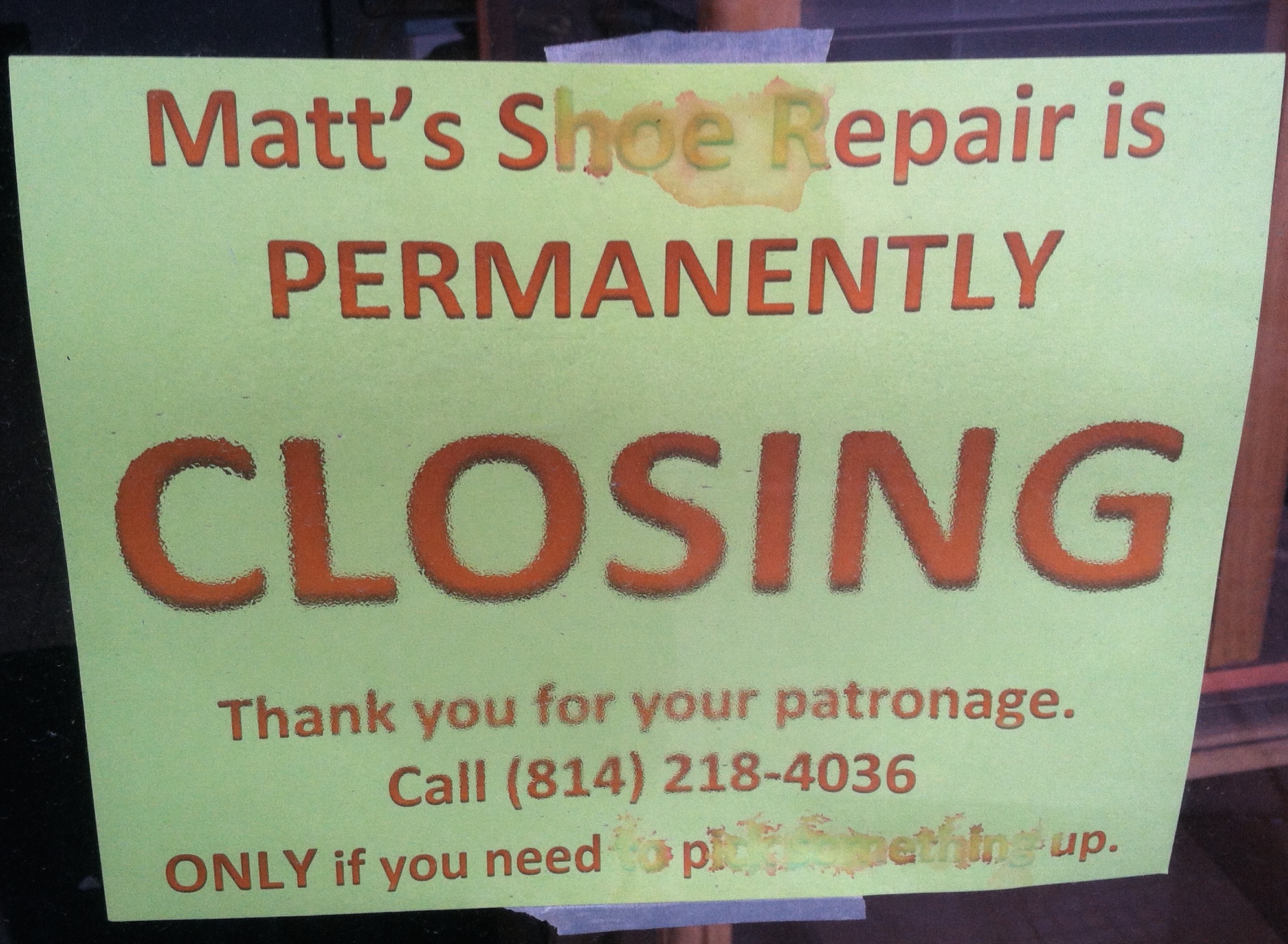
How long had the business been closed? Long enough for ink to run.

IMG_2917

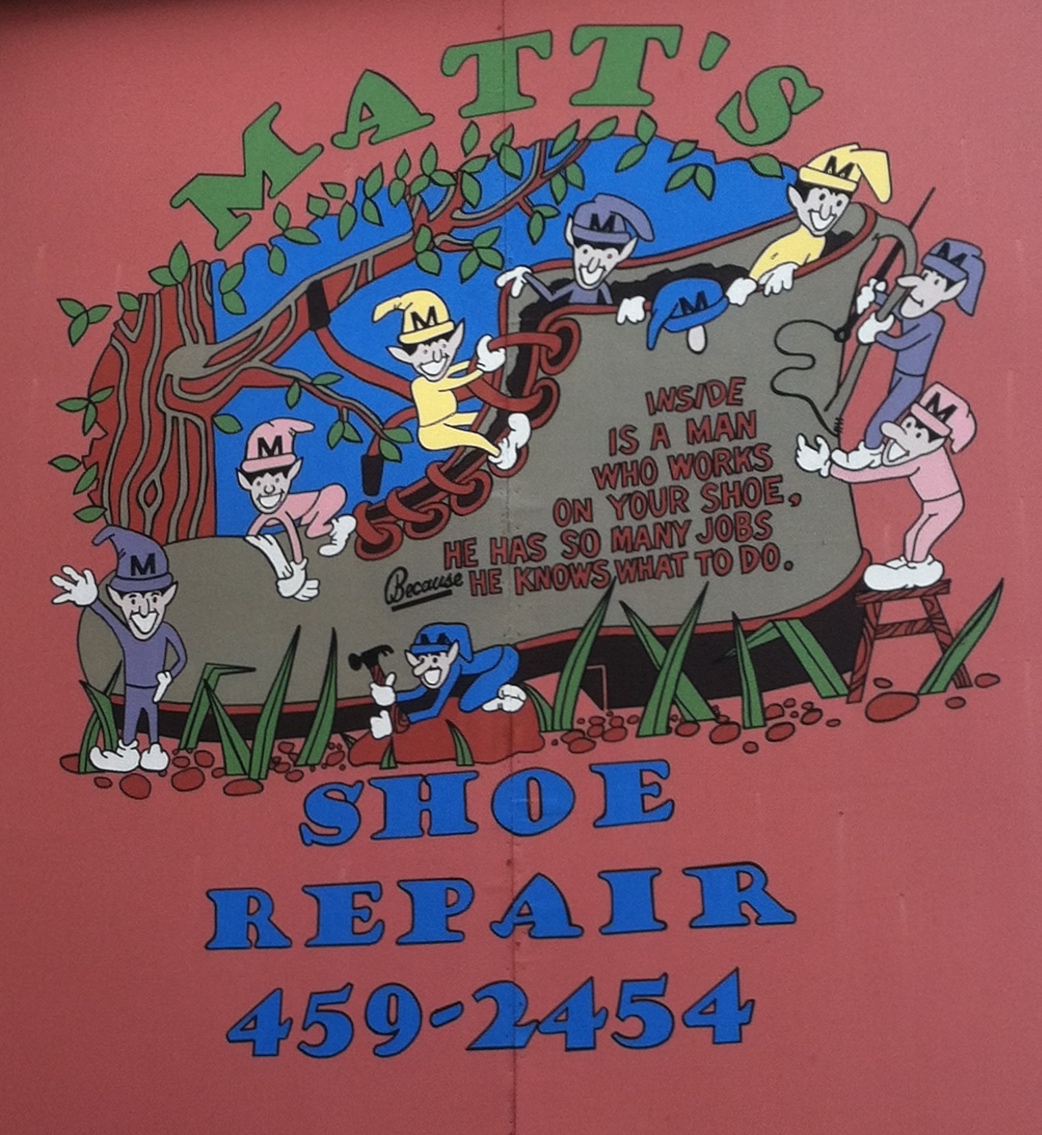
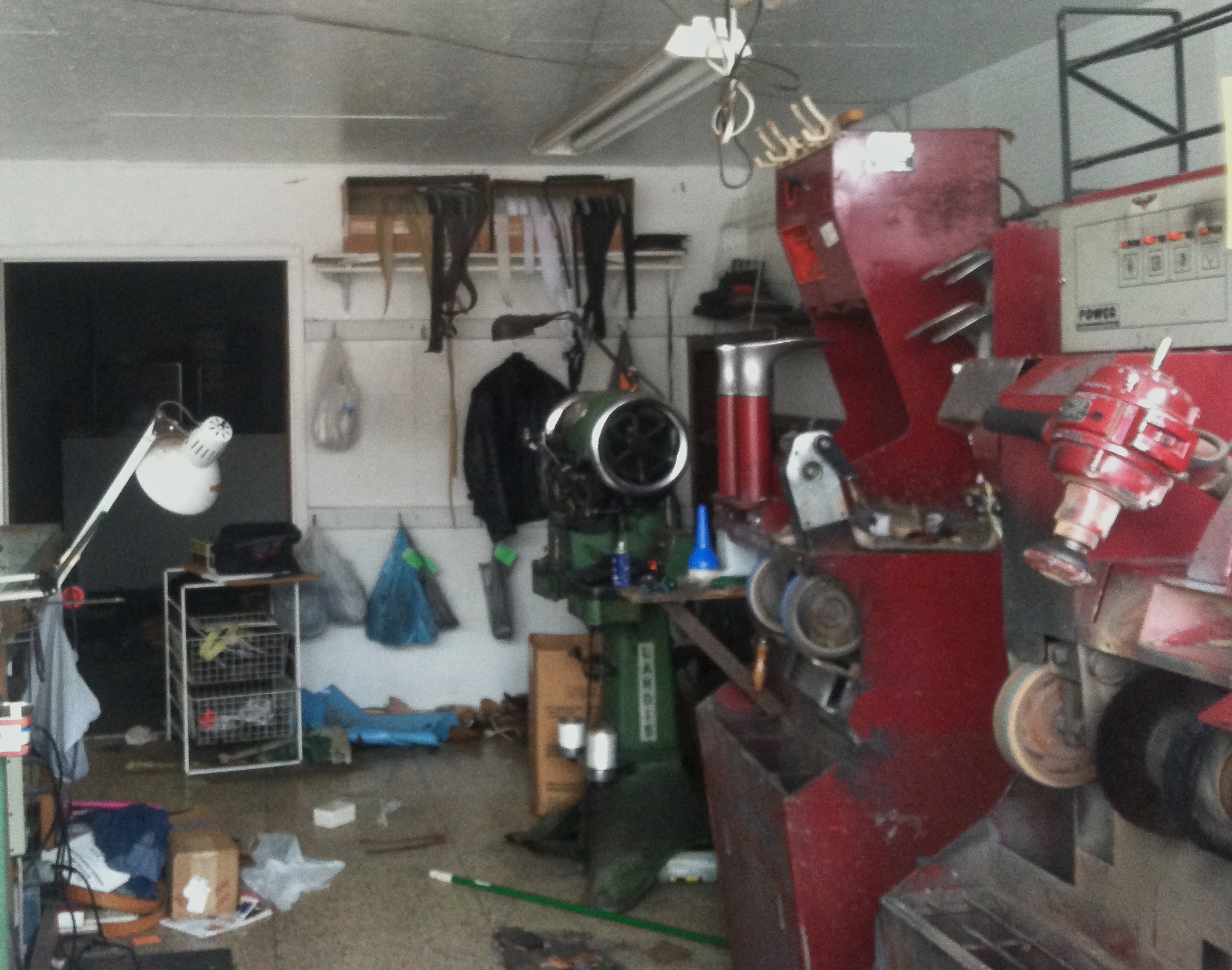
Matt’s machinery sleeps behind dusty windows. Goodbye to a vocation.

Actually, I’m not all that bugged about my wingtips being S.O.L. I’ll get a new pair. The trouble is, I’ve lost track of Dom Bruno, and it might have been nice to meet Mr. Krug and ask which kin started the shop in 1895. And anybody who makes a sign like Matt’s is bound to be good for a laugh or two.

Bottom line: the world’s best hope for health and gladness isn’t the robot, but the bellhop. There’s no way the former can look into a stranger’s eyes and recognize that a special word of kindness is needed. The latter not only carries luggage, but can also lighten a burden.

I might not be able to tell which wine was made by person or machine or which news story was written by an algorithm or a friend, but none of that matters. I want to be a Sister Phyllis receiving flawed, unpredictable, expensive human guests into the safety of my presence. I want to be an Andy White, betting my money and heart on women and men creating and mending the world over and over, messing up and starting again.

IMG_2698

Sanity: a nap in a monastery room as Sister Phyllis prays for you

When I reached the Mount and looked down at Phyllis, I was sobered. She didn’t look herself at all. Her face was oddly tanned, her hair flattened. But I’ve seen enough dear ones in coffins to give an interior shrug.

Before long Prioress Anne Wambach said hello and took my hand. At once I understood that my reason for paying respects to Phyllis wasn’t to honor the dead, but to receive life. Our conversation took less than a minute. I don’t remember what I said, but the idea was that Phyllis made me feel welcome. Clearly, Anne had heard this dozens of times already. She told me that Phyllis had done well until the end: a couple of falls, morphine, and confusion. Death came within a week.

IMG_1923

No Benedictine is forgotten. Every single sister matters.

Phyllis hadn’t suffered long; this gave me comfort. Anne took my hand and looked into my eyes; this gave me not only comfort, but a truth to live by. No software can estimate the value of a handshake or predict what healing and wisdom can result when two persons look into each others’ eyes.

Thanks, Anne. Thanks, Phyllis and Andy. I have my personal orders within the world order. I’m bound to mess it up, but I’ll try: take strangers by the hand, John, and see the Great Mystery in their eyes.


A Soul Message to My Regulars

Dear Regulars:

Europe_orthographic_Caucasus_Urals_boundary.svg

Elena’s old teacher notes that some students can’t find Europe on a map. You never know what the Starbucks regulars will kibitz about. (Credit: Wikipedia)

So what else would I be doing at 8:21 on a Monday morning? I’m at Starbucks, surrounded by regulars: a couple of lawyers dressed for court; a retiree who by coincidence was daughter Elena’s social studies teacher; a young artist who sketches fairies and dragons and buzzes half her skull down to stubble; an engineer numbed by an online meeting; and a woman who pours out her life for children and grandchildren. I’ve talked to all of them, some more than others. They feel like beloved cousins. Such goodness in these folks.

All tables are taken. The guy in my seat tries to pull the reigns on aging and negotiates with a temporarily bum shoulder. “Shoveling snow really did this to you? Do you need three ibuprofen or four?” “Make it four.”

As I sip a refill, the sun shines, then hides, then shines again. Breathing in and out, I think of you, whenever and wherever we inhabited each others’ days:

childhood

high school

college

graduate schools

seminary

old neighborhoods

and

jobs

grocery stores

coffee houses no longer

offices and waiting rooms

220px-Gilman_Hall,_Johns_Hopkins_University,_Baltimore,_MD

Gilman Hall at Johns Hopkins: it’s been thirty years. Herb and Rosemary, hi! Armand and Lynda, I’ll see you on the other side, right? (Credit: Wikipedia)

You aren’t showing up all at once. No, I receive you one-by-one, gratefully. Caroline. Bill. Jeff. Nancy. A procession of Garys. Because I know others by your names, namesakes straggle in. Welcome, everyone.

Hello, Becky, sister of Steven from Diehl Elementary School. (She had her leg amputated below the knee, then later—I don’t remember how long—she died, ten or twelve. Cancer.) Look into the eyes of glory, Becky. Belly laugh with the other children.

You don’t have to walk among the quick to be one of my regulars.

220px-Hyacinth_-_Anglesey_Abbey

Hyacinths always remind me of you, Gram–the curls of your wig.

Grandma Miller, your fingers are folded back into knuckled wings! I see your hair curled like hyacinths and your swollen face, but I can’t hear your voice anymore. I was sixteen. If it is permitted, Gram, please be there to receive me.

Hi, Alice, a wealth of Johns (that sounds wrong in a couple of ways), an embarrassment of Marys, more Kathys than I know what to do with. Matthews and Marks.

Now a tangible Patty shows up to share my table. That’s fine. She brings other Ps with her. Pauls, Pegs, Phils, one Penelope, and a lone Poopsie.

So many Richards and Elizabeths!

200px-Anne_Frank

Why have you arrived here, Anne Frank? No matter. All kids’ faces are sweet in my eyes. All are welcome. (Credit: Wikimedia)

What’s this? Jesse? I never knew you, but here you are, a sweet obituary face. Those who love you still dream you in their arms–your dear smile alone tells me this. I wasn’t expecting to welcome strangers to this gathering, but my plans seldom work out. So come in, Jesse. Stand glad with me in this warm light. Thich Nhat Hanh, wake up and bow to me. I’m listening. Rise, Ann Frank. Find your way home, Nigerian school girls. All of you, join Patty and me at this table.

Oh, my Lord, friends I’ve never seen or held are asking to join me in this public grace–names beginning with S, N, R, D, K, C, M. The alphabet isn’t long enough, though, miraculously, there’s room at this table, in this column of sun, for all of you, my regulars of many initials.

I don’t want to pretend. During these coffees in this now constant light, you haven’t all arrived. But wherever you are, I’m waiting. If mornings and afternoons are bitter and twilight is fretful, I’ll sit with you in safety. And if you have too many blessings to carry, hand me a few. We’ll give thanks together and I’ll share what you’ve given with others and probably hang on to one for myself.

I love you, friends. Your faces—skin creased by decades or still fair, eyebrows raised in surprise, or cheeks flushed with excitement or trouble—are dear to me.

Photo on 10-10-14 at 10.02 AM

This face, such as it is, welcomes you. Come share the light, rest a while.

If you haven’t visited today, don’t worry. You will soon. Meanwhile, know that whether this day is good enough to travel by its own steam or so lousy it refuses to budge, call on me for a visit. The shoulder pain has eased enough for me to put an arm around you.

We’ll be calm and glad. If clouds take over, so be it. Present to each other–just two or three gathered–we can shine anyway.

Peace and love,

John

Thanksgiving Letter to My Late Mother

Dear Mom:

November 8, 2014: your Christmas cactus is in full bloom. It may be my imagination, but every year the blossoms seem to show up a little earlier. We could now call your beloved old plant a Halloween cactus. How many holidays will pass before the pink flowers open up at Easter?

IMG_1190

Your matriarch of Christmas cacti

You know, Mom, you’ve been gone sixteen years, and I always figured that the older I got, the less I would miss you. Actually, the opposite seems to be true. The heaviness in my throat in this moment is greater than when I wrote you last year. The reason is your great-grandson Cole. I imagine the deep gladness you would know in holding him, talking to him as I do, sitting quietly as the minutes pass, watching him in ceaseless motion. You would say the same thing as we do: “He’s so busy.”

10665803_761152390621618_7552667270178936418_n

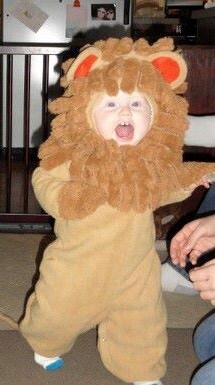
Your busy great-grandson in his Halloween costume–grrrr!

Most Sundays we have family dinner, Mom. I’m not sure why as your son I didn’t insist on this practice years ago, but I didn’t. I’m sorry. People who say that they have no regrets in life probably aren’t looking closely enough. Anyway, after we finished eating, Cole got fussy. Had you been there and not been burdened with arthritis, you would have picked him up and walked around the house, talking to him. I can see you telling your great-grandson about this and that. The decades glow and soften in my mind: there you are, my late mother holding my beloved grandson. It’s nice to see you.

But since you aren’t here—not really—and weren’t there after dinner to occupy Cole, I did. Our first stop was your Christmas cactus. I told him a little about the plant, but before I knew it I was telling him about you. Of course, I said you would love him like crazy and other things you would expect. But as he looked on momentary peace at your plant, I told him that when his mother was a toddler, you peeled grapes for her. Peeling grapes: that’s love. “Your great-grandma would do the same for you,” I said, imagining you putting bits of the pulp into his mouth.

IMG_2789

Was Cole looking at that glow in the center, Mom, the light of forever?

Next stop: the photograph of you in your wedding dress. “My gosh, Cole,” I said, “look at how beautiful your Great-Grandma Coleman was.” I was focused on you and Cole, but was also aware of somebody looking over my shoulder and saying, “Oh, yeah! She was beautiful.”

IMG_2795

You are younger here, Mom, than both of my children are now. It’s hard to make the years stay in the right order.

Tours with tired babies last only so long, so that was about it. Elena, Matt, and Cole packed up and headed home. Tomorrow being Sunday, we’ll go through the same ritual, and most likely I’ll use the spatula from home. No kidding, Mom, every time I pick it up, I remember you. Maybe I’ll show Cole, tell him it was yours.

IMG_2797

Still my favorite spatula

I wish you could be with us. We would sit at the dining room table and look at pictures. This afternoon I was missing you, so I went upstairs and pulled out some albums. Time passed. Two photographs held me up a while: one of Elena and one of Micah. I could see Cole in both of them.

IMG_2803

That’s Elena, Mom. I caught her, promise. That’s also Cole’s face.

IMG_2801

Here’s Micah, Mom, foreshadowing his nephew’s two front teeth and swagger.

I said before you were beautiful, but I’ve become suspicious of time, reluctant to accept its authority over us, covetous of eternity. More must await us beyond this lovely, troubled land, where early we toddle on fair-skinned, sausage legs and late travel tentatively, afraid of the fall that might crack our aching bones. There must be more because you deserve to hold this child, to kiss his promise of red hair—however this can happen in the Eternal Calm and Splendor.

IMG_2799

Kathy used to raise monarchs, Mom, and Elena used to wear them. Wish you could have seen.

So, Mom, I’ll correct myself: you are beautiful. I don’t visit your grave often, with its pound or two of ash and bone the required number of feet below. Better: I exchange this earthly chronology for one I compose myself. I close my eyes. Now, you pass your hands over my children’s cheeks as you did decades ago and speak to them gently. Cole sits on your lap. You bounce him and lean forward to look at his round face. Like the rest of us, you get lost there.

10641212_759719550764902_2925033126610744009_n

Cole on pumpkin carving day. We would have rinsed him off and handed him to you.

As you and I sit together, I hold your hand, still the softest I’ve ever known. Since this is my time, your knuckles and joints don’t blossom with arthritis—no pain. I’m looking at your skin and veins, Mom, and kissing your hand. Your eyes are closed. You hear me say, “You live.”

Love,

John

Humility Needed as the New Millennium Clears Its Throat

800px-Chili_con_carne_1234

It’s chili. You eat it. (Credit: Wikimedia Commons)

Last week while eating lunch at Coffee Culture courtesy of a parishioner’s gift card, I felt them: the twitches of meaningless impulse. Open up the MacBook. Check the iPhone. Write a few notes. Skim the newspaper. These twitches were both mental and physical: adrenaline-fueled, microbursts of habit energy. I saw Ronald Reagan smiling and delivering his famous 1980 debate line to me: “There you go again.”

This is Mindfulness 101! When you eat, eat. When you read, read. As Thich Nhat Hanh writes, “Don’t just do something. Sit there.” I know all this stuff, but even with pray-meditating twenty minutes twice or thrice daily, I constantly forget. Early into my huge Caesar salad and spicy ambush chili, I remembered, “John, you’re allowed to just eat. You don’t have to be doing something else.” As I replay that moment, the image of my late dad pops up, his fussy dementia hands going: fidget, fix, reach, button, smooth, worry. Madness.

IMG_2704

Ahhh. In the chapel at Mount Saint Benedict Monastery.

Don’t be afraid. This is not a rant, kvetch, or lament. Like everybody else, I’m responsible for the state of my own interior, which is getting some special attention these days. This morning I sip coffee and release my old inventory of anxiety, breath by breath. I’m good—well, getting better, let’s say. By 10:00 a.m. I’ll be at Mount Saint Benedict Monastery, trying to stay ahead of worries in progress.

In the words of the recently departed Joan Rivers, “Can we talk?” Is it just me, or is it quite a chore to remain centered as this new millennium clears its throat? Assemble the following ingredients: middle-class income, spiffy technology, and submission to contemporary attitudes toward time and labor; then, bam, like Emeril Lagasse, add pinches of garden-variety stress and a personal crisis or two. What do you get? You get a guy with an expanding torso, irritated tongue, jerking brain and muscles, and pleading spirit: For God’s sake, relax, will you.

The first thirty or so years of my life weren’t jerky. When I think about growing up and even college and graduate studies, 2014’s brisk march of time and frenzy of labor comes into clear view. For years I’ve had Han Solo’s bad feeling about this. Recently I happened upon an article by Dr. Peter Gray, who put some good words to my concerns. He graduated from high school in 1962, a year after I was born, but his description of childhood sounds a lot like mine:

In the 1950s, when I was a child, we had ample opportunity to play. We had school, but school was not the big deal that it is today. Some people might not remember, but the school year then was five weeks shorter than it is today. The school day was six hours long, but at least in elementary school, two of those hours were outdoors playing. We had half-hour recess in the morning, half-hour recess in the afternoon, a full hour lunch. We could go wherever we wanted during that period. We were never in the classroom more than an hour at a time or for four hours a day. It just wasn’t the big deal, and homework for elementary school children was essentially unheard of. There was some homework for high school students, but much, much less than today. Out of school, we had chores. Some of us had part-time jobs, but for the most part, we were free to play for hours a day after school, all day on weekends, all summer long.

IMG_2722

Beloved wife Kathy is still in touch with the power of play. This is our front yard on Halloween. The trick-or-treaters were slack-jawed with wonder.

I don’t know about the shorter school year, but Gray nails it for the 60s and 70s. I neither noticed nor appreciated the wide fields of time that opened up after school and in the summer. My single academic stress was trigonometry. Bless his heart, teacher Chet—an old anomaly who went by his first name—gave me a passing D one quarter to save my National Honor Society hide. Beyond that, my turmoil had to do with divorced parents and withering nerves with the ladies. But when my twenty-two-year-old Micah was in school, the whole family was constantly stressed. The homework was oppressive, especially for a kid who didn’t engage well with books and worksheets. I’m out of the loop now, but can’t imagine the expectations have eased much, if at all.

One of my favorite memories is of Micah’s fourth-grade teacher talking to wife Kathy and me about our son’s messy daily planner. “Daily planner?” I thought, “Micah’s follow through with toilet paper is sketchy, and you want him to keep a to do list? You’ve got to be &^%$# kidding me!” Of course, we nodded politely. Twenty-six-year-old daughter Elena faired much better academically, knocking off homework in study hall and devoting her teenage suffering to bi-polar disorder—at least we think that’s what it was. For me, 1988 through 2012 was a long stretch of parental confusion and convulsion peppered generously with joy.

IMG_2787

Micah in, what, kindergarten? His first grade teacher didn’t have much use for him, with his silly heart.

It would be whiney of me to blame academics for Micah’s troubles growing up, but I saw in his school experience seeds that have grown into the view of life that had me jangled over my lunch last week. I should first say that my son had many wonderful, skillful, appropriately affectionate teachers. My only gripe is with a few along the way who seemed to dislike children.

I get the impression that lots of teachers are frustrated by the Weltanschauung that stresses kids out and has adults multi-tasking themselves into hemorrhages. (Check out the excellent reflections of my blogging friend Beachmum for some insights on how some teachers feel.) We’re caught in a powerful current, a way of being that constantly vexes gladness. This way, the delight of pharmaceuticals, is driven by hubris and faulty assumptions.

We humans are overconfident in our knowledge. It’s an attitude thing. How many of us got pudgy twenty years ago because we watched our fat intake and gorged at the carbohydrate trough? One at least. Today, we’re assured that the sophistication and competence of the United States health care system make an Ebola outbreak here highly unlikely. Forgive my dis-ease. This has nothing to do with researchers, doctors, and nurses, who no doubt take their work seriously and have good intentions. But what seem to me to be preliminary findings are regarded as conclusive.

I may be in the minority, but the precaution of requiring people who have worked closely with Ebola patients to lay low for three weeks seems reasonable to me. Zipping Kaci Hickox into a tent was perhaps unwarranted—even though the tent was inside a hospital building, not outside as I foolishly first thought—but asking her to avoid contact with folks for a while is prudent. Given the ferocity of Ebola, the fuss over a twenty-one-day quarantine is surprising. Is that really a burdensome sentence, even if all the evidence suggests that a health care professional isn’t contagious? I suppose if you’re absolutely positive that we know all there is to know about Ebola, then ¾ of a month feels like a year. (More on time later.)

200px-Harland_Sanders

How sad: a “really inhumane” recipe. (Credit: Wikipedia)

Kaci Hickox could probably use a port-a-potty, not wash her hands, and stick her fingers in thousands of Maine residences’ mouths and not pass along a single case of Ebola. In fact, I’m not worried, but I do harrumph at the prevailing lack of humility, any sense that our knowledge might be incomplete, indignation toward those who maintain skepticism, and willingness to sling lawsuits so quickly. And Hickox’s comment that her treatment was “really inhumane” may be a stretch. Newark’s University Hospital didn’t shove her adrift on an ice flow; they put her in an indoor tent and brought her Kentucky Fried Chicken.

My point with the examples of carbohydrates and Ebola is that once we’ve decided we know something about science, we dig in our heels. According to Peter Gray, what we know about education and child psychology might also be mucking up future adults. In his aforementioned article, he identifies . . .

a “school-ish view of child development” – the view that children learn best everything from adults; that children’s own, self-directed activities with other children are wastes of time. We don’t often say it that way, but that’s the implicit understanding that underlies so much of our policy with regard to children, so childhood has turned from a time of freedom to a time of resume-building. 

Gray presents convincing evidence that our adult impulse to micro-manage childhood learning and development (i.e. not letting kids play, make up their own rules, work out their own conflicts, and generally not getting the hell out of the way and leave them be) is burdening a generation. Depression, anxiety, and suicide have been on the rise in recent decades. (Here’s a link to his article, “Kids Today Are More Depressed Than They Were During the Great Depression. Here’s Why” if you want his numbers.) My concern: like Gray, I remember when my habit energy wasn’t jangled and so have a shot at making changes to restore my peace. But what if all you’ve ever known is a relentless impulse to accomplish something and a haunting sense that if you’re playing or resting, then you’re wasting time? Gray argues that there is a crucial, “evolutionary function of play.” Again, follow that link if you want to explore his reasoning.

Our experience of time is irrationally rushed and troubled. Isn’t this really the impulse that drives multi-tasking, texting while driving perhaps being the most hazardous example? On his television show Phil Donahue used to hold the microphone in audience members’ faces and say, “So little time.” Those words knuckle our heads and slap our asses. You need to perform several actions at once because you don’t feel like you have enough time.

I offer one flimsy piece of evidence, a phrase that is regularly spoken by my adult children: real quick. Catch the urgency? “Dad, can I see your laptop real quick?” “Dad, can you hold [grandson] Cole real quick?” My thought is generally, “No.” I want you to use my laptop for as long as you need it. And, damn it, you hand me that baby, it ain’t going to be real quick.

IMG_0846

A painting by the late, self-educated Milton Sontheimer, whose work helps me to center myself

As proof that we can safely slow down, I present Milton Sontheimer of blessed memory. Toward the end of his life, which came about a month ago, congestive heart failure had reduced his pace to a crawl, but Milton always moved as if he had more time than he needed. The walls of his home with now-widowed Mary are crowded with his paintings. For years, he baked Communion bread for our church and wrapped it in foil, using and reusing the same piece until wrinkles rendered it flimsy. Wise Milton: no rush—and no waste.

We assume that because technology exists, we should make full use of it. Many thoughtful people are aware of this observation, but I want to credit the last two sages who have brought it to my attention: Beachmum, whom I’ve already referenced (I read back some ways, Mum, and couldn’t find the citation; I know you wrote it, though), and Dr. Brad Binau, a professor from my days at Trinity Lutheran Seminary, whom I mentioned in a recent post. Smart phones, tablets, notebooks, and laptops exercise centripetal force—literally, almost, considering how often my ear and nose are smashed up against my iPhone.

Birnau_Uhr_Sonnenzeituhr

Our opulent enemy? Why? (Credit: Saberhagen on Wikimedia Commons)

We peer over our reading glasses at people who are apparently lost, confused, or just making up their minds. I’ve learned to be watchful for what I call periods of discernment both in myself and others. In thirteen years as a parish pastor I’ve sat with scores of pilgrims on their way to new lands of the spirit. They wonder what to tell loved ones who want to know what’s up. I suggest, “Tell them you’re taking some time to figure things out.” These are stretches of months, even years, to honor, not stampede through. A couple days ago I heard the following what-I’m-saying story on The Writer’s Almanac about the poet C. K. Williams:

His two greatest passions in high school were girls and basketball. He was a good basketball player, 6 feet 5 inches, and he was recruited to play in college. But then he wrote a poem for a girl he was trying to impress, and she was actually impressed, and so he decided he should be a poet instead. He dropped out of college to move to Paris because that’s where he thought a poet ought to live. He didn’t write at all while he was there, but he did realize that he didn’t know anything and should probably go back to college. He said: “It was an incredibly important time. Not much happened and yet my life began then. I discovered the limits of loneliness.”

My point, I guess: if I’m not willing to be lost, I might not ever be found.

IMG_2699

A three-hour nap in a monastery guest room–a remarkable blessing

Endnote: I did make it to Mount Saint Benedict Monastery. (Obviously I wrote much of this post after my retreat.) I won’t bore you with the whole day, other than to pass along two details. 1.) I took a three-hour nap in the afternoon; the twitches of habit energy wear a guy out. And 2.) I noticed while reciting psalms with the sisters that they spoke more quickly than in the past. Their recitation is still spacious, but the gentle silence between verses is now thin. I don’t know why.

Lord, spare the sisters and us all from contemporary adrenaline and grant us mindful, humble impulses.
Rawhide, Love, and Happy Trails!

Dearly Beloved:

As the pastor of a small parish, I’m accustomed to what lots of ministers would consider a light wedding schedule. Well, in 2014 either “Trumpet Voluntary” is in the water or word is leaking out that my wedding homilies are pithy and I’ll give you your vows in nibbles so you don’t fumble them and the Lutheran service for marriage includes minimal fluff. If you’re not lighting candles or pouring colored sand or passing out roses or “there is love[ing],” I can get you hitched in fifteen minutes.

10568810_743627749040749_7461846994419812150_n

Daughter Elena and son-in-law Matt: I officiated their nuptials in around twenty minutes ago on October 2, 2010. No fuss, no muss.

Whatever the reason, this coming Saturday will mark my eighth wedding of the season, with four out of town and this last one twenty miles from my doorstep. The “Rawhide” song is rollin’ through my head, not the Frankie Laine version, but the Blues Brothers’ rendition with John Belushi deadpanning “head ‘em up, move ‘em on, head ‘em up,” and grabbing a barely plausible whip hanging by the stage for a couple of rousing cracks and “haws!”

Rollin’, rollin’, rollin’, keep them vows a rollin’, rawhide . . . to Saxonburg, Pennsylvania. Rain and wind and weather . . . to Shippenville, Pennsylvania. Hell bent for [tether] . . . to Findley Lake, New York. Wishin’ my gal was by my side . . . to Columbiana, Ohio.

With some personal struggles making my horse gimpy in recent months, my trail time has often been taken up with wound licking and obsessing. The weddings themselves have all been joyful, even gleeful. No bridezillas, no fussy parents, no bizarre requests. Good stuff. But, sheesh, the back and forth, with miles of staring at concrete, provided the perfect venue for what Brother Lawrence called useless thoughts. Ugh! (I’m like a doggie that remedies an itch on its flank by chewing open a crater. It is possible to ruminate yourself raw.)

But last Saturday as I was driving through Ohio, minding my own business, the dying leaves got through to me. Trees lining the highway sang out every lovely cliché of autumn. It was as if creation cleared scales from my eyes, and I saw colors. Pandora’s “Zen Garden” station—serenity now!—had my ears calmed down. And as the miles unraveled, I traveled into thanksgiving. Turns out the space behind my chest that shelters laughter and tears also rents out a secret loft to a tenant who has become unkempt and dusty lately: gratitude.

DSC_0067_(8187971025)

You get the idea–fall leaves along the road. (Credit: Albert Herring on Wikimedia Commons)

All the way to Columbiana I was whelmed in thanks. (Not overwhelmed, just pleasantly, peacefully whelmed.)

Thanks for Don and Janine Thompson, grandson Cole’s other grandparents. The little man spends a lot of time at their place, in part because they live a few doors up on the same street as Elena and Matt. Janine is always chasing the Cole-meister while full-time-mom Elena runs errands or takes an exit for some rest. I’ve seen with my eyes and felt in my bones their bottomless, gentle love for our boy. Knowing that he toddles around at Don and Janine’s house invites in me a cleansing breath. He is safe, spoken to with tenderness, and regarded with patience and generosity.

10294336_662639617139563_239592625100158740_n

Grandma Janine at Cole’s baptism

As a bonus, Cole is picking up a couple of fantastic lessons for life from his other grandparents.

unnamed

A big bonus at Grandma and Grandpa Thompson’s is cousin Shaylee, who loves Cole like crazy and comes to play.

1.) The Thompson house is trippy. Every time I drive by I chuckle a loving, admiring chuckle. It’s a typical ranch house, very well kept and attractive, but it has an addition on the roof that makes the place look like a thick letter “L” lying on its back. But here’s the thing: Don pretty much built the whole place himself. When the family needed more room, he added where he could. I dig that and am glad Cole is doing part of his growing up there because he can learn that what matters most isn’t the way a home is shaped on the outside, but the grace and care that fills the inside.

10246330_662639733806218_8215035329571795693_n

Grandpa Don at Cole’s baptism

2.) Along these same lines, Matt told me that his dad painted his car or truck with, well, a paint brush. You can hardly tell. Every summer the Thompsons have a bodywork day when all the cars in the family get what they need. I love this! Don once told Matt never to buy a new car when you can fix an old one. He’s right. I want my little Cole-mobile to grow up believing that a car’s primary job is to roll him somewhere.

3.) Rounding a bend here: During Elena and Matt’s engagement, there was a brief point of tension between Elena and Janine. I don’t even know what it was about, but I know how it ended. They talked it out and learned from each other. So a mother-in-law genuinely listened to her perky whippersnapper future daughter-in-law, took a look within, and was vulnerable and open. Now, this is a woman I want in my grandson’s life! A healthy, wise presence.

4.) When you put together everything in the Thompson’s cool-beans household, you also get another piece of first-rate craftsmanship.

Thanks for Matt Thompson! Son-in-law Matt is like his old man: intelligent, thoughtful, conversant on an amazing number of topics, but at the same time doesn’t take up a lot of space. When he comes into a room, his countenance doesn’t shout, “Here I am!” It smiles, “There you are!” All of my neighbors once agreed—the men, too—that we want to marry Matt. This Renaissance Man could build aircraft carrier out of gravel, twigs, hair, and boogers, and, in fact, he and Elena bought what was essentially a 800-square-foot dog kennel, gutted the yuck out of it, and made it their home. Matt knows everything about inventor Nicola Tesla, including I believe the circumference of his nostrils, and quotes Carl Sagan all the time. He refurbished the 1980 electric Commuticar wife Kathy drives to work and once explained how the batteries charge and alternate their responsibilities. I listened politely as Charlie Brown’s teacher’s wha, wha, wha, ah, ah, wha, wha came out of his mouth.

1897937_752930574777133_1408999987381090525_n

Matt and Cole: lucky man, lucky boy!

However, the fact that Matt Alan Thompson could perform brain surgery in the dark with balsa wood instruments is beside the point. He is a good man with a conscience and a large soul. Best of all, when he holds my grandson, he knows that he is in possession of a fragile blessing. I can tell. Matt’s thick hands loosen rusty bolts, but their grip on that baby is soft and kind. And he talks to Cole the same way he carries him.

10393825_466008580169501_6619881170819810570_n

The 1980 Electric Commuticar, which the Coleman family dubbed the Goudalet because one person observed that it looks like a wedge of gouda cheese rolling down the street. It lay dormant for over twenty years, but Matt willed it back to life.

Well, enough about my son-in-law. He chose to marry my daughter, so my neighbors and I have to accept that we don’t stand a chance with him.

1545926_616798758390316_1955422069_n

Matt and baby Cole watching an old episode of “Cosmos”–no kidding!

With another forty minutes to go on Route 6, I seemed to herd other reasons for thanks ahead of me like doggies. Don’t try to understand ‘em, just rope and throw and brand ‘em. Right, then, just enjoy the yips of gratitude.

Thanks for Kathy, Elena, and Micah. I’ve fussed over them in other posts. I remain grateful.

Thanks for my church kids. Most Sundays they’re a mosh pit of rosy-cheeked silliness. We love each other.

10177936_10154735974090384_8409962631402609596_n-1

Austin sees Pastor John sit down with the kids to listen to music. Austin puts his Halloween costume in reverse and sits down on Pastor John’s lap. Pastor John looks like he is frowning, but he is not. His eyes are closed because he is sitting in God’s lap.

Thanks for my blogging friends. Beyond their sincere care for me and each other, I appreciate my fellow bloggers’ patience. We seem to understand and accept when one or another of us drops off the grid for a while because good vittles, love, [or] kissin’ has somehow gone a-missin’. They are unseen guests in my days—great company.

And thanks for the leaves. Gorgeous, yet in extremis. Their reality gives me hope. On the doorstep of dust, they sing their loudest. Do they see something we don’t? Maybe as they fall to earth, they know they’ll go on living high and wide.

800px-Autumn_mountain_trail

Wishing you glad trails, height and breadth and depth. (Credit: Wikimedia Commons)

Rawhide, love, and happy trails!

John