Oniontown Pastoral: Listen to Your Grandma

Oniontown Pastoral: Listen to Your Grandma

Dear Cole and Killian:

img_4987Last week your Grandma Kathy came in all sweated up from picking vegetables and said, “Oh, John, there’s one of those tomato hornworms in the garden with eggs on its back, probably wasp eggs.” Her bottom lip wasn’t quivering, but tears weren’t far off. Poor bug.

I don’t want to see any creature suffer, but I’ve never been a fan of hornworms. First, they’re gross; they look like a bald, glossy-green, plump, juicy caterpillar. Second, they never finish their meals. I would be glad to share if they didn’t go from tomato to tomato, munching a portion and ruining the rest. And third, they leave pellet droppings called frass. Most of it falls into the soil unseen, but a little plastic table Grandma Kathy situated near a tomato plant got covered with it. The guilty insect frassed so much I couldn’t help thinking it chuckled to itself, pellet by pellet.

Your grandmother, who is on strangely good terms with the wastrels, wanted to send me on a rescue mission, but not by plucking the larvae off the hornworm or ending its suffering.

“You write about these things,” she said. “Maybe you could write about it.”

Grandma Kathy was right, boys. For whatever reason, your pop thinks a lot about sadness, and some likeminded folks like to read what I come up with. She was right, too, that in hopeless cases, one sympathetic witness can be a saving grace.

The trouble is, I don’t have much to say about future wasps dining on a hornworm, other than to note, “That’s life for you.” One being’s grilled chicken is another’s raw caterpillar. The main difference is presentation.

14291873_1234428669960652_5471190134161619255_n

Listen to your grandma, boys.

On the other hand, I do have something to say about Grandma Kathy. You won’t read this letter for another ten years, but as you grow I’ll be steering you toward this advice: “Grandma Kathy has a big soul. She knows how to live. Listen to her.”

I’m only trying to save you time and trouble. If my math skills are still operational, your grandmother and I have spent 2/3 of our lives together. Only in the last three years have I figured out that most of the time she knows best. Since 1980, then, I’ve been letting her steer 1/10 of the time, which is silly.

And I’ll tell you why. Grandma Kathy was right about that hornworm from the beginning. It’s as much a resident of the earth as I am and worthy of consideration.

“Don’t you think we ought to kill it?” I asked. “The last thing we need is a wasp infestation.”

“No, we’re too quick to kill things,” she answered. “Besides, I think wasps might be beneficial.”

I swallowed my response, which would have been, “Hey, I’m not too quick to kill things.”

But she was half right. I checked an almanac and learned that you shouldn’t squash the hornworm and its passengers. Wasps are—and I quote—“beneficial” for a garden.

img_5008Only in the last few weeks have I decided that Grandma Kathy also knows best where the garden hose is concerned. All our marriage long she has left it snaking around the yard rather than coiling it up. I bring the matter up once every decade, though not anymore. When I walk out the back door, my glance goes immediately to the hose and my mind says, “Unkempt.” Your grandmother looks first to the sunflowers, and her mind says, “Ah, beautiful.”

img_5011

The better part

She has chosen the better part, and I won’t take it from her.

When Grandma Kathy plays with you, Cole, she lets you decide what to do and where to go. That’s because you know how to play better than anybody else. By watching her, I’m learning to be a good pop.

And Killian, you’re just a few months old, but it already seems that you’re going to be quieter and more reserved than your big brother. You watch, kiddo, Grandma Kathy will look into your brown eyes and see how to help you love yourself and feel so happy you’ll want to fly.

Someday you’ll be able to understand that big souls make big sacrifices. When you’re ready, I’ll explain that Pop owes his life to Grandma Kathy.

IMG_4286But I’ll wait for later to tell you just how. It’s enough for now to say that when I was weary and lost unto despair, your grandmother left a few of her dreams behind as if they were frass to help me find myself again.

Grandma Kathy knows how best to love you and me and the rest of creation. Please, save yourself trouble and spend more than a sliver of your years following her lead and trusting her example.

Care for the tomato hornworm. Look first to the sunflower. Give yourself away for the sake of love.

We’ll talk before you know it,

Pop

Oniontown Pastoral: What I’m Looking For

Oniontown Pastoral: What I’m Looking For

IMG_4286Cashiers at Wine and Spirits Stores always ask the same question before scanning my bottle: “Did you find everything you were looking for?”

I say a lazy “yes, thanks” because an honest answer requires a treatise. Rarely, when nobody else is in line, the thesis comes out: “Well, I didn’t know what I was looking for, so I’m good.”

After a polite chuckle, the cashier carries on with no idea that a confessional transaction has also taken place.

I seldom know what I’m looking for. Call me slack, but purposeful searching generally yields frustration. The quotation residing warmly in memory is elusive, impossible to verify. And never go hunting for epiphanies. Those gems hide in desert caves until the seeker has forgotten that they exist.

But when I look for nothing, wonder ends up finding me. Of course, sometimes we’re all assigned a specific mission. There’s no avoiding, for example, the Thanksgiving curse of tracking down nomadic French fried onions in the grocery store for the sake of green bean casserole.

Obligations aside, though, I live like my late dog Watson, who was clueless as to what he was sniffing for, but overjoyed to discover it. What am I after? I’ll know when I find it.

Case study: Parishioner Barb invited me to her neighborhood. About twenty minutes from Oniontown, her neighbors are Amish. She introduced me to a couple of young guys working in their family’s lumber mill and walked me to points of interest, which on dirt roads can be beautiful, but nonchalant: houses with curtains pulled to one side, a sugar shack tucked back in the woods, a one-room school house, and one thing I wasn’t expecting.

IMG_4907

Amish phone booth

A phone booth. The Amish, it turns out, have a nuanced relationship with telephones. They can use them, but they can’t own them. So in her front yard, Barb collaborates to provide them with phone service. The booth, built with their wood and running off of her lines, gets used six or eight times each day.

An obvious question occurred to me: “What sense does it make to use a phone, but be forbidden to own one?” But hush. My faith can’t stand up to logic, either.

When Barb and I returned from our walk, a horse and buggy was parked by the phone booth. The father indulged in technology while his kids waited. The horse worried its bit and nodded as we rubbed its long face.

Since the Amish don’t allow photographs, I snapped only a shot of the booth. It says something about caring for people you don’t quite understand and keeping a spare room open in your heart for guests.

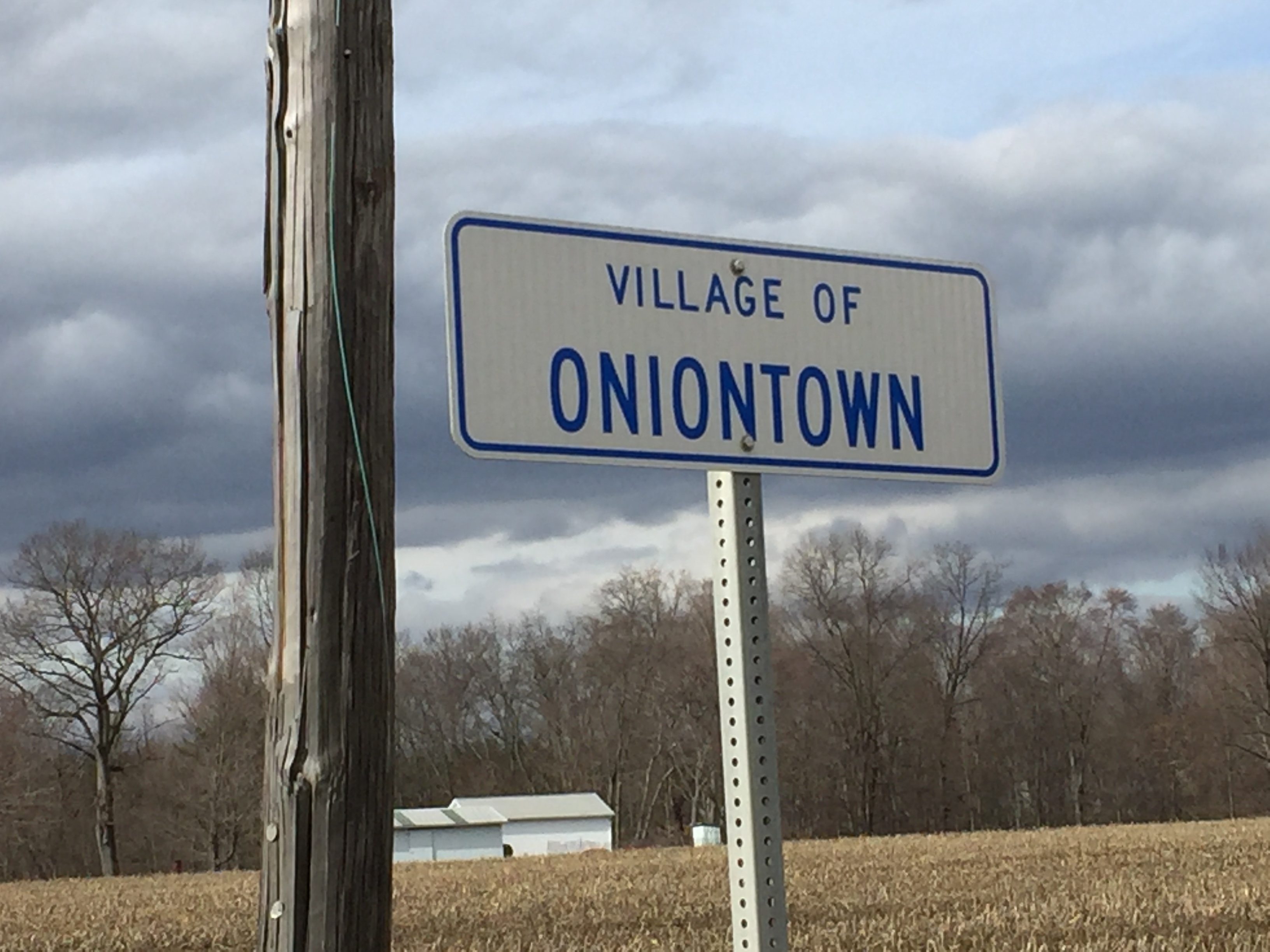
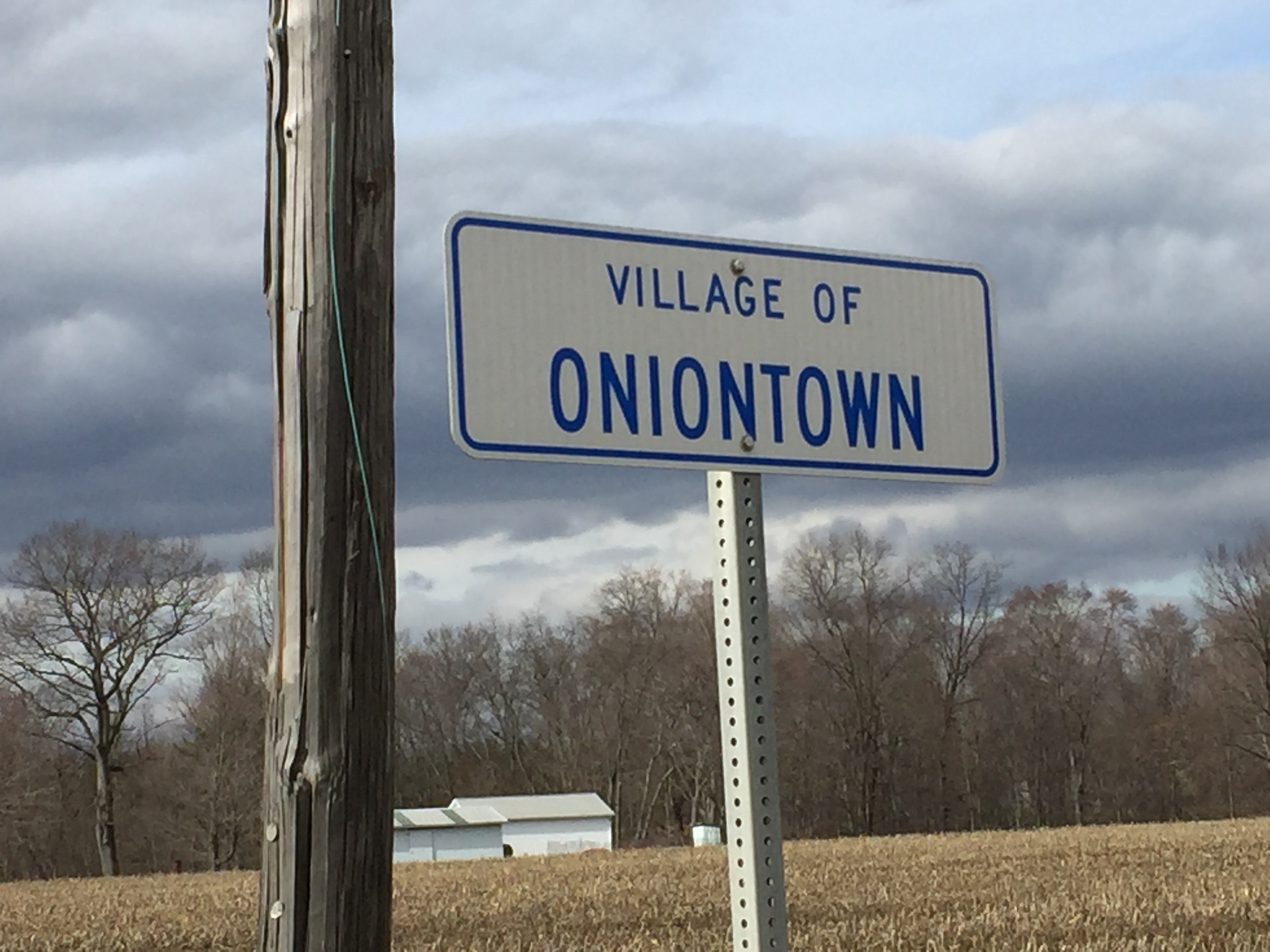
This is why I love Oniontown so much: it always teaches me. A village an hour south of Erie has even helped me to look at home and everything nearby with fresh eyes.

Days ago at Starbucks, I chatted with a boy, maybe six or seven, and his mother. The kid was a whip, his mom cheerfully resigned to having a child able to talk the bark off a tree. His segue between topics was “by the way.”

Our conversation ballooned to ninety minutes and included his Gentleman Claptrap toy, requests for the family shopping list, and some kiddie movie. I was weary, but sensed the approach of wisdom.

As Mom loaded her purse, I said, “I’ve never heard of that movie before.”

He looked at me in disbelief and said, “You have a lot to learn.”

Mom gave him a tame rebuke, but I interrupted: “Well, actually, he’s right.”

And he was. As a lifelong novice, I learn best by opening my eyes and holding out my hands.

Oniontown Pastoral #10: Mom, Please Tell Me About the Glammazombies

Oniontown Pastoral #10: Mom, Please Tell Me About the Glammazombies

IMG_4284My drive from Erie to St. John’s in Oniontown is never wasted. If nothing else, thoughts wander, graze and lie around with other sympathetic thoughts.

Halfway to church the other day, a tongue-in-cheek remark returned to me: “Your kids grow up and move out just as they start to get interesting.” I forget where I heard this and, in fact, disagree, but the ideas started moving.

I was remembering my mother and listening to Glenn Miller. No sniffles or tight throat, just a speculation: “By the time children want to listen to their parents, it’s too late. Mom and Dad are gone.”

Screen Shot 2016-04-25 at 9.01.39 AM

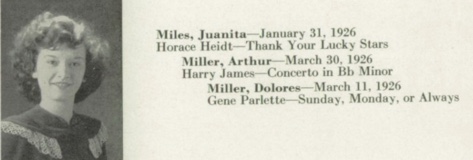
Dolores Miller

“A String of Pearls” made me think of Mom’s 1944 high school yearbook, which notes that her favorite song was “Sunday, Monday, or Always.” Crosby and Sinatra covered it, but Mom liked a version by Gene Parlette, who worked the Erie region back then.

In my imagination, Mom went to a dance, before my dad came along. Who was her date? She wore the dress from her graduation photograph, dark with bone-white lace. “I want you near every day in the year.” Was that the line of lyrics that spoke to her, Parlette singing and conducting his band? Did she dance, a bit awkward?

Then, with “Moonlight Serenade,” wonders came along.

“What was it like at home when you were growing up? What kind of a mother was Gram? What about Gramp? Did you and Uncle Earl and Uncle Ed fight? What were your chores?”

“Tell me about your friends in high school? What did you do for fun? Did you date a lot?”

I wished Mom were in the passenger seat, filling in the picture I never troubled to ask about before she passed eighteen years ago. Comings and goings in this life aren’t cordial to the past and the hours it takes to welcome stories. Some miscellaneous task always seems pressing.

But as years gather round, so does longing. Here I am, then, fifty-five pretty soon, with my wonderment pressing like a deep hunger.

I can see Mom with three or four friends, sitting on a log, probably on a beach at Presque Isle. Maybe one of my sisters or brother still has the photograph in an old hat box. The girls, smiling and carefree, are dressed in white sweatshirts and khaki pants—slacks, Mom would have called them. On the back she wrote, “The Glammazombies.”

“Mom, please tell me about the Glammazombies. Where did you get that name?”

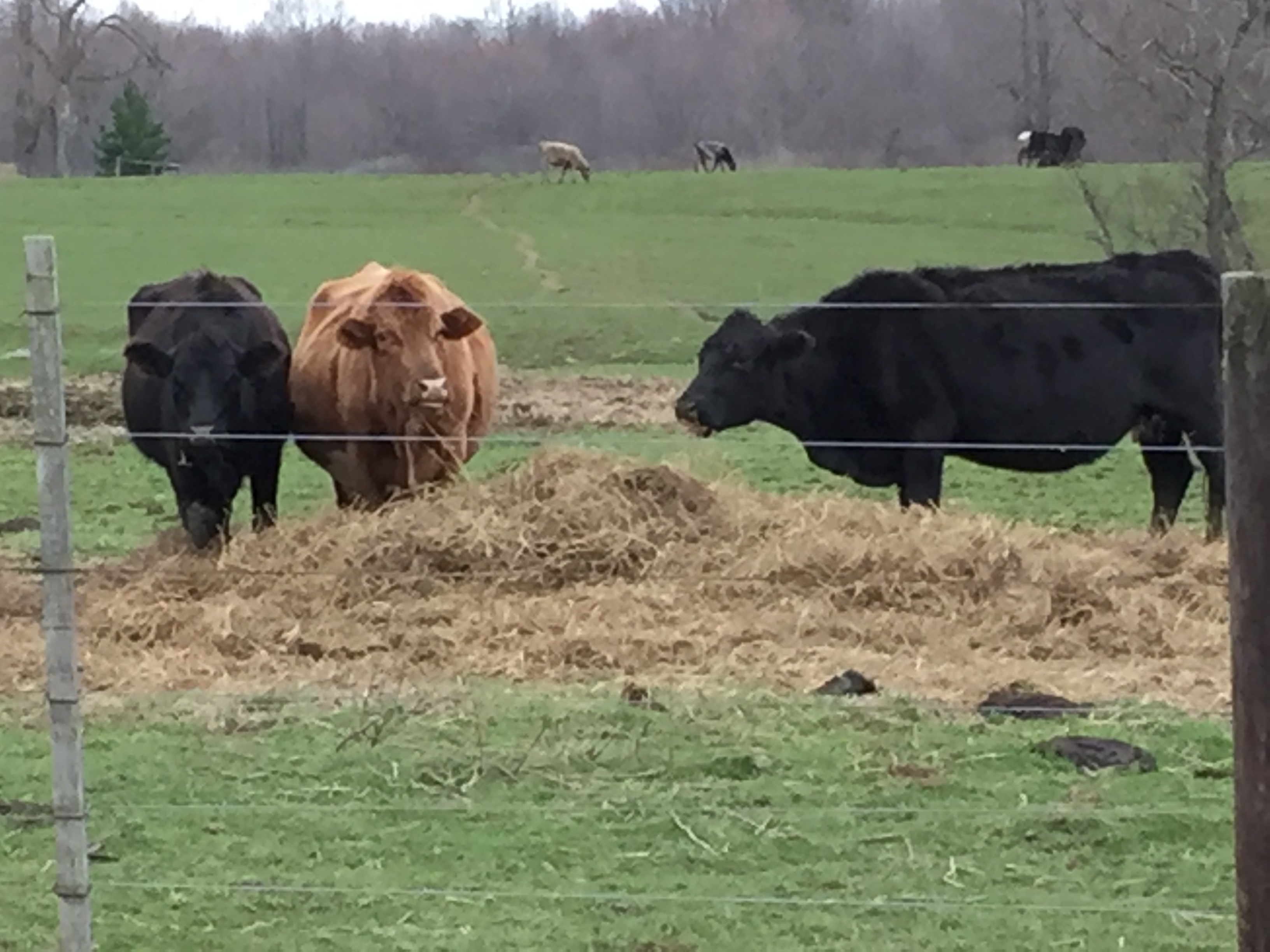
Why do my ears finally open up when the only response is a sweet, slow clarinet over a car’s speakers as it speeds by crops and cows?

IMG_4384

Good questions

The truth is, all my questions wander and graze. A few lucky ones rest in the sun, full and glad, but most remain hungry, needing more.

I take in longing when it visits, but sometimes lost conversations echo in my own breath. Sentences move silently past my lips into the empty space of the passenger seat.

“Mom, tell me what gave you joy. You loved being pregnant, I know that. But what were your dreams? Some of them came true, right? And you got hurt. What brought you to your knees?

“At least tell me about the Glammazombies. You looked so happy in that picture. Tell me about that day at the beach. And you couldn’t stand your own singing voice, but let me hear “Sunday, Monday, or Always.”

“One day long ago you sang to yourself, faintly. You had a lovely voice, Mom. I should have said so right away, but I was a kid and didn’t use words like lovely back then.”

Oniontown Pastoral #9: Kitchen Talk

Oniontown Pastoral #9: Kitchen Talk

IMG_3909Given the number of hours I spend at the stove, it’s inevitable that my best conversations with son Micah take place in the kitchen. Dad smashes garlic or micromanages an Alfredo sauce, and son shows up with revelations and mysteries.

He and I once rehearsed the Chinese words for you’re welcome so that he could answer an elderly immigrant’s thank you at work the next day.

One evening he sputtered a profanity-laced account of a cruelty he had witnessed in a grocery store parking lot. I realized at once that his words were intended as a lament, rough-hewn, but holy.

Micah’s latest beauty parked itself in the kitchen doorway, blocking my way: “Hey, Dad, have you ever felt like you needed a reason to cry?”

“No,” I almost said, “I keep plenty of reasons to cry on hand,” but decided to give my twenty-something some space.

His explanation turned toward the haunting Celtic music from a war film, Black Hawk Down. The Breton lyrics, which sound to English speakers like groans put to notes, choke him up. Is he drawn to listen because, who knows why, tears need to be released?

Since the one activity I spend more time on than cooking is navel-gazing, long, mind-numbing speculations about sadness are always in stock.

I kept my theorizing brief with Micah, and I’ll extend the same courtesy here.

We human beings never really get over anything. That’s the pith. Every death, breakup, failure and injury sleeps folded up in our cedar chest of memory. The teacher who said you would never amount to anything? The words are preserved as if on stationary and fade with the years, but no matter, you know them by heart. And the day you received the devastating phone call? That instant is a photograph waiting for the lid to open.

We live in layers. Today’s scorching goodbye invites every other parting to come along with it. And the current betrayal may sing a solo, but it’s backed up by a choir.

Every joy also has its lineage, but most of us are content to receive a moment’s gladness without interrogation. Who asks, “Why am I having such a great day?”

No. The question left standing belongs to my son. “Do you ever need a reason to cry?” Another way of posing it might be, “Why does each hurt in the chest beg to be aired now and then?”

I don’t know, but my days of stifling the truth are past, as is the impulse to name every lump in my throat.

IMG_4284Fortunately, men’s tears aren’t frowned upon anymore, though most of mine visit privately during my hour to and from pastor work at St. John’s Lutheran Church in Oniontown, Pennsylvania.

A mandolin plays or an oboe or a gravelly voice. The land offers its countenance. I might stop at Camp Perry for some farmer’s cheese and let its salt and cream grace the drive.

Always the weight in my sternum and fullness behind my eyes arrive of their own accord—and not terribly often. A sniffle, a damp cheek. The road blurs a little.

Who am I missing? What passing wants attention? What shadow of rejection has returned to make me small? I don’t ask anymore.

“Come in, whoever you are,” I think, maybe at a crescendo. “Find the air you need.”

By the time I get home, a cleansing has usually occurred. I’m happy to start supper, ready for more kitchen talk with Micah. My lungs are filled sails.

If each soul does have a chest—cedar or hope—mine has no lock. The contents come out and go back in, awakened by music they must recognize. After fifty-four years, I suppose they’re family.

Oniontown Pastoral #8: When the Student Is Ready the Teacher Will Appear

Oniontown Pastoral #8: When the Student Is Ready the Teacher Will Appear

My title here is widely attributed to the Buddha, but Bodhipaksa, host of the blog Fake Buddha Quotes, traces the idea to the 1886 book Light on the Path by Mabel Collins: “For when the disciple is ready the Master is ready also.”

IMG_4284Like any writer I want to be accurate, but in this case I’m busy learning and can’t afford to dwell on scholarship. In recent months, calmed and awakened by the pastures of Oniontown, I’ve found unexpected teachers, probably because I’m finally ready to receive their wisdom.

My teachers—the homebound, mostly—don’t recognize the lessons they’re lavishing upon me. I’m their pastor, after all, with a direct line to the Man Upstairs. When I pay them a visit, they expect to be on the receiving end of whatever insight and solace our time together yields. If only they could see how their fortitude blesses me.

Hopefully I have plenty of vitality ahead, but my teachers make me wonder if I will be strong in my final seasons, when the world grows painfully small. Afternoons bleed into evenings within the same four walls. Aches and frailties invite despair. Boredom and loneliness blanket even those blessed with visitors.

Wallowing would be understandable, but my teachers joke and ask after me and the St. John’s family. “It’s got to get discouraging,” I said to one man. “Well, sure,” he smiled, shifting in his recliner to ease a stab of hip pain, “but once you head down that road you’re done for.”

“What did you have for lunch today?” a parishioner with declining short-term memory often gets asked. “I don’t know,” he answers, “but it was good!”

Caregivers lift and wash and soothe hour after weary hour, unaware that they’re instructing my spirit in grace. How would I roll out of bed each morning with the knowledge that today will be just like yesterday? My teachers are heroic, their faces cleansing breaths of gentleness.

If my beloved Kathy no longer remembered our lives together, how would I cope? “You’re a hero,” I told a man who shows up at a nursing home every day to visit and eat dinner with his wife. “It’s what you sign up for,” he answered. For better or worse, indeed.

And could I endure infirmity, eyes dead to novels, ears deaf to sonatas, muscles slack, lungs spent?

IMG_4337

Faded-red castaway

Some of my teachers, their bodies like the elderly farm equipment castaways in the fields surrounding Oniontown, find ways to move forward without traveling anywhere at all.

One has model train tracks on a table in front of a window overlooking squirrels stealing from bird feeders. Imagine finding life in a locomotive with no destination!

Or how about turning old, brittle pedal sewing machines into shining end tables? One of my sweetest teachers did just this. On the morning his young daughter died recently, he and I sat at his kitchen table. Cancer and grief had knocked the wind out of him, but he mustered the stamina to look with me out a window.

“My God,” I said, “is that a Baltimore oriole?” I had never seen one up close before.

“They’re only here a couple weeks,” he explained, “and then they’re gone. They like jelly.”

Every time I drive to the church I see this man’s house. Less than a month after his daughter passed, he got his wish and followed her into the rest of everlasting peace.

Can I be like him and my other teachers? Can I witness beauty until my last breath? Can I endure and soothe, laugh and learn even when the future is four walls?

And when death is near, can I remember that someone may visit my small world—a student who is finally ready to receive the quiet treasure I have left to share?

My Father, My Son (or Why I Needed Chuck Blaze)

My Father, My Son (or Why I Needed Chuck Blaze)

Beyond boilerplate human regard, Chuck Blaze doesn’t matter to me. The only reason I began what I promised myself would be fifteen minutes of investigation was trivial. For the last few years, an old photograph has been wandering my desk’s geography, from drawer to sort pile to, lately, a space all its own near a corner.

A man in a suit sits holding a beer and a smoke. My father, younger than both of my children are now, stands beside him, caught just as beer crosses his lips. I have a name only because my father printed it on the flip side.

IMG_4584

A quarter of an hour turned into half a day of research and didn’t reveal what I imagined. Turns out Chuck Blaze was a stranger I had to befriend before understanding why his photograph hasn’t yet ended up in a box somewhere.

Chuck Blaze’s given name was probably Theodore Charles Blazowski, but confirming that would take more time than I have to give. By the time he graduated from high school he at least used the handle Blaze.

Screen Shot 2016-04-25 at 8.56.31 AM

“Not spectacular, but steady”: nothing like being damned by faint praise.

I made a trip to the library to find an obituary, which was similarly anticlimactic as well as incomplete. ‘Chuck’ served in WWII, worked thirty-five years at the American Sterilizer Company, and obviously relished fraternal organizations. But between November 22, 1910 and the same day in 1987, a couple facts are omitted. His first marriage to Aili Nokari Blaze—a war bride?—is missing, as are the names of his three brothers, all Blazowskis. By odd coincidence, the aforementioned birth and death date is not only of historical significance (in 1963), but also my parents’ wedding anniversary (in 1947).

I could be wrong here and there, but odds are nobody will object. The payoff is I tracked down the 1929 yearbook for Central High School, which gave me an idea: Could I find my father’s 1944 edition of The Bulldog from Wesleyville High School? No luck. But what about my mother’s Academy yearbook from the same year? Dolores Miller. Bingo.

Screen Shot 2016-04-25 at 9.01.39 AM

Just as I recently learned that forsythia was her favorite flowering bush and “In the Garden (He Walks with Me)” was her favorite hymn, I found out in that moment that she liked “Sunday, Monday, or Always.” Gene Paulette was a local bandleader, but I listened to Bing Crosby’s version. Truthfully, eh.

As I looked at Mom’s senior picture, a beautiful, but surreal, truth settled in: that carefree face belonged not to a mother, but a daughter.

I wished to meet this teenage Dolly, to hear her laughter before life had its way with her. She knew much joy, but if only I could prevent her portion of suffering. Her smile, so unburdened, belonged to my very own child, and the longing to preserve it caught in my throat.

An utterly new compassion took hold of me, and I’ve since wondered if such emotional revelations visit when you have lots more miles behind you than ahead. My mother, my daughter.

And, of course, my father, my son. In my dad’s last year, he couldn’t remember whether I was his brother or cousin or son. He asked whether his mother was still alive. Not for decades. He wondered what became of an old friend, Connie Diehl, and after some digging around I could give him an answer he would immediately forget.

IMG_4583

My father and Chuck Blaze

Dad never mentioned Chuck Blaze, whose photograph I now have in hand. What’s on the horizon he’s scanning? If I were behind him in that doorway, I’d sling an arm over his shoulder and we’d talk. He had great times, but maybe I could say something to help when life went wrong. The beer would be frosty and delicious.

My God, I could just cry.

Message for a New Grandson

Message for a New Grandson

Friend Jan assures me that those in extremis can hear and understand. Son Micah told me once that when death is close, euphoric chemicals show up with kind words, beloved faces, and bright lights.

IMG_3600

Lake Erie light

I’m all for our glands throwing us a going-away party, but what Jan says feels right. Besides, she is wise and knows about deathbeds.

But I have my own reasons for hoping that words of love and care somehow get through. During parishioner Annie’s last minutes, I leaned in close and whispered Psalm 23. Thou art with me. Goodness and mercy. Forever. A single tear ran down her crow’s foot to the pillow. I saw it.

And I saw my mother’s hand lift and fall as I said goodbye to her eighteen years ago. Mom’s purposeful movement said, “I’d answer if I could, John.”

Since then, I’ve spoken freely to the almost-gone. In fact, I’ll speak to everybody and nobody. Words are good, so I say what should be said in hopes that if nothing else, the universe might hear.

Years ago wife Kathy raised monarch butterflies on our front porch. Occasionally, one would be hopelessly deformed, and before resting it underneath a stargazer lily and giving it a quick end, I said, “I’m sorry this life didn’t work out, but it will be over soon. Everything will be okay. You’ll see.”

When geese fly over, in a pair or by the dozens, I say, “Thank you.” Am I addressing the birds or God? Both, I guess.

My most recent monologue came out on—appropriately enough—April Fools’ Day. Killian Davis Thompson, grandson number two, arrived at 2:01 p.m., and within a few hours I got to see him.

IMG_4401

Kathy and Killian

Kathy helped with the birth, so she had already held him. I let Micah go first. After Kathy had seconds, it was my turn.

Time passes dreamlike when you’re looking at a baby you’ve been imagining month after month. I heard giddy voices—daughter Elena, son-in-law Matt, Kathy and Micah—but, I swear, no words.

Killian and I were in a bubble. Even now, I remember only a couple of details, which I report without exaggeration: I disappeared into his face; before I knew what was happening, I found myself whispering to him; and, on one lucid front, I hoped my breath wasn’t nasty. (The little nugget was defenseless, after all.)

IMG_4403

Killian and Pop in a bubble

I can’t bring back exactly what I said, but what I meant is still fresh. As much as I wanted Mom to hear my goodbye, I longed for some quiet room in Killian’s soul to hold in safe keeping his foolish Pop’s welcome. I meant . . .

You were so safe and warm. Now here you are. It’s so cold and bright. Don’t wake up. You must be exhausted. Being born is hard, isn’t it?

But, listen, don’t be afraid. You’re so lucky! We’ve all been waiting for you, wanting to meet you, wanting to see your face.

Don’t be afraid. You have a whole bunch of people who will take care of you. Your mom and dad are beautiful. You have a nice little home. It’s warm and dry. And you have a big brother.

IMG_4444

Lucky baby, lucky family

I named everybody in the family and told him about his tribe. Then Elena’s voice penetrated the bubble: “Are you talking to him?” “Yeah.”

This world is pretty good, but it might not be as great as where you came from. I don’t know. But I’m here, don’t forget. Whatever you need, I’m here. I’ll try to stay close.

Yes, I know, newborns don’t remember anything. And a dying woman doesn’t take green pastures and still waters with her into forever.

But maybe. I’m allowed to hope. All I know is, loving words are good, and if only the universe hears, I’ll keep trying to say them.

Oniontown Pastoral #4: The Late Imposition of Ashes

IMG_4284

Part 1: Holy Saturday Evening

Chopped pears bubbled with white raisins and honey—an improvisation to anoint vanilla ice cream for Easter dessert.

Morning would come early. Before wife Kathy and I headed out for the hour drive from Erie to St. John’s Lutheran Church in Oniontown, Pennsylvania, bacon and congealed fat, soaking potatoes and sliced onions had to get from refrigerator to crock pot, along with whatever else Grandma Coleman included in her German potato salad recipe.

While I cooked, Kathy went to the Vigil of Easter at Abiding Hope, the congregation I served for fourteen years and said Godspeed to five months ago. The gracious interim pastor invited me to come, too, but it was too soon to go back.

Ash Wednesday arrived at an awkward time for this pastor’s heart. The last fifteen years have been disproportionately penitential, my topography rich with Gethsemanes. These forty days being mostly unburdened, I haven’t felt like sweating in the garden or walking the lonesome valley.

My ingredients for happiness aren’t exotic. A couple of untroubled hours at home suffice. With clove and cinnamon taking over the smell of bacon and guitar solos leaning into the dark, I pulled up the footrest and closed my eyes. Breathe in, breathe out. Then, without warning, a suggestion of Lent rose into my throat.

How many times over the decades have I refused to cry? I’m not sure why deferred tears surface on warm spring days, when each breeze is the Sacred One cupping my face. Or on quiet evenings, when the moon passes through living room windows, when failure and regret are subjects of past calendars and my lungs fill with the air of glad memory.

Part 2: Easter Sunday

7:00 a.m.: Why the mess? Everything everywhere, owner’s manual and insurance card on the floor, napkins and dry pens by the gas pedal.

Some little expletive had rifled through our unlocked car overnight. Since nothing was missing, Kathy and I agreed drug money was the goal. But lesson learned.

Dinner on low, we left for Oniontown: breakfast at 9:00, worship at 10:00. All was in readiness. The tomb was empty; “the cloth that had been on Jesus’ head . . . [was] rolled up in a place by itself.”

As Kathy sipped coffee, I thought through the sermon story. Notes wouldn’t be necessary. I can never get far from my dad’s last trip to see wife Mary in her nursing home.

They kissed. He rested his lips on her hand. “Come on,” he finally said. “Let’s get out of here.”

In spite of shared dementia, they both realized the impossibility. Mary’s legs were dead. The only place Dad was going was back to assisted living.

“Well, maybe we can get together . . . .” Dad searched his evaporating vocabulary. “Maybe we can get together at the other post.”

“Wouldn’t it be nice to step out on a cloud?” Mary said. “But that can’t be.”

Dad’s eyebrows gathered down—his standard incredulous look. “Why not?”

Dad, who didn’t have one church-going hair in his wavy gray compliment, was proposing heaven: the other post.

My sermon, falling on the ears of many parishioners who had endured loss after loss, wouldn’t be buoyant with resurrection, but hushed with hope. The other post: oh, that we could all gather there, offenses forgiven, injuries healed, fears rocked to sleep like colicky babies.

We were making good time, and my sermon was rehearsed. I can’t remember a more fair Easter morning. The sun was waking up the pale land, telling it to live.

Then, suddenly, I remembered something that placed the fullness of Lent on my lap. Half an hour away from church, the betrayal and nails and the sponge soaked in sour wine lifted on a hyssop branch all caught up with me. If I had consented to tears at that point I might not have been able to recover in time for a triumphant Easter shout.

What I remembered was four years ago. My own beloved expletive—son Micah—was hooked on heroin and owed a dealer $200. Desperate, expecting to be flogged, he rifled through a couple of cars for stuff to sell and scored a laptop and something else that escapes me.

He got arrested, spent a couple hours in jail, then went out and injected melted down fentanyl patches with a friend, who overdosed and nearly died. Micah earned a felony for his trouble.

My son got clean shortly after his one-day crime spree and is now a joy. Anyone who dismisses the earthly poetry of death and resurrection can talk to me.

My teenage junkie once knelt in the middle of West 8th Street, waiting for a minivan to run him over. I have seen with my own eyes the junkie stand and reach honorable adulthood. On the way to Oniontown, though, a wadded Kleenex still next to the clutch, I imagined the punk who chanced upon the car in the Coleman driveway and made a frenzied search.

My boy came to such a place, and it occurred to me that Easter morning’s little expletive was probably loved by somebody. Maybe he or she was a boilerplate creep, but did a parent pray—with face buried in hands, as I did—for a miraculous healing, a decent path, anything?

Familiar landmarks on District Road were a private blur. I couldn’t afford to have Lent—creation aching with needles, wounds, and rancor, lost pilgrims wandering the lonesome valley—crack me open a couple miles away from St. John’s.

IMG_4359

District Road landmarks were a blur.

Breakfast was five-diamond Lutheran. We shouted and sang. When I talked about the other post, my tears behaved, but some of the folks cried on my behalf. I appreciated their help and knew unfinished ashes would rise in my throat again on a still evening of their own choosing.

On My Mother’s 90th Birthday

On My Mother’s 90th Birthday

img_2795

Dolores Coleman, younger than my daughter and son are now

March 11, 2016: My mother would have turned ninety today. She died on June 8, 1998, of sepsis, the result of a reattached ileostomy. Our goodbye still feels like a door left ajar. She was unconscious by the time I reached her hospital room, so the best I could do was whisper and pat her bloated, purple hand.

She was gentle and loving. I thanked her for that. And I said she gave motherhood everything. She lost sleep and sweated small stuff. I didn’t use those exact words, but that was the gist.

The only sign that she could hear me was her fat hand lifted a little, then fell. Maybe she didn’t catch every detail, but I hoped that she sensed my attempt to surround her with kindness and affirmation.

The trouble was, Mom’s end was not certain at that point. I held out hope for a turnaround, so my deathbed blessing was a precaution.

But it would have to do. She passed within a couple of days, while I was at seminary in Columbus. By the time I got back to Erie, she was bone and ash in a beige plastic urn. No tender moment with Mom in repose, no soliloquy.

And no private crying. Those came at her funeral service, called forth by a hymn, probably my favorite: “Abide with Me, Fast Falls the Eventide.” I was loud and sloppy. It couldn’t be helped.

But this was almost eighteen years ago—my Lord! Grief has aged along with me, tears giving way to a longing that visits now and then. I don’t just miss Mom, but also myself as her kid, when life wasn’t perfect, but mostly good and glad.

Much as a hymn cracked me open when I was a younger man, music now makes me feel an emptiness in my chest that can only be filled by the past. Give me communion with those who would now be a hundred or more. Let me break bread with the living scattered by the centrifugal force of passing time.

465px-Cissy_king_bobby_burgess_welk_show_1969

Lawrence with ah Bobby and ah Cissy, 1969 (credit: Wikimedia Commons)

Last week Lawrence Welk—of all musicians!—had me pining. At the family gatherings of my youth, elders wanted big band and bubbles on the television. Enduring Bobby and Cissy and token black tap dancer Arthur Duncan was a tariff imposed on us before we pre-pubescents could watch Mutual of Omaha’s Wild Kingdom with Marlin Perkins and Jim Fowler and, of course, The Wonderful World of Disney.

My cousins and I regarded the burden as onerous, but now when “It’s The Lawrence Welk Show” belts out from the television and the accordion starts up, my mind and body want to be at Aunt Mart and Uncle Kenny’s house, in the always amiable commotion of generations.

The desire for this slice of the past is physical. I swear, when Welk goes “Ah one and ah two and ah,” my heart stirs. Even Joe Feeney’s nasally tenor makes my eyes smile.

Mom was in that joyful air, in the rise and fall of voices I can’t remember all that well anymore. I miss her. I miss bumping into those decent old souls and getting overheated running around with cousins.

The whole champagne rerun (Public Broadcasting Service) played out as I washed dishes and cooked and let a lovely ache move through me.

lossy-page1-800px-Nixon_meeting_with_Karen_and_Richard_Carpenter_-_NARA_-_194770.tif

Karen and Richard Carpenter with President Nixon (Credit: Robert L. Knudsen on Wikimedia Commons)

Not too many days later Karen and Richard Carpenter played the same trick on me—a PBS fundraiser retrospective. Admitting you like the Carpenters is for some people right up there with digging Barry Manilow. Confession: part of me loves them. Karen Carpenter’s voice puts me in another corner of my past’s attic. Family friends stayed late, played cards, gorged on long-gone Armand’s thin pizzas, and laughed until dizzy. I had just hit double digits, and the scene was so loosey-goosey that I scored a fair amount of beer out of the deal. All the grownups loved and played Carpenter’s albums and 8-track tapes.

Mom, who was built a little like Karen before the anorexia took over, was at the center of my memory’s comforting song. I can still see “We’ve Only Just Begun” in calligraphy at the bottom of our friends’ wedding photograph, their giddy features pinched against the flying rice. Who says “Goodbye to Love” and “Rainy Days and Mondays” aren’t happy songs? Those years weren’t too shabby, nestled in between my parents’ divorce and the ravages of Mom’s arthritis.

Part of my longing is to go back, before I knew how fragile and bruised elderly skin could be, how worry and disappointment can hunch your back, how some dreams end as wisps of smoke.

But that’s not all. I want to dunk my Grandma Coleman’s molasses cookies again, sit on the floor of a room packed with relatives as Tinkerbell blesses the Magic Kingdom with pixie dust and Fowler saves Perkins from a boa constrictor, and watch Mom tease her hair, then set it in curls with Dippity Do and bobby pins.

I wish for Karen Carpenter to sing again. I want to rewind Lawrence Welk’s sign-off and listen back when I couldn’t wait for it to finish.

Good night, good night, until we meet again,

Adios, au revoir, auf wiedersehn till then.

And though it’s always sweet sorrow to part,

You know you’ll always remain in my heart.

Good night, sleep tight, and pleasant dreams to you.

Here’s a wish and a prayer that ev’ry dream comes true.

And now till we meet again,

Adios, au revoir, auf wiedersehn.

Good night!

I’m not wiping away tears. My hand is drawn to my chest, though, and I’m sighing. Sadness and gratitude sit together. This is the best happy birthday I can say to Mom right now.

Oniontown Pastoral #1: My Wife Sleeping

Oniontown Pastoral #1: My Wife Sleeping

IMG_4284I’ve been going to bed by 9:00 p.m. lately and waking up several times during the night–changes in established rhythms. Wife Kathy and I have pruned home to 1000 square feet. My pastor work has slimmed to part-time to make room for writing. And Kathy cries out whenever she rolls over.

As our friends know, Kathy climbed to unfurl the royals on Brig Niagara. She put a new roof on our old house, remodeled the bathroom, fashioned a patio out of salvaged brick, and planted flowers I could never name.

When we bought our little house, which I call the hermitage, Kathy willed the dingy place into fresh order with elbow grease and doggedness. She has big plans: a vegetable and herb garden with raised beds; a deck cobbled together with wood from a backdoor ramp she will saw into pieces; and, of course, flowers.

Kathy has plans, but as we found out a few weeks ago, she also has rheumatoid arthritis. Questions still outnumber answers. Will medication help? Diet? Exercise? Can the condition be coaxed into remission?

She has swollen joints, particularly at the fingers and wrists, and pain all around. A steroid helps for now, but it’s not a long-term solution. Her spirit still sings. Just now she sent me this message: “I hope you are enjoying your morning writing time. You should try to get out for a walk today. What a lovely day. Love you.”

Lovely day, indeed. Lovely human being!

This morning at 1:48 I woke up, sipped some water, and watched Kathy sleep. She should win awards for the dexterity and variety of her snoring. A couple of exhales in a row, her throat sounded like a playing card being flip-flip-flipped by bicycle spokes.

When I smoothed hair away from her forehead, she started. “Oh, I’m sorry,” I said. For the first time in my life, I heard a complete, discernible sentence uttered in mmms. Cadence alone provided the words: “Oh, that’s okay. You can put your hand on my head.”

So I held her hair between the fingers of one hand, rested the other on her puffed out knuckles, and prayed—sort of. If wanting to draw pain out of my wife by touch, to take it upon myself, counts as prayer, then I prayed.

And if “Oh, my dear” counts, then I prayed without ceasing. How many times did moving a little bring rapid breaths and four or five ows out of her sleep?

“Your hands?” I asked.

“My leg,” she answered.

“Oh, my dear.”

She returned to snoring. I looked at her face and longed for a miracle, but I’m eccentric, a pastoral black sheep. You would expect articulate petitions from a trained theologian, but I pray best by breathing.

Each time Kathy resumed snoring, I drew close again and kept vigil. In our shadowy bedroom, we lay bathed in holy light.

One belief granted me sleep: every cry ripples in the waters of Eternal Love.

P. S. Please stay tuned for further Oniontown Pastoral posts and other explanations and solutions.