Message for a New Grandson

Message for a New Grandson

Friend Jan assures me that those in extremis can hear and understand. Son Micah told me once that when death is close, euphoric chemicals show up with kind words, beloved faces, and bright lights.

IMG_3600

Lake Erie light

I’m all for our glands throwing us a going-away party, but what Jan says feels right. Besides, she is wise and knows about deathbeds.

But I have my own reasons for hoping that words of love and care somehow get through. During parishioner Annie’s last minutes, I leaned in close and whispered Psalm 23. Thou art with me. Goodness and mercy. Forever. A single tear ran down her crow’s foot to the pillow. I saw it.

And I saw my mother’s hand lift and fall as I said goodbye to her eighteen years ago. Mom’s purposeful movement said, “I’d answer if I could, John.”

Since then, I’ve spoken freely to the almost-gone. In fact, I’ll speak to everybody and nobody. Words are good, so I say what should be said in hopes that if nothing else, the universe might hear.

Years ago wife Kathy raised monarch butterflies on our front porch. Occasionally, one would be hopelessly deformed, and before resting it underneath a stargazer lily and giving it a quick end, I said, “I’m sorry this life didn’t work out, but it will be over soon. Everything will be okay. You’ll see.”

When geese fly over, in a pair or by the dozens, I say, “Thank you.” Am I addressing the birds or God? Both, I guess.

My most recent monologue came out on—appropriately enough—April Fools’ Day. Killian Davis Thompson, grandson number two, arrived at 2:01 p.m., and within a few hours I got to see him.

IMG_4401

Kathy and Killian

Kathy helped with the birth, so she had already held him. I let Micah go first. After Kathy had seconds, it was my turn.

Time passes dreamlike when you’re looking at a baby you’ve been imagining month after month. I heard giddy voices—daughter Elena, son-in-law Matt, Kathy and Micah—but, I swear, no words.

Killian and I were in a bubble. Even now, I remember only a couple of details, which I report without exaggeration: I disappeared into his face; before I knew what was happening, I found myself whispering to him; and, on one lucid front, I hoped my breath wasn’t nasty. (The little nugget was defenseless, after all.)

IMG_4403

Killian and Pop in a bubble

I can’t bring back exactly what I said, but what I meant is still fresh. As much as I wanted Mom to hear my goodbye, I longed for some quiet room in Killian’s soul to hold in safe keeping his foolish Pop’s welcome. I meant . . .

You were so safe and warm. Now here you are. It’s so cold and bright. Don’t wake up. You must be exhausted. Being born is hard, isn’t it?

But, listen, don’t be afraid. You’re so lucky! We’ve all been waiting for you, wanting to meet you, wanting to see your face.

Don’t be afraid. You have a whole bunch of people who will take care of you. Your mom and dad are beautiful. You have a nice little home. It’s warm and dry. And you have a big brother.

IMG_4444

Lucky baby, lucky family

I named everybody in the family and told him about his tribe. Then Elena’s voice penetrated the bubble: “Are you talking to him?” “Yeah.”

This world is pretty good, but it might not be as great as where you came from. I don’t know. But I’m here, don’t forget. Whatever you need, I’m here. I’ll try to stay close.

Yes, I know, newborns don’t remember anything. And a dying woman doesn’t take green pastures and still waters with her into forever.

But maybe. I’m allowed to hope. All I know is, loving words are good, and if only the universe hears, I’ll keep trying to say them.
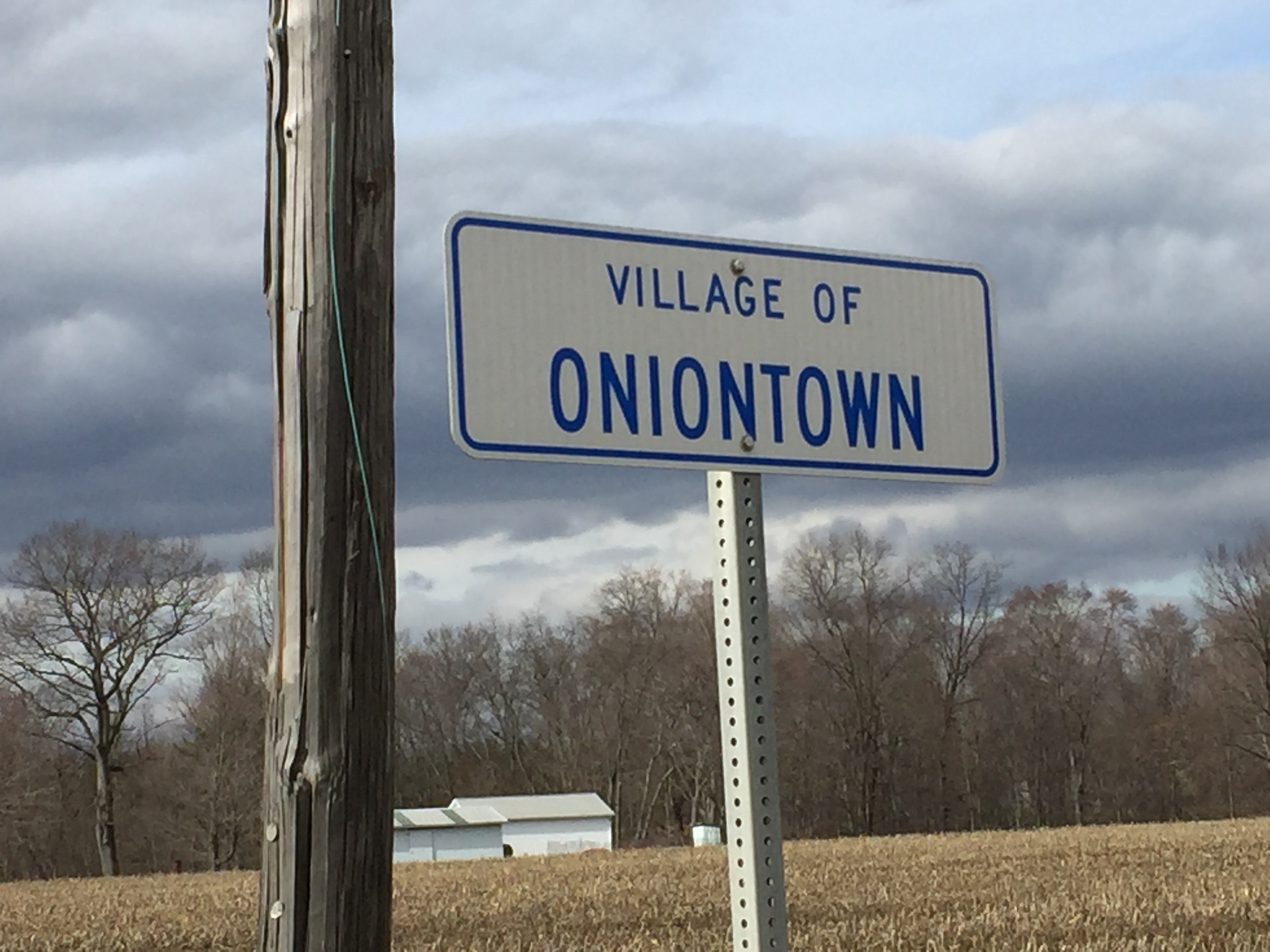
Oniontown Pastoral #4: The Late Imposition of Ashes

IMG_4284

Part 1: Holy Saturday Evening

Chopped pears bubbled with white raisins and honey—an improvisation to anoint vanilla ice cream for Easter dessert.

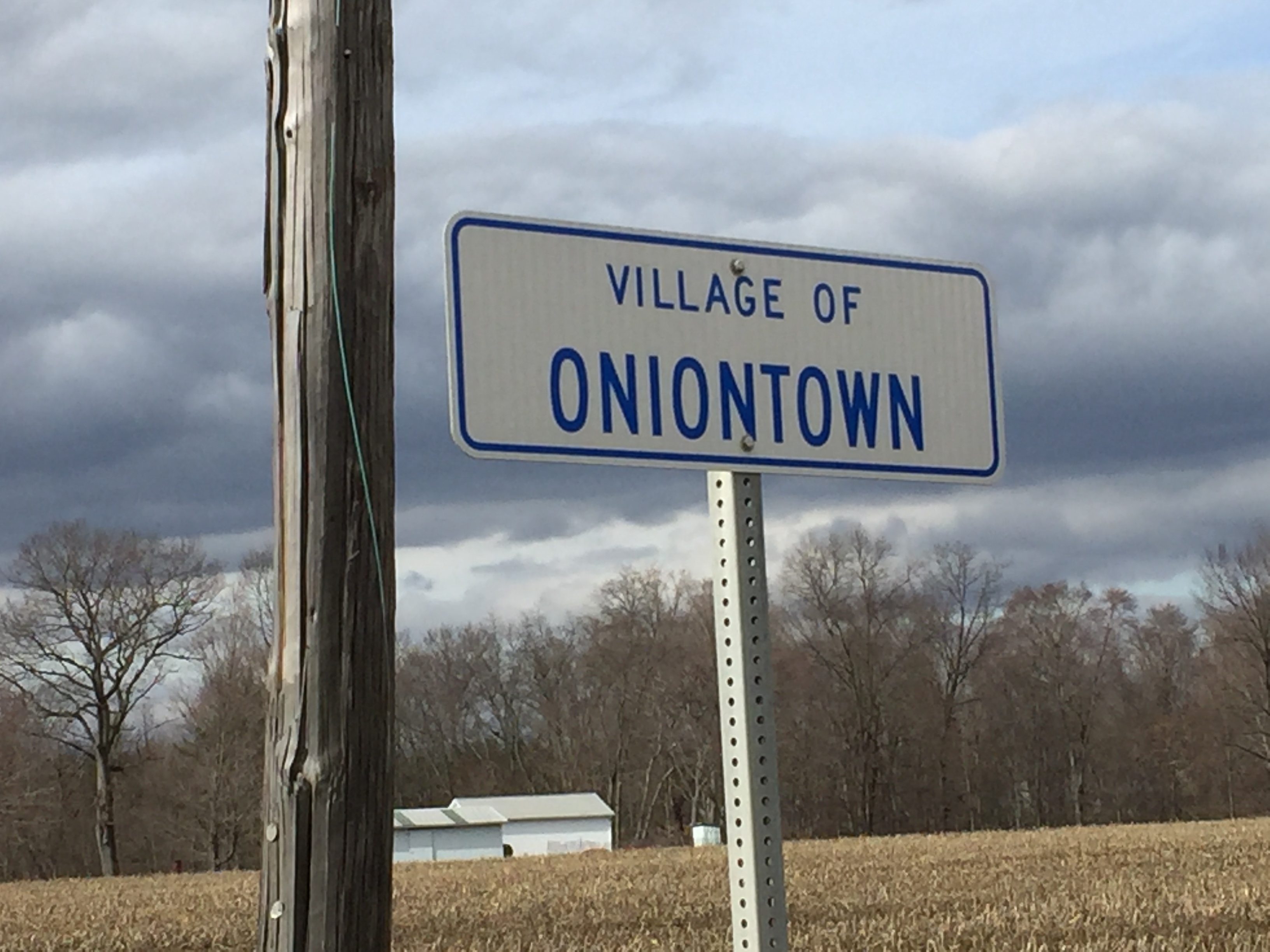
Morning would come early. Before wife Kathy and I headed out for the hour drive from Erie to St. John’s Lutheran Church in Oniontown, Pennsylvania, bacon and congealed fat, soaking potatoes and sliced onions had to get from refrigerator to crock pot, along with whatever else Grandma Coleman included in her German potato salad recipe.

While I cooked, Kathy went to the Vigil of Easter at Abiding Hope, the congregation I served for fourteen years and said Godspeed to five months ago. The gracious interim pastor invited me to come, too, but it was too soon to go back.

Ash Wednesday arrived at an awkward time for this pastor’s heart. The last fifteen years have been disproportionately penitential, my topography rich with Gethsemanes. These forty days being mostly unburdened, I haven’t felt like sweating in the garden or walking the lonesome valley.

My ingredients for happiness aren’t exotic. A couple of untroubled hours at home suffice. With clove and cinnamon taking over the smell of bacon and guitar solos leaning into the dark, I pulled up the footrest and closed my eyes. Breathe in, breathe out. Then, without warning, a suggestion of Lent rose into my throat.

How many times over the decades have I refused to cry? I’m not sure why deferred tears surface on warm spring days, when each breeze is the Sacred One cupping my face. Or on quiet evenings, when the moon passes through living room windows, when failure and regret are subjects of past calendars and my lungs fill with the air of glad memory.

Part 2: Easter Sunday

7:00 a.m.: Why the mess? Everything everywhere, owner’s manual and insurance card on the floor, napkins and dry pens by the gas pedal.

Some little expletive had rifled through our unlocked car overnight. Since nothing was missing, Kathy and I agreed drug money was the goal. But lesson learned.

Dinner on low, we left for Oniontown: breakfast at 9:00, worship at 10:00. All was in readiness. The tomb was empty; “the cloth that had been on Jesus’ head . . . [was] rolled up in a place by itself.”

As Kathy sipped coffee, I thought through the sermon story. Notes wouldn’t be necessary. I can never get far from my dad’s last trip to see wife Mary in her nursing home.

They kissed. He rested his lips on her hand. “Come on,” he finally said. “Let’s get out of here.”

In spite of shared dementia, they both realized the impossibility. Mary’s legs were dead. The only place Dad was going was back to assisted living.

“Well, maybe we can get together . . . .” Dad searched his evaporating vocabulary. “Maybe we can get together at the other post.”

“Wouldn’t it be nice to step out on a cloud?” Mary said. “But that can’t be.”

Dad’s eyebrows gathered down—his standard incredulous look. “Why not?”

Dad, who didn’t have one church-going hair in his wavy gray compliment, was proposing heaven: the other post.

My sermon, falling on the ears of many parishioners who had endured loss after loss, wouldn’t be buoyant with resurrection, but hushed with hope. The other post: oh, that we could all gather there, offenses forgiven, injuries healed, fears rocked to sleep like colicky babies.

We were making good time, and my sermon was rehearsed. I can’t remember a more fair Easter morning. The sun was waking up the pale land, telling it to live.

Then, suddenly, I remembered something that placed the fullness of Lent on my lap. Half an hour away from church, the betrayal and nails and the sponge soaked in sour wine lifted on a hyssop branch all caught up with me. If I had consented to tears at that point I might not have been able to recover in time for a triumphant Easter shout.

What I remembered was four years ago. My own beloved expletive—son Micah—was hooked on heroin and owed a dealer $200. Desperate, expecting to be flogged, he rifled through a couple of cars for stuff to sell and scored a laptop and something else that escapes me.

He got arrested, spent a couple hours in jail, then went out and injected melted down fentanyl patches with a friend, who overdosed and nearly died. Micah earned a felony for his trouble.

My son got clean shortly after his one-day crime spree and is now a joy. Anyone who dismisses the earthly poetry of death and resurrection can talk to me.

My teenage junkie once knelt in the middle of West 8th Street, waiting for a minivan to run him over. I have seen with my own eyes the junkie stand and reach honorable adulthood. On the way to Oniontown, though, a wadded Kleenex still next to the clutch, I imagined the punk who chanced upon the car in the Coleman driveway and made a frenzied search.

My boy came to such a place, and it occurred to me that Easter morning’s little expletive was probably loved by somebody. Maybe he or she was a boilerplate creep, but did a parent pray—with face buried in hands, as I did—for a miraculous healing, a decent path, anything?

Familiar landmarks on District Road were a private blur. I couldn’t afford to have Lent—creation aching with needles, wounds, and rancor, lost pilgrims wandering the lonesome valley—crack me open a couple miles away from St. John’s.

IMG_4359

District Road landmarks were a blur.

Breakfast was five-diamond Lutheran. We shouted and sang. When I talked about the other post, my tears behaved, but some of the folks cried on my behalf. I appreciated their help and knew unfinished ashes would rise in my throat again on a still evening of their own choosing.

Oniontown Pastoral #2: Visitation

IMG_4284

I don’t know anything sadder than a summer’s day.

(“The Geese” by E. B. White)

Who doesn’t love summer? Millions of northerners flock south each year in hopes of denying winter its due.

I accept the migration’s logic, but my attraction to summer or any mild weather is complicated. If the sky is flawless blue, I remember that for some folks, clouds block the light.

E. B. White’s summer sadness descended as he watched an old gander on his farm defeated by a young male. The Charlotte’s Web author, in his early seventies, sympathized with the displaced bird.

My ambivalence toward nice weather has its own causes. When I was a teenager my grandparents tried to outrun Gram’s arthritis by moving to Sun City, Arizona. While the dry climate was physically medicinal, the miles from children and grandchildren punished her heart.

My mother died in June of 1998 while I was doing chaplaincy training. At the end of each day of caring for others, I floated a city block to my car through a hot haze of grief.

So memories and disposition keep the unbridled joy of a beautiful day in check. I wouldn’t call my mood sad, though. Mindful is more accurate. I pray for people for whom getting from stoop to car is herculean or impossible. I dream them with me into the light.

Last week I visited homebound parishioners. Ah, the weather! Driving was a pleasure, windows down a couple of inches. Walking across parking lots was all Julie Andrews spinning and singing from the lively hills.

But it never takes long to recall that beauty depends on your perch. If walls and a non-compliant body keep you from taking in deep draughts of outside air and picking tomatoes with your own two hands, then whatever breeze sneaks in through the screen might bring out a sigh of resignation rather than delight.

IMG_4308

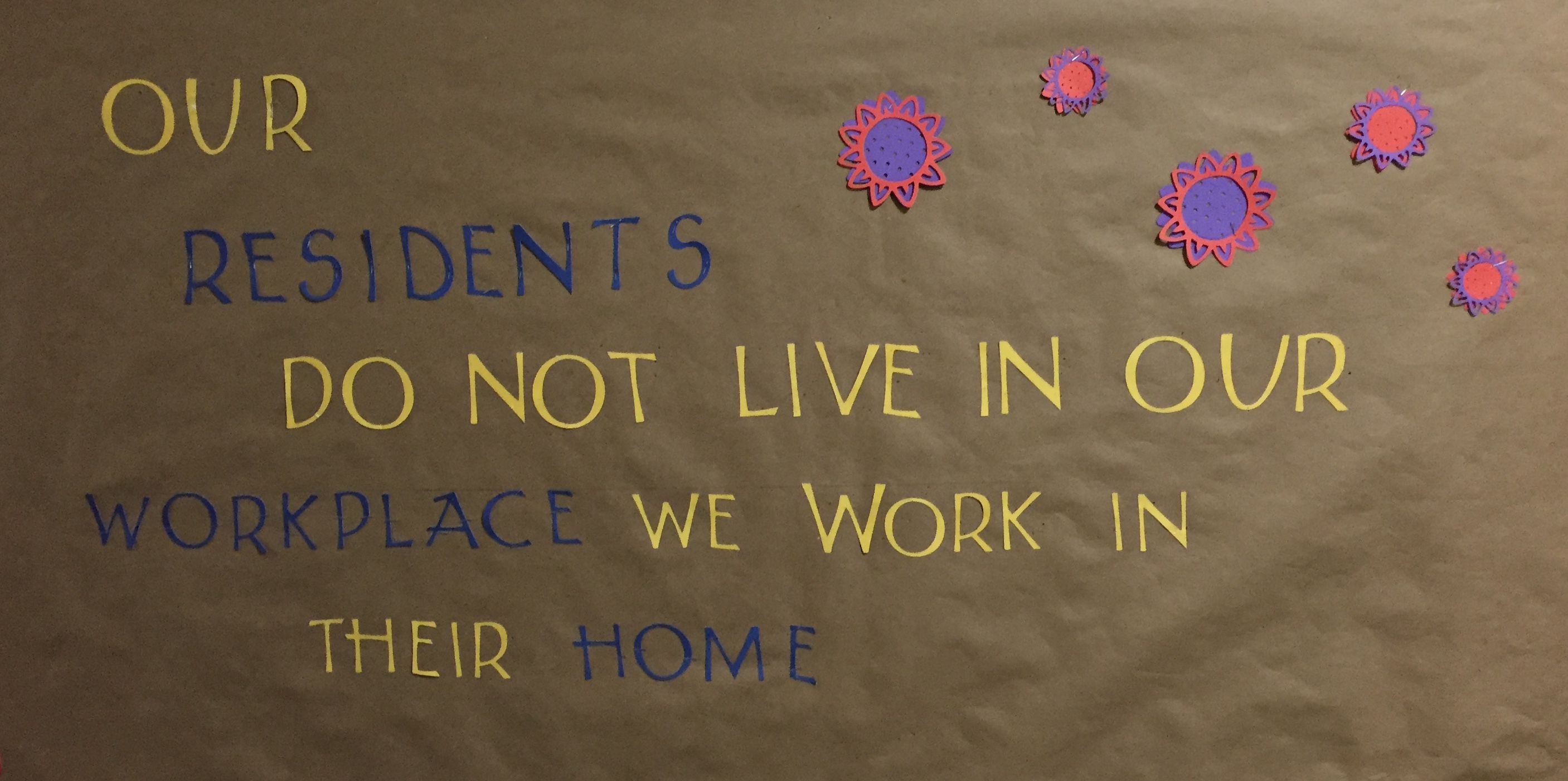
Bulletin board in an old folks’ home near Oniontown

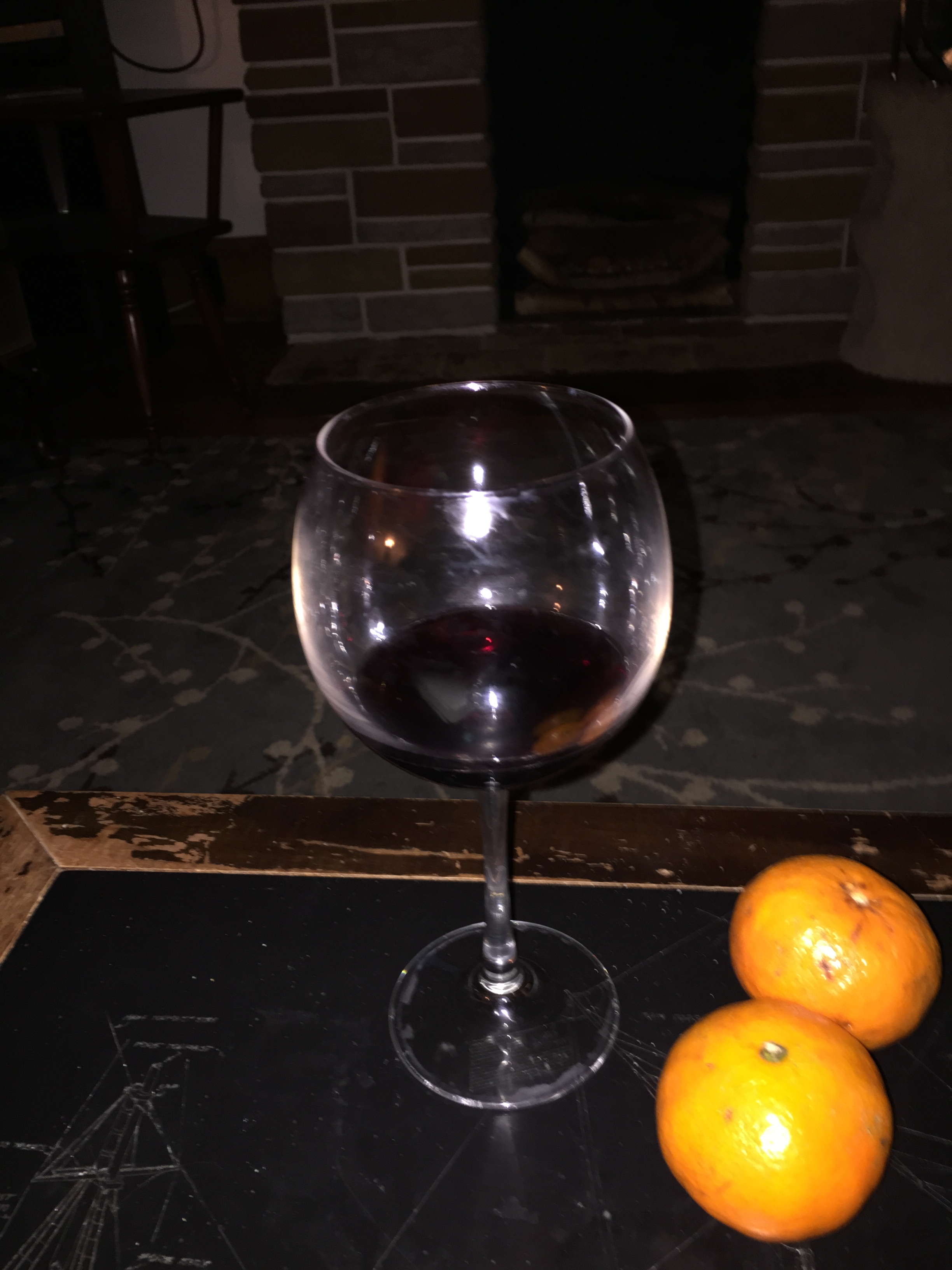
This evening while enduring the television news, I’ll have a splash of pinot noir—just to gladden my human heart. What does a long-stem wine glass look like to an elderly child of God who shakes unpredictably? Or a chalice full of Sacred Presence? Spills waiting to happen?

Such questions should depress me, but they don’t. Seeing through homebound eyes is a lighter prayer than you might think. Anyway, I won’t dishonor them with sorrow. Maybe God can use my gratitude—for the filling of lungs, lifting a spoonful of broth, finding the Big Dipper—to bless my friends, to grant them an hour’s gladness.

My own joy is tender to the touch—only selfish joy isn’t bruised. I miss Mom now more than eighteen years ago when summer hung on me like wool.

But this March day is stunning, brilliant, 60 degrees. Chores are next on the list, then a walk. I’ll bring Mom and gather everyone I can remember as I go.

Dear God, please take the saints I forget by the hand and lead the way.

Oniontown Pastoral #1: My Wife Sleeping

Oniontown Pastoral #1: My Wife Sleeping

IMG_4284I’ve been going to bed by 9:00 p.m. lately and waking up several times during the night–changes in established rhythms. Wife Kathy and I have pruned home to 1000 square feet. My pastor work has slimmed to part-time to make room for writing. And Kathy cries out whenever she rolls over.

As our friends know, Kathy climbed to unfurl the royals on Brig Niagara. She put a new roof on our old house, remodeled the bathroom, fashioned a patio out of salvaged brick, and planted flowers I could never name.

When we bought our little house, which I call the hermitage, Kathy willed the dingy place into fresh order with elbow grease and doggedness. She has big plans: a vegetable and herb garden with raised beds; a deck cobbled together with wood from a backdoor ramp she will saw into pieces; and, of course, flowers.

Kathy has plans, but as we found out a few weeks ago, she also has rheumatoid arthritis. Questions still outnumber answers. Will medication help? Diet? Exercise? Can the condition be coaxed into remission?

She has swollen joints, particularly at the fingers and wrists, and pain all around. A steroid helps for now, but it’s not a long-term solution. Her spirit still sings. Just now she sent me this message: “I hope you are enjoying your morning writing time. You should try to get out for a walk today. What a lovely day. Love you.”

Lovely day, indeed. Lovely human being!

This morning at 1:48 I woke up, sipped some water, and watched Kathy sleep. She should win awards for the dexterity and variety of her snoring. A couple of exhales in a row, her throat sounded like a playing card being flip-flip-flipped by bicycle spokes.

When I smoothed hair away from her forehead, she started. “Oh, I’m sorry,” I said. For the first time in my life, I heard a complete, discernible sentence uttered in mmms. Cadence alone provided the words: “Oh, that’s okay. You can put your hand on my head.”

So I held her hair between the fingers of one hand, rested the other on her puffed out knuckles, and prayed—sort of. If wanting to draw pain out of my wife by touch, to take it upon myself, counts as prayer, then I prayed.

And if “Oh, my dear” counts, then I prayed without ceasing. How many times did moving a little bring rapid breaths and four or five ows out of her sleep?

“Your hands?” I asked.

“My leg,” she answered.

“Oh, my dear.”

She returned to snoring. I looked at her face and longed for a miracle, but I’m eccentric, a pastoral black sheep. You would expect articulate petitions from a trained theologian, but I pray best by breathing.

Each time Kathy resumed snoring, I drew close again and kept vigil. In our shadowy bedroom, we lay bathed in holy light.

One belief granted me sleep: every cry ripples in the waters of Eternal Love.

P. S. Please stay tuned for further Oniontown Pastoral posts and other explanations and solutions.

Fats Waller and the Frosted Trees

Fats_Waller_edit

Fats Waller (Credit: Alan Fisher on Wikimedia Commons)

Fats Waller and the Frosted Trees

Jelly Roll Morton, Scott Joplin, and Fats Waller make me grateful. As Steve Martin said decades ago, “You just can’t sing a depressing song when you’re playing the banjo.” Same with driving in the country and listening to piano rolls, rags, and strides.

This past week Fats, the color white, and gratitude owned my commute from Erie to St. John’s Lutheran Church in Oniontown, Pennsylvania. The hour south on I-79, Route 19, and District Road was a hot damn of thanksgiving–“Handful of Keys,” “Lulu’s Back in Town,” “When Someone Thinks You’re Wonderful.”

d8ab0138-1236-43ad-a8dc-a930a0642a7f

Grandson Cole, wonderful kid with a new lid

Why did pianos and frosted branches make me take inventory? I don’t understand myself all that well, so who knows? My list wrote itself slowly and silently.

  • I have a surplus of love. One step in any direction, there it is. Wife, grown kids, one grandson and another on the way, more family and a ton of friends. An absolute wonder of wonderful souls.
  • Those closest to me are holding together okay. No crises going down or chops busting in process.
  • I have a home, warm or cool as desired, so much food that possibilities have to be eliminated, and a king’s ransom of clean water.
  • My closet holds wardrobes for varying weight classes with acquisitions I’ve forgotten.
  • Bill collectors are not breaking down the door.
  • I dig the bookends of my commute—solace to the north and good purpose to the south.

As the miles clicked away, as Fats sparkled, as the snowy trees formed cathedrals surreal with beauty, Gershwin lyrics came to me: “Got my gal, got my Lawd, got my song.”

IMG_4148

Beloved Watson with the mother of fatty tumors

“No use complaining,” Porgy says as an aside, though he didn’t know about the Coleman family’s dog Watson, weary, arthritic, laden with tumors. He is our hobbling source of agape—unconditional love. A month ago, a lump appeared in the middle of his forehead. Its rapid growth foreshadows his absence, even as he manages a fetch or two. He snorts constantly, trying to clear a mass that won’t budge.

Nearing the end of my commute, I allowed that happiness isn’t a prerequisite for gratitude. Twelve years of Watson’s mild presence has been extravagant by any measure.

IMG_4150I would say that my inventory was a prayer, but Fats alone was that, as were the frosted trees and a line from a musical. I received the wide mercy—alpha to omega—of giving thanks for miles with my eyes, ears, and lungs and not once calling God by name.


A Witness for Richard

I’m used to burying strangers. Plenty of deceased and their families believe in God, but the church not so much. That’s when pastors get a call from a funeral director. Not much explanation is necessary: “Are you available to do a service on such and such a date and time?”

If nothing is going, I’m in. Details are provided, name, next of kin, a phone number. From there I watch for an obituary and make the visitation if possible, talk to loved ones, gather some sense of the departed.

But my latest burial was a first: no name, no contacts, just when and where. I did reconnaissance in Section B of the paper and found one possibility, a man with a brother and a couple of nieces. Maybe the brother wanted a prayer and “ashes to ashes” at the grave. No fuss, just a man of the cloth and a few words. At the appointed hour I fishtailed to my commitment, confident I would find a seventy-something man in the casket.

Instead I found Richard, a fifty-something resident of a group home, where he lived with other adults in need of supervision and care. Some of them were sitting with their caregivers, waiting for an unfamiliar face to bring comfort and hope.

The funeral director pointed me toward Richard’s primary caregiver, who didn’t quite know what to tell me. Richard didn’t speak. He loved to look at artwork. “He loved to eat,” she said, raising her eyebrows and drawing out loved, making the vowel sound delicious. He expressed disapproval by screaming.

Others told me that he insisted on being called Richard and looked forward to his morning routine of chocolate milk.

Twenty minutes before the service, I stood with Richard: African-American guy about my age; chin drawn in; fingers showing some atrophy, I believe; passable suit jacket and tie; favorite afghan across his legs.

In certain situations I take it as my responsibility to witness, to pay attention and make a silent announcement to creation. Or maybe my job is to confess a belief consisting of equal parts tears, hope, and wonder. I don’t know.

But staring at an embalmed man whose life was nearly invisible, I put words in God’s mouth. Doing this has always felt dangerous. I don’t know the mind of God. I can’t even put together a sound argument that God exists. Anyway, words were in my mouth. I didn’t invite them. I heard them in my head as true beyond debate. It was as if I were not their author:

You’re as important as anybody in the world, Richard. Nobody is more loved than you are.

I imagined that Richard’s face, the lip puffed out over teeth that never got braces and his fingers bent at the last knuckle, were dear to God—as when a parent watches an infant sleep, each feature counted as a miracle. And to God’s ear, were Richard’s screams music?

I did my best with the service. Some lives make for scant eulogies, but that’s only if you forget that one person’s chocolate milk in the morning deserves mention as much as another’s Fulbright. “Richard was a charming, and funny man,” his obituary read. “He had a loving, caring soul and his smile would light up a room.” His friends, a dozen or so, cried for him. They wiped away tears, too, at the suggestion that God beheld Richard loving food and in him was well pleased.

A soul’s resume lists sacred trivia: knowing how to taste chocolate milk, getting lost in a painting, demanding to be called by name, caring for others with a smile or a scream. Richard’s accomplishments don’t shine up very well, but those who loved him in the world appreciated them and loved him to the end—from the group home to the funeral home to the cutting cold of the cemetery.

In under ten minutes, we had spoken the final amen and were back into our warm vehicles. Not many days later now, I sip routine coffee. Richard reminds me to taste it. His face, as clear in my eyes as when I stood by his body, doesn’t belong to a stranger. His features are fine the way they are. May God and all the quick and the dead remember to call him Richard.

Under the Clock

Getting out of bed this morning was like lifting an anvil. Both wife Kathy and I lay slack-jawed through alarm after alarm. I’m not sure choosing Bach’s Goldberg Variations as my iPhone wake up call was a good idea. Such a gentle, thoughtful melody, but I now associate the first few measures with the shared human struggle of starting a day.

IMG_1139

Six already? Come on!

We tried to hold each other the way some wives and husbands do, with Kathy’s head on my chest and my arm around her. That worked for five seconds, thanks to bursitis in my left shoulder. So, we adapted. I put my arm down, she slung her arm across my belly, and we listened to the morning household. Son Micah’s obnoxious alarm nagged him—he was tired, too. Watson made old-dog dozing huffs and grumbles. Baby Crash, the most beautiful cat I’ve ever seen, played drumrolls by dashing around the hardwood floors.

“How old is Baby now,” I said out of nowhere, “four?”

“Six,” Kathy said.

“Six! How is she six?” I was only off by two years, but still, 1/3 of her life. The passing of time weighed in on my chest like a second anvil.

My God, where are the decades going? Next week I’ll turn fifty-four. How can that be, when I walk tentatively through the world, shaking just like I did trying to summon teenage bravery to ask a girl out on a date? Gray hair sticks out of my shirt collar. So why do I feel the same as I did when Kathy and I were dating, thirty-five years ago? Hot summer day. We were watching television, and I had one long, pathetic hair sprouting from my left nipple.

Innocently, Kathy spoke and acted in the same instant: 1.) “What’s that?” 2.) Reach toward hair. 3.) Grab ahold. 4.) Yank.

I screamed. Carbon dioxide hissed from the pinhole in my areola.

Kathy laughed, hard. “Oh, was that attached?”

“Yes.”

I now have hundreds, maybe thousands of chest hairs, but I still remember that first, overachieving pilgrim, its lilt to the left, a jaunty kink 2/3 of the way to top, not a suggestion of gray. My Precious.

I’m still that kid. My God, where is life going?

Mountainous questions are on my mind lately because I’m leaving the folks I’ve served as pastor for the last fourteen years, moving on to a small congregation. There isn’t any dishonor in my departure, but it’s not quite the way I wanted to go. I expect my exit on October 25th will be loving, but probably not celebratory.

Yesterday afternoon I went to an art show in downtown Erie. A couple of friends have work displayed, and I figured abandoning myself in shape, color, texture, whatever would be therapeutic.

IMG_3878When I arrived at the old Boston Store, a spacious building that used to be home of one of Erie’s proudest establishments, my first priority was to find the men’s room. It’s tough to get lost in art when your Kegel is clenched. The show would wait a few minutes.

I walked mindfully past a cluster of radio stations that now squat where women’s shoes or sheets and comforters used to be displayed. When my eyes fixed on the great clock hanging at the center of the place, I remembered that my mother, dead seventeen years now, worked at the Boston Store.

After confirming my suspicion that in all the acreage of the grand department store there was no obvious place for a middle-aged man to pee, I returned to the clock. “I’ll meet you under the clock,” Erie-ites used to say. For a while, a restaurant used that name and location. Now, all that’s left is an expanse of tan tile floor.

I looked up, checked the time, and missed my mother. In my mind she walked under the clock, no hint of arthritis yet, tastefully dressed, mascara and lipstick perfect.

The silence was of a comforting dream. I’m not too proud to admit that when I’m going through changes, trying to keep my footing, I want to be with my mom, to connect with the love that held my head when I puked and endured my adolescent travail.

Could Mom still abide in a great cradle of Eternal Love—the Love I invite each day to take hold of me, still the crazy waters, lift my anvils, and use me for Love’s sake in this wonderful, stressed world? I couldn’t feel her presence, but as I breathed in and out under the clock and received the quiet of deserted space, she seemed to live.

IMG_3874

Wrong

My God, where are we all headed? And how much time is left? The great clock was no help—four clocks, actually, one on each side. Only one was correct. Two others agreed but were wrong, as was another that lagged two hours behind, or rushed ten hours ahead, depending on how you figure.

The art show, when I got there, was as good as any collection can be when a guy is pressed at his equator. My friends’ works were so compelling that I’m looking at them again now, behind closed eyes. (Thanks, Mary and Mike.)

In today’s sky, wisps up high seem fixed, while full white clouds just above me ease to the southwest. Over Lake Erie, a long gray assembly floats in the same direction.

Where has the time gone? I may as well ask, “Where are the clouds going?” Rhetorical questions, sighs of the soul.

I didn’t make it to the church this morning. There’s much to do before I leave, but this week of telling loved ones that I won’t be their pastor for much longer has me feeling like the tender, gentle, awful sentimental Tin Man after Dorothy kisses him goodbye: “Now I know I’ve got a heart ‘cause it’s breaking.”

Always breaking, always healing back up, I suppose. In the end, I’m content to ask questions without earthly answers, breathe them up to the sky and let the wind blow them from sight. I’ve built my life on the promise that clouds, souls, and mysteries find their way to a loving place.

Now, the promise tells me to go home, take a nap, do dishes, and pick up Kathy from work. In other words, the Promise says, “Go, now, and join the day you’re given.”

P. S. A note to blogging friends: For the last couple of months, I’ve been guilty of what I call selfish blogging; that is, posting without reading much. Please forgive me. I’ll try to catch up soon.

Lament for Aylan Kurdi

Sadness Alert! This post will be painful to read. 

He stood there biting his lower lip. “It is very difficult,” he said. “I cannot resign myself.”

He looked straight past me and out through the window. Then he began to cry. “I am utterly unable to resign myself.”

(from “In Another Country” by Ernest Hemingway)

IMG_3687

Citrus Photobomb of Pinot Noir

Close day in Erie, Pennsylvania, but central air pacifies me. So does a Smoking Loon pinot noir. A soprano (Callas, Sutherland, Caballe?) sings something from Madame Butterfly—I think. When hunger intrudes, I’ll walk a few feet to the kitchen, open the refrigerator, and decide what not to eat. That’s how stifling my life is. I have to eliminate meal options.

I’m inexcusably comfortable but for one trifle: Aylan Kurdi drowned. A photograph of a police officer carrying him from a Turkish beach appeared on the evening news. I recognized the boy immediately, his toddler legs. He was my grandson Cole. The tender calves, the tiny sneakers!

Two hours ago, he said, “Pop, come.” He had a tennis ball that he wanted me to toss high into the air. Into the humidity, above the young tree in his front yard, the yellow globe flew, then fell to the grass. Cole bounced. Or was it Aylan?

Unknown

Aylan Kurdi. Forgive me, friends, but can you make out your child here? Do you recognize the sneakers? (Credit: Reuters)

Now, as Jussi Bjorling kills some high notes from La Boheme, I comprehend: Aylan = Cole.

If my son-in-law fled bombs with my daughter and grandchildren and lost them to water, I would want nothing more than to join him, to sit beside their graves until merciful death arrived.

I cannot resign myself. I am utterly unable to resign myself.

Or as Aylan’s father Abdullah said, “I don’t want anything else from this world. Everything I was dreaming of is gone. I want to bury my children and sit beside them until I die.”

IMG_3640

Cole with Pop. Do you see Aylan’s hands? His little legs?

Hemingway’s Senior Maggiore grieved the unexpected death of his young wife from pneumonia after he had survived war, hand maimed but otherwise viable—the absurdity, the affront.

Syria is a hemisphere away, but geography is a rationalization. Aylan in the wet sand is Cole in the wet sand. To hell with similes. Any other conclusion is bullshit, for me and for the world. Our best hope is for Aylan to be my own grandson–and your very own, too. You feel this with me, don’t you?

I want to pick that boy up off the beach and love him back to life so badly my throat burns. You, too?

The Smoking Loon is gone, and I’m hungry.

Damn it!

An Unorthodox Peace

IMG_3646This past Sunday the church I serve, Abiding Hope Lutheran in Erie, Pennsylvania, held a groundbreaking ceremony at the site of our new church building, the foundation of which is already well underway. After morning worship at the old place, we all got into our cars and headed the mile or so to our future home.

For mundane reasons I had to drive son Micah’s car, which is always in unapologetic squalor. Almost to the end of the parking lot, I had to double back: the processional cross was still on its perch in the sanctuary. After fetching it, I looked at the backseat and paused: Should I put the cross down on that mess? Because I realized that entirely different questions were on my mind—ones I could answer right away—I rested the cross on my son’s work clipboard, toilet paper, hoody, etc., no food debris, thankfully.

The groundbreaking was meaningful and fun and didn’t seem at all redundant. No silver shovels for us. Everybody who wanted to turn some dirt brought a shovel from home, especially our kids. The ground was packed down by construction vehicle traffic and hard as the cinderblock foundation. We found a soft patch for the young ones with sandbox shovels and let them have at it, sang with gusto, and said our prayers and good intentions. The adults chipped loose teaspoons of gray crust.

When we finished, I lay the cross over the chaos for its ride to the Coleman house, where it leaned overnight in the dining room.

IMG_3650

Processional cross

“Ooh,” Micah said, spotting what he actually carried years ago as an acolyte. His question was implicit: “What’s the deal with the cross here?”

I explained.

He held it like a shovel—Christ at the top—and pretended to chip at the floor: “So did you dig with it?”

“It would have been fitting,” I said, “but, no, a couple of kids held it for the ceremony.”

As Micah has grown, we’ve developed an understanding. He gently teases me, but knows that my faith is spacious and merciful, blinding white with Mystery. And I take his searching seriously and don’t meddle with his atheism.

The purest image of my spirit’s posture is this: I don’t fear for my son. I don’t fear for anybody.

My Creator isn’t abstract. Often when I close my eyes and breathe, a love that feels bestowed rises in my throat—as when a parent watches a child disappear through the school doors. My chest is drawn toward a planetary embrace. The longing is physical.

It may be nothing more than my own middle-aged chemicals inducing some weird prayer-meditation high. I’m probably bat-crap crazy. I can’t offer a defense, only a description of the love that I bet my life on. God is what I call this love, but the older I get, the more I’m drawn to the ancient Jewish tradition of not vocalizing Yahweh. Shh. Only know and breathe compassion—for all, for self. I want to name the Holy One with my flawed heart and hands. My voice can’t be trusted entirely.

How far is the reach of Sacred Love? Whom and what does it rest upon? On Sunday, when I lay the cross on Micah’s slop in the backseat—nothing compared to the past squalor of heroin, arrest, and rage—I spoke my Christian answers to the questions behind my question. The universe is composed of beloved daughters and sons. Who am I to send anyone into exile? Helpless before grace as I am, how can I presume to stand in the way of Love?

IMG_3648

Christ’s metal blessing upon the chaos

This might not be the most convenient parking place for a pastor. Love’s current in the Bible is strong, but troubling blood flows there, too. I will only say that I’ve made an unorthodox peace with Egypt’s firstborn and Israel’s young women lacking evidence of their virginity, stoned to death on their family’s doorstep—we have a private understanding.

It’s enough, I guess, to admit that in resting a processional cross on the backseat of tired old Mazda sedan, I was confessing my belief: the risen Christ bestows a metal blessing on every mess in every land, on every soul aching with belief and disbelief.

I’ll Find You, Art, in the Sunset Dance

Art and I had a routine. He poked his head into my office doorway, checking to see if the coast was clear—a few times a week since Doris passed nine years ago.

“Thought I’d come in and bug you for a few minutes,” he said, then had a seat.

Image-20079_20150727

Friend Art

Half-hour by half-hour we picked through his life and pulled out stories as if from attic boxes: Korea, close enough to the action to hear the shells whistle; a garage-building crew in the old neighborhood and the keg they were bound to finish and the world spinning; Doris dying alone in the afternoon while he ran errands—he never quite forgave himself.

“Well,” Art said, standing up, “I’ll let you get back to work.”

“But, Art,” I always answered, “I have been working.”

He had to stop on the way home for something, maybe boloney. Samwiches every day for lunch get boring. After a while you forget to eat.

Art got to church first on Sunday mornings, unlocked the doors and set the bulletins out. But arthritis clamped down on his shoulders so badly that he gave in and got a crew cut. Combs and spoons weren’t his friends anymore. If I had a nickel for every time I fixed his collar or untwisted his suspenders . . . . Getting to worship became a project, weary and burdensome.

This past winter Erie, Pennsylvania, was cruel. Art’s car and many others at Niagara Village were snowbound, but the wind chills would have kept him inside anyway. He had time to dwell on the indignities of age: obstinate hearts, lungs, and bowels. And loneliness. He looked at Doris’ picture on the wall and told her, “Send me my ticket. I’m ready.” He lay in bed before dawn, anxious and hazy, and wondered if what he was feeling was death.

Kidney failure pushed him over the edge. I was there when a kind doctor leaned in close and with his manner as much as his words let Art know that forgoing dialysis was just fine. We prayed.

Oh, his poor arms, torn and purple.

Loved ones and nurses took in what was happening. Muffled tears. Compression devices off of his calves, the Velcro cackling. A tube or two removed. I don’t remember, exactly.

Art’s faithful son Mark went to make calls. Suddenly, Art and I were alone.

“What do you think Doris will say when you get there?” I said.

“Probably ‘What took you so long?’”

“Can I tell the [church] people what’s going on with you?”

“Yep, tell them I’m going home.”

I held his hand as he looked far off. Death wouldn’t arrive for a week or so, but he seemed to be peeking into another doorway, one where the coast is always clear—so I believe.

“Are you okay with this, Art?” I said. “Are you at peace?”

He was already on his way: “Yep, just help me through the door.”

Still holding his hand, I cried without him seeing.

IMG_0718

Church was home for Art. He always kept a prayer candle lit for Doris.

The sanctuary filled up for Art. We gave him a good send off—big choir, his boys sharp in uniform, loving words and a salute from his eldest, “How Great Thou Art” sung by one of his beloved church-grandchildren. We ended with our beautiful old prayer poem: “Into your hands, O merciful Savior, we commend your servant, Art. Acknowledge, we humbly beseech you, a sheep of your own fold, a lamb of your own flock, a sinner of your own redeeming. Receive him into the arms of your mercy, into the blessed rest of everlasting peace, and into the glorious company of the saints in light.”

The next morning I gathered with family at the cemetery. We said more words—“earth to earth, ashes to ashes, dust to dust”—and slid Art’s urn in next to Doris’. Some hugs later, I drove away through the deep, winding green of summer. I can’t recall what I did the rest of that day.

I sit now with coffee, keeping company with a few more tears that are still floating in my reservoir.

And I sit with an understanding: nothing can rush sadness through the door after a friend dies, especially one you’ve said to many times, “Here, let me fix your suspenders.” It was my privilege.

IMG_3583Last evening, knowing the best I can do is keep my own door open wide enough for grief to go in and out freely, I drove with wife Kathy to Presque Isle, to beaches that feel like home.

The Lake Erie sunset was on. Yes, a sunset, stunning cliché of the western sky, light everybody sails into eventually. Wind kept the landscape in motion, waves and light playing in the last few minutes of day.

Kathy and I stood at the water’s edge and held each other. The air moved over us—I want to say blew through us. As I breathed in and out, we seemed to be welcomed in by the sinking sun, the clouds mysteriously still, restless Lake Erie, and all the quick and the dead. We embraced each other, and creation embraced us.

It would be satisfying to say that I sensed Art’s presence, but that would be a slanted truth. Rather, resting my cheek against Kathy’s hair, receiving her cheek against my chest, my soul knew the hope of a gathering, a cosmic dance of sun, water, wind, sand, grass, and hearts. The song is of mercy.

IMG_3602

A pale vault opening

Just after the sun set, a pale vault opened in its place, glowing in the memory of the great light. I felt as though I was looking into the dance, moving with it as much as anyone can without joining it entirely.

What does death feel like? Art wondered, and so do I. Now he knows. I pray that it’s like losing yourself in a dance, completely embraced, yet free, too amazed by color, light, and love to straighten your collar or imagine that anybody has ever died alone.