Oniontown Pastoral: A County Tour

Oniontown Pastoral: A County Tour

unnamed

Prescription for discouragement: a look out at the soybean field behind St. John’s Lutheran Church and a dose of E. B. White’s wisdom

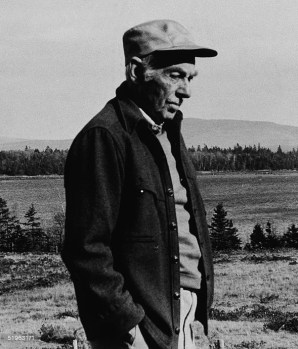
When I get discouraged about the civilized world, I often turn to E. B. “Andy” White, essayist for The New Yorker and Harper’s and author of Charlotte’s Web. White was not only a great prose stylist, but the last century’s most devoted naysayer to change.
51963171

E. B. White at his Maine farm in 1977 (Credit: Getty Images)

He frowned upon atomic energy: “I would feel more optimistic about a bright future for man if he spent less time proving he can outwit Nature and more time tasting her sweetness and respecting her seniority.”

He rejected conventional wisdom: “Many of the commonest assumptions, it seems to me, are arbitrary ones: that the new is better than the old, the untried superior to the tried, the complex more advantageous than the simple, the fast quicker than the slow, [and] the big greater than the small.”

And he challenged orthodoxy—and got my mind working just the other day: “Our whole economy hangs precariously on the assumption that the higher you go the better off you are, and that unless more stuff is produced in 1958 than was produced in 1957, . . . you are headed for trouble, living in danger and maybe in squalor.”

I agree, but wondered, “Is growth necessary for a healthy United States economy?” Actually, I hoped the investigation might lead to existential insights—my habitual trajectory of thought.

The Internet ambushed me with economic principles. Turns out experts disagree so diametrically that Andy could be heard laughing from the curmudgeons’ bleachers in heaven.

I also received a wave of nausea for my research efforts. In 2014, Forbes printed Peter Ferrara’s “Why Economic Growth Is Exponentially More Important Than Income Inequality,” which presents dizzying statistics and a blueprint for our technological future.

The author rhapsodizes over futuristic physicist Michio Kaku, who claims, “When you need to see a doctor, you’ll talk to a wall in your home, and an animated artificially intelligent doctor will appear. You’ll scan your body with a hand-held MRI machine, the ‘Robodoc’ will analyze the results, and you’ll receive a diagnosis that is 99% accurate.”

My AI doc better be more skillful than my smart phone. Siri, my allegedly intelligent assistant, can’t locate a Dunkin Donuts. Why should I trust a virtual endocrinologist with my pancreas?

More to the point, why would I ever confide in a wall? In 1955, White grumbled at his telephone company “for having saddled us with dials and deprived us of our beloved operators.” My misgivings about healthcare via hologram will seem similarly quaint in eighty years.

Still, I have a quick response for Ferrara and Kaku: “I’ll pass!”

Give me Andy instead. He was never a churchgoer, but he held a divining rod for the sacred. And he would have delighted in the county tour parishioner Dave, a retired cow veterinarian, took me on last week.

We wandered a 4-H Club show, where I visited Jocelyn and her prize-winning cows and greeted pigs, goats, a llama and an alpaca.

IMG_4841

St. John’s Lutheran Church’s very own Jocelyn with Dilly and Luci

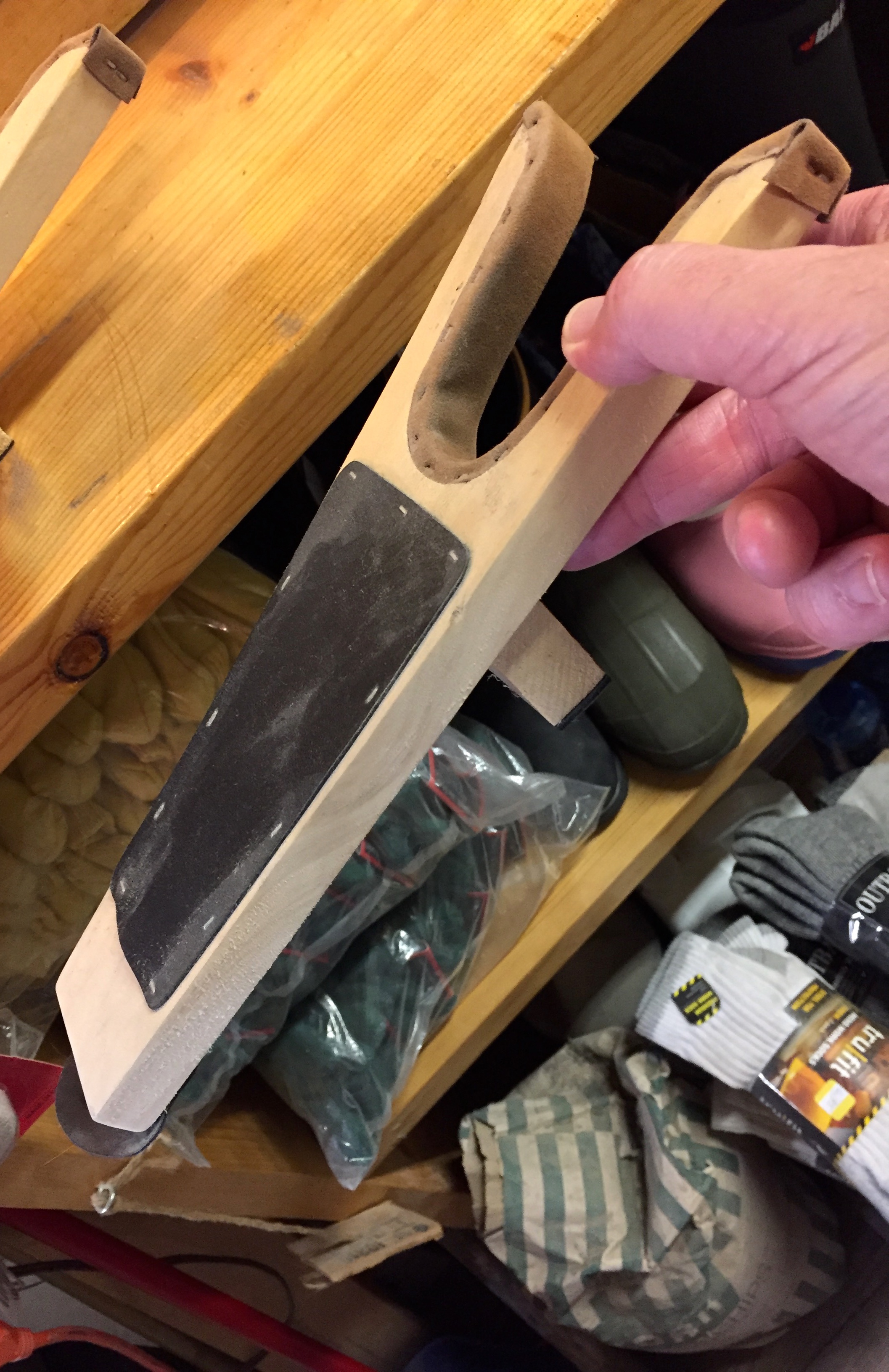
We browsed at McCartney’s Feed and Hardware, which is packed with implements exotic to my city eyes and operates without cash registers. The clerks make change directly out of their pockets.
IMG_4846

Exotic to my eyes, anyway: a “boot jack”

And Dave took me to the farmland he owns with wife Anne, where I got a primer on round bales and found out that cows can sleep out under the stars.

Andy would have pronounced the tour medicinal. Even now, his commentary on the wondrous land and skepticism about progress persist in my imagination. “A 99% accurate Robodoc might increase longevity,” he might ask, “but will the extra years hold any savor?”

While pastoring in my beloved Oniontown, I’ll honor E. B. White’s words and devote myself to “living itself, a task of such immediacy, variety, beauty, and excitement that one is powerless to resist its wild embrace.”

IMG_4286


In Defense of Justice Ruth Bader Ginsburg

In Defense of Justice Ruth Bader Ginsburg

Blogger’s Note: The scope of the opinion piece that follows is narrow. I have views about nearly every tangential topic imaginable, but I’m speaking here only to The New York Times‘ recent editorial board opinion about Ruth Bader Ginsburg’s statements about Donald Trump.

If you’re looking for the normal fare served by A Napper’s Companion, please feel free to order another entree. 

330px-Ruth_Bader_Ginsburg_official_SCOTUS_portrait

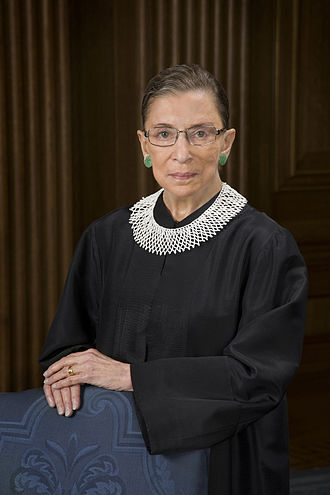
Justice Ruth Bader Ginsburg (Credit: Wikipedia)

Spirits of the coffee drinkers at Brew Ha Ha are merry this noontide, but I’m negotiating with a troubled heart. Former teaching colleagues Alice and Mary and I reacquainted and dissected one of our national obsessions, November’s presidential election. Since they left an hour ago, I’ve been palpating available Internet information and opinions in hopes of easing my suspicion of a terrible prognosis. The possibilities paralyze my brain and sour my gut.

The New York Times normally steadies me, but, oh, my precious, the editorial board has just poked at my gag reflex with this opinion: “Donald Trump Is Right About Justice Ruth Bader Ginsburg.” Whew! Pause. Breathe.

In a recent interview with Adam Liptak of the very newspaper that smacked her knuckles, Ginsburg had the impudence to say, “I can’t imagine what the country would be — with Donald Trump as our president.” A couple of other remarks added color to her opinions and probably set off editors’ subjectivity detectors.

Asked if she also thought that the Senate should act on Obama’s nomination of Merrick Garland to the Court, Ginsburg practically got hysterical: “That’s their job.” Please, somebody get this woman into a straightjacket.

The board’s assessment is terse: “Justice Ruth Bader Ginsburg needs to drop the political punditry and the name-calling.”

Okay, she did call Trump a faker. Bad Justice. Bad Justice. But punditry? Rising from my nausea are a litany of questions, summarized by one: “Where does punditry end and truth begin?”

Other words pose essentially the same question. “At what point does objective neutrality deny the obvious?” “When is bullshit given the full weight of fact?” And “When is denigration mistaken for discussion?”

Yes, these are dangerous questions. Whoever successfully lays claim to facts and truths has hold of power and moral high ground.

But these are perilous times. At least in politics, the historically accepted rules of engagement have been trodden under wingtips. I’m hardly the first to observe that even the pretense of civility and fair play in governmental chambers and circles is gone. And reality, fluid in the best of social climates, is now nothing but fog. Where are the brakes?

Americans who share Ruth Bader Ginsburg’s opinion about Donald Trump aren’t so much despondent about the candidate himself, but about the destination of “I, Donald John Trump, do solemnly swear that I will execute the Office of President of the United States.”

Trump will, indeed, execute the Office, and felled in the firing squad’s aim will be the languishing assumptions about how we Americans communicate with each other and come to agreements and define the world we live in. This is my dread, at least.

Adding insult to injury, the just, charitable identity we have struggled to embody—the “lamp [lifted] beside the golden door”—may give way to the hateful, fearful “angels of our nature.”

Our society has already taken many steps down a rancorous, violent path. Do we honestly suppose that we’ll find remedies to what ails America if we crown a man who delights in riling followers into stampede?

Pause. Breathe.

Am I being alarmist? Hyperbolic? Gosh, I hope so. But I don’t think so.

Ruth Bader Ginsburg knows that “the exception proves the rule.” Supreme Court Justices should keep their noses out of political controversies. Good rule. Good good rule.

But what Donald Trump says he would do as Commander in Chief—bluster though his every word may be—requires the assassination of what is most honorable in the people and the deportation of the Constitution Justice Ginsburg is sworn to interpret and uphold.

She was obliged to break a generally wise rule. She gets a pass.