
So, are you prepared to arrive at your polling places in November surrounded by pissed off masked men with weapons drawn? Continue reading
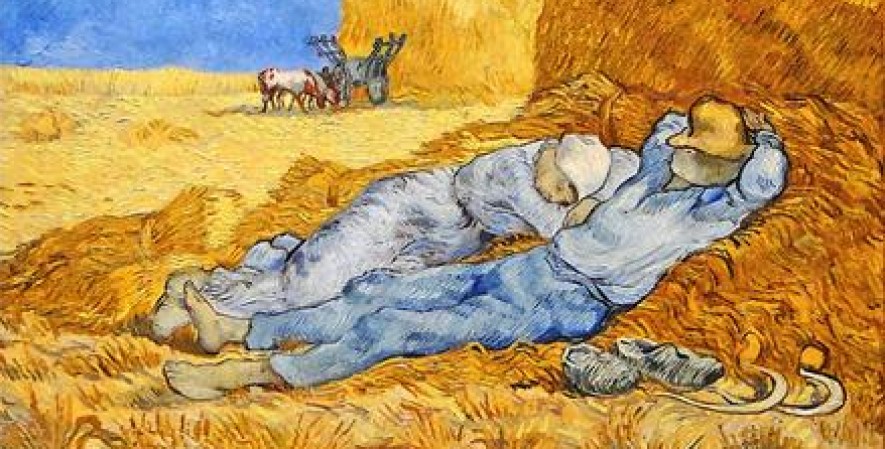
So, are you prepared to arrive at your polling places in November surrounded by pissed off masked men with weapons drawn? Continue reading
Trump and Musk’s Collateral Damage: Human Beings
This was 1984. My father was fifty-eight, five years younger than I am now. He sat on the couch and cried. He paced. He pulled himself together and made phone calls. The handshakes that guaranteed his return to American Meter’s tool room should his management position be eliminated turned out to be dead fish. A young Turk called Dad into his office and said, “You can run a drill press or retire.”
“But what about . . . ?”
“I’m sorry, Mr. Coleman.”
“No, thanks.”
No dishonor in running a drill press, but Denny Coleman, who had put in over thirty-five years, deserved better. He arrived at work early, drank black coffee at his desk and read the morning paper. He’d been a union steward. Everybody at the shop knew Coly. The place was in his bones.
But that’s how it goes. People lose jobs, get divorced, bury those they love. And sorrows greater than Dad’s befall millions the world over. Hopefully no litany of woe is necessary as evidence.
I thought of my late father a few hours ago while skimming The Washington Post. Headline: “President Donald Trump’s administration fired thousands of federal workers.” Bullet point: “Agency heads were told yesterday to terminate most trial and probationary staff.” The article estimates that the move “could affect as many as 200,000 employees.” That’s this particular move, with others to come that may kneecap a million or more. Who can say?
There are myriad complaints to register about this scorched earth campaign against governmental agencies and workers, but I want to stay focused on one consideration obscured by the consternation over Trump, Musk, and their operatives: human beings.

Denny Coleman was fortunate compared to the many employees who could be affected in this season’s purge-first-and-ask-questions-later ambush. He was within sight of retirement, had decades of valuable experience and easily secured employment for the homestretch. Twenty years of comfortable living awaited him. This said, nothing excuses the bum’s rush American Meter gave Dad at the end.
For two days he sat on the couch and cried. I never saw this myself; my stepmother told me. He wasn’t worried about money. No, he was cut to the quick. In my imagination he occupied his usual end of the couch, ran fingers through his wavy gray hair, went into his back pocket for the third handkerchief of the day, wiped his eyes and blew his nose. Maybe you would need to love someone who served long and faithfully get backhanded on his way out the door by some snot nose to appreciate the loss of self such treatment would cause. Please take my word for it.
Were there legitimate reasons for the Meter to trim Coly from the payroll? I have no idea. Are there great fat caps of waste in government spending? Probably so. The question is—and always has been—how can costs be controlled without exacting an undue human toll? We might up this reflection’s ante and ask, “Can’t changes be made without destroying lives?”
That the destruction of specific agencies is Trump-Musk’s goal complicates matters. Were the American house ablaze, the speed of closings and firings might be understandable, but the urgency is certainly stoked by a strike-while-the-iron-is-hot philosophy. Keep on the attack, let anxiety and outrage interfere with the opposition’s ability to mobilize. If a few million citizens in America are incommoded and millions more in countries desperate for our assistance languish, well, that’s acceptable collateral damage.
When I saw that number, 200,000, though, a distressing vision came to me: thousands and thousands of people crying on their couches. How many of the millions in Musk’s crosshairs are like my father was, devastated but on his feet?
I know of one person in the current upheaval who is not like Dad. This from The Washington Post:
One staffer who lost her job worked in the department’s office of special education, helping students with disabilities. In an interview, she said she had moved across the country with her partner to take the position last summer, spending all her savings in the process. She was working from home because of the snow when she got the email. She was removed from her position in the civil service that same day. Before she could process what had happened, her supervisor called,she said.He was surprised and devastated, he told her. He’d received the email at the same time she did.
“Do I need to finish work?” she recalled asking.
“No,” he told her.
When I read this account, I thought of my daughter Elena, a thirty-something spitfire who grabs life by the lapels, yet tears up out of sympathy for strangers in need. This staffer could be my daughter, set out thousands of miles from home to heal humanity one student at a time. I would have watched her drive away, fueled by dreams, my tears wishing, “Godspeed, my lovely.”

This civil servant may have reddish hair, like Elena’s. She’s on fire, I bet. I picture her taking in the admonition of planet earth’s wealthiest man: “We [Americans] have to reduce spending to live within our means. And, you know, that necessarily involves some temporary hardship, but it will ensure long-term prosperity.” Her cheeks flush at the hypocrisy.
So what has this young staffer—this grown offspring of my imagining—lost, exactly? Income, of course. But let’s not minimize other potential blows. Loss of esteem. Loss of purpose. Even loss of identity. Health itself unquestionably suffers when a vocation, perhaps long dreamed of and prepared for, is stolen by men who have lost count of how many dollars they’ve accumulated.
She and her partner drove across America, their piggy bank thereafter sighing like a seashell. Maybe they now cry on a futon, but they grieve all the same.
A ledger of the funds saved by gutting the United States government and dismissing millions of its servants is easy enough to compile, I suppose. Leaving aside concerns about the constitutionality of DOGE’s efforts, I ask citizens who witness what this department is doing and particularly how it’s accomplishing its goals, “Have you considered how people’s lives might be inadvertently upended or worse?”
Is there a column in your ledger for the price of one young staffer’s sojourn to Washington, D.C., accompanied by her parents’ longing and her own aspirations, only to be instructed, mid keystroke, “Your job ends now”? Can you spare the heart to multiply this cost by millions? And have you sufficient love within to sit on a couch or futon and, for their sake, reach for your handkerchief?
Oniontown Pastoral: Bartleby, the Faded Black Horse
 The truth arrived at dawn as I enjoyed the calm before facing another day: I see myself in a horse on the way to Oniontown.
My usual commute includes Route 19 South through the borough of Sheakleyville, but occasionally convenience sends me down Route 18 South through Adamsville, which with a population of 70 is too small to be called a village. According to the website “PA Home Town Locator,” it’s classified as a “Census Designated Place” (CDP)—a sterile title not even Norman Rockwell could warm up.
Of course, neither Adamsville nor any other spot on 18 requires charm from a New England artist. Amish homesteads dignify the land, with their clean white paint and good order. And a Presbyterian church, tall and well kept, keeps vigil over the CDP’s humble population. Most important for this spiritual traveler, I’ve found a soul brother on 18: a horse that is visible for a slim second or two as I pass by.
I’ve mentioned before in “Oniontown Pastoral” the blonde horse Onslow who lives along Route 19. Every trip to the St. John’s I check on him and think about him often, especially in winter when he wears a dusting of snow on his back. He doesn’t need me to worry about him nor do any of the farm animals. Our creator is present to us all in needful ways. I take that on faith.
But on 18 this faded black horse I named Bartleby just this morning draws me powerfully toward him. See, Onslow generally stands still when I drive by, but he chooses a variety of places in his yard to do so. Bartleby, on the other hand, is parked in the same spot 9 times out of 10. And a boring spot it is, beside a weathered gray barn with his muzzle an inch from the door. He is an evocative portrait.
I don’t know what Bartleby is thinking and can’t tell whether he is bored or depressed or tired. What I can say for certain is this: I’m generally happy, but sometimes if you could see my soul, it would resemble Bartleby.

Ah, Oniontown! Your fields bring me the peace that surpasses all understanding.
Both of us are in a daze lately, or so it appears. The horse’s gaze is fixed on the barn door, while the man’s is purposely averted from goings on in all quarters. The other day at St. John’s Lutheran Church I sat behind my desk and surrendered to the spell of the pine trees, soybean field and bright red barn out my window. The confession of Stephen King’s character John Coffey came to me as a prayer: “I’m tired, Boss. I’m tired of people being ugly to each other. I’m tired of all the pain I feel and hear in the world every day. There’s too much of it.”
I monitor the television news, read newspapers and permit myself snatches of social media. Society at present is a slugfest in a bar smelling of spilled beer and overflowing ashtrays. It’s a playground where bullies dispirit classmates with relentless name-calling. Or to set metaphors aside, it seems like what small claim gentleness, patience, compassion and simple honesty ever had on human behavior is being slapped away with a laugh and a sneer.
I’m talking about more than the drunken brawl that is government and the jousting match of international relations. A couple weeks ago, a friend’s daughter was riding on the school bus when some kid tossed a racial slur at her, prefaced with a predictable adjective.
“Why didn’t you speak up at the time?” a law enforcement officer later asked.
“Because I was afraid it would make it worse,” she answered. “And I was ashamed because I was black.”
When her father told me this story, anger was white-hot in my chest. Today, I’m mostly tired, Boss. This young woman’s sweet face shines in my imagination, and her words are too much to bear.

Still on the refrigerator in the Coleman house
Don’t misunderstand, I kindle hope within myself that kindness and wisdom may someday overcome violence and ignorance. But for now I have to look away, take a deep breath, reclaim the peace that surpasses all understanding and cling to the love that has claimed my life.
Tomorrow I’ll take Route 18 to Oniontown. Ah, Bartleby! If only I could stop and join you by the barn door, slide my arm around your long head and rest my face against yours. Maybe being together would comfort us, as only communion can do in a season beset with fury and rot.
A Napper Does Time
So I’m permitted to say in the most general terms possible why I have to be at the courthouse every day, but I won’t even do that. I’ll only say that I have to be there–don’t know how long exactly.
Not only will this obligation overrule siestas, but it will also deprive me of working in my beloved Oniontown. Meanwhile, I’ll certainly fall behind in reading my blogging friends’ posts and writing my own. A Napper’s Companion will offer tumbleweed and crickets.
Until my release, I leave you with a question: Would you place your trust in a face like this?

Forty-five minutes until reporting time
Starbucks, 6:27 p.m.: Bing Crosby’s “White Christmas” keeps playing in my brain. His whistling descant during the second chorus always makes me think of Dad, God rest him, an All-American whistler with a spry warble. The only song more blue is “Christmas Time Is Here.”
In the 1954 film White Christmas, Crosby sings to soldiers far from home, and by the time he gets to “may your days be merry and bright,” their heads are sagging. About twenty years later in A Charlie Brown Christmas, “snowflakes [are] in the air” and “carols [are] everywhere.” As kids skate on a frozen pond, Linus tells a depressed Charlie Brown, “Of all the Charlie Browns in the world, you’re the Charlie Brown-iest.”

Opinion: Charlie Brown understands Advent. (Credit: Wikipedia)
Both of these Christmas favorites sing about a complicated season. The lyrics are glad and wistful, but the music is melancholy, maybe for good reason. Does your Christmas spirit ever reach your mountaintop of expectation? As December 25th approaches, do you find yourself waiting for the doors of your soul to fly open and unfettered joy to blow in with snowflakes and sleigh bells? Never happens that way, right? (If your Christmas bliss is unbridled, I’m happy for you—honest.)
My Advent and Christmas moods follow the Buddy System. No emotion goes even to the lavatory alone. I’ve worn Khalil Gibran’s words from The Prophet thin because they fit:
Some of you say, “Joy is greater than sorrow,” and others say, “Nay, sorrow is the greater.” But I say unto you, they are inseparable. Together they come, and when one sits alone with you at your board, remember that the other is asleep upon your bed.

When sorrow sits alone with me at my dining room table, remembering that joy sleeps on my sofa saves me.
Last night at church, kids sang and made popsicle-stick Christmas trees. Cookies were everywhere. In my imagination Grandma Coleman’s molasses cookies joined the abundance. I could smell them. As children had fun, the beloved dead stirred in my soul.
Trees in the distance, snowless this December 5th, are bloodshot-gray veins against the Lake Erie sky—tender, lovely. A few hundred miles to my east, citizens under the Hudson River sky protest a guy choked to death for selling loose cigarettes. I receive the nonchalant blessing of an in-breath and an out-breath. Still, a cry echoes, “I can’t breathe!”
I’m stubborn enough to believe that joy will have the last cosmic word, but, man, is sorrow injecting anabolic steroids this Advent of 2014. (Blogger’s note: If you already know that creation is groaning in labor pains and don’t want details, skip to #4, which is a benign kvetch.) To wit . . .
1.) “Don’t shoot.” “I can’t breathe.” What will the next mantra be? How many wrongs can be packed into one historical narrative? Let’s see.
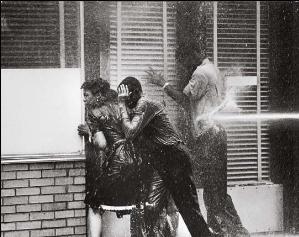
Birmingham high school students being hosed while on a peaceful walk, 1963. (Credit: Charles Moore on Wikipedia)
a.) No argument: throughout American history, blacks have been shat upon. Until the Civil Rights movement of the 1960s and 1970s, abuses were not only unapologetic, but lusty. Since then, slow progress has been lacerated in ways obvious to blacks and unconvincing to some whites. Most blacks, I gather, have misgivings about the police. They have either experienced unfair treatment (e.g. profiling) or know somebody who has. Or maybe they have been regarded by a cop with unwarranted suspicion. Or maybe they have been on the wrong end of a fire hose in Birmingham. Whatever the case, blacks of all levels of education and income aren’t feeling the love. Their convictions, of course, aren’t based solely on encounters with law enforcement. I bet every black citizen has absorbed the unprovoked disdain of a white stranger at least once. Such experiences must freezer-burn one’s DNA permanently.
b.) The news coverage of Ferguson, Staten Island, and Cleveland is muddy. The excerpt of George Stephanopoulos’ November 25, 2014, interview with Darren Wilson that ran on ABC Evening News was a slam-dunk for the Ferguson cop, at least to this viewer’s eyes. Some days later on PBS’s Democracy Now, which leans decidedly to the left, an interviewee noted that sixteen of eighteen eyewitnesses to Michael Brown’s shooting claimed the kid clearly had his hands up. In this case, a grand jury saw things Wilson’s way. But the treatment of Staten Island’s Eric Garner on July 17, 2014, is on YouTube for all to see, as is John Stewart’s rant about a grand jury’s decision not to indict the officer who administered what looks for all the world like a forbidden chokehold. (I’ll toss in that flattening Garner’s head into the sidewalk seems excessive, too.) So blacks who were pissed after Ferguson went berserk after Staten Island. Any white folks paying attention should start, well, paying attention.
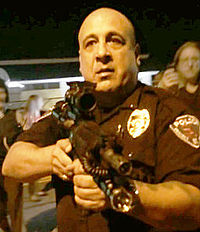
Police Officer Ray Albers, who was captured on video pointing his weapon at peaceful protestors and cursing. Before he was identified, he was known on social media as “Officer Go Fuck Yourself.” He resigned soon thereafter. (Credit: Wikipedia)
c.) Speaking of understandabilities, looting businesses and torching real estate are perhaps predictable mob responses to injustice, but thievery and flames are self-mutilation taken to a community level. Innocents on the home team have lost much in what television news calls “protests.”
d.) I won’t parse the shooting of Cleveland twelve-year-old Tamir Rice other than to point out something I’ve not heard mentioned in the conversation. Why is it okay for manufacturers to make toy guns that look unmistakably like the real thing? All you have to do is cut the impotent little orange tip off and you’ve got a weapon. In the dark a squirt gun could look convincing, I suppose, but are realistic airsoft guns necessary? Don’t bother citing the First or Second Amendments. I’m tired of clever folks lining their pockets by exploiting the noble intentions of the Constitution.
e.) A-whole-nother side of wrong is the untenable situation police officers face each day. Nothing less than perfection is tolerable in the new millennium. Never mind that human beings are increasingly expected to maintain sparkling performance with dwindling resources. Punishment is an imposing presence. A teacher makes a knee-jerk, cruel remark to a student. A nurse administers the wrong medication. And, yes, a cop who has dealt on his shift with three noncompliant citizens pops his cork in subduing the fourth. I don’t mean to excuse any behavior, but to acknowledge what I see as a reality. In all professions, the margin for error is literally razor thin, and forgiveness is in short supply.

Bill Cosby in 1969. (Credit: Wikipedia)
2.) Oh, Bill Cosby! Oh, Dr. Huxtable, who wore Christmas sweaters so well! If he drugged and raped women, then, in the words of Queen, “Another one bites the dust.” If Cosby harmed any woman in one of the most profound ways possible, then who was he channeling when he complained about blacks “with pants down around the crack”? But if twenty-six women are out to lynch an entirely innocent Cosby–how likely is that?–then we have another lousy statement about the human condition. Whatever the case, there are no winners; only ugliness all around.
3.) Here’s an odd thought for the list. In an April 12, 2012 Washington Post editorial, Thomas E. Mann and Norman J. Ornstein—left and right, respectively, and both well respected—claim that the current G.O.P. is “ideologically extreme; scornful of compromise; [and] unmoved by conventional understanding of facts, evidence, and science.” More and more I get the feeling that Mann and Ornstein have their fingers on our collective pulse. I would love to be corrected on this, but it seems to me that lots of us have our rancorous heels dug in. We mistake our fancies and hunches for certainties. Actual facts are greased pigs, but if you manage to secure one, expect to be dismissed with a sniff and a Bronx cheer. The point: our foundation for societal negotiation is cracked, our collection of shared assumptions depleted.
4.) Finally, on an irrelevant, purely selfish front, I’m filing a complaint against restroom hand dryers. How can machine blow hot air at a velocity that makes your skin ripple and still not dry your hands? When deprived of the paper towel option, I always exit feeling unkempt. Yes, a few extra seconds of vigorous hand rubbing would finish the drying job, but I reserve the right to be petty in this small matter. The head gets enough of my time as it is.

If this were a decent photograph of a hand dryer, you could see that the little arrow at the bottom says, “FEEL THE POWER.” I want to get a Dymowriter and cover “POWER” with “FRUSTRATION.” (Crappy Credit: John Coleman)
My last grievance notwithstanding, sorrow has one advantage over joy: sorrow tends to arrive like a freight train blasting its horn, whereas joy springs like a chocolate lab puppy from a Christmas box and quietly sniffs and licks your face. Sorrow carries a big stick; joy walks softly.

Joy happens by like this guy named Brownie. Yes, I, John Coleman, am trite! (Credit: Wikimedia Commons)
Consider twelve-year-old Devonte Hart of Portland, Oregon. At a protest about the death of Ferguson’s Michael Brown, the boy held a sign that said, “Free hugs.” The photograph of Portland Police Sgt. Bret Barnum and Hart hugging went viral.
Of course, as many an Internet cynic has claimed, the hug may have been staged. (I fell for a YouTube video showing a bicyclist being chased by a bear, so I’m not the most astute viewer.) Even so, I object to Jonathan Jones, a Brit who, writing in The Guardian, takes Facebook subscribers to the woodshed for their over 400,000 shares of the hug photograph: “Each one of those shares is a choice of what to see and what not to see. In the context of the completely unresolved and immensely troubling situation, not just in Ferguson but across the United States, where Ferguson has opened wounds that go back centuries, this picture is a blatant lie.”

Officer Bret Barnum and Devonte Hart in “the Hug” (Credit: Johnny Nguyen / AP Photograph in The Guardian)
One can’t help but envy Jones’ clairvoyance and nimble reasoning! As if he can see into my heart and mind and understand the meaning I assign to any photograph! As if sharing a photograph means that any Facebook viewer is in denial about what troubles America. As if—just one more—any roundhouse-throwing art critic gets to decide what muse speaks a helpful word to suffering citizens. I didn’t share the photograph on Facebook, but I’ll bet most of the 400,000 who did took the kid’s and the cop’s embrace not as a reflection of where American race relations now stand, but as a vision of where they ought to be. To me, the image doesn’t scream from atop a phony soapbox. It whispers hope into the patriotic dreamer’s ear. It’s the lab’s cold little nose brushed against America’s cheek. It’s a whistle over a familiar melody.
And consider Lori Burke. I mentioned a while back kids having cookies at church. The reason kids and adults showed up was to join in a sing-along led by Lori, which the latter enjoyed as much as the former. During snacks and crafts, she shared with me an idea in gestation. She already has a couple of CDs out as well as a popular parody of Meghan Trainor’s “All About That Bass” on YouTube.

Lori Burke . . . sing it, sister! (Credit: loriburke.com)
Now, Lori would love to start a movement of sorts. She has got a name—For the Love—and is now fussing with how best to communicate it. For the Love is Lori’s developing vision for helping us all to grow into the habit of showing kindness and generosity to strangers. She mentioned a couple of possible For the Love logos and at one point said “hashtag,” which means she has Twitter thoughts. I’ve never quite understood hashtags, but I’m rooting for this sacred sister.
This is how joy happens: two people kibitz and think out loud. “What can I do?” Lori wonders, then decides to trying something. Maybe. We’ll see. No matter what happens, the impulse to encourage sisters and brothers to love each other is just a crumb. A mustard seed. A widow’s mite. In other words, Lori’s impulse is everything—a fragile wish, a helpless mutt, the Indwelling hope of the world. Salvation depends on crumbs.
Endnote
In recent days “White Christmas” and “Christmas Time Is Here” have been replaced by Dean “Dino” Martin’s rendition of “Rudolph the Red-Nosed Reindeer,” in which he calls the hero “Rudy.” In the last stanza, all the reindeer “shouted out with glee, Rudy the Red-Beaked Reindeer, you’ll go down in history.” Oh, Dino, you casual fellow! Your song goes into the complaint file with those hand dryers.
.jpg)
Don’t even think of calling me Rudy. And I can’t breathe out of my beak. What the hey? (Credit: aussiegall on Wikimedia Commons)
 A Napper's Companion