Elegy for Cursive
“As a people we probably harbor seeds of goodness that have lain for a long time, waiting to sprout when conditions are right” (E. B. White in a letter to Mr. Nadeau).
Before me is my late mother’s shopping list, which takes up half of an index card:
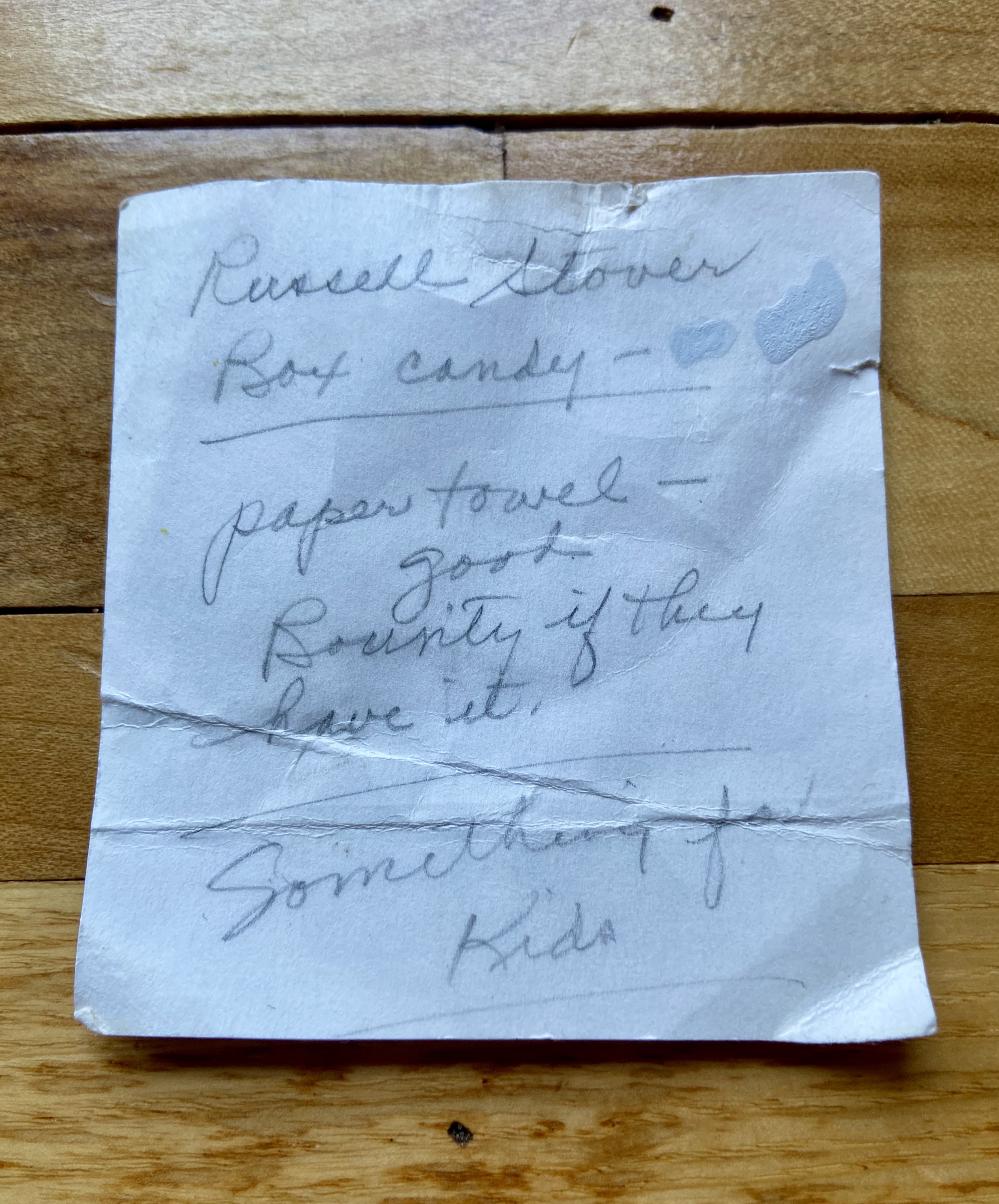
The kids were her grandchildren Elena and Micah. She awarded them a capital K, to the displeasure of the King’s English . When arthritis settled her into a recliner, she still had a little something for the kids each time wife Kathy and I brought them to visit: a bargain toy and candy bar. They understood, as children do. Grandma had thought of them. She never stopped thinking of them.
The words I now reverence suggest nothing of Mom’s puffed knuckles. “Ooh,” she would say, passing fingertips over the smarting sinew between her wrist and thumb.
One item has always been a mystery. Mom loved our hometown chocolatier, Steffanelli. Why did she request nougat and dollops of pink marshmallow foam coated in Russell Stover chocolate? The answer is unimportant, but her script—an endangered species that stood guard over my elementary school’s chalkboards fifty years ago—calls to mind the volumes I’ll never know.

During the Great Depression, Mom’s parents were desperate. I never asked her how it felt to be shipped off to live with an aunt and uncle. What went through her mind? Did she cry at night? Did the vulnerable girl in Mom’s soul still abide in her pained body? Was it dear Dolly, by necessity assigned to relatives, who thought, “Get something for Elena and Micah”?
Other mysteries sit with me as well.
The sighs sounding in this quiet room, are they of joy or sadness? Both, perhaps. Mom peeled grapes for my kids as toddlers—safe and easy to chew. What gladness to remember. But since 1998 she’s been gone. My sighs, then, are also whispers of a chorus: sadness. And the tightness in my throat, what might it say? That this artifact of my mother’s hand is a treasure? Yes. That I miss her? An understatement.
All I’ve shared so far would be disingenuous, though, if I didn’t confess heartbreak that cursive may be on a list less kindly than Mom’s: public education’s non-essentials.
Heartbreak? Seriously? Yes. The elegant lilt of a capital “S” as it rises to the right, then circles back upon itself, will be missed when few hands have been taught to make ink dance. Paper will suffer a new poverty when learning’s routines forget that the tedium of looping one “l” into the next grants the fingers memory.
Consider: Two syllables skillfully rendered—goodness, for example—can make my mother’s youngest child wish that the care once demanded of pens and pencils might now be lavished upon speech and spirit.

Back in 1973, essayist E. B. White received a letter from a certain Mr. Nadeau, who had lost faith in humanity. I’m not sure what his complaints were, but I have a surplus of my own in 2024. Cursive’s absence in public schools would not top my catalog of worries, but the decay foretold by its elimination gives the prophet within me the sense of standing at a grave.
My concern is abstract and poetic. A healthy civilization thrives on what cursive demands: practice, patience, attentiveness, appreciation for honest effort. When your handwriting is slack, everybody knows. It may be acceptable to swing your pen like Zorro when signing a document, but elsewhere indecipherable handwriting is presumptuous and ill-mannered.
Character is what I’m concerned about. If only folks would pay as much attention to what they say and how they say it—whatever the medium—as yesteryear’s kids did mastering the stubborn capital “G” or lowercase “z,” how much better off humanity would be. If only we could persist in listening as did the cramped little hands required to fill lined pages with one letter until they got it right.
Mr. Nadeau and I fear that, to quote his famous correspondent, “The human race has made a mess of life on this planet.”
Oh, Mr. White, say something to cheer us all: “As long as there is one upright man, as long as there is one compassionate woman, the contagion may spread and the scene is not all desolate. Hope is the thing that is left to us.”
Near her end, Mom mentioned that she had bequeathed life insurance policies to her children—not much, just so that we could each have a little something. A few thousand dollars.
Mr. Nadeau, you should have met my mother. Between E. B. White and Dolly Coleman, your hope could never have disappeared entirely.
 A Napper's Companion
Lovely, as usual, John! I still have a few recipe cards, handwritten in cursive, of course, from my mom and 2 dear aunts. Seeing their handwriting brings them right here into my kitchen! Thank you for your thought-full-ness. Karen Lundwall