Humility Needed as the New Millennium Clears Its Throat

800px-Chili_con_carne_1234

It’s chili. You eat it. (Credit: Wikimedia Commons)

Last week while eating lunch at Coffee Culture courtesy of a parishioner’s gift card, I felt them: the twitches of meaningless impulse. Open up the MacBook. Check the iPhone. Write a few notes. Skim the newspaper. These twitches were both mental and physical: adrenaline-fueled, microbursts of habit energy. I saw Ronald Reagan smiling and delivering his famous 1980 debate line to me: “There you go again.”

This is Mindfulness 101! When you eat, eat. When you read, read. As Thich Nhat Hanh writes, “Don’t just do something. Sit there.” I know all this stuff, but even with pray-meditating twenty minutes twice or thrice daily, I constantly forget. Early into my huge Caesar salad and spicy ambush chili, I remembered, “John, you’re allowed to just eat. You don’t have to be doing something else.” As I replay that moment, the image of my late dad pops up, his fussy dementia hands going: fidget, fix, reach, button, smooth, worry. Madness.

IMG_2704

Ahhh. In the chapel at Mount Saint Benedict Monastery.

Don’t be afraid. This is not a rant, kvetch, or lament. Like everybody else, I’m responsible for the state of my own interior, which is getting some special attention these days. This morning I sip coffee and release my old inventory of anxiety, breath by breath. I’m good—well, getting better, let’s say. By 10:00 a.m. I’ll be at Mount Saint Benedict Monastery, trying to stay ahead of worries in progress.

In the words of the recently departed Joan Rivers, “Can we talk?” Is it just me, or is it quite a chore to remain centered as this new millennium clears its throat? Assemble the following ingredients: middle-class income, spiffy technology, and submission to contemporary attitudes toward time and labor; then, bam, like Emeril Lagasse, add pinches of garden-variety stress and a personal crisis or two. What do you get? You get a guy with an expanding torso, irritated tongue, jerking brain and muscles, and pleading spirit: For God’s sake, relax, will you.

The first thirty or so years of my life weren’t jerky. When I think about growing up and even college and graduate studies, 2014’s brisk march of time and frenzy of labor comes into clear view. For years I’ve had Han Solo’s bad feeling about this. Recently I happened upon an article by Dr. Peter Gray, who put some good words to my concerns. He graduated from high school in 1962, a year after I was born, but his description of childhood sounds a lot like mine:

In the 1950s, when I was a child, we had ample opportunity to play. We had school, but school was not the big deal that it is today. Some people might not remember, but the school year then was five weeks shorter than it is today. The school day was six hours long, but at least in elementary school, two of those hours were outdoors playing. We had half-hour recess in the morning, half-hour recess in the afternoon, a full hour lunch. We could go wherever we wanted during that period. We were never in the classroom more than an hour at a time or for four hours a day. It just wasn’t the big deal, and homework for elementary school children was essentially unheard of. There was some homework for high school students, but much, much less than today. Out of school, we had chores. Some of us had part-time jobs, but for the most part, we were free to play for hours a day after school, all day on weekends, all summer long.

IMG_2722

Beloved wife Kathy is still in touch with the power of play. This is our front yard on Halloween. The trick-or-treaters were slack-jawed with wonder.

I don’t know about the shorter school year, but Gray nails it for the 60s and 70s. I neither noticed nor appreciated the wide fields of time that opened up after school and in the summer. My single academic stress was trigonometry. Bless his heart, teacher Chet—an old anomaly who went by his first name—gave me a passing D one quarter to save my National Honor Society hide. Beyond that, my turmoil had to do with divorced parents and withering nerves with the ladies. But when my twenty-two-year-old Micah was in school, the whole family was constantly stressed. The homework was oppressive, especially for a kid who didn’t engage well with books and worksheets. I’m out of the loop now, but can’t imagine the expectations have eased much, if at all.

One of my favorite memories is of Micah’s fourth-grade teacher talking to wife Kathy and me about our son’s messy daily planner. “Daily planner?” I thought, “Micah’s follow through with toilet paper is sketchy, and you want him to keep a to do list? You’ve got to be &^%$# kidding me!” Of course, we nodded politely. Twenty-six-year-old daughter Elena faired much better academically, knocking off homework in study hall and devoting her teenage suffering to bi-polar disorder—at least we think that’s what it was. For me, 1988 through 2012 was a long stretch of parental confusion and convulsion peppered generously with joy.

IMG_2787

Micah in, what, kindergarten? His first grade teacher didn’t have much use for him, with his silly heart.

It would be whiney of me to blame academics for Micah’s troubles growing up, but I saw in his school experience seeds that have grown into the view of life that had me jangled over my lunch last week. I should first say that my son had many wonderful, skillful, appropriately affectionate teachers. My only gripe is with a few along the way who seemed to dislike children.

I get the impression that lots of teachers are frustrated by the Weltanschauung that stresses kids out and has adults multi-tasking themselves into hemorrhages. (Check out the excellent reflections of my blogging friend Beachmum for some insights on how some teachers feel.) We’re caught in a powerful current, a way of being that constantly vexes gladness. This way, the delight of pharmaceuticals, is driven by hubris and faulty assumptions.

We humans are overconfident in our knowledge. It’s an attitude thing. How many of us got pudgy twenty years ago because we watched our fat intake and gorged at the carbohydrate trough? One at least. Today, we’re assured that the sophistication and competence of the United States health care system make an Ebola outbreak here highly unlikely. Forgive my dis-ease. This has nothing to do with researchers, doctors, and nurses, who no doubt take their work seriously and have good intentions. But what seem to me to be preliminary findings are regarded as conclusive.

I may be in the minority, but the precaution of requiring people who have worked closely with Ebola patients to lay low for three weeks seems reasonable to me. Zipping Kaci Hickox into a tent was perhaps unwarranted—even though the tent was inside a hospital building, not outside as I foolishly first thought—but asking her to avoid contact with folks for a while is prudent. Given the ferocity of Ebola, the fuss over a twenty-one-day quarantine is surprising. Is that really a burdensome sentence, even if all the evidence suggests that a health care professional isn’t contagious? I suppose if you’re absolutely positive that we know all there is to know about Ebola, then ¾ of a month feels like a year. (More on time later.)

200px-Harland_Sanders

How sad: a “really inhumane” recipe. (Credit: Wikipedia)

Kaci Hickox could probably use a port-a-potty, not wash her hands, and stick her fingers in thousands of Maine residences’ mouths and not pass along a single case of Ebola. In fact, I’m not worried, but I do harrumph at the prevailing lack of humility, any sense that our knowledge might be incomplete, indignation toward those who maintain skepticism, and willingness to sling lawsuits so quickly. And Hickox’s comment that her treatment was “really inhumane” may be a stretch. Newark’s University Hospital didn’t shove her adrift on an ice flow; they put her in an indoor tent and brought her Kentucky Fried Chicken.

My point with the examples of carbohydrates and Ebola is that once we’ve decided we know something about science, we dig in our heels. According to Peter Gray, what we know about education and child psychology might also be mucking up future adults. In his aforementioned article, he identifies . . .

a “school-ish view of child development” – the view that children learn best everything from adults; that children’s own, self-directed activities with other children are wastes of time. We don’t often say it that way, but that’s the implicit understanding that underlies so much of our policy with regard to children, so childhood has turned from a time of freedom to a time of resume-building. 

Gray presents convincing evidence that our adult impulse to micro-manage childhood learning and development (i.e. not letting kids play, make up their own rules, work out their own conflicts, and generally not getting the hell out of the way and leave them be) is burdening a generation. Depression, anxiety, and suicide have been on the rise in recent decades. (Here’s a link to his article, “Kids Today Are More Depressed Than They Were During the Great Depression. Here’s Why” if you want his numbers.) My concern: like Gray, I remember when my habit energy wasn’t jangled and so have a shot at making changes to restore my peace. But what if all you’ve ever known is a relentless impulse to accomplish something and a haunting sense that if you’re playing or resting, then you’re wasting time? Gray argues that there is a crucial, “evolutionary function of play.” Again, follow that link if you want to explore his reasoning.

Our experience of time is irrationally rushed and troubled. Isn’t this really the impulse that drives multi-tasking, texting while driving perhaps being the most hazardous example? On his television show Phil Donahue used to hold the microphone in audience members’ faces and say, “So little time.” Those words knuckle our heads and slap our asses. You need to perform several actions at once because you don’t feel like you have enough time.

I offer one flimsy piece of evidence, a phrase that is regularly spoken by my adult children: real quick. Catch the urgency? “Dad, can I see your laptop real quick?” “Dad, can you hold [grandson] Cole real quick?” My thought is generally, “No.” I want you to use my laptop for as long as you need it. And, damn it, you hand me that baby, it ain’t going to be real quick.

IMG_0846

A painting by the late, self-educated Milton Sontheimer, whose work helps me to center myself

As proof that we can safely slow down, I present Milton Sontheimer of blessed memory. Toward the end of his life, which came about a month ago, congestive heart failure had reduced his pace to a crawl, but Milton always moved as if he had more time than he needed. The walls of his home with now-widowed Mary are crowded with his paintings. For years, he baked Communion bread for our church and wrapped it in foil, using and reusing the same piece until wrinkles rendered it flimsy. Wise Milton: no rush—and no waste.

We assume that because technology exists, we should make full use of it. Many thoughtful people are aware of this observation, but I want to credit the last two sages who have brought it to my attention: Beachmum, whom I’ve already referenced (I read back some ways, Mum, and couldn’t find the citation; I know you wrote it, though), and Dr. Brad Binau, a professor from my days at Trinity Lutheran Seminary, whom I mentioned in a recent post. Smart phones, tablets, notebooks, and laptops exercise centripetal force—literally, almost, considering how often my ear and nose are smashed up against my iPhone.

Birnau_Uhr_Sonnenzeituhr

Our opulent enemy? Why? (Credit: Saberhagen on Wikimedia Commons)

We peer over our reading glasses at people who are apparently lost, confused, or just making up their minds. I’ve learned to be watchful for what I call periods of discernment both in myself and others. In thirteen years as a parish pastor I’ve sat with scores of pilgrims on their way to new lands of the spirit. They wonder what to tell loved ones who want to know what’s up. I suggest, “Tell them you’re taking some time to figure things out.” These are stretches of months, even years, to honor, not stampede through. A couple days ago I heard the following what-I’m-saying story on The Writer’s Almanac about the poet C. K. Williams:

His two greatest passions in high school were girls and basketball. He was a good basketball player, 6 feet 5 inches, and he was recruited to play in college. But then he wrote a poem for a girl he was trying to impress, and she was actually impressed, and so he decided he should be a poet instead. He dropped out of college to move to Paris because that’s where he thought a poet ought to live. He didn’t write at all while he was there, but he did realize that he didn’t know anything and should probably go back to college. He said: “It was an incredibly important time. Not much happened and yet my life began then. I discovered the limits of loneliness.”

My point, I guess: if I’m not willing to be lost, I might not ever be found.

IMG_2699

A three-hour nap in a monastery guest room–a remarkable blessing

Endnote: I did make it to Mount Saint Benedict Monastery. (Obviously I wrote much of this post after my retreat.) I won’t bore you with the whole day, other than to pass along two details. 1.) I took a three-hour nap in the afternoon; the twitches of habit energy wear a guy out. And 2.) I noticed while reciting psalms with the sisters that they spoke more quickly than in the past. Their recitation is still spacious, but the gentle silence between verses is now thin. I don’t know why.

Lord, spare the sisters and us all from contemporary adrenaline and grant us mindful, humble impulses.

Beholding Maine

A week ago wife Kathy and I returned home to Erie, Pennsylvania, after nine days in Maine. A few thunder storms in no way choked the cleansing breath of such a generous stretch of open time. We floated from attraction to junk shop. Sometimes we held hands, in what poet Galway Kinnell called the “familiar touch of the long married.” We celebrated our thirty-first wedding anniversary on board the Victory Chimes, a three-masted schooner sailing out of Rockland. And not once in well over thirty hours of driving did we turn on the radio or pop in a CD. We either talked or kept silent. Riding along with each other was music enough. I did snip at my wife over the Internet, know it all that I can be, but the moment passed like a few drops from the sky that never really turn to rain.

IMG_2449

The Victory Chimes at anchor, waiting for us to return from an island walk

Vacation in beautiful Maine is an eye of the beholder situation. Did you ever ask a friend, “So how was your vacation?” And did you ever regret that question after sixty seconds? After five minutes, as your friend gushed about the charming print on the sheets at a bed and breakfast, did you ever watch her or his mouth, know sound was coming out but could no longer make out words, and think to yourself, “I’m turning to stone”? Me, too. But luckily, you can walk away now, before I get started. If you decide to stay, I’ll offer this concise observation about Maine: “Boy, I sure can be a bummer.” Do you suppose I could go on vacation and just experience the thrill of seeing whales? Or just sit on a ship deck in a quiet cove, watching the sunset with my arm around my wife? Or just take in the stunning Maine countryside from a slow chugging train?

IMG_2421

Kathy, watching for whales, dolphins, and seals, hair at the mercy of ocean breezes

In other words, could I just have uncomplicated, $#%&! fun? Ah . . . no! I have to notice that what disappears from the earth shines before it goes black and that death often makes me grateful—or at least gets my mind going. Still, sumus quod sumus. We are what we are. I am what I am. And I see what I see, think what I think. In Maine, a healing tension had me by the heart and head over and over. Of course, the worthy stock images—sun touching the waves, layer upon layer of hills and islands, an eagle perched hundreds of yards away on a dead tree—made the trip a bargain at any price, but what echoed in my chest’s sacred cavern and invited me to stop and breathe was the long goodbyes of beauty shining before it goes out.

Our first mission in Maine was a stop at L. L. Bean, where Kathy had already picked out binoculars from a catalog. As she waffled and kibitzed and tested at the counter with the clerk, I browsed. Anybody who has been to Freeport’s L. L. Bean knows how massive the store is; that is, stores. Lots of merchandise! We were in the hunting and fishing department. I was interested in none of it, though a slim old guy in a gabardine suit and fedora caught my attention as he studied a .20 gauge shotgun by waving its business end in every face around him. Obviously, he never took a hunter safety course as I did forty years ago: NEVER POINT A GUN, EVEN AN EMPTY GUN, AT A PERSON! Once the mindless gun handling subsided, my eyes wandered. And when I survey any setting, a bummer can’t be far away. At L. L. Bean, it was taxidermy—stuffed death. Kathy wasn’t about to drop $160.00 on binoculars without a leisurely test drive, so I took pictures.

IMG_2262

Varnish on the bear’s nose?

IMG_2269

This javalina would have been fun to pal around with–an India pale ale, Calamata olives, summer sausage, and a few bawdy jokes!

IMG_2274

L. L. Bean’s instruction to taxidermist: “Playful! Playful! Give us frolicking raccoons!”

IMG_2277

A couple of old moose at L. L. Bean, one stuffed by the taxidermist, the other by himself.

Hunting isn’t for me, but I have nothing against it. Displaying dead game is okay, too. As I wandered among the trophies, though, I hoped that the tremendous moose and white tail buck had been granted the dignity of landing on a dinner plate before assuming their position and the tribe of raccoons was on display not simply because somebody thought shooting them would be fun.

On the long-married’s first full day in Maine, we rode the aforementioned train from Brunswick to Rockland and back, two hours each way. Yes, by the fourth hour I was bored, but for most of the trip I appreciated sitting next to Kathy, sharing a turkey sandwich with avocado, and watching small towns, swamps, inlets, and green hills go by. Lining the track for miles at a time were telegraph poles in various stages of decay. I couldn’t take my eyes off them. Some were in decent shape, others were listing badly, still others were in repose. All of them were pencils that outlived their language. “How long will it be,” I wondered, “before train tracks join telegraph poles?” We’re talking about patient transportation in an inpatient land. Amtrak is supposedly making a comeback, but I’ll wager by the time grandson Cole is my age, all people riding the rails will do so out of nostalgia.

IMG_2286

Telegraph pole: a pencil that outlived its language

My thoughts were sad, but wistful. It’s too bad that our current perception of time is pressurized, that unless movement from where we are to where we want to be involves g-forces, useable life is being wasted. Fortunately, despite my regrets about our cultural stampede, my spirit was light. I was, and am, glad that taking twenty-four hours to get from Pittsburgh to Orlando—as I did a couple of times on Amtrak’s Pennsylvanian and Silver Bullet—was once acceptable. And those wireless poles gave me hope that maybe one day the messages people take trouble to post won’t be insulting, combative, or bullying.

IMG_2284

Beloved Kathy and I shared lunch on a car bearing our hometown’s name as a younger couple a few rows up alternated between tonsil hockey and cuddling.

IMG_2336

Buddha at the Monroe Inn bed and breakfast.

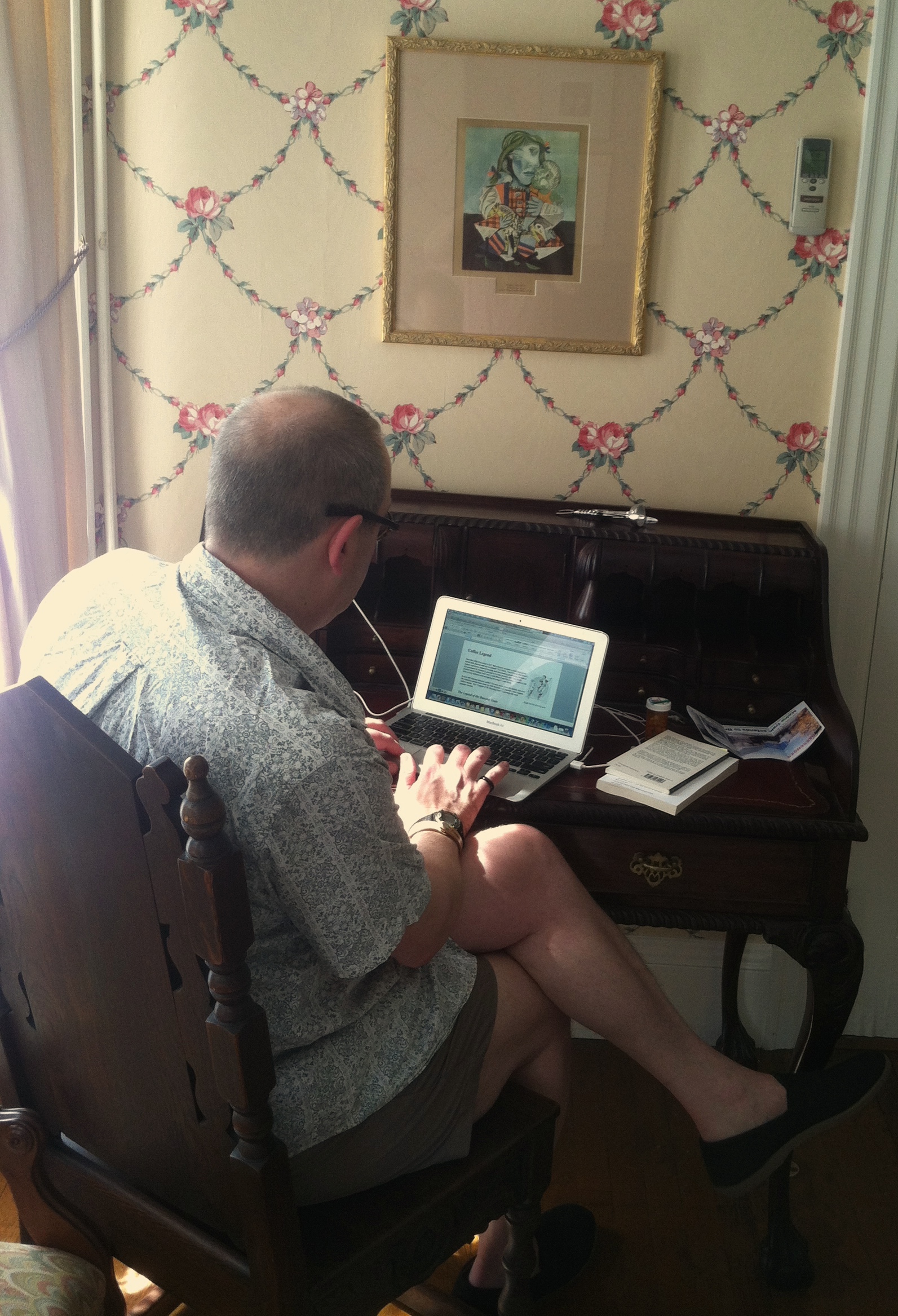
Far from dying out, bed and breakfasts in Maine are like corner bars in Erie. What’s curious is the idea behind a bed and breakfast: sleep the night in a beautiful old house and wake up for a meal prepared by one or two people in an actual kitchen; or let’s pretend it’s 1900—up to a point. Kathy’s favorite B&B was Auburn’s the Munroe Inn, where we stayed in the Noble Suite. “I could live in this house,” she kept saying. “I love this house.” Well, sure, you could be skanky after a day’s travel, have breath sour enough, as George Carlin once said, to “knock a buzzard off a shit-wagon,” but walk around the spacious living and dining rooms, and you feel stately and elegant. If you’ve been saying for years, “Oh, my life, I’ll tell you what, I could write a book,” the handsome roll-top desk in our suite would have given you the urge—by Jove!—to dip your pen in an inkwell and tell your story. Titles would run through your head: My Way (no wait, that’s been used); The Road Less Traveled (dang it, that’s taken, too; Frost, some guy named Peck; can’t remember). Your musings would be interrupted because you have to use the bathroom, where old-style faucets and goats-milk hand soap make what goes on in that euphemism of a room seem dignified.

IMG_2342

The roll top desk was a great place to get a few words down, though not with a dip pen and inkwell. The framed print above is a Picasso.

IMG_2325

Stately mantle and hearth

IMG_2343

We slept deeply, as if embraced by a sane and gentle past.

IMG_2351

We awoke to sun translated by stained-glass windows.

In short, B&Bs are great because they offer something that doesn’t exist anymore. And if guests had to pump their own water and use chamber pots, I bet Super 8 and Motel 6 would smile broadly. Whatever. I loved the Munroe Inn and took more pictures there than at Sabbathday Lake, the Shaker village (stay tuned). It was a special treat to meet the owner, Olga, originally from Russia, who spent years in New York City before doing something her friends considered kooky: move to Maine and run a B&B. But she has got a fantastic gig going, made distinctive by eclectic choices in art.

IMG_2339

For some reason, old and dignified marry contemporary and playful with pleasing results at the Munroe Inn.

IMG_2358

This faces guests as they descend a spacious staircase. Where, I would like to know, did Olga find this recent photograph of me naked on a rock, throwing a discus?

       Still savoring Olga’s inn, Kathy and I headed to Sabbathday Lake, 1800 acres of woods and rolling fields, free-ranging livestock, a dozen or so buildings, a faithful support crew of paid staff and devoted volunteers, a rich history in art and architecture, several reliable sources of income, and . . . three Shakers. A baseball enthusiast would immediately diagnose at least one reason for the shortage: no farm system for developing new talent. Shakers are celibate.

IMG_2369

The Shaker herb garden, which provides income for the community, is managed by a paid staff member. I brought home for daughter Elena a dried flower sometimes called “poor man’s saffron.”

A month ago I met the last two monks at a Byzantine monastery near Butler, Pennsylvania. I thought of them, Fathers Michael and Leo, as Kathy and I walked around the Shaker village in the rain. There are still Byzantine Fathers in other monasteries, but the trinity at Sabbathday Lake is it. At best, all other Shaker communities are museums or libraries. At worst, they’re malls or tumbleweed. Sister Francis (the community’s mother), Sister June, and Brother Arnold are a religion of three, with a great cloud of witnesses. I may have glimpsed Arnold as Kathy and I were hopping on a wagon for a hayride. Wayne, a brother until 2006, left Sabbathday Lake after falling in love with a reporter who visited to write a story–with, in my opinion, a faithful and glad ending. I didn’t see Francis and June.

IMG_2385

“Tis a gift to be simple.” The Shaker Meeting House, where Francis, June, and Arnold worship, along with visitors. Women enter through one door, men through the other. I peeked in. The inside is as plain as the outside.

IMG_2377

The Meeting House’s wooden siding: how much longer will fresh paint make the sacred dwelling “come round right”?

IMG_2364

These rules were posted in a barn where Shaker-friendly items were being sold. An exacting way that embraces goodness may die, but let’s hope its fervor lives.

Short of a miracle, the Shakers will be no more during this century—that is unless Arnold, fifty-seven, breaks longevity records. Francis is eighty-seven, June seventy-six. The likelihood of their extinction made me feel blue, but also grateful. The Shaker practice isn’t for me, but I admire their devotion to a life centered in goodness. The article by the reporter Wayne eventually married noted that after the American Civil War the Shakers numbered about 5000. At Sabbathday Lake, where visitors are asked not to take photographs inside the buildings, I learned that Shaker communities were once de facto orphanages and foster homes. Poor folks turned their children over to the Shakers rather than let them starve. (Francis arrived at Sabbathday Lake at age ten.) In old portraits Shakers often wore severe expressions, but underneath their regimentation and austerity was a well of radical love.

IMG_2395

Over 150 graves, but only one marker. With Shakers, I read somewhere, there is no “mine” or “yours”; only “ours.”

As much as anything, I appreciate not only Shaker history, but also Francis, June, and Arnold for carrying on a practice that seems right to them and for making heroic sacrifices to be the last of a family that still has much to teach the world.

300px-Victory_Chimes

The Victory Chimes (Credit: Wikipedia)

The official reason for our Maine trip was to sail on the Victory Chimes. If you’re not for sailing on mostly calm waters, taking naps whenever you please, going for walks on islands and in small coastal towns, and winding down by watching darkness descend on a horizon of pine trees, don’t board this vessel. And the food! Chef Pammy is phenomenal—a word I use sparingly—especially when you consider that she cooks on a propane stove that has two settings: simmer or hell. She makes the best chili and macaroni and cheese I’ve ever tasted, though these dishes don’t represent the menu. Think lobster with drawn butter, haddock in a dill sauce, curried greens soup, and smoked salmon with capers. Kathy and I were fortunate to sail this season with Pammy, since 2014 is her last. When we return, we’ll miss her presence even more than her spatula. She shares stories generously and listens without interrupting. I’ll consider myself blessed if we can catch up with her some day near her winter job at Sugarloaf Ski Resort.

unnamed

Relaxing after a day of sailing: Margaret, bridge expert from Ohio; chef Pammy; Kathy

There are a couple of minor drawbacks: the cabins are tight, and the heads are communal. I slept the hell out of my bunk and have no complaints. And about sharing three toilets amongst twenty or so passengers—some sprang for a cabin upgrade that includes a private privy—my attitude was, “Aw, look, get over it.” If there were a way of transporting the Victory Chimes routine to Erie, Pennsylvania, I’d vote for it. Breakfast at 8:00 a.m., lunch at 12:00 p.m., appetizers on deck at 5:00, and supper at 6:00. Between food, I wrote in the salon (mess hall), napped myself delirious, enjoyed deep draughts of prayer/meditation, and read. Nearly every day the boat anchored somewhere and conveyed passengers to shore for an hour or so. Of course, this is a vacation schedule, not to be expected when you’re back on company time.

IMG_2456

From the yawl boat Enoch, returning us to the ship after an hour on North Haven

IMG_2461

The Stonington Opera House. A little cultural venue on North Haven–who’d have thought?

Lots of travelers share Kathy’s and my love for a Victory Chimes cruise. Profitable as the enterprise is, Captains Kip and Paul have been hoping to sell the schooner for years. During sailing season, the work is consuming, and they purchased the vessel mainly to prevent it being sold to a Japanese interest that intended to transport it overseas and convert it into a restaurant. The last of her generation of Maine schooners, the Victory Chimes has the distinction of gracing the tails side of the Maine quarter.

150px-2003_ME_Proof

Congratulations, Victory Chimes! You know you’ve made it when you’re on currency. (Credit: Wikipedia)

The problem is, buyers aren’t coming forward. When Kip and Paul need to call it a career, I can only hope that somebody has the means and skill to take the helm. For now, the Victory Chimes is shining and delicious, and there’s no reason to assume that someone with a thick wallet and a spacious heart won’t make sure the Maine quarter doesn’t need to be revised. A final note on the boat: sailing with strangers for a few days has a way of inviting human authenticity. Kathy and I offered and received some personal stories that the waves and wind held in holiness, as if the water and air made themselves a cathedral. We told one couple a few years our senior about son Micah’s struggles with addiction and they responded with the wrenching account of their own daughter’s passing at twenty-six from the same lying thief. There was no judgment, no idiotic fixing. Just humans meeting each other in a nave and breathing in and out what is and what has been.

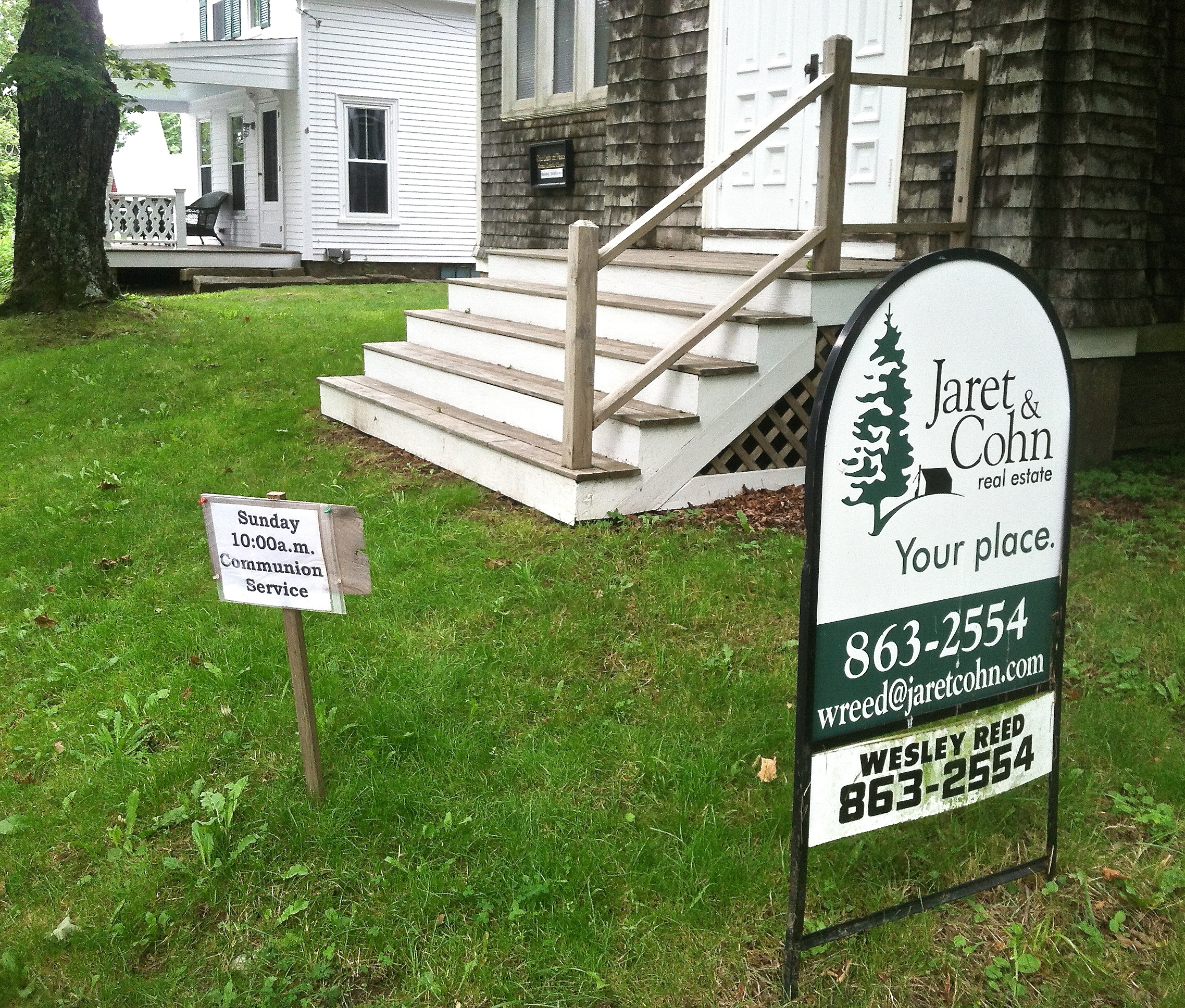
       A walk with Kathy on North Haven included two surprises. First, I’m pretty sure we saw author Susan Minot—no biggie, but neat. Second, we passed Our Lady of Peace Roman Catholic Church, which is for sale, a sign that the pews are anything but full on Sunday at 10:00 a.m. I took pictures of the exterior and was joined by two other Victory Chimes passengers, all of us staring up at the rust and rot. On a whim, I tried the door. Surprise! Unlocked.

IMG_2470

Our Lady of Peace

IMG_2469

I don’t imagine Our Lady of Peace will have a forwarding address.

IMG_2506

The nave from the balcony

IMG_2498

Organ in the balcony–an instrument deprived of its liturgy?

IMG_2511

One of the Stations of the Cross, hanging on an uninsulated wall.

This may sound odd coming from a Lutheran pastor, but I don’t particularly care if individuals go to church. Non-churchgoers meet me, look at the ground, and get stumbly and awkward. My attitude: I’m in no position to judge your beliefs. I do admit to being concerned, though. If human beings lose the longing to know the Ultimate and the impulse to gather with other pilgrims for adoration—of anything!—our race has a collective case of spiritual anemia. Of all the lights shining before going out in Maine, the rusty lamp of Our Lady of Peace on North Haven left me with a simple prayer.

IMG_2476

“Lamps will rust. Please don’t let the flame go out.”

       Some goodbyes, while serious, are also funny. On the way home, Kathy took a picture at a rest area on I-90 west in New York State, not far from home.

unnamed-1

Observation of an novice curmudgeon: Why not, “No littering”?

       I’m confident the written word has a few more generations of vitality before it takes on the shine of a long goodbye. That possibility is so far off that I laughed in our tune-less truck at the drawing of an arm hanging out a car window, its hand letting go of litter. Even a bummer has to lighten up once in a while.

Misgivings of a Cosmos Hugger

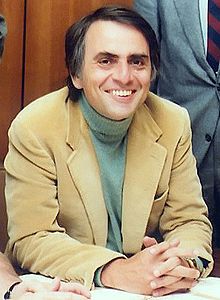
220px-Carl_Sagan_Planetary_Society

Carl Sagan, who had “billions and billions” of fans. (Credit: Wikipedia)

Good old Wikipedia tells me that “tree hugger may refer to a slang, sometimes derogatory, term for environmentalists.” If people consumed with ecosystems are dismissed as tree huggers, then you can write me off as a cosmos hugger. I’m in love with and worried about our whole existential collect: ginkgo bilobas, Carl Sagan, black dogs, harvest moons, avocados, even my neighbor who scraped his shovel as loudly as possible across the street in front of his house to clear 1/8 inch of snow—at 6:40 this morning, while I was enjoying in-breaths and out-breaths in the Ultimate Presence. Breathing in, I hear my neighbor shoveling. Breathing out, I smile at my $%#@ neighbor.

Because of my cosmos-huggerly love for neighbors of all shapes and sizes, all animals, vegetables, and minerals, all solar flares and black holes, I’ve had misgivings about the implications of several news stories in recent years. The following goodbyes and greetings have me stroking my beard and raising a cautionary finger.

Pluto Is No Longer a Planet.

220px-ESO-L._Calçada_-_Pluto_(by)

Computer-generated impression of the Plutonian surface. (Credit: Wikipedia)

The demotion of our distant neighbor Pluto is actually old news, but I still haven’t accepted it. Back in 2006, news.nationalgeographic.com reported that “the distant, ice-covered world is no longer a true planet, according to a new definition of the term voted on by scientists.” And what is a planet? “A full-fledged planet is an object that orbits the sun and is large enough to have become round due to the force of its own gravity. In addition, a planet has to dominate the neighborhood around its orbit.” Pluto, it turns out, is a scrawny hunk of ice with an “untidy” orbit.

Plutodog

Mickey Mouse’s dog Pluto. (Credit: Wikipedia)

The scientists’ definition is based on buff rather than character. The report notes the trouble ahead—I’m not sure how/when it was handled. Now a dwarf plant, Pluto will have to be written out of textbooks, an expensive proposition. I’m ambivalent about other important, but cheap problems. 1.) We can no longer remember the planets in order by saying, “My Very Excellent Mother Just Sent Us Nine Pizzas.” Now we’ll have to go with the same sentence with nachos or nectarines at the end. Either option is feeble. And 2.) What are we to do with Mickey Mouse’s English Pointer? Call him Neptune? Harrumph. So if the eighth planet is exiled, we’ll have a dog named Uranus? Imagine children at Disney Land pointing and shouting that. I vote we consider Pluto at least an honorary member of our solar system.

Okay, Who Made Off with My Cents Symbol?

I’m not such a grump as to expect to find the cents symbol, ¢, on my MacBook Air keyboard. There’s not much use for it anymore. Charlie Anderson offers on his website a detailed explanation for ¢’s disappearance—too detailed for this appreciation. In short, with the advent of computers in the 1960’s, engineers started fussing with keyboards, and pennies weren’t the only layoffs: “Three handy fractions were [also] cut: ¼  ½  ¾. This makes sense, especially when you consider that the ASCII [the American Standard Code for Information Interchange] committee was composed of engineers. I’m sure they thought, in their engineer’s way, ‘Why have ¼ but not 1/3?  And if we have 1/3, then why not 1/5?  Or 3/32?’ Similarly, the committee apparently found $0.19 an acceptable, if somewhat obtuse, way of expressing the price of a Bic pen. At any rate, the popular and useful cent sign didn’t make it.”

I have two kvetches about the ¢ issue. First, including “¢” in this text required over ten minutes of noodling around on the Internet for instructions. Yes, there is a generic cent symbol, but it’s clunky; it fits in like a welder’s mask with a prom gown.

US_One_Cent_Obv

Rolling into the sunset. (Credit: Wikipedia)

My second misgiving hasn’t come to pass, but it’s inevitable. Now that ¢ is becoming obscure, its main tenant faces eviction. RetireThePenny.org is leading the charge. MIT Professor and site founder Jeff Gore says, “The penny has outlived its usefulness. Let’s retire it.” His suggestion deserves consideration. If, as Gore argues, a penny actually costs 2.4¢ to produce, and if, all angles considered, “the penny drains almost $900 million from the national economy every year,” then, well, points taken. Here are my cautionary fingers: 1.) Any time financial decisions get made in the land of the free, the wealthy seem to benefit. Just saying. 2.) This may be quack economic theory, but if the penny disappears, I bet nearly all costs will be rounded up to the nearest nickel, dime, quarter, or dollar. Price tags won’t get rounded down. Watch and see. And 3.) Penny wise and pound foolish would slide into oblivion along with a penny saved is a penny earned and other useful expressions. So let’s keep the penny, even if children born today won’t learn what ¢ means in grammar school.

Goodbye to John Hancock?

“Is Cursive Writing Dead?” So barks cbsnews.com, and with good reason. “The recently established Common Core State Standards, the standardized educational benchmarks for U.S. public schools, omit cursive as a requirement. Some states, including Indiana and Hawaii, had dropped cursive from their curricula in favor of keyboard proficiency as early as 2011.”

505px-Us_declaration_independence

“I don’t read cursive.” (Credit: Wikipedia)

I get this decision and can go with it, but my cosmic Spidey sense tingles. Yes, handwriting as a whole is diminishing, while cents-less keyboards take over. And I admit, writing with a pen or pencil for any length of time now hurts. Still, consider a devil’s advocate. At the trial of the neighborhood vigilante George Zimmerman, witness Rachel Jeantel was asked to read a letter. With “her head bowed, [she] murmured with embarrassment, “I don’t read cursive.” So when we no longer teach cursive in schools, we’re leaving behind not only writing in that script, but also reading it. Someday, the Declaration of Independence and the Gettysburg Address will be as accessible as cuneiform—sad. Also, learning cursive may nurture patience and attention to detail in young, attention-strapped minds.

Starbucks friend John disagrees with me on cursive, and he’s usually right. We’ll all just read translations. I won’t go down swinging on teaching curls and loops.

Name Public Places That Are Quiet.

The first place that comes to mind is the library, right? Not anymore, at least at my beloved local library. Ed Palattella of the Erie Times-News is only the messenger, so he’s not in my crosshairs. As he reports, because “it often does seem quite noisy and loud in Blasco Library,” Mary Rennie, the Erie County Public Library’s director, is “looking to set a little bit of ambience.” We’re talking “mostly ‘soft classical’ and jazz” over “the library’s overhead speaker system.”

800px-Burlingame_Library1

Shh! Burlingame Library, Burlingame, San Mateo, California (Credit: Wikimedia Commons)

Rennie is probably a bright, thoughtful person, but noooooooo! True, libraries tend to be soaring spaces in which sound echoes, but for once in my life, I’m in favor of stern figures with furrowed brows and zero tolerance. Palattella ends his short piece with this surrender: “Music at Blasco. It is a tune of the times.” I’m going to the mat on this one—not that it matters. In monasteries and libraries, silence is foundational. Posses of inflexible librarians should be sent as missionaries to convert the rude and blathering with tough love. Shhh!

Glassholes, Glassholes Everywhere?

Good Lord, if the Google Glass site I’m checking out right now is legit, residents of the First World are either doomed or blessed. You probably already know the idea: put on a pair of these techno-glasses and “Say ‘take a picture’ to take a picture.” Or “Record what you see. Hands free.” Or “Speak to send a message.” Or “Ask whatever’s on your mind.” Want to know how to say “half a pound” in Chinese? You’re covered.

220px-A_Google_Glass_wearer

Please look at me when I’m talking to you. (Credit: Wikipedia)

I’m all for immediate access to information, but my cautionary finger points down another path. Google warns us not to be glassholes: in other words, with wondrous technology propped on our noses, remember to “respect others” and “be polite.” Yeah, right. With the cosmos’ current text-messaging drunkenness, can we really expect ourselves to pay attention to our fellow human beings when the next message or the latest swimsuit edition of Sports Illustrated pops up in our face?

Could any technological advance be harder to manage? Well, yes. Consider the smart contact lens currently in development. “Imagine texting while driving,” writes Brian Snyder of Reuters, “or placing a call while showering, without holding your phone in your hands. It’s not sci-fi any more – a new technology allows information like text messages and driving directions to be projected onto a contact lens.”

200px-Bionic_contacts

Bionic contact lens. (Credit: Wikipedia)

Imagine what’s next. (Warning: I’m pushing the envelope!) You and I are making love, and I’m looking into your eyes. Only I’m looking into someone else’s eyes, a projection. And I look down and see another body. It’s flawless. Each mole and stretch mark is gone. Wow!

Enough. You get the idea and might call me a worrywart. Maybe so. But this cosmos hugger has misgivings. In a universe where the humble ¢ and icy Pluto are unworthy, where music passes for silence, are scarlet scars—they’re lovely, actually—on mothers’ bellies sacred? Won’t it be irresistible to eliminate saddle bags by seeing them with artificial eyes?

What good is the cosmos when we can see constellations without looking up at the sky?

Micro-Post: The World Is Pulling My Leg

At the Millcreek Mall, Micah and I pass the Food Court and a pet store on the way to the E-cig kiosk. Smells: from Subway to General Tso’s chicken to pizza to a chemical cleaner that’s no match for pet poo.

A couple of kids play with a pup–maybe a Weimaraner, not sure–through the glass. The transaction seems friendly. The kids aren’t taunting; the dog’s having fun, spinning, reaching its paws toward them.

As I wait for Micah to pick up his cappuccino-flavored liquid tobacco, I begin to feel as though I’m from another world. Earth is pulling my leg.

In front of me is an establishment devoted mostly to eyebrows and eyelashes.

IMG_1398

“Oh,” I think, “you can get some kind of fabric woven into your eyebrows if you want them darker or you can make a weak mustache sturdy with facial threading.” But an eye-hair business? In this world, gracious, what you can buy!

After Micah pays, we head back the way we came. “Can you believe it,” I say, “a place where all they do is weave fake hair into your eyebrows and grow your lashes?”

“Uh, Dad,” Micah says, “I think with threading they roll thread over your hair to pull it out.”

Ah. Duly noted.

Back by the pet store, the kids are gone. The dog is lying in its cage–looking for more kids?

IMG_1399

In this world, animals that we consider friends are for sale. Dozens here alone, like sofas or flat screen televisions.

We sell what can love, fear, even save. And we micro-manage our eyebrows.

Dear World, please stop fooling around. Some of these jokes make me tired and sad.

A Prayer for Philip Seymour Hoffman, Justin Bieber, and a Child in a Fire

Philip_Seymour_Hoffman_2011

Philip Seymour Hoffman (Credit: Wikipedia)

I was settling in for my Sunday afternoon ministerial nap with a little channel surfing, and there it was on CNN: Philip Seymour Hoffman found dead in his bathroom; heroin in apartment; needle in his arm. I hollered downstairs for son Micah, a former addict. He sat on the bed at my feet, said, “Oh, no!” and put his face in his hands.

I let a minute pass. “Would he have known what was happening to him?”

“No,” Micah said. “He would’ve passed out right away. He died in a couple minutes.” Clean for over eighteen months, Micah would know.

Heroin has been in the news in Pennsylvania, New York, and Ohio lately—maybe beyond, I don’t know. Some sinister entrepreneurs came up with the idea of mixing fentanyl with heroin. The problem: fentanyl is 10 to 100 times stronger than heroin. One recent batch from Allegheny County in southwest Pennsylvania contained 50% fentanyl. Good night!

People are dying, and Hoffman himself appears to have overdosed on that sketchy brew. Maybe because Micah’s a fan, this average-looking-at-best actor is taking up spiritual room in me today. He was at the top of his game, most likely in great shape financially, but there was an ache in him somewhere. At least I imagine this was so. I bet most of us have pain burrowed down so far inside that nothing much can reach it.

431px-Believe_Tour_13,_2012

Justin Bieber (Credit: Wikipedia)

Without knowing it, Hoffman foreshadowed the difficulties of another troubled celebrity in a 2006 60 Minutes interview. He may as well have been talking about Justin Bieber, who at that time was probably up close to the mirror, searching for his first whisker. Hoffman said,

I always think, God, I have so much empathy for these young actors that are 19 and all of a sudden they’re beautiful and famous and rich — I’m like, ‘My God, I’d be dead’ — 19, beautiful, famous and rich, that would be it, you know … I think back at that time and think if I had the money, that kind of money.

Ironic, of course: Hoffman’s dead anyway. During Micah’s first months of sobriety, he mentioned that eventually shooting up wasn’t any fun. Life was just about getting ahold of drugs so he wouldn’t feel like crap. I wonder if that’s how it was with Philip Seymour Hoffman.

And what’s Justin Bieber thinking? Beautiful and famous and rich, he’s apparently shaking his groove thing at the edge of the abyss; that is if the news is accurate. Fast cars, booze, some weed. Who knows? Is Bieber going through too much, too fast, too young? Nineteen year olds can be explosive to start with. Whatever his deal, I’d say from my spectator’s distance that inner-peace isn’t part of the package.

What must it be like to have over 200,000 citizens sign a petition calling for you to be deported? My friend Mark posted an insightful defense of the Canadian heartthrob on Facebook a couple days ago:

I’m about tired of people crushing Justin Beiber. Get all your jokes out now. Ha ha ha. No, I don’t have a thing for teenage boys. Are you done? Good. I may be over sensitive to the abuse put on the kid because one of my girls loves him. She is crestfallen every time she hears bad press and even more devastated with the ensuing public dismantling. I love her. So when she hurts, I hurt. I don’t like his music and he’s made some absolutely stupid decisions. HE’S 19! Who among us didn’t do stupid stuff at 19? Okay, take 19 year old you and add, say, 10 million dollars. Holy Crap! Now factor in that everybody with a camera wants to take a picture of you. If you’re doing something wrong, even better. Multiply that by the fact that nobody ever told the kid “no”. He was their meal ticket. They had to keep him happy, no supervision makes a happy teen. All this, and he has screaming hoards of women of all ages wanting to, um, get with him. It’s just math people. He’s going to be a little screwed up.

IMG_1321

Daughter Elena holding grandson Cole. Proposal: What if I try to hold the world and everybody in it with this tenderness and joy? I want to try.

I don’t know if Bieber was never told “no,” but Mark’s got it right. If anything, the kid deserves our understanding. It’s easy to condemn Philip Seymour Hoffman’s junkie death and Justin Bieber’s dumb-ass choices, but only if addiction’s never had you by the throat or your post-pubescent brain has never told you the evil-twin lies: “You’re always right, and you’re invincible.”

© Copyright 2010 CorbisCorporation

Credit: corbisimages.com

The last thing Hoffman and Bieber need is my judgment. What they need is all the compassion I can muster. (And it ain’t easy with the latter’s chronically raised eyebrows and extravagant fitteds.) In fact, that’s what every corner of creation needs: my compassion.

Each week I spend hours in contemplative prayer, and you’d think heroin addicts and crazy kids would barge in on my silence and demand my attention. Sometimes this happens, but Hoffman, Bieber, and company are more likely to visit me at an inconvenient moment. On Sunday mornings, just before the congregation receives Holy Communion, we sing the Agnus Dei, the Lamb of God. The last words are “grant us peace.” We sing it three sweet times: “Grant us peace. Grant us peace. Grant us peace.”

42-21643553

Grant us peace! (Credit: Lew Robertson / Corbis)

I stand still and pray quietly: “Grant us peace!” I have just a few seconds; if I don’t start distributing the bread, people will think I’ve fallen asleep on my feet. Ah well. Philip Seymour Hoffman will arrive next Sunday, and I’ll sing, “Grant him peace.” Justin Bieber, too: “Grant him peace.” The four-year-old Erie girl who died in a house fire yesterday will appear: “Grant her peace.” And the firefighters who tried to save her: “Grant them peace.”

“Grant us peace.” Part of me wants to stand still in my alb and stole long after the congregation has gone home and sing: “Peace!” Peace for the wealthy and poor with needles stuck in their veins. Peace for the invincible. Peace for saints and sinners everywhere. Peace and healing to that hidden place in all of us, that dark corner where tears reside.

All are welcome in this prayer. Are you suffering? Are you alone to blame? Are you dead, gone into Mystery? Can you hear me? Show up in my spirit. I’ll sing your lovely name to God.

A Guitar in the Sky Brings Me Back to Myself

I’m not sure how to describe the last month. An awakening? A healing? Whatever. All I know is my spirit feels like my eyes do in the morning, after I rub them and the world comes into focus. What little truth I know has been closer to me than it has in years. The clarity hasn’t given itself all at once, but in instants of inconspicuous awareness.

IMG_1121

Amiable English professor Kirk and his pup Ryan.

One month ago today—September 19, 2013—while perched at Starbucks, I read a short piece in the Erie Times-News: “Coffee? Leave your gun at home.” “Starbucks,” the report begins, “says guns are no longer welcome in its cafes, though it is stopping short of an outright ban on firearms.” Whew. Glad I hadn’t brought my glock with me. My immediate thought: What’s the big deal? I understand the need for Starbucks to issue a press release to announce this—what?—friendly request, but what have we come to when a coffee shop has to ask patrons not to show up packing? A confederacy of dunces? I tore the article out and slipped it into my bag. A truth was being lifted up to me, something obvious when seen under a certain light. (Note: I happen to be writing this at Starbucks, where Kirk Nesset happily works away with Pomeranian pup Ryan on his lap. I suggest Starbucks put out word that well-behaved dogs are welcome.)

Mike_Webster

“Iron Mike” Webster, who died at 50. His autopsy revealed chronic traumatic encephalopathy. Some doctors estimate that his brain had suffered the equivalent of 25,000 car crashes. (Credit: Wikipedia)

Then I watched “A League of Denial: The NFL’s Concussion Crisis” on PBS’s Frontline, my jaw growing more slack by the moment. Everybody’s affronted by clear evidence that the National Football League has been playing dumb for years and covering up what it knew about how unhealthy it can be for a man to have his clock cleaned every Sunday. Seriously? The NFL deserves to get its knuckles cracked—more than 765,000,000 times—for letting its lucrative human demolition derby go on and on, but we’re not dealing with a league of denial here. We live on a planet of denial. What sane player or fan would suppose that you could repeatedly slam your head against other heads, bodies, and the ground and not spend your retirement dazed or worse? And don’t say, “Oh, but they wear helmets.” Um, okay, but no protection is going to prevent your brain from smashing about your skull if your head smacks into a hard surface. My point: this Frontline program holds a truth, but it’s not about football. It’s about a society’s capacity for reason. I love to watch football, but how compassionate is it to watch men risk destroying themselves? Time to give it up.

Rolodex.agr

A Rolodex like Mom’s, except hers was an ugly orange. (Credit: Wikipedia)

Next: on October 10, 2013, the Erie Times-News carried a short article by Patrick May of the San Jose Mercury News: “Tech stress: With proliferation of digital devices, we’re freaking out.” (Side note: Nobody forwarded me the memorandum announcing the change in practice of capitalizing first letters of words in a title. I’m not against it, but it looks wrong.) Mike Kushner, co-owner of Palo Alto, California’s Bay Area Computer Solutions, describes the rabid stress techno-junkies live with: “We see people crying; we see people angry; we have people lash out at us because we can’t recover what they lost . . . . People are under incredible pressure these days because of how dependent everybody is on their computers and especially their smart phones.” Boy, I’ll tell you, all this iTechnology is, in the words of Rick Postma of Holland, Michigan, “slicker than a harpooned hippo in a banana tree.” My mother of blessed memory kept a $1.99 K-Mart Rolodex on her end table and never once cried or lashed out over lost contacts. Meanwhile, I and thousands of others suffer from, as May puts it, “’phantom vibration syndrome,’ that creepy sensation that your smart phone is buzzing in your purse or pocket when in fact it isn’t.” As an iPhone owner, I ask members of the tribe, “Have we lost all good sense?” Suspected truth: We have.

Aime-Morot-Le-bon-Samaritain

“”The Good Samaritan” by Amie Morot.

Next: A few days ago fellow Starbucks barfly Alan stepped out outside on the porch where I was sitting, raised his closed eyes to the clouds, and took in a cosmic breath. “Yeah,” I said, “things could be a lot worse, huh?” Alan is Zen2 (tall, lanky, constant half-smile, slightly wild gray hair). He told me about a twenty-year-old guy he met at the Regional Cancer Center: “My throat cancer was nothing compared to what that guy had.” We breathed together a few times, then he bowed slightly and walked to his car, chewing his scone on the way. Truth: at every possible opportunity, close my eyes, breathe, and bow to my neighbor. (“And who is my neighbor?”)

© Copyright 2010 CorbisCorporation

“I want a human being.” (Credit: Wisson/Jordan)

Next: I was standing in line at the bank. An old guy sat in an armchair and voiced a single desire into his cell phone:  “No, I want to talk to a human being. No, I want a human being. Any human being who’s there. No, I want a human being.” Of course, he was speaking to an automaton, but speaking a sane truth all the same. Is it too much to ask for a human being? On the phone? At the grocery store check out? On the front porch? I’d like to invent a social media just for this man. I wouldn’t (and couldn’t) name it Facebook. I’d just call it Face.

IMG_1117

A guitar in the sky brings me back to myself.

Finally: Micah needed a drum pad, so we stopped at Erie’s World of Music. As he walked to the door, I stayed in the car and reached for my iPhone—a habit, impulse. For no particular reason, as I thumbed my phone’s snotty leather cover, I looked out my window at the sky and saw a guitar. I used to park in that lot once a week for Micah’s drum lessons and never noticed that guitar next to the World of Music sign. A wordless question brought me to myself: John, aren’t there better things to look at than text messages, e-mails, and ABC’s news stories? Check out the guitar in the sky and while you’re at it, receive the sky.

I’ve don’t think objectivity exists, but I do believe in truths. Though I’m not smart enough to define them, I now have sightings. Truths rest at my feet or hover in the sky when I’m aware, when I breathe. I see them and give thanks. I feel like myself. I feel at home.

Mean: the New Normal

Begin with this: I’m no better than anyone else. Pick whomever you like: the haggard, rotten-toothed crack head; the Ripley’s-Believe-It-or-Not 1000-pounder who eats four rotisserie chickens for lunch; parents who treat their kids like dog crap. One environmental variable; one chromosomal kink; one impulsive, destructive choice: slip one of these into my row of biographical Dominos, and I’m not a marginally respectful fifty-one-year-old blogger and Lutheran pastor. I’m a vagrant, letch, junkie, inmate, whatever. Because of this truth, what follows is a peek at a sad sore on my spirit. Don’t picture my hands as fists.

800px-DNA_molekula_života_-_česky

One mishap here, and I could be living under a bridge. (Credit: Wikimedia Commons)

Sometimes midday oblivion is joyful. Imagine finishing a swim in warm water. Your blanket and towel are in the shade. When you lie down, the sand cradles your body. The breeze is so perfect it seems like part of your skin. Sliding into sleep, you think for a moment your head is resting against the chest of Merciful Eternity. Yeah.

Other times, midday oblivion is the bird—not a bird, but the bird. It’s weary, though reptilian, repartee with the world. It’s a mumbled f-bomb. It’s a wet Bronx cheer. It’s what you say as you shoot the moon. It’s your way of grunting, “Go pound sand.” Or it’s a sighed, “Enough already. You win. I’m taking a nap.”

RudeGirl

Credit: openclipart.org

Today’s oblivion won’t be the beach kind, and before a glorious siesta, I’m wagging my flaccid bird at meanness, which is epidemic. Unless I go to a monastery, I can’t seem to escape it—probably because my eye is now hypersensitive. Mean is everywhere.

IMG_0937

Even canned coffee is mean these days.

The other day my son Micah asked me to run him to the Exchange, a great used media store with friendly, helpful clerks. As he looked around, an ad for some World Wrestling Federation video played over and over on a flat screen in a corner near the ceiling. I stared up, slack-jawed. So many means to celebrate: sweaty, snarling, barking, slamming, glistening, hollering. And that’s just the gladiators. The crowd is in a constant, lathery rage.

800px-Amasis_the_wrestler

Amasis the Wrestler–grrrrr. (Credit: Wikimedia Commons)

When an aching neck forced me to look down, I noticed that at eye level and below, no square inch of the Exchange goes unexploited. There’s junk for sale everywhere. Check out the gallery of confrontational action figures and other curiosities.

IMG_0935

Ew.

IMG_0940

Not one of Al Pacino’s finer moments, if you ask me.

IMG_0944

Sorry for the glare. What will scare a monster? Tell him Chuck Norris is hiding under his bed!

IMG_0949

Grrrr. Hulk pants too tight!

IMG_0950

At least the Joker laughs as he blows a puff of poison gas in your face.

IMG_0948

Bobble-heady Freddy. Needs dental work.

In fairness to the Exchange (did I mention the help is genuinely nice there?), not all items are angry.

IMG_0943

Most colorful of the Rolling Stones coaster set.

IMG_0947

$9.00? Seriously?

IMG_0945

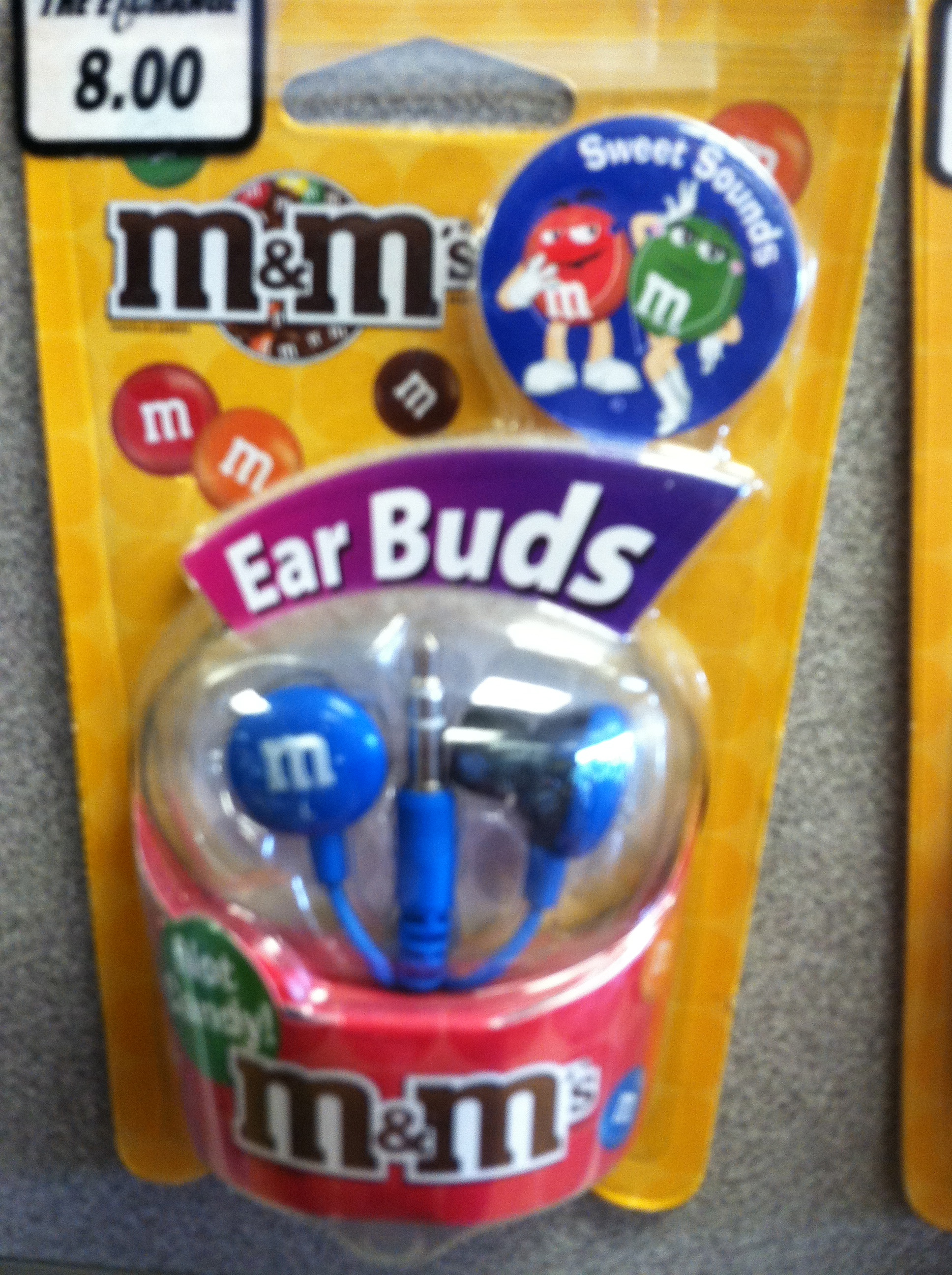
Love M&M’s. Need ear buds. Not tempted.

The common denominator here? If an item isn’t quirky, it must be baring its teeth. Who would buy somebody under eighteen a psychopathic action figure? Only Chuck Norris isn’t a physiological aberration or demented killer. And what adult would collect such diabolical kitsch? The absurdity and ugliness are draining.

Simon-Cowell-225x300

Ah, that would be a “no” vote from Simon. (Credit: newsbiscuit.com)

Of course, the face of mean isn’t always ugly. Often it’s stylish and witty. Back when “American Idol” was hot I didn’t watch it. Not only was it excruciating to witness performances by kids whose parents had lied to them about their talent, but I also couldn’t hack Simon Cowell’s delight in explicating their failure. I don’t blame Simon—he’s probably a great guy—but he has certainly contributed to the evolution of a television menu that’s riddled with mean. If you want to watch a cooking program, one of your options provides chefs with bizarre ingredients—pork tenderloin, Oreos, arugula, merlot-infused goat cheese, and honeydew melon—then puts their concoctions before restaurateurs, one of whom cowells them over the head for creating gunk. Throw a cluster of narcissistic brats on an island or into a mansion and you’ve got reality television: look how rotten these characters can be to each other, how many ways they can lie to and betray each other. And now home improvement and remodeling shows are caught in mean’s gravitational pull. What’s-their-names, those handsome twin brothers, are now leading teams of competing remodelers, and the underachievers are going to be thrown onto the scrap heap. I can’t tell you the names of these shows, since I watch for a minute, then catch another wave. (By the way, is “Survivor” on anymore? I honestly don’t know.)

I wonder what lesson all this mean entertainment teaches us—and don’t even get me started on “Grand Theft Auto” and “The Human Centipede,” diversions that are beyond mean. If nothing else, I’d argue that the stimulation I’ve mentioned contributes to the normalization of mean.

After watching a movie in which humans are sewn together in the most unsavory way possible, what’s the big deal about posting an embarrassing picture of a friend on Facebook? When housemates shout bleeps and stab fingers in each other’s faces during primetime, a nasty text message seems benign, arriving as it does without eye contact.

800px-Angry_woman

I imagine she’s actually very nice. (Credit: Wikimedia Commons)

But what’s got me looking napward at the moment is more basic than cinema, games, Facebook, and cell phones. I’m tired out by good, old fashioned, face-to-face mean, mean tendered for no good reason, mean delivered because—ah, what the hell!—mean is normal, even hip. (I’ve no empirical evidence to support any of this preachiness—sorry.) My impression is this: contemporary snarl and snark, far from being frowned upon, is now a compelling fashion statement. Wrestling gladiators and movie action figures, with their teeth bared, are only the new normal reduced to caricature.

In this regrettable landscape, simple unfriendliness doesn’t register on the interpersonal Richter scale. Even those who claim to be religious can treat fellow human beings shabbily without any fallout of conscience. Lately a dear friend has shared news that those around her are repeatedly breaking author Anne Lamott’s Rule #2, which I paraphrase here: “Don’t be a [schmutz].” My friend’s been hurt, worn down by cold shoulders and passive aggression.

Young boy with his mouth smeared with chocolate

Come here, kid. You’ve got schmutz on your face. (Credit: corbisimages.com)

Truth be told, it’s actually my friend’s pain that’s tiring me out—a cordial, hard worker being pummeled by schmutzes. There’s no remedy for what’s certainly longstanding bad behavior that I’m stung by now only because I’m thin-skinned. All I can do is follow Voltaire’s advice that I cultivate my own flawed garden. And I can give loving, juicy raspberries to a world that seems extra mean today, then lie down. My hope: in sleep the only teeth I dream will be framed by smiles.

Thich Nhat Hanh visits Calligraphic Meditation Exhibition in Bangkok

Make a bobble-head Thich Nhat Hanh smiling at me, and I’ll buy one. (Credit: corbisimages.com)