Abraham Lincoln’s Gettysburg Disappointment

Dear Friends:

The piece that follows is an excerpt from Your Grandmother Raised Monarchs and Other Wonders Before Your Time, a collection of notes to my grandchild(ren) when they come of age. The book, written in 2005-2006, is in the pipeline now, and I’ll holler unapologetically when it’s released.

Enjoy!

John

Abraham_Lincoln_seated,_Feb_9,_1864

The photograph Robert Todd Lincoln said was “the best likeness of my father.” (Credit: Wikimedia Commons)

I’m starting this note to you from the World of Music basement while Micah takes his drum lesson. Because tomorrow is Thanksgiving, the place is quiet with cancelled lessons: no soprano squeezing out scales, no trumpet blatting, just Micah drumming and one lone kid plucking an electric guitar. What I want to tell you about has nothing to do with music, though. Abraham Lincoln is on my mind.

You know that every morning I glance at the newspaper headlines, but I haven’t mentioned that I also listen to a radio spot called The Writer’s Almanac. In five minutes, host Garrison Keillor talks in his soothing baritone about literature and history and reads a poem. During the past week he shared a couple of facts about Lincoln that I didn’t know.

The first has to do with Lincoln’s “Gettysburg Address,” which is one of the most beautiful pieces of prose in the English language. Since it’s short—only 272 words—I’ll type it out for you right here:

Four score and seven years ago our fathers brought forth on this continent, a new nation, conceived in Liberty, and dedicated to the proposition that all men are created equal. Now we are engaged in a great civil war, testing whether that nation, or any nation so conceived and so dedicated, can long endure. We are met on a great battle-field of that war. We have come to dedicate a portion of that field, as a final resting place for those who here gave their lives that that nation might live. It is altogether fitting and proper that we should do this.

But, in a larger sense, we can not dedicate—we can not consecrate—we can not hallow—this ground. The brave men, living and dead, who struggled here, have consecrated it, far above our poor power to add or detract. The world will little note, nor long remember what we say here, but it can never forget what they did here. It is for us the living, rather, to be dedicated here to the unfinished work which they who fought here have thus far so nobly advanced. It is rather for us to be here dedicated to the great task remaining before us—that from these honored dead we take increased devotion to that cause for which they gave the last full measure of devotion—that we here highly resolve that these dead shall not have died in vain—that this nation, under God, shall have a new birth of freedom—and that government of the people, by the people, for the people, shall not perish from the earth.

220px-Battle_of_Gettysburg

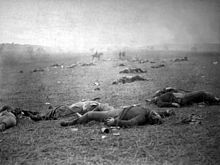
Union dead at Gettysburg. (Credit: Wikipedia. Photographer: Timothy H. O’Sullivan)

I already knew that Lincoln wrote this address on an envelope during his train ride to Gettysburg. What I didn’t realize was that the dedication of the cemetery, situated on the ground where hundreds of soldiers were buried quickly in shallow graves after the battle, was a grand, carefully planned affair with fifteen thousand people attending. Edward Everett, who was famous for his speeches about battlefields, went on for over two hours cataloging the battle’s endless instances of bravery and valor. When he finished, Lincoln read his slender 272 words. By the time the event’s photographer got set, his subject had already sat back down; he managed one blurry shot.

Lincolnatgettysburg

A blurry Lincoln at Gettysburg. (Credit: Wikipedia)

So restrained was the audience’s applause that Lincoln assumed his speech was a failure. Little did he know a century later school kids would be required to memorize his address, and English and history teachers would regard Lincoln, a politician, as one of the most gifted writers of his generation. Everett, however, knew a great speech when he heard one. The next day he told Lincoln, “I wish that I could flatter myself that I had come as near to the central idea of the occasion in two hours as you did in two minutes.” Of course, maybe Everett was mainly stroking the President’s ego.

170px-Edward_Everett

Edward Everett, who held forth when citizens had sturdy attention spans. (Credit: Wikipedia)

The second Abraham Lincoln story Garrison Keillor told this week had to do with the President’s letter to Mrs. Lydia Bixby, a widow who supposedly lost five sons in the Civil War:

Dear Madam,–

I have been shown in the files of the War Department a statement of the Adjutant General of Massachusetts that you are the mother of five sons who have died gloriously on the field of battle.

I feel how weak and fruitless must be any word of mine which should attempt to beguile you from the grief of a loss so overwhelming. But I cannot refrain from tendering you the consolation that may be found in the thanks of the Republic they died to save.

I pray that our Heavenly Father may assuage the anguish of your bereavement, and leave you only the cherished memory of the loved and lost, and the solemn pride that must be yours to have laid so costly a sacrifice upon the altar of freedom.

Yours, very sincerely and respectfully,

A. Lincoln

Oddly, Mrs. Bixby didn’t lose five sons. She lost two in battle; one deserted, one was honorably discharged, and another either deserted or died as a prisoner of war. Don’t misunderstand! This poor mother deserved every condolence she received, but the facts differ from those that inspired the President—if he wrote the letter at all. Most historians now believe that Lincoln’s famous letter to Mrs. Lydia Bixby was actually written by one of his White House secretaries, John Hay.

220px-John_Hay,_bw_photo_portrait,_1897

John Hay, Lincoln’s secretary and assistant. Nice facial hair arrangement. (Credit: Wikipedia)

Do any of these historical facts matter? Not to us. I bet it would have mattered to Abraham Lincoln, though, on November 19, 1863, as he sat down after saying his 272 words, to know that his speech was much better than he first thought and that history would judge him a courageous President, a wise man, and an elegant writer. But how could he have known, that man in a lone grainy photograph who felt the weight of a nation on his tired shoulders?

Blogging, Awards, and the Longest Acceptance Speech Ever

I’m a slow one, I am, but I catch on eventually. When I started A Napper’s Companion almost a year ago, it was a selfish endeavor. Editors were taking forever to get back to me about book submissions, and when they did, the answer was “Nope.” My morning writing discipline, nourishing as it was, occasionally felt like solitary confinement. So I stuck my neck out there with a blog, wanting mostly to get my stuff under somebody’s nose rather than letting it rot in my laptop’s guts.

42-53814834

All right, put your nose under those spectacles and read my stuff! (Credit: Radius Images / Corbis)

As the months have passed, I’ve received several nominations for blogging awards. The first time it happened I tried to track down the source of the award. Dagnabbit! Every road led to another blog. “Ah ha,” I thought, “this is a blogging gimmick.” So I settled on a policy: say thanks, be polite, but don’t engage.

But then something completely unexpected happened. Part one: it dawned on me that it was selfish to expect other bloggers to read my work if I didn’t read theirs. So I read and came to regard reading not only as an ongoing pleasure, but a responsibility. I don’t schedule blocks of time for keeping up with blogs I follow, but a couple times a week it happens: Coleman sits with a cup of coffee or a glass of wine and has great fun with my friends. Yes, I said it: friends. That’s part two: I never ever expected to find such a wealth of cool, funny, thoughtful friends in the WordPress community. I don’t suppose we’ll ever actually meet; hell, I don’t remember where most of them live. A few of them don’t pay much attention to my blog, but that’s okay. We’re comrades and considering the likes and comments some receive, they could spend several hours a day just following their followers and commenting thoughtfully. Not possible. Love them anyway.

Anyway, I’m accepting an award nomination today. I’ve known for decades that “writing is a quiet game”—can’t seem to track down who said so originally. What I’ve learned lately is that the blogging landscape is lovely, but, damn, is it crowded. WordPress stats say, “Over 409 million people view more than 13.1 billion pages each month.” Holy crap! But in the midst of all these voices, I’ve come to really connect with a little choir. In between reading posts, I think about my blogging mates (Australian lilt required). I hope they’re doing okay, and for some walking in the valley of the shadow, pray they’re still among the quick.

Among bloggers, awards are a way of patting each other on the back and extending genuine appreciation. Do we hope to increase our traffic a smidgen? I suppose so. But I’m accepting a nomination from blog bud nap time thoughts (I’ll do the same for another from kerry’s winding road in a separate post) for a human reason. She’s saying thanks, and I’m responding, “You’re welcome. And thanks back atcha!” I’m spreading and feeling the love.

I’m accepting a nomination for “the Quintet of Radiance Award,” which is actually a bundle of five awards. What the hey, why not go for a bundle? “Most Influential Blogger Award,” “Awesome Blog Content Award,” “Inner Peace Award” (by which my friend must mean “the Chunky Neurotic Dude Award”), “Sunshine Award,” and “The Versatile Blogger Award.”

most-influential-blogger-1

abc-award-1

inner-peace-award

sunshine-award-1

versatile-blogger-nominations-1

My only obligation is to describe myself using the alphabet, but because I’m a sunshiny little pain in the arse, I’m going to use the letters to describe things I like. This may at times read like a shopping list:

A: Abiding Hope family (the church I serve as pastor), avocado, asparagus, artichoke hearts, anything Alfredo, art, America’s Test Kitchen, atheists and agnostics (see last item in this series), and agape (Greek for God’s unconditional love)

B: basil, books, blogging, cat Baby Crash, the Benedictine Sisters of Erie, the Buddha, Big Band, David Brooks (best right-of-center columnist), and Samuel Barber’s “Adagio for Strings”

C: (so-cute-you-just-want-to-poop-your-trousers-along-with-my-grandson) Cole, curry, cardamom, cilantro, cabernet sauvignon, chardonnay, Chipotle Mexican Restaurant, Julia Child, contemplation, and compassion

IMG_1373

Grandson Cole. Admit it, you kind of want to poop, right?

D: Desitin (should I join grandson in pooping), E. J. Dionne (best left-of-center columnist), dill weed, delete, dude, and dang

E: (wonder-daughter) Elena, eggplant (dredge in egg and flour, fry in grease, delete nutritional value), El Canelo Mexican Restaurant, and eros (Ew! This from a pastor? You bet. Gift from God!)

F: feta cheese, friends, Food ala Floyd, and fubsy (which means “short and somewhat squat”)

G: gravy (any denomination, salty and fatty, bitte), guacamole, Greek olives, and gentleness

42-51110473

Straw, please. (Credit: Koji Hanabuchi / Corbis)

H: the Harvard comma and Phil Harris

I: India pale ale and irregardless (which isn’t actually a word; it’s just regardless)

J: Jesus, Joe’s Cheese House (Marinette, Wisconsin; cheddar aged 16.5 years; eat or use to remove warts), and jogging (ten years ago I’d have said “running”; oh well)

K: Kathy (wifely; good Lord, how has she tolerated me for 33 years?), (“I’ve Got a Gal from) Kalamazoo, and Graham Kerr

IMG_0182

Kathy, who could make any letter illustrious, with Watson.

L: lime, Louis CK (one is bright and refreshing, the other vulgar and hilarious), lasagna, Lutheranism, and love

M: Micah and Matt (son and son-in-law; proud as hell), meditation, monasteries, and music

N: nasty (a word I use for fart, as in “Oh, my dear chap, did you just emit a nasty?”; the actual item I can live without—really), “Nessun Dorma” (see T.), and napping

Press_photo_of_Jussi_Björling

Swedish tenor Jussi Bjorling. Sang a mean “Nessun Dorma.” Died of drink too young. (Credit: Wikimedia Commons)

O: oregano, olive oil, the Oxford comma, and Mary Oliver

P: pesto, pinot noir, pizza, the Palmer (walk and wiggle your hips like one of those girls in Robert Palmer music videos), Louis Prima, Jacques Pepin, poetry, prayer, and peace

Q: query (wrote a ton of those dang letters)

R: Ricardo’s Restaurant (best filet mignon in Erie, Pennsylvania), roasted red peppers, Leon Redbone, and Rachmaninov’s Second Piano Concerto

220px-Leon_Redbone_at_Knuckleheads_Saloon-Kansas_City_MO

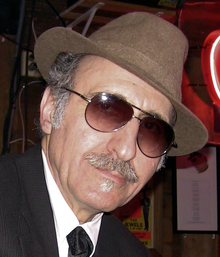
Leon Redbone (Credit: Wikipedia)

S: Siestas, sleep, shalom, shamatha, cat Shadow, Starbucks, Star Trek (original television show), Star Wars, sour cream, salmon, the serial comma, Paul Simon, and Steely Dan

T: operatic tenors (opera not so much, just take me to the mountain top) and tomatoes

U: uvula (just a fun word for the phlegmy stalactite hanging from the back of your throat)

V: Victory Chimes (a schooner in Maine) and singing along with Viagra commercials (“Viva, viva, Viagraaaaa!)

W: dog Watson, white pepper, E. B. White, weenus (slang term for your loose elbow skin), wine, The Writer’s Almanac,  and writing

X: X-rays (thank God; they eliminate exploratory drilling)

Y: yield signs (permission for rolling stop granted)

and

Z: Zen, Zoloft, and Brother John Zuber and his fellow monks at Gethsemani.

Okay, that was genuinely fun, but it’s time to move on. (I just know I’m leaving something really important out.)

I’m also supposed to nominate other bloggers for the “Quintet of Radiance Award.” I follow lots of blogs and am nominating only those I think might welcome such a nod. If I’m wrong, please forgive. Here goes, friends:

a little elbow room

always backroads

deep in the heart of textiles

Rosemary’s blog

Rob Fysh’s blog

nap a day

wading blue heron

coffee talk with Erin

Rosie smrtie pants

one thousand two

plan B-each

IMG_1453

Even if you don’t accept nominations, I raise my red blend to you.

Charles Darwin and Abraham Lincoln: Appreciations on Their Birthday

February 12, 2014: If Darwin and Lincoln were among the quick, they’d celebrate their 205th birthday today. I have a special love for both men and share these appreciations. This post is long, so you might need to consume it in two sittings. Hope it’s worth your time.

Happy Birthday, Charles Darwin, My Brother in Complaints and Conflict!

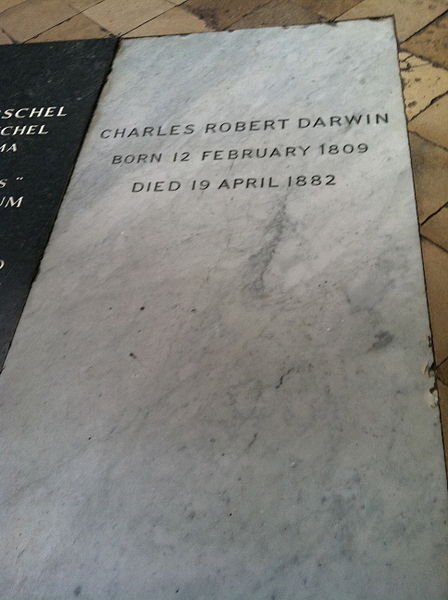
448px-Charles_Darwin's_grave_at_Westminster_Abbey

Charles Darwin’s grave: a little less grand than I would have thought (Credit: Wikimedia Commons)

David Quammen’s excellent biography, The Reluctant Mr. Darwin, notes that when the father of natural selection died, “the world . . . swooped in and claimed his body for history and posterity and the glory of British culture.” And the world “decreed that Charles Darwin be buried in Westminster Abbey,” which was ironic, since he was an atheist.

Biblical literalists would like to exhume Darwin and hose down his bones with holy water, but I consider him a planetary brother. Quammen describes the parallel development of Darwin’s transmutation of species and the onset of his health issues:

Darwin’s work on the transmutation notebooks coincided with his early complaints about what became chronic bad health. The symptoms were mysterious—jumpy heart, nausea, vomiting, headaches, nervous excitement, inordinate flatulence—but real enough to make him miserable and to slow his work. Was he a hypochondriac? A neurasthenic? Had he been bitten and infected by some nasty disease-bearing bug during a Beagle [the ship Darwin sailed on from 1831-36] stopover in Argentina? Many guesses have been made but nobody knows, to this day, what ailed him.

Inordinate flatulence–bummer. Fabienne Smith immediately and dryly states her theory about Darwin’s deal in her article “Charles Darwin’s Health Problems: the Allergy Hypothesis”: “The purpose of this paper is to buttress the evidence given in ‘Charles Darwin’s Ill Health’ [a previous article by the same author] for the theory that Darwin suffered from multiple allergy arising from a dysfunctioning immune system.” Sounds plausible, but I’m not about the read the whole thing. History.com presents its own list of guesses along with a few attempted remedies:

During Darwin’s lifetime, England’s most prominent physicians failed to decode the ailing naturalist’s jumble of symptoms. Their diagnoses ran the gamut from gout to appendicitis to hepatitis to mental exhaustion to schizophrenia, while the remedies they prescribed—lemons, Indian ale, hydrotherapy, arsenic, strychnine and codeine, among countless others—provided little relief.

An admirably researched Wikipedia article, “Charles Darwin’s Health,” lists “many hypotheses” for the man’s agony, including Crohn’s disease, panic disorder, Chagas’ disease, Meniere’s disease, lactose intolerance, lupus erythematosus, arsenic poisoning, hypochondria, migraine, cyclic vomiting syndrome, and chronic fatigue syndrome. That Darwin might have been cursed with even a couple of these conditions is frightening to imagine.

Editorial_cartoon_depicting_Charles_Darwin_as_an_ape_(1871)-1

Editorial cartoon of Darwin, 1871 (Credit: Wikimedia Commons)

The winner of my Scary Darwin Scholarship Award goes to Jerry Bergman, Ph.D., for his article “Was Charles Darwin Psychotic? A Study of His Mental Health,” which appears on the Institute for Creation Research website (icr.org). Bergman’s thesis is that mental health issues not only ruined the scientist’s body, but also led him to develop wacky theories. The article is part legitimate catalog of Darwin’s complaints and part smear job ala Lee Atwater and Karl Rowe. “Some speculate,” the author writes, “that part of Darwin’s mental problems were due to his nagging, gnawing fear that he had devoted his ‘life to a fantasy’—and a ‘dangerous one’ at that (Desmond and Moore, 1991, p. 477). This fear was that his theory was false and there was, in fact, a divine Creator.” (No, I’m not going to read the cited work, Darwin: the Life of a Tormented Evolutionist by Adrian Desmond and James Moore, but I did check the Publishers Weekly and Library Journal review excerpts on Amazon.com, and both sing that biography’s praises. I might be wrong, but I bet Desmond and Moore wouldn’t appreciate the use Bergman makes of their words.)

Bergman also hits below the belt when he implies that Darwin’s scientific conclusions are flawed because he passionately loved shooting birds as a kid, which points to a “sadistic streak” that “may have, in part, motivated his ruthless ‘survival of the fittest’ tooth and claw theory of natural selection”; because he referred to committing suicide when writing to fellow scientist Robert Hooker about his upset over the writing quality of one of his books; because author Clifford Picover wrote that Darwin treated his wife and adult daughters like children; because “Darwin exhibited the obsessional’s trait of having everything ‘just so’; he kept meticulous records of his health and symptoms like many obsessional hypochondriacs. Everything had to be in its place; he even had a special drawer for the sponge which he used in bathing.”

Charles_Darwin_by_Barraud_c1881-crop-1

Darwin’s wife wrote him a letter in 1839 expressing her fear that they wouldn’t spend eternity together. After his death, the following addition was found at the bottom of her letter–a loving atheist’s attempt at comfort? “When I am dead, know that many times, I have kissed & cryed over this. C. D.” (Credit: Wikimedia Commons)

The article’s final sentence nails down what the author has been getting at all along: “To understand Darwin as a person and his motivations, one must consider his mental condition and how it affected his work and conclusions.” Bergman’s claim that Darwin’s scientific conclusions are flawed because he had mental and physical issues is like saying that a singer has an unappealing voice because he sleeps around: non sequitur. What singers do with their junk has nothing to do with their vocal cords and breath control; and the fact that a scientist needs therapy and meds doesn’t mean he’ll do biased research. If anything, in Darwin’s case I’m betting Bergman has the situation backwards. Darwin’s troubled constitution and psyche didn’t skew his scholarly work; rather, his health went into the chamber pot in part because his thinking was so contrary to the assumptions of his day, not to mention deeply troubling to his wife, a devout Christian; Quammen’s speculations, in fact, head in this direction without coming across like a conspiracy theory.    

Charles_Darwin

Charles Darwin at 45 years old. (Credit: Wikimedia Commons)

In the end, as Quammen writes, “nobody knows . . . what ailed him.” I’m looking at a photograph of Darwin at around age forty-five, seven years my junior, and feeling a connection. If only he could have picked up Atenolol, Prilosec, Zoloft, Xanax, Beano, and other modern medications at the apothecary, his suffering might have been manageable.

And if only Darwin could have enjoyed a daily siesta rather than taking to his bed for months at a time. Illness leeched years of work off of what was already an amazingly productive life. What’s worse, more profound discomfort still resided in a place microscopes can’t get at. Employing quotations from Darwin’s letters, Quammen playfully describes the scientist’s fragility—and mine:

[Darwin’s] doctors had advised him to quit work and get a country vacation, he added, and he was taking their advice. ‘I feel I must have a little rest, else I shall break down.’  After a few weeks home in Shrewsbury, with his father and sisters [in the fall of 1837], he reported again . . . that ‘anything which flurries me completely knocks me up afterwards and brings on a bad palpitation of the heart.’ Social gatherings flurried him. Intense conversations flurried him. Conflict, or the very idea of it, was highly flurrisome.

The last part makes Darwin my kin: the slightest prospect of conflict is nearly incapacitating, flurrisome—spot-on for both of us. Flurrisome Charles had the brains. Flurisome John has the meds and the afternoon nap.

200px-Charles_Darwin_01

The Darwin we all know and love. (Credit: Wikipedia)

The part of Darwin’s story I love best takes place when he was near death. As he suffered through the final stages of heart disease, he continued to work as his body permitted. Quammen explained that a colleague who knew of Darwin’s interest in the migration of plants and animals discovered a clam attached to a beetle and wondered if this oddity might indicate that a sea creature could migrate by attaching itself to a bird. The colleague mailed the beetle/clam to Darwin so that he could look for himself. By the time he received the box, the clam and beetle had separated, and the former was dead, the latter languishing. As Darwin wrote the sender, he placed the dying beetle in a jar with torn up laurel leaves, which exuded a chemical that would help the poor thing relax and die in peace. Darwin himself followed the beetle into eternity about two weeks later. So even as one of the most brilliant minds in history was dying, he took time to ease the suffering of a beetle. Darwin considered himself an atheist. So be it. I call him “brother.”

Happy Birthday, Abraham Lincoln, My Weary, Burdened Brother!

170px-Abraham_Lincoln_O-116_by_Gardner,_1865-crop

Abraham Lincoln about two months before his assassination–such tired eyes. (Credit: Wikipedia)

A couple years ago on this day’s A Writer’s Almanac, Garrison Keillor told me a couple facts I didn’t know about Abraham Lincoln—facts that make me doubly grateful for his stay in the White House.

The first has to do with Lincoln’s “Gettysburg Address,” which is one of the most beautiful pieces of prose in the English language. Since it’s short—only 272 words—I’ll include it here:

Four score and seven years ago our fathers brought forth on this continent, a new nation, conceived in Liberty, and dedicated to the proposition that all men are created equal. Now we are engaged in a great civil war, testing whether that nation, or any nation so conceived and so dedicated, can long endure. We are met on a great battle-field of that war. We have come to dedicate a portion of that field, as a final resting place for those who here gave their lives that that nation might live. It is altogether fitting and proper that we should do this.

But, in a larger sense, we can not dedicate—we can not consecrate—we can not hallow—this ground. The brave men, living and dead, who struggled here, have consecrated it, far above our poor power to add or detract. The world will little note, nor long remember what we say here, but it can never forget what they did here. It is for us the living, rather, to be dedicated here to the unfinished work which they who fought here have thus far so nobly advanced. It is rather for us to be here dedicated to the great task remaining before us—that from these honored dead we take increased devotion to that cause for which they gave the last full measure of devotion—that we here highly resolve that these dead shall not have died in vain—that this nation, under God, shall have a new birth of freedom—and that government of the people, by the people, for the people, shall not perish from the earth.

Abraham_Lincoln_life_mask

Abraham Lincoln’s “life mask” from 1860–better than a death mask. (Credit: Wikimedia Commons)

Lincolnatgettysburg

Lincoln at Gettysburg just after delivering his address. (Credit: Wikipedia)

I already knew that Lincoln wrote this address on an envelope during his train ride to Gettysburg. What I didn’t realize was that the dedication of the cemetery, situated on the ground where hundreds of soldiers were buried quickly in shallow graves after the battle, was a grand, carefully planned affair with fifteen thousand people attending. Edward Everett, who was famous for his speeches about battlefields, went on for over two hours cataloging the battle’s endless instances of bravery and valor. When he finished, Lincoln read his slender 272 words. By the time the event’s photographer got set, his subject had already sat back down; he managed one blurry shot.

So restrained was the audience’s applause that Lincoln assumed his speech was a failure. Little did he know a century later school kids would be required to memorize his address, and English and history teachers would regard Lincoln, a politician, as one of the most gifted writers of his generation. Everett, however, knew a great speech when he heard one. The next day he told Lincoln, “I wish that I could flatter myself that I had come as near to the central idea of the occasion in two hours as you did in two minutes.” Of course, maybe Everett was mainly stroking the President’s ego.

The second Abraham Lincoln story Garrison Keillor told had to do with a letter the President is thought to have written to Mrs. Lydia Bixby, a widow who supposedly lost five sons in the Civil War:

Dear Madam,–

I have been shown in the files of the War Department a statement of the Adjutant General of Massachusetts that you are the mother of five sons who have died gloriously on the field of battle.

I feel how weak and fruitless must be any word of mine which should attempt to beguile you from the grief of a loss so overwhelming. But I cannot refrain from tendering you the consolation that may be found in the thanks of the Republic they died to save.

I pray that our Heavenly Father may assuage the anguish of your bereavement, and leave you only the cherished memory of the loved and lost, and the solemn pride that must be yours to have laid so costly a sacrifice upon the altar of freedom.

Yours, very sincerely and respectfully,

A. Lincoln

Lincolnatpeace2

Retouched post-mortem photograph. (Credit: Wikimedia Commons)

Oddly, Mrs. Bixby didn’t lose five sons. She lost two in battle; one deserted, one was honorably discharged, and another either deserted or died as a prisoner of war. Don’t misunderstand! This poor mother deserved every condolence she received, but the facts differ from those that inspired the President—if he wrote the letter at all. Some historians now believe that Lincoln’s famous letter to Mrs. Lydia Bixby was actually written by one of his White House secretaries, John Hay. Whatever: if Lincoln had such a gifted writer on his staff, I’m willing to call that moving letter co-authored.

Do any of these historical facts matter? They do to me. And I bet Lincoln would have cared on November 19, 1863, as he sat down after giving his 272-word address, to know that his speech was much better than he first thought and that history would judge him a courageous President, a wise man, and an elegant writer. But how could he have known, that man in the grainy photograph with the weight of millions of Americans on his tired shoulders?

I pray today that in repose he hears me call him brother.
Watching the Clock Rock Evenly

At my back I always hear time’s winged chariot hurrying near.

“To His Coy Mistress” by Andrew Marvell

IMG_1076

Most of the news is still fresh to me. I’ll read it. I promise.

If you know me personally, prepare to wet yourself with laughter: there’s hardly a moment when I’m not aware of the clock. I was reminded of this a few days ago while deciding whether to buy a copy of the Erie Times-News.

“Come on,” I thought. “When are you going to have time to read the paper today?” And that’s when I caught myself: “Really? You don’t have time for the news? What the hell’s wrong with you?” That was my non-Zen way of saying, “Hmm. You’re a little out of balance these days, old boy.” So to make a point to myself, I bought the paper and snapped a picture of one just like it, one that I haven’t read yet.

“Seriously,” you might be thinking, “you have time to nap, pray, jog, cook, sip wine, not to mention do pastor work and write, but you can’t squeeze in the obituaries and funnies? Have you considered therapy?” Yes, actually. But I do have an explanation. All of the activities I get to have a clear purpose.

U146396INP

This photograph is proof enough for me of napping’s clear purpose: Thomas Edison asleep in the afternoon. (Credit: corbisimages.com)

  • Nap: I sleep one hour less at night and reserve an hour in the afternoon. My experience and the science are conclusive: I work and function much better in the late afternoon and early evening with a siesta under my belt.
  • Pray: One hour a day for prayer is medicinal, like insulin and Zoloft.
  • Jog: If I run four days a week and am still Mr. Chunky Trunks, imagine me without exercise. I’d need to get a second job just to afford enough talcum powder to keep my thighs from chaffing.
  • Cook: Hey, the family has to eat.
  • Sip wine: You raise your eyebrows: what’s the clear purpose here? Well, that shows how little you know. Red wine has many health benefits, as does dark chocolate. Honest. Look it up.
  • Pastor work: No joking around. I can’t imagine a better bunch of people to work with and serve. I’m constantly grateful that they trust me with a flexible schedule; therefore, I watch the clock and give them a full week’s work for a week’s pay.
  • Write: Out of all the activities on this list, the world would probably take the least notice if I didn’t find time to write. Regardless of my abilities, life without writing would amount to that feeling you get in your throat before you cry.
42-22790284

No, this isn’t me, but a fellow Mr. Chunky Trunks. (Credit: Ian Hooton)

But reading the paper, that has always fallen into a forgiving category of time use—until now. As I get to know some friends who write for the Erie Times-News, what was once a guiltless omission is now selfishness. Not only do my friends’ livelihoods depend on the 285k-plus residents of our region buying and reading the paper, but as a blogger I’m becoming an auxiliary member of the local writing fraternity/sorority. Just as I take seriously keeping up with the work of my fellow WordPress bloggers, I’m now settling into reading the daily paper as a pleasant obligation.

Sadly, my personality defect remains, which you have probably figured out by now: I struggle to relax and have fun. As I mentioned, I understand the need for rest and get it, but I’m way too constipated about the whole business. I’d be much better off learning how to sit on the couch in my boxers, munch Cheetos, and curse as the Cleveland Browns give the game away after cruising for three quarters. Probably won’t happen.

I remember during my seminary studies a professor said that once you hit forty, you aren’t likely to improve more than 10% in any specific area of life. Are you generally nerved up? Don’t count on mellowing out more than 10%. I don’t necessarily believe this number, but I keep it in mind as a reality check, along with the lyrics from Simon and Garfunkel’s “The Boxer”:

Now the years are rolling by me

They are rockin’ evenly

I am older than I once was

And younger than I’ll be and that’s not unusual.

No it isn’t strange

After changes upon changes

We are more or less the same

After changes we are more or less the same.

That same morning I bought the Erie Times-News and wondered about my life balance, I ran across a cluster of yard sales after picking up flea medicine at the veterinarian’s office. I breathed and walked from house to house, picking up a couple treasures and reminding myself that I’ll always be more or less the same, but once in a while I can step outside of my normal and do something for no good reason. The purchases pictured below should prove that I had a little fun.

IMG_1074

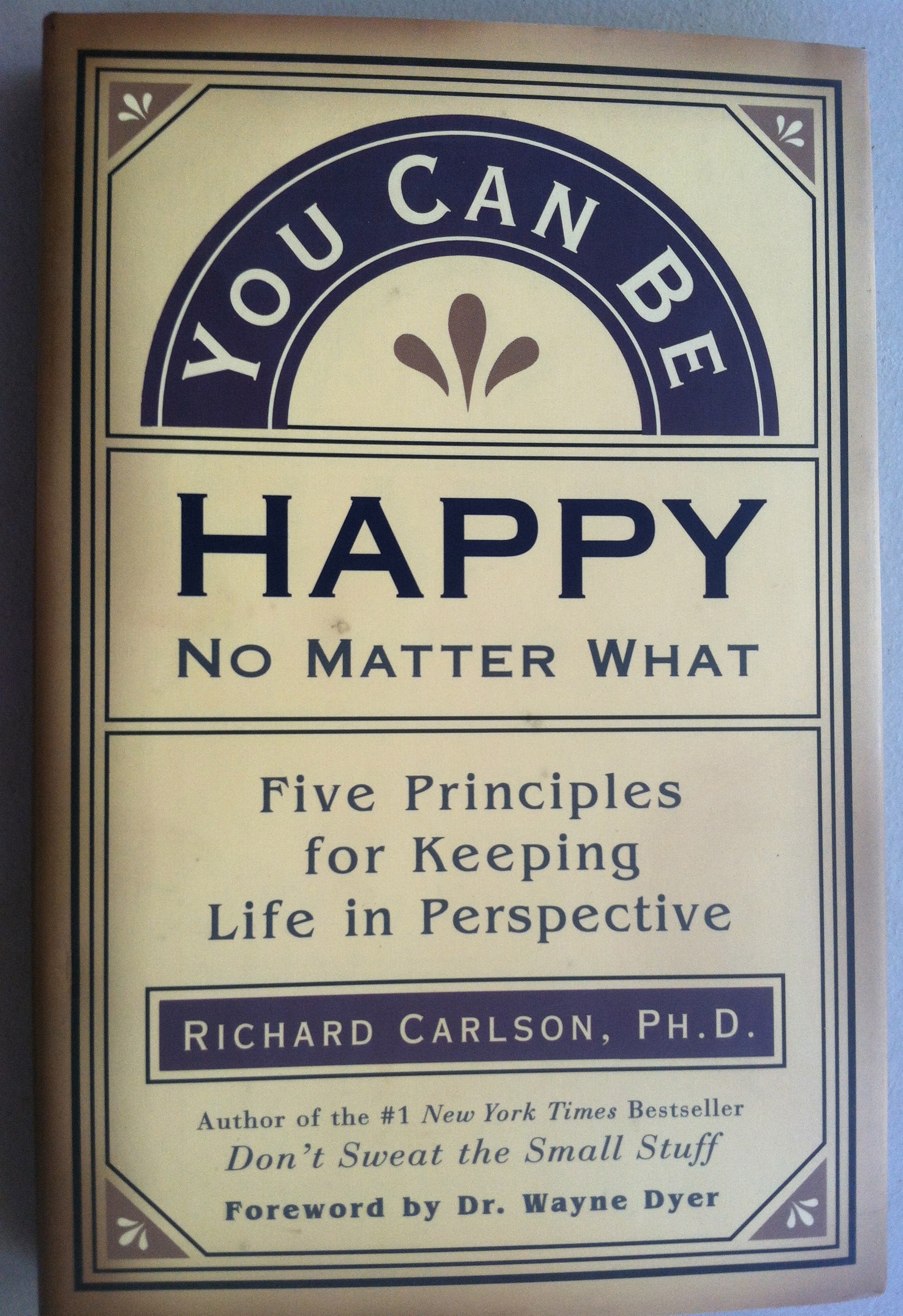
I bought three books for a quarter each. I’m all about simplicity but laid down these two bits to say, “I call BS.” No, you can’t be happy no matter what. If you can’t say something wise to people sitting around a deathbed, then stifle yourself.

IMG_1075

This Dr. Ornish cover is guilty of a typo. It should read, “Eat More Lettuce, Weight Less”

IMG_1073

Note the artistic reflection of my dumb hand and iPhone taking a photo of this book. One of the many unsavory questions from the authors: “If you could be one article of clothing, what would you be, and who would you want to belong to?” I’m leaning toward Charles Kuralt’s suspenders. I want to see America, baby!

IMG_1071

If I could pick the Coleman household’s china, I’d get all different plates, bowls, etc. Kathy prefers a pattern. Okay, but I still bring home refugees. At this sale an old guy tried to sell me Ike and Mamie and LBJ plates–out of his trunk! No, thanks.

IMG_1072

A twenty-cent purchase for one reason and one reason only: Marvin Gaye: “The Christmas Song”!

IMG_1070

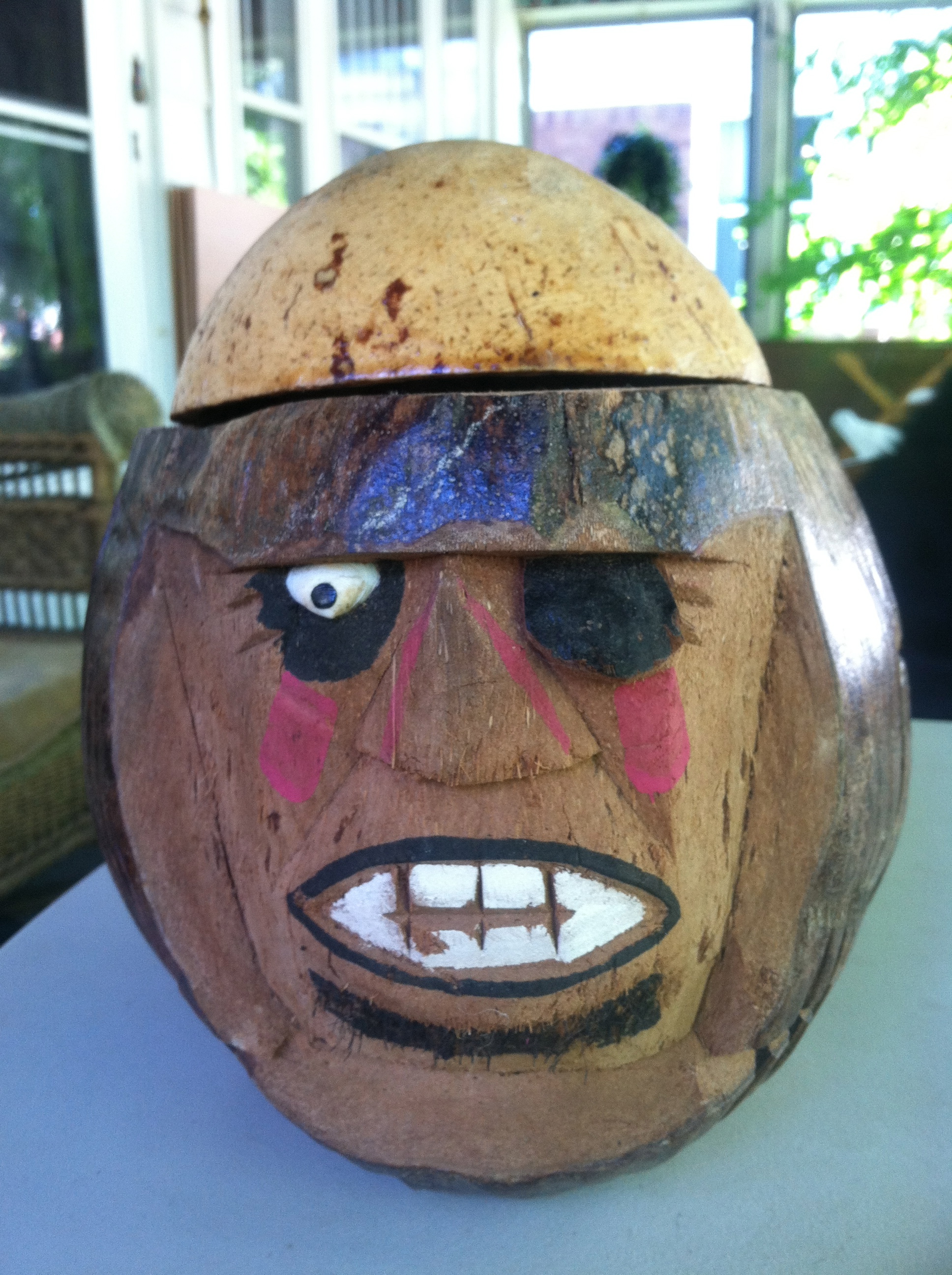
My favorite, $5.00. A coconut pirate whose skull cap lifts up so you can put in a beverage, stick a straw through a hole, and sip away. Bulky, but festive. He may be Wilson’s cousin.

A closing reality check: I did visit a few yard sales, but was thinking of “A Napper’s Companion” the whole time. So I had some task-oriented fun. Let’s call this progress.